Foliate Heads, or green men have always fascinated me, ever since I saw one peering out at me from some carved fronds of oak leaves in an old stone church when i was a child. Although the carving was over 600 years old, the leafy face seemed more alive than the dreary service going on around me. William Anderson, in his book .The Green Man’ described them as a symbol of ‘irrepressible life’ which sums them up best for me. There are a great many books tracing their origins and meanings but, whatever our ancestors were thinking of when they carved the first heads with the leaves sprouting from the face or spewing from the mouth all those hundreds of years ago, they still touch many of us now, just as powerfully. In our ‘modern’ age, too, they represent out link with the natural world, a relationship that can seem strained or even broken at times.
I enjoy drawing them often, sometimes as rudimentary squiggles in the margins of papers during long and tedious work meetings, sometimes over and over in sketchbooks; all you need is a couple of eyes and a sprig of greenery and you’ve got him, or her – no two are the same, each has it’s own character, no matter how many you draw them. They’re like snowflakes, billions of repeated, similar shapes, but each one unique, never to be seen quite the same again.
Since the proliferation of these characters all over churches and cathedrals throughout the twelfth and thirteenth centuries the green man (and woman, although there don’t seem to be so many of them for some reason) has never really gone away and over the last few decades has enjoyed renewed flowerings now and again, each time popping up in new and intriguing guises. From the 1940’s, for example, John Piper, forsaking his earlier experiments with pure abstraction, fused simplified, geometric shapes with his highly successful development of a dramatic and romantic representation of the British landscape and architecture. He went on to created foliate heads in paint, ceramics and stained glass during the second half of his career, such as the Foliate Heads II below from 1975.

Some years later, the green man popped up again in the brilliantly realised and much more overtly political graphic novel character, ‘Swamp Thing’. Swamp Thing is definitely my favourite incarnation of the green man of recent times. As a character in a graphic novel, especially during the period when Alan Moore was writing for the character in the ’80’s, we get to know him well, and we become absorbed in his story which is set in our own age, not the distant past or some mythical realm. Swamp Thing was different to many previous realisations of the archetype; he walked the earth, interacted with the world, and had an emotional, romantic and sexual relationship with another human being, Abby. Here are a few frames from the story ‘Rite of Spring’ published in 1985 – you never got this kind of thing going on with the Green Man before!:

Over the last few months I’ve been taking great delight in a series of foliate heads that Clive Hick-Jenkins has been producing to illustrate a new book of poetry by Marly Youmans. Clive’s paintings, drawings and maquettes are always staggeringly good and his bold, yet subtle green men are no exception. Earlier this year Clive also found time to coordinate an open exhibition of maquettes which he showed on his wonderful blog, http://clivehicksjenkins.wordpress.com/.
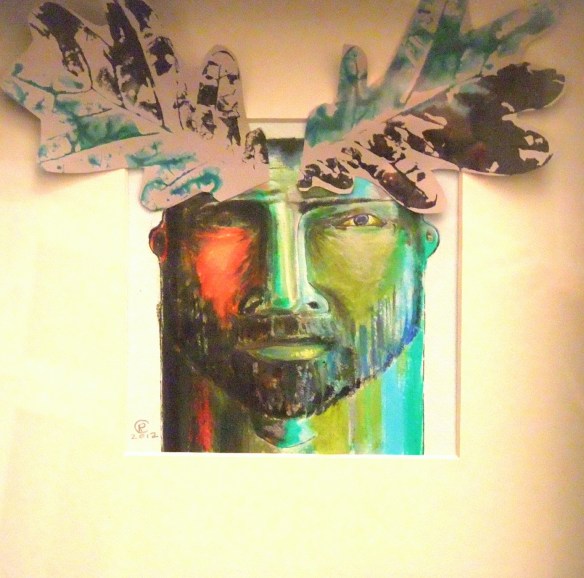
Clive was kind enough to include a sort of foliate head I did for the exhibition. Making this piece renewed my interest in the subject and really fired up my enthusiasm for using collage. I’ve been working through a few ideas for creating some green men collages and the first couple are below: I can see myself spending quite a bit of time developing these over the coming weeks so lots more will be popping up here…..



 Hedgecrows