
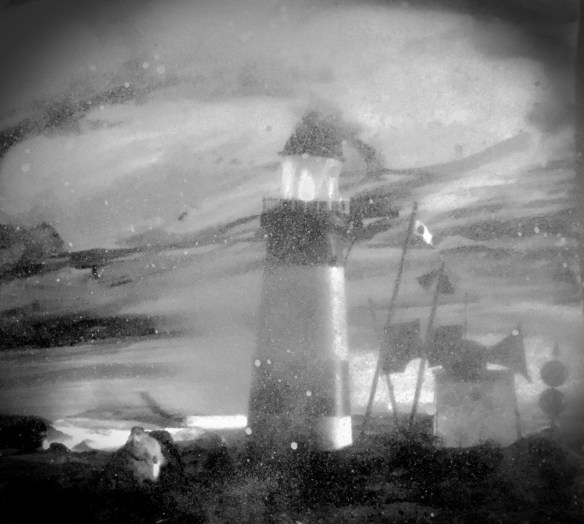
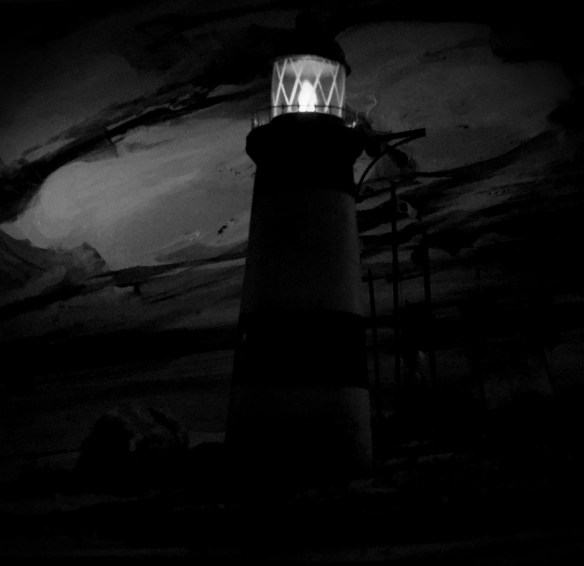
With the advent of satellite and computer controlled positioning systems for ships, the foghorns around the coast, as well as the lighthouses themselves have become almost completely obsolete in recent years. I don’t know exactly how many foghorns are still active around Britain, 20 maybe, but it’s not many and it’s a dwindling number. The new positioning and communications technologies are a thoroughly good thing, of course, they save lives and are better at keeping people safe, but I hope that the foghorns don’t completely disappear. They are one of the most thrilling sounds I can think of; close to they’re terrifying, the sound goes right through you and you feel like you’re coming apart. But they are more often heard from a distance and then they become soft and beautiful, modified by the atmosphere and the landscape to a sound that is as evocative of the sea as waves breaking on the shore, gulls crying, or whales singing. It’s a precious sound too, part of our maritime history and culture and part of the communities that live around our nineteen and a half thousand miles of coastline. These fantastic machines inspired these new models and photographs. I’ve enjoyed playing with lighting and effects to conjure different moods and the images may become a basis for some drawings I want to do of the subject as well as some video work.

You can only get a maximum of 70 miles away from the sea in Britain, at a place in Derbyshire, and that is only 45 miles from a tidal river, which underlines just how much the seas are deeply embedded in the British psyche and imagination. I’m always returning to it in my thoughts and in my work and I hope that the lighthouses, foghorns, beacons and buoys that may not be needed for any practical reason now can live on in some way and be enjoyed by generations to come. I think this is what I have in mind for my rather fanciful images of the lighthouse and foghorn. They are seen here at some point in the future, when they are used for different purposes, to watch the weather, to commune with the skies, converse with sea creatures, and to join with the music of the stars.The lighthouse keeper will be a magician of sorts. There are numerous bits of old maritime kit clustered around the lighthouse. Their original purpose is forgotten and their new uses perhaps more esoteric, but I wanted to include some typical coastal stripes and blocks of colour just because they are so evocative. One of my favourite British artists, John Piper, wrote in The Listener in 1933 about ‘the powerful emotive force’ of the sea in English art and wrote an article entitled The Nautical Style for The Architectural Review in 1938. The markings, designs and messages of all the maritime flags, pennants, coloured lanterns and signals may be a mystery to most of us but we’re deeply familiar with many of them and their aesthetic is an important part of our fondness for the coast. Having moved to Germany I have a new coastline and a whole new batch of offshore islands to explore too.

Now, while these images are inspired by the glorious sounds of the foghorns around the coast, the images themselves are silent, which is a shame because foghorns, of course, are all about that spectacular PAAAARP! But I’ve discovered, whilst making these models, that there are some pieces of music that use the sound of foghorns and other maritime horns and these recordings have become my soundtrack to the images. I wish I could fix it so that they played when you opened up the post but I’ll add some links so you can hear them because they are, to me anyway, rather fabulous.
The first is the extraordinary Foghorn Requiem, a piece originally commissioned as an artwork to be performed as part of the Festival of the North East. The two artists involved, Lisa Autogena and Joshua Portway took the commission in an unexpected direction, and conceived a performance piece with the Souter Lighthouse foghorn at its heart, both sonically and emotionally. Orlando Gough was then chosen to compose a piece of music featuring the foghorn. The project become epic in scale, incorporating local brass bands and over 60 ships out at sea, all contributing to the Requiem. The landscape itself become a part of the performance too, as its terrain directly shaped the sounds drifting across the sea from the ships. You can hear the Foghorn Reqiuem here and you can see a lovely little film about the making of the piece here – just watch the spectators jump at the end when they sound the foghorn!
It’s quite melancholy too, as it’s a requiem, featuring the dying beast of the Souter Lighthouse foghorn. It’s also particularly emotional for me seeing the brass band musicians walking across the landscape playing, as Dad was a keen trombone player in his local band, Vintage Brass. Brass music will now always have the capacity to make us blub in the family I think.

Another fab piece is Bill Fontana’s Landscape Sculpture with Foghorns. There’s a link to an installation performance of the piece from 1981 here. There are so many evocative maritime sounds included in the piece, beautifully put together, I absolutely love it and could have it on repeat play all day.


There’s a brilliant podcast put together by Robin the Fog for Resonance FM which features foghorns and all kinds of music with horns. I have to admit I found the 1939 recording of Tutankhamen’s 3000 year old trumpet a bit hard going although it did have a strange other worldly quality, but many of the other more ambient sounding recordings are very beautiful and I’ve listened to them again and again. There’s a link to the broadcast page of Robin the Fog’s website here . Scroll down and you’ll find the OST Denman Horn programme – so called because it was originally broadcast simultaneously on Resonance FM and from the restored Denman horn in the science museum – it’s a heck of a thing, I’d dearly loved to have been in the audience!
In fact, since I started making the models for this piece of work I’ve become a bit obsessed by the rather niche genre of foghorn music. There are worse things to develop an obsession for I guess…..


A big thank you to my hubby, Jan, who set up his photography equipment so I could take these images. I’ve got a lot to learn about how to photograph my work but, lucky for me, Jan is a gifted and knowledgeable photographer so I can always bother him with endless questions! Here’s a photo of the set up; I’m slowly taking over the flat with my models, maybe time to get a studio.



 Hedgecrows