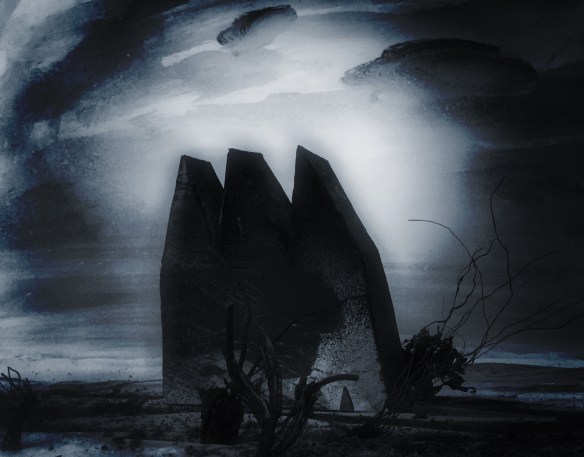
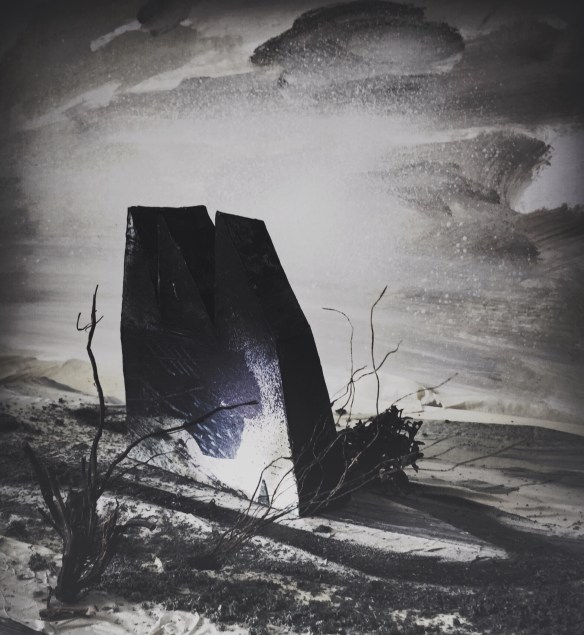
Sunset over Midville Bridge 

I’ve been thinking this week that the little village I’m building needs a name, so Midville Bridge it is. It’s a place rather in between things, neither here nor there, but somewhere in the middle, that provides a useful crossing between the two. It’s a queer sort of place and no mistake, in the old fashioned sense of the word (actually in the more modern sense of the word too). It often seems to get left off the maps, and if you go out looking for it you usually find yourself inexplicably in the next village (Digby Scroop) and when you turn around you find that the road back had been closed due to an overturned tractor and that sort of thing.  But if you’re not looking for it, if you’re driving along, perhaps on your way to the craft market at Digby Scroop, or the Auricula Festival at Woodhall, and your mind goes blank for a moment, you may find yourself turning the sharp bend by the old lodge and you see the sign saying ‘Welcome to Midville Bridge’, not the place you were heading to at all….

I’ve been photographic sunsets from Whistable beach this week, and pretty stunning they’ve been too. Here are a couple of photos from yesterday evening:


The evening skies here are often very beautiful. Turner loved them and painted here often, just along the coast on the Isle of Thanet. So I wanted to give my village a proper blast of hot colour, and blow away the gothic gloom for a moment at least. Time to crank up the saturation and give Midville Bridge something suitably dramatic.


Construction work 

There’s been some building work going on in the village this week, and some of the new dwellings are not quite finished….

The models I’m making are made from paper and card, just cut and glued together. After last week’s work I wanted to get a more of a spikey, expressionist feel to the little village so I’ve been trying out different shapes, roofs and silhouettes:


Putting them together with models I made last year I start to get a nice little village together, although there are plenty more elements I want to make; a well, more houses, some trees and topiary.

What I’ve been fascinated with these last few weeks is just how transformative the process of modelling paper and photographing it can be. I use cheap, everyday materials, sometime salvaged from the rubbish like cardboard packaging. I light it with daylight a table lamp or a tiny cheap torch, photograph it on my iPad and it can quickly evolve into a mysterious and self contained little world that has a life and magic of its own. The table top set up looks like this; sophisticated it isn’t!


Even without painting or any photo processing I like how the models look. Just in their raw state the have character and the potential for magic is already there. The challenge it to channel it without losing the energy and life of the original models:


Once the shapes are glued together I give them a painted paper ‘skin’:


Then the fun can start and I put them together, play with them; they’re like characters waiting in the wings to come onto the table top stage:


I’m slowly working my way to the look and feel that I want. I do like the raised viewpoint in the first photo, so I’ll do some more of these this weekend I think, although the village is going to look a bit of a building site for a couple more days!

The white tower 

image

Although this first image above that I  made this morning is going in a direction I’m probably not going to pursue, that is a bit hyper-real and overwrought, I’ve learnt a few things whilst doing it and it’s been useful. I’m pleasantly surprised at how easily different elements can fit together; the rock with the big hole in is a small stone I found on the beach this morning and it sits happily with a tower made out of a toilet roll tube, on a ‘heath’ made from foil and tissue paper with a painted sky backdrop. I’d like to get back to stronger shapes and a bit more energy in the pieces but these highways and byways are all useful. I’ve been using very cheap photo apps on the iPad to process the photos and they’re amazing, but they don’t allow for much precision so, having forked out for a new laptop and a subscription to photoshop I’m going to roll up my sleeves this weekend and start to learn how to use it. I’m a bit intimidated by photoshop but I keep putting it off so the only thing to do is get stuck in. Having said that the other thing I’m learning with these is that simpler is often better and refinement with over processing often loses something that was aparent in the raw image.

imageimageimage

Table top villages 

img_8279

The little models on my desk top are proliferating as I brought a couple of models I made last year back from Berlin at the weekend. I’ve been able to put togther a little hamlet of weird, gothic buildings on my little work table and take a few snaps. I’m really enjoying it as once you get a few shapes together you can play around much more with compositions and skylines.

imageimageimage

I like the way that tiny old villages huddle together, for protection from the weather, or better defence maybe, and they also look like they’re pressing together for warmth and company when there the wild was much more wild and the things that go bump in the night were more numerous.

For the last few years we’ve often spent holidays in the foothills of the French Pyranees staying in villages perched on hilltops. I love the perspectives of the narrow lanes that wind up and down and roundabout the rustic houses, often ending up at an ancient Romanesque church, right at the top of the hill. I love these places, I think they’ve lodged in my subconscious and are often feeding in to the compositions I put together with these models. Another strand of inspiration is a photo of the fisherman’s huts next to the harbour at Hastings that my friend Sarah sent me this week. This area of the harbour where the fishing boats are launched is called the Stade and is home to the largest fleet of beach-launched fishing boats. Here’s a photo of the wonderful huts, and the Pinterest site I sourced the image from is here.

image

And a comment from another friend, Maggie, also highlighted another image that might be lurking in the background, Arnold Böcklin’s The Isle of the Dead, painted in 1880 and a postcard of which was on my wall for years when I was younger. There’s an article from the Independent here which argued that it is a good bad painting; ridiculous (the oarsman is facing the wrong way) but still with the power to move you. I don’t agree, a painting with such power to captivate, however it is achieved, is no bad painting at all!

These kinds of places, hunched in on themselves have an atmosphere of sanctuary about them, of places you find in the wilderness, places of refuge and discovery.

imageimageimage

Tiny worlds

Having turned my attention to ways of displaying and exhibiting  delicate 3D work made from paper and card I’ve started exploring the wonderful worlds of dioramas, toy theatres, glass vitrines and bell jars. I’ve been thinking about why it is I find these objects so satisfying and so enthralling. Maybe because, like film, or theatre, there’s a strong sense of story about these tiny world, they seem like scenes set out where things could happen. Then there’s the fact that they are worlds set apart, behind the glass, within the confines of the frame, where the rules may not be quite the same as the world we inhabit, maybe the rules can be whatever we want them to be, anything can happen. My friend Sarah sent me this quote recently, from a Canadian writer, who happens to share his name with the great English poet John Keats. He wrote:

‘Each of us needs something of an island in his life – if not an actual island, at least some place, or space in time, in which to be himself…’

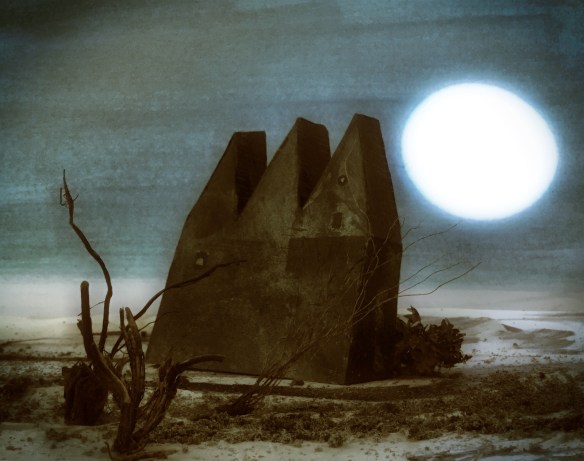
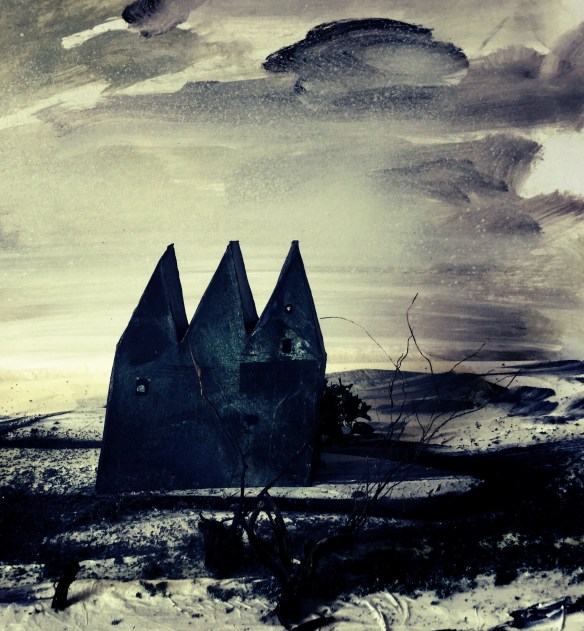
So maybe that’s one of the drivers for our creativity, to carve out a little corner where we are ourselves. I like to think of them as distilled essences, reduced down and concentrated little fragments of imagination. Whatever it is, I’m hooked at the moment; here are some more images of the little scene I made this week, trying to work out the dimensions for ordering some glass fronted boxes to make some dioramas and what textures and materials might work. Just quick snaps on the iPad and using Photogene and Enlight apps to add some atmosphere. This is just a rough, I think I’ll go about a third bigger for the exhibition pieces:
imageimage

imageimage


It’s really quite tiny; here’s the little building in my hand.

It’s probably the smallest model I’ve made, and I think for the purposes of exhibiting work later this year I could go a bit bigger. The main gallery at The Horsebridge Centre in Whitsable I’ve got booked with my two pals Phil and Phill (I know) is a very nice, large space so I could work in a bigger scale although glass cases could get a bit heavy and unwieldy if I went too big!
There are quite a few elements in this work that’s been inspired by my surroundings down in Kent where I’m living and working for a few months this year. The main model building is inspired by the shape of the oyster huts around the Harbour here in Whitsable. The huts are clad in wooden weatherboards, the traditional Kent style and painted tar black to protect the building from the weather. I love the jagged line of the roofs and the black colour makes them that bit more dramatic. I photographed them this morning on a blustery, showery day:

The landscape of the scene is inspired by the mysterious shingle spit at Dungeness on the south Kent coast. We’ve been visiting this awe inspiring place for many years now and I love it more and more each time I visit. Here are some photos Jan took when we were there last weekend:


It’s a wide open, bleak and haunting place, it gets under your skin. You really feel like you’re on the margins of things and I want to come and stay a few days here in the summer. On a bright sunny day it can take on a much friendlier , warmer atmosphere, when the sea kale and other shingle plants are out and the pale shingle is shining, but at other times of the year it’s often very empty and mournful, but beautiful nonetheless.

While I was making the landscape I was also recalling images I’d got in my head from Dickens, and Wilkie Collins, of vast expanses of marsh and mudflats, mists and sea fogs, and evening sky reflected in still pools and creeks. I think it could be the scene of a ghost story….
I’ve used some bit of flotsam and jetsam in the landscape that I’ve picked up from the beach here in Whitstable; roots, seaweed, pieces of old frayed rope. I like using some locally foraged material in the new work as it’s going to be exhibited here and wherever they end up they ‘ll carry of bit of Whistable beach with them 😊.

Making again

enlight1-21

It’s been over a month since I’ve posted anything – eek! I’ve taken on a ‘day job’ again in the UK for a few months to earn some money and I’ve got rather absorbed in it. It’s a bit scary how quickly the making and writing and exploring can go by the wayside, you turn round and a month’s gone by. But I’ve got to get started again as I’ve got projects on the go this year and an exhibition at the end of August, which is fast approaching!

Luckily the day job is an interesting contract, working on learning disability services in the Medway towns in Kent, I’m working with nice people and living down in Whitsable which is delightful and helps with not seeing hubby for two weeks at a time.

But back to the art table, and the only thing to do is do something, so I’ve started modelling, little self contained worlds, just rough and ready structures in neutral colours at the moment while I explore shapes and compositions. I’d enjoyed the model making very much last year but I was a bit stuck on ways to display and kind of work. A couple of ideas have coalesced while I’ve not been making, with a few things coming together to suggest a way forward. First were some wonderful paper sculptures by Ed Kluz I’ve long admired, which are displayed in glass domes. You can see a fine example with this link to The Curious One’s Pinterst site. I particularly love the strips of coloured paper for the waterfall.

And then the Borderlands paintings by my Clive Hicks-Jenkins which I adore; I often look at them online and I love to inhabit and explore their marvellous and mysterious spaces. Here’s a link to a post about Borderlands on Clive’s Artlog

And finally my ongoing love affair with German expressionist architecture and film from the 1920s added to the mix with its skewed perspectives and dramatic shapes.

So I had the idea of making some more models and putting them in glass domes and diorama boxes to display them. Glass domes and bell jars have become very popular for interior decor so they’re readily available. I bought one from John Lewis and started modelling a tiny village to see if it would work.

At the moment I’m just putting rough shapes together but I’m happy enough this could work so I’m going to start refining the models and painting them to make a finished piece. Here is the rough model in the glass jar, it just about fits although the curved top distorts the image when viewed form some angles, but I don’t mind that too much:


And with a bit of photo editing:


And some thumbnails working out the structures and composition:


The challenge now is to keep going and fit in the making with the day job and the flying to Berlin for weekends. I need a time management app or something or maybe just to be more organised! But on the up side there’s some great places to explore and get inspired by down here, living by the sea really is magical. Here’s the beach at Whitsable, and a beautiful photo Jan took down at Dungeness when we drove down for an afternoon last weekend; it really is an awe-inspiring landscape:


img_7470