Showing posts with label Lively. Show all posts

Monday, November 26, 2018

Excellence in Short Stories Looks Like This

Over the last little while as I've been reading toward finishing my Century of Books project, I had two short story collections in the rotation that I was working away on, story by story. Mavis Gallant recommended reading stories one by one, not all mashed up together like a novel, and since I first heard that, I've been trying to do just that, as much as I can.

In any case, I picked up Mansfield's classic, finally; and also a large collection by one of my favourite authors, Penelope Lively. I'll start with the older book.


The Garden Party & other stories / Katherine Mansfield   
London: Penguin, 1971, c1922.
255 p.

This collection of 15 stories was a delight. I was drawn in by the style and the approach: they focus on the little moments, on domestic settings and on women's thoughts and feelings. The writing is evocative, poetic, and spare at the same time. 

I found it interesting how the stories all end in a very open-ended way. They drift off, or they stop without a complete tying up of loose ends. They leave the characters carrying on in uncertainty or without huge epiphanies; but they leave the reader in the midst of the narrative, without closure, and unable to forget the characters. 

The first two stories are the longest, and the title story is quite dreadfully intense, as a young upper class girl at her family's garden party must face the horror of death, loss and the complete dissociation from these things endemic to the class system. Mansfield's light touch dances over these elements in all the stories, but the underneath peeks through nonetheless. 

The first story is set in Mansfield's native New Zealand, and the setting is rich. You can feel the heat and the sea as you read - I can picture the house and the yard and the quiet clearly. You can feel the stifled energy of the women as well. The writing style reminds me quite a bit of Virginia Woolf; no wonder Woolf both appreciated and envied Mansfield, they are very similar. 

I'm glad I read this - the fine writing and the illumination of women in many situations, either as domestic workers or wives/mothers or indeed daughters, was compelling. The spinsters who show up in stories like Miss Brill or The Daughters of the Late Colonel are always teetering at the edge of pathetic, one feels sympathy for them while realizing their precarious existence. Definitely a collection worth reading, and rereading. I'm sure I'll revisit it often.


Pack of Cards / Penelope Lively 
London: Grove, 1999, c1986.
336 p.

And now to one of my favourite authors, whose stories are always enjoyable (though I think I prefer her novels just that little bit more). It's a larger collection than some, incorporating stories from an earlier collection (Nothing Missing But the Samovar) and ranging over the years 1978 -1986. Because there are so many stories here (35) and Lively's voice is so distinct, I'd recommend not reading it all at once, or it will pall. There are some excellent stories and some that have dated quite a bit, mostly the ones in which she is tackling a current social problem (ie: The Voice of God in Adelaide Terrace). 

A connection that I might not have seen if I hadn't been reading these two books so near to one another is that many of the stories in this collection echo some of those in Mansfield's. 

In Mansfield's Miss Brill, for instance, a happy spinster at a concert in the part is hurt by overhearing what a pair of young people is saying about her. In Lively's Miss Carlton and the Pop Concert , an older woman joins the audience in the park at a music fest of sorts, and happily imagines the inner lives of the romantic looking hippies near her. But she's disillusioned by their talk of work and cars and the music and she leaves feeling not quite so young as she'd started out feeling. There are other similarities of tone between them, of attention to the domestic. I'm surprised I've never seen that before, but then, I haven't read much Mansfield until now. 

This collection is quite British in its restrained emotional understatement. Lively is always intelligent, and wryly witty, and many of her preoccupations show up in these stories. Archaeology, history, time passing, the past, memory, houses, what-might-have-been - all these turn up in some form. I enjoy feeling like I know an author's approach to life and I do feel that I can estimate, at least generally, what a Penelope Lively story or novel will be like, and this book doesn't deviate from that pattern. I enjoyed it, revisiting some old favourites and finding some new gems as well. 


Sunday, July 09, 2017

The Purple Swamp Hen

The Purple Swamp Hen & other stories / Penelope Lively
New York: Viking, c2016.
197 p.

I've read all of Penelope Lively's novels and most of her short stories, at least all the ones I've been able to get my hands on. And almost all of her children's novels too. I really like her writing.

So I was pleased to see this new collection of 15 stories, and was looking forward to reading it as soon as I could. Thankfully, I really enjoyed it.

These stories are both a bit lighter and a bit more edgy than some of her other writing. The title story in particular surprised me with some of the slightly risque content - not what I'd expect to see in her work. But it was a great read; set in Pompeii, told from the viewpoint of a purple swamp hen who was kept as a decorative fowl for the garden, somewhat like peacocks now. (by the way, have you ever seen a purple swamp hen? I'd never even heard of one - they are quite astonishing). It is clever, with a modern feel, even while clearly sharing Lively's preoccupation with the past and with the "what ifs" that I've seen in some of her other short stories. The narrator is unforgettable, that's for sure.

The other stories are contemporary, and deal with families, relationships, misunderstandings, history, the presence of the past in the present: all of Lively's usual preoccupations. And the reason I love her writing so much. Because these are short stories there isn't as much room for her lyrical explorations of thought to spool out, so the storylines are necessarily more compact. Her style really shines in a novel, but in these stories she allows herself a punch line, so to speak, and the stories often have a reversal at the conclusion. There's a bit more "liveliness" (am I allowed to say this?) in some of the stories because of their brief nature.

The closing story, "The Third Wife" is equally as snappy and satisfying as the first, as an odious man gets his comeuppance. Though you can sort of see it coming, the tale is still entertaining and pleasing. There are other quieter stories about marriages and friendships, and even a couple of ghost stories -- one about a girl in a garden was my preferred ghostly tale, even if it was obvious as to plot -- nobody does atmosphere like Lively does.

A great addition to her list, I was pleased to read it even if it does mean I'm running out of new Lively material! A few more of her backlist story collections and I'll be caught up.

Read this alongside another of her collections (and my favourite), Making It Up, and you will get a strong sense of her style and her writerly themes.


Wednesday, November 13, 2013

Lively Excitement!

Holy cow, how did I miss this? Penelope Lively has a new book out! It's a memoir of sorts, a meditation on age. It's called Ammonites and Leaping Fish, and is a look back at her long life of reading and writing, through six objects that she has gathered and cherished (surprise, ammonites and a leaping fish potsherd are part of these objects).

I can not wait to read it -- it's available in Canada in February from what I can tell and I am so excited to see it! Can not wait to get my hands on it :)

A little more info on this book can be found at The Guardian, as it is apparently out and buyable in the UK, and has been for a while, lucky Brits.

Sunday, July 07, 2013

The Photograph

The Photograph / Penelope Lively
New York: Penguin Viking, c2003.
231 p.

This is one of the few Lively books I haven't read yet, so decided that this week was the perfect time to pick it up. I found a nice hardcover a few months ago and was waiting for the Lively mood to strike me. It's very much about her common preoccupations: memory, how well we know people, the place of the past in the present.

The story is thus: Glyn, landscape historian, has married Kath, young, beautiful, rather feckless. Her elder sister Elaine, garden designer, is married to Nick, a man stuck in the big ideas/no follow-through adolescent stage of development. Kath has been dead for a number of years when the story opens, when Glyn, on the search for a paper he wants to use in an article, uncovers an envelope in his archive. It has a photograph inside, a photo of Kath and Nick surreptitiously holding hands.

This throws the whole narrative into overdrive. Glyn, furious, does what he does best -- he obsesses over it and tries to track down every last bit of information about what this photo represents. Elaine, on the other hand, wishes that she'd never found out. Things will now have to change.

Nick can't understand the fuss; it was 15 years ago, it didn't mean anything, why is Elaine getting so worked up? It's more his reaction than the original action that spurs Elaine to boot him out. He's been so dependent on her income and her patience that he is utterly incapable of surviving alone, so, he decamps to his daughter's flat in London, from where she is only too glad to press her mother to take him back.

The past rises up to shatter the present, and has everyone questioning how well they really knew Kath -- and really, how well do they know one another? The man who took the original photograph, Nick's previous business partner Oliver, gets dragged into the drama against his will. As first Glyn, then Nick, come to him about it, he muses that Kath "has become like some mythical figure, trawled up at will to fit other people's narratives. Everyone has their way with her, everyone decides what she was, how things were. It seems to him unjust that in the midst of this to-do she is denied a voice" 

In Lively's writing, there are always sharp comments on individual peculiarities, but is the person self-aware about their quirks? This is never as certain. The story, though resplendent with sound and fury, dies off into a quieter acceptance near the end. The characters seem to accept that the objective Truth will never be known, that Kath's character is a jumble of impressions made up of many different viewpoints.

The fact that there are so many incompatible couples in this narrative -- Glyn & Kath, Elaine & Nick, even their daughter and her various suitors -- gives it a melancholy realism. It's not a very happy book, tinged with betrayal, obsession, fear, and resignation. And yet Lively can write in such a fluid style, sweeping in and out of interior monologue to a wide view of history and landscape to the most minute social interaction. She can express exultant happiness and bitter anger on the same page. The writing is really wonderful, very recognizable as her particular style, and her regular themes arise, and I am greatly fond of both.

An excerpt to close -- Glyn is on a hillside in Dorset, working, in a place that he had taken Kath early in their relationship. He sees a kestrel fly over, and suddenly he is with Kath once more.

Glyn is now diverted from his reflections on the functions of time; he notes that his flow of observation -- unconsidered, uncontrived -- is a nice instance of the tumultuous, spontaneous operation of the mind. He knows enough of the theories of long-term memory to identify his recognition of the mill and the hill fort as the practice of semantic memory -- the retention of facts, language, knowledge, without reference to the context of their acquisition. He simply knows these things, along with everything else he knows that makes him a fully operational being -- a being considerably more operational than most, in his view. Whereas the vision of Kath sparked by the kestrel is due to episodic memory, which is autobiographical and essential to people's knowledge of their own identity. Without it we are untethered, we are souls in purgatory. Those glimmering episodes connect us with ourselves; they confirm our passage through life . They tell us who we are.

It is exactly this idea, that accepted moments in one's autobiographical memory can be disrupted, shifting one's understanding of reality, that this book strives to represent. I think Lively succeeds -- despite the irritating behaviour of these characters, the shifting sands beneath their once secure past are clearly drawn. The effects will go on and on into the future, beyond the 'end' of this story.

Another masterful tale, though because of the prickly relationships and melancholy outlook, it didn't find the warm and cozy spot in my heart that some of her other titles have. Still a worthwhile read, however!

Monday, December 17, 2012

How It All Began

New York: Viking Penguin, c2012.
229 p.

What a gorgeous read this was. Lively just keeps getting better, and keeps in touch with modern life in her writing, which I enjoy. She doesn't write with the tone of a 79 yr old examining the past, rather she is fully engaged in daily life now.

This book is fresh in tone and in design -- look at that cover! I love it. It represents the theme of the story, the idea that everything gets bumped around and jangled by chance, and that we have to expect to be shaken up. The image reminds me of a snow globe with everything tossed around with one little shake.

The epigraph of this novel refers to the "butterfly effect", quoted by James Gleick in his book "Chaos". The idea that one small event can result in rapid, unforeseen consequences is the motif of this story.

It opens with 77 yr old Charlotte Rainsford being violently knocked down in the street and mugged. Her hip is broken and thus she must recuperate in her daughter Rose's home. As she has always been an active and independent woman, this chafes. Her pain and sense of constriction make her unable to even enjoy her traditional method of relaxation and engagement: reading.

To feel more useful she takes on a job tutoring Anton, an adult English learner. They begin by chucking out the dull ESL lessons that Anton is not finding helpful, and turn to children's books, which appeal to his sense of narrative. The two of them discuss the power of and the need for telling stories, along with their literacy instruction. That's one thing that I really adored about this book -- the love for books that permeates it, especially with Charlotte. She refers to novels and authors she's read throughout her life, she discusses them with others, she  notes other people reading, and measures her recovery by how she is able to move from reading Wodehouse to reading James and other challenging authors. Other characters also pick up books, including Anton (in his own language), or a cab driver who just happens to be reading Rasselas!

But Charlotte's mugging has many unseen effects. Because she is staying with her daughter Rose, Rose is unable to go with her employer to a lecture he is giving, and he makes a mess of things. Because he doesn't have Rose, he takes his niece Marion. Because Marion has to go along she sends an apologetic text to her married lover which his wife intercepts. Because Rose is at home she meets Anton, and they become friends and then perhaps a little more. I also liked the fact that the mugger was not part of the story; he was the catalyst in the opening pages and then was referred to near the end, but doesn't play a role in the lives that his one act disrupted.

I think my favourite element was the relationship between Rose and Anton. It is very moving, as another example of how lives could have gone in different directions at a certain point, but presently they are both too far down the path to turn back to other possibilities. Their relationship is subtle and yet powerful. I adored Anton, while also really liking the duller, more prosaic Gerry, Rose's husband. I thought that Lively did a great job of balancing these relationships and the tiny elements of each life that direct the action in specific ways.

All of these individual lives intertwine and each one is fascinating. The characters are engaging, each being caught up in the midst of their unpredictable lives and evoking sympathy, interest, or annoyance. Lively is very good at creating characters who are full of life, who think and discuss and feel things strongly. She also has a characteristic wit when it comes to people's foibles and flaws, and is able to puncture pretensions without being cruel. I love her vision, and her writing is memorable and quotable on its own.

Some of my favourite bits from this book:

Forever, reading has been central, the necessary fix, the support system.  Her life has been informed by reading.  She has read not just for distraction, sustenance, to pass the time, but she has read in a state of primal innocence, reading for enlightenment, for instruction, even.  She has read to find out how sex works, how babies are born, she has read to discover what it is to be good, or bad; she has read to find out if things are the same for others as they are for her – then, discovering that frequently they are not, she has read to find out what it is that other people experience that she is missing.
Specifically, she read bits of the Old Testament when she was ten because of all that stuff about issues of blood, and the things thou shalt not do with thy neighbour’s wife.  All of this was confusing rather than enlightening.
She got hold of a copy of Fanny Hill when she was eighteen, and was aghast, but also intrigued.
She read Rosamond Lehmann when she was nineteen, because her heart had been broken.  She saw that such suffering is perhaps routine, and, while not consoled, became more stoical.
She read Saul Bellow, in her thirties, because she wanted to know how it is to be American.  After reading, she wondered if she was any wiser, and read Updike, Roth, Mary McCarthy and Alison Lurie in further pursuit of the matter.  She read to find out what it was like to be French or Russian in the nineteenth century, to be a rich New Yorker then, or a Midwestern pioneer.  She read to discover how not to be Charlotte, how to escape the prison of her own mind, how to expand, and experience.
Thus has reading wound in with living, each a complement to the other.  Charlotte knows herself to ride upon a great sea of words, of language, of stories and situations and information, of knowledge, some of which she can summon up, much of which is half lost, but is in there somewhere, and has had an effect on who she is and how she thinks.  She is as much a product of what she has read as of the way in which she has lived; she is like millions of others built by books, for whom books are an essential foodstuff, who could starve without.

Ah, old age. The twilight years -- that delicate phrase. Twilight my foot -- roaring dawn of a new life, more like, the one you didn't know about. We all avert our eyes, and then -- wham! you're in there too, wondering how the hell this can have happened, and maybe it is an early circle of hell and here come the gleeful devils with their pitchforks, stabbing and prodding.

...if people don't read, that's their choice; a lifelong book habit may itself be some sort of affliction.


Wednesday, December 12, 2012

Lively Time and Houses

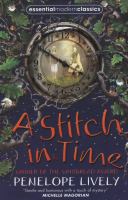
A Stitch in Time / Penelope Lively
London: HarperCollins, 2011, c1976.
221 p.

Set on the English shore one summer in the 70's, this story follows Maria, a dreamy only child as she and her parents take summer vacation and she discovers fossils, history and a raucous family next door. At the beginning of the tale, Maria is quite solitary, and has a habit of beginning conversations with inanimate objects, cats, and more which was amusing and clever at times.

She is fascinated by a girl named Harriet, her aged landlady's great aunt, who has left traces of her presence through her books (one on fossils which Maria claims) and photos...but only up to the age of 10. Did something awful happen long ago? Maria seems to hear events from the past -- a barking dog, a squeaky swing, and wonders why nobody else seems to notice. Here is one of Maria's dawning realizations:

Harriet is like the ammonites in the rock, she thought, not here anymore but here in a ghostly way, because of the things she left behind. The sampler, and the drawings in the book. And it came to her, as she turned to go into the house, that places are like clocks. They've got all the time in them there's ever been, everything that's happened. They go on and on, with things that have happened hidden in them, if you can find them, like you find the fossils if you break the rock.

This was a very 70's kind of story, with Maria's older parents being strangely disengaged, and the crazy family next door the kind of uncontrolled chaos that a large family could be, especially as the children are allowed to run freely all day, down to the beach, through the woods, and to wander off on their own at events like a Faire at a nearby stately home. To me, this was one of the elements that most dated it; I can't even imagine parents letting their 10-13 year olds wander off all day long in a strange setting, not these days.

I liked this story, seeing familiar themes of time and change and the peculiar staying power of inanimate objects. I also saw the familiar sharp characterization of others through our main character's perception. It was a good read, though not my favourite of her juvenile works which I've read.


The House in Norham Gardens / Penelope Lively
Harmondsworth, Middlesex, England: Puffin Books, 1986, c1974.
174 p.

This one is an old favourite which I decided to reread. When I first read Lively, it was this title, Astercote, and The Wild Hunt of Hagworthy, which I'd found in tattered condition in an old library, many years ago. I didn't realize at the time that she also wrote adult books, which I discovered only a few years back, when my Lively fascination really began.

With this book I realize that her great strength in her more 'teen' books is the power of atmosphere. There is not that much of a plot here -- or rather, the plot isn't all that important. The fascination lies in our main character, 14 yr old Clare, and the feeling of living in a rattling old house with two eccentric aunts, or meeting 'exotic' black men in the museum and bringing them home (another thing which really dates this book; the unusual sighting of a black person in England, and her freedom as a teenager in inviting a strange man to come home with her...) She explores the Pitt Rivers Museum (a real place) and discovers even more artefacts in her own home, what with all the unused rooms that are full of junk in a house that has passed down through a few generations!

Again, there is a strong element of time's fluidity, as Clare dreams about a mask she finds in the spare room -- her great-grandfather was a Victorian archeologist and brought home ceremonial objects from New Guinea long ago -- she begins to blend past and present and comes to the realization that the past can not be preserved intact. Within so much of Lively's work there is philosophical reflection on time, memory, responsibility, history and more. This book carries on that thematic interest but is also simply engaging in its own right. The house is marvellous and Clare's observations of everyone and everything that she encounters are enjoyable and illuminating. Still such a good read!

Saturday, December 08, 2012

December and Bookish Goodies

It's been a whole week since I've posted anything...time seems to go so quickly this time of year. I hope everyone is enjoying their holiday planning and Happy Hanukkah to those celebrating tonight!

I've been busy with work, events and life in general. I'm behind on all my blogs! But, oh well. Stuff happens. I have some reviews that I'm working on, but today I just wanted to share a look at the bookish goodness I've gathered at the library this week. I don't know how much time I'll have for reading but I just could not resist these titles ~ sharing the covers along with the publishers' summaries for quick reference. Are any of these on your radar?


A Stitch in Time by Penelope Lively

A quiet lonely child spending her holidays by the sea is changed by an inexplicable link with people and events of one hundred years ago and also by the very real and lively family next door. 

This is a nice reissue of a Lively book I haven't yet read. Children's.


Malarky by Anakana Schofield

Recommended to me by Pickle Me This, I knew I wanted to grab this one!

Swamped by a confusion she refuses to let overcome her, Philomena embarks on a rural odyssey that skirts madness, passes through grief, and returns her to the remarkable resilience of spirit that will make Our Woman the character of the decade.


Psychology and other stories by Craig Boyko


"Psychologists are people we admire and resent. They're all in this book, and so are their patients." 

A singularly nondescriptive blurb... I've read this author's short stories before and liked his work quite a lot.


Magnificence by Lydia Millet

This stunning novel introduces Susan Lindley, a woman adrift after her husband's death. Suddenly gifted her great uncle's Pasadena mansion, Susan decides to restore his extensive collection of preserved animals, tending to "the fur and feathers, the beaks, the bones and shimmering tails." Meanwhile, a menagerie of uniquely damaged humans-including a cheating husband and a chorus of eccentric elderly women-joins her in residence. 


The Circus of Ghosts by Barbara Ewing

New York, late 1840s, and in the wild, noisy, brash and beautiful circus of Silas P. Swift a shadowy, mesmeric woman entrances crowds because she can unlock the secrets of troubled minds. Above them all her daughter sweeps and soars: acrobat and tightrope-walker. People cannot take their eyes from the mysterious woman in the Big Top who can help so many others but she cannot unlock dark, literally unspeakable, memories of her own. In London memories fester in the mind of an old and venomous duke of the realm. He plots, with an unscrupulous lawyer (and a huge financial reward) against the mother and the daughter: to kill one, and to abduct the other and bring her across the Atlantic to him.


Dark of the Moon by Tracy Barrett

Retells the story of the minotaur through the eyes of his fifteen-year-old sister, Ariadne, a lonely girl destined to become a goddess of the moon, and her new friend, Theseus, the son of Athens' king who was sent to Crete as a sacrifice to her misshapen brother. 

 I have to read this, since it has some connection to the myth of Ariadne, the minotaur and the labyrinth.


************************************
Library Loot is a weekly event co-hosted by Claire from The Captive Reader and Marg from The Adventures of an Intrepid Reader that encourages bloggers to share the books they’ve checked out from the library. If you’d like to participate, just write up your post-feel free to steal the button-and link it using the Mr. Linky any time during the week. And of course check out what other participants are getting from their libraries!

Monday, November 12, 2012

The Voyage of QV66


The Voyage of QV66 / Penelope Lively
London: Heinemann, c1978.
192 p.

This is one of Lively's children's books that was recommended to me recently by another Lively reader. I never need too much encouragement to pick up one of her books, as I'm a big fan of her writing. But this one had not really come up on my radar yet, so I was pleasantly surprised by my discovery of it. 

Lively writes children's books that are fairly complex, in that she doesn't talk down to her readers. She is good at creating an initial situation that is unfamiliar, while not over-explaining things, trusting the reader to catch on as they go along. 

This book opens with a strange premise: there are various animals gathering together into a "tribe" of sorts -- a dog (our narrator), a cow, horse, cat, bird and a strange animal who is different from everyone else. Upon discovering this strange brown, furry animal, who is named Stanley, it is decided that they will all travel to London to find out just what Stanley is. 

The story of their voyage -- how they do it, and why, and what happens when they get there -- is situated within a Britain that is devoid of people. The QV66 mentioned in the title is a boat that the group of friends finds and claims as a way of getting to London, since most of the countryside is completely flooded, with little hilltop islands left here and there. Stanley, being an unusual kind of animal, thinks and puzzles his way to creating and building new tools and objects, for example, scavenging some wheels and attaching them to the boat so that Ned, the horse, can pull them overland when necessary. 

The narrative voice is wry and amusing, and the animals each have their own particular personality which led to some amusing reflections by this reader. Lively creates a backstory for the animals that allows her to comment on some religious and military elements, as well as the most obvious issue of climate change and a great flood. It seemed timely to read this right now, especially as the group reaches London and describe exploring a subway station that is dark and watery and smelly. The flood has left traces of human inhabitation behind that animals everywhere are reusing and repurposing to their own desires. 

Once in London, Stanley figures out what kind of animal he is, and that he isn't the only one of his kind. But this is not the cathartic happy ending that he expects; in fact, he is quite put off by his discovery, and rejoins his happy band of friends to continue their journeying ways. In a way, I found the ending satisfying. And in a way I didn't -- as the way forward leads out to sea I found that I was uneasy when imagining what lay ahead for this motley crew. 

It was a fascinating read, though. Lively is particularly good at drawing sharp portraits of human foibles, and here she turns that to the new society of animals which has arisen. There is a resurgence of tribalism,with the main lot of creatures being -- literally and figuratively -- sheep. A few of the more clever species, like crows, dogs, and apes, have taken on the role of priests, warriors, or bureaucrats, while others are either followers or very independent creatures in their own right (like Stanley). It seems to hold a mirror up to our own civilization and what we may become in times of crisis. Various animals have decided on their own new rules and means of living, and as many other readers have mentioned, this lends a hint of  "Animal Farm" to the tale.

While dealing with serious issues, this story is also simply a good read. The journey to London is the purpose of the story but doesn't bring the happy ending the travellers expect. However, seeing the destroyed landscapes and derelict cities through their eyes was pretty interesting for this reader, and I imagine would be so for juvenile readers as well, who may be trying to puzzle out what exactly the animals are seeing as each incident is recounted. I thought the premise was very well done, and the story was dense with ideas and incidents, making it a perfect source of further discussions for readers too young for Animal Farm.

Friday, January 06, 2012

A Lively Dame

This makes me happy:

Penelope Lively made a Dame (that's the female equivalent of being knighted).


She is an amazing writer, a favourite of mine, one of the only authors who has her own tag on my blog ;)

She has a new book out, How It All Began. I can not wait to read it. I've been reading her steadily for a few years and only have one or two titles left unread so very delighted to know there is another.

Sunday, March 06, 2011

Lively: Going Back

London: Mammoth, 1994, c1975.
122 p.

All of Lively's work seems to focus on the vagaries of memory; how remembering occurs, what the past means to us in the present, what is remembered and what is not. How memory colours and sometimes overwhelms the present. How we can't quite restore the reality of the past through memory despite our best efforts. This is another example of a childhood re-experienced through deep memory, something Lively excels at writing about.

This is published and marketed as one of Lively's children's books, but I don't think it is one. The characters are children, yes, but the narrator is looking back at an event in their childhood from an adult perspective, and the themes and preoccupations of the novel are definitely appealing to an adult sensibility. Despite that small disagreement with the proposed readership, I did love this book, as I have so many of Lively's other novels.

Two children, Jane and Edward, exist within an enchanted childhood -- even though they are motherless, and their father leaves them to go off to the Second World War. They live in an old country house called Medleycott, and are left in the care of the cook & housekeeper, a motherly woman named Betty. Joining them eventually are two land girls and a conscientious objector, Mike. Jane and Edward have nearly unlimited freedom; they explore their world and spend their days roving the countryside and interacting with a few friends, especially local boy David, who is exotic to them since he lives in a regular working class family and gets along with his parents.

Upon their father's irregular returns, nerves overtake them, especially Edward, who is a disappointment to their father as he is unsporty and uninterested in 'manly pursuits', preferring music and art. Their father decrees that Edward must attend boarding school (Jane of course is not worth any educational consideration) and this precipitates the main action of the book -- the children run away, trying to find Mike who has been moved to work at a distant farm. They are out overnight but are returned to Betty the next day. They must adjust to the realization that they can not control the trajectory of their lives, and are forced to accept their new surroundings. The enchantment is broken, and Jane and Edward drift apart; we hear the ends of their stories near the finish of the novel when Jane updates us on what has occurred since that moment.

That summary covers the extent of the plot; really not an action filled one, it is more interested in questions of detail -- what can one recall of the past? What stands out? The action takes place during the war, and yet the children are most shocked by the discovery of a mutilated rabbit's head in the quarry they have been exploring. These kind of moments remain. Who are the people around one in childhood? Jane's narrative tries to capture Betty, Edward, Mike, the land girls, even their father, but each is an incomplete picture. Mike's late decision to enlist, after first being a conscientious objector, is never really explained, simply presented. But Jane wouldn't have known the reasons behind that decision, and as a child would not have discussed it with others; people and their decisions remain mysteries to us as adults. As readers, we can try to make sense of the elements of the story from our own perspective, but Lively is more interested in exploring how the children perceived their world and how they understood and absorbed their surroundings. Misperceptions, misunderstandings and having their own perspectives and preferences ignored seem a common occurrence, and yet all they can do is adapt to the adult world and its demands.

As Cressida Connelly said of this book in the Guardian a few years ago now:

Going Back is a lyrical, moving book about a country childhood. But it also tackles important themes: pacifism, the English class system and how it was altered by the Second World War; how children are affected, morally, by events and people. The beauty of fiction is that it can address such questions without appearing to do so, through sleight of hand.

Lively once again reanimates a moment in the past in all its fragmentary recollection, with landscape and a physical house playing major roles. Her ability to enter into a child's perceptions is uncanny, and as usual the characters feel very real. She is endlessly returning to the idea that memory itself is a circular notion. I'll end with a quote that I found appealing and have copied out for myself:

Spring: summer: autumn: winter. Years are orderly things. One should be able to twitch away months from the mind, like sheets from a calendar, and say, 'Ah, yes, of course -- before that happened there was this...' But it is not so at all. In the head, all springs are one spring -- a single time when we are in a garden jungly with birdsong, blackbirds sweeping across the lawn with vampire shrieks, primeval croaks and moanings in the elms. And all autumns are one purple-fingered blackberry picking and all winters are one scramble across glass-cold lino to dress quick without washing before Betty sees and down into the warm kitchen for breakfast.

And all summers are one hay-making and raspberry time and lanes tented over with leaves and the tipping hillsides bleached pale where they have cut the corn.
As usual in my experience of reading Lively's works, this is recommended. It is a beautiful, nostalgic yet thoroughly unsentimental read.


Sunday, March 28, 2010

Next to Nature, Art: according to Penelope Lively


Next to Nature, Art / Penelope Lively
London: Penguin, 1984, c1982.
186 p.


This latest Lively read was -- as usual with my Lively picks so far -- enjoyable, so much so that I read it in one sitting. It is sharper than some of her others, but perhaps that is because the subject matter lends itself to easy skewering.

It takes place in a large but crumbling English country house, Framleigh Hall, that has been made over into an artists retreat as a way to keep it going. The year is 1974, a time when week long retreats to discover your artistic merit in pottery or watercolor were de rigeur. Eleven students have paid their money and are on their way to an artistic experience they hope will enliven their lives. Toby owns the house and loves to play lord of the manor. He is in a relationship with Paula, the woman who helps him run the place, and they have a young son together, one whom Toby barely acknowledges. But Toby is also in a relationship with Nick, a young male art student who works at the retreat, and he quite enjoys the resultant power he has over the young man. Add in a few other instructors with their own quirks, a kitchen staff who disappears halfway through the week, and the motley gathering of very different students all in close quarters, and you have the ingredients for a story of human nature exposed.

The peccadilloes of artists who are cynical about both amateurism and the taint of 'selling out' by actually making money make perfect subject matter for Lively's sharp, discerning eye. The self-image of both artists and students seems to be one of self-deception more than truth; each person's longing to be more important than they are comes clear in the compulsions and behaviour which begins to identify each one as the group starts to settle. There are various types, but even so, each is still an individual with a back story that somehow seems to just be there, without needless exposition. Lively is very good at sketching a character in a few precise phrases.

Sexual desire, self-importance, betrayal and schadenfreude all appear, as most of the cohort revert to what feels like school-yard behaviour. There are a couple of characters that actually have talent, and these level headed beings stand separate from the desperation and jostling for position among the others.

Things come to a head when, as a special event, a local author shows up to read from his work late in the week. By this time the retreat has rather gone off the rails, with the students taking on the kitchen rota after the flight of the unpaid kitchen staff. Resentments abound, and incompetence is in full flight: the lights go out on the poor aged author and his wife, and sarcastic chaos abounds. The petty insults and misery are dreadful, yet dreadfully funny as well. Lively never descends into tragedy or portentous writing, she always has a light and ironic eye which makes an observer of the reader and allows us to see such scenes in a way which (after time) we might regard them if they'd happened to us; so terrible that you just have to laugh.

In any case, this is a more direct, plot filled story than some of her others, but so entertaining. The horrible characters are dealt with, the story moves on, and the pretensions of this self-enclosed artistic world are pricked. The only true note of sympathy is sounded for the neglected six year old who knows only this world, and only the lack of supervision he senses in not the norm for all his school friends. Sharp observation and cool writing make this another winner in my read-all-of-Lively project.

Friday, February 12, 2010

Road to Lichfield


New York: HarperPerennial, 1992, c1977.
216 p.

Another Lively to begin the year, and another novel about adultery. I seem to have had a streak of those this month. This was Lively's first novel, and it was shortlisted for a number of awards. Having begun with her most recent work and made my way back to the beginning, I didn't see this novel as being as powerful some I've already read. It deals with some of her preoccupations: history, identity, families, memory and so on.

Anne Stanway Linton's father lives in Lichfield. He has had a bad stroke and is in nursing care. She takes the road to Lichfield repeatedly this year in order to visit him and clear out his house, as it seems he will not likely be going home. This act of clearing up his papers reveals a new side of her father, one which she was not always aware of. She finds things out that perhaps she didn't really want to know, primarily the existence of a mistress in his past.

Anne also discovers a part of herself she wasn't familiar with. She meets a local schoolteacher, one who had been a good friend to her father although he is Anne's age. There is an immediate attraction, though Anne tries to rationalize it. Eventually they become lovers, on the weekends when she is in Lichfield. Their relationship is drawn with some passion at the beginning but as it progresses slowly, their real lives get in the way. Family vacations must be taken; secrets must be kept; and the everyday facts of shaving, eating, getting lost on a day trip, having to be home for their spouses and children, all begin to wear on the relationship.

Meanwhile, Anne is dealing with the trauma of an ill father, a philandering brother with medical issues of his own, and a cold and remote husband who does not like scenes or any passionate communion. She has just been let go from her job as a high school history teacher, as her style of teaching is no longer au courant with the new theories of education in the Seventies. She is being rounded up by the local activist who is attempting to save an old 16th century cottage from being bulldozed for a new development. All this allows for great moments of skewering the academic circles in which she moves as well as the minutiae of the Seventies (decor, clothing, etc.)

It is a deceptively quiet novel, as so many of Penelope Lively's books are. It is a smooth surface with so much going on beneath. Anne's loss of her job, due to the changing ideas of what history is and what it means, reflect also the questions about what purpose local history holds, in the form of the to-be-bulldozed cottage. The idea of personal history, that of the family and of a marriage, also comes under question. What should we hold onto and what should we let go? What exactly makes us who we are? These eternal themes of Lively's work are given their first airing in this novel, and it made for interesting reading in light of all the later novels of hers which I've read. The men come off rather poorly in this one, but Lively always seems most interested in women's interior lives as well as how they shape their communal identity, and that is really what I love most about her work. Another enjoyable read from my newest favourite author.

Tuesday, January 12, 2010

Berenice: Cleopatra's forgotten sister


Cleopatra's Sister / Penelope Lively
New York: HarperPerennial, c1994.
281 p.

My first Lively of the year, this novel was not what I had expected at all. In fact, it made me think of a blend between Ann Patchett's Bel Canto and Madeleine L'Engle's Troubling a Star - the situation of a hostage taking from Bel Canto, and the menace and history of an imaginary dictatorship from Troubling a Star. The tone of this book also seems to be a combination of both.

The light style of the narrative meanders between the lives of Howard Beamish (paleontologist) and Lucy Faulkner (journalist), and intersperses the history of the country of Callimbia, located somewhere between Egypt and Libya. The book focuses throughout these three strands on one of Lively's favourite preoccupations: the contingencies of history. How did Howard end up a paleontologist? By coming across a fossil on a dull family holiday as a child. And Lucy? Well, she had her own childhood responsibilities which pushed her in the direction of journalism. Callimbia, meanwhile, began in the far distant past as Cleopatra's sister Berenice settled there after being forced out of Egypt. Due to her beauty she kept Marc Antony there just long enough to affect the course of history - and everything that happens is pointed out in hindsight as being the key moments which led to the present dictator's position. Randomness rules in this view of history.

But as all three strands come together, the story suddenly picks up and instead of just drawing connections between how things have come about, the narrative becomes quite serious and suspenseful. Lucy and Howard just happen to be on the same flight to Nairobi, their plane just happens to have serious engine trouble while in the area of Callimbia, which just happens to be undergoing a major coup attempt. The plane must land. The British passengers on the plane are singled out to be held hostage in return for Britain sending the Callimbian rebels who have fled to England back to Callimbia. This leaves a random group of strangers prisoner in Callimbia with no information, no knowledge of what is to happen to them. They develop a bit of group solidarity, with individual foibles still delineated sharply. Howard and Lucy also develop their own romantic relationship, and that part of the story felt a little forced to me, actually. As if the contingencies had declared it should happen thus it happened. Still, the idea behind it all was compelling and endlessly fascinating. And the second half of the book ratcheted up to such a level of tension that I did what I never do while reading -- I flipped ahead to see what was going to happen, I couldn't stand the suspense any longer.

While this wasn't my favourite Lively so far, I enjoyed it a great deal. Her whimsical history of Callimbia turns dark suddenly and surprisingly and there is a lot more depth to the story than appears at first glance. As usual, my own abiding interest in history and how it is made, as well as how people end up where they do, makes Lively's writing infinitely appealing to me. Worth reading if you are a Lively fan.


Other opinions:

A man's eye view at The Civil Librarian

Thursday, September 17, 2009

BBAW: Bloggers' Book Recommendations

I have two bloggers who I read pretty much daily to thank for my recent obsession with Penelope Lively, two bloggers who mentioned two different Lively books which started me off on a reading binge.


First of all, Dorothy at Of Books and Bicycles reviewed Lively's Booker winning novel, Moon Tiger in October of 2007. Here's part of what she had to say about it:


[Lively] has a quiet, understated way of writing that can work magic on you and leave you moved and wanting more. ... She’s getting at the idea that how we choose to tell our story shapes the story itself. There are no meaningful facts outside a story told by a particular person in a particular way. This holds true for the narrative of history as well; to study history is to study the manifold ways people have told the story of humanity over time.


As a former history student this intrigued me. I had moved this book up on my mental TBR list, thinking I'd get to it soon. Then, in March of this year, I read a quote about libraries excerpted from Lively's book Consequences, on the Canadian blog Pickle Me This. It was so delightful that I thought I needed to read Consequences immediately, if only to find that quote to add to my commonplace book. And I loved it. That started my infatuation; I read Moon Tiger next, then a few more, and then I was just lucky enough that Lively had a book coming out this fall (Family Album, which I've just discussed). And I am lucky that she has quite a backlist as well, so I still have new books to explore.

Thanks to these two intrepid bloggers, I've had months of a wonderful reading streak, with many more chances to indulge my new addiction in future. :)

Wednesday, September 16, 2009

Family Album by Lively


Family Album / Penelope Lively
Toronto: Key Porter, c2009.
261 p.


I can summarize this book very succinctly: Brilliant!

I've been reading a lot of Lively lately, but this new novel really impressed me. It has a contemporary feel to it, it's clever and deceptively simple, and I really think she is just getting better with every book she writes.

Family Album is the history of a house, and the family which inhabits it. Allersmead is a big house, well suited to the Harper family of two adults, six children and an au pair. The tale is told by an omniscient narrator, but with sections focused on each of the various characters. Lively provides glimpses into the family dynamics via succinct moments, from childhood to a time when all the children have left home. Her precise eye captures a scene, a statement, a personal habit which sums up a character, allowing you to extrapolate further in imagination. There are family secrets here, but nothing horrific, no "child called It" in this tale. With the cover intimating something awful, and dark hints thrown in all along about something not quite right, I expected the eventual revelation to be a little more shocking. Not that I wanted something awful to appear, it's just that it did seem to be suggested. But that is one small quibble in a fully enjoyable reading experience.

The story circles around Charles and Alison who marry quite young, a seemingly mismatched couple, but with their first child on the way there wasn't much choice for them. Alison is completely and utterly focused on home and children; Charles sometimes feels incidental to her life plan. Charles, meanwhile, is an independent academic, writing popular books about topics such as "Youth Culture around the World". He is independently wealthy thanks to a prescient ancestor who invented household products such as Vim and Dettol. Alison, though, is most proud of the fact that she has six children: "none of the other mothers have so many". Her sister-in-law Corinna has no children, by choice, and is eternally grateful for it, especially after spending time at Allersmead. I was impressed by how Lively creates two such different women with drastically opposite viewpoints on children and family life; yet neither is condescended to or presented as having made the "right" choice. All the characters are flawed in some way -- being human with no pretensions to perfection. Eldest son Paul turns out to be a bit unmotivated in life, Gina is brisk and investigative, Sandra is unusual (she loves fashion and matures early), Roger and Katie are a unit of two within the family, and youngest sister Clare is lithe, blond, and only interested in dancing.

In a story with such a large cast, a couple of the characters inevitably get short shrift, and in this book, the fourth and fifth children, Roger and Katie, are the least detailed. Still, they move to North America in adulthood, Roger to Toronto and Katie to the US and this allows for some discussion of Canadianness -- which of course I loved! Roger marries a Toronto girl who is of Chinese descent, and the first time she meets Roger's clueless parents Charles wants to know where she is from, to place her. He asks if she's from Hong Kong or Taiwan; Susan, being thoroughly Canadian, calmly replies, "Toronto."

The book is centred in Allersmead; Charles and Alison bought it when they were first married, and the story carries us through the family trials and tribulations until such time as, perhaps, with children all scattered around the world, it is time to move on. The chapters are brief but as usual with Lively, full of telling moments. Family dynamics are front and centre, and it is next to impossible not to have a favourite (for the reader as well as for the mother in the tale). I must admit Alison drove me a bit batty, but I found it very interesting to wonder why she irritated me. And why Gina was my favourite.

It's a fantastic presentation of family life in a large group of siblings, with eccentric parents, and an au pair who stays for thirty years. I really can't describe much more of a plot; that's about it. But it is in the telling that this story shines; Lively captures the essence of suburban middle class living, all the petty things you remember about childhood and sibling relationships. Some of her regular preoccupations show up here -- family, the vagaries of memory, the history of a house (with resultant past and present existing side by side), academic characters -- but somehow this book feels more open, fresher and very modern, with new fascinations arising. Gina is a journalist who travels the world; Sandra ends up in Italy; Clare travels the world with her dance troupe. The final chapters are emails between the siblings, which feel so realistic yet are not vague or wordy filler but a brilliantly obvious usage of modern communication. The last page of the book I loved so much I can't even express it. It reminded me of a favourite Canadian novel, David Helwig's Saltsea, in its use of a house to express passing time and the ever changing nature of time and circumstance.

Anyhow, I am going on a bit about this really quite brief book, but I loved it. A favourite out of all the Lively I have read so far, I am going to buy my own copy so I can read it again and savour all the nuances. It's her voice that captivates me, and I very much enjoyed the way she told this story.

Tuesday, September 08, 2009

Lively: Making It Up


New York: Viking Penguin, c2005.
215 p.


This book by Penelope Lively is different from the others I've read so far, in a couple of ways: first, it is a collection of eight stories rather than a novel, and secondly, it moves out into a wider range of settings and imaginative themes than the novels seem to. It has a freshness and a light touch which I admired greatly -- I think that it is one of my favourites of her work so far.

Lively takes her interest in the past and the vagaries of fate to great lengths in this book: each story has sprung from a moment in her actual life - that moment is told to us as preface to each story. But then she flings out her imagination, to create another person she might have been if things had happened differently, or to imagine a world without her in it, or even just what kinds of things might have occurred to someone else in her particular circumstances. It is a dazzling idea, and the stories are successful glimpses into other lives, fascinating and all very different. Lively has said in an interview that these are not biographical, not about her at all - the impetus behind them was her habit of wondering about the turns of chance, but they are all very much fiction. In the preface she states:

...the mythology that is intriguing today is that of imagined alternatives. Somehow, choice and contingency have landed you where you are, as the person that you are, and the whole process seems so precarious that you look back at those climactic moments when things might have gone entirely differently, when life might have spun off in some other direction, and wonder at this apparently arbitrary outcome... This book is fiction. If anything, it is an anti-memoir. My own life serves as the prompt; I have homed in upon the rocks, the rapids, the whirlpools, and written the alternative stories. It is a form of confabulation.
I particularly enjoyed "Comet", a tale about a woman in London whose half sister Penelope died in a plane crash years before, but whose remains have just been discovered, bringing up all kinds of memories and undercurrents in present day Sarah's life. It is a touching story, and somehow gallant, imagining the world going on without one's possible self in it. And of course Lively has to create a version of the myth of Odysseus and Penelope: in her memoirs which I've recently read, she makes mention of how she enjoyed reading the Odyssey as a child because she was right in the middle of it, as the long-suffering wife Penelope. She retells that bit in the lead up to this story, and then provides a very amusing take on the aftereffects of Odysseus' carousing and return home, and Penelope's reactions, in a modern setting of artists' colonies and London parties. Some of the other settings are shipboard off the coast of Africa during WWII, an archeological dig in the 70's England, at war in Korea, or even Number Twelve Sheep Street, a marvellous old house inhabited by a crochety spinster, the last of her line. Here is how we are introduced to the house:

A house that contains books has concealed power. Many homes are bookless, or virtually so, as any house hunter discovers. And then suddenly there is a place that is loaded -- shelf upon shelf of the things -- and the mysterious charge is felt. This house has ballast; never mind the content, it is the weight that counts -- all that solid, silent reference to other matters, to wider concerns, to a world beyond these walls. There is a presence here -- confident, impregnable.

It continues in that vein, with a larcenous nephew, an old bookseller, and a vaguely scatterbrained housewife researching a book all making appearances. What an enjoyable story!

I found myself copying out many passages from these stories, and will search out some of her earlier collections as well. It was nice to view her writing from a different angle, and to watch her working out her fascinations with the themes of memory and recollection and happenstance in another form. I highly recommend this collection.

Wednesday, September 02, 2009

The Life of Lively

Again with Penelope Lively! I know, I am going through a definite Lively phase. I have just read, side by side, her two books based in her childhood, both not strictly memoir but more essays springing from her experiences. They reflect what I've come to think of as her major themes in fiction: memory, perception, the role of physical objects in one's recollections, history, women's lives.

Oleander, Jacaranda / Penelope Lively
New York: HarperPerennial, 1995, c1994.
133 p.

This is Lively's attempt to reconstruct a child's perception of the world. She had an unusual childhood, growing up in Egypt, unable to travel back to England until after WWII. Her parents suffered a nasty divorce when she was 12, and she was sent back to England to go to school, remaining with her father's family. She didn't return to Egypt for 40 years.


Near the beginning, she states:

I have tried to recover something of the anarchic vision of childhood -- in so far as any of us can do such a thing -- and use this as a vehicle for a reflection on the way in which children perceive. I believe that the experience of childhood is irretrievable. All that remains, for any of us, is a headful of brilliant frozen moments, already dangerously distorted by the wisdoms of maturity. But it has seemed to me that it might be possible to take these pictures in the mind -- those moments of seeing -- and, by turning them into language, to look both at the way in which a child sees and at how this matches up with what it was that was seen.


And this book is a series of moments; memories recalled with clarity, and sense perceptions. Things smell, or have sounds, textures, bright colours, attached to them. Egypt is rather taken for granted, as it was just home, after all. Some of these moments come with philosophical enlightenment: the title derives from a car ride in which the young Penelope was watching the trees go by, naming them "jacaranda, oleander" and then suddenly realizing that in the near future, on the way home, she would be doing the opposite, "oleander, jacaranda". The concept of a person in time broke in upon her consciousness at this young age, and hasn't seemed to desert her since.

It is definitely a childhood from a different time. Even in England things were moving ahead during and after the war, but out in Egypt an Edwardian childhood seemed in order. Penelope rarely spent time with her parents, rather being cared for by Lucy, her nearly heroic nanny. The separation from Lucy upon her return to England seems to be the great trauma of the entire situation, but as usual Lively tells us the facts without attendent sentimentality. Another of the traumas she suffered in England was being sent to a girls' school; from a solitary child being schooled alone by her nanny/governess, she was thrown into a crowd of adolescent girls from which there was no escape. It was a very sporty school -- literature was not highly regarded, revealed especially in the fact that one punishment was to be sent to the library for an hour to read. Horrors!

This was not a memoir which attempts to reveal the private person, or assign blame for any character flaws. It is a look at memory, at the possibility of regaining the perspective of a child when looking back. It was a brief glance at an intriguing life, shaped by the interests and philosophy of a mature writer, and thus of great interest.


A House Unlocked / Penelope Lively
London: Viking, c2001.
221 p.

In this work, Lively moves forward to the years she spent in England, living at her grandmother's Somerset house in between school terms. Golsoncott looms large in her recollections, and she paints a picture of a dreamy, old fashioned English society where children were not the centre of attention. Her grandmother and Aunt Rachel (a spinster and well regarded artist) cared for her there, but Lively also introduces us to her two bachelor uncles with little use for women, who lived together and spent their time reading and writing rhyming verse.

The book is really a collection of essays, on various topics which arise from the study of objects in the house. Lively references Frances Yates' The Art of Memory, and turns the idea of building mnemonic rooms into using actual rooms as prompts for memory. The chapters begin with items such as a hand embroidered firescreen, which records the presence of six child evacuees in the house during WWII, and then moves on to talk about the differences between the health of rural children and those from poor London families. Or she looks at the garden and begins a discussion of design trends and the results of shaping landscapes in rural England. Or then, after examining her grandmother's prayer book, laments the loss of small village churches decommissioned due to lack of a congregation. It's a wide ranging and intriguing approach to the history of England through the 2oth century; personal and yet about everything.

The lack in this book is mainly in its dearth of photos -- there are none. Talk about physical artefacts would have been bolstered by a few images of said items. The most evocative item for me was the embroidered firescreen which by a great coincidence is shown in the Guardian's article revealing Penelope Lively's modern writing space. It's lovely.

Reading these two books together has given me a good overview of Lively's concerns and preoccupations in her writing life. It has also revealed the genesis of some fictional events in her novels, and was a great duo to read before I tackled her recent collection of stories, Making it up. Fiction based on alternative outcomes to real pivotal moments in her life, I've just finished that one and will be talking about it soon.

Wednesday, July 29, 2009

Lively Links

As I've been reading so much Penelope Lively recently, I have began researching her online. She has a new book coming out this fall, entitled Family Album (which I am looking forward to greatly). This has increased mentions of her in various newspapers and so here are a few of the most interesting links I've come across in the last while:


Interview at The Guardian (July 25/09)

Her envy-creating writing space (Guardian, 2007)

Talking about herself as a reader, and then a writer (Guardian, 2004)

(A)musing about Rules (a restaurant) and Rosamond Lehmann


2008 lecture at Yale, (it's an hour long) about reading history and writing fiction, in conjunction with David McCullough -- fascinating look at history, memory, the art of fiction writing and libraries! Quote: "Libraries are notorious hotbeds of romance". :)