Showing posts with label guest post. Show all posts

Wednesday, June 27, 2012

Guest Post: Everyday Creativity by Cassie Stocks

After reading a review copy of Dance, Gladys, Dance I was delighted to be able to have Cassie Stocks write a guest post for this blog. Something that really struck me about the novel was the way in which Fine Arts and more domestic Crafts were blended into a whole. I asked Cassie Stocks about how and why she felt the two were equivalent; considering the way the novel also highlights women's roles in the arts, I knew there was something interesting there! Cassie has a marvellous response, and her vision of creativity in the everyday is thoroughly convincing and inspiring.... please enjoy her wonderful words:

Every Day Creativity

Cassie Stocks

author of Dance, Gladys, Dance


There are those who want to make art their life’s work. In Dance, Gladys, Dance, through the eyes of the main character, Frieda, I look at the struggles they encounter. There is a painter, a crocheter, a photographer, a filmmaker, a dancer, a screenwriter, and a maker of cardboard box installations and tea cozy hats in the novel. I don’t differentiate between what might be considered art (painting) and craft (tea-cozy hat making).

Women who practiced domestic arts, making quilts and rugs, were never invited to a New York gallery show. But elevating the ordinary, in the form of an intricately embroidered pillowcase, is art. In Dance, Gladys, Dance, Miss Kesstle creates patterns for her crocheted items. A young Goth girl takes Miss Kesstle’s discarded doilies and turns them into a Haute Crochet evening gown. Both are equally valuable.

In “real life” I don’t differentiate between producing art or craft and living a creative life. I am uncomfortable with being an Artist with a capital A. Creativity is an approach to life. A carpenter who envisions a cabinet in a pile of boards, a mother who gets her child peacefully to bed, an office clerk who designs a new filing system, a scientist who interprets data in a new way are all artists.

Ordinary can be turned into the creative extra-ordinary in three ways: make rules, break the rules, and do nothing.

The first is to elevate the ordinary with your own ritual. Do the dishes with classical music playing and scented dish soap; mow the lawn in a pleasing pattern. Like the Japanese Tea ceremony, where attention is paid to the smallest of details, any action performed with focus and mindfulness can be promoted to the status of art.

The second is to completely disregard given rules and explore. What if we went grocery shopping and purchased only food we’d never tried? That shopping trip becomes art. What happens later in the kitchen will be creativity.

Recently a woman all in blue walked past my son and me. Her rain hat, blouse, scarf, pants, handbag, and shoes were all in the exact shade of deep blue. My son said, “I think having everything that matching might be a mental illness.” It might be, but it was also beautiful. She didn’t care that matchy matchy clothing was ‘out’. She was happy and brilliant in blue. Do, wear, purchase, and create what appeals to you.

The third is to do nothing but pay attention. Slowing life down enough to see the gorgeous details of the world is creative time. It nourishes the mind and enriches a life. While standing in line at the bank, instead of silently fuming at the line up, look around, see the way the elderly man tenderly holds his wife’s elbow, look at the work scarred leather boots of the rig hand. Notice everything. Living in creativity can turn life into poetry. In the novel, when Frieda is determined to give up the life of an artist, because she has nothing to lose “but a few glimpses of beauty in an otherwise ordinary world” she learns that these glimpses give her life meaning.

Living this way isn’t always easy. Your neighbour might think you’ve lost your nut, staring at the bark on a birch tree. Your father might think your chairs painted five different colours are an abomination. As the characters in Dance, Gladys, Dance discover, living in creativity takes courage and intention, but the reward of a richer life is worth it.




Wednesday, August 26, 2009

Guest Post: Cathy Marie Buchanan on Libraries and Writing Historical Novels


Please welcome Cathy Marie Buchanan to the blog today! She is discussing some of the ways libraries and librarians helped her with the writing of her historical novel, as well as sharing some of the historical photos she located which are included in The Day the Falls Stood Still.

(photo credit: Nigel Dickson)


While researching The Day the Falls Stood Still, I reacquainted myself with the library of my youth, The Niagara Falls (Ontario) Public Library. Things had changed: Card catalogues were online. There were banks of computers. I didn’t think to ask, but I doubt the vinyl LP of Merchant of Venice that I had once borrowed to cram for high school English exam was still on the shelf. That isn’t what surprised me though. My astonishment was reserved for the richness of the local history collection housed between the walls.

I crossed the threshold of the library’s main branch, thinking I might find a useful history book or two. After all The Day the Falls Stood Still is set in Niagara Falls in 1915, and the male character central to the plot was inspired by William “Red” Hill, Niagara’s most famous riverman.

What I found beyond that threshold was a robust local history collection, an astonishingly good online image database, and a local history librarian eager to share her expertise. It was there that I found the text I turned to most often while researching The Day the Falls Stood Still, an anthology put together by the Niagara Falls Kiwanis Club in 1967. As one tiny example of the thousand ways that book helped me shape mine, consider that the name of every local boy who didn’t make it home from the Great War appears in that text, that a smattering of those names reappear in that same context in The Day the Falls Stood Still.


Still, history books were just the beginning. I was handed file upon file bursting with old newspaper and magazine articles, essays, pamphlets, and images all sorted according to topic, and I came upon gem after gem. Where else in the world would I have unearthed a pamphlet, self published by “Red” Hill to commemorate his heroics and sold to tourists for 50 cents? Where else would I have come across an essay detailing the history of Glenview, the mansion where the book’s heroine lived? There were collections of historical maps and travel books, too, many helping me get my head around Niagara Falls way back when.

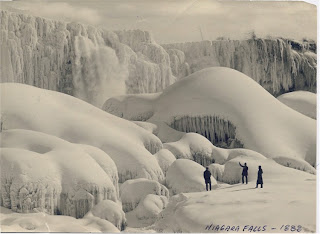
I was directed to the library's online image database and was dumbfounded to find over 20,000 images there. The Day the Falls Stood Still is peppered with historical images, and even if finding the best pictures was often tedious, hitting upon a shot of William “Red” Hill or his famous scow rescue made the hours spent searching easily worthwhile. I scoured the online image databases of the Library of Congress, Library and Archives Canada, the Ontario Archives, the Toronto Archives, and, of course the Niagara Falls (Ontario) Public Library. I would not have predicted it, but when I tallied the images that made it into the book, the highest number came from the library’s database.

Local history librarian, Cathy Simpson, expertly culled files and books, according to my latest query. She knew to which of the local museums and historical societies to point me. And, in one of her many leaps beyond the call of duty, she tracked down the whereabouts of William “Red” Hill’s riverman kit of grappling hooks, ropes, and life saving equipment and sent me off to have a look.

The text on the cover of The Day the Falls Stood Still reads “Steeped in the intriguing history of Niagara Falls, this is an epic love story as rich, spellbinding and majestic as the falls themselves.” Any reader who finds the statement the tiniest bit true should know that without the Niagara Falls (Ontario) Public Library, The Day the Falls Stood Still would have been a lesser book.


Picture captions and credits:


William “Red” Hill (right) - Niagara Falls (Ontario) Public Library


Ice bridge – Niagara Fall (Ontario) Public Library


Collapse of Table Rock – Niagara Fall (Ontario) Public Library