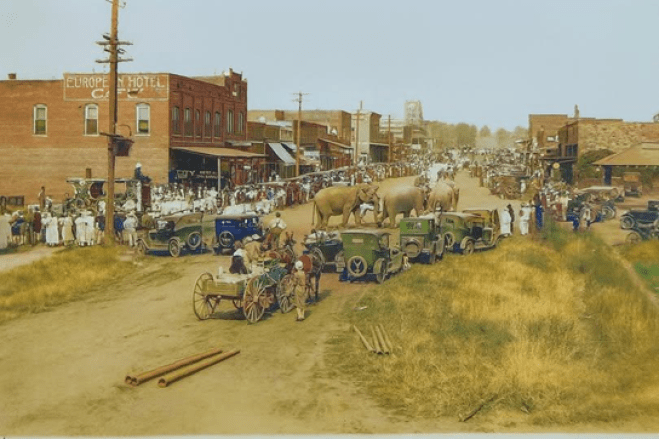
When the circus came to Booneville, Arkansas, around 1910, the whole town turned out to watch. Elephants paraded past the European Hotel as wagons and Model T’s lined the street — a glimpse of small-town wonder preserved in color. (Colorized Attribution: Unknown)
A Look Back at Small-Town Wonder in 1910
There are moments in a town’s history that seem to capture its very heartbeat. This colorized photograph of my hometown, Booneville, Arkansas, taken around the turn of the twentieth century, freezes one such day in time — the day the circus came to town. At the time, my grandfather was only 13 years old.
A Day to Remember
Booneville around this time was a growing community — supported by agriculture, small industry, and the Arkansas Central Railroad. A circus parade like this one would have been a symbol of connection to the wider world — a spectacle of modernity and wonder that briefly turned the small town into a stage for adventure.
The scene bursts with life. Main Street is lined with onlookers dressed in their Sunday best, their faces turned toward the extraordinary sight before them. From the dirt road rises a parade of elephants, marching solemnly past brick storefronts and cheering children. At the heart of the image are, of course, the three elephants, walking in line down the main street. Behind or around them would likely have been wagons carrying performers, musicians, and banners. Traveling circuses were a big attraction then — names like Ringling Bros., Barnum & Bailey, or Hagenbeck-Wallace often toured small Southern towns, bringing animals and performers never before seen locally.
This was Booneville at one of its most vibrant moments — a crossroads between rural tradition and modern change. Horse-drawn wagons stand beside early automobiles, both halted to watch the spectacle. The dust of the unpaved road swirls in the summer heat while townsfolk cluster along the wooden sidewalks, the excitement almost palpable even now.
The Heart of Town
To the left stands the European Hotel, its sign boldly painted on the red-brick wall — a proud establishment that once offered travelers rest and hot meals after a long journey on the Arkansas Central Railroad. Its presence tells us Booneville was a thriving hub of trade and community life, connected to the outside world while retaining its small-town soul. For those who may not know, hotels like this were common in Southern railroad towns; the term “European Plan” meant guests paid for rooms only, with meals separate.
The buildings that line the street — dry-goods stores, cafés, hardware merchants — form a familiar backbone of rural America in the early 1900s. Their striped awnings, wooden porches, and swinging doors were fixtures of a time when downtowns were the heart of every town’s rhythm.
A Town in Transition
This photograph captures Booneville at the moment when one era was fading into another. The horse-drawn wagon in the foreground belongs to an older world — the world of farms, mules, and simple living. But just behind it stand the boxy Model T-era automobiles, shining with promise. The two forms of transportation side by side tell the story of progress, as Arkansas and much of America stepped into the modern age.
The telephone poles that line the street hint at another transformation — the dawn of electric light, long-distance conversation, and a rapidly changing way of life.
A Celebration of Community
The circus parade was more than a show; it was an event that brought everyone together. Families traveled from nearby farms, merchants closed their shops, and children pressed forward for a better look at the elephants. For one afternoon, the entire town shared a single moment of wonder and joy.
For me, this image is not just history; it’s heritage. It reminds me that Booneville has always been a place of resilience and togetherness — a town that could stop everything for a parade and remember how to marvel at the extraordinary. The gathering feels communal and festive — the kind of event that would have been talked about for months afterward.