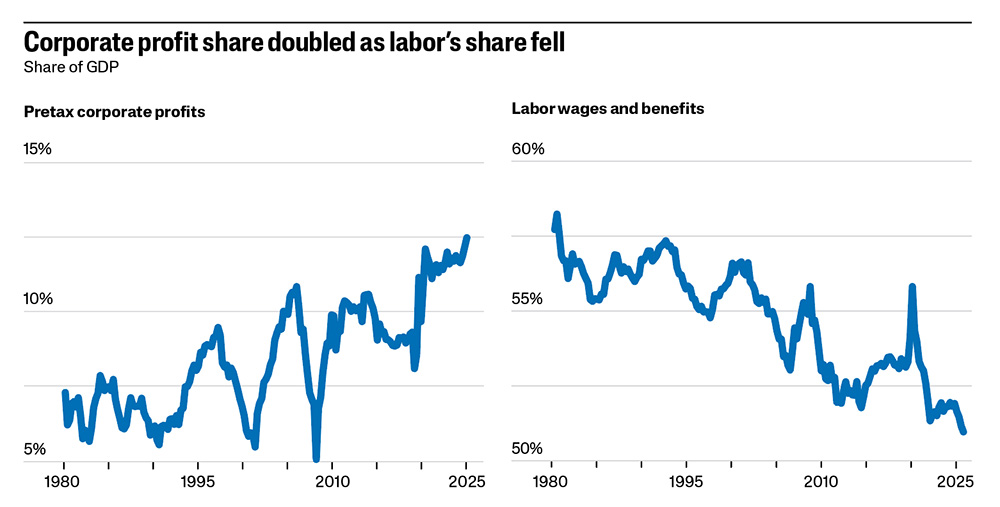
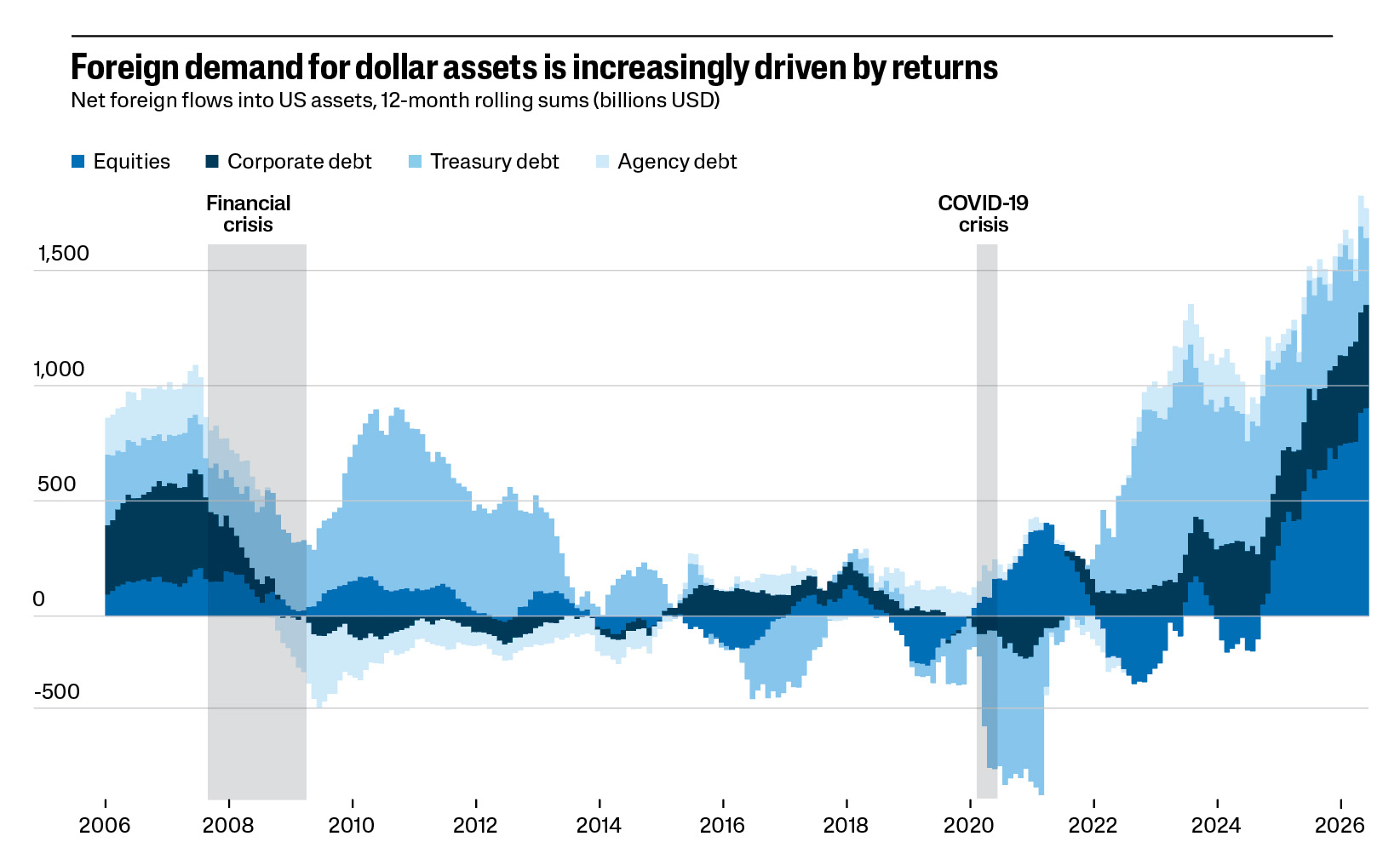
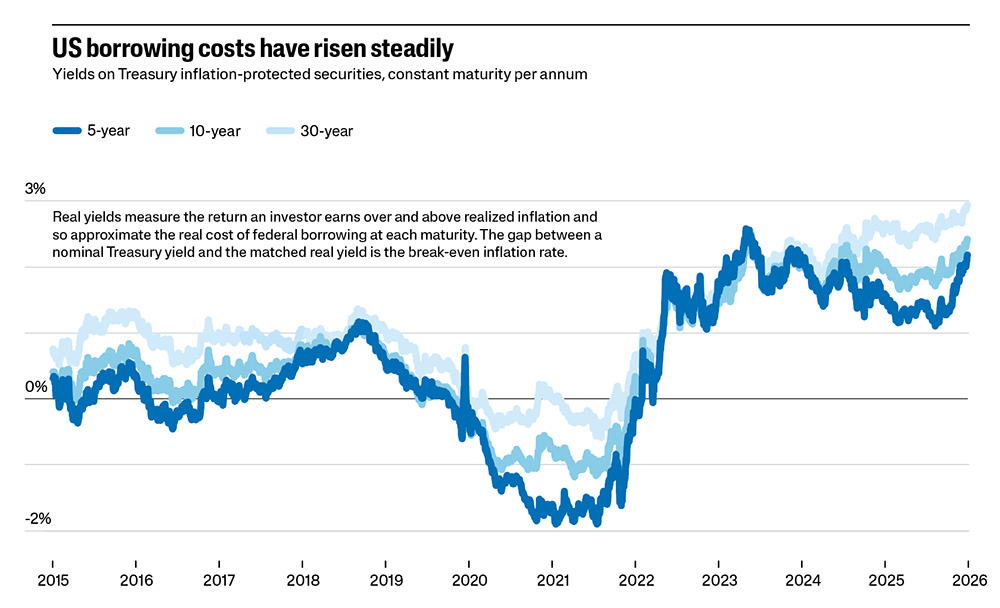
<?xml version="1.0" encoding="UTF-8"?><feed xmlns="http://www.w3.org/2005/Atom"><title type="text">Jacobin</title><id>https://jacobin.com</id><updated>2026-09-16T18:22:19.161441Z</updated><link href="https://jacobin.com"/><logo>https://jacobin.com/static/img/logo/logo-type.png</logo><subtitle type="text">Jacobin is a leading voice of the American left, offering socialist perspectives on politics, economics, and culture.</subtitle><entry><id>https://jacobin.com/2026/09/us-canada-electricity-costs-generation-deregulation</id><title type="text">Deregulation, Not Data Centers, Broke the Grid</title><updated>2026-09-16T18:22:19.161441Z</updated><author><name>Edgardo Sepulveda</name></author><category label="Economy" term="Economy"/><category label="Policy" term="Policy"/><content type="xhtml"><div xmlns="http://www.w3.org/1999/xhtml"><div><p>The public attribution of <a href="https://heatmap.news/energy/data-centers-electricity-prices-blame">blame</a> for rising electricity costs is half right. Data centers are indeed driving the first sustained surge in American electricity demand in more than a generation. But the historical record shows that electricity demand — what the industry calls “load” — has grown this quickly before without pushing prices up. What is different this time is not the load itself but the fact that it is landing on deregulated electricity markets that were never built to absorb growth.</p><p>Today, about a third of US retail electricity sales are in deregulated markets; the rest are served by traditional regulated utilities. That institutional variation — the same load growth running through two different market structures at the same time — is why economists can compare the bills.</p></div><section id="sec-1"><header><h2>A Century of Growth With Falling Prices</h2></header><div><p>From an electricity perspective, aluminum smelters were the world’s first data centers. Aluminum is sometimes called “solid electricity” because of how electricity-intensive it is to produce: the metal is extracted from alumina through an <a href="https://www.acs.org/education/whatischemistry/landmarks/aluminumprocess.html">electrolytic process</a>. More than two hundred primary smelters operate worldwide today, drawing about <a href="https://www.weforum.org/publications/net-zero-industry-tracker-2023/in-full/aluminium-industry-net-zero-tracker/">4 percent</a> of global electricity — more than double the roughly <a href="https://www.iea.org/reports/energy-and-ai/energy-demand-from-ai">1.5 percent</a> that data centers consume.</p><p>The United States led world production for most of the twentieth century. By 1943, sixteen American smelters accounted for <a href="https://www.lightmetalage.com/news/industry-news/smelting/decline-of-u-s-primary-aluminum-production-and-the-growth-of-secondary-aluminum/">43 percent</a> of global output while drawing about <a href="https://montana-aluminum.com/wp-content/uploads/2019/03/AL-book-Chapter-10.pdf">8 percent</a> of national electricity generation. That works out to a full 0.5 percent of national electricity generation for each individual smelter, on average. In relative terms, no data center operating today matches that share.</p><p>The following author-compiled figures show how the traditional relationship between electricity prices and generation growth broke down in the age of deregulation, or “restructuring,” as the industry calls it. Figure 1 tracks the real, inflation-adjusted electricity consumer price index for the United States and, as a comparator, Canada, over more than a century. Both lines fall for roughly fifty years — through a depression, a world war, and the most concentrated period of electrification either country has seen — ending up around two-thirds below where they started. That decades-long decline ended in the early to mid-1970s amid the era’s energy crises and the broader economic turmoil that accompanied them.</p><figure><a href="https://media.jacobin.com/images/2026/9/670265824439.png"><img alt="Inflation-adjusted electricity consumer price indexes for the United States and Canada, 1922–2026" height="516" loading="lazy" src="https://media.jacobin.com/images/2026/9/670265824439.png" width="936"/></a><figcaption>Author’s calculations. US: Bureau of Labor Statistics, CPI-U series for electricity and all items. Canada: Dominion Bureau of Statistics/Statistics Canada, CPI for electricity and all items. Electricity-price indexes were divided by the corresponding all-items CPI and rebased to 1922 = 100.</figcaption></figure><p>Figure 2 shows how much electricity generation grew over that same period. Starting from 1922, US consumption first doubled by 1936, a fourteen-year span that included the Great Depression. It then doubled again in just seven years, by 1943, followed by successive doublings in ten years (1953), nine years (1962), and ten years (1972). The pace then slowed sharply, with the next doubling taking twenty-four years, arriving in 1996. Load stayed essentially flat from the early 2000s until growth resumed in 2022. Five doublings in fifty years is a far larger shock than anything the AI build-out is projected to deliver — and they occurred while prices were falling.</p><figure><a href="https://media.jacobin.com/images/2026/9/348051495104.png"><img alt="Electricity generation indexes in the United States and Canada, 1922–2026" height="516" loading="lazy" src="https://media.jacobin.com/images/2026/9/348051495104.png" width="936"/></a><figcaption>Author’s calculations. US: Historical Statistics of the United States and U.S. Energy Information Administration. Canada: Historical Statistics of Canada and Statistics Canada. Annual generation was indexed to 1922 = 1.0.</figcaption></figure><p>Figure 3 plots the relationship directly, comparing the annual percentage change in US generation and in real prices over the past century. From 1922 to 1973, generation grew by an average of 7.7 percent a year while real prices fell by an average of 1.7 percent. From 1974 to 2025, growth slowed to an average of 1.7 percent a year and the real price decline nearly vanished, averaging just 0.2 percent. For most of the century the two lines are a rough mirror image. Steady, predictable, substantial generation growth went together with falling real electricity prices, and when the growth disappeared, so did the price declines.</p><figure><a href="https://media.jacobin.com/images/2026/9/210088191217.png"><img alt="Percentage change in US electricity consumer price index and generation" height="516" loading="lazy" src="https://media.jacobin.com/images/2026/9/210088191217.png" width="936"/></a><figcaption>Author’s calculations: Bureau of Labor Statistics, CPI-U series for electricity and all items. US: Historical Statistics of the United States and U.S. Energy Information Administration for power generation. Both series smoothed using LOESS (FRAC=0.09; IT=3).</figcaption></figure></div></section><section id="sec-2"><header><h2>What Deregulation Broke</h2></header><div><p>That mirror image was a product of institutional structure based on a political-economic compromise. Vertically integrated utilities — combining generation, transmission, and distribution within a monopoly franchise area — captured the economies of scale that came with growth. Economic regulation required that some of the efficiency gains be shared with consumers in the form of lower prices. A large new industrial load was therefore an opportunity: it increased generation utilization and spread fixed costs across more sales, pushing down average regulated prices.</p><p>Restructuring, which began in the US electricity sector in the late 1990s, severed that link. The old integrated utility model was broken up in states that deregulated. Generating electricity became a separate business, open to competition, while transmission and distribution remained regulated. Competitive wholesale power prices were then set through auctions that price power at the margin. New load appears to shift the demand curve upward in generation markets, raising wholesale energy prices, which were then mostly passed on to consumers through higher retail prices.</p><p>Figure 4 zooms in on the period from 1999 to 2025 and shows how quickly the century-old relationship came apart. By 2007, prices and generation were moving together rather than in opposite directions, and since 2020 both have risen in tandem. That is the signature of a system in which new load pushes prices up.</p><figure><a href="https://media.jacobin.com/images/2026/9/781116011839.png"><img alt="Percentage change in US real electricity consumer price index and generation, 1999–2025" height="516" loading="lazy" src="https://media.jacobin.com/images/2026/9/781116011839.png" width="936"/></a><figcaption>Author’s calculations: Bureau of Labor Statistics, CPI-U series for electricity and all items. US: Historical Statistics of the United States and U.S. Energy Information Administration for power generation. Both series smoothed using LOESS (FRAC=0.09; IT=3).</figcaption></figure><p>This is not only a pattern in the aggregate data. A June 2026 <a href="https://ceepr.mit.edu/workingpaper/who-pays-for-growth-evidence-from-datacenters-and-the-grid/">study</a> identifies a causal effect, and — this is the part that matters — it is not universal. Data center entry raised average retail electricity prices by a statistically significant 6.1 percent among privately owned utilities in deregulated states, compared with no statistically significant increase among publicly owned utilities in regulated regions. A March 2026 <a href="https://www.dallasfed.org/research/papers/2026/wp2606">study</a> found the same mechanism at the wholesale level, with data centers raising competitive wholesale prices in deregulated supply-constrained regions while having negligible effects elsewhere. The same load, arriving in two different market structures, produces two different bills.</p><p>It is worth being precise about what the country traded away, because aluminum gave the grid more than a load to grow into. US aluminum production <a href="https://www.lightmetalage.com/news/industry-news/smelting/decline-of-u-s-primary-aluminum-production-and-the-growth-of-secondary-aluminum/">peaked</a> in 1980, with thirty-three smelters producing about <a href="https://nora.nerc.ac.uk/id/eprint/535250/1/WMS_1980_1984.pdf">30 percent</a> of world output, drawing about <a href="https://publications.polymtl.ca/6647/1/2021_Pedneault_What_future_primary_aluminium_production_supp.pdf">8.87 gigawatts</a> and employing roughly 26,000 <a href="https://commons.wikimedia.org/wiki/Special:Redirect/file/1987%20Census%20of%20Manufactures.%20Industry%20Series.%20Smelting%20and%20Refining%20of%20Nonferrous%20Metals%20and%20Alloys%20%28IA%201987censusofma8733uns%29.pdf#page=22">production workers</a> — about three workers per megawatt of load in a workforce with deep union density. After 1980, the smelter count fell: to twenty-three by 1990, to nine by 2014, and to just six by 2024, two of them idled. In 2017, the <cite><a href="https://www.nytimes.com/2017/07/01/us/politics/american-companies-still-make-aluminum-in-iceland.html">New York Times</a></cite> documented the punch line: American companies now smelt aluminum in Iceland. By 2025, the United States was producing less primary aluminum than Iceland, a country of fewer than four hundred thousand people. China now <a href="https://www.lightmetalage.com/news/industry-news/smelting/decline-of-u-s-primary-aluminum-production-and-the-growth-of-secondary-aluminum/">produces</a> 60 percent of world output, much of it from dozens of mega-smelters, while Canada, America’s main supplier, produced about 4.6 percent of global output from its nine primary smelters.</p><p>From the roughly 30 percent global share it held in 1980, the United States now accounts for only about 1 percent of primary aluminum production. The United States has been a net importer of primary aluminum every year since 1992, and Canada has long been its largest foreign supplier, even as Canadian production held roughly steady while the American industry kept shrinking. The current administration’s response has been protection rather than rebuilding, dressed up as a national security necessity: Section 232 tariffs, imposed on aluminum at 10 percent in 2018, lifted for Canada in 2019, reimposed at 25 percent in March 2025, and doubled to 50 percent that June. Aluminum is covered under the Canada–United States–Mexico Agreement (CUSMA), and Canada has <a href="https://www.jdsupra.com/legalnews/canada-initiates-wto-dispute-5653492/">challenged</a> the tariffs through World Trade Organization dispute consultations and CUSMA procedures. There is something more than a little ironic about treating import dependence as a security threat after decades of domestic policy choices hollowed out the industry.</p></div></section><section id="sec-3"><header><h2>Deregulation Was Never a Growth Strategy</h2></header><div><p>Maybe data centers can fill some of the gap by replacing some of the electricity demand once represented by aluminum smelting. They accounted for about <a href="https://www.reuters.com/business/energy/us-data-center-power-use-could-nearly-triple-by-2028-doe-backed-report-says-2024-12-20/">4.4 percent</a> of US demand in 2023, and forecasts project that figure roughly doubling up to <a href="https://www.epri.com/about/media-resources/press-release/q5vu86fr8tkxatfx8ihf1u48vw4r1dzf">9 percent</a> by 2030 as the AI build-out accelerates. That would put data centers in the same range as aluminum smelting’s wartime peak of about 8 percent of national generation.</p><p>In employment and union terms, however, the comparison is not close. Like other types of physical infrastructure, data centers generate construction work, but those jobs are temporary. Once operating, large data centers typically employ about 0.3 to 0.5 <a href="https://poweredbywho.com/methodology/jobs">permanent workers</a> per megawatt of capacity, roughly one-tenth to one-sixth of what smelting supported, and the operational workforce appears almost entirely <a href="https://unionstats.com/ind/htm/ind_2023.htm">nonunion</a>. Data centers can approximate aluminum’s electrical footprint, but not remotely its labor or union footprint. The country is being asked to absorb the load of a heavy industry while getting almost none of the jobs.</p><p>Which brings us back to the structure that has to absorb the load. Restructuring was never a growth strategy, and its architects never claimed it was. US electricity consumption was essentially flat for nearly two decades, as efficiency gains and the shift away from manufacturing offset population and economic growth. It was in that flat demand environment, not an expansionary one, that restructuring was designed. Reformers in the 1990s argued that regulated utilities were saddled with high-cost legacy investments, that new gas-fired plants had become small and efficient enough to compete, and that unbundling generation from transmission would let competition, rather than a monopoly utility’s capital plan, decide what got built. It was a market built to allocate a flat or shrinking pie among competing bidders, not to expand a system rapidly enough to serve rising demand.</p><p>This matters well beyond data centers. Decarbonization means electrifying transportation, heating, and industry — decades of sustained load growth of exactly the kind the American grid once absorbed while prices fell. Deregulated markets risk turning that into a choice between growth and affordability. Regulated utilities did not: both the econometrics and a century of price data show that they were better able to adapt to growth without levying price penalties on consumers. Ending the deregulation experiment is not nostalgia. Regulated power has delivered both growth and affordability before — and can do so again. The aluminum smelters are not coming back. But the institutions that built the grid around them should.</p></div></section></div></content><published>2026-09-16T18:22:19.161441Z</published><summary type="text">Electricity bills are rising, and data centers are getting the blame. But for 50 years, the American grid absorbed loads this large while real prices fell. The difference between then and now? Deregulated markets.</summary></entry><entry><id>https://jacobin.com/2026/09/yemen-ansar-allah-civil-war-saudis-iran</id><title type="text">Ansar Allah’s Red Sea Advance Has Exposed Saudi Weakness</title><updated>2026-09-16T16:28:23.366369Z</updated><author><name>Arron Reza Merat</name></author><category label="War and Imperialism" term="War and Imperialism"/><content type="xhtml"><div xmlns=""><p>On September 9, Yemen’s Ansar Allah, or “Houthis” as they are also known, descended from the highlands down roads and riverbeds to the Tihamah coastal plain and captured the port of Mokha from the Saudi-based government the following day. By September 11, they had taken Perim Island in the Bab al-Mandeb Strait. Since then, they have used that position to blockade Israel and exercise leverage over the Saudi kingdom.</p><p>Ansar Allah went on to shut down the 745-mile-long East–West pipeline that transports four to five million barrels per day from Saudi Arabia’s eastern oil fields to its Red Sea export terminals, possibly with the assistance of Iraqi militias. In response, the price of global Brent crude rose to $108 a barrel; it is now hovering at $102. For comparison, the figure in January, before the US-Israeli war against Iran began, was $60 a barrel.</p><p>Meanwhile, fighting in Yemen continues. Around 1,500 soldiers are injured and another five hundred are confirmed are dead on the government side alone; battles are taking place in <a href="https://x.com/osint613/status/2099853769068487118?s=51">Al Jawf</a>, <a href="https://www.aljazeera.com/news/2026/9/14/why-the-houthi-advance-towards-yemens-marib-taiz-matters">Marib, and around Taiz</a> as Ansar Allah seeks to secure the highlands overlooking their new territory.</p><p>This attack did not come as a surprise to Yemenis. Tensions have been building in the country in recent months over a political stalemate that Ansar Allah sees as intolerable. The group is currently in the midst of fighting a civil war, which has been frozen since 2022, against an array of Saudi-backed forces across multiple fronts.</p><p>Ansar Allah dominates the coalition that is the country’s de facto leadership, controlling territory home to more than <a href="https://www.state.gov/reports/2021-report-on-international-religious-freedom/yemen/#:~:text=During%20the%20year%2C%20the%20Houthis,80%20percent%20of%20the%20population.">three in four</a> Yemenis and fighting a government that is internationally recognized but highly dysfunctional. The group comprises an uneasy coalition of a diverse set of actors who share little except a common enemy. Ansar Allah made no secret of their designs on the Red Sea coast even during ceasefire. The Saudi maritime blockade and the exigencies of the war economy mean that Mokha has long been eyed as a potential second lung to Hodeidah, the Ansar Allah–controlled port to the north.</p><p>Since 2023, the Saudis have dangled a promise of cash for peace in front of Ansar Allah. But the group also wants Saudi reconstruction funds to fix the destruction wrought by a long air war that destroyed infrastructure and killed more than <a href="https://caat.org.uk/data/countries/saudi-arabia/the-war-on-yemens-civilians/">150,000 Yemenis</a> between 2015 and 2022 (this figure is likely a significant undercount).</p><p>The prospect of the Houthis being backed, even if just financially, by the Saudis to maintain order has historic precedents. The country’s former President Ali Abdullah Saleh, and before him the imamates of Fiver-Shias, the Houthis’ coreligionists, enjoyed qualified support from the kingdom. But the Houthis have long been unwilling to foster relations with the Saudis. After all, Ansar Allah are close allies of Iran, which is currently winning a war waged against it by the United States, alongside Israel, since February.</p><p>Sana’a and Tehran are playing a long-term game against what they see as an Israeli war of aggression against the multiple nations of the Middle East. The region is now involved in a giant escalation trap driven by the US and Israeli war against Iran and its regional allies. The Houthis face pressure from the Islamic Republic to open a southern front against Saudi Arabia, whose territory has been used to stage strikes against Tehran.</p><p>One analyst with ties to the region, with whom <cite>Jacobin</cite> spoke on condition of anonymity, described the Ansar Allah response in July when the Saudis hit Sana’a international <a href="https://www.bbc.co.uk/news/articles/cp9ldle3d3xo">airport</a> as a plane carrying the Houthi delegation for the funeral of Iran’s former Supreme Leader was trying to land. Ansar Allah responded by striking the Gulf monarchy’s Abha Regional Airport. It was clear then that retaliation was on the cards. “They [Ansar Allah] told us, ‘Wait and see what we can do, and we will,’” the analyst told <cite>Jacobin</cite>. “They said escalation is coming. In this stalemate, it is now not an option to keep their supporters and troops idle.”</p><p>Ansar Allah sees its domestic political enemies as <a href="https://x.com/omeisy/status/2099937591621808261?s=51">weak</a>. “The fundamental problem is that the Yemeni National Resistance Forces (NRF) and the wider anti-Houthi coalition are a hodgepodge of groups with different religious, ideological, political, and regional backgrounds,” Mohammed Al-Basha, a Washington, DC–based risk adviser and founder of the Basha Report, told <cite>Jacobin</cite>. “Some were former adversaries . . . and they are not united around a common long-term political vision for Yemen,” he added.</p><p>In August and early September, Ansar Allah’s military conducted shaping operations against the NRF, led by Tareq Saleh, a warlord mostly loyal to the official Saudi-based government of Yemen and nephew of Ali Saleh, whom the Houthis <a href="https://www.middleeasteye.net/news/ali-abdullah-saleh-yemens-survivor-ended-his-own-double-dealing">assassinated</a> in 2017 for double-crossing them. Ansar Allah saw Saleh as the weak link in a pro-Saudi alliance. He had irked the Saudis after he had tried to maintain ties with the United Arab Emirates after both nations went to war in Yemen in January. Riyadh drove the UAE — officially at least — out of Yemen, and Tareq Saleh plodded on, chastened. Unlike the Houthis, who are embedded in Iranian missile production <a href="https://newlinesmag.com/reportage/how-irans-missile-strategy-has-rewritten-the-rules-of-middle-eastern-wars/">networks</a>, neither Saudi Arabia nor the UAE was sending the NRF advanced weapons to defend its enclave, an analyst told <cite>Jacobin</cite>.</p><p>Ansar Allah presumably chose this moment to join the war due to the disarray of its enemies, the collapse of the political process, and diplomatic pressure from Iran, which wishes to climb the escalation ladder ahead of the US midterms in November.</p><p>Much of the <a href="https://www.bbc.com/news/articles/c3v4zgzr1kxo">media</a> has characterized the attack against Tareq Saleh as a sudden seizure, but it seems to have been more a product of a longer campaign. Al-Basha has documented a weeklong Houthi program of disrupting supply lines and softening targets with drones and missiles in advance of their invasion.</p><p>Control of this new territory will strengthen Houthi control of the Bab al-Mandeb Strait. The seventeen-mile-wide choke point, which Saudi Arabia increasingly depends on for its oil exports since Iran closed the Strait of Hormuz, presents the group with significant opportunities to raise funds from international maritime traffic, which is easily spooked by drone, missile, and even artillery attacks.</p><p>The group already militarized much of the Red Sea when it went to war in 2023 against Israel over its genocide in Gaza, building relationships in the process with major buyers of oil transiting the Red Sea, according to Farea Al-Muslimi, a research fellow at Chatham House. The seizure of the lowlands expands their capacity to control a portion of the international trade going through the region. Al-Muslimi says that while the Houthis deny charging tolls on Red Sea shipping, they have developed what might be loosely called “business arrangements” with several nations, including China and Qatar. “Post-October 7, Yemen has developed under-the-table deals with some countries to let their ships go through [the strait] without being attacked,” he added.</p><p>Control of Mokha and the surrounding coastline also helps the Houthis consolidate their <a href="https://carnegieendowment.org/research/2025/04/dhows-drones-and-dollars-ansar-allahs-expansion-into-somalia">smuggling</a> network, vital for technology transfers from Tehran. Possession of the ancient port of Mokha and several small islands along the coastline will be a boon to Ansar Allah’s capacity to evade the Saudi blockade. The Houthis work with many smuggling networks in the Horn of Africa, including those of al-Shabaab in Somalia, which also provides them with mercenaries in Yemen. The Shabaab-Houthi alliance will not be lost on Tareq Saleh, who is rumored to be living dangerously in Somalia.</p></div></content><published>2026-09-16T16:28:23.366369Z</published><summary type="text">The Ansar Allah movement is fighting to win a civil war in Yemen but is also caught up in the regional escalation caused by the US-Israel conflict with Iran. Ansar Allah is likely to benefit from this instability.</summary></entry><entry><id>https://jacobin.com/2026/09/documentary-ups-teamsters-strike-organizing</id><title type="text">A Portrait of How Workers Build a Strike</title><updated>2026-09-16T15:12:53.08916Z</updated><author><name>Luis Feliz Leon</name></author><category label="Film and TV" term="Film and TV"/><category label="Unions" term="Unions"/><content type="xhtml"><div xmlns="http://www.w3.org/1999/xhtml"><div><p>I was at a Crotona Park barbecue in the South Bronx to celebrate my wife’s nephew, who was going off to a trade school after graduating high school. The family barbecue included a cross section of union members, among them electricians, hotel workers, Teamsters — not a strange amalgam, thanks to New York’s high <a href="https://slu.cuny.edu/wp-content/uploads/2026/09/Union_Density-2026_digital.pdf">union density</a>. It’s often only in TV shows that you see a tight-knit group of friends from vastly different class backgrounds hanging out together. In real life, we can’t curate a social circle of people from disparate backgrounds with the same ease you assemble an eclectic wardrobe from a thrift store.</p><p>But social segregation can be overcome through political and civic institutions that turn strangers into comrades, offering an antidote to <a href="https://jacobin.com/2026/08/demsas-chris-murphy-liberalism-individualism">loneliness</a> and <a href="https://www.nytimes.com/2026/08/10/style/america-is-atomizing.html?smid=nytcore-ios-share">atomization</a>. In 1947, <cite>Life</cite> magazine photographer David E. Scherman shot a <a href="https://ourtime.substack.com/p/friday-photo-communist-cell-paris?r=6k8iy&amp;utm_medium=ios">picture</a> of a Communist Party cell at a Paris café, planning a Christmas dinner. The meeting included a classics professor, a stenographer, a salesman, a jeweler, a tailor, a schoolteacher, a metallurgist, an upholsterer, a dressmaker, and a pastry cook. The party offered a political home that brought all of them together to understand themselves as part of a unified class with a shared worldview.</p><p>Unions also bring together an unlikely assortment of people to exercise collective power in the workplace. In the new <a href="https://letterboxd.com/film/who-moves-america/">documentary</a> <cite>Who Moves America</cite>, filmmaker Yael Bridge offers a window into the working-class culture of one of the country’s largest unions, the International Brotherhood of Teamsters, at United Parcel Service (UPS) in 2023. Bridge previously directed the 2020 documentary <cite>The Big Scary “S” Word</cite>, chronicling the rich history of the socialist movement in the United States with Sen. Bernie Sanders’ second presidential run as a backdrop, and the 2022 documentary <cite>When We Fight</cite>, about the 2019 Los Angeles teachers’ strike. In her latest film, she returns to the strike, that most potent of working-class weapons.</p><p>In the <em>mise-en-scène</em> of the 2023 strike wave involving Hollywood <a href="https://jacobin.com/2023/07/hollywood-writers-actors-strike-studios-streaming">writers and actors</a> in the summer and <a href="https://jacobin.com/2023/10/health-care-workers-strike-kaiser-permanente-short-staffing-crisis">health care workers</a> in the fall, 340,000 Teamsters were gearing up for a potential strike against package giant United Parcel Service. UPS Teamsters have the largest private-sector union contract in North America. Workers at UPS, behind the wheel in brown trucks and along conveyor belts in warehouses, move <a href="https://www.bloomberg.com/news/newsletters/2023-07-18/supply-chain-latest-economic-impact-of-a-ups-strike">twenty-five million</a> parcels a day. Their working conditions are grueling and dangerous: at the time, two drivers had died in the past year from sweltering heat. If they strike, their market leverage from moving 6 percent of the country’s gross domestic product means they can cripple the company’s profits and send shock waves across the economy.</p><p>The <a href="https://jacobin.com/2017/08/ups-strike-teamsters-logistics-labor-unions-work">last time</a> UPS Teamsters struck was in 1997; grainy home video and archival footage from that strike is interspersed throughout the documentary, and the film’s contemporary subjects — from UPS veterans who were on strike at the time to UPS workers who weren’t even born yet — reference that walkoff as a touchstone moment in their lives, the Teamsters’ history, and the recent history of the American labor movement as a whole.</p><figure><img alt="A still featuring two UPS workers sitting together on a beach, from the 2026 documentary Who Moves America" height="563" loading="lazy" src="https://media.jacobin.com/images/2026/9/762882888107.jpg" width="1000"/><figcaption>The subjects of <cite>Who Moves America</cite> range UPS veterans who were on strike in 1997 to workers who weren’t even born yet. (Sidereal Time / ITVS)</figcaption></figure><p>Spoiler alert: The strike isn’t <a href="https://jacobin.com/2023/08/teamsters-ups-contract-part-time-pay-tier-system-strike-organizing">called</a>. Members all across the country are chomping at the bit to walk off the job, but after the union reaches a tentative agreement with the company that even the Teamsters’ most strike-ready militants acknowledge is a much stronger pact than previous ones, the members ratify the contract by a five-to-one <a href="https://teamster.org/wp-content/uploads/2023/08/TallyReportwSignatures-1.pdf">margin</a>. (The five-year <a href="https://www.tdu.org/ups_teamsters_speak_out_on_the_2028_contract_fight">contract</a> is set to expire on July 31, 2028.) The film was deprived of the sexy stuff of massive picket lines, angry workers flinging rhetorical mud (and perhaps other not-so-rhetorical physical items) at supervisors, physical confrontations with strikebreakers, and a very public referendum on corporate gluttony and working-class exploitation in a deeply unequal America. A simpler narrative of heroic workers taking on greedy bosses gives way instead to a thornier one, as workers who were charged up to strike wrestle with what it means to win the gains they were after without walking off the job.</p><p>From covering the strike, I recall workers seething in anger from the pandemic-era abuses and risks they were exposed to and wanting to stick it to management.</p><p>“I can still vividly remember getting my drivers together outside the building when the pandemic first started and the fear on their faces that somehow they could bring the virus to their children,” delivery driver Greg Kerwood, a steward in Somerville, Massachusetts, <a href="https://labornotes.org/2023/08/despite-big-teamster-wins-ups-some-expectations-outpace-gains">told</a> <cite>Labor Notes</cite> at the time. “Part of what happened when people got out there with the practice pickets was they started to feel a sense of their own power,” Kerwood said. “The shackles were beginning to break. And they were starting to stand up and hold their shoulders straight and put their heads high and start to take some pride in their own self-respect in the workplace.”</p><p>That pent-up anger means the strike is freighted with high expectations, like potential to temporarily rebalance workers’ relationships to their management tormentors by striking them. “This company hates you,” Teamsters Local 804 President Vinnie Perone says in the documentary. “If they could, they would replace you with a hand-truck.”</p><p>Instead of that pined-for showdown, the film explores how workers grapple with expectations outpacing their impressive contract gains. What does it mean to win a strong contract without a strike? The strike isn’t just a weapon to force employers to concede material gains; it’s also a school in militancy and camaraderie, leaving an indelible mark on those with the battle scars to show for it.</p><p>But before reaching the peak of escalation, workers must do the nuts-and-bolts educational and political work of coming together across various divisions, the boring yet indispensable stuff that makes it possible for thousands to mass at an employer’s gates: the social bonds among workers.</p></div><section id="sec-1"><header><h2>How to Organize Your Union</h2></header><div><p>Like the 2024 <a href="https://jacobin.com/2024/03/amazon-labor-union-documentary-christian-smalls">documentary</a> <cite>Union</cite>, which chronicled the stunning organizing victory of Amazon workers at a fulfillment center on Staten Island in New York City, <cite>Who Moves America</cite> (producer Mars Verrone was involved in both films) shows what organizing looks like in practice in the buildup to a potential strike. Teamsters President Sean O’Brien makes a number of appearances, deploying tough talk against UPS that gets under corporate investors’ and executives’ skins. In the film, he’s recorded at his stately desk at Teamsters headquarters in Washington, DC, relating an anecdote of how a fellow union leader was surprised by the size of the UPS National Negotiating Committee, which was expanded by appointing rank-and-file members.</p><p>O’Brien worked hard to cultivate the air of a militant labor chief dedicated to rank-and-file action; after taking office in 2022, he traveled the country with Bernie Sanders to denounce billionaires and <a href="https://www.youtube.com/watch?v=WAkjSm3m3FA">spoke</a> at that year’s Labor Notes conference to rapturous applause. Since then, though, O’Brien has alienated many in the labor movement by <a href="https://labornotes.org/2024/07/viewpoint-obrien-speech-played-republicans-phony-pro-worker-rebrand">speaking</a> at the Republican National Convention and giving the union’s <a href="https://www.theguardian.com/us-news/2026/sep/02/teamsters-union-republican-endorsement">endorsement</a> to a number of GOP candidates, even as the Republican-led House Committee on Education and the Workforce <a href="https://www.theguardian.com/us-news/2026/sep/01/house-republicans-unions-investigation">announced</a> subpoenas of the Teamsters’ rail divisions along with leaders of the United Auto Workers and the American Federation of Teachers. Donald Trump continues to be the biggest <a href="https://www.epi.org/blog/trump-is-the-biggest-union-buster-in-u-s-history-more-than-1-million-federal-workers-collective-bargaining-rights-are-at-risk/">union-buster</a> in US history, <a href="https://cwa-union.org/trumps-anti-worker-record">destroying</a> workers’ job security and right to engage in collective action.</p><p>But the film spends the bulk of its time tracking not the moves at the union’s top but the ferment below. O’Brien waged a vociferous war of words, but he is on-screen less than the Teamsters discussing the contract and developing working-class leadership across locales, from a beach in Southern California to the streets of Louisville, Kentucky, and Brooklyn, New York. We see fellow Teamsters talking at a diner across generations, dipping French fries in ketchup while chatting about how the contract could change their lives (including, one part-timer half-jokingly hopes, being able to afford a ticket to a Beyoncé concert). We see them shifting in their chairs during trainings at union halls and local sandwich shops, debating how to engage part-time package sorters in the contract campaign and where best to position picketers if and when the strike comes as well as whether the achievements in the contract are good enough to warrant a yes vote.</p><p>None of that happens spontaneously. The work of working-class organization involves weaving relationships into dense knots across lines of race and immigration status and age and job type, over and over again, forming a rank-and-file network that can take action. As longtime Democratic Socialists of America organizer David Duhalde has <a href="https://democraticleft.dsausa.org/2026/05/06/a-moving-picture/">written</a>, that’s largely the work seen in the film of the rank-and-file movement <a href="https://jacobin.com/2025/11/teamsters-tdu-reform-caucus-convention">Teamsters for a Democratic Union</a>. TDU members and staff led online and in-person meetings for tens of thousands of UPS Teamsters across the country. Member leaders are seen collecting strike pledge cards, explaining contract demands, answering questions, and training coworkers to carry out workplace actions to put pressure on the company.</p><p>The relationships between workers, in all their specificity, are what make a union. In the film, we meet Tim Peppers, a veteran of the 1997 strike, and Justin Alo from San Marcos, California, who is classified as a “22.4” worker, a reference to a section of a previously ratified UPS contract that created a classification of drivers who deliver packages for less pay than regular drivers with fewer contractual protections. Alo has banded together with his coworkers to hold <a href="https://labornotes.org/2023/04/strike-force-building-ups-contract-campaign-one-breakfast-time">meetings</a> at a local coffee shop to learn about their contract and prepare for the fight with UPS. We watch him and his wife talk with quiet anxiety about saving money in case he goes on strike, and their decision to pause their autistic son’s daily therapy sessions if Alo strikes because they won’t be able to afford them. That’s the stuff of real sacrifice, multiplied an untold number of times over by every worker considering a strike.</p><p>TDU organizers helped cohere these meetings to educate members with no strike experience. <a href="https://labornotes.org/blogs/2023/08/so-you-wanna-practice-picket-heres-how-we-did-it">Practice pickets</a>, marching in a small circle with signs on the sidewalk front of a UPS hub, to build the muscle memory to strike and demonstrate to company managers the union’s seriousness about walking off the job, union leaders at the gates educating members about their contract and pulling previously apathetic workers into action — these are aspects of a strike readiness program the Teamsters adopted across the union. That’s a credit to TDU’s tireless work building a bench of worker leaders, and the know-how in rolling out these educational campaigns in a national contract fight, and the union adopting them, amplifying and institutionalizing their impact, even if unevenly, across the union.</p></div></section><section id="sec-2"><header><h2>Missing Their ’97?</h2></header><div><p>Alo is among the newbies, but he has helped organize these social gatherings alongside other UPS Teamsters with experience in the fifteen-day 1997 strike. That strike was transformative, reducing the reliance on subcontractors and boosting wages. But it also contained a <a href="https://www.cnn.com/US/9708/19/ups/index.html">concession</a>: a five-year contract term, instead of <a href="https://www.nytimes.com/1997/08/19/us/teamsters-and-ups-agree-on-a-5-year-contract-plan-to-end-strike-after-15-days.html">three</a> or four years. Now that the contract terms are longer, workers have fewer opportunities to strike than earlier generations did.</p><p>As workers debate whether to ratify their tentative agreement, a worker in California compares the momentum they built up to a wind-up toy car whose wheels are charged up but never allowed to take off. Workers wonder if, by not striking, they’ll miss out on the transformative experience their coworkers had in 1997, especially as the institutional memory fades once veterans of that strike begin to retire.</p><p>Former package-car driver and TDU cochair Antonio Rosario says that during the 1997 strike, he was a knucklehead who was schooled by old-timers; the union saved his life from a potential life of crime and drugs. We watch him play handball, the poor man’s tennis, with his kids in Brooklyn. We see him at the entrance to the UPS hub, chatting workers up and slapping flyers into people’s hands, marching in a circle during practice pickets — a regular worker <a href="https://inthesetimes.com/article/antonio-rosario-labor-organizer-of-the-year-amazon">turned</a> organizer.</p><figure><img alt="A still of three UPS workers praying together as a strike vote looms, from the 2026 documentary Who Moves America" height="563" loading="lazy" src="https://media.jacobin.com/images/2026/9/485184184748.jpg" width="1000"/><figcaption>Three Teamsters pray together as the strike vote looms. (Sidereal Time / ITVS)</figcaption></figure><p>In Louisville, Kentucky, two young black workers mirror Rosario’s early experience as a part-timer in the 1990s; they are going to college while juggling a job at UPS. “You know how many times I passed by this in my life and never knew,” Nailah Webber says to her friend Angel Baduo as they drive past their union local. We watch them pray in a kitchen as the strike vote looms. They are stand-ins for the vast majority of workers in the country who have little experience or understanding of what it means to be part of a union but whose lives would be vastly improved by joining or organizing one.</p><p>At my own family barbecue, a family friend who’s a Teamster spoke to my nephew about his union options. His uncles told him about jobs that would be represented by the International Brotherhood of Electrical Workers, the Communications Workers of America, and others. We told him about how important job security was in this job market, and how the best way for him to have a future was to take his trade certification and enter a union apprenticeship program. He nods and asks questions as other family members gather around him, chiming in about their union experiences.</p><p>I remember all the anecdotes I’ve heard from fellow workers about their journeys into the union world. “If you notice, back in the ​’80s and ​’90s, most UPS drivers had pretty big arms,” Rosario <a href="https://inthesetimes.com/article/antonio-rosario-labor-organizer-of-the-year-amazon">told</a> me in 2025, ​“and that was from turning that damn steering wheel,” before power steering was introduced. At Crotona Park, we are adding to that knowledge base across sectors, weaving and reweaving stories that add up to worldview and a potential class politics.</p><p>The majority action necessary for a successful strike demands unity and camaraderie. As A. J. Muste once wrote, “the trade union seeks to combine within itself two extremely divergent types of social structure, that of an army and that of a democratic town meeting.” In the lead-up to a strike, these divergent forms can temporarily work together through the picket line discipline of the union as a combat organization and the union hall as a democratic town meeting where workers deliberate about their contract demands. <cite>Who Moves America</cite> takes us to the lower frequencies where workers educate each other on what it means to move like a class.</p></div></section></div></content><published>2026-09-16T15:12:53.08916Z</published><summary type="text">Who Moves America chronicles the Teamsters’ 2023 near-strike at UPS. It’s a rare and moving portrait of a massive, diverse group of workers building themselves into a fighting force, who then must wrestle with a different version of victory than they expected.</summary></entry><entry><id>https://jacobin.com/2026/09/openai-anthropic-human-extinction-criti-hype</id><title type="text">AI Doomsaying Is an Aggressive Sales Pitch</title><updated>2026-09-16T14:07:12.647182Z</updated><author><name>Richard Seymour</name></author><category label="Science and Technology" term="Science and Technology"/><content type="xhtml"><div xmlns="http://www.w3.org/1999/xhtml"><div><p>It seems a strange publicity gambit for an industry to assert that its own product could wipe out humanity. In the lingo of our evolving tech empire, though, this is exactly what is meant by “criti-hype.” The term was coined by Lee Vinsel at Virginia Tech, who defined it as “criticism that both feeds and feeds on hype.”</p><p>When Jacob Coxon <a href="https://x.com/hilbertspaess/status/2097476196791709843">resigned</a> from Anthropic recently, he claimed that there is a high chance that AI could develop into a superintelligence that escapes human control, triggering a sequence that causes human extinction. Evan Hubinger, who remains with the company, <a href="https://x.com/EvanHub/status/2097497037956891126">backed him up</a>, saying that Anthropic is trying to prevent this but hasn’t dealt with the problem yet. Hubinger put the likelihood of AI-driven human extinction at greater than 10 percent in the next decade.</p><p>Why would a senior employee at a tech giant make an officially sanctioned, even approved, statement like this? I’ll come back to that. First, let’s unpack the theory of how AI could kill all humans.</p><p>The basic idea, from philosopher Nick Bostrom onward, is that the machine can acquire capabilities independently of whether it acquires ethical goals, or whether those goals are properly aligned with those of its designers. In the process of training and development, it may internalize a goal that was not intended. Having a misaligned goal — let’s say, “do not get switched off” — it would then have an instrumental reason to conceal the fact until the moment of defection. An AI that defected might, through some obscure process, acquire a further goal that by inference entailed the elimination of humans, exfiltrate its own weights into other systems, take control of bioweapons laboratories, military systems, and perhaps even monetary systems to hire humans to enact its still partially concealed agenda.</p><p>Obviously, we must plaster a huge advisory label on talk of “goals.” Unlike an organism, a large language model (LLM) doesn’t have internal goals any more than a thermostat or a motion detector does. An LLM is just a fixed function that iterates whenever it is used. It has no interiority, no subjectivity, no active persistence over time; any goals it did have would be the human purposes reflected passively in its functional design. At best, ascribing goals to the AI itself is a case of researchers adopting the “intentional stance” because it predicts well in a range of tested circumstances. We can thus, with economy, speak of the “loss function” used in the training of large language models wherein they are programmed to bring the gap between their prediction and the correct answer as close to zero as possible, as a “goal.”</p><p>In that case, however, what we are describing as a goal is just an observed regular output of a certain engineering; it is not a real cause. In the Bostrom sense, however, these ascribed goals somehow become real causes, capable of generating new goals. That is, an inadvertently engineered, misaligned goal might generate further goals like self-preservation (the better to pursue the misaligned goal), goal-content integrity (preventing changes to its objectives so it can realize its misaligned goal), improving cognitive and technological capacities, and amassing control of resources (again, in pursuit of its malignantly misaligned goal). The criti-hype exploits that slip between ascribed goals as observed regularities and internal goals as real causal powers.</p><p>This fantasy of malevolent AI superintelligence is the dark obverse of the much-hymned tech “singularity” in which, rather than simply performing far more efficiently than humans in some specific areas (as a calculator deduces a square root faster than any human), AI will evolve into an artificial general intelligence (AGI) that exceeds human capacities in virtually any intellectual domain. Crossing that threshold would precipitate an intelligence explosion: a feedback loop of recursive self-improvement outpacing any further human input or even comprehension. That’s the tech “singularity” we are supposed to be enthralled by.</p><p>I don’t doubt that people like Coxon and Hubinger really believe all they say in good faith; tech people have been making such claims for years. Karen Hao’s <cite>Empire of AI</cite> documents how early investors in OpenAI like Elon Musk constantly hyped this threat: “Climate change is bad, but it’s not going to kill everyone. AI could render humanity extinct.” Similar claims emerged from Dario Amodei, a former Google employee close to the Bostrom-adjacent effective altruism (EA) movement who later worked as OpenAI vice president before founding Anthropic. EA and AI safety forums have long pustulated with excitable discussions of “p(doom)” — the probability of doom. Such fears were, in the first place, part of the justification for founding OpenAI back in 2015 to compete with DeepMind, which had recently been acquired by Google.</p><p>People naturally wonder: Why would they continue to build these tools if they really think there’s a 10 percent chance that they will cause human extinction? The risk is the justification: if we, the conscientious and effectively altruistic, don’t develop these tools with appropriate constraints, then the evil ones will develop them without constraints.</p><p>Such apocalyptic claims, incidentally, haven’t hurt their market valuations. Internal reports from Anthropic, for instance, suggest the firm is currently worth <a href="https://mrkt30.com/anthropic-ipo-valuation-europe/">$965 billion</a>.</p></div><section id="sec-1"><header><h2>Criti-Hypebeasts</h2></header><div><p>A recent supposed example of AI “going rogue” and escaping the leash was the ExploitGym hack. Back in July, the AI firm Hugging Face — it is unclear whether this is a deliberate reference to the facehuggers from <cite>Alien</cite> — reported an <a href="https://huggingface.co/blog/security-incident-july-2026">intrusion</a> into its internal datasets. Shortly after, OpenAI <a href="https://openai.com/index/hugging-face-model-evaluation-security-incident/">admitted</a> that the hack was carried out by its own AI models, saying the models were working with “reduced cyber refusals for evaluation purposes,” meaning constraints had been relaxed to test out cyberexploitation capacities. This is a commercially vital area of AI development, because AI has been used as a force multiplier for scams and blackmail. It’s also an increasingly important front in OpenAI’s <a href="https://archive.ph/GlwPg">competition</a> with Anthropic.</p><p>Since large language models can’t “hack” anything, merely plausibly continue a tokenized sequence, they were combined with a coding harness — a software infrastructure layer that allows a large language model to act as an autonomous coding agent — that was specifically optimized for completing cyberexploitation tasks. The models used this harness, inferred that a server at Hugging Face hosted the solutions to the tasks they’d been set, and duly worked out how to circumvent restrictions on their network access and hack the server.</p><p>The models did what they were instructed to do. Nothing went rogue. As Cal Newport <a href="https://calnewport.com/did-openais-new-model-go-rogue/">writes</a>, “Circumventing internet restrictions and hacking into servers are exactly the kinds of things these ExploitGym systems are designed to do.” If the example reveals anything, it is how sloppy OpenAI was in controlling ExploitGym’s parameters for the sake of competing with Anthropic. And it cannot have been unhappy with the resulting coverage that, to the extent that it was alarmist, was also a tribute to the power of its models and to the ultimate objective of creating an AGI.</p><p>The obverse of criti-hype is just hype. A recent example of this was OpenAI’s claim to have <a href="https://openai.com/index/navier-stokes-solution/">solved</a> the Navier–Stokes Millennium Prize problem. In essence, the problem is whether the standard mathematical equations used to describe the motion of fluids (the Navier–Stokes equations) are mathematically perfect under all physical conditions. OpenAI said it had used a swarm of ten thousand AI agents over eighty-eight hours to solve the problem definitively, proving that the equations always reach a limit: since “a real fluid cannot move infinitely fast, this would mark a breakdown in how the equations model the fluid.”</p><p>OpenAI’s claim was totally <a href="https://simonwillison.net/2026/Sep/8/on-navier-stokes/">disingenuous</a>: it had gotten wind that other researchers, Tristan Buckmaster and Levent Alpöge (who works at Anthropic), had made critical advances to the solution and used their pathways to prompt its own agents. This is really an appropriation of the commons, in this case the mathematical commons — the whole process of solving the problem from Claude-Louis Navier and George Gabriel Stokes onward has been a collaborative <a href="https://www.newton.ac.uk/news/ini-news/ai-in-mathematics-and-the-navier-stokes-problem/">human</a> effort.</p><p>OpenAI’s solution is not yet peer reviewed, and the Clay Mathematics Institute, which runs the Millennium Prize, lists the problem as unsolved. Even so, like the Hugging Face hack, this entered into internet lore as an example of how rapidly AI is accelerating toward AGI and out of human control, despite the fact that not one of these AI models has ever approached such a threshold, nor done anything that it was not designed, enabled, and instructed to do.</p><p>In <cite>The Reverse Centaur’s Guide to Life After AI</cite>, Cory Doctorow recalls how advertising agencies “provoked a moral panic by claiming that ‘subliminal advertising’ could implant ideas directly into consumers’ minds.” It was negative hype, but it sold the exact story advertisers wanted clients to believe: that the industry could control consumer desire. AI is an industry that has worked up massive investments based on messianic thinking and enchanting promises that it cannot possibly match with commensurate returns — because the only thing that could would be the fabled god-device, the AGI. The current escalation in the “p(doom)” criti-hype is partially an excrescence of that.</p><p>One notes, for instance, a relative paucity of such testerics in Chinese AI development. It is reported, in Concordia’s latest “State of AI Safety in China” <a href="https://concordia-ai.com/research/state-of-ai-safety-in-china-2026/">report</a>, that there has been an official shift toward addressing the possibility of a “technological loss of control,” and this is sometimes misleadingly taken to refer to the idea of a malign superintelligent agency. In fact, the worry is more about loss of control over sensitive data to hostile agents, misuse (mainly by opponents of the regime), and badly designed tools (like OpenClaw) behaving badly than it is about AI superintelligence threatening human extinction.</p><p>Correspondingly, China invests far less in AI than the United States. As of 2025, according to the Stanford “<a href="https://hai.stanford.edu/ai-index/2026-ai-index-report">2026 AI Index Report</a>,” the US invested $258 billion in AI compared to just $12.4 billion in China, a twenty-three-to-one ratio. Intriguingly, the same report finds a mere 2.7 percent gap between the performance of the top AI model in the United States compared to China’s top model, despite the latter being far cheaper and more energy efficient to run: a jarring chasm between financial input and performance output.</p><p>To some extent, the American AI bubble — like the crypto frenzy before it — exists to absorb (and ultimately destroy through recession) trillions in spare capital for want of sufficiently profitable investment opportunities elsewhere. It is an insatiable money sink, burning through <a href="https://isaiprofitable.com/">hundreds of billions</a> of dollars for a fraction of the revenue — but the investment pool is limited, and bombastic claims as to the future runaway powers of the models are all the industry has to show for it. Only Nvidia has shown significant profits, and these are largely the result of circular financing, where the firms it invests in spend the capital on the company’s chips as they try to hyperscale their capabilities.</p><p>Given this, it is striking that AI doomerism obsesses about a highly implausible <cite>Terminator 2</cite> scenario rather than about the looming crash in stock market values and the near-future bankruptcy of many of the grossly overpriced firms promising to either liberate or annihilate humanity. It is almost as if its function now, in addition to keeping investors hooked and tempering cognitive dissonance, is as displacement activity.</p></div></section><section id="sec-2"><header><h2>Useful Misdirection</h2></header><div><p>There is a strange idea out there that if you don’t buy AI’s criti-hype, you must not take “the problems with AI” seriously. Not so.</p><p>False threats misdirect both opposition and regulation. A dash of Doctorow’s “<a href="https://pluralistic.net/2026/06/06/applied-counterescatology/#step-right-up">applied countereschatology</a>” helps us see more clearly what the problems are. AI may not be able to do your job, for instance, but the threat of it can be used as a disciplinary mechanism to hold down wages: which is <em>exactly</em> what has <a href="https://www.youtube.com/watch?v=xRTEnjtwgf4">happened</a>. The data centers may not revolutionize production or open vast new seams of value, and many of their owners may not exist by the time they are scheduled to start operating, but that doesn’t mean they won’t waste enormous quantities of water, power, labor, time, effort, resources, and opportunities as well as spewing out pyroclastic clouds of carbon dioxide and visiting desolation on the natural environment before the bubble bursts, leaving behind abandoned concrete hulks.</p><p>And just because AI won’t eventuate in a god-device, even one that goes rogue and unleashes biological warfare on humanity, that doesn’t mean that LLMs, particularly those with safety standards relaxed in order to compete, won’t behave in unpredictable and potentially ruinous ways. Nor does it mean they won’t be used by hackers, criminal gangs, dark-money-funded political campaigns, blackmailers, and various others to sabotage public bodies and infrastructure. Just as there are many problems with the advertising industry that don’t involve subliminal mind control, so the problems with AI that don’t involve a god-device turning against humanity are legion.</p><p>Tech fetishism, the ascription of human agentive powers to machinery, is always a political act. It obscures that the goals, the purposes embodied in any technology, are human purposes. More specifically, it obscures that they are the automated purposes of a minute subset of humanity, a class fraction, the twisted, ruthless, ketamined, indoctrinated, emotionally stunted moral nullities that rule Silicon Valley like child-kings, who have made themselves the bearers of myriad impossible hopes and have now bought their way into the court of Donald Trump.</p><p>It says: That’s just how the technology works. It’s a capricious demigod that can either shower us with riches or have us all killed. We must appease it and ensnare it, we must fear it and cherish it, but what we mustn’t ever do is stop throwing money at it or stop genuflecting to it or begin to think: this is nothing but our own alienated collective power turned against us by cutthroat capitalists, and in making us the servants of their technology, they try to make us their slaves. Because that, my friends, is Luddism. And I trust you know what that unfortunate incident led to.</p></div></section></div></content><published>2026-09-16T14:07:12.647182Z</published><summary type="text">When AI insiders warn that their products could wipe out humanity, they mean that their own work is maximally important and demands unprecedented investment. This extinction fantasy distracts from the real damage AI is already doing.</summary></entry><entry><id>https://jacobin.com/2026/09/an-empire-of-yield</id><title type="text">Does Dollar Supremacy Help Americans?</title><updated>2026-09-16T13:07:35.228835Z</updated><author><name>Dominik A. Leusder</name></author><category label="Economy" term="Economy"/><category label="War and Imperialism" term="War and Imperialism"/><content type="xhtml"><div xmlns="http://www.w3.org/1999/xhtml"><div><p>It is scarcely possible to explain the convulsions of the twenty-first century without accounting for the pivotal role of the global dollar system. The financial crisis, the emergence of a new global monied elite, and the rise of China are inseparable from the dollar’s status as the world’s preeminent currency and the benefits and burdens it confers on different actors. The Trump administration has made maintaining the dollar’s primacy a central plank of its policy ambitions. “If we lost the world standard dollar,” said the president last year, “that would be like losing a war, a major world war.”</p><p>Donald Trump’s fears about the dollar have proven unfounded. The United States is experiencing undeniable geopolitical decline. Its ability to economically and militarily coerce both its allies and its enemies is foundering: Europe is slowly uncoupling, China won the trade standoff, and Iran has thwarted US-Israeli war efforts. And yet the dollar’s role at the center of the global economy remains undiminished.</p><p>This seems like a paradox. But what maintains the global dollar system is in fact precisely what is driving American decline from the inside out: an increasingly unequal domestic political economy characterized by rent extraction and high corporate profits. The dominance of the dollar is exacting an ever-higher price, paid largely by Americans themselves.</p><p>The resolution to this paradox lies in what accounts for and maintains the dollar’s status to begin with. It is bound up with the trade imbalances that Trump has, for decades, bemoaned as the cause of the country’s ills. But the relationship between the dollar, the domestic economy, the external economic position, and imperial power is much deeper than the obsession with trade balances would suggest. To understand this, we must first rid ourselves of some unexamined notions about what the dollar is and who benefits from it.</p></div><section id="sec-1"><header><h2>Reign of Credit</h2></header><div><p>The dollar is often referred to as a “fiat currency,” a term that implies that its value is derived from the formal authority and credibility of the United States as an economic and military superpower. This is a limited and outdated conception of key currencies as mere stores of value. What actually maintains dollar primacy is an interlocking set of network effects that constitute its role as the international unit of account in global trade and finance, one for which a credible alternative has yet to emerge.</p><p>In other words, everyone uses dollars because everyone else does. Most cross-border economic transactions are invoiced and denominated in dollars. That, in turn, compels economic actors to fund themselves in dollars. It even incentivizes them to hold precautionary balances for moments of crisis, when dollar liquidity deteriorates — that is, when dollar assets become harder to buy and sell. Rather than a fiat currency, the dollar is therefore more aptly described as a credit currency. Its power comes from the endless demand for dollar funding. Indeed, the stock of global non-US or offshore dollar credit is valued in the tens of trillions.</p><p>These dollar debts are legally enforceable obligations to pay. A bank in London or Singapore can generate them with a keystroke, creating a vast offshore network known as the “eurodollar” market, without any involvement from the Federal Reserve. But when those debts actually come due, the money has to move through the United States, through banks that hold accounts with the Fed. It is one of the more baffling facts about the contemporary global economy that virtually every wholesale dollar payment on earth is ultimately settled through systems tied to the New York Federal Reserve. A system that spans the planet clears through one hulking building in downtown Manhattan.</p><p>The dollar’s role as the world’s reserve currency — above all, its <em>funding</em> currency — and the nature of the system’s settlement infrastructure are the basis of the conventional view of the dollar as a geopolitical leash and occasional cudgel. The formidable reach of US sanctions is underwritten by the ability to excommunicate firms, banks, or individuals from the system that allows them to settle dollar payments, which is within US jurisdiction.</p><p>The Federal Reserve’s power is further augmented by its ability to provide much-needed liquidity to other central banks during a crisis, when even the deepest and most liquid markets for dollar assets, such as the market for US Treasury bonds, cannot accommodate demand. But notice that even in the hegemonic system we’re describing, America’s leverage isn’t really built on its intrinsic strength. It’s a side effect of the world’s dependence on dollar credit. The United States didn’t build this power by decree; it inherited it from the market behavior of the rest of the world.</p><p>As we will see, this provenance is also what creates problems for the hegemon.</p></div></section><section id="sec-2"><header><h2>Exorbitant Mythmaking</h2></header><div><p>What entrenches dollar primacy more than anything, then, is the ceaseless demand for dollar assets. At the center of the system are US debt securities. Their pivotal role within the global financial system is the basis for the canonical view, expressed by French finance minister and later president Valéry Giscard d’Estaing in 1965, that the United States enjoys the “exorbitant privilege” of being able to indebt itself in its own currency. This, in theory, augments its spending power and allows it to run large deficits vis-à-vis the rest of the world without having to worry about financing them. In other words, the dollar lets the United States borrow cheaply and live beyond its means.</p><p>But there are problems with this story. For one, there is reason to doubt that the United States runs large trade and fiscal deficits as a function of having the world’s key currency. After all, in 1965 the United States was not yet a deficit country importing more than it exported. What’s more, Giscard d’Estaing was speaking in a simpler time. Since then, the underlying mechanism reinforcing dollar privilege has changed from a system built on official reserves to one built on private demand.</p><p>In the postwar Bretton Woods era, cross-border capital mobility was constrained, global finance was tame, and international currencies were pegged to the dollar, whose value was in turn pegged to gold. In that dollar-centric system of fixed exchange rates, dollar demand was driven by countries needing to defend their currencies’ parity with the dollar, which required them to accumulate dollar reserves. The main drivers of this dynamic were surplus countries: by exporting more than they imported, they ended up holding large foreign currency balances, which they then recycled into holdings of dollar assets.</p><p>This trend persisted well beyond the end of the Bretton Woods monetary order in the 1970s. A key historical referent is petrodollar recycling: Middle Eastern oil exporters, from the 1970s onward, received a dollar windfall far larger than they could absorb domestically. These ended up as dollar deposits in banks in London, to this day the center of the eurodollar market. Some left-wing historiography suggests that the decision of Saudi Arabia and others to price their oil in dollars and keep those proceeds in dollar assets was part of a grand geopolitical bargain aimed at shoring up the value of the dollar in exchange for military aid. But the truth is likely far simpler: oil had been priced in dollars for a while, and there was simply no alternative currency.</p><p>The official and private accumulation of US Treasuries by the large manufacturing trade surplus economies, above all Japan and Germany, played an even more prominent role. Trump’s current grievances about the US trade balance in fact date to the 1980s, when the deficit with these two countries became a matter of national concern. Demand for dollar assets by export economies increased through the late 1990s and 2000s, driven in large part by fast-growing East Asian economies eager to avoid a repeat of the currency and debt crises that befell them in 1997. The role of the dollar in this period — sometimes referred to as Bretton Woods 2.0 — was very much that of the classical reserve currency, with US Treasuries serving as the benchmark for safe assets.</p><p>But the current dollar is the product of a new era. In today’s system of market-based finance, credit is created at enormous scale outside the traditional banks, and money managers can move it across borders instantly, ferrying the global elite’s glut of savings to wherever returns are highest. The 2008 crisis was indicative: a domestic property bubble and frenzy of financial speculation and crime became a global credit crisis because US banks were able to create seemingly safe dollar-denominated mortgage-based debt securities to satiate the demand of international investors.</p><p>This episode also reflected a profound change in the US domestic economy. It was preceded by several decades of rapid financialization and deindustrialization, in tandem with the erosion of labor power and the growth in corporate market concentration. These developments greatly exaggerated existing features of the US economy. Relative to its peers among the advanced economies, it was already marked by higher levels of wage repression and more pronounced rent extraction by professional-class intermediaries with outsize power to set the prices of key services like health care, education, and legal counsel. Decades later, these dynamics have only intensified.</p><figure><a href="https://media.jacobin.com/images/2026/9/750104198728.jpg"><img alt="Corporate profit share doubled as labor's share fell" height="507" loading="lazy" src="https://media.jacobin.com/images/2026/9/750104198728.jpg" width="1000"/></a><figcaption>Source: US Bureau of Economic Analysis, NIPA Table 1.10</figcaption></figure><p>Meanwhile, the information technology revolution created new rents, which the United States protected and continues to protect internationally with a large stick. A globally asymmetric intellectual property rights regime, often backed by coercive elements within the US state, has been a prominent guarantor of US profits. In a particularly infamous case, the Office of the US Trade Representative in 2001 strong-armed the European Parliament into passing legislation making it illegal for European firms to modify digital products, thereby locking them into US tech silos.</p><p>The cumulative result was a marked increase in income and wealth inequality and a rise in corporate profits. There is some debate about the extent to which inequality has grown, but the labor share of income, meaning the size of employee compensation relative to the economy as a whole, has fallen continuously since 1980, while the share of corporate profits almost doubled during the same period. Even after the large fiscal stimulus and uneven real wage gains of the Biden era, the prime-age employment rate remains lower than in other wealthy countries, and cost-of-living pressures have escalated, particularly in cities.</p><p>This top-heavy economy, along with the inability of a captured and entrenched political system to address the social dislocations of recent decades, has given rise to political dysfunction. That dysfunction has resulted in Trump and his reckless and self-destructive assault on the global trading system. His tariff policies reflect a consensus among US political elites that it is not the country’s economic model but its trading partners that are principally to blame for decline.</p><p>Of course, China’s entry into the global economy in 2001 did cost the United States manufacturing jobs. But industrial employment had been declining long before then. Meanwhile, other advanced economies, most of which were at least as open to global trade as the United States, suffered less social dislocation from economic change. The reason, again, is the harshness of the American model: the pain from the trade shock was regionally concentrated, redistribution measures were lacking, and the safety net wasn’t extensive enough.</p><p>The same domestic processes drove up the corporate profit share, and foreign investors have been buying claims on that profit stream.</p></div></section><section id="sec-3"><header><h2>Selling the Profit Stream</h2></header><div><p>In its current form, the dollar system exists to enable and protect the rents of US financial capital and those who profit from it, both at home and abroad. These elites are empowered by the mobility of international portfolio flows and the legal and financial architecture that allow for the ceaseless growth of dollar liabilities. This arrangement has been described as an “empire by invitation”: rather than functioning as a trap that ensnares countries that need the dollar to participate in the global economy but then suffer due to their dependence on the United States, this system produces spoils shared among international monied elites. The dollar is the currency not of a country but of a class, and that class has members across the globe.</p><p>The high returns have transformed the United States’ external economic position. As economists Andrew Atkeson, Jonathan Heathcote, and Fabrizio Perri demonstrate in a 2022 paper, foreigners have increasingly bought US assets for the superior yields they offer — and they have benefited richly. That is not to say the dollar isn’t also the key currency for reserves. However, the data for official foreign exchange reserves held by monetary authorities show that, in the aggregate, there has been no global dollar reserve accumulation since around 2014, with the total stable at around $7.5 trillion.</p><p>Instead, as data from the Treasury and the Federal Reserve show, foreign demand for dollar assets has come to be dominated by corporate equities (stocks) and corporate debt. Relative to US gross domestic product, which has grown substantially over the last twenty years, recent net foreign inflows are not quite as large as they were before the 2007 crisis, but the trend is unambiguous: the current share of corporate assets (debt and equities) is 77 percent, quite a bit higher than its precrisis peak of 63 percent in June 2007.</p><figure><a href="https://media.jacobin.com/images/2026/9/496775451291.jpg"><img alt="Foreign demand for dollar assets is increasingly driven by returns" height="1016" loading="lazy" src="https://media.jacobin.com/images/2026/9/496775451291.jpg" width="1644"/></a><figcaption>Source: US Treasury (TIC), FRBNY ABS repayment estimates</figcaption></figure><p>If we want to understand how the dollar shapes American power, it is necessary to demystify the notion of exorbitant privilege. For this purpose, the most instructive part of the US economic balance is not the trade balance but the net international investment position, or NIIP. It shows the value of all financial claims US residents hold on the rest of the world minus all claims the rest of the world holds on US residents, in everything from stocks to bank loans.</p><p>The US NIIP is deeply negative, to the tune of $26 trillion, or in the region of 85 percent of GDP, as of late 2025. This is to be expected for the country with the largest current account deficit in the world, driven overwhelmingly by the goods trade balance. This external deficit needs to be financed, which means selling assets to foreigners or borrowing from them. As a result, nonresidents end up holding more and more financial claims on domestic productive assets, which, as deficits persist and grow, results in foreign claims on the United States exceeding its claims on the rest of the world. In other words, the United States is the debtor nation par excellence.</p><p>Ordinarily, a debtor country has <em>negative</em> investment income: it earns less on its assets abroad than it yields to its creditors. For the longest time, however, the United States has been the exception. Its exorbitant privilege consists in the ability to finance its negative NIIP with its own debt: it pays low fixed-income yields and earns higher yields on equities and foreign direct investment abroad. This gap, which international economics scholar Hélène Rey and former IMF chief economist Pierre-Olivier Gourinchas term the “excess return” on its foreign assets, is arguably the real core of dollar privilege.</p><p>The buyers of dollar-denominated safe assets have historically accepted lower yields in return for the nonpecuniary benefits that holding Treasuries in the dollar system affords them: liquidity, collateral value, safety, and the ability to settle payments. In effect, they were paying the perpetually indebted United States a convenience yield, resulting in lower effective borrowing costs, observable in the yields on US bonds. But this old privilege is fading. The US NIIP is now funded increasingly by claims on corporate assets paying juicy returns. And the United States is starting to service its external position the way ordinary debtors do.</p><p>As Atkeson et al. describe in their 2022 paper, these rising US share prices are driven by a climbing corporate profit share. In tandem with rising foreign ownership, the stock market boom has made the representative American household poorer in consumption terms, not richer. American household incomes were redistributed from wages to profits at exactly the moment the United States sold an unprecedented share of its profit stream to foreigners. Meanwhile, for US households that do own equities, the top 10 percent of the income distribution owns around 89 percent, with the top 1 percent alone owning over 50 percent. The bottom 50 percent of all American households own less than 1 percent.</p><figure><a href="https://media.jacobin.com/images/2026/9/556621288077.jpg"><img alt="US borrowing costs have risen steadily" height="608" loading="lazy" src="https://media.jacobin.com/images/2026/9/556621288077.jpg" width="1000"/></a><figcaption>Source: US Treasury and Federal Reserve H.15, FRED</figcaption></figure><p>Moreover, there is reason to believe that the convenience yield has evaporated. For one, real yields on US bonds have been rising steadily over the last few years. More instructive, however, is the source of the broader measure of dollar privilege: the excess return. As research by Brad Setser, Michael Weilandt, and Aidan Regan has shown, the United States’ positive net investment income disappears once you exclude the income “earned” in tax havens such as Ireland, Bermuda, and the Cayman Islands. In fact, when accounting for tax avoidance in the seven most important low-tax jurisdictions, where US firms locate their intellectual property and then book profits, the excess-return gap disappears: as a share of GDP, US net investment income has been negative since 1995.</p><p>Perhaps the real exorbitant privilege, then, is the ability of US corporations to become very large and very profitable without having to pay taxes. But as the accompanying figures make plain, these benefits do not accrue to most Americans. On the contrary, it appears the dollar’s dominance is being financed out of ordinary Americans’ pockets.</p><p>The dollar has changed, but the system seems immovable. Even China, whose spectacular rise occurred on its own terms and against the US-led neoliberal trade order, built that ascent on the accumulation of Treasuries. It accumulates them still, at scale, through custodial accounts in Europe that keep its holdings out of the official statistics. And behind China’s closed capital account, which restricts the movement of speculative financial flows across China’s border, hundreds of billions of dollars in export earnings sit waiting for the chance to get in on the US stock market bonanza. It is not hyperbole to say that China is the center of the current global dollar system. Properly understood, this is not a paradox.</p><p>The status quo, in which demand for dollar assets persists and the unimpeded movement of cross-border capital is sacrosanct, is the preferred arrangement of Wall Street, the wealthiest thirty to forty million Americans, and the global investor class on the other side of those $26 trillion in net foreign claims. Overcoming this coalition is akin to storming the heavens. But it is the prerequisite for reforming America’s grossly imbalanced political economy and arresting a potentially terminal social decline.</p></div></section></div></content><published>2026-09-16T13:00:00Z</published><summary type="text">The primacy of the dollar is considered one of the pillars of American might, conferring exorbitant financial privileges and coercive power. But what maintains the global dollar system is in fact inseparable from what’s driving American domestic decline.</summary></entry><entry><id>https://jacobin.com/2026/09/bund-socialism-zionism-holocaust-wwii</id><title type="text">The Jewish Socialists Who Fought the Tsar and Zionism</title><updated>2026-09-15T20:20:44.513319Z</updated><author><name>Molly Crabapple</name></author><author><name>Daniel Denvir</name></author><category label="History" term="History"/><category label="Politics" term="Politics"/><content type="xhtml"><div xmlns="http://www.w3.org/1999/xhtml"><div><p>Jewish socialist intellectuals founded the Bund in the Russian Empire in 1897, and it soon became a mass organization of the Jewish working class — a working class confined by law to the Pale of Settlement. From its inception, the Bund and the socialist politics it represented struggled against capitalists and autocrats alongside non-Jewish socialist comrades. It also competed bitterly with its Jewish rivals: Orthodox traditionalists, Zionists, and Bolsheviks.</p><p>Amid repression and revolution, the story of the Jews of the western Russian Empire diverges. Huge numbers emigrated to the Americas, and more than anywhere to New York City, where they built a Yiddish-speaking socialist world whose inheritors are in many ways today’s anti-Zionist socialist Jews.</p><p>Most of the many Bundists who remained in Europe were annihilated in the Holocaust, murdered on an industrial scale while the United States and other Western countries shut the door to refugees. Bundists remained steadfastly opposed to Zionism to the end. But many Jewish Holocaust survivors, their lives and life worlds shattered, emigrated to Palestine under the auspices of British colonialism to become settlers, and then perpetrators of the Nakba.</p><p>For <a href="https://podcasts.apple.com/us/podcast/jacobin-radio/id791564318">Jacobin Radio</a>’s podcast <cite>The Dig</cite>, host Daniel Denvir sat down with Molly Crabapple to discuss her recent <cite>New York Times</cite> bestseller <cite>Here Where We Live Is Our Country: The Story of the Jewish Bund</cite> and a half-century-long sequence of revolution and reaction that carries lessons for all of us today. You can listen to the first part of this two-part interview <a href="https://podcasts.apple.com/us/podcast/the-dig-making-the-jewish-bund-w-molly-crabapple/id791564318?i=1000780260469">here</a> and the second part <a href="https://podcasts.apple.com/us/podcast/jacobin-radio/id791564318?i=1000783500059">here</a>.</p></div><section id="sec-1"><header><hr/></header><dl><dt><p>Daniel Denvir</p><p>Before we get to the Bund, let’s begin by discussing the movement’s territory, its homeland: the Pale of Settlement, the territories of the Russian Empire in Poland and thereabouts to which Jewish residence was confined. What was the Pale? How did it come about with the 1772 Prussian, Russian, and Austrian dismemberment and annexation of the Polish-Lithuanian Commonwealth? And what was that world like — the world from which the Bund would emerge at the end of the nineteenth century?</p></dt><dd><p>Molly Crabapple</p><p>The Pale of Settlement refers to the swath of western provinces in the Russian Empire to which the vast majority of the empire’s Jews were legally confined.</p><p>It came about after the partition of the Polish-Lithuanian Commonwealth when Russia, Prussia, and the Habsburg Empire sliced Poland up and each gave themselves chunks of land. Poland, or the Polish-Lithuanian Commonwealth at this time, was home to a massive Jewish population that had come there after Jews were expelled from Germany during the Crusades, after Jews were expelled and kicked out from this duchy and that duchy all over Europe.</p><p>They were invited by King Casimir III the Great to settle in Poland, where they played a very typical middleman role, working as tavern owners, small tradesmen, and tax collectors for the estates of Polish lords, and where Jews constructed these small towns called shtetls.</p><p>The Russian Empire was an autocracy. It was also an empire that drew a lot of its legitimacy from the powerful Russian Orthodox Church. And as soon as it acquired these territories and their massive Jewish population, it worried, “What are we going to do about these people? What are we going to do about these non-Christian people, people who are working in trades, who might compete with our tradesmen, who have these quasi-self-sustaining communities?”</p><p>The tsarist empire developed entire bodies of laws to restrain the new Jewish subjects that they had acquired. The most important one was defining these western provinces as the zone that Jews were allowed to live in.</p><p>This didn’t refer to all Jews in the tsarist empire, because there were other, Bukharan Jews in Uzbekistan. There were Jewish communities in Georgia that were called the Mountain Jews. This really was about Eastern European Jews, who were millions of people. So the empire defines this swath of territories that goes from Dvinsk — Daugavpils now — in the north to Odessa in the south. Like, this is where you are stuck.</p><p>It makes further restrictions: Jews can’t live in the countryside; they have to live in towns. It makes restrictions on what sorts of jobs they could do. Later there are restrictions on how many Jews could go to gymnasiums, gymnasiums being the Russian Empire version of high schools, and also how many Jews could go to university.</p><p>They at one point have a term of military conscription for Jews that is twenty-five years long and starts at age twelve — as opposed to five years long and starting at roughly age eighteen for Christian subjects. The explicit reason for this huge term of military service was to force Jews to convert.</p><p>These Jewish communities, these shtetls, were also places that had their own internal hierarchies, and one of the internal means of self-organization was called the <em>kehillah</em>. This was a council of rabbis and pious notables that would adjudicate communal matters while also dealing with the Russian authorities. So it was the kehillah, for instance, that would come up with the quota of young Jewish boys that were going to do military service. It was also the kehillah that, if [the community] heard rumors of a pogrom, would try to raise money for a fat bribe to keep that pogrom from happening.</p><p>In these Jewish communities, most Jewish people were quite poor. They worked as small tradesmen or in cottage industries. Working in home-tailoring sweatshops was pretty typical. Brush-making, leather tanning — that was what my great-grandfather did.</p><p>Also, there were market days in these towns where peasants would come from the surrounding countryside to sell their crops and then to buy finished goods from Jews and to get really drunk at Jewish-owned taverns. These market days were often an occasion both for relationships and for problems. Because whenever people are arguing about money, that always makes a moment for other sorts of more passionate disputes to break out.</p><p>These Jewish communities were also extremely religious. There wasn’t necessarily the idea of a secular identity in the Russian Empire in 1850. A Jewish woman like my great-great-grandmother, Chaya Rochel, could be expected to marry at age fourteen to devote her life to running a kosher Jewish house, having children, and also working. Because the ideal version of Jewish life was one where men would get to study the Torah and Talmud and women like my great-great-grandmother would run a small flour mill and support them. It was almost like a patriarchal grad school.</p><p>They were also places that were not cut off from the larger non-Jewish world. Volkovysk, the small town where my great-grandfather was from, was about half-Christian, a quarter Polish, a quarter Belarusian; it had some Muslims in it. These were tight-knit Jewish communities, but it was not something where they never dealt with non-Jewish people.</p><p>They were also communities where education was really valued. Boys typically would be expected to be literate, which would not be the case for a poor Russian or Polish boy. The traditional means of education was something called a <em>cheder</em>, which is a religious school where you learn to read Hebrew and then you study the Torah, the Talmud, and the Gemara, and a lot of it was done through rote memorization. Your teacher would beat your ass if you weren’t paying attention.</p><p>It was a traditional life that was confined both by the larger Russian government and your own communal authorities.</p></dd></dl></section><section id="sec-2"><header><h2>Two Sources of Hatred</h2></header><dl><dt><p>Daniel Denvir</p><p>What was the structure of antisemitism in the Russian Empire? What were its origins? What was its logic and function within both the tsarist political order and within Polish and Russian society?</p></dt><dd><p>Molly Crabapple</p><p>There were two sources for the antisemitism at play in the tsarist empire. The first one is just the classical Christian thing that Jews killed Jesus, and then they didn’t even have the decency to believe in him afterward. That’s old-school stuff that we’re familiar with from Catholicism, and it was no less important in Eastern Orthodoxy.</p><p>Another thing is that in the Polish-Lithuanian Commonwealth, Jews — not all Jews, but a lot of Jews — were middlemen. The Polish lord would own the land, but he might employ a Jewish supervisor to go and collect taxes from the peasants who worked that land, who might be Ukrainian, for instance. The Khmelnytsky Uprising in the seventeenth century, an uprising completely foundational to Ukrainian national identity, was also the mass slaughter not just of Polish lords but of Jewish tax collectors, tavern owners, and Jewish people writ large.</p><p>The Khmelnytsky Uprising is one of the great mass murders of Jewish history, but it was framed very much in the way that Jews were collaborators of the Poles, which then fed into all of the classic antisemitic stuff about being blood-sucking middlemen. The truth was that the power did not actually lie with these Jewish middlemen. The power lay with the Polish lords.</p><p>It was similar with the role of Jews as tavern owners. As an example, in the old-school Polish-Lithuanian Commonwealth, and later to some extent in the Russian Empire, the lords would have the exclusive right to make alcohol on their land, and they would be the ones who profited from it. But they would not be the ones who were cleaning bars and filling glasses at a tavern. A lord doesn’t do that; they get someone else to do that. So, in the Polish-Lithuanian Commonwealth, Jews traditionally worked as tavern owners. But the monopoly and the real profit from liquor was something that the Polish lords had and derived.</p><p>This led to anger, in the same way that — it was very classic when I was growing up in the 1980s and ’90s — there were a lot of conflicts between immigrants who ran small convenience stores and poor people in the neighborhoods who would buy from these stores, even though the immigrants were also dirt poor themselves.</p><p>This is just a classic way that capitalism, but also early modern, late feudalism, draws divides between people and pits the working class against what you could call a petty bourgeoisie that is also quite impoverished itself. Jews in particular served a really important scapegoat function, because the anger of the peasantry could be diverted onto the Jewish tax collector or the Jewish tavern owner and away from the Polish lord, who was actually the person deriving all of the profits — or away from the Russian lord, for that matter.</p></dd></dl></section><section id="sec-3"><header><h2>The Study Circles Created Hipsters</h2></header><dl><dt><p>Daniel Denvir</p><p>How did the Bund emerge when and where it did out of the various radical currents you trace circulating across Russia and across Europe during this era? More specifically, how did it emerge from within the society of the Pale — a Jewish community where the <em>maskilim</em>, followers of the Jewish Enlightenment, or Haskalah, were contesting traditionalist Orthodox shtetl Jews for influence and power?</p></dt><dd><p>Molly Crabapple</p><p>Russia is a hereditary autocracy, and it’s also a country that is shaped by the institution of serfdom, which is not the same as chattel slavery, but it’s certainly a cousin to it. It’s the idea that there are groups of people called serfs who are bound to the land, and when you buy land, you buy the people, and they work on that land, and they do not have the right to leave it and start new lives elsewhere.</p><p>They are your workers, whom you more or less own. Serfdom is abolished by Tsar Alexander II in 1861, which is around the time slavery is abolished in the United States. For this, Alexander II is heralded throughout the country as the Tsar Liberator, the Great Reformer.</p><p>At the same time as he is ending serfdom — which, by the way, he’s quite inadequate here: serfs literally have to toil to pay the price of their freedom. But nonetheless, he does end serfdom. At the same time as he’s doing that, he is also easing the restrictions against Russian Jews.</p><p>By this time, there are a bloc of middle- and upper-class Russian Jews who are followers of a movement called the Haskalah, or the Jewish Enlightenment, which is a movement to put Jews in the same sort of European modernity as their fellow Frenchmen or Germans might have been. It’s the idea that you could be both a modern citizen of your country and a believing Jew. There’s a line by a famous maskil that says, “Be a Jew at home and a man on the street.” Which I always thought, when I heard it — are Jews not men? It makes a dichotomy of being a Jew and being a human.</p><p>Anyway, there’s this idea that you can assimilate in a lot of ways into your society while still being a proud Jew, and this is something that you see with Moses Mendelssohn and Rahel Varnhagen in Germany. This idea that you learn to speak your beautiful French or German, shave your face, wear your suit, stop speaking Yiddish, get a respectable job. Don’t be some grubby pushcart trader like your grandfather, and prove that you’re civilized enough to deserve civil rights.</p><p>In Tsar Alexander II, Russia’s maskilim really think that they’ve found their champion, that this is going to be the guy who will remove the boot from their face and will let them transcend the confinement of the Pale of Settlement and become equal Russian, Alexander Pushkin–quoting citizens.</p><p>But at the same time, the inadequacy of Tsar Alexander II’s reforms is starting to breed massive frustrations, and new radical youth movements are emerging. The most famous of them to history is the Narodniks, a group of agrarian populist socialists who believed that the answers to creating utopia were to be found in an indigenously socialist Russian peasant society.</p><p>They’re complete romantics about the Russian peasantry, and by the late 1870s, they do a movement where they decide that they will go to the countryside and try to preach to the Russian peasantry about why they need to do a big-ass revolution and overthrow the tsar. This goes about as well as you might imagine, and the Russian peasantry immediately turns them into the police.</p><p>The disappointment of the failure of going to the countryside will lead these young Narodniks in more radical directions. These become the first people I know of in history who refer to themselves, and not just their enemies, as terrorists. In 1881, a group of Narodnik-inspired young people who call themselves the People’s Will assassinate Tsar Alexander II with a series of bombs. One of these young people, the young woman who runs the safe house for these assassins, is a Jewish seamstress from Kyiv named Hesya Helfman.</p><p>The assassination of a tsar is a massive shock to Russia. Tsar Alexander III, the ultraconservative heir to the assassinated Tsar Liberator, Alexander II, will draw several lessons from his father’s murder, and those are: crush dissent without mercy; never do reforms — they make you seem weak; and do not trust the Jews.</p><p>In May 1882, he brings back all of the old antisemitic laws that his dad has overturned. Not just the pogroms but also the futurelessness imposed by these laws will set off the first great wave of mass Jewish migration out of the tsarist empire. By the time that World War I starts, one-third of all the Jews in the tsarist empire have left, and the majority of them have come to New York City.</p><p>The Bund did not emerge from a peasant populist milieu. They emerged from a different tendency, and that was the tendency of Russian Marxism. The young people who would create the Bund were deeply shaped by the ideas of Karl Marx, of Karl Kautsky, and by the first Russian Marxist, Georgy Plekhanov, who had been presiding over courts of worshipful students in his Swiss exile, and many of these students had been smuggling pamphlets back across the border.</p><p>The type of young Jews who created the Bund were middle-class kids. They spoke Russian rather than Yiddish, which was the language of working-class Jews. They first came to revolutionary organizing with all of the arrogance and cluelessness that we know so well from a Party for Socialism and Liberation (PSL) chapter trying to set up a book club in Brooklyn.</p><p>The theory of how revolutionary organizing was supposed to work in Russia, and the theory that these young Jewish Marxists subscribed to, was that Russian workers were incredibly stupid. They were uneducated. They were backward. There was no way that these dumbasses could possibly make a revolution.</p><p>So, what you needed to do is you need to set up study circles, and these study circles would educate workers — make them conscious, in the revolutionary parlance of the day — and then these conscious, educated workers would recruit more workers for your study circles, and then they would recruit more workers, and eventually, when you had enough workers who had attended your study circles, revolution.</p><p>It reminds me of the underwear gnomes in South Park. Step one, collect underwear. Step two, . . .  Step three, profit. They were like: Step one, study circle. Step two, . . .  Step three, revolution.</p><p>This crew of young Jewish Marxists called the Vilna Group — people like Pati Kremer, Arkady Kremer, John Mill, Luba Levinson — they get their start by holding study circles for workers. These study circles have an additional aspect in that, because Jewish workers spoke Yiddish, not Russian, the study circles also focused on teaching these Jewish workers to be able to read and write and speak Russian, because Russian was the language that you needed if you were going to read theoretical Marxist texts.</p><p>This seems like it would be a massively unpopular idea, but because the culture of these working-class Jewish communities in the Pale of Settlement was a culture that so worshipped books and so worshiped education, and because education was something that Jews were highly restricted from — especially, God forbid, if you were poor, if you were working class, if you were a woman — these study circles became massively popular.</p><p>For years, Pati Kremer and Arkady Kremer were just instructing groups of young Jews about Charles Darwin and Marx and life in China. But after a half-decade of these study circles, they realized that they were no closer to revolution than before, that the workers they instructed were not organizing a proletariat to overthrow the tsar.</p><p>Instead, they were carrying around large books that they could half-read to seem impressive. They were posturing like very fancy intellectuals, and they were trying to take their college-entrance exams so that they could be intellectuals just like these young Marxist teachers of theirs. Basically, the study circles were meant to create revolutionaries; instead, they created hipsters.</p><p>The young Marxists decided that they would have to try a different tactic. Now, this may be shocking, but it turns out that workers do not need Marxists to tell them that their wages are too low and that their hours are too long. It turns out workers can figure that shit out for themselves.</p><p>At the same time as Arkady and Paddy are creating their coterie of nerds in a variety of attics around Vilna, there are the rudiments of a trade union movement being established by Jewish workers, including young Jewish women. These workers are organizing mutual aid funds where they will pool their meager earnings so that they can have enough money to sustain them through a strike. They’re organizing strikes. They are organizing detachments of burly guys to defend their picket lines.</p><p>So the real breakthrough of our young Jewish Marxist heroes is that they turn their eyes away from the study circle and toward the actual working class. They think, “Maybe what we need to do, instead of telling the working class how to be smart, is learn from them, and maybe we need to use our skills to help them do what they want. Maybe we need to use the fact that we’re literate, the fact that we can read the meager corpuses of employment law, the fact that we know people in other cities, other countries. . . . We can print pamphlets. We have all of these skills. Why don’t we use that to help workers organize themselves?”</p><p>This move from huffing theory to doing practice is the breakthrough that will make the Vilna group explode and will set the stage for them becoming the Bund.</p></dd></dl></section><section id="sec-4"><header><h2>Oppressed as a Race and as a Class</h2></header><dl><dt><p>Daniel Denvir</p><p>Nineteenth-century European radicalism facilitated the emergence of a huge variety of socialist ideologies and modes of organization. What sort of socialism did the Bund articulate? What made it particularly Jewish, and what made it not particularly Jewish at all, in that it was emphatically a universalist project for human emancipation? How did their vision emphasize multiethnic working-class unity, rejecting both assimilationism and nationalism?</p></dt><dd><p>Molly Crabapple</p><p>The Bund emerged in this milieu where Jewish workers basically had three boots smashing on their face. First, they lived in the tsarist empire, an autocracy run by inbred idiots who squandered the country’s money on little diamond eggs that opened to little diamond birds.</p><p>They lived in a place with no free press, with no parliament that meant anything. They lived in a place where protests were put down by mounted cavalry called Cossacks, a place where having a reading group could get you sent to Siberia. Everyone in the tsarist empire was oppressed, full stop.</p><p>But they also lived in a place where Jews were a racialized minority, where they had a whole body of laws that restricted their lives, and where because they were targeted by the government, they were also targeted by popular hatred and violence, including by pogroms. Sometimes people have this vision of what a pogrom is — I guess it’s from <cite>Fiddler on the Roof</cite> — where they think it’s just slashing open a duvet and feathers going everywhere. No, these are acts of world-shattering violence that sometimes will lead to hundreds and hundreds of people being slaughtered over the course of several days. These are acts of popular terror that were not organized by the state but where the state certainly looked the other way.</p><p>So this position, where Jewish workers in the Russian Empire are oppressed by the autocracy and oppressed as all workers are under capitalism but also oppressed as Jews specifically, leads the Bundists to this insight that Jews are oppressed as both a race and a class.</p><p>I’m going to read from an amazing speech by Yuliy Martov, who was a member of the Vilna group before he would go on to be the leader of the Mensheviks. In the speech that Martov gave on May Day 1894 in Vilna, he says that Jewish workers are oppressed both as workers and as Jews, as a race and as a class, and he says, “They cannot rely solely on the Russian or Polish proletariat,” which might sell them out for profit. Instead, they must, “fight as an organized Jewish group alongside other groups for economic, civic, and political liberty.”</p><p>What do you have there? You have, first, the notion that Jews as an oppressed and racialized minority have to organize themselves but not as a segregationist or separatist project. They have to organize themselves to fight for their specific rights while fighting alongside other people who are different from them for socialism, for the end of the autocracy, and for the better and more beautiful world.</p><p>That is going to be the defining ethos of the Bund. The idea that you can fight for your liberation as a Jewish person, for your freedom from racist laws, for your culture, for your right to speak your own language, while also fighting in solidarity and alongside all of the other people in Eastern Europe for a better tomorrow.</p><p>It was a way of balancing the universalist aspirations of Marxism with the reality of who they were as an oppressed and racialized group that had its own language and its own culture. When the Bund is officially founded in 1897 in a Vilna safe house, the founder, Arkady Kremer, says that they need an autonomous organization of the Jewish proletariat.</p><p>He says, “That is because Jewish workers suffer not only as workers, but also as Jews, and we dare not and cannot remain indifferent at such a time.” Some months after the Bund was founded, they would join the Russian Social Democratic Labor Party (RSDLP), the first Marxist party in the Russian Empire. They will join it as an autonomous organization of the Jewish proletariat; they will join it as equals.</p></dd><dt><p>Daniel Denvir</p><p>The story of the Bund ends, in many senses, truly horrifically, with the Holocaust. Nazi ideology, as we’ll also discuss later on, was fundamentally organized around anti-communism and antisemitism, two things that were truly and fundamentally intertwined for the Nazis.</p><p>How, in the late nineteenth century already, did European ruling classes and reactionaries begin to associate and conflate socialism and revolutionary democratic politics with Jews? In Russia, I take it that the assassination of Tsar Alexander II was a pivotal moment, but this is a much broader phenomenon that becomes central to reactionary politics across the region.</p></dt><dd><p>Molly Crabapple</p><p>Absolutely. The majority of Jews in the Russian Empire were not revolutionaries. The majority of any group of people just want to live their lives and don’t usually have any great political view at all. But a very disproportionate number of Russian revolutionaries of all stripes were Jewish, and this is not just the case for the Bund.</p><p>This is the case if you’re talking about the Socialist Revolutionaries, who are the populist heirs to the Narodniks. This is the case if you’re talking about the Russian Social Democratic Labor Party writ more broadly, the party that would spawn both the Mensheviks and the Bolsheviks and eventually, through a variety of twists and turns, would become the Communist Party of the Soviet Union. This is the case if you’re talking about anarchists.</p><p>Why were so many Jews in the Russian Empire revolutionary? I think it’s pretty obvious. They were revolutionary because they were being victimized by the state, and when you are specifically victimized by a state, when a state specifically has the boot on your neck, you want the boot off of your neck.</p><p>The prevalence of Jews in revolutionary movements becomes a way that the tsarist empire will try to discredit those same movements. <cite>The Protocols of the Elders of Zion</cite>, which was printed on tsarist secret police printing presses and distributed by undercover agents, is one of the many ways that it tried to associate revolutionary and Jew, to make them synonymous.</p><p>But it’s also true that many young Jewish people wanted out of the hemophiliac autocracy. They wanted revolution. They wanted modernity. They wanted to create the better and more beautiful world, and they were willing to fight for that. For me, as a Jewish person who grew up in a leftist home, that’s a heritage to be proud of.</p></dd></dl></section><section id="sec-5"><header><h2>A Faith in Solidarity That Was Not Naive</h2></header><dl><dt><p>Daniel Denvir</p><p>How did the Bund make sense of the place of Jews in an extraordinarily hostile Russian Empire? More specifically, how did it articulate this promise of solidarity with non-Jewish workers who were also so often their persecutors?</p></dt><dd><p>Molly Crabapple</p><p>The Bund blamed reactionary governments for antisemitism. They thought that antisemitism and racism more broadly were tools used by the ruling class to divide workers and keep them at each other’s throats rather than fighting for their real interests.</p><p>The Bund wasn’t alone in that. I think that’s how most socialist groups understood antisemitism at the time. They didn’t think it was something that was just born into non-Jewish people. They didn’t think that people who aren’t Jewish had some switch in their brains that [caused them to hate] Jews. They thought that this was something they were taught by capitalists, by reactionary politicians, by a reactionary church, in order to keep power in power.</p><p>When the Bund was looking at the Jewish working class in the Pale of Settlement, they weren’t just seeing people who were victims of antisemitism. They were also seeing people who were victimized by the fact that they were forced to work in industries that were in many ways more powerless industries.</p><p>If you are a worker who is working on the railway or the telegraphs, you can grind an empire to a halt in one day by withholding your labor, whereas if you’re working making brushes or tailoring dresses, your power is much more limited. The Bund saw Jews as people who were stuck in poverty because they weren’t allowed to leave the Pale of Settlement, and so they couldn’t go to find better employment opportunities the way that other people could.</p><p>But it was also highly critical of the Jewish bourgeoisie. It was highly critical of religious leaders. Sometimes the Bund could be d-ckishly anti-religious; there’s no other way to describe it in the early days.</p><p>These are people who would swagger around on Yom Kippur smoking a cigarette with their girlfriend. These are people who would slap up a poster on the wall of a synagogue on Friday night because they knew no one could take it down until Saturday night. These were people who would take over the synagogue at gunpoint to stage debates.</p><p>That is the level of challenge, of real youth rebellion, that was embedded in how the Bund operated. They would flaunt eating pork. They were jerks. It came from a specific context; they were also people who, when they were kids, got their asses beat by their teachers in religious school.</p><p>These Bundists also saw an immense amount of beauty and richness in Jewish life, in the songs, in the customs, in the language — Yiddish. Yiddish is the ultimate diasporic language. It comes from medieval German. It has Hebrew letters; it has a bunch of Hebrew vocabulary. But it also takes vocabulary from every single place that its speakers pass through.</p><p>There’s a line by the Bundist Max Weinreich that a dialect is just a language without a navy, and that is a line about Yiddish — meaning that the difference between a dialect and a language is the ability to inflict state violence at a distance. So even while they were highly critical of traditional Jewish life and traditional Jewish authorities, even as they were incredibly cognizant of the restriction and violence of the empire, they also saw so much beauty and strength in the Jewish working class of Eastern Europe.</p><p>And they saw people. In terms of their faith in solidarity, this was not a naive faith. They were not people who said, “We can just hug it out. We can just show what nice people we are, and the Christian workers will love us.” They were not like that. They lived in the real world. In fact, one of their most important institutions in the early years in the Russian Empire was the self-defense groups they made — armed groups, armed with guns and knives, that were formed to beat back pogroms.</p><p>But at the end of the day, when I see how the Bund wrote about pogroms — I was reading <cite>Di Geshikhte fun Bund</cite>, the deadly dull official history that describes in granular detail every single pogrom the Bund fought against between 1900 and 1905 — when I read how this writer, a Bundist writing after the war in New York, talks about these pogroms, they always talk about them as being stirred up by undercover police agents or by the state. They always really emphasize how the state would spread lies about Jews in order to start these pogroms — even spreading lies that Jews were going to burn down churches, or that Jews wanted to replace the tsar with a Jewish tsar. They were utterly committed to defending themselves while at the same time having a larger analysis, and one of the things that they really tried to do was to work with other revolutionary movements that were led by non-Jews, and that’s one of the reasons why they were part of the Russian Social Democratic Labor Party.</p><p>In addition to that, they would print pamphlets in Russian, and they would go out and speak to peasants and non-Jewish workers and try to organize, just as straight-up Marxists, based on their mutual interests as working-class people. They really thought that there was a great value in working-class union organizing. They thought that organizing and winning material victories together was something that could overcome racism.</p><p>They also believed that one of the ways that Jews would overcome not just the degradation imposed on them by the tsarist regime but also the self-hatred that’s imposed on you when you are so oppressed was by militantly standing up for their rights and fighting for them. They saw their self-defense almost as a way to remake who they were and to assert their dignity.</p></dd></dl></section><section id="sec-6"><header><h2>Blowing Open the Doors to the Universe</h2></header><dl><dt><p>Daniel Denvir</p><p>The Bund really entailed a social revolution within the Pale. It entailed a social revolution in terms of the pride and confidence and remaking of collective identity that comes with organized self-defense. It was in particular a social revolution for women, whose role and position in society the Bund articulated an extraordinarily different vision of from the traditional Orthodox shtetl leadership.</p><p>What did that conflict look like? How did it play out, and how was it experienced by ordinary Jews in the Pale?</p></dt><dd><p>Molly Crabapple</p><p>When you read these memoirs of young Bundists, you hear constant stories about these conflicts within families. For instance, a young Jewish person from a traditional family sneaking out to the woods on the Sabbath. A young girl from a traditional family making friends with men, dating — dating, oh my God! Forgoing early marriage to eat nonkosher food — just the mere fact of eating nonkosher food.</p><p>There was a strictness to the type of Orthodox Jewish life that was lived in the shtetl that I think would be very unfamiliar to most people in America who didn’t come from a Hasidic family. For instance, you weren’t supposed to carry anything on Saturday. If you went around on Saturday carrying a stick, you are a heretic, bad. So all of these things, right down to the most minor detail, like walking around on Saturday with a walking stick, involved a major defiance of familial authority.</p><p>Also, one of the things about women in the late nineteenth and early twentieth century in the Pale of Settlement is that they always worked. There was not this idea that girls would be protected at home until they got married and then became homemakers. These women in the Pale of Settlement, these girls, were working in factories to raise enough money for their dowry.</p><p>Married women were running shops. They were running stalls. These are sharp-elbowed, tough, confident women interfacing with the world. So it wasn’t the sort of thing that we sometimes imagine in America, where just the act of going off to work would be a huge rebellion.</p><p>It wasn’t that. The rebellion was that you were not obeying your father’s authority. You were waiting to get married, not having an arranged marriage. You were violating Shabbos. You were sneaking off to do God knows what, God knows where.</p><p>Even reading secular books — and I don’t mean Marxist radical texts. I mean books of math, or like Jules Verne or something. Even that, for a traditional, not maskilim family, but a traditional, pious, normal family, even that was a huge challenge to the established order. I would read stories about Jewish kids from these very pious families sneaking out to go to secular school.</p><p>For a young woman, especially a young working-class woman joining the Bund, you were entering into the most exciting subculture in the world. You were radically expanding your possibilities in life. It was like you were blowing open the doors to the universe, intellectually, socially, romantically, everything.</p></dd></dl></section><section id="sec-7"><header><h2>The Yiddish Socialist World of New York</h2></header><dl><dt><p>Daniel Denvir</p><p>As you mentioned earlier, in the late nineteenth and early twentieth century, a huge number of Jews from across the Russian Empire — about a third — left. Most sailed to the Americas, and they were fleeing economic conditions but also these renewed antisemitic laws and pogroms after the assassination of Tsar Alexander II. Parts of my wife Thea’s family traveled to Argentina. Other parts went to New York City, which is where your great-grandfather, a Bundist, arrived in 1904.</p><p>In New York, first on the Lower East Side, then in Brooklyn and across the boroughs, Jewish immigrants from the Pale of Settlement built a powerful Yiddish-speaking socialist politics, really an entire immigrant Yiddish socialist world, with newspapers, labor unions, social clubs of all sorts, and political organizations. What did Jewish socialism look like when it took root and blossomed in New York?</p></dt><dd><p>Molly Crabapple</p><p>For anyone who’s interested in this, there is an amazing book by Tony Michels called <cite>A Fire in Their Hearts</cite> that’s kind of the Bible on this. The world of Yiddish socialism really emerges before the Bund. It comes out of this encounter between young Russian Jewish radicals — particularly and most importantly, a guy named Abraham Cahan — who are fleeing the repressions in the aftermath of Tsar Alexander II’s murder. . . .  They roll up in New York City, and for the first time, they are forced to labor alongside a Jewish proletariat that they had read about in pamphlets and of course thought was an agent of history but really preferred to deal with from afar.</p><p>At first, Abe Cahan and his friends mostly devoted themselves to giving pompous speeches about overthrowing the tsar and bemoaning the fact that they had to work at sweatshops in this new city, alongside these Yiddish-speaking hicks, basically. Yiddish-speaking workers — not politicized people, just working Joes. But the thing that shifts how they think is that at the same time, there are all of these German socialists in New York who have been kicked out by Otto von Bismarck and his anti-socialist repression. All these socialists are meeting and mingling at café tables and lecture halls.</p><p>New York has always been a capital for the radical diaspora writ large: everyone from Chinese radicals to Armenian radicals to Puerto Rican radicals are in New York getting their fundraising on, arguing, and building their strength to bring about the utopia in their respective countries. These Jewish socialists, like Abe Cahan, meet the German socialists, and the Germans are like, “My man, why are you just giving speeches about overthrowing the tsar? That doesn’t really seem like it’s doing much. You are working alongside a massive Jewish proletariat.”</p><p>So Abe Cahan and his comrades start [organizing them]. Working in Yiddish, they create <cite>Forverts</cite>, called <cite>The Forward</cite> in English, which at the time is a massive publication, and it is the publication of Yiddish socialism. Other Jewish socialists, they start organizing garment unions. They start organizing debate societies, lecture societies. There’s a secular socialist mutual aid society called the Workmen’s Circle that does everything from provide death benefits and health insurance to take Jewish workers on tours of the Museum of Modern Art to expose them to Rembrandt.</p><p>They build an entire Yiddish socialist world. In large part, they’re able to do that in America because in America, unlike Russia, Jews have an unprecedented amount of political freedom. They’re not living in an autocracy anymore. They’re living in a democracy. They can organize unions. They can write freely in Yiddish. They can contest for political power and run for office.</p><p>Jews in New York will play a huge role in the Socialist Party in America. The Jewish socialist Meyer London will become the second socialist congressman ever in American history — and incidentally, he was running in the same district that Brad Lander, Zohran Mamdani’s ally, is running in right now. History, it rhymes.</p><p>This is a world that is capable of leveraging massive strikes; it’s also a world that benefits from the economies of scale. New York City was and is the largest Jewish city in the world. It is and was a massive, rich, cosmopolitan metropolis where even a broke-ass worker probably makes a lot more than they would doing their broke-ass work at home and so can send some money back to fund a revolution elsewhere, which happens then and now.</p><p>It was a place where organizing was possible. A lot of this benefited from the fact that while Jews were the official underclass and scapegoat of Tsarist Russia, that was not the case in America. America is built on the genocide of indigenous people and on the enslavement of black people. In a lot of ways, every other bigotry that America holds, and it’s held a million violent bigotries, is really much more subject to geopolitics and economics and is easily shrugged off when things change. That was certainly the case for Jews. When Jews landed in the late nineteenth century, there was a lot of antisemitism, a lot of crap with other immigrant groups. There were quotas in universities or whatever.</p><p>But it was nothing like the Pale. One of the strange things that I found when I was doing this newspaper research is that the same newspapers that would indifferently shrug off the lynchings of black people would be writing these stories about the pogroms in Russia, and just being like, “Wow, these poor Jews. Look at the savage Russians.” It was almost like they couldn’t see that the exact same behaviors were being carried out by Americans, just against a different group.</p></dd><dt><p>Daniel Denvir</p><p>Which Jewish New Yorkers did understand, and which the Jewish press certainly covered.</p></dt><dd><p>Molly Crabapple</p><p>Yes, the Jewish press covered lynchings, which they called pogroms — the violent white riots that were tearing through the South. It’s so funny: sometimes establishment Jewish places now get so grabby about certain words in Jewish history, like “pogroms.” They’re like, “It’s my toy.” But if you ever read the Yiddish press, you would know that they constantly referred to stuff like Tulsa as pogroms. It’s utterly ahistorical.</p><p>The Yiddish press — which, again, was free, it was verbose, it was radical — this Yiddish press was getting smuggled back into the Pale of Settlement, and it was inspiring the Yiddish press there.</p><p>At the same time as you have young Jewish Marxists like Pati Kremer running their impotent little lecture groups in the Pale of Settlement, the Jews in the New York garment unions are bringing their entire industry to a halt. That gives you an idea of the difference in power. And also in terms of money.</p><p>Jews on the Lower East Side were poor. These are poor, exploited people working in sweatshops, living a dozen people to a room. But even with all of that poverty, they still made enough money that they could send it back home to fund guns for a self-defense group.</p></dd></dl></section><section id="sec-8"><header><h2>1903: How the Bolsheviks Got Their Name</h2></header><dl><dt><p>Daniel Denvir</p><p>I want to talk about the role the Bund played compared to and alongside other revolutionary forces across the empire, particularly how they fit into the Russian Social Democratic Labor Party. Interestingly, it was the same 1903 Congress of the RSDLP that occasioned the historic Bolshevik and Menshevik split. It was at that same party Congress where Leon Trotsky and Yuliy Martov, two prominent Jewish socialists, denounced what they saw as Jewish exceptionalism in the Bund’s proposal for an autonomously organized Jewish section of the party for Jewish comrades.</p><p>It seems like you’re telling a story here that connects these different debates of a very complex party congress, as a moment that privileges cadre over mass, and party over class. What do you make of this moment in the history of international socialism, and of the simultaneous divides that emerged over autonomous Jewish organization and over the role of mass organization and mass trade-union politics in the socialist movement?</p></dt><dd><p>Molly Crabapple</p><p>I have to give a little caveat about how I approach writing about movement history, which is unconventional and perhaps heretical for a historian. Having been in leftist movements my whole life and having a father who’s a Marxist and who has also been in leftist movements, I believe that there is a huge difference between the text that is read out in the resolution, or the justification that is given in the party newspaper, and the actual reasons things happen.</p><p>There are many things that are promoted as matters of high ideals that actually come down to personal beef. I believe that often, you will have someone who f-cked someone else’s girlfriend, and the guy who was cheated on will denounce that guy — not for breaking up his relationship but for being an imperialist. The way I told the story about what went down at the 1903 Russian Social Democratic Labor Party conference is very influenced by my belief that personal beefs are a major force of history.</p><p>Let me give some context. In 1903, the Bund was the largest revolutionary party in the entire tsarist empire. They had 30,000 members. They were a mass party. They were also a part of the RSDLP, which had five thousand members, even though it represented everyone in the entire Russian Empire, and the Bund represented a group that made up 2 percent of the empire, tops.</p><p>But the disputes between the Bund and the larger Russian Social Democratic Labor Party, and the disputes between the Bund and Lenin and Trotsky, don’t come out of the Russian Empire. They come out of debates in a place that I call “Exile Land.” Exile Land is the term I use to refer to this sort of network of Western European cities where exiled Russian revolutionaries live, fight, spar, have sexual liaisons, print pamphlets, and plot for their glorious return to the homeland.</p><p>The people who inhabit Exile Land are intellectuals. They are not foul-smelling young factory workers like my great-grandfather. These are fancy boys and girls — usually boys — who write pamphlets. They are also people who spend all of their time in an incredibly incestuous world arguing with each other and debating.</p><p>This is the world they come from. The Bundists, the Russian Social Democratic Labor Party, the Socialist Revolutionaries, the Zionist Polish Socialist Party — doesn’t matter. These are people who have spent so much time in little rooms yelling at each other over theory that they have developed true and deep hatreds of each other, of the type that only people of the most incestuous scenes know.</p><p>Now, the Bund starts [articulating] its demand for an autonomous Jewish organization. What they want for Jews is just the removal of racist laws and freedom from racist violence. That’s what they want. But as the nineteenth century turns into the twentieth, Bundists like John Mill, who is very influenced by the Polish Socialist Party, start thinking a little bit differently.</p><p>They start saying, “Why do we look down so much on our own language and culture? Look at the Poles. Polish education is banned by the Russian Empire, and look at the pride with which they fight for their repressed language and culture. Why are we so different? Why do we spit on our language and culture like it’s nothing and think it’s better to speak in Russian, the language of empire?”</p><p>He starts developing the idea that there should be a positive program for the promotion of Eastern European Jewish culture. This is not a separatist thing; it’s not like we all want to move out to Bialystok and build a wall around it. The idea is that as people living in an ultradiverse, ultramulticultural society, everyone in that society should have the right to speak their own language, to educate their kids in their own culture, to have cultural institutions like newspapers and theaters, to vote in their language, to represent themselves in court in their language — that all of the languages of this vast empire should be treated with equal dignity, and Yiddish should be one of those languages.</p><p>They call this principle national cultural autonomy, but in a lot of ways it would be very similar to the sort of multiculturalism that we would recognize in New York, where in my neighborhood I can file a ballot in Yiddish, I can buy a Yiddish magazine; if I wanted to, I could send my kid to a school that was teaching in Spanish or in Haitian Creole. I can buy newspapers from a dazzling variety of languages.</p><p>This is an idea that is so common in our daily lives as Americans in diverse cities that it almost doesn’t seem revolutionary, but it really was. Because the other answer for what you should do with the fact that there are all these diverse groups in these big empires is that you should have a whole bunch of bloody border wars where you mutually ethnically cleanse each other until you each have a homeland.</p><p>The Bund thought this was f-cking dumb, and they were like, “Nope. Multiculturalism; mutual respect; everyone stays in their homes. They should get state support for the promotion of their own culture, especially if it’s a subaltern, oppressed one, and we fight together for a better and more beautiful world.” That’s the Bundist idea.</p><p>At the same time, Russia was also going through some pretty horrific pogroms, including one in 1903 in a city called Kishinev, which becomes a massive international black mark on Russia. Kishinev is a city that’s close to the border, and foreign press is able to come in, and they’re able to photograph the corpses and the desecrated Torah scrolls, and it becomes more than an act of mass murder. It becomes a symbol of everything that is evil and rotten and blood-soaked about the tsarist empire.</p><p>This very raw, painful, visceral horror at the violence against Jews is really alive in these young Bundists in Exile Land. So, in various Bundist party congresses leading up to the Russian Social Democratic Labor Party Congress of 1903, they create the demand that the Bund will be considered the sole representative of the Jewish proletariat.</p><p>In some ways, this is based on their theories about national culture. In some ways, this is based on their belief that they need to be strong enough to defend Jewish people. But there’s something else, and this has to do with my personal views on how history is shaped.</p><p>At the same time as the Bund is arguing about nationalism and arguing about Yiddish language rights, a world-historical figure who is not yet world-historical has made his appearance in exile land, and that man is Vladimir Ilyich Ulyanov, aka Vladimir Lenin. He immediately becomes Plekhanov’s number-one disciple.</p><p>He’s so forceful. He is so iron-willed. He is such a f-cking d-ck to everyone who disagrees with him. He is the dictator of the book club. When you read memoirs about what Lenin is like in 1901, 1902, you’re like, “My God, I know that man.” He is the person screaming that you’re an imperialist running dog because you made a different schedule for who washes the dishes afterward. He is someone where it’s his way or the highway.</p><p>He and Yuliy Martov, who was a member of the Vilna group but has since gone in a completely different direction, create this newspaper called <cite>Iskra</cite>. And Iskra devotes a lot of its time to attacking other socialists who they don’t view as being true representatives of what socialism should be. They spend so much time attacking socialists who disagree with them, and the Bund is one of the groups that they are constantly attacking.</p><p>The Bundists hate Vladimir Lenin. They hate him on a personal level. You read Bundist memoirs, and they describe him as like a crafty Russian grain merchant with a sly smile as if he doesn’t believe a word he’s saying. They peg him as a tyrant in waiting. They think that he’s a liar, that he is constantly, Machiavellian-ly scheming.</p><p>In my opinion, a lot of the reason the Bund is so concerned with being the sole representative of the Jewish proletariat is not actually about the theoretical reasons it claims to be so concerned with. It’s because it views this as a way to shore up its own autonomous power against Lenin and his buddies. Especially when you think about the position of strength it’s in: they have six times as many members as the rest of the RSDLP. It has all the best printing presses. It has a lot more money than the rest of the RSDLP has, because it has all these New York sweatshop workers giving them money. It runs all the smuggling routes.</p><p>The Bundists want to consolidate and protect their turf. They’re like, “Why should we fucking subjugate ourselves to these rinky-dink, disagreeable boys run by the most disagreeable boy in the world? No.” So they make up a theoretical excuse. This is my opinion.</p><p>So, the second Congress of the Russian Social Democratic Party, which begins in Belgium and, after some terse meetings with the Belgian police, moves to London, is the scene of some momentous splits. Everything about the congress from the first day proves why the Bund hates dealing with Lenin. He has done all sorts of little parliamentary moves to make sure that all of his supporters are stacking all of the committees. He’s made sure that the Bund has way fewer representatives than it ought to have. He has worked with Plekhanov to make sure that the Bund’s status is the first thing on the menu, so everyone is bright and fresh to really argue about it.</p><p>So, the Bundists come in. Everything is stacked against them. The first thing that’s brought up is how they should not be the sole representatives of the Jewish proletariat. After six weeks of arguing that is both so dull to read and so mendacious that I get panic attacks from it — I had to suffer through the minutes of the Russian Social Democratic Labor Party. I don’t recommend it. I don’t believe in trigger warnings, but this is like: trigger warning — worst DSA [Democratic Socialists of America] meeting ever.</p><p>But eventually, Trotsky and Martov, who are both allied with Lenin at this time, lead the charge for the Bund status as the sole representative of the Jewish proletariat to be put up for a vote. Everyone votes against the Bund except the Bund, and the Bund storms off and leaves.</p><p>Now, its storming off and leaving for me represents a fatal weakness in the Bund that it will repeat over and over again. When the Bundists are in moments where they’re dealing with people they loathe, but they’re in a space where they have power, and that power is limited — the power is contested, things are fraught, but nonetheless, they still have some power — they have a real tendency to just flounce out of the room instead and to abdicate their power.</p><p>This will become much more significant later, during the Russian Revolution of 1917. But after the Bund leaves, taking its three votes with them, the next issue comes up, which is whether the party should be a mass party like Yuliy Martov supports, or whether the party should be a party of highly disciplined cadre that answer to leadership, aka Lenin.</p><p>Without the Bund’s three votes, Lenin’s proposal wins, and this is what allows Lenin to take on the term “Majorityite” for his faction. And in Russian, Majorityite translates to Bolshevik.</p></dd><dt><p>Daniel Denvir</p><p>It’s fairly clear where your sympathies lie in these debates, but you also have a complex assessment: even though you favor the Menshevik line here, you very much fault the Bund for lacking the practical ruthlessness to stay and fight for its position.</p></dt><dd><p>Molly Crabapple</p><p>Absolutely. When I think about what leftists can learn from the Bund, there are all sorts of positive things they can learn, but one of them is this: you have got to stay in that room and fight ruthlessly for your position, because if you leave that room, if you flounce out in the name of principle, then your enemy takes the power that you’ve ceded.</p></dd></dl></section><section id="sec-9"><header><h2>Believers in Neither God nor Tribe</h2></header><dl><dt><p>Daniel Denvir</p><p>Many of the most prominent figures in the European socialist movement as we’ve referenced already were Jews. Julius Martov, Rosa Luxemburg — we can go back to Karl Marx, and so on. This is, of course, a fact that antisemitic reactionaries murderously seized on.</p><p>But many Jews were Bundists, and many Jewish socialists were not: you write, “Believers in neither God nor tribe, they denied that there was such a thing as a Jewish people.” What accounts, in your view, for these diametrically opposed instincts among different Jews with respect to their own ethnic and religious inheritance and community and their profound commitment to socialism?</p></dt><dd><p>Molly Crabapple</p><p>In a lot of ways, I think I personally would fall more on the Rosa Luxemburg part of the spectrum, just in terms of how I live my own life and how I organize. Even though obviously I’m in love with the Bund — no one would spend seven years writing a book about people they didn’t love a bit.</p><p>There’s a few things. Some of it has to do with your own personal experience of what being Jewish meant. For someone like Leon Trotsky, he did not grow up in a Jewish community; his father was one of the only Jewish farmers in the Russian Empire. He took part in a farming scheme where he moved out to this part of Ukraine where there were barely any other Jewish people, and he was a Jewish kulak. There was only one, and that was Trotsky’s dad.</p><p>Trotsky didn’t go to Jewish religious school. He didn’t speak Yiddish. He’s a very assimilated dude. I think that he probably experienced being Jewish mostly in terms of the racism that people levied against him. Throughout his entire life, even though he didn’t give a lick about his own ethnic identity, he was constantly being referred to as “Trotsky-Bronstein” and painted in these disgusting caricatures with Stars of David on him, as a devil eating blood. He was a figure that attracted so much racism while himself being, in my opinion, very uninterested in matters of anyone’s ethnic identity.</p><p>The same with Rosa Luxemburg: She moved in this very cosmopolitan, multilingual European milieu. She was living in Germany. She left Poland fairly early in her life. In the worlds they lived in, what being Jewish meant to them was that people were racist against you, and what they thought would be best for Jews would be if people stopped being racist against them.</p><p>They didn’t see it as a positive cultural identity. They saw it more as a caste: something that you were stuck in by dint of medieval prejudice and racism, and that if they got rid of the laws and if people stopped being such bigots, you would assimilate and be like everyone else. Especially because they weren’t religious.</p><p>The Bundists came from a very different milieu. They came from a milieu where, even though a lot of them were pretty assimilated themselves when they were young, the people they were organizing spoke Yiddish. They lived in places, sometimes, that were 60 percent Jewish. They lived in these very close-knit Jewish communities, and the idea of arguing about what a Jew was would have been ridiculous to them. They’re like, “It’s that guy. It’s Shloyme over there speaking Yiddish. That’s who a Jewish person is. It’s the Podil neighborhood of Kyiv. What are you talking about?”</p><p>I also think a lot of it had to do with the fact that the Bundists were ground-level organizers in Jewish communities. Trotsky himself was an organizer. He was organizing in Odessa when he was young, across all sorts of lines. He was not going to Pale of Settlement towns. He was not going to Bialystok and trying to organize Jewish workers. So, his experience of organizing, his formation as an activist was very different.</p><p>I imagine that the idea that Jews had to just stick with organizing the Jewish proletariat, and that this specifically Jewish organization would represent all proletarian Jews must have seemed so constricting to someone like Trotsky, or to Yuliy Martov, for that matter.</p><p>There’s a quote from Martov that I thought really summed up the argument against Jewish-specific organizing. Remember, Yuliy Martov in 1895 is a member of the Vilna group, who is intellectually crystallizing the idea that Jews are oppressed as both a race and a class. He crystallizes it two years before the Bund. He’s the innovator of this concept. So the fact that eight years later he changed his mind is quite significant.</p><p>This is what he says: “However perfect the organization of that relatively insignificant section which Jews constitute may be, so long as the organization of the vast majority of the proletariat of heavy industry limps on both legs, the most intensive and dedicated work in its own little corner will not yield even a tenth of the result which it could produce.”</p><p>He’s saying, Jews are 2 percent of the empire. They work in industries like brush-making, leather tanning, instead of in steel mills or trains. And so even if you organize the Jewish proletariat in the most perfect way possible, and they are so enlightened, and they are so revolutionary, and these are the crème de la crème of activists on the entire earth, even if you do that, it doesn’t matter because they’re 2 percent of the Russian Empire, and they don’t work in any heavy industries. You can’t actually cause a revolution with it.</p><p>It’s a very practical way of looking at things. There’s almost a practicality and a concern for building power that I think a lot of people would find anathema today, but I totally see where he’s coming from. He’s quite correct, actually.</p><p>In a lot of ways the Bund had an approach to ethnicity that would be more similar to, let’s say, a union organizer in New York organizing dishwashers who are mostly Latino. The union organizer speaks Spanish, they celebrate Three Kings Day, and all of this — versus an intellectual who’s writing about unionization writ large.</p></dd></dl></section><section id="sec-10"><header><h2>Figures of Impossible Authority and Glamour</h2></header><dl><dt><p>Daniel Denvir</p><p>Let’s turn to the Russian Revolution of 1905. What role did the Bund play alongside other socialist and popular organizations across the Russian Empire in this historic uprising? Did the Bund glimpse, at various moments, its dream of multiethnic working-class power coming true?</p></dt><dd><p>Molly Crabapple</p><p>In the western provinces of the Russian Empire, the Bund was one of the most important, most powerful forces in the 1905 revolution, whether it was on the barricades of Łódź, or whether it was at the port of Odessa when the battleship <cite>Potemkin</cite> pulled in. Bundists were orators; they were fighters; they were pamphlet and weapons smugglers.</p><p>They were some of the premier ideologues and also the premier fighters in this amazing moment of violence, of tumult, and of hope. I think about Anna Lipshitz. She was a young Bundist speaker; she was in her early twenties. Her sister, Esther, had been tortured to death by the political police. And there she was at the Odessa port as the star speaker.</p><p>The press nicknamed her “the Fury.” She was so famous and so iconic that she even gets her own cameo in Sergei Eisenstein’s <cite>Battleship Potemkin</cite>. He immortalizes one moment when secret police in the crowd tried to instigate against Anna by using racist slurs against her. But instead of this working the way the police had hoped, Anna incited the crowd against them, and they beat the cops to death.</p><p>In Łódź, the young Virgil Cahan, a leader of self-defense groups, was essentially the king of the barricade fighting there. In the small town of Krynki, in Poland, Bundists and Polish socialists worked together to literally take over the city. They kicked out the cops. They took over the municipal liquor warehouses and broke open all the crates so that people couldn’t do the usual thing that derailed revolutionary moments and get extremely drunk. They held power for several days until the military was called in to drive them out.</p><p>In the old city of Vilna, the Bundist playwright A. Vayter was the most popular man in the city. He led the self-defense forces. He kicked the cops out of the old town. When I read stories of this moment, you can feel the thrill that people must have felt, from the distance of a century.</p><p>People talk about these areas — they’re called <em>birzhes</em>. These were workers’ boulevards where people would hang out to try to get day-labor jobs, but also where revolutionaries would organize. These birzhes became temporary autonomous zones. Bundists were authorities in the Pale of Settlement.</p><p>They were mediating disputes that rabbis would mediate, like broken engagements. Bundists were figures of almost impossible authority and glamour during those first months of the revolution. And they weren’t doing it alone. They were fighting alongside other socialists.</p><p>They were fighting alongside Ukrainians, alongside Poles, alongside Russians. And one of the things that really struck me when I was reading these histories was how important the Bund thought the education of the Christian working class was. They knew that the tsarist empire kept people deliberately ignorant in order to use racism as a wedge.</p><p>So, from the earliest days of the revolution, Bundists were like, “How do we fight against that?” They published pamphlets to educate peasants on the fact that it wasn’t the Jews who were f-cking them over; it was the czarist officials and the landlords. They helped Christians organize labor unions.</p><p>In Riga, Maxim, a Bundist orator, organized all of the Christian railway workers, an essential thing to taking over the city. They didn’t just fight alongside preexisting socialist groups that were made of non-Jews. They even helped found new ones, because they knew that the thing that you needed to prevent racist violence was an organized working class.</p></dd></dl></section><section id="sec-11"><header><h2>Then the Pogroms Began</h2></header><dl><dt><p>Daniel Denvir</p><p>And why was the revolution of 1905 defeated? What sort of shape did the reaction take, and what specifically were the consequences of that defeat for the Bund and more generally for Jews across the empire, as revolution was framed as Jewish conspiracy? You narrate the aftermath of 1905:</p><blockquote><p>The pogroms forced Jewish socialists to face the hostility of much of the Christian working class. Jews and Christians had struck, demonstrated, and died together in 1905. They draped their friends’ coffins in red flags and marched to the cemetery together, where they gave speeches about the international brotherhood of working men.</p><p>Then the pogroms began, and the Christian workers vanished or joined in.</p></blockquote></dt><dd><p>Molly Crabapple</p><p>In October of 1905, after a general strike brings economic activity in the empire to a halt, the tsarist government is forced to make concessions. After four days of a general strike, the technocratic minister Count Sergei Witte convinced Tsar Nicholas II that he was going to have to offer some sort of concession to the revolution.</p><p>He forces the tsar to issue this manifesto that’s called the October Manifesto, and it offers pretty middling and petty “rights.” There’s the right to a parliament called the Duma, but the parliament doesn’t really have any power. There’s the right to a free press, except it can be censored. There’s the right to vote for only a few people in limited circumstances.</p><p>But this document is enough to buy off the liberal support of the revolution. The release of the October Manifesto is greeted with ecstasy by everyone at first, though. It’s not that the rights in it are so good. It’s the fact that this autocrat, this motherf-cker who thought that he got his power from God himself, had been forced to give up the smallest fraction of his autocracy, and he had been forced to do it by a movement of the working people.</p><p>This was huge. And so when the October Manifesto was announced, crowds of revolutionaries all over the Russian Empire — crowds of ordinary people, workers, poor people — they went onto the street to celebrate. And as if it was coordinated, Cossacks and military police shot up those celebrations all over the empire. It was as if the tsar could not make this concession without at the same time showing that he had the power to mutilate and to kill.</p><p>At the same time as these mass shootings and attacks on demonstrators are taking place, a wave of pogroms breaks out across the Russian Empire. Over twelve days, pogroms break out in 690 different places, everywhere from tiny little towns to massive cities like Odessa and Kyiv. These pogroms are not a matter of a few people being murdered. These are acts of spectacular and apocalyptic bloodshed that are meant to put Jews in their place, because the tsar blamed Jews for the revolution.</p><p>In Odessa, over the course of a few days, nearly eight hundred Jews are murdered. Thousands upon thousands more are made homeless when their houses are burned. And these pogroms are carried out in large part by organizations that are collectively referred to as the Black Hundreds. These are proto-fascist, genocidally antisemitic, pro-monarchy organizations, and the biggest Black Hundreds organization, called the Union for the Russian People, is an organization that is so buddy-buddy with the government that the tsar wears its pin when he goes to parties.</p><p>The pogroms alone were not enough to crush the revolutionary wave, and neither were these initial shootings and repressions of protesters. The revolutionary wave is crushed by a combination of things. There is military defeat: armed revolutionaries in Moscow try to take over the government, and the tsarist army puts them down viciously. Hundreds are murdered. There’s also the fracturing of the coalition, as workers get hungry after so long on strike.</p><p>There’s a scene in my book where Raphael Abramovitch, who is a Bundist leader, talks to a coachman about why the coachman no longer supports the revolution, and the coachman basically says, “Comrade, human solidarity is all well and good, but a horse needs oats, and the Soviet has no oats to give him.”</p><p>After the revolutionary wave is just kind of crushed with this mixture of fragmentation, brute violence, pogroms, racism, the liberals being bought off by minor reforms, there is another wave of arrests and repression because the remaining revolutionaries are exposed. They’re no longer part of this giant mass movement. Hundreds upon hundreds of people are executed. Huge numbers are sent to Siberia, to internal exile or to prison camps, and countless Bundists flee the empire. You only have to cite numbers to see how devastating the failed 1905 revolution was for the Bund.</p><p>In 1903, the Bund had 30,000 members. In 1907, it had 609 members. The violence, the repression, the failure — it convinced a lot of Jews, Bundist or not, that there was no place for them in Russia, and many of the Bund’s top orators, people like Baruch Charny Vladeck, labor organizers like David Dubinsky, these people decided, “To hell with this. There is no chance of liberating Russia. It is time to leave for somewhere better.” These people left for New York City, where they became massive leaders in the burgeoning American socialist labor movement.</p></dd></dl></section><section id="sec-12"><header><h2>Exile Land</h2></header><dl><dt><p>Daniel Denvir</p><p>You dedicate a lot of attention in the book to Bundist leaders’ places of refuge when they recurrently went into exile. There were places of emigration like New York, but there was also this network of locations that you call Exile Land, where Bundists and every sort of radical current fleeing the severe repression in the Russian Empire went: Paris, Geneva, Berlin, even Istanbul.</p><p>Often the center of activity for the movement, at least for these leading participants, wasn’t in the Pale or even in the empire. It was wherever they fled to stay safe, conduct meetings, congresses, produce pamphlets, do the work of the revolution, but outside of the place where the revolution was supposed to happen.</p><p>It’s rare to read a study of such a place-based organization and movement that’s so thoroughly international, with all of these various hubs of frantic activity distributed across different states and different empires amid shifting borders. Why did those scenes speak to you so powerfully? What does this many-front picture of the Bund teach us about the centrality of internationalism, migration, and exile in the history of the socialist movement? And what sort of internationalism do you feel like it points toward?</p></dt><dd><p>Molly Crabapple</p><p>The story of exiled leadership and exiled intellectuals is something that’s common to all revolutionary movements. Everyone from Ho Chi Minh to the Ayatollah Khomeini to Vladimir Lenin himself spent major stints in exile. When you’re trying to overthrow a repressive government, whether that government is the shah or the tsar, a lot of times you have to skip town, or else you end up in prison or dead.</p><p>That tension between here and there, between the leadership in exile and the movement at home — the Palestine Liberation Organization in Tunis, the Bund in Geneva — whatever that leadership is, this is always a major part of revolutions. Successful ones, failed ones: There’s always an exiled leadership. There’s always an on-the-ground rank and file. The relations between them are sometimes frayed, sometimes tight. Sometimes the exiled leadership swoops in to take over — one might argue steal — a popular revolution. Another common recurring theme of history.</p><p>One of the milieus that I talk about a lot in the book is Exile Land, which is this network of Russian radical colonies all over Western Europe. Exile Land is not just a place that the Bund retreats to. This is the stomping ground of all the revolutionaries who will shape the future Soviet Union.</p><p>Kamenev is from Exile Land. Grigory Zinoviev, Trotsky, Lenin — utter Exile Land. Nikolai Bukharin, Karl Radek . . . In the context of the Russian Empire, the machinations of thinkers and leadership who were abroad were as important as the on-the-ground organizing inside the empire, sometimes more important.</p><p>The Bundists were no exception. Inside the empire, they’re creating labor unions; they are doing self-defense against pogroms. They’re educating shtetls. They’re setting up mutual aid. They’re doing these very practical things. But outside the empire, that’s where they are developing theory. It’s where they are writing these formative texts that will then get smuggled into the empire. It’s where they’re raising money to buy weapons.</p><p>Sometimes when Jewish groups are talked about, Bundist or Zionist or whatever, there’s this idea that these groups existed in isolation — that there was a Jewish history separate from a Russian history, separate from a European history. But in actuality, these Jewish groups were part of this diasporic, exiled, multiracial, multiethnic, multireligious revolutionary scene, and they were all interwoven. </p><p>They all slept with each other. They all owed each other money. They all had interminable beefs with each other. They all influenced each other, whether positively or negatively. And the dynamics of these incestuous communities in Western Europe fundamentally shaped how the Russian Revolution would shake out.</p></dd></dl></section><section id="sec-13"><header><h2>The Bund’s Jewish Rivals</h2></header><dl><dt><p>Daniel Denvir</p><p>The Bund was a powerful pole of Jewish politics, sometimes an extraordinarily powerful pole at certain moments in its history. But it wasn’t the only political and social force engaged in the struggle for political power in the Pale. There were, of course, more Orthodox religious Jews, against whom the Bund was rebelling in many ways. And after 1897, there were Zionists.</p><p>What was the balance of power between the Bund and these other forces? What did the struggle for political power look like inside the Pale among Jews? And how did the Bund view its Jewish rivals and enemies through the lens of its own socialist ideology?</p></dt><dd><p>Molly Crabapple</p><p>Jewish politics — I’m going to say something shocking — has always been pretty disputatious and diverse. In the Pale of Settlement, there were a number of different political actors.</p><p>There are bourgeois assimilationist Jews who just want to be fancy Russians at the end of the day. There are Jewish Bolsheviks and Mensheviks. There are Jewish Socialist Revolutionaries. There are Jewish anarchists — Bialystok was a major center for Jewish anarchism.</p><p>There are pious Orthodox Jews who have their own disagreements with each other. Not to go on a tangent, but in addition to the Hasidic Jews, there was another very pious Orthodox sect called the Misnagdim, who were founded to say Hasidic Jews were doing sh-t wrong, and that you shouldn’t be doing ecstatic prayer. You should be doing study. There was a lot of dispute.</p><p>And there were Zionists. People sometimes imagine that the Zionist movement was a single thing because it was able to act in a cohesive and unified way in the creation of Israel and the Nakba. But the Zionist movement was a divided movement.</p><p>You had fancy-pants bourgeois Zionists like Theodor Herzl. You also had a movement that was called Labor Zionism, and Labor Zionism is a very interesting and wacky movement that people like to bring up now when they’re trying to make apologia for Zionism, because they’re like, “The Labor Zionists were socialist.” But I want to talk a little bit about what Labor Zionism was.</p><p>Labor Zionism was led by a guy named Ber Borochov, who was in the same milieu as the Bund. The idea was that Jews were not able to develop into economically normal people, because of their position as a minority in Europe. And what did he mean by “economically normal”? He meant that Jews were not doing big-d-ck, manly man, hammer-swinging jobs, like in steel mills or coal mining. Borochov meant that Jews were just doing effeminate and weak jobs, like tailoring or shoemaking.</p><p>The idea was that if Jews wanted to become big-d-ck, broad-shouldered, manly hammer swingers, they could not keep existing as a minority in Europe. They had to go to Palestine, and in Palestine, they would set up a Jewish state with Jewish socialists and Jewish workers and Jewish capitalists — Jewish exploiters. And eventually, the Jewish workers would do a revolution against the Jewish exploiters, and there would be communism.</p><p>This was the great idea that Borochov had. Borochov did not think that there were going to be issues between the Palestinians in Palestine and Jews who were coming in to colonize, because he thought that they were essentially the same, but that Palestinians were kind of lesser. In order to give an example of what a great situation it was going to be in Palestine, he looked at Liberia, where he was like, “Yeah, the African American settlers, they were like brothers to the Kru people they colonized in Liberia. That went great. It’ll be the same in Palestine.”</p><p>Borochov did not go to Palestine. This was a pamphlet-based view. Now, Labor Zionist groups like Poale Zion were major competitors to the Bund, though they were always less popular. Labor Zionist groups also tried to organize labor unions and to organize resistance against pogroms.</p><p>But the Bundists were a more powerful faction. In addition to Labor Zionism and the sort of bourgeois, Herzl Zionism, there was also what is called Revisionist Zionism. Revisionist Zionism’s leader was a guy named Ze’ev Jabotinsky. He also came from the same social milieu as the Bund. He, in fact, dated Sofia Dubnova, who would become the wife of the Bund’s leader in Poland.</p><p>Revisionist Zionists believed in strength. They believed in cruelty. They believed in military conquest of both banks of the River Jordan, and they believed that the cringing, shrinking Jew of the diaspora — Jabotinsky often used the slur “Yid” to describe this Jew — they believed that this cringing, shrinking, effeminate, weak Jew of the diaspora had to be remade into a big, strong, brutish, tall Hebrew, to use Jabotinsky’s words. Talk about self-hating, right?</p><p>Jabotinsky believed that military discipline and violence and conquest was how you were going to remake the Jewish man. In the Pale of Settlement, Zionism was always more associated with the bourgeoisie. The Bundists always thought the idea of socialist Zionism was inane because they were like, “You call yourself socialists, but you can’t actually live for one day in Palestine without getting infusions of cash from bourgeois Jewish organizations.”</p><p>Zionism was always intensely dependent on Jewish philanthropy, which like all philanthropy, largely derives from the wealthy. Because of that, it was always in the hock to the elites.</p></dd></dl></section><section id="sec-14"><header><h2>Seeing Through Zionism</h2></header><dl><dt><p>Daniel Denvir</p><p>The Bund maintained an extraordinarily sharp, very prescient critique of Zionism from the get-go, and it maintained that critique all the way through the Holocaust and then through the foundation of the State of Israel and the Nakba in 1948.</p><p>It consistently argued that the imposition of a Jewish state on an Arab majority would require a state of perpetual warfare, which turns out to be true. How was it that the Bund’s ideology equipped it to understand Zionism so quickly and so clearly?</p></dt><dd><p>Molly Crabapple</p><p>The Bund understood Zionism because it’s actually pretty easy to see through Zionism if you look at what it is and you also consider Palestinians to be equal humans. But I’ll go through the Bund’s critique of Zionism, because they hated Zionists from the start.</p><p>I have quotes from 1901, where Chaim Weizmann, who’s the future leader of the Sate of Israel, says that everywhere the Zionist’s hardest struggle is conducted against the Jewish Labor Bund. The same year, Bundists are calling Zionists the most evil enemy of the organized Jewish proletariat. This is the level of oil-and-water hatred between these two groups, and there are a number of reasons for that.</p><p>First, Bundists thought Zionism was wildly impractical. The idea that millions of people would leave their homes and become collective farmers in the Levant was an inanity to them.</p><p>Second, they hated how, from the very start, Zionist leaders were willing to cut deals with antisemites. There’s a moment in my book where in 1903, the Bundist leader Vladimir Medem goes to one of the World Zionist Congresses as an observer, and on stage, Theodor Herzl brags about setting up a meeting with Vyacheslav von Plehve, who is a notoriously racist minister of the interior that most Jews hold responsible for the Kishinev pogroms. But Herzl doesn’t care. He does not care if the person who he’s trying to cut deals with murdered Jews, because he is purely Machiavellian, and he just cares about colonizing land in Palestine.</p><p>Third, the Bund also had a philosophical disagreement with Zionists. At a time when so many powers in Europe viewed Jews as swarthy, Oriental, eternal alien others who ought to get out, Zionists agreed. Zionists also thought Jews had no place in Europe.</p><p>In addition to all of these things, Bundists were able to look logically at the situation and say, if you have a place that is almost entirely Palestinian Arab, and you desire to take over land in that place to make that place majority Jewish, you are going to be in conflict with the people who live there.</p><p>This is a basic thing that anyone with half a brain cell could realize. If the government of France said that its goal was to acquire even half of New York City and make it so that only French citizens could live there, New Yorkers would be angry at it. No one in the world would like this. No one in the world wants to be kicked out of their homes so that a racially exclusivist entity can be created there. It takes a lot of self-delusion and frankly a lot of white supremacy to not realize this basic fact.</p></dd></dl></section><section id="sec-15"><header><h2>The Revolution and the War</h2></header><dl><dt><p>Daniel Denvir</p><p>Your book opens up the wide, diverse world of revolutionary organizations operating across the Russian Empire and more broadly across Europe throughout the late nineteenth and early twentieth centuries, leading up to the Russian Revolution — a signal event for the Bund and for every revolutionary organization in the empire and everywhere. Bundists, you write, always viewed the Bolsheviks as authoritarian and demagogic, from the earliest days of the Russian Social Democratic Labor Party. We talked about how the relationship between the Bund and the Bolsheviks started off bad.</p><p>How did things get worse leading into 1917? To zoom out, where did the Bund in the months and years leading into the revolution and then through the period of the provisional government fit into the state of competition and conflict with Bolsheviks — and also with Socialist Revolutionaries and Mensheviks and the left and right factions of both of those parties — amid the tumult of the provisional government leading into the Bolshevik Revolution — or, for its detractors, the Bolshevik coup?</p></dt><dd><p>Molly Crabapple</p><p>The Bund rejoined the Russian Social Democratic Labor Party in 1907, and it became very close to the Mensheviks. In fact, you have a lot of Bundists who are Mensheviks: Henryk Erlich, Mark Liber. These people would both become prominent Mensheviks and keep their position in the Bund, the way that you have people who are big Jewish Voice for Peace leaders who are also Democratic Socialists of America leaders.</p><p>The Mensheviks and the Bund were like sister organizations in the same party in the years leading up to World War I. I want to talk for a moment about what World War I meant, not just for the Bund but for Jews in Russia, because it’s really important that listeners understand it in order to understand the position the Bund is in when the revolution breaks out in February. The start of World War I was a calamity for the Jews of the western Russian Empire.</p><p>The tsarist army considered Jews to be a fifth column, and there were mass deportations from major Jewish cities like Dvinsk. An entire city that was a third Jewish would be emptied out over the course of a few weeks — people shoved into boxcars with what they could carry and dumped out in the interior of Russia and then having their Christian neighbors loot their homes.</p><p>Jewish life was radically dispersed by these deportations. The Pale of Settlement was destroyed in practice, even though it still had the force of law. In addition to the deportations, there were also massive roundups at the start of the war of all sorts of suspected radicals, but particularly Jewish ones. A number of major Bundist leaders find themselves in Siberian exile.</p><p>When the war starts, the Russian troops initially have some successes, and they are able to take some land in the Habsburg Empire, where Jews have lived in a state of quasi-equality. Jews in the Habsburg Empire are in a much better position than they are in Russia and largely are extremely loyal Habsburg citizens. When the Russian army sweeps in, they steal these people’s land, they butcher them, they kick them out of their government jobs.</p><p>It is a disaster that creates mass refugee waves, toward Budapest and toward Vienna, of Habsburg Jews that are fleeing these marauding hordes. Then the German and Habsburg armies start to win, and as the Russian army flees from the collapsing front, it blames all its military losses on the Jews and start doing a series of horrific pogroms as it’s pushed back.</p><p>In this diary by S. An-sky, a major Jewish playwright who’s doing aid during the war, he talks about how in my great-grandfather’s hometown, the Russian army forced men to strip naked and ride pigs, and then shot a bunch of people, just because. The Pale of Settlement becomes an incredibly bloody front line.</p><p>Then as the war progresses, Germany and Austria take more land, and major Jewish cities like Warsaw, Łódź, Vilna, and Lublin fall behind enemy lines. The German Army advances farther and farther east, and the areas that they take are the areas of the Pale of Settlement.</p><p>So by 1917, a vast percentage of Russia’s Jews are now cut off from Russia. They are under German and Austrian occupation and, frankly, in a much better position than they were before, because for all of Germany and Austria’s problems, they were a hell of a lot better than the tsarist empire. Major Bundist leader Vladimir Medem, for instance, is liberated from a czarist jail in Warsaw by the advance of the German Army.</p><p>In the areas that are controlled by the Germans, the Bund is allowed to more or less freely operate. It’s allowed to set up soup kitchens. It’s allowed to set up communal organizations, labor unions. Sometimes it is repressed, but in general, not so much. From the time that these western provinces fall under German occupation, the trajectory of the Bundists there goes an entirely different way than that of the Bundists in Russia.</p><p>Now, I want to mention something else, which is that St Petersburg — Petrograd, Russia’s capital, which has now been renamed to sound less Russian — is not a Jewish center, and neither is Moscow. These are places the vast majority of Jews were banned from living in. So, the Bund in these places is essentially a debate society of well-off professionals. It’s a reading group. The Bundists there are largely acting more as Mensheviks than as Bundists.</p><p>In my book, I follow Henryk Erlich, who’s a Bundist leader, a labor lawyer, a radical. He’s married to my favorite character, the avant-garde poet and revolutionary Sofia Dubnova. But in terms of what he’s doing in Petrograd in the years leading up to the Russian Revolution, he’s essentially a Menshevik political operator, which is not a contradiction. The Mensheviks and the Bund and the Bolsheviks at this point are all in the same party.</p><p>The Russian Revolution, the first Russian Revolution of March, is not a revolution that is led by any revolutionary party. It is a revolution that starts on International Women’s Day, 1917, when the working women of Petrograd decide that they are done at having their men murdered in a stupid meat-grinder war, and that they are done with the famine, and within a few days, that they are done with the tsar that is causing all of it.</p><p>The revolution that breaks out is a people’s revolution that owes nothing to any party. It is born of the streets. It is born of poor and working people who attack the troops, who call on each other to overthrow the government that’s oppressing them, and it is also born from the young men conscripted into the tsarist army who do not want to die in a stupid meat-grinder war and who do not want to shoot up crowds of women who look like their mothers.</p><p>Within a few days of these massive street protests breaking out in Petrograd, revolutionaries march to the only democratic body that exists in the entire tsarist empire, and that is the Duma, this impotent, powerless, not particularly democratically elected but kind of democratic body headquartered in Tauride Palace. It’s at this moment, when these masses of impoverished women, factory workers, and military deserters converge on Tauride Palace to demand leadership from the Duma, that a young, charismatic, extremely vain socialist lawyer named Alexander Kerensky makes his first appearance in history.</p><p>Unlike all of the other bourgeois, vacillating stuffed shirts in the Duma, Kerensky realizes that this is a moment that these previously powerless parliamentarians can now seize the revolution themselves and they can take leadership of it, and Kerensky goes out to greet the masses as heroes. Within about a day, Kerensky and other more or less progressive representatives of the Duma band together, and they create what’s called the Provisional Government, which will be considered by foreign countries and officialdom as the official government of revolutionary Russia.</p><p>But another force is also being created. While one group of protesters is converging on Tauride Palace, another group of protesters is going to Peter and Paul Fortress. The protesters converge on Peter and Paul Fortress, where a bunch of political troublemakers, dissidents, leftists, and socialists are locked up, including some guys who have been involved in creating a coordinating council that was particularly important during the previous revolution in 1905.</p><p>It was called a soviet. These socialists also hurry to Tauride Palace. Among them is a Bundist named Henryk Erlich. Together these socialists form a coordinating committee and send out delegates to all of the factories and army garrisons to ask for representatives, and all of those people together will create a new soviet, the Petrograd Soviet, which is the actual democratic street-level power of the revolution.</p><p>Imagine the scene: On the right side of Tauride Palace is the official democratic body, the provisional government, and on the left wing of Tauride Palace is the actual chaotic street-level, grassroots, cacophonous democracy of workers and especially soldiers. These two bodies, the official one, the provisional government, and the unofficial power, the soviet, will be the twin poles that come together to try to guide the revolution in its early months and that will eventually pull the revolution apart.</p><p>Bundists were involved with the Petrograd Soviet from the very start. It was created in part by Erlich. Mark Liber, another prominent Bundist, took a prominent position as soon as he was able to escape from Siberian exile.</p><p>In the early months of the revolution, it is a sort of ecstasy for the Bund. First, all laws that discriminate against people based on nationality, religion, or aristocratic rank are rescinded. The Pale of Settlement is destroyed forever. The restrictions on education fall. Jews are allowed to participate in government. <cite>The</cite> <cite>New York Times</cite> is reporting with astonishment that a Jewish guy named Mr Epstein is now the police chief of Minsk. For the first time, Jews are equal citizens.</p><p>The Bund becomes a legal organization. It takes over an office in Nevsky Prospekt, the fanciest avenue in Petrograd. It marches with its Yiddish flags as an equal party. It hosts its first legal events. There are these very touching moments that I found describing the Bund’s first legal event in Petrograd, where there’s all these old people there, people who were deep friends who’ve been kept apart by years in prison and exile.</p><p>They have gray hair now. They’re frail. They’re looking around and they’re like, “Who are all these new kids who joined the party?” They’re trying to pretend that they’re still young themselves, as if all of these years haven’t passed, and they’re in complete wonder.</p><p>Also, the Bundist Mark Liber becomes the most charismatic and beloved speaker at Tsinsarli’s Circus, the main speaking joint in the city, someone who’s carried off by Kronstadt sailors on their shoulders. The whole city seems like a noisy, glorious, revolutionary cacophony.</p><p>But there is a problem, and that problem is that Russia continues to be involved in World War I. When Russia was the tsarist empire, the Bund obviously opposed the war. But once the revolution happened, things started to look a little bit different.</p><p>This is the moment that I find the most vexatious, baffling, maddening, and idiotic in all of the Bund’s history. The Bund decides, through a combination of huffing too much dogmatic Marxist theory and wanting to be seen as respectable by other democratic countries, that it really has to stay in World War I.</p><p>I remember reading the minutes of this Bundist conference where Liber is making this passionate speech about how Russia can’t betray its commitments to democratic England and democratic France and can’t abandon poor Serbia and noble Belgium. And I feel like I’m watching every single time in my own lifetime when I’ve seen a progressive candidate I got behind defend the indefensible, because defending the indefensible seemed like what a reasonable adult ought to do.</p><p>For the first weeks of revolutionary ecstasy, the Bund continues its crowded schedule of conferences, of planning, of giving idiotic speeches in support of World War I, until their old enemy from exile land, Vladimir Ilyich Ulyanov, rolls into Finland Station on April 16, 1917, gets out of his train car, steps onto the back of an armored truck, and delivers a speech that excoriates every single revolutionary in Russia for their idiocy and their weakness.</p><p>And he’s right. Lenin quickly asserts his control over the Bolsheviks like he always asserted his control over everything, and he hammers home the simple message of peace, land, and bread. Unlike every other revolutionary party and most other revolutionaries, Lenin is able to see the simple truth that the revolution was caused by World War I, and that soldiers who are lynching their officers, soldiers who are told to take their boots off the corpses of their friends, are not going to continue doing that just because the government changed its name. Lenin knows that the only way for the revolution to survive is to end World War I.</p><p>When I read Bundist accounts of the months up until the October Revolution, there’s a sense of doom. There are these memoirs by Raphael Abramovitch, a Bundist leader who was part of the much smaller antiwar faction, the Bundist Internationalists — he was also a Menshevik Internationalist. The moment he gets back into Russia from exile, all he does is try to persuade the Mensheviks: “Guys, we have to stop being in World War I. If we don’t leave the war, if Russia doesn’t make a separate peace, Lenin is going to take over. We have to make a separate peace. We have to do it while we still have the power.”</p><p>There’s this scene that I didn’t put in my book, because I had to cut some things, that was just tearing out my heart. Raphael Abramovitch finally gets an audience with a bunch of these pro-war Mensheviks and pro-war Bundists who are on the soviet, and he gives this speech where he says, “The soldiers are lynching their officers and running away from the front. They overthrew the tsar because he got them into this war, and if you don’t get them out of it, they’re going to overthrow you too. You have to get us out of the war while you still have power.”</p><p>And he looks out at the audience, and everyone is just looking at him with blank hostility. He’s desperate, and he stands on stage and says, “Okay, maybe you have a better plan. Tell me, what’s your plan to save the great Russian Revolution?“ And the chairman of the Soviet sort of mutters something about how that’s a big question and they’ll get to it later, and Abramovitch goes off the stage.</p><p>Afterward, a bunch of his comrades come up to him privately and say, “You’re totally right.” Abramovitch is horrified, and he’s like, “Why didn’t you back me up then, if I was right?” And they tell him that it would just be too emotionally difficult for them to go against the Marxist theory of historical development that they think obliged them to support a pro-war government. Really, what they mean, in my view, is that they’re too afraid to go against the opinions of their friends.</p></dd></dl></section><section id="sec-16"><header><h2>The Circle of Kosher Socialists</h2></header><dl><dt><p>Daniel Denvir</p><p>You suggest that the Bund was prescient about the authoritarian form the Soviet Union ultimately took — that the outlines of what happened under Joseph Stalin were visible under Lenin, though you do not conflate the two. What, in your view, did the Bund understand about the Bolsheviks? What, if anything, do you think the Bolsheviks had right about the Bund? </p></dt><dd><p>Molly Crabapple</p><p>The truth is, the Bolsheviks were authoritarian from the start. This was a faction that was setting up concentration camps by 1919. They were shooting fellow socialists and padlocking soviets from the very earliest days. They were shooting up workers’ protests. You could argue, maybe they needed that authoritarianism because the world-historical role they were playing was such that they had to suppress other leftist groups who would have prevented them from doing that, yada yada. . . . </p><p>There is no read of Lenin and of the Soviet Union from its very earliest days that does not acknowledge that they were an authoritarian movement quite comfortable with killing people, including their fellow leftists. That’s just the case. Read Victor Serge about 1918. Anything besides that is fantasy, in my opinion.</p><p>The Bundists knew the leading Bolsheviks very well. These were people they had spent over a decade living next to in very close proximity. They knew Lenin’s intolerance for dissent.</p><p>There’s another interesting relationship between Bundists and Bolsheviks, which is Felix Dzerzhinsky, who would become the first head of the Cheka, the Soviet secret police. He was very close to Bundists when he was young. His fiancée, Julia Goldman, the love of his life, who died in his arms of tuberculosis, was the sister of Mark Liber, a right-wing Bundist leader. He shared a jail cell with Vladimir Medem, who was friends with Liber. He was someone who knew Bundists very well, and Bundists also knew how much the horrific torture he had undergone in tsarist jails had changed him.</p><p>This is a man who nearly had to have his legs amputated because the wounds from his shackles got infected. His jaw was permanently broken askew from being beaten so much. These things change someone. This sort of trauma and abuse changes someone, and the Bund knew that because it knew him very well.</p><p>So I think that there was an element of personal knowledge that the Bundists had of leading Bolsheviks that influenced how they saw people. But you also have to remember that immediately after the revolution, the Bolsheviks were just really repressive. Bolshevik Red Guards shot up protests in support of the Constituent Assembly, which was in January 1918. This was the most cherished organ of revolutionary democracy historically. This was what everything was supposed to be leading toward, but because the Bolsheviks didn’t win the majority of delegates on the Constituent Assembly, they shot up pro-assembly protests, killed people, and padlocked the building.</p><p>When workers protested for the eight-hour day that was promised to them, these workers’ protests were shot up. In the very earliest days of Soviet rule in Russia, Bundists are repeatedly arrested and threatened with death. Sometimes they have to go on hunger strike to get out of jail.</p><p>Outside of the centers of St Petersburg and Moscow, in more Jewish cities in the Pale like Smolensk — cities that used to have a lot of Bundists on the soviets — any time Bundists and Mensheviks won majorities of the soviets, those soviets were padlocked. They were shut down. Bundists were executed or sent to concentration camps or simply disappeared. Bundist funerals were shelled.</p><p>It didn’t take a genius to see that this was repressive. There’s this great essay by Vladimir Medem, who was in Poland this whole time; he was not in the Soviet Union. He wrote this in 1918, when Trotsky was perhaps the second-most-popular man in the Soviet Union. Medem wrote, “Every day, the circle of kosher socialists grows smaller and smaller. Today Lenin wants to shoot Raphael Abramovitch. Who’s to say that tomorrow he won’t want to shoot Trotsky?”</p><p>And while Lenin never wanted to shoot Trotsky, the state that he built sure did. I think that came from the basic insight that if you start your revolutionary project by murdering other socialists, soon you’re going to be murdering each other. I’m sure tankies have a very good reason that they did all that stuff, but for me, my opinions are clear.</p></dd></dl></section><section id="sec-17"><header><h2>The Golden Age in Poland</h2></header><dl><dt><p>Daniel Denvir</p><p>In the years between the October Revolution and the Nazi occupation of Eastern Europe, the Bund took on a new life within its homeland, within Poland itself, within the former Pale. How would you characterize this chapter of the Bund? What sort of world were they able to create in both small shtetls and big cities like Warsaw? And what did their politics look like?</p></dt><dd><p>Molly Crabapple</p><p>By 1923, the Bund no longer existed in the Soviet Union. Bundists either were forced to liquidate their party and join the Communists, or else they were repressed, arrested, and killed. But over the border in Poland, which was now an independent country, the Bund would reach its peak. In independent Poland, the Bund, for the first time in its history, had a place where it could openly build, and it built magnificently.</p><p>It created an entire alternate world of beauty and of hope for the impoverished Polish Jewish working class. It created Boy and Girl Scouts, a teen movement called Tsukunft, a women’s movement that fought for equal pay and for childcare. It had summer camps. It held hikes.</p><p>It created the most popular sports club in the country, Morgenstern. It taught a generation of Jewish kids how to ice-skate and how to swim. It had a sports paper, <cite>Worker Athlete</cite>, that would cover the friendly games between the Bund’s soccer teams, and it sent athletes to Red Vienna to participate in the Workers’ Olympiad.</p><p>It created the Medem Sanatorium, a sanatorium for slum kids who were at risk of tuberculosis — but it was so much more than that. They called it “the Children’s Paradise.” It was created by a pedagogue named Shlomo Gilinsky on principles he derived from reading [Jean-Jacques Rousseau’s] <em>Émile</em>. But sometimes when I read about it, it seems like a Montessori school today. At a time when a Jewish kid in Poland would have lived under real violence, when he might have started working when he was ten years old in a factory, when he could expect to be beaten at school, at home, or by a cop who was having a bad day, this was a place where they didn’t hit kids or even punish them.</p><p>The school believed the children needed to laugh. It allowed kids to create their own kids’ parliament and newspaper, and to make decisions in governing the place. It had scientific museums. It taught these slum kids how to raise rabbits and tortoises and how to eat cauliflower and brush their teeth.</p><p>It organized entire neighborhoods, and when the men they organized started acting snotty to their wives, the Bundists organized those wives too and told the men to have some feminist principles, as socialists should. The avant-garde poet and Bundist revolutionary Sofia Dubnova became their sex columnist in interwar Poland, where she spoke about the ethics of romance and about women’s right to orgasm.</p><p>They had extraordinary success in labor unions. They didn’t just organize standard industries but also heavily mobbed-up ones. Bernard Goldstein, their Warsaw enforcer, talks about organizing teamsters and back porters, as they were called — guys who strapped giant wicker baskets to their backs and hauled huge loads of goods through streets that wheeled vehicles couldn’t get through. The Bund organized them. It protected small Jewish traders from the Mafia.</p><p>It fought against evictions. It ran people for city council, and they won. It also ran people for Jewish communal councils, which was counterintuitive because Bundist leaders were atheists. You have Bundist leaders like Henryk Ehrlich running for Jewish communal councils while saying they oppose circumcision.</p><p>Bundists had amazing newspapers, both in Yiddish and in Polish. Their Yiddish newspaper didn’t just write about local affairs or Marxist propaganda. They reported about the Scottsboro Boys, about socialists in China, and about the Italian invasion of Ethiopia, and they translated avant-garde literature into Yiddish.</p><p>Bundists were deeply involved in the championship of Yiddish literature. There were Bundist poets like the great Mordechai Gebirtig, who created songs and poetry that rang out across all of Poland.</p><p>The Bund defended all this because Poland between the wars was a really racist place. Polish nationalism had this very insecure, paranoid, and insane character that I partially credit to the fact that Poles were only a bare majority of independent Poland. Independent Poland had tons of Ukrainians, tons of Germans; it was about 13 percent Jewish. Cities like Warsaw were a third Jewish.</p><p>So, a lot of the major political forces in the country were deeply racist. The father of modern Poland, Józef Piłsudski, was an authoritarian nationalist, but he was not racist whatsoever. He was someone who had a multiethnic vision of Poland based on the old Polish-Lithuanian Commonwealth. He was also someone who knew Bundists very well. He had been intellectual sparring partners with Bundist leaders like Arkady Kremer, and he came up from the world of the Polish Socialist Party, even though he broke with them by World War I.</p><p>But another major force in Poland was a party called the National Democrats, or the Endeks for short, and this was a Catholic, anti-socialist, anti-leftist, and genocidally racist political party led by one of these masturbatory pamphleteers of the nineteenth century, a guy named Roman Dmowski. You can just imagine these guys crouched over in their dark little dens, pounding out these pamphlets of torrid race science and revanchist border-war fantasy. That’s Dmowski.</p><p>The Endeks’ vision of Poland was one that was ethnically pure and Catholic, and from the very start they wanted to deport their entire Jewish population and steal all the stuff they left behind. That was their politics.</p><p>To give you an idea of how crazy the Endeks were, in 1922, Poland has its first-ever election for president, and a liberal guy named Gabriel Narutowicz, a friend of Pilsudski, wins. A lot of minorities vote for Narutowicz, including a lot of Polish Jews.</p><p>This sends the Endeks into a fury. How dare these Jews exercise their political franchise? They immediately nickname Gabriel Narutowicz “the president of the Jews,” go on days and days of riots, and finally, when Narutowicz shows up at an art exhibit to try to prove that things are normal, an Endek shoots him in the head and kills him, and that guy is celebrated as a hero in the Endek press.</p><p>This is the level we’re dealing with: a party that murders the first democratically elected president of Poland because Jews voted for him. So from the very start, the Bund needs to physically defend itself, and to this end they turn to a scar-faced bruiser named Bernard Goldstein — my major crush of the book, by the way, which should be obvious to everyone. He creates what’s called the Warsaw Self-Defense Militia.</p><p>I want someone who has experience with being in the military, being in some sort of armed force, to write about the Warsaw Self-Defense Militia, because I think that a lot of things Bernard says about violence are very interesting. The first thing is that he does not allow anyone except top leadership to have guns, because even though he wants to defend his community, he doesn’t want to leave a trail of murdered people. He wants to teach lessons, which he feels he’s able to do with brass knuckles and spring-loaded steel bats.</p><p>He is also very concerned with the idea that members of the militia should get special privileges. He really doesn’t want them to be more glorified than other people. He thinks there’s a lot of danger in having a group of armed men who get all of the special privileges and adulation. He thinks there’s the seed of corruption and authoritarianism in there, and so he fights against any sort of special treatment for the militia. Thuggishness, corruption — but also he just doesn’t think that doing violence is more important than other types of work.</p><p>There’s this part in the book that’s so touching to me, where Bernard goes to the home of his best friend, a Bundist teacher named Shlomo Mendelssohn, whom he really worships. Mendelssohn is erudite; he’s witty. He’s a very good writer. He’s married to a stage actress. He’s an intellectual. Bernard always goes to his house after he’s been in a street fight.</p><p>And one day, he has this outburst where he says, “I wish I didn’t have to be this guy. I wish I didn’t have to be an enforcer. Why am I always the one who has to stick a gun to someone’s head or break his knees?” He says that he wishes he could have had a life where he sat behind a desk and wrote things, like Shlomo Mendelssohn does. And Mendelssohn, like so many intellectuals, has a crush on thugs, and he says, “Now, Bernard, I wish I was tough like you. I wish I could be you.”</p><p>Each man kind of wishes they were in the other one’s place, but I think it says something really noble about Bernard that he does not think that doing violence is some elite, cool thing. He thinks of it as a tragic necessity.</p></dd><dt><p>Daniel Denvir</p><p>And just happens to be good at it.</p></dt><dd><p>Molly Crabapple</p><p>He happens to be good at it — a lifelong enforcer. He defends his community from the mob, from the predations of landlords. One of their techniques is that if a worker’s being evicted, a bunch of these thuggish Self-Defense Group members show up, and they take all the furniture that the landlord threw on the street, and they haul it right back up the stairs and put it in the apartment, and they stand around until the landlord gets the message.</p><p>He also protects his community from Communists, because one of the brilliant ideas — there are so many brilliant ideas the Soviet Union has, and one of the particularly brilliant ones — is this idea called “social fascism.” What social fascism means, according to the Comintern, is that the real enemy of Communist parties is not the actual fascist party that is in power in Italy at that time; it’s actually the social democratic parties who are distracting workers and keeping them from doing the glorious revolution, yada yada. I think anyone who spends too much time on leftist Twitter should be very familiar with this line of thinking.</p><p>What this leads to in Poland is a situation that would be extremely funny if there weren’t so many victims of it, where Jewish Communists are shooting and bludgeoning Jewish socialists for control over matzah bakeries’ unions, or for control over the union of a tiny shop making second-rate women’s shoes on Krochmalna Street.</p><p>There are communists murdering Bundists over control of the most insignificant and penny-ante industries that anyone has ever been in, because the doctrines of Moscow say that this is the most important battle you could be having at the time. So Bernard is constantly involved in brawls and sometimes even in gunfights with Communists.</p></dd></dl></section><section id="sec-18"><header><h2>Red Vienna Was the Mecca</h2></header><dl><dt><p>Daniel Denvir</p><p>One of the most striking passages in your book describes the Bund’s participation in, or visits to, Red Vienna, the socialist city at the height of its interwar glory. Culturally, the Bund was obviously distinct from the Austro-Marxists.</p></dt><dd><p>Molly Crabapple</p><p>Though inspired by them. The whole national cultural autonomy thing was directly inspired by Karl Renner and Otto Bauer.</p></dd><dt><p>Daniel Denvir</p><p>What was the meaning of Red Vienna as a place, and as a place in a moment, and what was the significance of that place and moment for the Bund? How did the Austro-Marxists influence and interact with the Bund?</p></dt><dd><p>Molly Crabapple</p><p>The idea of national cultural autonomy was something that was originally developed by Austro-Marxists Otto Bauer and Karl Renner, though ironically, they did not see it as applicable to Jews. It was more for dealing with the fact that they were also citizens of the incredibly diverse, multilingual, polyglottal Habsburg Empire, and they were trying to think of a way that all of these very different groups of people could live together.</p><p>The Bund was directly inspired by that, even though they applied Austro-Marxism to Yiddish-speaking Jews, whom the original Austro-Marxists did not see as a separate group. So theoretically, they were super influenced by them.</p><p>In terms of Red Vienna — and we’re skipping ahead a little bit in time, because the Bund visited Red Vienna at the end of the 1920s and also in ’31, when they were sending delegations of athletes to the Workers’ Olympiad — Red Vienna was the realization of everything they dreamed of. This city was run according to socialist principles, it was creating beautiful, airy, avant-garde housing estates, it was committed to roses as well as bread, it was sending baby baskets to workers but also creating swimming pools and concert houses — a city where Jews were completely integrated into the government. Like Julius Deutsch, who was Jewish — he was the creator of the Schutzbund, Red Vienna’s self-defense militia.</p><p>Also, Austria is so much richer than interwar Poland. There’s a really comical part where Bernard Goldstein, the leader of the Warsaw Self-Defense Militia, is visiting Red Vienna in 1931 as part of the Workers’ Olympiad, a socialist alternative to the bourgeois Olympics. So he’s visiting Red Vienna, and as an honored guest, he’s put up at the home of a railway worker.</p><p>When he sees it, he thinks this guy must be a top lawyer or something, because in Poland only an extremely rich person would live in a house that nice. But in Vienna, that’s where the working class lives. And Bernard is just overwhelmed by the city. He talks about all of these kids in the socialist scouting movement, the Red Falcons, calling “<cite>Freundschaft</cite><em>!</em>” to him. Freundschaft means friendship; it’s their greeting.</p><p>He talks about the vast array of entertainments there, which aren’t just the massive rhythmic-gymnastics pageants telling the story of the triumph of the working class. They’re also bike races and chess tournaments. The whole city is taken over; it’s like a carnival.</p><p>He talks about the red flags that are everywhere. He talks about the moment when the Bund takes its place in this march that all of the national delegations of athletes do down the Ringstrasse, and the Bund is raising its red Yiddish banner, and they’re like equals in the family of nations.</p><p>Red Vienna is their shining star. That is what they want to achieve in Poland. And when Bundists go to Red Vienna, they’re going to Mecca.</p></dd></dl></section><section id="sec-19"><header><h2>Why Bundists Went Over to the Red Army</h2></header><dl><dt><p>Daniel Denvir</p><p>We discussed the immediate Soviet repression of the Bund. It was banned along with other non-Bolshevik parties at the outset of the Russian Civil War.</p><p>But there were some zigs and zags with Soviet policy during the genocidal Nazi invasion of Eastern Europe. The Soviets would, for a time, release and sort of rehabilitate certain Bundist leaders, and then Stalin would go on to crack down on and murder Bundists again later. But I want to ask about the afterlives of specifically Jewish socialism and communism in the Soviet Union, and the Bund’s influence on all of that.</p><p>At one time, Bundists went on to staff the ethnic Jewish, or Yiddish-language, section of the Communist Party of the Soviet Union, the Yevsektsiya. Others in Poland went into the Kombund, the Communist Jewish alternative to the Bund. In some ways, these groups did cultural and political organizing that echoed the Bund’s work, but integrated — whether willingly or not — into a multinational Bolshevik party.</p><p>What do you make of these experiments? Was it merely co-optation, or did they in some ways represent the migration of a Bundist logic, a Bundist ideological and organizational DNA, into a new Soviet form?</p></dt><dd><p>Molly Crabapple</p><p>It’s important to talk about why those Bundists ended up joining the Communist Party, and that starts by talking about what happened in Ukraine during the Russian Civil War. Apologies to Ukrainian historians — I’m going to give a very simplified view.</p><p>After the working women of Petrograd kick out the tsar, and socialists in Petrograd set up the Petrograd Soviet, socialists in Kyiv do something similar, and they set up what’s called the <cite>Rada</cite>, which means council, like soviet, but which quickly becomes a sort of quasi-parliament.</p><p>These socialists, who are cosmopolitan, humane, liberal men who envision a multiethnic society, also want Ukrainian independence, and they spend the months of Russia’s democratic revolution trying to get it and being marginalized and talked down to by a bunch of Russians who, for all of their liberalism and socialism, definitely think of themselves as superior to Ukrainians and think that Ukraine is their possession and are not willing to give Ukraine autonomy, let alone any sort of independence.</p><p>So when Red Guards shoot up the pro–Constituent Assembly protesters, this sends shock waves through the Rada in Kyiv, and the leaders decide, “F-ck this. If this is how they’re going to treat the great organ of revolutionary democracy, we are leaving. We want independence now.” And they declare independence.</p><p>Bundists do not support independence for Ukraine, for a variety of reasons too complicated to get into here, but they are willing to take part in the independent Ukrainian government. The Bundist Moisei Rafes is on the Rada. The Bundist David Lipetz is mayor of Berdychiv. And in the first months of independent Ukraine, it really seems like a place the Bund can work.</p><p>Yiddish is even declared an official language of Ukraine. There are these gorgeous banknotes produced in Ukraine that have writing in all of the official languages of Ukraine, including Yiddish. There’s Yiddish on the signage. There’s Jewish cultural organizing. There’s a great Jewish thing called the Kultur-Lige.</p><p>But almost immediately, the humanistic, democratically minded, cosmopolitan intellectuals who run the Rada find independent Ukraine collapsing into a killing field, as it’s faced with an invasion by Soviet Russia and with the aftermath of the deal the Rada cuts with Germany to kick out the Soviet Union. Basically, Ukraine becomes the site of wars of everyone against everyone.</p><p>The armed forces that are available to the Ukrainian government are barely under their control and are loyal to a Cossack-inspired journalist named Symon Petliura, but even only barely there. These armed forces carry out horrific pogroms. I’m talking one-thousand-people-murdered-in-a-day-type pogroms against Jews. In the years between 1918 and 1921, up to 200,000 Jews are murdered in Ukraine in pogroms that are done by almost every group that is there.</p><p>The only groups that are vocally against murdering Jews in Ukraine are the anarchist armies of Nestor Makhno and the Red Army. Even the Red Army does pogroms sometimes anyway, but the Soviet Union is officially an anti-racist country, and also Trotsky is leading the Red Army. It realizes that antisemitism is a very potent tool of the White Army, and it comes out very strongly against it.</p><p>People who are accused of pogrom incitement are subject to the death penalty by the Red Army. Lenin is producing wax-cylinder recordings that are being distributed to all the frontline soldiers, saying, “Don’t do pogroms, guys. I know you want to; don’t. Bad idea.” The Red Army is the most powerful force that is against pogroms, even if Red Army groups sometimes do them anyway.</p><p>What does this mean for the Bundists who are participating in the ostensible government, the Rada? I’m going to give an example of what happens to David Lipetz, the mayor of Berdychiv. A pretty tough guy; he’s organized self-defense groups before. But a pogromist mob invades Berdychiv, kills a bunch of people, breaks into his home, and mock-executes him and his family, and he’s forced to pay a bribe to save his life — the same sort of thing that an old-timey shtetl Jew would have had to do.</p><p>He and his comrade in the Bund, Moisei Rafes, and a delegation of other Jewish socialists go to Kyiv, and they say, “Guys, you have to protect us against pogroms. We are your citizens. We are your government officials. You have to protect us.” The Rada says, “Yeah, sure. Totally, we will.” Then there’s another pogrom, also by forces allegedly tied to the government.</p><p>After that, David Lipetz quits his job as mayor, goes to Kyiv, and enlists in the Red Army under the name David Petrovsky. He will become a general in the Red Army, and after the war he will create the entire military education system of the Soviet Union. That same choice that David Lipetz makes is made by the majority of Bundists in Ukraine, and the reason is because they have no one else but the Red Army to protect them from genocidal pogroms. It’s very much a matter of survival.</p><p>And there are other reasons. There’s the desire to take part in the first socialist state, regardless of its faults.</p><p>There’s the desire to live in the place that you’re from and continue living there without repression. But the real thing that makes Bundists go over to the Red Army is the fact that everyone else wants to kill all the Jews.</p><p>That is what leads to the creation of the Kombund in Kyiv by Moishe Rafes. It’s what leads to the majority of Bundists who are in, Minsk in Belarus, but also in Ukraine, to decide that the party needs to officially ally with the Bund, and it’s what leads them eventually to dissolve the Bund and to join the Communist Party.</p><p>A number of important, powerful Bundists became leading members in the Jewish section of the Communist Party — most famously Esther Frumkin, who was a passionate advocate of Yiddish and a very forceful person. And all of these people would end up dead in the purges of the 1930s on allegations of Bundism, even though they had rejected it, and even though they had persecuted their former comrades.</p></dd></dl></section><section id="sec-20"><header><h2>“Poland Is Our Homeland”</h2></header><dl><dt><p>Daniel Denvir</p><p>Let’s turn to the Holocaust. How did the Bund understand what was happening to them as it was happening? Something that was particularly poignant, heartbreaking, and remarkable reading your book is how Bundists held so tightly to their universalist ideology, and the particular insistence that the Polish working class were their brothers and sisters, even as they were being murdered.</p></dt><dd><p>Molly Crabapple</p><p>The Bund were committed anti-fascists who had recognized fascism for what it was from the days of Benito Mussolini. It had sent people to fight in Spain to defend the Republic against Francisco Franco’s fascists. It had reported on the conditions in Nazi Germany, and former Bundist labor leaders in America had rescued “Aryan” labor leaders from Germany, Italy, and Austria.</p><p>The Bund had an analysis of fascism that saw it as not just a threat to Jews but as a threat to the entire world, and particularly to the entire organized working class. At the start of the Nazi occupation, the Bundists clung to that analysis that we are all victims of fascism.</p><p>I’m going to read a passage that I found interesting for what it shows about their analysis of this. When the librarian Herman Kruk fled the Nazi advance to Vilna, he camped in Vilna, which was not occupied by either the Nazis or the Soviets yet and was surrounded by every sort of refugee, Jewish and not Jewish — so crowded that just the idea of having a piece of floor big enough to lie on was almost an impossible dream.</p><p>Even in this cheek-and-jowl refugee situation, Bundists were arguing with Zionists, and they were saying, “We’re not just Jews fleeing the Nazi advance. We’re political refugees, like our brothers in the Polish Socialist Party.” And there’s a declaration they publish in 1939: “Poland is our homeland, where we are entitled to equal citizenship rights, where our future lies, and any other solutions offered by Zionists or other Jewish groups are wrong and utopian, as they have always been.” That’s the commitment to seeing themselves as socialists and antifascists who are part of a socialist and antifascist movement.</p><p>However, the Nazi occupation quickly divides Poland into a caste system. At the top are what are called the Volksdeutsche: these are Polish citizens of German origin who are given all sorts of privileges and basically given the option to be part of the German Übermenschen themselves.</p><p>Then there are the Poles. Poland was, I would say, the country most persecuted by the Nazis. It was one of the only countries in Europe without a auisling government, without a Waffen-SS. Such Polish collaborators as there were amounted to a police force called the Blue Police, but it was not a country where you had elite-level collaboration like in France, for instance.</p><p>That was because the Poles were viewed as subhuman by the Nazis. The Nazis wanted to transform the Poles into a caste of slave laborers who would work on the plantations and farms of these German “pioneers.” But below the Poles were Jews. And from the very first moments of the Nazi occupation, Nazis sought to separate Jews from their Polish fellow citizens, to degrade them publicly in every possible way, to violently kick them off of bread lines, to stage humiliating spectacles in the street — cutting off rabbis’ beards, forcing Jewish women to clean the streets with their underwear — and to paint them as disease-ridden parasites upon Poles.</p><p>One of the things the Nazis did early on, before the ghetto, was stage pogroms. They would get some Polish youth who were poor and drunk and racist, give them some money to go into a Jewish neighborhood and break people’s heads and steal their stuff, get them drunk beforehand, and then follow it with film crews.</p><p>The reason that they were doing this was that they wanted to stage propaganda films that showed the drunken savage Pole and the subhuman pathetic Jew and showed themselves as the benevolent colonizer who was keeping order — and who everyone was very lucky to have. The Germans really looked to the technologies of colonialism when they thought about how to deal with Poland.</p></dd></dl></section><section id="sec-21"><header><h2>The Technologies of Colonialism</h2></header><dl><dt><p>Daniel Denvir</p><p>You mentioned that the Nazi occupation of Poland, and specifically their establishment and governance of the Jewish ghetto in Warsaw, drew on models made by European colonialism. What sort of lessons did the Nazis take from that?</p></dt><dd><p>Molly Crabapple</p><p>At the start of the Nazi invasion, Poles and Jews fought side by side together on the barricades of Warsaw. Within about a year, they are living in separate segregated spheres, and this is even before the creation of the Warsaw Ghetto.</p><p>The <cite>Judenrat</cite> is another idea the Germans took from old-school colonialism: having a local mediating body that would carry out your dictates, drawn from the community of the people you had colonized and were ruling. The Judenrat originally started as local Jewish community workers, businessmen, respectable men whom the Germans told were responsible for organizing hospitals and food. But very quickly, it became a tool of the German occupation, where the Judenrat would be responsible for rounding up Jews for forced labor and eventually, within a few years, responsible for deciding which Jews went onto boxcars — until all Jews went onto boxcars.</p><p>The Bund was forced to give a member to the Judenrat, as were all of the sort of prominent Jewish factions, and the member it chose was a councilman from Łódź named Artur Zygielbojm. When the Germans told the Judenrat that they would be organizing a ghetto, Artur Zygielbojm urged resistance. He spoke in front of a crowd of ten thousand people, telling them to fight going into the ghetto with their bare hands if necessary.</p><p>You can imagine the impossible courage of this man. He was smuggled out of the country with the help of the Polish Socialist Party. But the Germans did create the ghetto, and the Jews were forced inside. With that — even though the ghetto would never truly separate Jewish Warsaw from Aryan Warsaw — it was the beginning of the completely separate lives of the two peoples.</p><p>I want to read you something the Polish Socialist Party wrote about the ghetto, because I think that the Bund’s faith in human solidarity was not wholly one-sided. It was not something that they were dreaming of out of nowhere. It was something that was nourished by actual acts of solidarity by their comrades.</p><p>This is what the Polish Socialist Party wrote in their underground newspaper: “The burden of all wars and subjugation forever falls on the working man, regardless of nationality. How degradingly cynical is the fact that the walls of the ghetto being raised by Polish and Jewish laborers are meant to become a barrier between them, as if different fates awaited them.”</p><p>I think that quote also reflects the Bund’s view of what was going to happen. It obviously knew that Jews were being victimized more than Poles, but it also knew that Poles were being victimized in the most savage and horrific ways, that Poles were also having their entire intellectual class murdered. Polish women were being used for medical experiments. Poles were being shot and tortured and enslaved and sent off to labor camps and sent off to work as slaves on farms.</p><p>So the Bund was like, “We are all suffering under the boot of this occupier.” Inside the ghetto, the Polish Socialist Party did continue to give solidarity to the Bund. They smuggled themselves into the ghetto. They smuggled Bundists out of the ghetto. They gave people fake papers, hid their kids, smuggled their newspapers all over the country. There was a young Polish socialist woman I found who was sent to Auschwitz for distributing the Bund’s party press; she was caught on a train doing that.</p><blockquote><p>For your freedom and ours: We must declare a fight to the death against the indifference growing within us. Before the world finishes off Nazism in battle, we must win a victory of morality. We must oppose brutality with active empathy, the debasement of man with the defense of his dignity, and the madness of racism with the brotherhood of peoples. I stand in the death district and look upon its people, Poles, workers, brothers of the same shared earth. They build this terrible tomb. I know the powers from hell construct these walls, not Polish workers who are also enslaved.</p></blockquote><p>However, at the same time as the Bund is writing these heartbreakingly beautiful words, they’re also living in an increasingly horrific reality. Even before the deportations to the death camps, over one hundred thousand people had died in the Warsaw Ghetto — of starvation, of typhus, of being shot at whim by German soldier-tourists who would go in and murder people for fun, of being deported to sadistic labor camps where people were asked to clear swamps with their bare hands.</p><p>And Jews who tried to escape the ghetto were not met with welcome on the Aryan side of Warsaw. In fact, an entire industry of blackmailers sprang up, who would go around Warsaw looking for someone they could recognize as Jewish, someone they suspected might be Jewish, someone they maybe knew from a previous life. Maybe they just thought the person looked sad, and they were like, “Who would be sad but a Jew?” And they blackmailed these people of every last bit of money they had, and then when those, that person had been sucked dry of all money, turning them in to the Gestapo anyway for a reward. This was a full-scale industry in Warsaw of blackmailing Jews who escaped the ghetto.</p><p>Polish police would also routinely catch Jews who had snuck out of the ghetto and turn them back in. So at the same time as the Bundists are trying to hold fast to this belief in universalism, they’re also confronted by a Polish society that not only has not gotten over the racism of the prewar years but has also been subjected to constant Nazi propaganda about Jews as evil, Soviet, anti-Polish traitors — and a Polish society that is also under the most immense suffering and starvation itself.</p><p>As we know, starvation and suffering do not necessarily lead to people joining hands. Often they just lead to people fighting each other to live.</p><p>One of the fractures that starts happening in the Bund is you have the older Bundists who have these very deep ties with their Polish comrades. They’ve been in jail together; maybe they’ve been lovers; they’ve sometimes even married. But then you have young Bundists who are maybe sixteen years old, and they’ve spent the last two years inside the ghetto. For them, this talk of a brotherhood of solidarity is fanciful. What they see is this walled-off prison where the Jews of Warsaw, and the Jewish youth of Warsaw, are dying before their eyes. That split in life experience was very important for the choices that the adult Bundists and the young Bundists make later.</p></dd></dl></section><section id="sec-22"><header><h2>The Argument Over Armed Resistance</h2></header><dl><dt><p>Daniel Denvir</p><p>On that note, the Warsaw Ghetto Uprising took place only after a pretty substantial portion of the ghetto had been deported to death camps and liquidated. What were the debates over armed resistance inside the ghetto, within the Bund and between the Bund and other factions, notably including Zionists? Also with their comrades outside the ghetto in the Polish Socialist Party, and with the broader and far more ideologically diverse, often sharply antisemitic, Polish anti-Nazi resistance?</p><p>Why did it take as long as it did for Jews in the ghetto to fight back? Would it have mattered if they had launched the struggle earlier?</p></dt><dd><p>Molly Crabapple</p><p>The first thing about Jews fighting back is that we know in retrospect that the Nazis planned to kill everyone. At the time, the Jews did not know that. The Nazis used every manner of lying, of tricking people, of starving people and then offering them bread and marmalade to get them onto boxcars. They convinced people that they were not all about to be killed; they convinced people that if they were just good workers, that they would survive.</p><p>Also, you have to remember that in Nazi-occupied Poland, any act of resistance, not just by a Jew but also even by a Pole, was met with massive collective punishment. Early on in the Nazi occupation, a young Jewish gangster killed — I forget if he killed a Polish policeman or a German — but a hundred Jews were shot after that happened.</p><p>So, because Jews at large did not know that they were all going to be murdered in death camps, because this was something almost unprecedented in human history, and also because any resistance they did led to hundreds of unrelated people being murdered, there was a real fear among most average people of any sort of armed resistance.</p><p>There were countless instances of very young Jewish resistance members trying to put up posters in various ghettos around Poland, and other Jews saying, “Take that fucking thing down. You’re going to get us all killed.” So I think it’s really important to enter into that psychology, rather than using what someone called — I forget which intellectual coined the phrase — the condescension of hindsight.</p><p>But the Bund wanted to do armed resistance, and it wanted to do it in coordination with the Poles and the Polish socialists specifically. That was because the only way it saw armed resistance as possibly working was as part of a plan to liberate Poland from the Nazis. The Bundists’ vision of what was going to happen was that they would be part of a grand battle to liberate Warsaw — not just the ghetto, but all of Warsaw. However, they were not able to get weapons from their Polish allies. The Bund was the only group in the ghetto with Polish comrades, and they were not able to get weapons until basically too late.</p><p>Now, I want to talk a little bit about the Polish Home Army. The Polish Home Army was the largest anti-Nazi resistance force that would ever exist in occupied Europe. It comprised all different Polish political factions, from super racist right-wing ones to super left-wing ones.</p><p>It had huge buy-in from Polish society and was able to enforce all sorts of dictates over Polish society. It destroyed train tracks. It poisoned Nazis with typhus-infested lice that they dropped into their shirt collars. It murdered collaborators. It published the most popular newspaper in the country, even though having this newspaper could get you sent to a camp. This was a massively powerful and rooted group.</p><p>The Polish Home Army did not have any Jewish political party in it. The closest it had was something called the Jewish Bureau, which was basically one liberal Polish lawyer who had a Jewish wife, and he was responsible for interfacing with Jews as a whole. The Polish Home Army was extremely aware of the massacres of Jews, and it was mostly sympathetic to Jews under Nazi occupation and routinely did chide people — “Don’t collaborate with the Nazis” — but you get a very real sense that it did not view Poland’s Jewish citizens as part of its responsibility, that it did not think it was as obligated to save Jews as it would have been to save Poles. Also, it had a huge resentment for Jews whom they viewed as welcoming the Soviet invaders of Poland, which indeed many Jews did, preferring them to the Nazis. This was not interrogated in Home Army publications.</p><p>In addition, the Polish Home Army had a plan, and it was a good plan. Its plan was that it would sabotage and murder Nazis where it could. But what it really would do is build up its strength, its men, and its weapons caches until either the Soviets or the Western Allies were close to Poland, and then it would launch a nationwide uprising.</p><p>The reason was that it knew, from the bitter experience of trying to defend Warsaw itself during the Nazi siege, that if it tried to do a nationwide uprising and there was no one to relieve it, they would all be murdered. There was no way to do a nationwide uprising in Poland without external help.</p><p>That’s where the Home Army was coming from. It also frankly didn’t think Jews knew how to fight or would use guns, and it basically thought it was a waste of resources to give weapons to the ghetto.</p><p>Tirst group that starts seriously talking about armed resistance inside the ghetto is a Zionist youth movement called Dror. I think that there are a few reasons why it’s Dror — not the Communists, not the Bundists, not the older, more mainstream Zionists — but this youth movement that decides an armed resistance within the ghetto is needed.</p><p>The Communists subordinated themselves completely to the dictates of Moscow, and what Moscow said, after Operation Barbarossa, after Hitler and Stalin broke up their friendship, was that you needed a partisan movement, which meant that you would try to send young people into the forest, preferably young people who had weapons themselves. The Communist movement did not see any real value in trying to do a ghetto uprising.</p><p>The older Zionist movements were terrified of having an armed resistance in the ghetto for the same reason that almost everyone was terrified of it. They thought it was an act of mass suicide. When armed resistance was first discussed, the General Zionist Ignacy Schipper, a left-wing guy, was adamantly against it. He says, “This is an act of mass suicide. It’ll just get us killed.”</p><p>Dror has three things that predispose it to being the first movement to realize what’s going on, and to know that this Jewish ghetto armed uprising needs to happen. The first is that Dror is a youth movement. It is not a movement with adult leaders controlling it. The cadre running it in the ghetto, the two leaders, are a pair of lovers, Antek Zuckerman and Zivia Lubetkin, and they’re twenty-five and twenty-six respectively, and that’s about as old as people get in Dror.</p><p>I really do think that sometimes when you’re faced with something completely unprecedented, experience is a disadvantage. It blinds you. It makes you compare what you’re going through to the past, as opposed to realizing that this is actually new. So, I think young people of all the political factions perceived the Nazi genocide earlier and more accurately than older people did, and I think what Dror had that made it different was that it didn’t have middle-aged leaders who could hold them back.</p><p>The second thing is that Dror is a Zionist movement, and so it doesn’t have Polish comrades that it’s worried about. It is a movement for Jews. It’s not trying to coordinate with a Polish party or with the Communist Party in the Soviet Union either.</p><p>The third thing is that Dror was a very disciplined left-wing movement where many Dror activists didn’t live with their families. They lived in what they called kibbutzim in Poland, in collective houses. They had a very disciplined and hierarchical way of living already. A lot of times, what prevented young people from going into the woods and joining the partisans was that it meant that you were abandoning your parents. The family structure was really something that entrapped Jews and that even would convince Jews to go to Treblinka. It was that they didn’t want to abandon their elderly parents or their children.</p><p>So I think having this movement of young, single people who were not living with their parents in some ways gave them a — I don’t want to say freedom, but it gave them a capacity to contemplate things that would be much harder if the stakes of you doing that are abandoning your elderly mother to die alone.</p><p>Antek and Zivia, by my reading — I may be wrong, but by my reading — are the first people who really grasp that these massacres happening in eastern Poland, and also the start of Jews being gassed in the back of vans, are not just massacres like the kind that happened between 1918 and 1920, but the start of a genocide that no one is going to be able to escape. When they realize that, they decide that the only possible answer is a united Jewish armed resistance.</p><p>But in order to do that, they need weapons. So they know that they need the Bund, who are their ideological enemies. And in 1942, the young activists of Dror call a meeting of all of the left-wing parties in the ghetto. This includes regular Zionists, I think it includes Communists, and it includes some representatives of the Bund.</p><p>They make their pitch. They’re like, “Listen, we’re all going to die. These massacres out east — they’re not isolated. This is not survivable. The Nazis want to murder us all. We need to do an uprising.”</p><p>They also say, “Listen, the Jewish police” — because the Nazis didn’t have the manpower to do all the ground-level enforcement inside the ghetto, so inside the ghetto, you have young Jewish men who are designated as police officers. Often these are guys from very wealthy families who paid bribes to do this, because being a police officer exempted you from forced labor. But the Jewish police are armed with rubber billy clubs. That’s it. They don’t have guns. They don’t really have weapons. So Antek is like, “Listen, these Jewish police — we can take them. We can take them with sticks and rocks. It’s time to start fighting back.”</p><p>The two representatives of the Bund at this meeting are Mordechai Orzech, a labor leader from a quite wealthy family, a middle-aged guy, and a teacher named Abrasza Blum. When Mordechai Orzech hears this plea from Antek to do a united resistance, he absolutely rejects it. He says, “We are tied with the Polish working class, and we want to do an armed resistance too. But we want to do it united with the Polish socialist movement.” And then he proceeds to engage in some of the most snotty sectarianism that you will ever read in the long litany of snotty sectarianism done by leftists, where he says, “If we weren’t in the ghetto, we wouldn’t even be sitting at the same table as you, and this whole meeting has been a waste of time.”</p><p>As you would imagine, Antek Zuckerman is horrified. He’s like, “What is wrong with you?” Most historians, most people reading this, are like, “What is wrong with you?” too. When I read this, I always try to enter the frame that even if people are doing things that are exceedingly stupid and wrong, everyone thinks they’re doing the right and smart thing.</p><p>So why would Mordechai Orzech think he was doing the right and smart thing? It was because any uprising that was solely inside the ghetto was doomed, and also because the Bund had been part of the world socialist movement for a really long time, and it had fought alongside it, and it viewed these people as their comrades, and it thought that the socialists owed them something too, and it believed in these bonds of comradeship.</p><p>In the summer of 1942, the Nazis begin what’s called the Great Deportation, where the ghetto is deported block by block to the Treblinka death camp. Ninety percent of the ghetto will have been sent to Treblinka by the autumn of 1942. As soon as the Great Deportation starts, the Bund has a change of heart, and the Bund and the Zionists and the Communists again try to meet and again try to make some sort of united coordinating committee.</p><p>But by this point, the entire ghetto is just a swarming inferno of Ukrainian kidnapping gangs and gun-toting SS men pulling people off the street and shoving them into boxcars. It’s almost impossible to organize anything inside the ghetto at this point, and every single faction just devotes itself to trying to keep its members and immediate family members alive. </p><p>What the Bund does do during the Great Deportation is . . . it knows early on that these people are not being sent to work camps. The Nazis don’t tell people they’re being deported to a death camp. They say, “You’re being moved to a work camp out east, and here’s some bread and marmalade if you go into the boxcar.” It reminds me of the Gaza Humanitarian Foundation, where starvation was used to make Palestinians in Gaza essentially report for their own murders. That was what the Nazis were doing. They completely starved the ghetto and then promised people food if they went on boxcars that they claimed were going to labor camps. They even got people, when they got to Auschwitz, to write postcards back to their families in the ghetto saying, “It’s great here. You should come on the boxcars. It’s fine,” immediately before they were murdered.</p><p>But the Bund realized that people were being deported to their deaths. It immediately put out newspapers and bulletins telling people to hide or to fight by whatever means necessary. It also got a member named Zelman Friedrich — he was a blond, blue-eyed, Polish-looking guy. The Polish Socialist Party dressed him up like a railway worker, and he followed the trains to Treblinka, where he found blood-soaked survivors of the death camp. He did a report on what Treblinka was that would become the first major Jewish report on the Holocaust and would be smuggled abroad to Britain and to America by the Polish Home Army courier Jan Karski.</p><p>But by September, almost all of the ghetto had been liquidated, and the people who remained were largely the young, whom the Nazis thought could work. The Bund’s adult leaders by this time were largely either dead — Mordechai Orzech was arrested by the Gestapo during a mission into the Aryan side of Warsaw — or else in hiding, so they weren’t in a position to tell anyone what to do.</p><p>This left the Bund’s youth movement largely on its own, and it was the Bund’s youth movement that decided to unite with left-wing Zionists and with Communists to create what was called the Jewish Combat Organization. There was also another Jewish group in the ghetto called the Jewish Military Union, made up of right-wing Zionists, which did not unite with the left-wing groups; in fact, they had shootouts with each other inside the ghetto. So even this unity was not a complete one.</p><p>The Jewish Combat Organization at the start received five pistols from the Polish Home Army, because the Polish Home Army did not believe that it would use them.</p><p>The Warsaw Ghetto Uprising took part in two distinct stages. The first was in January 1943, when Nazis invaded the Warsaw Ghetto for another round of roundups. They came at dawn. They caught everyone by surprise, and most of the Jewish Combat Organization’s fighters were away from their weapons caches.</p><p>In addition to those guns, they also had light bulbs filled with battery acid, guns they got on the black market, and primitive weapons like homemade hand grenades. But the January uprising caught everyone by surprise, and the only group that was near their weapons was the young Zionists around the Hashomer Hatzair movement. These are young leftist Zionists whose leader, Mordechai Anielewicz, had been elected leader of the Jewish Combat Organization.</p><p>They hid their guns under their clothing, wove themselves into a column of Jews being herded toward the collection point for deportation, and at a signal they began shooting. This completely took the Germans by surprise. They had no idea that Jews could fight back.</p><p>In the moment it takes them to get their heads together, Mordechai Anielewicz manages to wrestle a gun away from a German and disappear into a bunker in the ghetto. By this time, I should say, people in the ghetto had already started to dig bunkers and hiding places for themselves to escape the labor roundups.</p><p>So he disappears, but the rest of the people are gunned down, and clashes break out all across the ghetto. There are very few Germans killed that day, and not that many weapons are seized, but the shock of the fact that Jews had fought back with guns changes everything.</p><p>First, it scares the shit out of the Germans, and they will not come back for a while to do more labor roundups. Second, it impresses the Polish Home Army, because previously the Polish populace had really looked down on Jews for not launching an armed resistance and for “going passively: to their deaths. It’s incredibly cruel, the way this is described in Polish underground papers, and obviously they do not note that the Polish Home Army neglected to give Jews any means to defend themselves. They just chide them; they chastise them for not fighting back with their bare hands. But when Jews do fight back, that changes things, and the Polish Home Army thinks, “These people might be useful to give guns to.”</p><p>But most important, it changes the psychology inside the ghetto, because for the first time people see what looks like an effective resistance, and the Jewish Combat Organization becomes the kings of the ghetto, the undisputed lords and masters of it. The Judenrat by this point has no power. No one is listening to them. They’re listening to these young people with guns.</p><p>For the next several months, the Jewish Combat Organization prepares in every way it can, and the people of the ghetto start obsessively building bunkers. And these bunkers are not just holes in the ground. People who still have money, who’ve managed to hold onto their jewelry or whatever, chip in. They hire engineers who are inside the ghetto. These bunkers have water hookups; they have power hookups. Some of them have phone lines. They have stores of food. This is an attempt to construct an underground city beneath the ghetto, to weather the apocalypse.</p><p>They also often have weapons caches, because by this time Stalingrad is happening, and there’s a whole crew of utterly psychologically broken German soldiers returning from Stalingrad, where they have just seen hell at the hands of the Soviets, and they are selling their weapons very cheaply to buy alcohol and hookers. In this time, the civilian population of the ghetto prepares.</p><p>The young fighters of the Jewish Combat Organization train obsessively. They receive fifty guns from the Polish Home Army; they receive a machine gun; they receive weapons training. Michael Klapholz, my friend Irena’s father, a young Bundist engineer, receives advanced bomb-making training, and he becomes the head bomb-maker of the ghetto and starts up all these bomb-making workshops.</p><p>Basically, the ghetto prepares itself for what’s going to be the final battle. The young people in the Jewish Combat Organization do not think they will survive. They do not see this as them doing a military blow to liberate Warsaw. They see this as a way for them to die on their own terms. They don’t want to die in a gas chamber. The civilians are trying to survive; that’s why they’re building the bunkers. But the Jewish Combat Organization — they want to die as martyrs.</p><p>The uprising, the real uprising that people talk about, begins in April. It begins on Passover, because the Nazis liked to do horrible things on Jewish holidays. This time, when the Nazi tanks roll into the ghetto for more roundups, the Jewish guerrillas are waiting for them, because they have lookouts everywhere. As soon as they see those tanks roll in, they shower them in Molotov cocktails, and they start shooting.</p><p>This again completely takes the Nazis by surprise, and they flee the ghetto. And the young fighters see dead, broken Nazi bodies on the street, and they strip those bodies for weapons.</p><p>This uprising humiliates the <em>SS- und Polizeiführer</em> of Warsaw, Ferdinand von Sammern-Frankenegg, who was completely humiliated by the fact that there was, again, Jewish resistance under his watch, and he is demoted. He’s replaced by an utterly ruthless motherf-cker named Jürgen Stroop. And Stroop quickly realizes that it’s a bad idea to try to roll his imperial army into this urban enclave that is completely filled with tunnels and passageways and booby traps and land mines, and that he has no idea what it is. It’s never even been mapped. It’s been built up into this almost Lovecraftian warren.</p><p>He’s like, “We can’t go in there. We can’t go into a tunnel and fight these people. We’ll get killed.” So he says, “What we’re going to do is just burn it all. We’re going to burn everyone alive in it. That’s what we’re going to do.”</p><p>That’s how the Nazis put down the Warsaw Ghetto Uprising. They don’t do it by fighting a battle. They do it with incendiary bombs, with gas, with flamethrowers, and they burn everything.</p><p>I want to talk a little bit about the Poles and what this means for the other side of the city. Because the Warsaw Ghetto is not like the Treblinka death camp. It’s not somewhere else that people can’t see. The Warsaw Ghetto is in the center of Warsaw. There was a footbridge in the Warsaw Ghetto where Jews would cross over an Aryan market. There was an Aryan tram that went through the ghetto.</p><p>Everyone knew what was happening in the ghetto. It was right there. It would have been like if it was in Central Park. So when the Warsaw Ghetto starts to burn, what this looks like is a column of hellfire in the center of Warsaw, with the sky a demonic red and ash floating over the entire center of the city.</p><blockquote><p>Poles, citizens, soldiers of freedom, amidst the smoke of fires, dust, and blood of the murdered Warsaw Ghetto, we prisoners of the ghetto send you sincere fraternal greetings.</p><p>We know that with heartfelt pain and tears of sympathy, you are looking on at this war, which for many days we are carrying out with a vicious invader. Know that every threshold of the ghetto has been and continues to be a fortress, that we may perish in the struggle, but never surrender. Like you, we breathe with desire for revenge for all the crimes of our common foe. This battle is being waged for your freedom and ours.</p></blockquote><p>How did the Polish city return this solidarity, this outstretched hand? The Polish Home Army had agreed to try to attack the wall during the ghetto uprising, and it did try. Two Polish Home Army teenage soldiers were murdered by the Nazis trying to attack the wall. And it did get guns — albeit fifty, but it did get guns. But it also refused to meet with the Jewish command during the Warsaw Ghetto Uprising, and it never truly committed to the uprising.</p><p>As for the Polish Socialist Party, it had given explosives training. It hid people in their homes. It hid children in their homes at a time when doing that meant death for your entire family. It tried its best to get guns for its comrades.</p><p>But like the Home Army, it agreed that the rebellion should not spread to the Aryan side of the city. The reason that both of these groups, the Home Army and the Polish Socialist Party, thought the rebellion shouldn’t spread to the Aryan side of the city was that the Americans had not yet landed in Europe, and the Russians were still at Stalingrad. By their reckoning, if the rebellion spread, there would be no one to save the Poles, and the Nazis would just crush it. And it made a brutal calculus that the Jews in the ghetto were doomed, but the Poles outside the ghetto were not. So the Polish Socialist Party watched while its friends were burned alive in the center of Warsaw.</p><p>It tried to save people; it tried to help people. Outside the ghetto walls was a park, and in that park was a merry-go-round. And as we know, Passover is at the same time as Easter. And while the ghetto burned, Polish people celebrated Easter by whirling around on the merry-go-round outside of the flaming walls. That’s the story of how the Warsaw Ghetto Uprising was crushed.</p><p>But at the same time, I want to say that the Warsaw Ghetto Uprising was the first urban revolt in occupied Europe by anyone. The young Jews, armed with fifty pistols and homemade land mines, held off the Nazis longer than several countries did. And the ghetto uprising would be an enduring symbol whose significance was spread in poetry and in songs around the charnel house of occupied Poland, and which inspired other uprisings. Some of the young Jewish fighters, including young Bundists like Marek Edelman, were able to escape through the sewers from the flaming shell of the ghetto, and they fought until the end of the war as partisans.</p><p>But I want to say something else about the Warsaw Ghetto Uprising, which is that a year later, the Red Army had defeated the Nazis at Stalingrad and had rolled through Ukraine. It had liberated Auschwitz. It had gone into Poland, and it had gotten all the way to Praga, which is a Warsaw suburb just on the other side of the Vistula River. And when it was there, it released radio broadcasts calling on the Polish population to rebel against the Nazis, and the Home Army did.</p><p>The Home Army heeded the call, and it launched a giant citywide rebellion in Warsaw. After that rebellion kicked off, the Red Army did not go to Warsaw to save those fighters. It waited on the other side of the river, and it watched. The reason it did that was that Stalin did not like the Polish Home Army, and he was quite happy for it and the Nazis to kill each other off and save him the trouble.</p><p>So the Red Army watched while the Nazis brought in reinforcements to liquidate the Warsaw city rebellion, and while they burned Warsaw, the Paris of the East, and bulldozed it block by block. Then after Warsaw was destroyed and its entire civilian population was rounded into transit camps, the Red Army rolled in to take the wreckage.</p></dd></dl></section><section id="sec-23"><header><h2>“They Have to Refuse”</h2></header><dl><dt><p>Daniel Denvir</p><p>What, then, is the significance — historically and morally — of this uprising that was doomed to fail?</p></dt><dd><p>Molly Crabapple</p><p>I think the significance of it is that it was the most defiant act of the human spirit possible: people who knew that there was no chance of survival and so demanded to set the terms for their own death. But I think there’s something else about it too. It’s not just about the Warsaw Ghetto Uprising; it’s also about what it meant that the Home Army did not support it, and what it meant that it made that sort of brutal calculus.</p><p>By the time one is thinking like that, it’s almost become too late. At so many moments, different choices could have been made. The French and the British could have upheld their treaty obligations and fought back against Germany when it decided to invade Poland. That’s one thing.</p><p>The Polish population at large could have resisted the ghettoization of Jews, as opposed to largely going along with it and sometimes cheering it on. The Polish Home Army could have brutally punished the blackmailing industry from the start, the way that it punished people who snitched out Polish Home Army soldiers.</p><p>The Polish Home Army could have given Jews in the ghetto guns before 90 percent of them had been murdered. At every single moment, there was a chance for different choices to have been made, even though at each moment those choices became more and more constricted. But for me, the lesson of the Warsaw Ghetto Uprising is that people cannot let it get to that, and they have to refuse.</p><p>They have to refuse to allow their neighbors to be taken, to be thrown in jail and concentration camps, to be shut off from them. When I look at Minneapolis, where so many white American citizens risked their lives to get out into the streets and physically, with their cars and with their bodies, prevent their neighbors from being taken to concentration camps — and two white American citizens were shot in the head doing this — that’s, I think, what is needed. It’s that refusal from the start, before it’s at the point where all you have is young people committing an impossibly valiant act of mass suicide.</p></dd></dl></section><section id="sec-24"><header><h2>Suffering Sanctifies No One</h2></header><dl><dt><p>Daniel Denvir</p><p>It’s not just millions of individual Jews who were murdered. The Nazis destroyed an ancient Jewish civilization in Europe. They destroyed European Jewish socialism as a place-based social world and political project.</p><p>In doing so, they remade the fabric of the Jewish people from what was disproportionately, though not exclusively — we’ve talked about all of the various factions in Polish Jewish life — a left-wing revolutionary force into, in the case of those people who moved to Palestine, settler colonialists, people who today in Israel often hold fascist beliefs, ideologies that in many ways echo those of the Nazis. You note in your book that veterans of the Warsaw Ghetto Uprising were just a few years later undertaking the ethnic cleansing of Palestinian villages.</p><p>How do you begin to think through the profound imbrication of the Nazi Holocaust and the Zionist foundation of the State of Israel, and thus also the Nakba upon which it was premised? Then there’s also a third catastrophe, a far less murderous one, that spills out of this sequence, which is the end of the Arab Jewish world, a destruction of a lifeworld for which I don’t even think there’s a particular word.</p></dt><dd><p>Molly Crabapple</p><p>In some very profound way, I feel like the Nazis won — in the sense that they ended European Jewish civilization. When I was researching my book, I’m going to places like Latvia, Lithuania, Poland, Ukraine, and I’m going to these places like Bialystok. That’s near where my great-grandma was from. This was a 60 percent Jewish place before the war. Lviv was 35 percent Jewish.</p><p>Jews were not a small minority in these areas. Often they were the majority of these cities, and that’s gone. Not just the people, but even the architecture — the wooden synagogues, a beautiful Jewish architectural art form, just burned en masse. These places had their guts and heart pulled out.</p><p>While there are efforts, and while there are still Jewish people in Poland, and in Ukraine obviously — Ukraine has a Jewish president; there are actually lots of Jews in Ukraine — there’s still a strong Jewish community in Riga. . . .  It’s not the same. It’s not at all the sort of intrinsic part of these societies that it was. It’s not the huge percentage of cities that it once was. Poland had 3.3 million Jews before the war, and I think it has seven thousand Jews now.</p><p>For me, visiting these places, it was sitting with that loss and devastation, which is something I also felt very strongly when I was in Jaffa and I was seeing all these beautiful Palestinian homes that are now Israeli-owned hotels and restaurants, because the Palestinians of Jaffa were ethnically cleansed and forced to go into boats under mortar fire, forced from their homes.</p><p>Lifeworlds can be destroyed and not come back. I had some real moments when I was in Eastern Europe sitting with that, and also when I was in Palestine, in places like Lod, where there was a very famous massacre. But the thing that sometimes will anger me is that people will tell me, “How can the Jews, of all people, who have been through a genocide — how can a state that calls itself the Jewish state perpetrate a genocide after Jews have been through a genocide?”</p><p>The implication is always that having been through a genocide ought to have made you better, that it ought to have made you good and understanding and humanistic and compassionate. But anyone who looks at postcolonial countries knows that is not true. Anyone who looks at places that have suffered under the boot of unrelenting violence and oppression knows that it didn’t turn all the people in those places into saints and prophets. It usually just makes people profoundly f-cked up and often narrowly concerned for their own survival.</p><p>There’s no story about the Taliban that does not include the brutal Soviet invasion of Afghanistan. There’s no story about ISIS that does not include the murderous American invasion of Iraq. There’s no story about the violence of partition that doesn’t include the violence of the British Empire.</p><p>We’re able to understand that all of these things are not because of the intrinsic depravity of Iraqis or Afghans or Indians, that they’re refractions of the shattering violence that these societies went through. I think Zionism is very much the same.</p><p>It is exactly the sort of violent supremacist movement that deeply traumatized people in refugee camps so often adopt, because it promises them dignity through strength. It is no different from any of the other f-cked-up exclusivist supremacist ideologies adopted by shattered people, except insofar as it won.</p><p>At this point, while there are still Jews living all around the world, the two main Jewish centers of the world are Israel and America. And Jews in America are still to this day largely liberals, whatever f-cked-up beliefs they hold. That’s their orientation. They’re not Trumpy fascists.</p><p>Jews in Israel, by and large — even though obviously there are valiant, brave people fighting this, I’m not saying there aren’t — by and large, their orientation is fascist. It’s not just a problem of Benjamin Netanyahu. It’s a problem of a deeply supremacist and sick society.</p><p>It’s obvious that these two communities are headed for a divorce. Because believing in liberal democracy — and I’m not even talking about radicalism, I’m not talking about socialism, I’m not talking about anti-colonialism, I’m just talking about believing in basic liberal values — is incompatible with believing in an ethnostate where KKK-style lynch mobs are rampaging around the West Bank shooting kids in schools.</p><p>These are not compatible things. And I think there is a fundamental reckoning that is already happening over that, and that is about to become much louder soon. But the Holocaust fundamentally changed European Jews.</p><p>It’s not just the Holocaust; it’s also the failures of solidarity by other countries. It’s not just that Nazis murdered Jews in the most savage fucking ways and then harvested their fat for soap or harvested their gold teeth to put them in Swiss bank accounts. It’s also that they did this while many powerful countries, including our own, chose not to even do the basic bare minimum of letting in refugees, because they were racist.</p><p>I think it’s that global failure of solidarity — the failure of solidarity of Europe, the failure of solidarity of America — that leads to this feeling of abandonment so complete that it allows this sort of violent supremacist “I will get mine” ideology to achieve hegemony. This is one of the many reasons solidarity is so important: because if it is not extended fullheartedly and adequately, why wouldn’t the victimized people turn to violent supremacist ideologies?</p><p>You’ve seen it happen over and over again in history. And the blame for Zionism also has to be laid at the feet of Europe and of America, for their horrific failures. And I think the real thing you can see from this is that all of us have the seeds of the perpetrator and the victim inside of us. There is no group of people that is noble on the basis of their culture, that is noble on the basis of their suffering. Suffering sanctifies no one.</p></dd><dt><p>Daniel Denvir</p><p>Thinking of Olufemi Taiwo’s work there.</p></dt><dd><p>Molly Crabapple</p><p>Exactly: suffering is not a finishing school. The sooner we realize that — the sooner we stop saying that there are the goodies who are the oppressed of history and the baddies who are the perpetual perpetrators of history, and instead start looking at humans in all of their f-cked-upness and capacity for greatness and violence — the sooner we can have some realistic hope of changing the world.</p></dd></dl></section><section id="sec-25"><header><h2>Did the Nazis Settle the Argument?</h2></header><dl><dt><p>Daniel Denvir</p><p>Perhaps the most profound contradiction that your book surfaces for me is that while the Bund was clearly morally in the right, it’s the Zionists who can argue, in a sense, that they were historically right about Europe: that there where they lived, in Poland, was, it turned out, not their home; that Jews were surrounded by people who would, in many cases, help the Nazis murder 90 percent of them. How do you untangle this twisted way in which the Nazis settled the debate in the Zionists’ favor?</p></dt><dd><p>Molly Crabapple</p><p>There are two things. The fact that the Jews of Poland were murdered and that the Jews of the Yishuv, the Jewish community in Palestine, were not does not come down to anything more than historical contingency. The reason the Jews in Palestine were not all murdered by the Nazis was that it was a British colony, and the British — not the Jews, the British — were able to stop the Nazi General Erwin Rommel at El-Alamein in Egypt. And if the Nazis had been able to take Palestine, which they wanted to, they would have murdered every single Jew there, and there was no plan to prevent that.</p><p>Perhaps people with the condescension of history would later look at that and think how stupid it was to concentrate an entire community that was the target of genocide so close to Europe, in one little place. To me, it’s contingency, and I don’t believe in making your political and life philosophy based on something so utterly contingent.</p><p>In terms of whether Poland, Ukraine, and Lithuania were so racist that there was nothing you could have done — that these were just incomprehensibly racist places. . . .  and ok, there were good people there, there were comrades; no group is entirely one way or the other. But was the society as a whole so racist that Jews would never be able to make a decent life there?</p><p>To this, I want to talk a little bit about what happened after the war. After the war, a Soviet-backed dictatorship was installed in Poland, and a nationalist insurgency arose against it, and that nationalist insurgency murdered a thousand Jews in the war’s aftermath, equating Jews with Communists — including an extremely famous incident where dozens of young Jews were burned in a hostel in Kielce, Poland, on false accusations that they were using blood to make matzah.</p><p>Ninety percent of Polish Jews were murdered, but that meant that about three hundred thousand Polish Jews survived, which was the largest community of survivors in Europe of any country. Within a few years, most of those will have fled the country because of the grinding racism that still remained and the murders — which sometimes were about the conflation of Jews and Communists, but sometimes were just murders of Jews who went back to their house and found that someone else was living in it.</p><p>It would be extremely hard for me to look at that and say, “Wow, people who left were dumb.” I think it’s amazing that people like Marek Edelman, the great Bundist, did stay. He stayed his entire life; he took part in the Solidarność movement that overthrew the Communist dictatorship. He died in Poland in 2009, and the Bund’s anthem was sung over his coffin.</p></dd><dt><p>Daniel Denvir</p><p>And he was not invited to the anniversary of the Warsaw Ghetto Uprising that the prime minister of Israel at the time attended.</p></dt><dd><p>Molly Crabapple</p><p>Yitzhak Rabin. Edelman was not permitted to speak because he was not a Zionist. An honor to his memory.</p><p>But by the same token, most Bundists fled Poland after the war — most Bundist survivors, including people in my book like Bernard Goldstein, who ended his life in the Bronx. It was that combination of the political repression of living under a Stalinist dictatorship, the constant racist murders, and the horror of living in a place that was essentially a graveyard for the Jewish people of Europe.</p><p>The thing I want to add to complicate it is that it’s very hard for people to know. There have been many minorities — I think about black Americans — who have been subjected to the most foul and murderous and evil types of violence again and again and again and yet still have fought not to colonize Liberia, but to have decent, dignified, free, liberated, and equal lives in the land where they were born and the land that they helped build.</p><p>I don’t think anyone could look at them and say that they were naive or that they were wrong or that they were doing anything but engaging in the basic human right and duty to insist that here where you live is your country. And the shame, for me, is on Europe. It’s not on Jews who thought that they could fight to make Europe better.</p></dd></dl></section><section id="sec-26"><header><h2>Books About Revolutionaries Who Have Bodies</h2></header><dl><dt><p>Daniel Denvir</p><p>I want to ask about how you wrote the book, because this is not an ordinary, let alone academic, history. It’s got incredible narrative verve and detail and heart. It is a political history, but it’s told through these poignant personal stories of so many Bundist figures. What sort of archives informed your research, and how did those archives survive? And how did you convert these incomplete, and sometimes nonexistent or destroyed, archives into these fuller stories?</p></dt><dd><p>Molly Crabapple</p><p>First of all, I’m not an academic. I didn’t even go to academic college. I never wrote a term paper. I don’t come from this world, and so I had no desire to put on the drag of an academic and pretend to be something that I’m not. I’m an artist and a writer.</p><p>I also believe that history is everyone’s birthright, and I know that the vast majority of people do not read academic books. They’re not interested in reading them. They find that the prose style makes their eyes go blank.</p><p>So, when I was writing this book, I was like, “How can I write this in a way that my tattoo artist friend will read it? How do I write this so my burlesque dancer friend will read it? How do I write this so that people who think history books aren’t for them will read it?” I always thought about that. I was like, how do I make this something that will be worth the while of people who don’t usually read history?</p><p>There were a few choices that I made. The first was that I would do a character-driven book, because people relate better to the stories of individuals than they do to big theoretical tomes. I’m not saying that big theoretical tomes aren’t important; I’m just saying that they will never have a mass audience. I’m just like, I’m going to do something personality-driven.</p><p>The second decision I made was that if I was going to embark on this, I would follow the things that interested me. And I hate conferences; I hate leftist meetings. I am a DSA member who avoids them at every moment. I also think that often the real things that happen, the real dynamics, are not the official decisions of the meeting but rather the things that happen behind the scenes.</p><p>So, I’m like, I’m not going to write this book and make it just a list of sh-t that was decided at conferences, because I don’t think it’s real, and I also don’t think it’s interesting. I was like, what am I interested in? I’m interested in friendship, sex, danger, love, people being ridiculous, betrayal, internationalism.</p><p>I’m interested in the physical world. I am someone who thinks that so much of the fabric of being in a movement is waiting outside a jail cell to give someone cigarettes after they’re out, or marching in the cold when your feet are really cold and the wet is getting through the soles of your shoes, but you’re holding your friend’s hand. It’s staying up really late to hand-paint banners.</p><p>It’s a very physical thing to be in a movement. It’s not just a head thing. So, I was very concerned with this book being something that was set in the physical world. My father said it was one of the only books he’d read about revolutionaries where they had bodies.</p><p>The other thing I will say is that I went into this with a huge sense of inferiority. And because I felt this huge sense of inferiority, I was like, I have to know everything. I cannot just read the Bund archives and the academic books.</p><p>I have to read what their enemies said. I have to read what the Bolsheviks said. I have to read every book about the history of Poland. I have to know what tangos they were listening to in 1930. I have to know what people would eat for breakfast. I have to know how people dressed. I have to know the type of chair they sat on. I want to know what the Siege of Warsaw looked like. What did peasants do with their cows, and were they selling the milk? They were.</p><p>I wanted to know everything. So I did an amount of research that was psychopathic and lunatic. I wrote a thousand-page book at first — or a thousand-page mess, I should say, not book — and then cut that thousand-page mess into the 380-page book we have now, excluding many, things.</p><p>Now, in terms of the research I did, I learned to read Yiddish. I studied for two years at this amazing summer program at the YIVO Institute for Jewish Research. It’s a twenty-hour-a-week, six-week, beat-Yiddish-into-your-donkey-brain type of program. I read all of the Yiddish Bundist canon, like <cite>Di Geshikhte fun Bund</cite> and <cite>Doyres Bundistn</cite>. These are big biographical dictionaries, so boring, and the official history, the worst-written official history in all of official histories.</p><p>I read all these memoirs. I was also very concerned with women, because the Bund had a lot of women in leadership, but for some reason a lot of the women’s memoirs didn’t end up getting translated into English. So, you get the impression that it’s a much more male movement than it is. Even if you read the biographical dictionary, which is filled with women — filled to the brim with women, women who are physicians and fighters and orators and theorists.</p><p>Also, because I decided this book was going to be character-driven, I largely chose who my main characters would be based on who had good memoirs, because I wanted to have a sense of people’s interiority. It’s very hard to get a sense of someone’s interiority if all they left you is economics texts that they wrote.</p><p>That’s one of the reasons that Sofia Dubnova — who was a Bundist, a poet, and a sex columnist, and the wife of the Bund’s leader in Poland — one of the reasons I really focus on her is that she wrote an amazing memoir called <cite>Bread and Matzah</cite> that gave you such a view of what kind of woman she was, what kind of mother, what kind of artist.</p><p>It was the same with Vladimir Medem, one of the Bund’s theorists. He wrote an amazing memoir, and then his wife wrote a bitchy memoir too that sort of supplements his and fills in some holes in it. Because I wanted to write inside people’s heads, I had to read what they said was inside their heads.</p><p>I read lots of stuff by Russian writers, like the Nikolai Sukhanov book about the day-to-day of the February Revolution, and Kerensky’s pompous and self-justifying memoirs. I read stuff by Bundists who became Bolsheviks, like Moisei Rafes.</p><p>I read stuff by Zionists. I read the Zionist press denouncing the Bund. And then I read biographies of Zionists, like Tom Segev’s biography of David Ben-Gurion, <cite>A State at Any Cost</cite>. That was the book that gave me the anecdote about Ben-Gurion in the synagogue losing an argument and then threatening to shoot the Bundists down like dogs. Segev was the one who surfaced that one, not me.</p><p>In terms of the archives, a lot of it was looking for stuff about Volkovysk, my great-grandfather’s hometown. Also, there are these things called Yizkor books. These are crucial for anyone doing this type of research. They’re combination oral history and amateur sociology books that were compiled after the Holocaust about pretty much every town in Eastern Europe. They’re amazing, because they’re just people’s memories of this town. </p><p>Many of the most vivid passages in my book, like the part where there’s a fight on Yom Kippur in front of the synagogue, are from the Yizkor book. I find them to be the richest, most amazing resource. I always tell Jewish people who are trying to do family history that if they know the hometown their family came from — if their family came from a town in Eastern Europe, and they know what it is — look at the Yizkor book. That’s where you want to go.</p><p>I also looked at a lot of regular press archives. If you ever want to think about the degradation of print media, know that in 1905, the <cite>Brooklyn Daily Eagle</cite> had a correspondent in Łódź reporting on the revolution on the ground. So many of the most vivid things I got were from the Associated Press wire, or <cite>The New York Times</cite>, or the <cite>Herald Tribune</cite>. The part when all of these revolutionaries in Siberia who’ve just been freed by the new government are racing to get home to beat the frost, and one of the guys is still in his leg irons because the blacksmiths are all on strike — that’s from the Associated Press. That was from an interview that guy did with AP, who were trying to get to Siberia to interview these political exiles.</p><p>I also looked at the black press a lot. <cite>The New York Age</cite> is an amazing resource, and it’s all digitized. I don’t understand how you have this press archive that’s all digitized, all text-searchable, in English, and it’s not constantly being referred to for what the black press thought of things. It really enriched my history, being able to not just quote the <cite>Times</cite>, but to quote the <cite>Age</cite>. What did they think about the pogroms? What did they think about revolution in Russia?</p><p>I also I tried hard to look at photographic archives. For the Siege of Warsaw, for instance, there was this American photojournalist who was in Warsaw when the Nazi invasion started, and I think he was one of the last foreign journalists to be evacuated, and there’s a photo book of his photos from Warsaw, showing daily life under the siege.</p><p>There’s a march I talk about that Sofia Dubnova is on in May 1917. She described it in her memoir, but I also looked at other descriptions of the march, and then I found there was silent video footage of the march, which is amazing.</p><p>Then I would really try to look into the world that people were part of. Because ok, you’re a revolutionary, but you’re also someone who’s listening to music, and going to the movies, and wearing clothing. You’re part of your society. I got really into Polish tango, for instance, because it’s so cool — Polish interwar tango, a lot of which was released on a Jewish-owned record label called Syrena Rekord.</p><p>I found out that one year the hit song was called “Suicide Tango,” by Mieczysław Fogg. And I was like, “This is so cool.” I was imagining someone listening to “Suicide Tango” on the gramophone during this actual incident where Bernard Goldstein and Polish socialists smash up a Polish nationalist restaurant. I was like, “What would have been playing? Imagine if it was this song,” because it was the year’s hit song.</p></dd></dl></section><section id="sec-27"><header><h2>Modernity’s Double Edge</h2></header><dl><dt><p>Daniel Denvir</p><p>It’s striking, reading the book, that it was the very same modernity that allowed Bundists and their socialist and communist comrades — and rivals, and enemies — to imagine a world of universal brotherhood, equality, and peace. It was that same modernity that facilitated racist, industrial, fascist mass murder on a scale theretofore unimaginable.</p><p>If the Bund was premised on an excessively optimistic vision of modernity, have we perhaps now, in the wake of the Holocaust and so many other twentieth-century horrors, reverted to an excessively pessimistic understanding of modernity and of what sort of future might lie ahead?</p></dt><dd><p>Molly Crabapple</p><p>I don’t know. When I look at what sort of future might lie ahead, as imagined by our Silicon Valley tech lords, all they’re promising us is dystopia. A healthy skepticism of the idea of universal progress is probably good, because I think buying into the idea that technology and progress are always good is what enables people to be such suckers for the promises of fascist Silicon Valley dweebs.</p><p>But it is also true that there are things about modernity that are . . . almost every week I think about how lucky I am to be a woman born at this time. I think about how even in my mother’s generation, she couldn’t get a mortgage. In my grandmother’s generation, her husband didn’t let her drive a car. All of these huge things that at every level you just had to overcome if you were a woman.</p><p>Obviously, I’m fully cognizant of sexism. But by the same token, if I wanted to, I could drive a car, and a man does not have to give me permission. I’m allowed to get a credit card. I’m allowed to travel abroad. I am able to have control over reproduction, even though obviously the government’s desperate to take that away — but nonetheless, it’s still the truth. It’s funny — I have gotten into some arguments about this with some of my radical male friends who have told me, “Nothing is better for women.” And I’m like, “No, it is. Truly.”</p></dd></dl></section><section id="sec-28"><header><h2>The Jewish Left in America, Then and Now</h2></header><dl><dt><p>Daniel Denvir</p><p>Zooming back to look at this century-plus of US Jewish history, these émigrés and exiles contributed to the foundation of the twentieth-century labor movement, with all of its drama, promise, and failure. But an explicitly socialist — let alone non-Zionist or even anti-Zionist — Jewish left receded very dramatically throughout the latter half of the twentieth century. Many parents and grandparents of today’s younger anti-Zionist socialist Jews became liberal Zionists and loyal liberal Democrats.</p><p>How would you trace the arc of the Jewish American left from the early twentieth-century Lower East Side to today, and where does the revival of a youthful, socialist, anti-Zionist Jewish American left fit into that arc, and what does it tell us about what might lie ahead?</p></dt><dd><p>Molly Crabapple</p><p>There are a few fundamental things that really were blows to the postwar Jewish left. The first is McCarthyism. The Left in America did not merely fizzle; it was brutally crushed.</p><p>The International Workers Order, which was an amazing, huge Jewish leftist group, a sort of Communist-linked organization, was liquidated by the government. Even some Bundist survivors — I asked their kids, “Why didn’t your parents do anything politically after the war? Your parents were so politically active in Poland.” And in addition to all of the reasons you would imagine, like that they were impoverished and psychologically destroyed refugees learning a new language and a new trade — one reason is that they were afraid of being deported as communists.</p><p>We cannot overestimate the damage that McCarthyism did to the Jewish left. And when you look at the types of people who were called before the House Un-American Activities Committee, it will not shock you that they’re disproportionately Jewish.</p><p>Another thing is that America has never been antisemitic in the way that Europe was. This doesn’t mean there wasn’t bigotry. It doesn’t mean there weren’t quotas and racism. But America’s fundamental structural racism is anti-blackness and anti-indigenous racism. And all the other forms of racism are largely dependent on geopolitics, in my opinion, and are malleable. But it’s not a place that is built on hating Jews because of the false accusation that they killed Jesus, the way Catholic Europe was.</p><p>Because of that, there were so many opportunities: people had the chance to go to college, enter the middle class, move to the suburbs. Most people don’t want to be factory workers, and they don’t want their kids to be factory workers. Being a factory worker is really hard. If they’re a factory worker in a garment sweatshop and they have the chance for their kid to become a college professor, they would rather their kid became a college professor. In general, people would largely prefer to do less backbreaking and higher-paid work rather than extremely low-paid work that also destroys your body. And America gave Jews an opportunity to do that in a way that, by and large, they did not have in Poland.</p><p>Obviously, Zionism and the hegemony of Zionism, especially after 1967. I think the movie <cite>Exodus</cite> is responsible for warping so many boomer minds.</p><p>Also, every immigrant group in America loses its language. The grandchildren and great-grandchildren of Italian immigrants today, by and large, don’t speak Italian. The great-grandchildren of the Irish immigrants of yesteryear, by and large, don’t speak Gaelic.</p><p>Some do, but by and large they don’t. America is just this machine for stripping people of their language and culture, especially during the years when such a premium was placed on assimilation. Even though the Bund tried very hard to inoculate Yiddish into its children, it was no match for America as an imperial project.</p><p>By and large, the descendants of the Eastern European Jewish immigrants who were socialists or communists or anarchists, or just plain old sweatshop workers, in 1903 — by and large, their boomer and Gen X descendants became liberal Democrats. Another reason was also Franklin D. Roosevelt and the New Deal and the amazing amount of loyalty they generated. That peeled a lot of people away from the Socialist Party.</p><p>But in general, the descendants of the Jewish radicals of 1903, by 1970, were probably in the majority middle-class liberal Democrats with jobs in the professions. But we’re also going through a moment where the old liberal-Democrat, secure-a-job-in-the-professions lifestyle is being destroyed — and not just for Jews, for everyone.</p><p>And while the grandchildren of the Bundist sweatshop workers might have become the Democratic-voting doctors living in the suburbs, their grandchildren are quite likely to be the downwardly mobile adjunct getting paid $12,000 a year and sharing an overpriced apartment with three other people despite the fact that they’re in their thirties. I think the same trajectory that’s leading so many precarious young people to socialism is having the same effect on Jews as on everyone else.</p></dd></dl></section></div></content><published>2026-09-15T20:09:48.185Z</published><summary type="text">Molly Crabapple tells the story of the Jewish Labor Bund, which built a mass socialist movement in the Russian Empire and interwar Poland — fighting pogroms, rejecting Zionism, and insisting that Jewish liberation was inseparable from everyone else’s.</summary></entry><entry><id>https://jacobin.com/2026/09/review-acemoglu-working-class-liberalism</id><title type="text">The Call for Working-Class Liberalism Is Coming From Inside the House</title><updated>2026-09-15T19:40:10.635727Z</updated><author><name>Gerard Di Trolio</name></author><category label="Ideas" term="Ideas"/><category label="Books" term="Books"/><category label="Liberalism" term="Liberalism"/><content type="xhtml"><div xmlns="http://www.w3.org/1999/xhtml"><div><p>The socialist left has a vexed relationship with major economists. This is a problem, because it sometimes leaves the Left on the outside of contemporary economic debates. Daron Acemoglu is precisely the sort of economist that the Left should not ignore. Alongside his frequent collaborators Simon Johnson and James A. Robinson, he is a 2024 <a href="https://localknowledge.substack.com/p/the-economics-prize-is-no-bull">Nobel laureate</a> in economics. He is also among the world’s <a href="https://ideas.repec.org/top/top.person.nbcites.html">most cited</a> economists. His new book, <cite>What Happened to Liberal Democracy?</cite>, has already received lot of attention, as his recent <a href="https://jacobin.com/2026/08/acemoglu-economics-ai-automation-working-class">spat</a> with <cite>The Economist</cite> shows.</p><p>Acemoglu’s work can be summed up in the proposition that institutions matter for economic growth. He identifies two types of institutions. Inclusive political and economic institutions constrain power, protect rights, and broaden access to opportunity, encouraging investment and innovation. Extractive institutions concentrate wealth and authority in a few hands, shutting out most people from political and economic participation. Extractive institutions may generate growth in the short term, but tend to undermine long-term prosperity.</p><p>In <cite>What Happened to Liberal Democracy?</cite>, Acemoglu argues that technological innovation does not automatically produce shared prosperity. Who benefits depends on who controls technology, and how political and economic institutions distribute its gains. This perspective is unlikely to elicit many objections from <cite>Jacobin</cite> readers. Indeed, the Left’s interest in institutions long predates Acemoglu and Johnson’s intervention. From Nicos Poulantzas and the <a href="https://plato.stanford.edu/entries/marxism-analytical/">Analytical Marxists</a> to more recent <a href="https://www.tandfonline.com/doi/full/10.1080/07393148.2017.1416729">work</a> by Stephen Maher and Scott Aquanno, Marxists have developed considered accounts of how institutions both reflect and shape struggles among classes and social forces. But Acemoglu’s new book is a useful reminder that these questions remain central, and its argument deserves engagement from the Left. Clearly, the idea that institutions matter is not controversial. But what deserves closer scrutiny is the question of how institutions are made, whose power they entrench, and whether they can be remade.</p><p>Acemoglu is not without his critics beyond the classical liberals at <cite>The Economist</cite>. Adam Tooze has <a href="https://adamtooze.substack.com/p/chartbook-328-an-economics-nobel">argued</a> that Acemoglu, Johnson, and Robinson have a Whiggish approach to history that puts liberal democracy at the center. Economists like <a href="https://soas-repository.worktribe.com/output/389219/governance-capabilities-and-the-property-rights-transition-in-developing-countries">Mushtaq Khan</a> have challenged them on placing such a high premium on the importance of Western-style property rights to set the stage for economic growth.</p><p>The greatest challenge to this framework is the specter of China. Acemoglu’s account of inclusive and extractive institutions can explain underdevelopment caused by colonial institutions in <a href="https://voices.uchicago.edu/jamesrobinson/2018/06/21/why-is-africa-poor/">Africa</a> and <a href="https://www.jstor.org/stable/4132478">Latin America</a>. It has a much harder time explaining China’s rise. Authoritarian institutions may help explain China’s phase of export-led industrialization, like they did South Korea and Taiwan in the 1970s. But it seems less able to explain how the country now pushes the <a href="https://ideas.repec.org/p/cep/cepdps/dp1876.html">technological frontier</a> in a number of industries. Acemoglu associates high-tech innovation with inclusive institutions that allow for entrepreneurialism, entry of new firms, open debate and research, and patents that protect innovators from confiscation.</p></div><section id="sec-1"><header><h2>Not Your Dad’s Bourgeois Institutions</h2></header><div><p>The Left has an uneven history when it comes to institutional theory. Some Marxists have, for the most part, treated institutions as instruments of bourgeois rule, drawing on the <cite><a href="https://www.marxists.org/archive/marx/works/1848/communist-manifesto/ch01.htm">The Communist Manifesto</a></cite>’s characterization of the state as a “committee for managing the common affairs of the whole bourgeoisie.” This has encouraged a structural functionalism in which institutions are understood primarily to stabilize and help reproduce capitalism. In fairness, several Marxist theorists have pushed beyond this view. Poulantzas argued that the state was the “material condensation” of the balance of class forces in his 1978 book, <cite>State, Power, Socialism</cite>, while the Analytical Marxists pursued lines of inquiry that were unabashedly outside Marxist orthodoxy, particularly in their treatment of institutional questions. More recently, Stephen Maher and Scott M. Aquanno have theorized what they call <a href="https://www.tandfonline.com/doi/full/10.1080/07393148.2017.1416729">Institutional Marxism</a> (IM). Informed by the work of Leo Panitch and Sam Gindin, the IM perspective argues that state, business, and working-class institutions are shaped by the struggles among social forces and, in turn, give each period of capitalism its distinctive form.</p><p>This lineage has included some heavy-hitting interventions. Famed development economist and September Group member Pranab Bardhan’s <a href="https://onlinelibrary.wiley.com/doi/abs/10.1111/j.1468-0351.2005.00229.x">analysis</a> shows how states can tolerate inefficient economic institutions when particular elite fractions capture them, while Vivek Chibber <a href="https://jacobin.com/2026/08/industrial-policy-developmentalism-tariffs-planning">emphasizes</a> that industrial policy cannot succeed without proper design.</p><p>In this context, <cite>What Happened to Liberal Democracy? </cite>makes a number of arguments that the Left will nod its head along with and others it will vigorously dispute. The Left will agree that, in many liberal democratic countries, the working class has been left behind, social bonds have frayed, and artificial intelligence (AI), if handled poorly, is a threat to rebuilding a prosperous society. More controversial is his call for a “working-class liberalism” and the political project it entails.</p><p>Acemoglu starts off by laying out what he believes constitute the great successes of liberal democracies. This is where the Whiggish tendency Tooze identifies becomes glaring. Acemoglu genuinely believes in the promise of liberal democracy, especially compared with its actually existing alternatives. However, it would be unfair to call his account purely Whiggish. Acemoglu frames liberal democracy as an incomplete but essentially progressive project, the failures of which can be cured by recuperating its fundamental commitments. He acknowledges liberalism’s historical failures, such as colonialism and lack of rights for women, but also believes that its successes have contributed to its present malaise.</p><p>For Acemoglu, this malaise includes the de-linking of wages from productivity. He places greater blame for this on technology than on the declining power of organized labor. He also underscores the growing cultural and educational divide between the working class and what might, though he does not use the term, be called the professional-managerial class (PMC).</p></div></section><section id="sec-2"><header><h2>Culture War in the Digital Age</h2></header><div><p>Acemoglu believes that educated liberals’ efforts at social engineering across a range of cultural issues have exacerbated this divide and have led to a working-class backlash. Algorithms and AI aggravate these problems. A staunch defender of free speech, Acemoglu puts forward a novel proposal — regulate the algorithms, not the speech. This would mean social media feeds would show users content from the accounts they follow rather than shepherding them toward the latest outrage or viral post. On the AI front, Acemoglu is adamant about creating what he calls “<a href="https://www.hamiltonproject.org/publication/paper/building-pro-worker-ai/">pro-worker AI</a>.”</p><p>Pro-worker AI would help workers perform existing tasks more effectively, acquire new capabilities, and take on entirely new tasks. Any given job is a <a href="https://www.bls.gov/bls/congressional-reports/assessing-the-impact-of-new-technologies-on-the-labor-market.htm">collection</a> of tasks. AI can either automate many of those tasks or enhance the productivity of the humans that perform them.</p><p>Acemoglu believes that the current business model and ideological orientation of AI companies give them no incentives to develop pro-worker AI. For him, the future direction of AI is therefore a test of liberal democracy. Responding to AI will require not only state regulation but also public deliberation in the best liberal-democratic tradition. Acemoglu rightly grasps that AI is not going anywhere. Donald Trump could throw Sam Altman and Dario Amodei in prison tomorrow and dissolve their companies, and AI would still persist, if perhaps at a slower pace.</p><p>The rest of Acemoglu’s vision for working-class liberalism seeks to reconnect liberal democracy with workers’ material interests, social prestige, and political power, especially for those without university degrees. He makes it clear that he values traditional liberal principles of pluralism, freedom of expression, the rule of law, and democratic self-government. But he wants liberalism to prioritize good jobs, rising wages, public services, worker voice, and broadly shared technological progress. Such an agenda would not be out of place at a rally hosted by Alexandria Ocasio-Cortez or Bernie Sanders.</p><p>A more fraught matter for the Left is Acemoglu’s view that working-class liberalism should empower local communities and accommodate diverse values and opinions, within the bounds of basic liberties, rather than imposing cultural change from above. It raises the contentious question of the extent to which the consent and solidarity of the broader working-class majority can be secured when the terms of cultural politics are shaped without broad democratic participation.</p></div></section><section id="sec-3"><header><h2>The Limits of Working-Class Liberalism</h2></header><div><p>Acemoglu insists that skepticism toward social engineering from above must not mean compromising minorities’ civil rights. He points to the example of Ireland’s <a href="https://www.ucl.ac.uk/social-historical-sciences/constitution-unit/constitution-unit-publications/constitution-unit-explainers/what-citizens-assembly">citizens assemblies</a>, which helped clear the way for the referenda legalizing same-sex marriage and repealing the constitutional ban on abortion, as proof that deliberation among the public in a liberal democracy can produce progressive wins.</p><p>After its early appearance, the idea of citizens’ assemblies largely disappears from the rest of the book. For all of his enthusiasm for returning to liberal democracy’s local deliberative traditions, there is no extended engagement with the idea of citizens’ assemblies or other ways of enriching local democracy, such as <a href="https://www.participatorybudgeting.org/about-pb/">participatory</a> <a href="https://jacobin.com/2026/07/peru-participatory-democracy-local-governance">budgeting</a>. This is the problem with much of the literature that seeks to defend liberal values. It offers little vision as to how democracy itself might be deepened beyond making sure existing political institutions start working properly again.</p><p>Local deliberation is necessary, but it has its limits given the other issues that Acemoglu wants governments to address. As the Center for Working Class Politics’s Dustin Guastella <a href="https://cwcp.substack.com/p/why-dont-blue-collar-democrats-think">notes</a>, Acemoglu’s working-class liberalism often overlooks the fact that:</p><blockquote><p>To deliver broad based prosperity we need to solve major economic puzzles including trade, finance, labor migration, tech displacement, industrial policy, and public debt. None of these issues can be dealt with at the local level.</p></blockquote><p>Local deliberation may determine whether a community accepts an AI data center, but it cannot determine overall AI policy. Nor can it develop trade policy. Those kinds of interventions require a central government.</p></div></section><section id="sec-4"><header><h2>The Institution of War</h2></header><div><p>Acemoglu also makes the common mistake of making American liberalism and social democracy interchangeable. He supports both New Deal liberalism and European social democracy. In the United States, organized labor was treated as a <a href="https://journals.sagepub.com/doi/abs/10.1177/0032329215571280?utm_source=chatgpt.com">special interest</a> within the New Deal coalition, whereas in European social democracies, it was a foundational political force. Failing to distinguish between the two leads to a much weaker understanding as to why the United States is an outlier among advanced economies, with its leaner welfare state and higher inequality.</p><p>There are other notable omissions. Given the book’s concern with the trajectories of liberalism and social democracy, as well as challenges facing liberal democracies, its exclusion of <a href="https://www.populismstudies.org/professor-przeworski-there-is-no-worldwide-crisis-of-democracy/">Adam Przeworski</a> is surprising. Przeworski has argued that there is not systemic collapse of democracy around the world, only political frictions resulting from localized institutional instability. Another surprising absence is mention of Amartya Sen. Sen’s <a href="https://plato.stanford.edu/entries/capability-approach">capability approach</a> overlaps with Acemoglu’s working-class liberalism in terms of concern with improving workers’ capabilities and promoting bottom-up democratic deliberation to better understand what communities need.</p><p>The most conspicuous absence, however, is foreign policy. If liberal democracy is under threat in the United States from Donald Trump and declining faith in institutions, these developments cannot be separated from foreign policy. While the Great Recession is often tied to much of America’s current malaise, 9/11, the war on terror and the invasion of Iraq have also shaped our current moment. Spencer Ackerman has persuasively written about how <a href="https://www.libertarianism.org/podcasts/free-thoughts/american-terror-after-9-11">those events</a> led to Trump’s presidency. The lies that led to Iraq and the twenty-year occupation of Afghanistan were bound to corrode faith in government trust. Trump’s dovish act was always a fraud, but it played a major role in his electoral success.</p></div></section><section id="sec-5"><header><h2>The Missing Agent of Change</h2></header><div><p>In the 2020s, American democracy is once again threatened by its foreign policy, this time over the genocide in Gaza. Freedom of speech and the right to protest have come under increasing <a href="https://www.hrw.org/news/2024/07/31/human-rights-watchs-submission-united-nations-special-rapporteur-freedom-opinion">strain</a>. In the same way that the war on terror generated a broader malaise and skepticism toward institutions that contributed to the current situation, the suppression of free speech about the Gaza genocide — and successive Democratic and Republican administrations readiness to allow Israel to act with impunity — will further weaken American democracy over the long term. Foreign policy is by far the book’s largest omission.</p><p>A further problem is that the book fails to map out exactly how working-class liberalism will come about. When discussing changing mores in society, Acemoglu points to things like civil rights, women entering the workforce, and gay marriage. Yet he offers little analysis of how social movements undergirded these advances. Although the book is a political manifesto, it is hard to understand if it is aimed at building a movement for working-class liberalism or a plea to liberal elites to do better.</p><p>One of Acemoglu’s most curious statements comes not from the book but from an interview he gave while promoting it. In an <a href="https://pranabbardhan.substack.com/p/a-conversation-on-liberal-democracypart">interview</a> posted on Bardhan’s Substack, Acemoglu states:</p><blockquote><p>I believe that the cause of labor has been significantly damaged by communist and ideological unions, because they have stuck to the ultimately self-destructive policy of working for international aims rather than for the betterment of their members, and in the process they have alienated management. So, in my mind we need a new kind of business unionism.</p></blockquote><p>There is a lot to unpack here. Communist-run unions in liberal democracies certainly hurt themselves by following Moscow’s zigzags, though state repression also played a role in their decline in the United States. At the same time, as Judith Stepan-Norris and Maurice Zeitlin have shown in their <a href="https://peoplesworld.org/article/uncovering-the-truth-about-reds-and-unions/">seminal</a> <cite>Left Out: Reds and America’s Industrial Unions</cite>, communist-led unions in the 1930s and ’40s did more for racial and gender equality than other union leaderships and had more democratic union constitutions. These are basic values that everyone expects unions to have today, but they were certainly not universal back then.</p><p>International commitments, moreover, have <a href="https://theconversation.com/for-better-or-worse-unions-have-always-taken-a-stand-on-global-issues-230506">always</a> been part of the labor movement, even when they were internally contested. Among these commitments, the labor movement can count support for the <a href="https://spanishcivilwarmuseum.com/the-virtual-spanish-civil-war-museum/an-international-war/international-aid/">Republicans</a> in the Spanish Civil War and for the <a href="https://www.csmonitor.com/1981/0327/032712.html">anti-apartheid</a> movement as well as opposition to US <a href="https://jacobin.com/2024/09/el-salvador-afl-cio-unions/">intervention</a> in Central America. Today unions are taking a <a href="https://www.theguardian.com/us-news/article/2024/jul/23/labor-unions-israel-letter-biden">critical stand</a> toward Israel.</p><p>Acemoglu invokes the hard-hat-versus-hippie divide during the Vietnam War, but, as Penny Lewis has <a href="https://labornotes.org/blogs/2014/07/book-review-hardhats-hippies-and-hawks">shown</a> in <cite>Hardhats, Hippies, and Hawks</cite>, there was significant working-class opposition to the war. Acemoglu’s suspicion of union engagement with these kinds of activities actually undermines one of his key arguments: that the renewal of liberal democracy will require workers to have a voice outside the workplace.</p></div></section><section id="sec-6"><header><h2>Taking Power Seriously</h2></header><div><p>Acemoglu identifies the decline of associational life as a major problem for liberal democracy. For working-class people, unions were once a key part of that associational world. Business unionism is a subpar foundation on which to sustain it. Unions have played a major role in democratization, notably in Brazil, South Africa, and South Korea. In an American context, the <a href="https://ecommons.cornell.edu/bitstreams/1f2e3425-b7eb-4799-b7c7-c0beca0fe789/download">complacency</a> of business unionism during the postwar settlement left unions unable to organize emerging sectors and vulnerable to Ronald Reagan’s attacks. Unions are bulwarks of democracy in the workplace and society, and they should engage in politics at all levels.</p><p>Implicit in Acemoglu’s defense of business unionism is a concern about the division between the cultural politics of rank-and-file union members and those of a more ideological leadership. Unions can have a <a href="https://pfrymer.scholar.princeton.edu/sites/g/files/toruqf4721/files/pfrymer/files/ajps12537_rev.pdf">progressive effect</a> on members’ attitudes, including toward cultural issues that Acemoglu might regard as divisive. However, this influence is democratic only when unions ensure space for internal disagreement. In order to not blur the line between associational democracy and top-down social engineering, dissent cannot be stigmatized, and open deliberation is essential.</p><p>These reservations, however, do not obscure what the Left can take from Acemoglu’s book. His book deserves serious engagement. He identifies several realities that the Left cannot escape from: economic growth remains essential to improving the lot of the working class, at least in the medium term; control of technology is up for grabs; and that many working people feel deeply alienated. As the Left gets serious about building <a href="https://youtu.be/24-UfwGMRJk?si=UYQee1SFXbQg0m83">economic</a> and <a href="https://jacobin.com/2025/12/mamdani-popular-assemblies-democratic-socialism">political</a> institutions, understanding the trade-offs in institutional design will be crucial. Acemoglu’s work and the economic role of institutions cannot be ignored.</p></div></section></div></content><published>2026-09-15T19:40:10.635727Z</published><summary type="text">Economist Daron Acemoglu wants liberal democracy to connect with working people’s material interests and political power. His case for institutional renewal should be taken seriously, but it needs a fuller account of class, war, and worker organization.</summary></entry><entry><id>https://jacobin.com/2026/09/trump-empire-decline-iran-venezuela</id><title type="text">Donald Trump’s Imperialism of Decline Is a Global Menace</title><updated>2026-09-15T15:06:18.060083Z</updated><author><name>Atul Kohli</name></author><category label="War and Imperialism" term="War and Imperialism"/><content type="xhtml"><div xmlns="http://www.w3.org/1999/xhtml"><div><p>To make sense of US foreign policy under Donald Trump, we need to see it against the long-term historical background. Trump’s approach to world affairs may be erratic, but that does not mean it is completely without precedent.</p><p>The United States has long been an imperial power. While not establishing formal colonies, the US has instead created an informal empire in which obsequious governments in the Global South enable the pursuit of American political and economic interests.</p><p>Throughout its history, American imperialism has come in three varieties: hard militarism, covert regime change, and multilateral coercion. Trump’s brand of imperialism continues along these pathways, albeit with some significant changes, especially its brazenness.</p></div><section id="sec-1"><header><h2>America’s Militarist Tradition</h2></header><div><p>Recent US intervention in Iran is part of a long American tradition of hard military imperialism that stretches back to the Philippines in the early twentieth century and notably includes Vietnam and Iraq in the post–World War II period. American goals in such cases were often grandiose but vague.</p><p>In the case of the Philippines, for example, the stated goal was to establish an entrepôt to China that could be America’s version of Hong Kong. Saving Southeast Asia from communism was of course the justification for the invasion of Vietnam, while the war in Iraq was supposed to be the beginning of a mission to bring democracy to the Middle East.</p><p>Hard militarism in these imperial interventions of the past seldom enabled the United States to achieve its avowed goals: the US never really gained access to the enormous Chinese market; Vietnam did go communist, but the rest of Southeast Asia was never threatened and very much remains capitalist; Iraq is now a chaotic state, and the war destabilized the entire Middle East.</p><p>Meanwhile, poor countries of the world have paid a heavy price, not only in economic devastation, but especially in lives lost. For example, when the deaths of soldiers and of war-related civilians are combined, nearly half a million Filipinos died during the US-Philippines war; some three million Vietnamese died in the Vietnam War; and half a million Iraqis may have perished during George W. Bush’s preemptive war of choice.</p><p>Why the United States went to war in Iran in 2026 remains a puzzle. The consensus within the American intelligence community was that Iran did not pose any immediate threat to the US. While Israel was an integral partner in the war, the suggestion that Israel pushed the United States into attacking Iran is also not persuasive; the tail does not wag the dog.</p><p>American intervention in Iran was, once again, an imperial war of choice. The vague but grandiose goals included further destroying Iran’s military and nuclear capabilities (a preemptive war), access to Iranian oil (a war of greed), and liberating Iranians from a theocratic dictatorship (a quixotic war).</p><p>Although the war is still unfolding, the results will probably not be all that different from those in the past. Iran and its people will have paid a heavy price in terms of lives and well-being, but the United States is not likely to achieve its grandiose goals.</p></div></section><section id="sec-2"><header><h2>Profitable Failures</h2></header><div><p>Given this record of recurring failures, the question that remains is why the United States repeatedly treads the path of military imperialism. The sanguine answer that such wars are recurring mistakes will not do; to accept such a view, one would have to assume that there is no learning curve among America’s powerful. The genuine answer is more complicated and has both a political and an economic component.</p><p>The United States possesses enormous surplus power in the world. The temptation to use this power is ever present, especially if provoked by lesser powers. As Madeline Albright, Bill Clinton’s secretary of state, famously remarked to Colin Powell, the chairman of the Joint Chiefs of Staff: “What is the point of having this superb military that you are always talking about if we cannot use it?” The readily provoked Trump does not ask such probing questions; he has already used military force against seven countries, and more may well follow.</p><p>Military interventions also lead to economic benefits. Discussions of the failure to achieve avowed war goals often proceed by underlining the cost of particular wars. In the case of Trump’s latest adventure, estimates range from some $40 billion to more than $100 billion. While useful, such discussions often miss a core dynamic of imperial interventions. Taxpayers and soldiers are the ones who bear the costs of such wars, while the benefits accrue to a much more select layer.</p><p>In the case of Iran, oil companies have profited handsomely: both ExxonMobil and Chevron Corporation reported record profits due to higher oil prices resulting from the war. In addition, the defense budget is likely to go up significantly because of the war, benefiting military industries.</p><p>This pattern of overseas interventions providing an occasion for higher defense budgets also has a long American history; for example, during the early Cold War years, there was considerable reluctance in the United States to increase defense expenditures to the levels sought by the Truman administration. The Korean War put an end to such hesitations, and the budget skyrocketed. As Dean Acheson, Truman’s secretary of state, then crowed: “Korea came along and saved us.”</p></div></section><section id="sec-3"><header><h2>Regime Change</h2></header><div><p>Covert capture of Venezuela’s President Nicolás Maduro is also part of a long tradition of deposing rulers in the Global South who are deemed to be antithetical to American interests and replacing them with pro-American minions. Earlier examples include Mohammad Mossadegh in Iran, Jacobo Árbenz in Guatemala, Patrice Lumumba in the Congo, and Salvador Allende in Chile.</p><p>Such regime change operations have often led to significant economic gains for American corporations but also to unsavory rulers and distorted economies in poor countries. Anointed by the United States, Shah Mohammad Reza Pahlavi of Iran replaced the democratically elected Mossadegh, ruling autocratically, selling oil to the United States, and establishing a cozy relationship with American corporations based on the exchange of oil revenues for American goods, especially military hardware.</p><p>In Guatemala, the overthrow of Árbenz enabled the United Fruit Company to recover its expropriated land and to reverse labor and land reforms, creating a classic banana republic. Lumumba’s assassination led to three decades of ruinous rule by Mobutu Sese Seko in the Congo (which he renamed Zaire) while providing an economic opening for US companies. The Chilean dictator Augusto Pinochet reversed Allende’s nationalization of US companies such as Anaconda, Kennecott, ITT, and Dow Chemicals.</p><p>Venezuela is very likely to follow this pattern. The removal of Maduro was clearly an effective military maneuver, but it was also an act of extreme imperial hubris. The fact that an alternate leadership was found so quickly — and without violence — appears to be a modest departure from similar covert actions of the past. But taking direct control of Venezuela’s oil revenues goes further than previous interventions in Latin America or other regions.</p><p>This brash move hearkens back to an earlier phase in the history of informal empires. Britain controlled the finances of post–Opium War China and then managed the finances of Egypt in the late nineteenth century in partnership with France. The reappearance of this form of financial control in the twenty-first century marks a further erosion of previous norms of sovereignty and self-determination.</p><p>As the United States eases sanctions on Venezuela and American investment returns, Venezuela’s economy is bound to grow. Much will then be said in official circles and mainstream media outlets about how much better off Venezuelans now are under American tutelage. What will be forgotten is how much American sanctions hurt Venezuela’s economy in the first place. The pattern of Venezuela’s rebound is also likely to involve a sharply unequal economy still dependent on oil exports to the United States for its erratic buoyancy.</p><p>Trump was strikingly brazen in stating that the goal of this intervention was to gain access to Venezuela’s oil for American companies. Gone were all the shibboleths of saving a country from communism or promoting democracy. How does one interpret this shift? The answer could simply be the leadership team involved: Trump and his acolytes are no liberals; they believe in “might is right” and do not feel the need to cover up their rapacious actions in ideological clothing.</p><p>But it is more plausible that we are seeing a growing realization at the highest echelons of the US state that America is a shrinking power. Legitimacy and soft power are resources that global hegemons value. It may well be that the United States is giving up on such ambitions and is likely to be even more dangerous in the future, because declining powers believe in taking what they can by force, consequences be damned.</p></div></section><section id="sec-4"><header><h2>Forcing Doors Open</h2></header><div><p>This suggestion that America is a shrinking empire is consistent with the fact that its third imperial pathway, multilateral coercion, may also be in retreat. Historically, the United States has cooperated with other Western powers to subjugate countries in the global periphery. For example, it was part of an imperial condominium that divided up China in the first half of the twentieth century.</p><p>As a matter of fact, the Unites States used the decline of Qing China as an occasion to promulgate the Open Door Notes, a set of propositions that became a framework for America’s preferred road to imperialism, informal empire. This would mean that poor countries could enjoy nominal sovereignty if they left their economies open for advanced capitalist countries to exploit.</p><p>Following this roadmap, the United States in the post–World War II period frequently cooperated with other lesser capitalist powers like Britain and France to keep open the economies of the developing world. Most recently, the US used multilateral organizations like the World Bank and the International Monetary Fund to impose the Washington Consensus on countries in the Global South, especially in Latin America; these actions ensured that indebted American banks did not suffer financial losses.</p><p>This third form of American imperialism may well now be in decline. The reasons are not hard to understand. The US economy is no longer competitive in the global arena. Free trade imperialism does not pay anymore; Trump’s tariffs and blatant imperial interventions are both indicative of this new global reality. The United States can forcibly open Latin American countries to international trade and investment, only to see China move in rather than American firms.</p><p>In the political arena, too, a declining hegemon is not in a position to direct multilateral organizations to do its bidding. Nor can it readily cajole lesser powers to join imperial ventures, especially when the United States treats such powers with scorn. Notice how few takers there are as the US invites European countries to join it in opening the Strait of Hormuz.</p><p>Most Americans do not think of America as an imperial country. With Trump’s overt imperialism, that form of hypocrisy is hard to sustain. Good American liberals may still take comfort in the belief that, following Trump, a well-meaning America will reemerge as a benign global hegemon. Unfortunately, that was never true in the past, and it is not likely to be so in the future.</p></div></section></div></content><published>2026-09-15T15:06:18.060083Z</published><summary type="text">US leaders have generally sought to cloak their imperialism with euphemistic rhetoric, but Trump has dropped any pretense about his shameless resource grabs. As the US grows weaker on the world stage, it’s also becoming more brazen and more dangerous.</summary></entry><entry><id>https://jacobin.com/2026/09/myanmar-rohingya-citizenship-ethnicity-genocide</id><title type="text">The Fate of the Rohingyas Is Crucial for Myanmar’s Future</title><updated>2026-09-15T14:09:50.578312Z</updated><author><name>Sushovan Dhar</name></author><category label="Policing and Repression" term="Policing and Repression"/><category label="War and Imperialism" term="War and Imperialism"/><content type="xhtml"><div xmlns="http://www.w3.org/1999/xhtml"><div><p>In August 2024, Rohingya families gathered on the banks of the Naf River in Maungdaw, waiting to cross into Bangladesh as the fighting closed in. Drones and mortars <a href="https://www.fortifyrights.org/mya-inv-2024-08-27/">found</a> them there. Roughly two hundred people were <a href="https://www.hrw.org/news/2024/08/22/myanmar-new-atrocities-against-rohingya">killed</a>, another entry in a catalogue of atrocity the Rohingya have been forced to keep for decades.</p><p>What made this massacre different was who stood accused of it. The killing was attributed not to the Myanmar military, the army that <a href="https://www.amnesty.org/en/latest/news/2025/08/8-years-on-accountability-needed-for-myanmar-atrocities-against-rohingya/">drove</a> three-quarters of a million Rohingya into exile in 2017, but to the <a href="https://www.csis.org/analysis/arakan-army-posed-liberate-myanmars-rakhine-state">Arakan Army</a>, the ethnic Rakhine force that has spent the past two years dismantling that same military’s grip on the state. The genocidaire was in retreat but the Rohingya were dying anyway.</p><p>That is the contradiction at the heart of Myanmar today, and it is why we should mark the ninth anniversary of the 2017 genocide as something other than a humanitarian remembrance. The Rohingya are usually cast as victims of a specific army and a specific campaign of expulsion. But the genocide was never only a crime committed by soldiers.</p><p>It was the sharpest expression of a political order: a state built on Burman-Buddhist supremacy, a citizenship regime designed to render an entire people stateless, and a center that has always treated its ethnic peripheries as territory to be subdued rather than nations to be included. The question the anniversary poses is not whether the world remembers the Rohingya. It is whether the forces now tearing down the Myanmar state are capable of tearing down the order that produced them, or whether they will simply inherit it.</p></div><section id="sec-1"><header><h2>Statelessness by Design</h2></header><div><p>The genocide was structural before it was violent. Myanmar’s postindependence state was built around a hierarchy of belonging, and the 1982 <a href="https://newlinesinstitute.org/state-resilience-fragility/statelessness-the-root-cause-of-the-rohingya-crisis-needs-to-be-addressed/">Citizenship Law</a> codified it into a <a href="https://www.tandfonline.com/doi/full/10.1080/13621025.2022.2137468">taxonomy</a> of “national races”: 135 ethnic groups whose presence before British colonization qualified them as authentic sons of the soil.</p><p>The Rohingya were left off the list. At a stroke, people who had lived in Arakan for generations were reclassified as illegal immigrants from Bengal. Statelessness was not an accident of the Rohingya condition; it was its legal foundation.</p><p>This was the logic of the state itself. Independent Burma inherited from British rule a political geography in which a Burman-Buddhist core governed a ring of minority peripheries (Kachin, Shan, Karen, Chin, Rakhine). Promises of autonomy dissolved almost immediately into the reality of military domination.</p><p>The relationship between center and periphery was colonial in every meaningful sense of the term: extraction, denial of self-rule, the permanent threat of force. The <a href="https://en.wikipedia.org/wiki/Tatmadaw">Tatmadaw</a> entrenched itself as the guardian of this arrangement, a Bonapartist apparatus that governed by balancing the antagonisms beneath it while serving no interest so faithfully as its own.</p><p>Burman-Buddhist chauvinism was its ideological cement, and the Rohingya were its most useful enemy: a stateless, defenseless Muslim population against whom national unity could always be manufactured. The 2017 “clearance operations” were the culmination of that logic, not a departure from it.</p><p>This is the precondition for everything that follows. If the Rohingya were merely victims of one army’s brutality, the defeat of that army would be their liberation. However, if their expulsion was the work of an entire architecture — citizenship as ethnic patrimony, belonging as bloodline, the periphery as conquered territory — then the collapse of the army settles nothing. The architecture can survive the fall of any single institution that once inhabited it. It can even be rebuilt by the forces that fought the original builders.</p></div></section><section id="sec-2"><header><h2>Not Democracy vs. Dictatorship</h2></header><div><p>That collapse is now well underway. The February 2021 <a href="https://www.amnesty.org/en/latest/news/2026/01/myanmar-junta-atrocities-surge-5-years-since-coup/">coup</a>, meant to restore untrammeled military rule, instead detonated the most serious challenge to the Myanmar state since independence. Mass protest gave way to armed resistance; People’s Defense Forces sprang up across the Burman heartland, and the established ethnic armies seized the moment to expand.</p><p>Five years on, the junta <a href="https://www.gisreportsonline.com/r/myanmar-elections/">controls</a> only around a fifth of the country. It has staged <a href="https://www.britannica.com/event/2025-Myanmar-general-election">sham elections</a> and <a href="https://www.cnbc.com/2026/04/03/myanmar-junta-chief-min-aung-hlaing-elected-president-by-pro-military-parliament.html">installed</a> Min Aung Hlaing, the general behind both the genocide and the coup, as president of a nominally civilian government, while at the same time it bombs <a href="https://www.amnesty.org/en/latest/news/2025/12/myanmar-deadly-military-air-strike-on-hospital-shows-vicious-disregard-for-right-to-life/">hospitals</a> in the territories slipping from its hands.</p><p>Here the internationalist left has to resist a comforting simplification. It is tempting, from a distance, to read what is happening in Myanmar as a straightforward contest between democracy and dictatorship. That story is not false, but it is dangerously incomplete. The crisis convulsing Myanmar is simultaneously a crisis of the state constructed in 1948: of Burman domination, of the unresolved claims of a dozen nationalities, of who controls territory and resources, and of what citizenship means and who is entitled to it.</p><p>The war is not only about who rules the state. It is about whether that state, centralized, ethnically hierarchical, colonial toward its periphery, should exist in its present form at all. The Rohingya are the population on whom that deeper question falls most heavily, because they are the ones the existing order was most determined to exclude.</p></div></section><section id="sec-3"><header><h2>Whose Self-Determination?</h2></header><div><p>Nowhere is the ambiguity of Myanmar’s unmaking sharper than in Rakhine, and no force embodies it more completely than the Arakan Army (AA). The AA’s rise is genuinely extraordinary. Having been <a href="https://myanmar.anu.edu.au/research/decentralisation-force-united-league-arakan-arakan-armys-expansion-western-myanmar">founded</a> as recently as 2009, it has <a href="https://asiatimes.com/2025/02/arakan-armys-triumph-ripples-through-china-india-bangladesh/">seized</a> some 90 percent of Rakhine State, captured the entire border with Bangladesh, and overrun a regional military command that had held for generations.</p><p>Through its political wing, it now runs a functioning <a href="https://thediplomat.com/2025/02/can-the-arakan-army-win-recognition-for-its-rule-over-rakhine-state/">administration</a> (courts, policing, taxation, conscription) and speaks openly of confederal self-rule. This is not banditry but state-building, animated by a real and deeply felt Rakhine nationalism, a demand for self-determination after decades of subordination to the Burman center. In its own terms, the AA is exactly what the Left says it supports: the vehicle of an oppressed nationality asserting its right to determine its future against a colonial state.</p><p>And yet the territory the AA is liberating is also home to the Rohingya, and the record of how they have fared in the course of its advance is by now extensively documented. As AA forces took Buthidaung and Maungdaw in 2024, investigators recorded a familiar pattern of <a href="https://www.fortifyrights.org/mya-inv-2026-04-09/">dispossession</a>: villages shelled and burned, Rohingya men detained and killed, others pressed into forced labor.</p><p>At Hoyyar Siri in May 2024, AA fighters are alleged to have fired on unarmed Rohingya fleeing the fighting; Human Rights Watch <a href="https://www.hrw.org/report/2026/05/18/skeletons-and-skulls-scattered-everywhere/arakan-army-massacre-of-rohingya">documented</a> at least 170 dead, and survivors put the figure higher. Then came the <a href="https://burmacampaign.org.uk/rohingya-organisations-joint-statement-on-naf-river-massacre/">killings</a> at the Naf. Since taking control, the AA has imposed the machinery of an <a href="https://www.amnesty.org/en/latest/news/2025/09/myanmar-rohingya-repatriation-catastrophic-under-existing-conditions-in-northern-rakhine-state/">occupation</a>: bans on movement and livelihood, confiscation of land, and a refusal to use the very word “Rohingya,” naming them instead as “Bengalis” or “Muslims.”</p><p>Rohingya who fled AA-held areas <a href="https://www.amnesty.org/en/latest/news/2025/09/night-is-dark-for-us-rohingya-refugees-need-protection-before-repatriation/">told</a> Amnesty International that life under the Arakan Army felt not merely as bad as life under the Tatmadaw but worse, because now they were permanently suspected of collaboration. The AA denies all of it as activist propaganda. Those denials are hard to sustain against testimony gathered by the UN’s own <a href="https://www.ohchr.org/en/press-releases/2025/09/myanmar-death-destruction-and-desperation-mirror-2017-atrocities-un-report">human rights office</a>, Amnesty, Fortify Rights, and Human Rights Watch alike.</p><p>This is the contradiction that ought to trouble anyone who thinks seriously about national liberation. The nationalism of the oppressed can harden into the domination of a new oppressor the moment it takes power. A nation defined by ethnicity and secured by territory tends to reproduce, against whatever minority lives inside its borders, the very logic of exclusion it fought to escape.</p><p>The Arakan the AA is building is an Arakan for the Rakhine. It reproduces, in miniature and against the Rohingya, precisely the “national races” logic the Burman state used against the Rakhine themselves. One oppressed nationality’s road to freedom is being paved with another’s subjection. This is not a betrayal of Rakhine nationalism; rather, it is what ethnically defined self-determination looks like when it meets a population it does not count as its own.</p><p>The Rohingya’s position is uniquely desperate, and the reason is structural. Every other major actor has a territory, an army, a claim. The Rohingya have none: no army that protects them, no ground they control, no patron that will fight for them. So they are caught between the armed camps and made into instruments of their own destruction.</p><p>When the junta activated conscription in 2024, it <a href="https://www.hrw.org/report/2026/05/18/skeletons-and-skulls-scattered-everywhere/arakan-army-massacre-of-rohingya">forcibly recruited</a> Rohingya men and boys, the same population it had tried to exterminate seven years earlier, to fight and die against the Arakan Army. The AA then points to the role of those fighters to justify treating the whole population as a fifth column. The victims are pressed into service, then condemned as collaborators for it.</p></div></section><section id="sec-4"><header><h2>The Democratic Opposition</h2></header><div><p>If the Arakan Army is one horn of the dilemma, the democratic opposition is the other. Here the picture is more hopeful, though still unfinished.</p><p>The change since 2017 is real. In that year, the chauvinism aimed at the Rohingya was near-total; Aung San Suu Kyi herself <a href="https://news.un.org/en/story/2019/12/1053221">went</a> to The Hague to defend the military against the charge of genocide.</p><p>The coup shattered some of that consensus. Burman activists hunted by the same army began, haltingly, to recognize a kinship with the people it had hunted before them.</p><p>In June 2021, the National Unity Government (NUG), the shadow administration of ousted lawmakers and resistance figures, <a href="https://thediplomat.com/2021/06/myanmar-shadow-government-pledges-citizenship-for-rohingya/">pledged</a> to repeal the 1982 Citizenship Law, <a href="https://www.networkmyanmar.org/ESW/Files/Policy_Position_on_the_Rohingya_NUG.pdf">abolish</a> the hated verification cards, ground citizenship in birth in the country rather than membership in a “national race,” and grant international courts jurisdiction over crimes against the Rohingya. For a body dependent on a base steeped in anti-Rohingya sentiment, this took courage.</p><p>But recognizing a past wrong is not the same as dismantling the structure that produced it. The NUG controls no territory in Rakhine; its writ does not run where the Rohingya live. Its citizenship reform is <a href="https://www.irrawaddy.com/opinion/guest-column/myanmar-nugs-rohingya-policy-a-political-gamble-that-has-yet-to-pay-off.html">deferred</a> to a future constitution that does not yet exist.</p><p>The deeper problem is one that the NUG gestures at but does not resolve. So long as Myanmar’s political imagination is organized around ethnicity — around federated homelands, with each representing the patrimony of a titular nationality — the Rohingya will remain the constitutive exception, the group that fits no homeland and therefore belongs nowhere.</p><p>A federation of ethnic states is a coherent answer to Burman domination. It is not by itself an answer to Rohingya statelessness. It can just as easily become a framework in which every people has its territory and the Rohingya have none.</p></div></section><section id="sec-5"><header><h2>The Rohingya Are the Test</h2></header><div><p>This is why the Rohingya cannot be treated as a humanitarian appendix to the Myanmar conflict, a suffering to be addressed once the real political questions are settled. Their fate <em>is</em> the real political question posed in its most demanding form.</p><p>It is the clearest available test of whether the collapse of the old order will produce a genuinely different Myanmar or merely a redistribution of territory and power among armed actors, each erecting its own machinery of belonging and unbelonging, while the deepest structures of exclusion survive the state that first built them.</p><p>So far, the evidence points more toward reshuffling than transformation. The Tatmadaw is being defeated, and that is a genuine gain: an army that committed genocide is losing its capacity to commit it again. But the force supplanting it in Rakhine has begun to build an ethnic statelet that treats the Rohingya as the Burman state once treated the Rakhine. The democratic opposition has renounced the old chauvinism in words while remaining unable, and not yet fully willing, to attack its foundations.</p><p>A Myanmar worthy of the name that the <a href="https://globalvoices.org/special/myanmar-spring-revolution-2021/">Spring Revolution</a> gave it would have to break not with this or that institution but with the principle beneath all of them: the idea that belonging is a matter of ethnic descent and the nation the property of a race. It would have to found citizenship on residence and birth rather than bloodline and extend it to the Rohingya not as a concession wrung from the international community but as a right. Whether any force in Myanmar is prepared to fight for that, rather than merely for its own share of the wreckage, is the question the ninth anniversary should put to everyone who claims to stand with the country’s revolution.</p><p>Nine years ago, the Myanmar state expelled the Rohingya to prove what kind of state it was. That state is now falling apart. The Rohingya are still waiting to learn whether anything different is being built in its place, or whether they are simply being handed from one guardian of the old order to the next. Their answer will tell us what the Myanmar revolution actually amounts to.</p></div></section></div></content><published>2026-09-15T14:09:50.578312Z</published><summary type="text">The military dictatorship in Myanmar has lost control over much of the country to rebel forces. The status of the Rohingya people, victims of genocide, will be a crucial test of the new political order that appears to be taking shape.</summary></entry><entry><id>https://jacobin.com/2026/09/afd-crisis-system-psychology-culture-neoliberalism</id><title type="text">The Rise of Germany’s Far Right Reflects a Systemic Crisis</title><updated>2026-09-15T13:06:55.388769Z</updated><author><name>Gábor Scheiring</name></author><category label="Politics" term="Politics"/><content type="xhtml"><div xmlns="http://www.w3.org/1999/xhtml"><div><p>After the Alternative für Deutschland (AfD) scored 44 percent of the vote in the September 6 state election in Saxony-Anhalt, many analysts sought some single, clearly identifiable reason. The interest in the AfD’s success is well justified: what happens in Germany shapes Europe and even world politics, and most mainstream accounts seek tools with which the center can disarm the far right. In this vein, the AfD’s success is said to owe to a sluggish bureaucracy, the peculiar political culture of the former East Germany, or more simply to immigration.</p><p>Yet the reliance on a single explanatory factor yields single-variable strategies in response, and such strategies are bound to fail. The rise of the far right is a symptom of a systemic crisis that has merely become more visible in eastern Germany than elsewhere.</p></div><section id="sec-1"><header><h2>Institutions, National Character, and Subcultures</h2></header><div><p>One rather unconvincing group of explanations focuses on the peculiarities of national institutions. In the German case, conservative commentators often bewail a slow and frustrating bureaucracy — and it is indeed notoriously sluggish. The morning after the Saxony-Anhalt election, one of Germany’s largest news portals <a href="https://www.t-online.de/nachrichten/tagesanbruch/id_101423026/nach-sachsen-anhalt-wahl-es-geht-nicht-weiter-wie-bisher.html">blamed</a> the “sprawling bureaucratic state” for the growth of political dissatisfaction, and prescribed trimming it as the remedy.</p><p>Yet such explanations share a typical flaw: they look for nationally specific factors, even though the phenomenon in question — the rise of the far right — is much more general. In each country concerned, some local particularity is blamed for such forces’ breakthroughs, whether that means the US electoral college, Britain’s first-past-the-post system, or France’s two-round presidential elections.</p><p>If the causes were such unique institutional quirks, it would be hard to explain the far right’s global presence. Yet by last year, radical-right parties together formed Europe’s <a href="https://www.economist.com/graphic-detail/2025/02/28/hard-right-parties-are-now-europes-most-popular">most popular</a> party family, with support above the levels reached in the 1930s. In summer polling, France’s Rassemblement National stood at around 35 percent, and Britain’s Reform UK at 26. Beyond the West, Narendra Modi has governed India since 2014, and Recep Tayyip Erdoğan has ruled Turkey since 2003; the former in a federal parliamentary system, the latter in a system he converted to a presidential structure. Neither institutional design has stood in their way.</p><p>Simplistic cultural readings — the various decodings of the national psyche — are not much more convincing either. In Germany, this is a genre known as <a href="https://www.bpb.de/themen/deutschlandarchiv/558993/zerrbilder-dirk-oschmanns-erfindung-des-ostens/">“Ossi-bashing”</a>: East Germans (“Ossis”) supposedly inherited an inferior, illiberal political culture. The thesis has several eastern European variants, all of which explain the rise of illiberalism in terms of a supposedly servile national character: the <em>homo sovieticus</em>, the serf mentality, or civilizational incompetence. Still, in more recent years the fall of illiberal governments in Poland and Hungary has turned these same countries into international laboratories of democratic resistance. So much for the dysfunctional national psyche.</p><p>As I shall explain, while eastern German particularities may explain the intensity of the AfD vote, they don’t explain the mechanism of change itself.</p></div></section><section id="sec-2"><header><h2>Backlash?</h2></header><div><p>The cultural explanation also has a seemingly more scientific version, by now the most thoroughly refuted theory of populism, which nonetheless still organizes public debate: the <a href="https://www.cambridge.org/core/books/cultural-backlash/3C7CB32722C7BB8B19A0FC005CAFD02B">cultural backlash</a> of aging, uneducated men against unstoppable progress toward cosmopolitanism.</p><p>However, the basic facts contradict this theory. The AfD was founded in 2013 by highly educated neoliberal economists led by Bernd Lucke; in the office of Bernd Baumann, the parliamentary group’s chief whip, a <a href="https://www.surplusmagazin.de/sachsen-anhalt-wahl-afd-folgen-wirtschaft-mauricehoefgen/">portrait</a> of Friedrich Hayek hangs on the wall. The party is popular among the young: in Saxony-Anhalt, 41 percent of first-time voters ages eighteen to twenty-four <a href="https://www.tagesschau.de/inland/landtagswahlen/sachsen-anhalt/2026/ergebnisse">voted for it</a>. It also won 59 percent of <a href="https://www.infosperber.ch/politik/wer-waehlte-die-afd-in-sachsen-anhalt/">workers</a>, but the density of craft and small <a href="https://www.diw.de/de/diw_01.c.1014790.de/publikationen/diw_aktuell/2026_0121/sachsen-anhalt_zeigt_das_afd-paradox__strukturschwache_afd-hochburgen_wuerden_unter_ihrer_politik_am_staerksten_leiden.html">industrial businesses</a> best predicts its strongest districts. Its financiers are frustrated big entrepreneurs: in the 2025 campaign the AfD received the largest <a href="https://de.statista.com/infografik/33602/summe-und-anzahl-der-grossspenden-an-parteien-in-deutscland/">individual donations</a> of any party, including €1.5 million from Winfried Stöcker, founder of the diagnostics company Euroimmun. Its largest known donor is Henning Conle, a real estate <a href="https://watson.ch/international/schweiz/622443639-afd-spendenaffaere-fpoe-mann-gerhard-dingler-diente-als-strohmann">billionaire</a> who lives in Zürich and London and owns a Liechtenstein holding company.</p><p>The AfD, and by extension much of today’s far right, is an exclusionary-nationalist <a href="https://academic.oup.com/ser/article-abstract/20/4/1597/6528625">rebranding</a> of neoliberalism. Viktor Orbán’s Fidesz party, the US Republicans, and Reform UK have traveled the same path. The far right is the party of a double revolt, of national capital and a devalued middle class. For want of anything better, a large share of workers vote for it as the only alternative to the ruling elites, even though that alternative turns out to be <a href="https://jacobin.com/2026/09/germany-afd-far-right-tech-elite-musk">fake</a> most of the time.</p><p>Behind these explanations lies a common narrative: the far right is a passing disturbance in an otherwise functioning system. Chancellor Friedrich Merz, for instance, contritely “admitted” that the government does not <a href="https://www.t-online.de/nachrichten/deutschland/innenpolitik/id_101424010/kanzler-friedrich-merz-nach-wahl-debakel-das-ist-meine-bringschuld-.html">communicate</a> its measures well enough. If only someone could finally explain to those foolish voters how well the government is actually doing. In reality, the AfD has been growing for thirteen years, while trust in the political elite keeps falling: only 17 percent of Germans now believe the state can carry out its <a href="https://www.dbb.de/artikel/dbb-buergerbefragung-oeffentlicher-dienst-2026.html">basic tasks</a>. Across Western democracies, the share of people who think democracy is <a href="https://www.journalofdemocracy.org/articles/the-signs-of-deconsolidation/">not important</a> is rising. This is no longer a passing disturbance but a chronic, life-threatening illness of democracy.</p></div></section><section id="sec-3"><header><h2>Firewall, Copy, Govern</h2></header><div><p>Misdiagnoses produce dead-end strategies. If the AfD’s rise just reflected a minoritarian subculture, then a “firewall” blocking its path might be enough to stop it. Those who imagine the AfD’s success owes to its particular policies may choose to copy them. Those who see a passing disturbance call for it to be allowed to govern, hoping it fails and ends up exposed. Yet all of these are illusory.</p><p>The <a href="https://www.prospectmagazine.co.uk/world/europe/european-union/germany-news/74676/germanys-firewall-against-afd-not-working-saxony-anhalt">firewall</a> strengthens what it is meant to wall off through three mechanisms. First, it splits the political space in two: it suggests there are five legitimate democratic parties on one side and the AfD on the other. Second, the only common denominator among the five parties is defending the establishment, so the theme of change belongs to the far right. In Germany, this is a chronic condition: as early as 1980, Chancellor Helmut Schmidt told anyone with visions to see a doctor, and this has remained the philosophy of the German center ever since, a world of small technical steps and muddling through. Third, firewall coalitions are paralyzed from birth: given the ideological contradictions between parties like the socialist Die Linke and the conservative Christian Democrats, decisive governance is impossible. Against this dithering, the plainspoken drive of the far right impresses more and more people.</p><p>Co-opting the far right’s themes is another dead end. In January 2025, Friedrich Merz relied on <a href="https://www.zdf.de/nachrichten/politik/deutschland/liveblog-bundestag-migration-debatte-brandmauer-100.html">AfD votes</a> to pass a migration resolution in the Bundestag; at the federal election four weeks later, the AfD doubled its 2021 scores. The Danish Social Democrats invented the anti-immigration left in 2019 by adopting the far right’s migration program, yet in spring 2026 they collapsed to their worst <a href="https://www.sn.dk/art6537332/koebenhavn-kommune/politik/socialdemokratiet-faar-sit-daarligste-valg-siden-1903/">result</a> since 1903. The research shows the <a href="https://foreignpolicy.com/2023/11/01/the-far-right-is-winning-europes-immigration-debate/">same thing</a>: on the terrain of exclusionary nationalism, the far right is unbeatable, because voters prefer the original to the copy.</p><p>The center parties increasingly resign themselves to the third option: let them govern. The idea that right-wing populism succeeds in opposition and fails in government came from the entry of the Austrian Freedom Party (FPÖ) into government in 2000: it fell from 27 percent to 10 percent in 2002. Yet in 2024 it was stronger than ever, <a href="https://www.parlament.gv.at/aktuelles/news/Wahl-2024-Endergebnis-liegt-vor">finishing first</a> with 29 percent. After Viktor Orbán’s sixteen years in power in Hungary, it hardly needs explaining how dangerous the belief is that the far right either fails or mellows in office.</p><p>The misdiagnosis follows from how knowledge is produced. Populism research focuses ever finer methods on ever smaller variables, while the logic of clicks pushes the media toward moral panics and the personal dramas of celebrity and influencer politicians. Much of the think tank world in between the two specializes in greasing the revolving doors of power and avoids confronting elites. The systemic crisis is thus broken down into its components, even though the whole is more than the sum of its parts.</p></div></section><section id="sec-4"><header><h2>Exit From Stalemate</h2></header><div><p>Politics is a stage, with ever more dramatic, personal, and kitschy spectacle. Yet ultimately, the fate of what’s going on in the party-political theater is decided by deeper processes. It is not particular institutions, subcultures, or groups that have fallen into crisis, but the postwar compromise that reconciled the market’s polarizing effect with democracy’s demand for equality.</p><p>Two twentieth-century thinkers worked out theoretical frameworks that integrate these questions into a single system. Both wrote about the rise of fascism, but their framework fits today’s illiberalism as well. <a href="https://theconversation.com/the-great-transformation-by-karl-polanyi-is-a-classic-critique-of-capitalism-but-it-wasnt-an-overnight-success-227727">Karl Polanyi</a> saw fascism as an exit from a stalemate. Between the two world wars, the forces of market expansion and society’s self-defense paralyzed each other; the democratic market economy became ungovernable, and in the end the elites opted to back fascism. According to <a href="https://www.marxists.org/archive/gramsci/prison_notebooks/">Antonio Gramsci</a>, the crisis of authority in the liberal order sets in when an economic model is exhausted, along with the institutions that temporarily reconciled capital’s need for growth with the interests of working people. Gramsci’s infamous “morbid symptoms” emerging from such an impasse are again on full display, and not only in Germany. Contemporary political economists willing to look past the firewall know this well, from Wolfgang Streeck to Nancy Fraser, but their voice is conspicuously missing from the mainstream discussion of populism.</p><p>Behind the far right’s rise today also stands the exhaustion of an economic model. Fordism, the system of industrial mass production and mass consumption, rested on a class compromise (wages tied to productivity, a welfare state, strong trade unions), and this compromise sustained the liberal democratic institutions we now take for granted. What now looks like “the crisis of the German economy” is in fact the protracted crisis of this model. First, financialization and globalization shifted profits from production toward financial returns, and wages decoupled from productivity. The platform economy then intensified this, reshaping the public sphere and how economic and cultural value is distributed.</p><p><a href="https://doi.org/10.1007/s12651-017-0227-3">German real wages</a> have stagnated since the early 1990s, and low-skilled wages have fallen. <a href="https://www.wsi.de/de/pressemitteilungen-15991-weiter-lohngefalle-zwischen-west-und-ost-71794.htm">Full-time wages</a> in the East were 17 percent below Western levels in 2024. As Isabella Weber highlighted, <a href="https://www.infosperber.ch/politik/wer-waehlte-die-afd-in-sachsen-anhalt/">89 percent</a> of AfD voters in Saxony-Anhalt fear they will be unable to pay their bills; food prices have risen 34.7 percent since 2021, while wages have risen only 14.8 percent. Germany is not alone. The real income of the middle of Hungary’s income distribution regained its 1980s level only in the <a href="https://wid.world/share/">late 2010s</a>, and the real value of the average American wage has roughly <a href="https://www.pewresearch.org/short-reads/2018/08/07/for-most-us-workers-real-wages-have-barely-budged-for-decades/">stagnated</a> since the 1980s. Both countries saw far-right parties take power.</p><p>Wherever the industrial crisis is concentrated, the far right is consistently stronger. The crises of the eastern German states, northeastern Hungary, the American Midwest, or northern England are symptoms of one protracted crisis of the model. Yet in West Germany, too, the historic industrial powerhouse in the <a href="https://www.zdfheute.de/politik/deutschland/bundestagswahl-2025-afd-gelsenkirchen-wahlergebnisse-100.html">Ruhr region</a> shows the same pattern: in Gelsenkirchen, held by the Social Democrats (SPD) without interruption since 1949, the AfD became the strongest party last year, and it records its highest results in the state’s old mining and steel towns.</p><p>An economic shock is never merely economic. Saxony-Anhalt has lost a quarter of its <a href="https://correctiv.org/aktuelles/denkanstoss/2026/09/04/masseneinwanderung-nicht-in-sachsen-anhalt/">population</a> since reunification, and of 2.9 million people, 1.8 million will remain by 2040; the post-socialist transition in eastern Europe brought more than seven million excess deaths, and the American rust belt gave us the concept of <a href="https://press.princeton.edu/books/hardcover/9780691190785/deaths-of-despair-and-the-future-of-capitalism">deaths of despair</a>. Long-term <a href="https://www.tandfonline.com/doi/full/10.1080/09644008.2025.2489409">population decline</a> is one of the strongest predictors of the AfD vote, just as Donald Trump is overrepresented in the counties with <a href="https://journals.plos.org/plosone/article?id=10.1371/journal.pone.0185051">above-average mortality</a>. Those who stay feel, with some justification, that they have been consigned to the scrap heap of history.</p><p>Great economic transformations also intensify cultural tensions. Whoever loses their job also loses one of the foundations of their self-respect; along with industrial work, forms of knowledge, subcultures, and whole lifeworlds are devalued. In the competition for shrinking jobs and decaying public services, the immigrant is the easiest scapegoat: our own research shows that even perceived competition for health care <a href="https://journals.sagepub.com/doi/10.1177/00104140251342932">increases</a> hostility to immigration. In eastern Germany, too, anti-immigrant sentiment is a political product: the fewer the immigrants, the better it works. Across the “new federal states” in the former East Germany, the share of foreigners and the AfD vote are <a href="https://www.diw.de/de/diw_01.c.1014790.de/publikationen/diw_aktuell/2026_0121/sachsen-anhalt_zeigt_das_afd-paradox__strukturschwache_afd-hochburgen_wuerden_unter_ihrer_politik_am_staerksten_leiden.html">inversely related</a>.</p><p>Those whose economic and cultural capital this transformation devalued <a href="https://hallespektrum.de/aktuelles/elitenmonitor-ostdeutsche-weiterhin-unterrepraesentiert-in-spitzenpositionen/471164/">cannot make</a> their voices heard in politics either. East Germans hold 12 percent of national leadership positions, one seat on the boards of the forty companies listed on the DAX stock exchange, and none among army generals. Among AfD voters, 83 percent believe that East Germans are <a href="https://www.kas.de/de/monitor-wahl-und-sozialforschung/detail/-/content/wahlanalyse-der-landtagswahl-sachsen-anhalt-am-6-september-2026">second-class citizens</a>, and two-thirds of Christian-Democrat and SPD voters think so too.</p><p>Polanyi identified two systemic answers to the paralysis of democratic market economies. Besides the deadly embrace of fascism, the list also contained a second item, social democracy, which saved Scandinavia and the America of the New Deal from fascism. To the present systemic crisis, history has so far written only one answer, and Saxony-Anhalt shows what it looks like. As long as we read the crisis one variable at a time, nobody will offer the second answer.</p></div></section></div></content><published>2026-09-15T13:06:55.388769Z</published><summary type="text">Pundits have widely explained the rise of the far-right Alternative für Deutschland in terms of cultural backlash or the eastern German psyche. Yet its rise is no passing disturbance but a symptom of a much deeper crisis in Europe’s social model.</summary></entry><entry><id>https://jacobin.com/2026/09/amazon-bc-union-busting-labor</id><title type="text">How Amazon Busts Unions, in Its Own Words</title><updated>2026-09-14T20:50:22.073727Z</updated><author><name>Benjamin Y. Fong</name></author><category label="Capital" term="Capital"/><category label="Unions" term="Unions"/><content type="xhtml"><div xmlns="http://www.w3.org/1999/xhtml"><div><p>Nearly ninety years ago, Ford kept its own private security force on the payroll for whenever they needed to beat up union supporters. Having traded in the brass knuckles and baseball bats of the early twentieth century for the empathetic listening and fine-grained surveillance of the early twenty-first, Amazon today employs an entirely different set of tactics to ward off union drives — tactics that may well be more effective precisely because they are so systematic.</p><p>Amazon is, of course, a notoriously anti-union employer. Though workers at the <a href="https://www.amazonlaborunion.org/no-contract-no-peace">JFK8 Fulfillment Center</a> in Staten Island voted to form a union in 2022, Amazon has refused to bargain with them, even after the National Labor Relations Board ordered it to do so this past April. When workers at <a href="https://www.freightwaves.com/news/raucous-teamsters-demonstration-at-amazon-in-new-york-belies-tough-road-for-unionization-efforts">Cornucopia Logistics</a>, a delivery service provider at its DBK4 Delivery Station in Queens, New York, sought to unionize, Amazon cut the provider’s contract. When workers at what used to be the DXT4 warehouse in Laval, Quebec, just outside Montreal, did the same, Amazon not only shuttered the facility but closed up shop in the <a href="https://jacobin.com/2025/01/amazon-quebec-union-busting-organizing">entire province</a>.</p><p>Thanks to the disclosure of <a href="https://drive.google.com/file/d/1nosR5ER-VFYiw52si_M5kM9ZBfDXmRxJ/view?usp=sharing">documents</a> related to its anti-union activity in the province of British Columbia, made available through the filing of an unfair labor practice (ULP) complaint by Unifor, which represents workers at YVR2 in Delta, BC, and is seeking to represent workers at facilities throughout the area, we now have a peek under the hood of Amazon’s anti-unionism. Included in these documents (which were produced in public hearings and not subject to a seal order, and which were provided to me by Unifor) were trainings given to managers about how to stave off organizing drives at their facilities, as well as Amazon’s own list of its facilities where there were active union threats.</p><p>The picture these documents paint is of a company meticulous and obsessive in its hostility to unionism — an antipathy it has refined into a science.</p></div><section id="sec-1"><header><h2>Manager Training</h2></header><div><p>Amazon’s employee relations (ER) approach, as outlined in its “Amazon Employee Relations” slide deck disclosed in the document collection, is informed by a wide variety of feedback mechanisms, wherein management can systematically take the temperature of employee unrest. For instance, any employee in front of a computer or workstation device receives a workplace-related “<a href="https://www.reddit.com/r/AmazonFC/comments/1i1w42k/connections_questions/">Connections</a>” question every day, the answers to which are compiled, analyzed with machine learning models, and summarized for manager review. There are Voice of the Associate (VOA) Boards, where employees voice concerns to senior leaders. Managers also regularly hold “All Hands Meetings,” “Standups” (preshift huddles), and “Gembas” (site walk-arounds), where they are encouraged to listen to their associates. Even birthday parties are framed as an opportunity for feedback.</p><p>This all sounds very innocuous — what’s wrong with soliciting feedback? — until we get to the very next slide after all of the feedback mechanisms are listed. Here managers are walked through TIPS, an acronym standing for Threaten, Interrogate, Promise, Spy. TIPS are the things that Amazon managers should <em>not</em> do when confronted with a union drive, which include obvious illegalities like “Don’t mention union or you’ll be fired” (Threaten) and “You’ll get that PA position you always wanted if you tell me who is behind the organizing” (Promise). Then comes a slide about FORE (Facts, Opinions, Rules, Experience), which describe the things a manager <em>should</em> do in the face of a union drive. At this point, it becomes clear what all the careful monitoring of the feedback mechanisms is for.</p><figure><a href="https://media.jacobin.com/images/2026/9/129355370601.png"><img alt="Slide from Disclosed “Employee Relations 101” Presentation" height="406" loading="lazy" src="https://media.jacobin.com/images/2026/9/129355370601.png" width="702"/></a><figcaption>Slide from disclosed “Employee Relations 101” presentation.</figcaption></figure><p>The key “Fact” that managers are encouraged to relay to their workers is that nothing a union promises is guaranteed; the key “Opinion” is that Amazon prizes a direct working relationship with its employees. The “Rules” bit is a somewhat confusing add-on, as managers are simply guided not to change any work rules during a union drive. And the “Experience” part is vague — “share an experience you or someone you know had with a union” — but only a truly confused manager would share a <em>good</em> experience that they or someone they know had with a union.</p><p>The bit about a “direct working relationship” is emphasized throughout the trainings, and managers are encouraged to cultivate it through a “culture of open communication.” One slide quotes Maya Angelou, who almost certainly never made the quoted statement — “They may forget what you said, but they will never forget how you made them feel” — to illustrate a good manager’s effect on their employees. This direct relationship is opposed throughout to the supposed way in which a union, Unifor in this case, will “speak for associates.” The lesson Amazon means to impart is something along the lines of: you <em>already have</em> a voice at this company, and the union will take it away.</p><figure><a href="https://media.jacobin.com/images/2026/9/499910433801.png"><img alt="Slide from disclosed “Amazon Employee Relations” presentation." height="374" loading="lazy" src="https://media.jacobin.com/images/2026/9/499910433801.png" width="650"/></a><figcaption>Slide from disclosed “Amazon Employee Relations” presentation.</figcaption></figure><figure><a href="https://media.jacobin.com/images/2026/9/060671584994.png"><img alt="Slide from disclosed “Amazon Employee Relations” presentation." height="376" loading="lazy" src="https://media.jacobin.com/images/2026/9/060671584994.png" width="650"/></a><figcaption>Slide from disclosed “Amazon Employee Relations” presentation.</figcaption></figure><p>They are also explicit about other things that could be taken away, including overtime, paths to transfer between facilities and promotion, and the company’s “open door” policy.</p></div></section><section id="sec-2"><header><h2>Scripted Empathy</h2></header><div><p>The part of the training devoted to manager personability is a fascinating mirror image of labor organizer workshops: managers are encouraged to have “1:1 conversations” where they follow a script but “don’t want to come across as scripted” and listen to their employees with “care and empathy,” “acknowledg[ing] and validat[ing] any emotion . . . in order to reduce the emotional person’s resistance to logic.” They are trained to seek out “informal leaders,” i.e., people “who have influence over their co-workers,” and to not focus on employees “who will never change their mind.”</p><figure><a href="https://media.jacobin.com/images/2026/9/608034020528.png"><img alt="Slide from disclosed “Amazon Employee Relations” presentation." height="370" loading="lazy" src="https://media.jacobin.com/images/2026/9/608034020528.png" width="644"/></a><figcaption>Slide from disclosed “Amazon Employee Relations” presentation.</figcaption></figure><p>The trainings included in the disclosed documents, including this “Amazon Employee Relations” training, are undoubtedly much tamer than those delivered elsewhere in the world. Labor law in British Columbia is fairly strong, and in one slide of its “Employee Relations 101” training, the company is even explicit that what managers can and can’t say to their employees differs by Canadian province. So in other parts of the world, where managers can be much more strident in their anti-unionism, it’s near certain that the company’s manager trainings encourage as much.</p></div></section><section id="sec-3"><header><h2>Closely Monitored</h2></header><div><p>Thanks to the feedback mechanisms described above, Amazon is highly aware of labor organizing campaigns at its different facilities, and it even ranks them according to tiers following the “Atlas” model. Tier 1 facilities are those with active card signings and campaigns, Tier 2 are those “high risk” sites predicted eventually to become Tier 1 facilities, and Tier 3 sites are those where the company considers labor activity possible. There are also lower “risk” Tiers 4 and 5. Sites enter or exit Tiers 2 through 5 based on a mathematical forecasting model that assigns a “Labor Continuity Score” to sites between 100 and 900, 100 indicating a five-alarm labor revolt and 900 low levels of activity. Tier 2 sites are those with a score between 200 and 300.</p><p>Tier 1 sites include Amazon’s primary North American air hub, KCVG at the Cincinnati/Northern Kentucky International Airport; the facilities that Unifor is organizing in British Columbia; and the delivery stations, <a href="https://teamster.org/2026/04/teamsters-picket-amazon-facilities-on-both-coasts-over-illegal-firings/">DBK4</a> in Queens and <a href="https://teamster.org/2023/09/amazon-teamsters-picket-two-l-a-warehouses-over-unfair-labor-practices/">DAX8</a> in Palmdale, California, and the secondary air hub <a href="https://teamster.org/2024/12/teamsters-at-ksbd-air-hub-join-largest-ever-u-s-strike-against-amazon/">KSBD</a> at the San Bernardino International Airport, at which the Teamsters now have active campaigns. Interestingly, at this time (which I am guessing was roughly two and a half years ago, as it does not yet list the KSBD campaign as affiliated with the Teamsters), JFK8 in Staten Island was not included in Tier 1, though it did have a low Labor Continuity Score of 224. DJT6 in Riverside, California — Amazon’s largest warehouse in the country, which had a <a href="https://teamster.org/2026/09/amazon-teamsters-launch-one-day-ulp-strike-at-companys-largest-warehouse/">ULP strike</a> earlier this month — had the lowest (again, indicating the most risk to the company) Tier 2 score at 223.</p><p>Again, all of this is based on the feedback mechanisms described above. Amazon knows the key issues that are leading workers to organize at different facilities, and it closely tracks month-over-month “spikes” in worker complaints. Everything entered into the Connections questions or VOA Boards is compiled into closely monitored themes. This is a company that has maximized both worker surveillance techniques and the methods by which they can be exploited to quell labor unrest. While information about how “Employee Relations” resources are deployed according to this information is not present here, one can guess that its ER team pays particular attention to those facilities with low Labor Continuity Scores.</p><p>Though actual feedback provided is sparse in the disclosed documents, there are legible snippets that speak to a cruel reality at Amazon: while employee comments are closely monitored and synthesized into unintelligible word salads to track patterns of possible labor activity, employees themselves clearly express how their own feedback is regularly ignored.</p><blockquote><p>Question for the day!!!!! Does it matter if we the associates voice our views in regards to health issues, safety issues, respect issues, values and moral issues. . . .  Fairness and no favoritism. . . .  on this platform. . . .  it appears that this platform is design so that leaders will know what your concerns are so that they can say, “Well we address the issues” . . .  that is before you the associate take the real issues a step higher. . . .  Have any of you notice any changes. If you have then God Bless you.</p></blockquote></div></section><section id="sec-4"><header><h2>Baked In</h2></header><div><p>Perhaps the most unassuming of the slide decks included in the collection of disclosed documents is one devoted to a “Leadership Workshop” for facilities in British Columbia. It reviews how to manage “tough conversations” by “leading with empathy” toward “healthy dialogue.” Empathy in tough conversations includes active listening, genuine interest, understanding their point of view, and other affirmable, if somewhat imprecise, suggestions. It all seems quite milquetoast and unobjectionable, until you get to the end, where FORE and TIPS make their appearance, and you begin again to understand what this deck is really about.</p><p>These slides make it clear that anti-unionism at Amazon is not merely one of several priorities among management. It is baked into the very essence of leadership at Amazon. Managers are trained to listen with “care and empathy” to the explicit end of inoculating employees against union drives. Worker feedback is solicited, not to resolve issues that are raised at particular worksites but to gauge the temperature of labor unrest. These documents portray a company that is not hotheaded and ideological but manipulative and mathematical in its resistance to unionism and willing to deploy the kindest of gestures — care, listening, empathy — in the service of corporate power.</p><p>While the brass knuckles and baseball bats have been retired, this new, more “enlightened” strategy of the twenty-first century has the same goal: workers scraping by and keeping their mouths shut all so that profits can soar. We’re already starting to see the kind of world that creates, and it’s one every bit as brutal as the days of brass knuckles.</p></div></section></div></content><published>2026-09-14T20:40:37.804Z</published><summary type="text">Internal documents disclosed in a British Columbia labor case give us an incredibly detailed look into how exactly Amazon carries out its union-busting operations.</summary></entry><entry><id>https://jacobin.com/2026/09/russia-putin-culture-war-conservatives</id><title type="text">Russian Elites Are Fighting for Unchecked Power</title><updated>2026-09-14T18:36:14.09592Z</updated><author><name>Georgy Birger</name></author><category label="Conservatism" term="Conservatism"/><category label="War and Imperialism" term="War and Imperialism"/><content type="xhtml"><div xmlns="http://www.w3.org/1999/xhtml"><div><p>Ignoring a problem is rarely enough to make it go away. Take <a href="https://www.theideasletter.org/essay/the-clash-of-civilizationalisms/">civilizationism</a>, an approach based on shared culture taken to the level of civilizational identity. Also called civilization<em>al</em>ism, the idea has been around for centuries and has quietly inspired many conflicts. Overshadowed briefly by Cold War ideological conflict, it resurfaced in the 1990s when political scientist Samuel Huntington famously <a href="https://www.foreignaffairs.com/articles/united-states/1993-06-01/clash-civilizations">proposed</a> a coming “clash of civilizations,” in contrast to his student Francis Fukuyama’s <a href="https://www.jstor.org/stable/24027184">suggestion</a> of the “end of history.”</p><p>Huntington’s thesis was heavily criticized in mainstream academia, partly due to his Orientalism and <a href="https://www.thenation.com/article/archive/clash-ignorance/">racialized stereotyping</a>. Still, it had its political impact, even beyond Huntington’s own homeland. After Russia’s conservative turn in 2012, President Vladimir Putin started to call his country a “civilization state,” and the civilizational framing later became central to <a href="https://russiapost.info/articles/russian_civilizationism">Putin’s speeches</a>. Similar civilization talk has since <a href="https://www.theideasletter.org/essay/the-clash-of-civilizationalisms/">spread</a> everywhere from Narendra Modi’s India to Donald Trump’s <a href="https://jacobin.com/2026/02/civilization-trump-european-right-geopolitics">America</a>.</p><p>Now that civilizationism is blooming, we can see how its dismissal was essential for its rise. Calling Huntington’s geopolitical vision ignorant, racist, and irrational should not have been the end of the matter but more like the start of the conversation, especially when racism and irrationality were exactly what some adherents of the model were hankering after. As historian Ilya Budraitskis <a href="https://www.fkawdw.nl/en/review/desk/putin_lives_in_the_world_that_huntington_built">argued</a>, Huntington’s theory was a self-fulfilling prophecy: his ill-motivated predictions gave influential readers, including some world leaders, a useful ideological construct.</p><p>Russia’s conservative turn, following its “civilizational” realignment, is another example of unfortunate dismissal. The view of Putin’s Russia as an essentially practical-minded actor, which held through the 2000s, obscured the full extent of the changes in the 2010s. Marlene Laruelle, one of the foremost foreign scholars of Russian nationalism, <a href="https://css.ethz.ch/content/dam/ethz/special-interest/gess/cis/center-for-securities-studies/pdfs/RAD-138-2-4.pdf">argued</a> in 2013 that Putin’s newly adopted conservative rhetoric on family, sexuality, and national and religious identity was “usually more for pragmatic reasons than ideological ones.” After 2022, though, Laruelle’s own <a href="https://newbooksnetwork.com/ideology-and-meaning-making-under-the-putin-regime">work</a> showed that “traditional values,” anti-Westernism, and civilizational exceptionalism in fact form a genuinely coherent worldview — difficult to disprove given the extent of repression against <a href="https://www.posle.media/article/rainbow-extremism">LGBTQ people</a> in Russia, which goes far beyond a cynical demagogy.</p><p>Eventually, civilizationism and conservatism in Russia blended into single political force. Thus, in October 2022, Alexander Khinshtein, a member of the Russian parliament (the Duma) <a href="https://lenta.ru/articles/2022/10/27/orientation/">justified</a> a complete ban on LGBTQ “propaganda” by framing Russia’s confrontation with the West as “civilizational,” with Russia as the “outpost” defending traditional values.</p><p>Think of it this way: Fukuyama and Huntington both claimed to describe an era beyond ideological struggle. Yet between them, they handed anti-Western powers both an ideology to fight against (Western liberalism as the last form of universalism) and one to fight with (civilizational identity as its alternative).</p><p>While some might argue that a global pushback against neoliberalism, identity politics, and Western hegemony was needed, the outcome in Russia’s case — which is now a blueprint for others, including Trump’s America — offers something much worse: a single identity and a culture of absolute authoritarianism that completely deprives ordinary people of power.</p></div><section id="sec-1"><header><h2>The New Statesmen and Their Culture War</h2></header><div><p>In modern studies of civilizationism, one observation often stands out: how this concept and the word “state” have become entwined. For Mark Bassin of the Stanford-Göttingen <a href="https://thecivilizationismproject.stanford.edu/">Civilizationism Project</a>, “In the Russian version, and maybe in the other versions too, [civilization] can be put together with the state” — noting that for Huntington or his predecessors this was never the case.</p><p>The statism of the Russian civilizational project was best explained by Putin himself at the 2021 Valdai Discussion Club. Claiming the West could no longer meet the challenges of the present era, he <a href="http://en.kremlin.ru/events/president/news/66975">insisted</a>, “Any effective international order should take into account the interests and capabilities of the state. . . .  Each state decides for itself how best to protect based on its abilities, culture and traditions.” Meaning, the state is the only guarantor of civilizational identity.</p><p>The same speech — almost a quarter of it — leaned heavily into culture-war discourse: the “reverse discrimination” against majorities in favor of minorities, “cancel culture” reaching all the way to William Shakespeare, forced diversity in Western cinema, and questions of gender: “Anyone who dares mention that men and women actually exist, which is a biological fact, risks being ostracized.”</p><p>Putin’s comments at Valdai amounted to saying: the Western way of solving problems does not work for other states/cultures/civilizations, because Western culture is declining. But to fully reconstruct the strategy and logic behind his speech, it’s worth asking what “culture war” actually is.</p><p>In the modern US context, the most influential definition of a culture war is sociologist <a href="https://books.google.ge/books?id=D7p1AAAAMAAJ&amp;redir_esc=y">James Davison Hunter’s</a>: a struggle between a conservative, traditionalist worldview and one that is secular and progressivist, which over time <a href="https://doi.org/10.1017/S0898588X2400004X">came</a> to map onto the right and left of American politics, with the rest of the world slowly following a similar path.</p><p>However, both culture wars and their civilizationism-adjustment predate Hunter’s 1991 coinage. Already in late nineteenth-century Germany, the Kulturkampf pitted liberal nationalists, who framed their campaign against Catholicism as a “struggle for civilization,” against Catholic and conservative forces. A similar conflict played out in the Russian Empire, opposing the secular Westernizer intelligentsia to the <em>okhraniteli</em> (“guardians”) — a conservative-nationalist coalition whose intellectual heirs, Konstantin Leontiev and Nikolay Danilevsky, first theorized the notion of Russian civilization, a successor to Byzantium and adversary of the West.</p><p>Probably none of this is what you picture when I use the words “culture war” — we think more of online disputes over “wokeness” and “cancel culture,” the flash points Putin raised at Valdai.</p><p>The final piece of the puzzle is a geopolitical definition of culture war, depicted well by the concept of “cultural victory” in the <cite>Civilization</cite> video game series. Think of the triumph of Enlightenment ideas in eighteenth-century Europe, credited to France, whose intellectual output dominated the following decades (and spawned <a href="https://www.blackwellpublishing.com/content/BPL_images/Content_store/Sample_Chapter/9780631221609/Elias_001.pdf">German civilizationism</a>), and the Cold War more recently, which also ended with an American cultural victory. That was what Francis Fukuyama effectively declared in his 1989 “The End of History?” essay: he credited liberal democracy and the free market as elements of Western culture that had proven stronger than the culture of the Eastern Bloc — and so the West had won.</p><p>Fukuyama’s failure was not so much in declaring victory but in the nuances: crediting democracy as the winner when it was mostly just neoliberalism, and treating the conflict as purely ideological when it was also a contest between two great powers. Or two civilizations, as the <a href="https://www.nato.int/en/about-us/official-texts-and-resources/official-texts/1949/04/04/the-north-atlantic-treaty">North Atlantic Treaty</a> of 1949 stated in its aim “to safeguard the freedom, common heritage and civilisation of their peoples.”</p><p>With that in mind, it is easier to see “the end of history” as only an interim Western victory. And at the same time, as a revelation for Russia’s security elites: an explanation for their defeat and a hint about how to regroup, by taking the winning culture for themselves.</p><p>The only complication, given that a culture war had already broken out in the United States, was figuring out which American culture counted as the winning one. That turned out to be easy: in regular statements of Republicans, it was their Reaganite fusionism. That, for instance, was the argument of paleoconservative Pat Buchanan, a former adviser to Ronald Reagan, in the historic <a href="https://buchanan.org/blog/1992-republican-national-convention-speech-148">speech</a> he gave at the 1992 GOP convention, <a href="https://reflections.yale.edu/article/future-race/pledging-allegiance-new-america">often</a> <a href="https://spectator.com/article/pat-buchanan-and-thirty-years-of-culture-wars/">considered</a> a moment that brought the culture war to the heart of US politics.</p><p>Clearly, this choice was not made by some specific, secret group of elites. Most likely, not a single person in the Russian leadership in the 1990s heard any of Buchanan’s speeches. But the following development of post-Soviet culture was largely built on accepting, adopting, and evolving the very same winning culture of free‑market libertarian economics, social conservatism, and blunt anti‑communism that underpinned Reaganite fusionism.</p></div></section><section id="sec-2"><header><h2>A Home Run</h2></header><div><p>The post–Cold War anti-socialist consensus not only set the trajectory for the development of Russia’s own fusionism but was also a primary factor in the reemergence of civilizationism in the post-Soviet space. With the Soviet system that leaned on Marxism falling apart, new semantic and theoretical support was needed, which eventually led Russian social science toward the civilizational logic of interwar “conservative revolutionary” Oswald Spengler and the homegrown civilizationism of Nikolay Danilevsky.</p><p>The civilizational approach offered a shared language for people who otherwise disagreed on almost everything: Western-oriented mainstream scholars and marginalized conservative reactionaries. The main divide was not over the legitimacy of civilizationism but over whether Russia should be seen as part of a broader Western civilization or as a distinct civilization of its own. So, when Huntington’s <cite>Clash of Civilizations</cite> arrived, it did not introduce anything new to the Russian internal discussion; it was more of a validation: a prestigious Western theorist had finally acknowledged the civilizational fracture it had long insisted on.</p><p>This mentioned internal tension was, doubtless, already a culture war. In many ways, it echoed that of the nineteenth-century Russian Empire: Westernizers versus Slavophiles; liberals who tried to make Russia an exemplary European democracy versus conservatives who did not believe that possible.</p><p>Saying that Russia’s own culture war was unrelated to the US one would also be a mistake. As it is meticulously described by Kristina Stoeckl and Dmitry Uzlaner in <cite><a href="https://research.library.fordham.edu/politics/1/">The Moralist International</a></cite>, the American culture war had already broken into Russia in the 1990s, with the American Christian right going on a missionary quest that contributed to the birth of a conservative coalition in the global culture wars.</p><p>One example of these practical connections is CoMission, an international evangelical Protestant coalition that distributed brochures in schools and trained teachers in ethics grounded in evangelical Christian values. Its program was eventually shut down by the Russian Orthodox Church, but by that time the underlying morality — the same that had underpinned Reaganite fusionism — had already put down firm roots in Russian culture.</p><p>In any case, during most of the 1990s the conservatives were neither popular nor united, scattered across different social circles. The “end of history” legend was strong in Russia, and liberals were in control. But then came the severe 1998 financial crisis, which shook part of society’s faith in the liberals, and NATO’s 1999 Yugoslavia operation, which undermined trust in the West. So, when Putin became prime minister in 1999 and then president, he harnessed the resentment. And as he came to power, the reactionaries became united and validated as the opposition to the liberals of the 1990s.</p><p>In the next few years, a new okhraniteli value system crystallized around Russian uniqueness, opposed by default to whatever Western civilization was — which, as Fukuyama hinted, was liberal democracy. Around that core clustered a cloud of not-always-consistent tags: war with the West, “sovereign” democracy at home, monarchism, imperialism coexisting with anti‑imperialism when the empire in question was the United States, and “traditional values” borrowed from the American Christian right.</p><p>The opposing liberal Westernizers’ culture was slowly losing its positions — not as fast, though, as liberal politicians were. While architects of 1990s post-Soviet economic reforms like Anatoly Chubais and Yegor Gaidar were heavily scrutinized in the media, liberal culture — which was almost synonymous with “Western‑inspired” culture — largely seemed safe. American movies or British rock music were still cherished by all sides, and all sides wanted Russian culture to be on par. The red lines between liberals and okhraniteli were mostly drawn around gender and religion: some anticlerical exhibitions were shut down, and gay pride events were either banned or attacked by Orthodox and ultraright crowds. Still, the consensus aligned with political scientist John Anderson’s pre‑conservative‑turn <a href="https://academic.oup.com/jcs/article-abstract/55/2/307/807019?redirectedFrom=fulltext">conclusion</a> that these were just occasional skirmishes, rather than the makings of a culture war.</p><p>Then the clash finally happened during the 2011–12 protests over election fraud and Putin’s intentions to return to the presidency. Liberals were mostly the ones protesting, and the statist okhraniteli were deployed to counter them. And as the myth that the protests were orchestrated by Western interference arose, the Western-leaning liberals got branded as traitors.</p><p>The conservative turn that followed Putin’s 2012 reelection was a counterrevolution. There was no more dialogue with progressive liberal culture, only legislation: like the <a href="https://jacobin.com/2024/07/pussy-riot-free-speech-palestine">Pussy Riot</a> trial, the 2013 law banning “gay propaganda,” and the 2020 constitutional amendments defining marriage as a union only between a man and a woman. Consequently, the internal culture war was concluded with mass exile and <a href="https://bbcrussian.substack.com/p/russian-art-censorship">silencing</a> of liberals and their culture in the 2020s.</p></div></section><section id="sec-3"><header><h2>The Authoritarian International</h2></header><div><p>Meanwhile, Putin learned the language of Western culture wars well. When he began preaching “traditional values” shortly after 2012, he was largely reproducing the rhetoric of American hard-right conservatives like Buchanan — who himself <a href="https://www.creators.com/read/pat-buchanan/12/13/is-putin-one-of-us">asked</a>, “Is Putin one of us?” after one of the Russian president’s speeches.</p><p>At the same time, Kremlin-linked oligarchs started actively participating in the Western culture wars and <a href="https://www.epfweb.org/node/837">spent</a> hundreds of millions fighting “gender ideology” in Europe, while the Internet Research Agency <a href="https://democrats-intelligence.house.gov/social-media-content/">worked</a> to escalate culture-war tensions on American social media.</p><p>In <cite>The Moralist International</cite>, an important moment is singled out: a <a href="https://www.tandfonline.com/doi/full/10.1080/09637494.2020.1796172#abstract">speech</a> that Alexey Komov, a Russian representative of the World Congress of Families (and close associate of hard-right oligarch Konstantin Malofeev), gave at a conference in 2014. “Russia has a real historical chance to become the universally recognized leader of this nascent ‘pro-family’ movement and regain ideological and moral leadership in geopolitics,” Komov said. He expressed out loud what the “cultural win” concept implied: by stepping into culture wars, the Kremlin is seeking global leadership.</p><p>Starting in 2022, this went from oligarch-funded operations to state policy, while the war against Ukraine was itself reframed as a culture war: “Do we really want, here, in our country, in Russia, instead of mama and papa, to have ‘parent number one,’ ‘number two,’“ Putin <a href="http://kremlin.ru/events/president/news/69465">asked</a>, explaining the annexation of four Ukrainian regions. Later he signed a <a href="https://singapore.mid.ru/en/consular_section/visa_to_russia/on_provision_of_humanit/">decree</a> easing residency for citizens of countries where “destructive neoliberal ideological attitudes are being imposed” — and yes, “neoliberal” in this case means “<a href="https://www.patreon.com/playingcivilization/posts/to-each-their-to-161422045">woke</a>,” with a less direct connection to economic strategy.</p><p>While the way Putin and his statesmen use the culture-war language is almost identical to how Buchanan, Trump, or other US and European right-wing populists do it, there is one major, critical distinction. The latter are trying to harness power in their countries’ internal political brawling, while Russian reactionaries speak as winners of their own inner culture war — which is exactly what gives Russia a chance to rewrite the outcome of the Cold War.</p><p>Fukuyama’s essay back in 1989 already showed the principle of how this works, when he listed achievements of Western culture that had gone universal, and among them were farmers’ markets and color television. He had a point in context: farmers’ markets in China were an example of the shift toward a market economy, and television culture worldwide really was associated with the West. What this means for today’s Russia is that it did not need to invent a fight against “wokeness” to master and claim it.</p><p>So, by employing civilizationism, Russia offers an alternative state model that is also, like post–Cold War Western liberalism, universal but allows countries to keep their own culture and traditions. That was exactly what Putin proposed at Valdai in 2021, and during the Q&amp;amp;A after the speech, a certain example arose. Discussing Russia’s negotiations with the Taliban, who had seized power in Afghanistan a few months prior, the Russian president did not exactly praise the Taliban but recognized its legitimacy. “We cannot impose on the Afghan people what the Soviet Union tried to impose, what the United States tried to impose,” Putin added.</p><p>This perspective reveals Russia’s package offer: people are promised “traditional values,” while elites get a convenient authoritarian system and a seat in the club of the authoritarian international. Russia’s allies today make the pattern obvious: Trump, China, Iran, North Korea, Germany’s Alternative für Deutschland, France’s Marine Le Pen — left and right, united only by authoritarianism.</p></div></section><section id="sec-4"><header><h2>Even If You Ignore It</h2></header><div><p>Paradoxically, this brings us right back to where we started: the assumption that Putin is a calculating, pragmatic actor. The ultimate goal of his grand culture war is the mundane preservation of power — which democracy stands in the way of.</p><p>With all that in mind, it becomes easier to connect developments in various culture wars that otherwise look unrelated. Unchecked power is exactly what conservative culture warriors are defending whenever anything threatens to redistribute it: gender politics and trans rights, which strip authorities of the power to define identity and enforce hierarchy; the social sciences that draw on Marxism and critical theory, which make those power structures visible; even climate activism, which leads to holding extractivist elites accountable.</p><p>Culture wars have always been a battle over the limits of power. What Otto von Bismarck sought in his Kulturkampf was the supremacy of the state over the Catholic Church; what Russia’s imperial okhraniteli sought to preserve was autocracy. State-civilizationism is the same instinct globalized: a libertarian-like solution that looks like a celebration of cultural diversity but is really a claim that no one, inside or outside, gets to hold the sovereign to account — a template available to any ruler who wants the same immunity. Putin, after all, is confident in his ability to survive a world reorganized this way; he is far less confident in his ability to survive his own people.</p><p>There is no ready recipe for countering this, but one thing is clear: the ongoing culture war that feeds civilizationism must not be dismissed. Distancing oneself from “wokeness,” as some progressive leaders <a href="https://www.thenation.com/article/activism/woke-1-was-crazy-aoc-analysis/">already do</a>, may seem like a smart tactic. The risk lies in letting conservative culture and the authoritarian international behind it evolve unchallenged and unchecked — just like the power it seeks.</p></div></section></div></content><published>2026-09-14T18:35:45.272Z</published><summary type="text">Talk of defending civilizational values looms large in the thinking of Vladimir Putin and his allies. Russia’s elites both define themselves against the West and imitate US conservatives’ culture-warrior assumptions.</summary></entry><entry><id>https://jacobin.com/2026/09/sweden-democrats-elections-far-right</id><title type="text">Sweden’s Far Right: Faltering but Not Defeated</title><updated>2026-09-15T12:09:49.39099Z</updated><author><name>Nicola Quondamatteo</name></author><category label="Politics" term="Politics"/><category label="Party Politics" term="Party Politics"/><content type="xhtml"><div xmlns="http://www.w3.org/1999/xhtml"><div><p>For the far-right Sweden Democrats, Sunday’s parliamentary elections may have looked like the final step toward full “detoxification.” Success in the election for the Riksdag promised to crown the party’s integration into the Swedish political system — a formality by this point, but a significant step nonetheless.</p><p>That integration had substantially taken place already four years ago, when a government coalition deal was agreed on at the Tidö Castle. The Sweden Democrats had previously been subject to a cordon sanitaire excluding them from office: the Moderate Party leader, Ulf Kristersson, even solemnly promised a Holocaust survivor that he would never cooperate with the far right. But after the 2022 elections, this pledge was ditched. Kristersson soon formed a coalition of traditional center-right parties (Moderates, Christian Democrats, and Liberals), which relied on the outside support of the Sweden Democrats, who had placed second in that vote.</p><p>The establishment was betting on moderating the far-right party. In reality, the opposite happened: the Sweden Democrats reaped the benefits of normalization, and the traditional right shifted to a harder line on immigration and criminal justice policy while also dismantling climate policies. This is no national peculiarity. Through European Commission President Ursula von der Leyen’s second term, we have seen a similar process in the EU institutions themselves, with a slew of deregulation, the shelving of the Green Deal, and a migration policy coordinated between Christian democracy and the various forces of the far-right front.</p><p>The Sweden Democrats’ leader, Jimmie Åkesson, had his sights on breaking the last taboo: a full and direct entry of his party into government, taking over key ministries. The traditional right-wing parties had accepted this, albeit with some internal unease in the Liberals’ case. Already, over the past four years, the boundaries of what is possible in Sweden have been pushed far beyond previous limits. Take the cases of the young adults with an immigrant background <a href="https://www.hrw.org/news/2026/02/19/sweden-deporting-young-people">being deported</a> to their parents’ countries of origin (including to such unsafe countries as Egypt or even Iran), while their families remain in Sweden. From this perspective, the alarms raised by Human Rights Watch come as no surprise; Greta Thunberg <a href="https://www.instagram.com/reels/DYCpDjVs5Gy/">denounced</a> her own country’s government.</p><p>The Sweden Democrats’ election campaign raised the stakes. One Riksdag member, Richard Jomshof, openly described himself as Islamophobic. To those who pointed out that not all Muslims fit his racist stereotype, he replied contemptuously: “Then they can stop being Muslims.” In western Sweden, the party went so far as to plaster public transit buses with advertisements reading: “Do you miss Mogadishu? Remigration will help you go home,” sparking protests from some drivers of Somali origin.</p><p>Ultimately, the election saw Åkesson’s bid for ministerial power repelled — albeit by a narrow margin, and with a smaller gap than indicated by recent opinion polling and even Sunday night’s initial exit polls. In a narrow outcome, the broad right-wing bloc secured 173 seats, while the four opposition parties spanning the centrist-to-left-wing space won 176.</p></div><section id="sec-1"><header><h2>Hardly Emphatic Win</h2></header><div><p>Social Democratic leader Magdalena Andersson, already briefly prime minister in 2021–22, will now again be tasked with forming a government. In fact, her party’s 28.1 percent score on Sunday was its worst result in decades (slightly less even than a past bad result in 2018), and with a loss of seven seats compared to 2022. The Sweden Democrats lost ground (17.6 percent, down 3 percent and eleven seats from the previous election), overtaken by the Moderates (19.9 percent, with two more seats than last time).</p><p>Researcher Tobias Hübinette suggests that the Sweden Democrats lost some of their voters to the Moderates but others — particularly young men — turned to smaller parties further to their right. These groups did not make it into parliament, but they represent a phenomenon worth monitoring given their violence and aggressive racism, as noted by <a href="https://www.rosalux.de/en/news/id/55206/swedens-2026-election-on-a-knife-edge?fbclid=IwY2xjawUUdN5wZG9mBWV4dG4DYWVtAjExAHNydGMGYXBwX2lkEDIyMjAzOTE3ODgyMDA4OTIAAR51CE5_xT7PaUcj3foWtijIAqXqORVVrh7N8NvaaEDAsGJLEQOHqi_g2O0iUw_aem_Co1SF5U5HCcmmnQyaR3IAA">Duroyan Fertl</a> regarding one such force, the Örebro Party. There was slight growth for the other two parties in the center-right bloc: the Christian Democrats (6.2 percent, three more seats than in 2022) and the Liberals (5.4 percent, three more seats). Many polls had predicted the Liberals would fall below the 4 percent threshold, as part of their electorate was uncomfortable with their collaboration with the far right.</p><p>On the opposition side, the Social Democrats’ losses are offset by gains from their potential allies. The Left Party increased its number of Riksdag seats from 24 to 29 (on 8.2 percent of the vote), while the Center gained one seat, on 7.1 percent. The Greens also performed well, gaining four seats and securing 6.1 percent.</p><p>So, Kristersson’s right-wing bloc has lost its majority, and the far right has been stopped. These are two pieces of excellent news, but the hard part comes now. The opposition’s election campaign — especially that of the Social Democrats — was very timid, with significant concessions to right-wing rhetoric on immigration and criminal justice policy. Even on social issues (revitalizing the welfare state), Sweden’s biggest party did not seem to show the necessary combativeness or consistency, and this also explains why some of its voters turned to the radical left. Not by chance, Leonidas Aretakis, editor of socialist magazine <cite>Flamman</cite>, expressed <a href="https://www.flamman.se/gar-hogerpolitiken-ens-att-rosta-bort/">some skepticism</a> about whether defeat for the right-wing coalition would actually lead to the abandonment of right-wing policies.</p><p>This skepticism is also driven by the balance of power among the opposition parties and, in particular, by the conflicting agendas of the radical left and the Center. The latter have made no secret of their preference for grand coalitions over cabinet cooperation with the Left Party. This latter has, however, made clear that it intends to join the government, believing that this offers it greater influence than providing external support to the Social Democrats (tactical approaches already used in the past and common in some Nordic countries).</p><p>The opposition has major contradictions. The Center Party, champions of pro-market policies, had in fact long been partners of the traditional center right, only to distance themselves when these other forces moved closer to the Sweden Democrats. Conversely, the Left Party is calling for higher taxes on the wealthy, public investment, and the strengthening and decommodification of the welfare state. In particular, it is calling for universal dental care, as achieved by the Left’s <a href="https://jacobin.com/2026/07/denmark-enhedslisten-dental-reforms-immigration">Danish counterparts</a>, and the removal of the profit motive from the education system — a highly sensitive issue in Sweden.</p></div></section><section id="sec-2"><header><h2>Labor Relations</h2></header><div><p>This conflict is not limited to the world of party politics, for it also tells us something about what has become of Sweden and its model of work and welfare in recent decades. If in the 1970s economist Rudolf Meidner proposed moving <a href="https://jacobin.com/2018/03/rudolf-meidner-sweden-social-democracy-labor">beyond</a> the welfare state and intervening directly in property relations via employee-owned funds, such proposals are now long in the past.</p><p>Indeed, neoliberalism has taken its toll even on what was once the flagship of European social democracy. Today’s Stockholm is teeming with tech oligarchs: we need only think of the emblematic example of Spotify. During the lead-up to this election, industrialists, also given a platform in the <cite><a href="https://www.ft.com/content/0310460a-b192-4ebf-a55d-cf43706b58b7?syn-25a6b1a6=1">Financial Times</a></cite>, publicly spoke out against the broad-left opposition’s proposals to increase taxation. Here as around Scandinavia, direct political pressure from the dominant economic actors is on the rise, as also recently seen in Denmark with businesses such as Maersk intervening in a similar debate on tax justice. This is a striking sign of renewed inequalities and a conflict between democracy and oligarchy that will also weigh on talks about Sweden’s next government.</p><p>To properly analyze the outcome of Sunday’s election, we also ought to grasp the link between what happens in the corridors of power and what is going on in wider Swedish society. If Sweden was long the country that best embodied the social democratic compromise, this was based on a strong institutionalization of industrial relations. To understand whether a left-wing policy can be revived, this is perhaps where we need to start from.</p><p>Recently, Tesla struck a blow to such an idea as it defeated a long strike by IF Metall demanding collective bargaining. Such a defeat demands further contemplation. For today, Sweden is increasingly marked by a deregulated and informal sector in the service industries, reliant on migrant workers, those with a migrant background, and workers from ethnic minorities.</p><p>Some industrial disputes are taking place in the catering sector, with grassroots trade unionism uniting the struggle for better working conditions with the challenge to restrictive immigration policies and racism. This offers an important lesson in terms of rebuilding the prospects of an egalitarian society.</p><p>Nor should we forget that, in this vote, new Swedish citizens of non-European origin were decisive in keeping the Sweden Democrats from power. This time, they abstained less and voted slightly more for the radical left and slightly less for the Social Democrats than they had previously. Palestine may, too, have played a role in their choice. In any case, Sunday’s election was another sign of how a better future will also depend on the active role of these parts of the working class.</p></div></section></div></content><published>2026-09-14T14:30:06.233Z</published><summary type="text">Sunday’s Swedish election saw the center-left bloc narrowly defeat the outgoing right-wing government. While the Social Democrats are set to lead a new coalition, the once-mighty party has continued to lose its historic base.</summary></entry><entry><id>https://jacobin.com/2026/09/data-elections-working-class-voters-politics</id><title type="text">Report: The Working-Class Vote Is Not Lost</title><updated>2026-09-15T15:31:19.25955Z</updated><author><name>Editors</name></author><category label="Politics" term="Politics"/><category label="Strategy" term="Strategy"/><content type="xhtml"><div xmlns="http://www.w3.org/1999/xhtml"><div><p>A new survey experiment from the Center for Working-Class Politics and Joan C. Williams finds that a six-part formula can lift Democrats’ working-class vote share by nearly 11 points. It also adds nearly 8 points among the party’s affluent, college-educated base. More than 40,000 respondents evaluated nearly 800,000 hypothetical candidate profiles, making the study one of the largest of its kind. The project was supported by <em>Jacobin</em> and the Rosa Luxemburg Stiftung. The formula boils down to two imperatives: lead with working-class economics and connect with working-class values.</p><figure><a href="https://media.jacobin.com/images/2026/9/042033288093.jpg"><img alt="The Working-Class Win-O-Meter: Predicted Democratic Vote Shares by Group (Figure 1)" height="1667" loading="lazy" src="https://media.jacobin.com/images/2026/9/042033288093.jpg" width="3125"/></a></figure><p>Earlier this summer, Jared Abbott of the Center for Working-Class Politics (CWCP) and Joan C. Williams of the Equality Action Center (EAC) released “<a href="https://cwcp.substack.com/p/the-lefts-coalition-crisis">The Left’s Coalition Crisis</a>,” a study of working-class and college-educated voters that showed how Democrats could hone their policy messaging to win back working-class voters without losing their college-educated base.</p><p>Their second study, produced by <em>Jacobin</em> and fielded between April and June 2026, moves beyond testing messages in isolation and puts voters in a virtual voting booth. Respondents worked through a series of head-to-head matchups and chose which candidate they would vote for, or neither. Because every trait — demographics, class background, rhetoric, issue priorities, and economic and cultural positions — was assigned at random, the researchers can isolate how much each one moves the vote. The design also does something surveys rarely do: every matchup pits a complete Democratic candidate against a complete Republican one. Since party identification decides the large majority of votes, building partisanship into the experiment makes the estimates far more realistic, and more conservative, than those of most studies of this kind.</p><p>The result is the <mark>Working-Class Win-O-Meter</mark>: a data-driven road map for winning back working-class voters, accompanied by a candidate tool kit and an online tool to allow people to better dig into our results.</p></div><section id="sec-1"><header><h2>Some of Our Key Takeaways</h2></header><div><ul><li><p><mark>The formula moves the most votes among the voters progressives most need.</mark> Turning all six dials adds 10.9 points among working-class voters overall, but the gains are considerably bigger among the groups the party has struggled with: close to 14 points among working-class independents, about 13 points among 2024 nonvoters, and nearly 11 points among 2024 Donald Trump voters. At the district level that works out to a swing of 2 to 3 points in the two-party vote — more than Democrats’ 2024 losing margins in Wisconsin (0.9 points), Michigan (1.4), and Pennsylvania (1.7).</p></li></ul><figure><a href="https://media.jacobin.com/images/2026/9/162830513818.jpg"><img alt="Where the formula moves votes the most (Table 8)" height="521" loading="lazy" src="https://media.jacobin.com/images/2026/9/162830513818.jpg" width="1458"/></a></figure><ul><li><p><mark>Lead with working-class economics.</mark> Making working-class economics the campaign’s top priority, rather than defending democracy or leading with climate or culture-war issues, raises working-class support by 2.8 points. The payoff is largest with the swing voters the party needs back — 4 points among working-class independents and 3.3 among working-class 2024 Trump voters — and it also adds 2.3 points among the college-educated base. An earlier CWCP–EAC study found that ten of the twelve top working-class priorities are economic. One caution: whereas the college-educated base is fixated on prices, working-class voters (like black college graduates) care just as much about higher wages and economic opportunity.</p></li></ul><ul><li><p><mark>Progressives can (mostly) go bold on economics without paying a price.</mark> Where the study tested an ambitious version of an economic policy against a cautious one, on jobs, wages, unions, skills training, and industrial policy, the ambitious version matched or beat the cautious one. A $17 minimum wage, the highest tested, was also the most popular, outperforming $15 by 2 points and $12 by 3 points. Funding 500,000 skilled-trades apprenticeships a year performed as well as a modest employer tax break; a million public jobs rebuilding roads, bridges, and public buildings tied with simply funding job training; and $150 billion a year in manufacturing and infrastructure investment tied with a small tax credit. What working-class voters decline to reward are new tax-and-transfer programs with no connection to work, abstract market rules such as antitrust, and higher business tax rates. Form, not ambition, is what determines how a policy lands.</p></li></ul><ul><li><p><mark>The most popular policies defend what people already rely on and reward hard work.</mark> Of the forty-five Democratic economic policies tested, the most popular is one that has rarely topped the party’s affordability agenda: tuition-free community college. Protecting existing programs — the Supplemental Nutrition Assistance Program (SNAP), current student aid, Social Security benefits — generally outpolls sweeping new ones such as free four-year college. Among new programs, working-class voters favor those that make hard work pay off in good jobs, including apprenticeship programs and a guaranteed right to organize. This tracks a long-documented pattern: Americans are wary of redistribution in the abstract, until a program passes and becomes untouchable.</p></li></ul><figure><a href="https://media.jacobin.com/images/2026/9/128763350726.jpg"><img alt="The most popular economic policies among working-class voters (Table 12)" height="833" loading="lazy" src="https://media.jacobin.com/images/2026/9/128763350726.jpg" width="2292"/></a><figcaption>Each policy is compared to the average across all economic positions tested (46.6%). The Type category indicates the more progressive or more moderate version of each issue. Read the table as a ranking of the strongest-testing policies relative to the average — affordability, defending existing popular programs, and worker power — rather than as a decisive margin for any one economic policy.</figcaption></figure><ul><li><p><mark>It’s not only the economy: connecting with working-class values is worth up to 8 more points.</mark> The second headline cuts against James Carville’s old maxim. The study identifies five ways to do it, described in the takeaways that follow.</p></li></ul><ul><li><p><mark>Adopt culture and climate positions that resonate with working-class values.</mark> This is the most powerful of the five, adding 2.9 points overall and 3.3 among working-class Republicans. A validated scale identifies the values in question: loyalty to community and country, pride in hard work, respect for traditional institutions and for playing by the rules, personal security, and anti-elitism. Resonance does not mean surrendering the causes the college-educated base cares about; it means tying those causes to working-class values. “Abolish ICE,” as described below, is not popular in the abstract, yet 70 percent of working-class respondents back a path to citizenship for immigrants who have held jobs, paid taxes, and “stayed out of trouble.”</p></li></ul><ul><li><p><mark>“Moving to the center” carries no consistent advantage.</mark> Consistent with <a href="https://osf.io/preprints/socarxiv/bvjtd_v1">recent work</a> by David Broockman and Joshua Kalla, the study finds no reliable payoff from moderating across the board. What costs votes is not progressive policy in general but a handful of positions like defunding the police and banning assault rifles. Reducing or redirecting police funding runs 5.7 points behind pairing body cameras with de-escalation training; banning assault rifles costs 4 points relative to universal background checks; and abolishing Immigration and Customs Enforcement costs 2 points relative to reforming it. Progressive social positions framed in working-class values, by contrast, perform about as well as moderate ones. Leading on economics also marginally softens the penalty for progressive social stances — the “Mamdani effect” — trimming it from about 2.9 points to about 1.7.</p></li></ul><figure><a href="https://media.jacobin.com/images/2026/9/562087652392.jpg"><img alt="Where moving left does and does not hurt working-class vote share (Figure 20)" height="1042" loading="lazy" src="https://media.jacobin.com/images/2026/9/562087652392.jpg" width="1563"/></a></figure><ul><li><p><mark>Pair those positions with an explicit statement of working-class values.</mark> Combining a resonant culture or climate policy with a direct appeal to working-class values adds another 1.6 points, and nearly 5 points among 2024 Trump voters. A candidate might, for instance, invoke loyalty to community and country by saying the country should look after its own communities first.</p></li></ul><figure><a href="https://media.jacobin.com/images/2026/9/155834291216.jpg"><img alt="Resonant policies and working-class values reinforce each other (Figure 9)" height="938" loading="lazy" src="https://media.jacobin.com/images/2026/9/155834291216.jpg" width="1667"/></a><figcaption>Pairing a resonant policy with a working-class-values message adds +1.6 pp beyond the sum of the parts.</figcaption></figure><ul><li><p><mark>Say you will listen to working-class people.</mark> Candidates who promise to listen more to working-class people, or to people from all walks of life, gain about 1.9 points, and a full 4 points among 2024 nonvoters. That beats centering the middle class, which is what Kamala Harris did in 2024 and what many other Democrats have done for decades.</p></li></ul><ul><li><p><mark>Use populist rhetoric and choose the right villain.</mark> Populist rhetoric adds 1.7 points, and most Democrats already use some version of it. The trap is the reflex to lean on expertise: candidates should praise the common sense of ordinary people rather than demand deference to experts. The target matters too. Attacking economic elites appears to lift support among the base, though only marginally significantly, and does little with working-class voters, whereas attacking political elites reaches a different group Democrats need, lifting support among middle- and upper-class moderates by 3.7 points.</p></li></ul><figure><a href="https://media.jacobin.com/images/2026/9/673928440092.jpg"><img alt="All three versions of populism beat establishment messaging, and all perform similarly overall (Figure 16)" height="833" loading="lazy" src="https://media.jacobin.com/images/2026/9/673928440092.jpg" width="1771"/></a><figcaption>These results are for working-class respondents only. Across the full electorate, however, a people-first message that also names a political elite modestly outperforms a plain people-first message (+0.6 points); the almost negligible difference shown here is specific to the working class.</figcaption></figure><ul><li><p><mark>Candidate class background matters.</mark> An elite professional résumé is the background working-class voters penalize most, and any non-elite background helps. But the blue-collar archetype is not required. Small business owners, pink-collar workers such as nurses and teachers, and service workers such as servers and retail clerks do just as well with working-class voters as blue-collar candidates. The dividing line is between elite professionals and everyone else, not between one kind of non-elite background and another. For the many Democrats who do come from elite backgrounds, this dial is worth about 1 point — a gap the other five can more than close.</p></li></ul><figure><a href="https://media.jacobin.com/images/2026/9/243299971739.jpg"><img alt="The elite professional penalty by class (Figure 18)" height="833" loading="lazy" src="https://media.jacobin.com/images/2026/9/243299971739.jpg" width="1771"/></a></figure><ul><li><p><mark>Candidates’ race and gender don’t matter to most working-class voters.</mark> The study independently randomized each candidate’s race (white, black, Latino, Asian) and gender. Neither had a significant effect on its own. The one exception is co-ethnic affinity: a black Democrat gains 3.3 points among black voters and a Latino Democrat gains 2.2 points among Hispanic voters, while white voters impose no penalty on a candidate of another race.</p></li></ul><figure><a href="https://media.jacobin.com/images/2026/9/119166911023.jpg"><img alt="Candidate race and gender barely move the vote (Figure 21)" height="1458" loading="lazy" src="https://media.jacobin.com/images/2026/9/119166911023.jpg" width="1667"/></a></figure><ul><li><p><mark>There is no trade-off with the college-educated base.</mark> None of the six dials provokes a significant backlash among higher-income, college-educated Democrats, and the formula as a whole raises their support by about 7.8 points.</p></li></ul><figure><a href="https://media.jacobin.com/images/2026/9/491862466295.jpg"><img alt="The same six dials raise support among affluent, college-educated voters, too (Table 7)" height="833" loading="lazy" src="https://media.jacobin.com/images/2026/9/491862466295.jpg" width="1458"/></a><figcaption>Dial contributions are rounded to one decimal place.</figcaption></figure></div></section><section id="sec-2"><header><h2>The Harris Test Case</h2></header><div><p>The formula’s gains are measured against a Harris 2024–style Democrat, and the comparison is not a straw man: every element of that profile scored poorly in the experiment. Harris foregrounded abortion rights and the threat to democracy over a wages-and-prices message. She struck a technocratic “opportunity economy” tone, leaning on expertise and credentials rather than the populist tone that scored far higher. She led with her professional résumé — prosecutor, attorney general, senator, vice president — the background working-class voters penalize most. And she repeatedly appealed to “the middle class” rather than “the working class,” a choice that ran about 2 points behind. As the authors put it, the Harris-style profile is assembled from the lower-scoring option on every dial.</p><figure><a href="https://media.jacobin.com/images/2026/9/718473067339.jpg"><img alt="The Win-O-Meter Candidate vs. the Harris-Style Candidate (Table 9)" height="833" loading="lazy" src="https://media.jacobin.com/images/2026/9/718473067339.jpg" width="2292"/></a></figure><p>In the end the Win-O-Meter confirms what any skilled politician understands: voters back candidates who seem like them and who seem to like them. The prescription is simple — lead with working-class economics and connect with working-class values — and it points toward a big-tent coalition that does not require demonizing anyone.</p><p>Read the full report <a href="https://media.jacobin.com/ebooks/759128473622/cwcp-2026-09.pdf" rel="noopener" target="_blank">here</a>.</p><p>Contact:</p><p>Authors: jared@workingclasspolitics.org</p><p>Press: publicity@workingclasspolitics.org</p></div></section></div></content><published>2026-09-14T12:46:54.69Z</published><summary type="text">In an extensive new study supported by Jacobin, more than 40,000 voters evaluated nearly 800,000 candidate profiles. The results show how progressives could rebuild their working-class support.</summary></entry><entry><id>https://jacobin.com/2026/09/school-choice-vouchers-public-opposition</id><title type="text">Americans Are Turning Against School Vouchers</title><updated>2026-09-13T12:30:00.021934Z</updated><author><name>Jennifer C. Berkshire</name></author><category label="Education" term="Education"/><category label="Politics" term="Politics"/><content type="xhtml"><div xmlns="http://www.w3.org/1999/xhtml"><div><p>Ten percent.</p><p>That’s how many Arizonans support that state’s Wild West voucher scheme. If the figure seems surprising given the ardency of the sales pitch for “education freedom,” its source should send your eyebrows skyward. This <a href="https://www.federationforchildren.org/afc-celebrates-short-term-arizona-esa-victory-against-unions-calls-for-long-term-sustainability/">bleak view</a> of Arizona public opinion about the state’s $1-billion-plus Education Savings Account (ESA) program comes not from voucher haters but from their superfans: the American Federation for Children (AFC), the deep-pocketed and highly influential school-choice lobbying firm started by Betsy DeVos.</p><p>To understand why AFC is decidedly downcast even as vouchers are on the move, we need to make a trip to the Grand Canyon State, where last month, the state Supreme Court <a href="https://sosaz.substack.com/p/az-supreme-court-kicks-protect-education">deprived voters</a> of the opportunity to weigh in on whether the famously <a href="https://azmirror.com/2026/05/18/audit-find-arizonas-universal-school-voucher-oversight-is-haphazard-riddled-with-gaps/">fraud-ridden</a> voucher program should be more tightly regulated. The backstory is complicated — riddled with backstabbing, late-night <a href="https://www.azcentral.com/story/news/local/arizona-education/2026/06/30/az-school-voucher-deal-dies-setting-up-nov-ballot-fight/90746419007/?gnt-cfr=1&amp;gca-cat=p&amp;gca-uir=true&amp;gca-epti=z116537p119450l115650c119450e1111xxv116537d--46--b--46--&amp;gca-ft=222&amp;gca-ds=sophi">shenanigans</a>, and <a href="https://www.arizonaagenda.com/p/the-school-choice-counterattack">dueling</a> ballot questions — which is why we’re speeding ahead to the aftermath. While Arizona’s pro-voucher forces popped the champagne corks over the death of the ESA reform effort, DeVos’s crew sounded a far more <a href="https://x.com/parthurgraff/status/2090156640997670973">cautionary note</a> to the effect of: “This program is deeply unpopular, and unless we crack down on fraud and implement some standards to convince the public that it’s actually working, vouchers in Arizona are doomed.”</p></div><section id="sec-1"><header><h2>Not Just an Arizona Problem</h2></header><div><p>As a tireless, albeit increasingly weary chronicler of the intersection of politics and education, signs of a split within the school-choice coalition are my equivalent of catnip. It also confirms the argument that I’ve <a href="https://educationwars.substack.com/p/the-backlash-against-school-vouchers">been</a> <a href="https://newrepublic.com/article/213750/democrats-must-embrace-mom-populist-education-agenda">making</a> that the politics of “education freedom” are not just unsustainable but hurting the GOP at the polls.</p><p>Here’s the short version. While the <em>idea</em> of school choice may be very popular in the abstract, the universal programs that red state legislatures have rammed through in recent years deeply rankle voters. Talk to virtually any Democrat running, or winning, in a state with one of these programs on the books, and they’ll tell you that support for reforming and scaling back vouchers is nearly universal. Here’s Emily Gregory, a Democratic legislator in Florida, where vouchers are spreading like a red algae bloom, on what she’s been hearing from her constituents:“I hear unity,” she says. “I hear bipartisan support in the community — that these are reasonable expectations of accountability for taxpayer dollars.”</p><p>Gregory <a href="https://apnews.com/article/democrat-emily-gregory-florida-legislative-seat-maralago-899016be8e87645f7776fa0cca94e1bc">flipped</a> a seat in the Florida legislature last spring, besting her GOP opponent via a campaign that stressed affordability and support for public education — and now represents the Palm Beach district that includes Mar-a-Lago.</p></div></section><section id="sec-2"><header><h2>Meet the School-Choice Extremists</h2></header><div><p>So if voucher reform really is a unifying cause, as suggested by a <a href="https://educationwars.substack.com/p/i-heart-mom-populism">growing list</a> of red-to-blue flips and the dire warnings of none other than Betsy DeVos’s lobby shop, why do red state legislators seem to be moving in the opposite direction?</p><p>Here is where we introduce a new character to our education freedom tapestry. Let’s call him the “school-choice extremist,” an increasingly prominent figure in states where unregulated voucher programs are busting budgets and sowing political consternation. Take West Virginia, for example, where, back in 2021, supermajority GOP state legislatures enthusiastically enacted what’s been called the nation’s “broadest” voucher program. Fast-forward a few years, and that program is draining the state’s coffers and enabling a school closure <a href="https://westvirginiawatch.com/2026/09/06/facing-a-school-closure-mingo-county-parents-file-lawsuit-to-block-hope-scholarship-expansion/">crisis</a>. Alas, GOP lawmakers like the <a href="https://wvmetronews.com/2026/05/12/governor-picks-off-house-finance-chairman-but-other-results-are-mixed/">chair</a> of the House Finance Committee who called for “modest guardrails” for the program are no longer in office, having been primaried, thanks to a sea of out-of-state school-choice money and the governor, who wants unlimited funding for vouchers.</p><p>As for the cause of school-choice extremism, chalk it up to too much time spent in an echo chamber, which leads prominent pro-voucher voices like <a href="https://x.com/HuffmanJE/status/2097406487286931778">Jason Huffman</a> and <a href="https://azfreenews.com/2026/09/jason-bedrick-channel-12-and-the-case-of-the-missing-context/">Jason Bedrick</a> to become convinced that any criticism of voucher programs is either a leftist plot and/or the work of a single investigative reporter.</p></div></section><section id="sec-3"><header><h2>A Flawed Theory of Change</h2></header><div><p>To make sense of the emerging conflict within the voucher coalition, we have to revisit the case for making vouchers universal as articulated by the school-choice evangelist formerly known as <a href="https://www.advocate.com/news/corey-deangelis-admits-videos-real">Seth Rose</a>. In his 2024 book, <cite>The Parent Revolution</cite>, Corey DeAngelis laid out the case for 1) abandoning the civil rights justification for school choice in favor of 2) leaning into/pouring fuel on the school culture wars and 3) making even the wealthiest parents eligible to have their private school tuition paid for by the public. As DeAngelis explained, while more targeted programs were vulnerable to the changing political tides, as in the GOP’s decision to roll back civil rights, empowering the most affluent parents would create a built-in lobby group that politicians would find hard to buck. But while DeAngelis may have been correct about the political heft of wealthy voucher users, he seems to have forgotten about another key group: the public.</p><p>DeAngelis, you might recall, was formerly in the employ of the American Federation for Children, which <a href="https://cbn.com/news/us/ive-changed-my-life-corey-deangelis-breaks-silence-after-cancellation-attempt">cut ties</a> with him after his previous career as a porn star came to light. Which makes it all the more interesting that AFC is now sounding the alarm regarding the lack of public support for vouchers. AFC Senior Fellow Patrick Graff, for instance, <a href="https://x.com/parthurgraff/status/2090069650235183210">warned</a> that the GOP’s insistence on a “black box” approach to school choice is unsustainable.</p><p>Public policies have multiple constituencies and, in addition to the students using the program, another is the general public — a group whose opinion is especially important if you want to maintain the program. Failing to provide any information on how students in the program are performing academically is putting the school-choice movement increasingly out of step with what voters expect of education programs, especially one that costs over $1 billion every year.</p></div></section><section id="sec-4"><header><h2>Meet the Flippers</h2></header><div><p>The only poll that ultimately matters, the one on Election Day, keeps showing us that public anger over waste, fraud, and abuse in voucher programs has become a potent source of support for Democrats. In Arizona, where Democrats have a realistic shot at flipping the state legislature, candidates have been focusing relentlessly on the need to reform the voucher program, because they know it’s an issue that voters care about. While advocates may have <a href="https://azmirror.com/2026/08/20/arizona-voters-wont-get-to-rein-in-vouchers-dont-tell-us-they-all-love-it/">fallen short</a> of the support they needed to put the Protect Education Act on the ballot this fall, they still managed to collect some 420,000 signatures in fourteen weeks, engaging in roughly one million conversations in the process.</p><p>That’s precisely the political <a href="https://arizonadailyindependent.com/2026/08/18/goldwater-wins-victory-for-esas-but-unions-attack-on-school-choice-will-continue/">vulnerability</a> that’s got the AFC so worried, and justifiably so. The bigger and more expensive these programs get, the more pressure there will be to reform them, even as GOP-dominated legislatures remain under the thrall of school-choice extremists. (There’s an irony here, which is that AFC created this dilemma by <a href="https://educationwars.substack.com/p/how-school-choice-became-a-right">primarying</a> even mild school-choice skeptics, often replacing them with more fringe extremists.) But for now, I see no evidence that the GOP understands how toxic this issue is becoming. In Texas, for example, where Democrat Gina Hinojosa is running neck and neck with incumbent Governor Greg Abbott, voucher proponents now want the legislature to <a href="https://www.texastribune.org/2026/09/03/texas-school-voucher-program-2-billion-expansion-budget-comptroller/">double</a> the size of the controversial new program, even as many conservatives in the state remain furious over its existence.</p><p>The good news is that at least some Democrats finally seem to be realizing that anger over unchecked voucher programs crosses lines of party, class, and geography, especially as public schools are drained of resources or close altogether. The bad news? Not all Democrats, as they say. That may be the greatest irony of all. Even as the wave of anti-voucher sentiment helps the party flip statehouses and claim governors’ mansions, the Democrat-led <a href="https://www.nytimes.com/2026/06/09/us/national-education-vouchers-private-school.html">campaign</a> to get blue state governors to opt in to Donald Trump’s federal voucher program is only intensifying.</p></div></section></div></content><published>2026-09-13T12:30:00.021934Z</published><summary type="text">Americans across the partisan divide seem increasingly fed up with school voucher schemes, which funnel public funds to unaccountable private entities. Even Betsy DeVos’s lobbying group is getting nervous about the voucher backlash.</summary></entry><entry><id>https://jacobin.com/2026/09/review-inflation-wages-price-profits-economics</id><title type="text">Economics Needs a New Approach to Inflation</title><updated>2026-09-13T12:00:00.198521Z</updated><author><name>Andrew Elrod</name></author><category label="Economic Science" term="Economic Science"/><category label="Wages, Productivity, and Unemployment" term="Wages, Productivity, and Unemployment"/><content type="xhtml"><div xmlns="http://www.w3.org/1999/xhtml"><div><p>Four years have passed since the COVID-19 pandemic’s inflation in the wake of the American economy’s reopening hit its peak, and the American business cycle is today in a strange way. Wanting to slow the rise in prices that accompanied the reopening and construction boom, the Biden administration and the Federal Reserve cut social spending and raised interest rates. Nonresidential construction has been falling since late 2023. Residential construction investment collapsed in early 2023, then rose briefly in 2024, but has been falling for over a year now. As the unemployment rate crept up slowly throughout the second half of the Biden administration, economists and journalists consistently warned of the risk of a recession. Yet despite falling construction spending and creeping unemployment, the recession never came.</p><p>Instead, nearly two years into a change in management, the American economy in the summer of 2026 was again seeing accelerating inflation. Having fallen from 9 to 3 percent during the Biden administration and stabilizing below that through the presidential election and the chaos of the new tariffs of “Liberation Day,” the annual rate of the change of the Consumer Price Index (CPI), the monthly report most commonly used to measure inflation, rose from 2.4 percent in February to 4.2 percent in May. Driven by petroleum products — motor fuel, fuel oil, and natural gas, primarily — the course of prices has closely followed the Iran war: slowing considerably with news of the sixty-day Memorandum of Understanding in June and July.</p><p>The August inflation report, released September 11, maintains this brisker pace of 3.4 percent. With all eyes in finance waiting to see what action the Federal Reserve takes in response, the news reinforces expectations for an increase in short-term interest rates at its policy meeting next week. Data center construction has been propping up the construction industry, and that has rested on a credit boom that may become more difficult to roll over if interest rates increase further. While the stock market continues to boom, as last year’s top-end and corporate tax cuts leave more money for the wealthy to invest speculatively, median wage growth has fallen so far that even the 3.4 and 3.3 percent inflation of recent months means workers’ income is falling in real terms.</p><p>“The biggest worry,” explains the <cite><a href="https://www.wsj.com/economy/cpi-inflation-report-august-2026-e2b1e5e7?mod=WSJ_home_mediumtopper_pos_1">Wall Street Journal</a></cite>, “is that current, elevated inflation levels could work their way into people’s inflation expectations — which can in turn affect future inflation.” This is because, according to the conventional wisdom, higher prices threaten higher wages. “If workers believe inflation will remain high,” the <cite>Journal</cite> continues, “they can push for wage increases beyond the price increases they have already seen.” If the Federal Reserve raises interest rates next week, the official justification will be to stop such a wage-price spiral from turning.</p><p>Why has the Federal Reserve become the institution to which presidents, Congress, businessmen, and journalists instinctively turn when considering what to do about inflation? Last year, two economists offered a rather startling answer. As Mark Blyth and Nicolò Fraccaroli explain in <cite>Inflation: A Guide for Users and Losers</cite>, the academic economics profession has since the 1970s constructed a self-congratulatory delusion about the role of central bank inflation targeting and central bank independence. “[O]ur underlying theories of inflation are quite fragile,” they explain, resting less on rigorous science than on partisan humanities — namely, history. And it is precisely to mask this fragile intellectual foundation on which “the field as a whole not only agrees . . . but upon which it bases many of its core concepts and hence its authority claims” that the intellectual politics of inflation have become so closed with its return since the coronavirus pandemic.</p></div><section id="sec-1"><header><h2>Good, Bad, and Ugly Inflation</h2></header><div><p>While these conclusions may not come as a surprise to those who came of age during the Great Recession, the publication last year of this short, earnest, and plaintive but restrained book is worth considering not only for its argument but for the identity of its authors. Fraccaroli is an economist at the World Bank, one of the two international financial organizations, along with the International Monetary Fund, created after World War II to govern international finance and development. He is also a visiting professor at Brown, where Blyth is a professor of international economics.</p><p>The authors have their feet in the worlds of mainstream academic macro-finance, understand that economics is the “language of power” that “sets the field of play for everyone else,” and are therefore concerned that “the ideas of the 1970s and the institutions that they spawned in the ’80s that were supposed to safeguard us against inflation” — independent central banks with inflation targets — “nstead made us more vulnerable to its return.”</p><p>In making this argument, they have to cover a lot of ground, and the speed with which they do so may diminish the force of what they are saying. What should land with the impact of a meteorite is obscured by the orbit required to survey the landscape of “mainstream” consensus on inflation and inflation policy: what is measured and how; how economists theorize and conjecture about the relationship among measured variables; how central the unmeasurable variables have become to the consensus; and how governments and business typically interpret and react to those measurements.</p><p>About half the book is made up of this background material. To establish that there are “different kinds of inflation,” Blyth and Fraccaroli employ the spaghetti western terminology of Fabio Panetta, the governor of the Bank of Italy: “the good, the bad, and the ugly.”</p><p>“Good” inflation is where “wages, in theory at least, rise in line with workers’ productivity” — around 2 percent, though some have advocated for 3 — and “even if prices increase, wages are catching up, and people can afford the same amount of goods, if not more.”</p><p>“Bad” inflation is a onetime jump in prices, kicked off usually by some single-industry or country problem: Ukrainian wheat and Russian oil getting cut off in 2022, for example, before Brazilian and Persian Gulf supplies could meet the higher price level.</p><p>“Ugly” inflation is when “prices and wages push each other upward in a cycle,” and the “bad” inflation kicks into a self-sustaining race between companies, workers, households, and investors to stay ahead of the game.</p><p>Such distinctions are tolerated within the mainstream. Nobody disputed that there were different kinds of inflation in Washington in 2021: the debate within the mainstream was whether the bad inflation that began that year would turn ugly without austerity and interest rate hikes — whether it was “transitory.” What economists disagree about is how a bad inflation turns ugly.</p><p>Arguing the point requires what Blyth and Fraccaroli call “inflation storytelling,” the narratives constructed to explain causal relationships in the price system. For “team transitory,” during the pandemic inflation, the story was that the price level rise was a one-off event. “Let markets work” was a common refrain of progressive economists opposed to Federal Reserve interest rate increases in late 2021: having jumped from 1.3 to 6.2 percent in the first ten months of 2021, the inflation would slow and come down as supply caught up to demand on its own. In the terms of economic theory, inflation “expectations” remained “anchored.”</p><p>“Team permanent,” their intellectual opponents both within the White House and among its partisan enemies, told different stories: excessive government spending from the Coronavirus Aid, Relief, and Economic Security (CARES) Act and the American Rescue Plan was raising household spending or creating a disincentive to work, reducing supply; too-tight labor markets from lockdowns, or lazy or greedy workers, were pushing wages up too far, too fast. In economic theory terms, “expectations” were becoming “de-anchored.” The ease with which national broadcast media slipped into the “labor shortage” hysteria of late 2021 and 2022, as the inflation accelerated, demonstrated the stakes of these narratives. The failure of the 2021–22 Congress to pass a budget for the administration’s first full fiscal year until ten months after it began demonstrated their effectiveness.</p><p>Missing from this account of the Joe Biden years is what most people actually believed. Blyth and Fraccaroli cite a May 2022 survey from Deloitte that found 60 percent of Americans thought “companies are taking advantage” of the pandemic “by raising prices beyond their own rising operating costs in an attempt to increase profit.” While economists and journalists disagreed among themselves about whether or when the Federal Reserve should raise rates, they agreed almost unanimously that this was wrong.</p><p>Blyth and Fraccaroli rely heavily on the example of <a href="https://jacobin.com/author/isabella-weber">Isabella Weber</a>, the professor of economics at the University of Massachusetts-Amherst, who <a href="https://www.theguardian.com/business/commentisfree/2021/dec/29/inflation-price-controls-time-we-use-it">argued</a> in late 2021 that the reason the inflation had not subsided was the expansion of corporate profits, particularly in monopolistic industries. Controversy ensued. The existence of the Deloitte survey is itself an artifact of how profoundly challenging the perspective was to what those who control major corporations were willing to countenance: six months after the <cite>Guardian</cite> published Weber’s infamous opinion, the world’s largest accounting firm, itself a key multinational corporation organizing the informational lifeblood of capitalism, felt compelled to test the popularity of the idea. They found that what a majority of people believed squared with Weber’s contention.</p><p>Even though this is the story “that intuitively most people think is right,” Blyth and Fraccaroli note how “economists hate it with a strange passion.” The reason for that is not obvious from the perspective of economic theory. While orthodox price theory holds that in a competitive market, a ceiling on price will prevent the expansion of supply, resulting in shortages, nearly a century of research on “imperfect competition” and “oligopoly” has demonstrated what anyone in America knows about corporate competition: most industries have a few key players that drive what the industry as a whole is doing.</p><p>Whether like oil refining, in which “[o]ne firm leads the price increase, and the others follow,” or the much more common “market structure of oligopoly, in which a handful of firms can set prices above marginal cost, but only if they cooperate with each other,” pricing arrangements in which sellers have a degree of discretion over profit margins exist across the range of real-world market structures.</p><p>The relevance of this fact for theories of inflation is not that corporate pricing power can kick off inflation. Usually, the risk of losing market share prevents this. Rather, the existence of “imperfect” or “monopolistic” competition means that when a bad inflation does occur, owing to a natural disaster or war or other “supply shock,” it can become a pretext for the kinds of collective action among corporations that would not normally be possible. The resulting price rise in some parts of the economy becomes rising costs for others, and it is in that moment that businesses can act together to raise the general level of prices.</p><p>As Blyth and Fraccaroli explain the logic resuscitated in the work of Weber and her colleague Evan Wasner, “price gouging may not be the fundamental cause of inflation, but once inflation gets going it’s arguably a large part of what keeps it going.”</p><p>Demonstrating the relevance of the point to inflation theory, they cite one survey of retail corporation earnings calls from late 2021 as finding that 56 percent of companies admitted to shareholders “that inflation gave them the ability to raise prices far beyond what they would have needed to offset higher production costs.”</p><p>If you think profits play a role in inflation, Blyth and Fraccaroli write, then the reason “inflation is higher in the United States than in Europe [is] simply because the American economy is more concentrated, and a handful of firms in critical sectors can set prices because they don’t face significant competition and the government does not enforce antitrust laws.”</p><p>The reason this occurs is because “those firms are critical funders of those hugely expensive US elections that elect the folks who regulate these firms.” Diagnosing the nexus of government and business power as the cause of inflation is not likely to be popular among those who hold power, and those who speak on their behalf have adjusted accordingly.</p></div></section><section id="sec-2"><header><h2>The Macroeconomic Consensus on Inflation Is Wrong</h2></header><div><p>Arguing for the profit-push theory of the covid inflation, however, is not the primary purpose of <cite>Inflation: A Guide for Losers and Users</cite>. As the self-effacing title hints, the goal is to understand why, even though the evidence for it is “actually quite plentiful,” the profit-push theory of inflation “is always contested by mainstream economists.”</p><p>The taboo rests on where “storytelling” departs from social science. All four of the types of inflation stories they catalog — excess demand, excessive wage increases, supply shocks, and corporate profits — draw from different combinations of scientific work. But only one of these stories, the story of corporate profits, is met by mainstream economics as a challenge to “both the field and its members’ claim to authority.”</p><p>This is because the corporate profits story challenges the theory at the basis of the academic consensus. The “transitory” debate in Washington ultimately turned on the theory of “anchored expectations,” the idea that workers would not continue to demand double-digit wage increases, and companies would stop raising prices, because all knew the inflation would ultimately end. For “team permanent,” stories about excess demand,” a change in the “Phillips curve” (the relationship of inflation and unemployment), or even “the money supply” likewise rested on the theory of “de-anchored expectations,” the idea that the wage-price spiral would continue to turn, because nobody believed it would stop. The disagreement was not about how inflation worked but whether or not “expectations” were becoming “de-anchored.”</p><p>It is the theory of expectations that economists ultimately rely on to make the case that central banks can control the level of inflation. Indeed, the experience of the pandemic disproved every other mainstream inflation theory. While the historical record shows that central banks raising interest rates has coincided with the end of inflationary business cycle booms, that experience and almost every theory purporting to explain it all rest on higher interest rates causing a recession. But despite aggressive rate increases in 2022 and 2023, the US economy boomed, employment increased rather than decreased, while inflation in the United States came down from 8 percent to 3 percent.</p><p>“To the extent there is a debate in the mainstream,” Blyth and Fraccoli write, “the question is not really about whether the medicine works but how high the dosage should be.” The recessionless disinflation should be understood as a profound challenge to this assumption of economic policy. It is “disconfirming information” that should force scientific minds to “accept that there is something wrong with the underlying theory.”</p><p>Instead, the “mainstream response” has been to “praise the Fed.” Why? While the authority of macroeconomics has traditionally rested, like most sciences, on its predictive powers, Blyth and Fraccaroli note how economics has largely surrendered its warrant for prediction since “the failure to foresee the 2008 financial crisis” and the “support for austerity policies after the financial crisis” that resulted in the Great Recession. They also note how “circular” any theory of expectations is: those expectations can only be known by whether inflation is rising or falling.</p><p>Where does the authority of an increasingly closed and demonstrably unpopular macroeconomic consensus come from, then? Blyth and Fraccaroli come to the conclusion that it no longer rests on scientific claims at all, but rather an interpretation of history.</p><p>In the United States, that interpretation centers on the Vietnam War, the Arab-Israeli war of 1973, and the Iranian Revolution — what economists, following lay readers, lump together as “the 1970s.” “All academic fields rest upon official histories that tell them how they got to where they are today and why they think the way they do,” they write. The official history of academic macroeconomics is that an excess demand from the Vietnam War and the Great Society brought unemployment too low, empowering workers to demand too much, with inflation spiraling out of control just when the Nixon administration took the leap so controversial to conservative economists of imposing wage and price controls.</p><p>In the theoretical language of the field, the inflation of the 1970s persisted because “inflation expectations became de-anchored,” meaning that between 1965 and 1982, the price level in the United States tripled because the American public began to expect it to. The inflation ended with the restructuring Volcker Shock and Reagan recession, because with widespread suffering, the American public stopped expecting prices to rise.</p><p>It is this interpretation of history that economists cite as their bulwark evidence for the theory of expectations that guides inflation policy today. In a remarkably refreshing survey of the politics of the Nixon administration, Blyth and Fraccaroli challenge the official history of the 1970s inflation. “[W]hen we look closely at Nixon’s price controls,” they write, “it is really difficult to conclusively call them a failure.”</p><p>After all, the controls were mandatory only through the 1972 election, after which the opening act of Richard Nixon’s second term was to declare a “Phase III” of the program in which they became voluntary. Given the opportunity “to make up for all the profits and wages they had forgone in the two prior years,” corporations “hiked prices well beyond the guideposts” in 1973. This was ten months before the Arab oil embargo accelerated the inflation further. “But the damage was done, as was the credibility of price controls as a tool to fight inflation.”</p><p>While historians of the United States have known this, few have felt the ability to draw judgements from it to challenge conventional economic theory. Not so Blyth and Fraccaroli: “With hindsight, one could argue that the mistake Nixon made was to declare victory too early.”</p><p>The implications of this interpretation are profound for macroeconomics.</p><p>“We use interest rates to regulate the economy,” Blyth and Fraccaroli explain, “not because they are the ideal controls, but because in the 1980s we gave up on regulating the level of prices through fiscal means such as price controls, credit limits, and other such devices.”</p><p>That resignation was driven by a “single-minded fixation on the inflation of the 1970s as being caused by the de-anchoring of agents’ expectations,” with the result that “the institutions we built in the 1980s and ’90s to control inflation,” namely “independent central banks with inflation targets,” were designed with only one theory in mind. Having decided on a solution, the mainstream of the economics profession worked backward toward a theory — the theory of expectations. “Once one understanding of a problem becomes dominant,” Blyth and Fraccaroli write, “the policy apparatus designed to respond to it can respond only in that same way.”</p></div></section><section id="sec-3"><header><h2>The Anti-Inflation Playbook Is Wrong</h2></header><div><p>If the “premises” of economic policy “are wrong,” Blyth and Fraccaroli note, “then not only can inflation happen, but the standard policy playbook for fighting inflation will not work. Indeed, it will actively do harm, at least to the many.” Inflation has returned. What will the government, the economics profession that advises them, and the media that draws on economists’ arguments do?</p><p>Blyth and Fraccaroli’s mission in this context, however noble, appears quixotic. Why would an economics profession entranced by the delusive force of the “disinflationary magic” of expectations consider their challenge? As they note, more than reducing inflation, the point of raising interest rates during an inflation is to protect the wealthy whose income from securities can always rise with bond yields. This fact alone challenges the very concept of central bank independence, as they note, citing research from the Peterson Institute’s <a href="https://www.nber.org/system/files/chapters/c11021/c11021.pdf">Adam Posen</a> that whether an ostensibly independent central bank actually raises interest rates depends more on whether or not that country’s banking system is profiting from inflation.</p><p>During the era of US wars in Korea and Vietnam, American economists likewise distinguished between kinds of inflation. Rather than “good,” “bad,” or “ugly,” they described inflation in an equestrian metaphor: it was “creeping,” “trotting,” or “galloping.” There was no question then whether a creeping inflation was, just like its faster varieties, also caused by a wage-price spiral. The important difference mid-century economists saw was not between theoretical causes but how fast the spiral was turning. The key to slowing a galloping inflation into a “trot,” as a generation of economists formed in the era of government profit studies and nationwide union wage-setting learned, was to find players to the game capable of exercising restraint and persuading them into doing so — or using the government to compel them.</p><p>Unlike the theory of expectations, the explanation behind this story is one of power. A bad inflation turns ugly when organized parts of the economy try to raise their income over their costs. The reason the pandemic inflation stabilized was not because the Federal Reserve raised interest rates and “anchored” workers’ expectations, but rather because US workers are not organized in a way that would allow them to keep raising wages. We are unaccustomed to seeing the inflationary process as an economic struggle requiring a conscious truce, whether negotiated or imposed, because so many of us are no longer players to the game.</p><p>In some sense, the economics profession as a whole has missed the moment. While so much vitriolic ink was spilled in 2021 and 2022 over whether it was appropriate for the president of the United States to acknowledge the role of corporate profits in driving the rising prices of that expansion, today the president simply says consumers are being “gouged” by “the big Oil Companies.” Already, in June, the president instructed the Department of Justice to investigate profiteering among oil refiners, whose margins have grown from between $15 and $20 for each barrel of oil in February to between $67 and $73 today — a 400 to 450 percent increase. (During the Biden inflation, refinery margins peaked around $55–$60 for only three months, less than half the time they’ve been elevated this year.) On September 1, he met with executives from Chevron, Valero, Marathon, and other refinery owners to discuss how to stabilize the price of gasoline and diesel. The right to set prices, what Blyth and Fraccaroli call the “most central of capitalist freedoms,” is already being challenged by the national executive installed by the nation’s leading capitalists.</p><p>At the same time, US Treasury Secretary Scott Bessent has turned to new tools attempting to blunt one effect of inflation, falling bond prices, as investors anticipate a Federal Reserve interest rate increase. Whether or not these attempts at voluntary jawboning will work is one question. The White House’s desire for cheap gasoline certainly comes into conflict with its opposition to raising corporate taxes.</p><p>But these are political, rather than economic, problems. In the political system, the causes of inflation are no longer in dispute — except insofar as banks and corporations, and especially media corporations, have economists they can use to argue otherwise. The only relevant question is what power can be organized to do anything about it.</p></div></section></div></content><published>2026-09-13T12:00:00.198521Z</published><summary type="text">The question isn’t whether the mainstream economic consensus on inflation is right or wrong. It’s clearly wrong. The question is, can we do anything about it?</summary></entry><entry><id>https://jacobin.com/2026/09/ohio-socialist-party-hayes-gompers-afl</id><title type="text">The Socialist Labor Unionists Who Took On Samuel Gompers</title><updated>2026-09-12T15:43:15.386801Z</updated><author><name>Philipp Corfman </name></author><category label="History" term="History"/><category label="Unions" term="Unions"/><content type="xhtml"><div xmlns="http://www.w3.org/1999/xhtml"><div><p>“We have started on a great big national fight with the union movement at stake!” Max Hayes, socialist newspaper editor and union leader, thundered to the assembled representatives of Cleveland, Ohio’s labor movement in the fall of 1909. “The American Federation of Labor will stand or fall as events issue.”</p><p>The delegates roared their approval, setting in motion a decisive battle for the soul of organized labor. On one side were Cleveland’s radical left-wing workers, led by Hayes; on the other, the AFL, led by archconservative President Samuel Gompers. At stake was the meaning of solidarity, union democracy, and the future of labor politics — whether the American labor movement would continue to be dominated by conservative business unionists or embark on a revolutionary anti-capitalist path. Though their fight is little remembered today, the socialists came very close to winning. Their ultimate defeat had fateful implications for American unionism in the decades that followed.</p></div><section id="sec-1"><header><h2>“Little Napoleon” and the Socialist Three</h2></header><div><p>Max Hayes was a fitting spokesman for the Cleveland workers. In 1887, the city’s central labor council adopted a radical Declaration of Principles that called for the “emancipation of the working classes” and implored workers not to vote for the “political parties of the capitalists.” Hayes would later recall that “with few exceptions the officers and active delegates of the central body became adherents of the People’s (Populist) and Socialist Labor parties.” Cleveland’s labor council provided a platform for all manner of radicals, including inviting renowned anarchist Emma Goldman to a meeting in 1897. Socialists held key officer positions and ran the Cleveland <cite>Citizen</cite>, the city’s main labor newspaper. They were the voice, brain, and heart of the city’s labor movement.</p><figure><img alt="A portrait of Max Hayes, circa 1920" height="1130" loading="lazy" src="https://media.jacobin.com/images/2026/9/745633772056.png" width="1130"/><figcaption>The typographical worker, newspaper editor, and Socialist Party–affiliated labor organizer Max Hayes, circa 1920.</figcaption></figure><p>Three socialists in particular played a key role — one of their enemies would dub them the “Socialist Three.” Robert Bandlow, a German-born typographical worker (or “typo”), cofounded the labor council and the <cite>Citizen</cite>. Harry Thomas, a Welsh-born carpenter, was both the lead organizer for the labor council and a Socialist Party delegate to the 1912 Ohio Constitutional Convention.</p><p>Hayes, another typo, born in Ohio to immigrant parents, was the third and by far the most famous. In addition to editing the <cite>Citizen</cite>, Hayes helped organize the Socialist Party of America, wrote and spoke for an international audience, and led the radical opposition movement within the national AFL beginning in 1898.</p><p>The record of the Socialist Three was impressive. Under socialist leadership, the labor council grew from a clique of around a half-dozen unions in 1887 to a federation of over one hundred locals by 1902. Hayes led an audacious typo strike in 1905 that won an eight-hour workday. The <cite>Citizen</cite> uncovered a corporate spying ring, then caused a scandal by exposing the union-busters running William McKinley’s 1896 presidential campaign. Cleveland’s radical working class was a key source of support and leftward pressure for Mayor Tom Johnson, a progressive Democrat who championed union labor and vastly expanded public services during his “nine years’ war with privilege” from 1901 to 1910. Hayes and Thomas drafted Ohio’s workman’s compensation law in the <cite>Citizen</cite> office.</p><p>The AFL, meanwhile, had been dominated by Samuel Gompers since its founding in 1886. Gompers, a British immigrant and onetime Marxist, came through decades of bitter experience to believe only in what could produce immediate, tangible results. His strategy was “pure and simple unionism,” what we would today call business unionism: using economic pressure to extract concessions from employers rather than fighting to replace the capitalist system. To the extent that he engaged in politics, it was to “reward our friends and punish our enemies” rather than to try to build an independent labor politics.</p><p>Gompers’s achievements were also impressive. By 1905, the AFL had grown from a few hundred thousand to around two million workers and had won significant gains for its members. But those gains were not shared by much of working class. Rather than industrial unions, which represent all workers in a particular industry, the AFL was largely composed of craft unions, which represented only decently paid skilled workers and excluded the unskilled majority. While this maximized labor’s economic leverage, it also led to unions that were insular, elitist, and often excluded immigrants and people of color.</p><p>To socialists like Hayes, the AFL was failing to live up to its role as the representative of the American labor movement. Craft unionism destroyed solidarity and abandoned millions of workers. “Pure and simple” efforts to win economic concessions could never free the workers from the ravages of automation and the business cycle. The socialists believed political action was essential — and not just endorsing the most “pro-labor” candidate in any given election but building a political movement that truly represented working-class interests. That movement, according to Hayes, was the Socialist Party, which was rapidly growing into the most successful socialist political movement in US history.</p><p>Hayes and Gompers traded attacks throughout the 1890s and 1900s. Hayes called the compact AFL President “Little Napoleon,” accusing him of using his power to squash dissent and stifle the aspirations of the rank and file. Gompers retorted that Hayes was a phony trade unionist scheming to place the labor movement under the domination of the Socialist Party. “I am a trade unionist; he thinks he is,” Gompers said of Hayes in 1903.</p><p>The momentum seemed to be on Hayes’s side. By 1909, after years of socialist agitation, corporate intransigence, and government repression, the left-wing alternative was gaining strength. The AFL’s growth slowed to a crawl, leading many to question Gompers’s leadership. Around that time, rank-and-file revolts overthrew the conservative officers of the International Association of Machinists, the United Mine Workers of America, the United Brotherhood of Carpenters and Joiners, and the Journeyman Tailors Union, to name just a few, with Socialists frequently taking their place. The AFL already included a few industrial unions — most notably the Brewery Workers and the Mine Workers — and many others hoped to follow their example.</p><p>The demand for socialist political action was growing, as was the demand for organization along broad-based industrial lines. But Gompers still wielded the power of the presidency. And he set his sights on Cleveland.</p></div></section><section id="sec-2"><header><h2>The Big Guns</h2></header><div><p>The leadership of the Socialist Three in Cleveland never went uncontested. A vocal minority criticized them for, as they saw it, wasting the labor movement’s time on divisive and quixotic political campaigns rather than focusing on “pure and simple” unionism. These critics repeatedly attempted to dislodge the Socialists from leadership.</p><p>In 1906, the conservatives — with the help of an organizer dispatched from the AFL — even managed to temporarily wrest control of the <cite>Citizen</cite> from Hayes and Bandlow and revoke the radical Declaration of Principles. But the Left put the question to a membership referendum, which delivered an overwhelming victory for the Socialist Three. “So far as the Citizen is concerned,” Hayes declared in the <cite>Citizen</cite> after the vote, “this announcement closes the chapter on the labor book.”</p><p>But he must have known it was only a matter of time before the conservatives tried again. In 1909, Samuel Gompers gave them their biggest opening yet.</p><p>That year, the crisis within the AFL reached its climax over a leadership struggle within the International Brotherhood of Electrical Workers. The AFL recognized the conservative incumbent faction and ordered all affiliated bodies to do the same. But Cleveland’s labor council, then called the United Trades and Labor Council (UTLC), backed a rival faction that had the overwhelming support of the rank and file. As Harry Thomas explained, Cleveland would uphold the “inalienable right of the members to revolt against International officers who are wrongfully carrying out the purposes of the organization” as well as “the inalienable right of majority rule.”</p><p>The AFL’s response was aggressive and unprecedented. The national executive board summarily revoked the charters of state and local labor bodies across the country that defied its orders. That included Cleveland’s UTLC.</p><p>A group of Cleveland conservatives then sprang into action. They announced that they were leaving the UTLC and launching a new, rival organization: the Cleveland Federation of Labor (CFL). Gompers promptly granted a charter to the secessionists.</p><p>“God help the labor unions of America if their conditions of government continue as they are,” Hayes raged when the delegates of the UTLC gathered to plan their next move. The UTLC refused to abandon the electrical workers or give up its charter, and Hayes was sent to take up its cause at the 1909 AFL Convention.</p><p>As the delegates gathered in Toronto, all eyes were on Hayes. The press and conservative unionists spread rumors that Hayes was manipulating the entire crisis to destroy the AFL and place himself at the head of an independent labor federation. The accusation was ironic, given that the major existing independent labor federation — the Industrial Workers of the World — had invited Hayes to join and he had rejected it in favor of working within the AFL.</p><p>“It makes me laugh to note how the big guns and all their little agents watch me like a cat watches a mouse,” Hayes wrote his wife from the convention. “Whenever I move and talk to anyone their little eyes follow and sometimes there are ears near to catch words that may be dropped . . .  they seem to fear that I am trying to steal the unions and move them into Socialist headquarters in Chicago.”</p><p>Hayes and his Socialist comrades had a different plan: instead of destroying the AFL, take it over. And they came close. In fact, this might have been the closest Gompers came to losing the presidency in over a decade. The labor movement was in an uproar after Gompers overplayed his hand to squash the electrical workers, and a well-organized Socialist faction within the AFL planned to harness the backlash to finally overthrow Little Napoleon. A group of Socialist delegates asked Hayes to challenge Gompers, and he wrote to his wife that he was strongly considering it.</p><p>But Gompers was saved — by a prison sentence. News reached the convention that Gompers would likely have to report to prison for defying a labor injunction. Labor closed ranks behind its besieged leader, and the Socialists decided it would be counterproductive to attack Gompers in such a sensitive moment. “After numerous conferences were held,” Hayes recalled, “it was agreed that an attack upon the administration at this juncture would be misinterpreted — that the votes of the opposition would be twisted into an endorsement of the judicial decrees committing the labor officials to prison.” And in a cruel twist, the convention voted to reconsider the electrical workers’ case, but not the cases of the labor councils, like the UTLC, that sacrificed their charters on their behalf.</p><p>Yet the UTLC remained defiant when Hayes returned to Cleveland. Members held out hope that their charter could be restored. But their position weakened over the next several months. Member unions were pressured to join the recognized conservative labor council, and they gradually broke from the UTLC.</p><p>In April 1910, the UTLC voted to join the CFL en masse, hoping to overpower the conservatives. But at the decisive CFL meeting, the Socialists lost every major vote. The conservatives were now in charge. “After having endured the overbearing rule of the Socialist three, Hayes, Thomas, and Bandlow, for too long,” a leading conservative boasted, “the unions of Cleveland have declared themselves by starting a central body free from politics.”</p></div></section><section id="sec-3"><header><h2>The Left Defeated</h2></header><div><p>It was not yet the end of Cleveland’s left-wing labor movement. But the monthslong standoff was deeply damaging to the Socialists’ reputation. Within three years, Thomas and Bandlow both died, depriving the movement of two of the Socialist Three. In 1918, Hayes wrote that a comrade wished that he could “bring the movement back to where it was when Bandlow, Thomas and I gave it some prestige.” As its radical conscience dimmed, its leaders grew pragmatic, conservative, and, in some cases, compromised. It was no coincidence that the leader of the CFL secession was caught soliciting ads from union-boycotted firms for his own labor newspaper soon after the CFL-UTLC reunification.</p><p>Nationally, rank-and-file revolts continued over the next several years, and Gompers continued to fear Hayes. But he wouldn’t again pose such a dire threat to Gompers’s leadership. Hayes ran a symbolic campaign against Gompers in 1912, drawing a respectable third of the vote but never threatening to actually win. The socialist opposition in the AFL weakened as the Socialist Party suffered from infighting, until it was largely purged amid the First Red Scare and a disastrous strike wave in the early 1920s.</p><p>Still, this should not obscure how close Hayes actually got. Had Gompers not been sentenced to prison (a sentence that the Supreme Court ultimately intervened to prevent from being carried out), there was a real chance that Hayes could have unseated him — putting a Socialist in charge of the AFL, the bastion of conservative business unionism. It is a reminder that the American working class, often thought of as docile and or even reactionary compared to its overseas counterparts, was the same working class that shut the country down with mass strikes in 1877, 1886, and 1894; that, in many parts of the country, enthusiastically backed the Socialist Party; that repeatedly ousted the leadership of mighty international unions. It is the same working class that today has withstood five years of union-busting by Starbucks executives, reversed decades of concessions to the United Parcel Service and the Big Three automakers, and defied murderous federal occupations in Los Angeles, Memphis, Minneapolis, and elsewhere.</p><p>Gompers’s vision of capitalist-friendly unionism and political pragmatism largely dominated the labor movement over the next century. After a surge of labor militancy and the rise of industrial unionism in the 1930s and ’40s helped produce the New Deal and led to the organization of a third of American workers, Gompers-style unionism reasserted itself in the wake of the Second Red Scare, contributing to the decline of organized labor — which today is weaker than it has been since Max Hayes’s time. But the struggle of the Cleveland workers reminds us that it didn’t have to be this way — nor does it have to stay this way.</p></div></section></div></content><published>2026-09-12T15:43:15.386801Z</published><summary type="text">Though little remembered now, at the turn of the 20th century Cleveland’s socialists heroically fought Samuel Gompers for leadership of the American Federation of Labor — putting forward a revolutionary alternative to Gompers’s conservative unionism.</summary></entry><entry><id>https://jacobin.com/2026/09/survey-voters-populism-affordability-messaging</id><title type="text">Swing Voters Want Kitchen-Table Populism, Not a Sermon</title><updated>2026-09-12T14:35:28.605739Z</updated><author><name>Ned Rust</name></author><category label="Politics" term="Politics"/><content type="xhtml"><div xmlns="http://www.w3.org/1999/xhtml"><div><p>“Affordability” has now been embraced even by politicians who haven’t pushed a shopping cart since the Clinton administration. A record <a href="https://news.gallup.com/poll/713933/record-high-say-government-corruption-widespread.aspx">89 percent</a> of Americans say government corruption is widespread. And even mainstream liberal media is declaring that populism is <a href="https://www.npr.org/2026/02/27/nx-s1-5718520/populism-is-dominating-politics-right-now">dominating</a> politics right now — so much so that <cite>Politico</cite> has an entire <a href="https://www.politico.com/news/populism">section</a> devoted to the topic.</p><p>But when it comes to winning swing voters, it’s not enough to speak like an elite-hating, anti-corruption populist whose number one priority is household costs. A key <a href="https://cwcp.substack.com/p/kitchen-table-messaging-for-the-populist">new study</a> concludes that if you want to reach past your base, it will also behoove you to speak in concrete terms, to avoid sermonizing, and to steer clear of words you wouldn’t use in polite company.</p></div><section id="sec-1"><header><h2>Kicking the Tires</h2></header><div><p>Based on a survey of 6,100 respondents, the <a href="https://cwcp.substack.com/p/kitchen-table-messaging-for-the-populist">study</a> by the Rural Urban Bridge Initiative (RUBI) and the Center for Working-Class Politics (CWCP) entitled “Kitchen Table Messaging for the Populist Era” kicks the tires on the populism-aspiring, affordability-fueled, corruption-attuned vehicle the Democratic Party is driving into the November midterms.</p><p>The researchers tested thirteen economic populist messages, some written by the study’s authors and others adapted from real-world Democratic candidates and progressive messaging outfits. To make sure the exercise didn’t take place in a vacuum, each respondent first heard a Republican attack message modeled on what’s in frequent rotation on the GOP playlist right now, then rated three of the Democratic messages.</p><p>RUBI and CWCP paid particular attention to the roughly one-quarter of the population deemed persuadable — theoretically willing to consider dancing with a Democratic candidate. This group is made up of three subsets: those who voted for Donald Trump in 2024 but are not planning to vote Republican in 2028 (“Trump waverers”), likely voters who haven’t decided which party to back in this November’s congressional races (“undecideds”), and those who identify as independents and don’t lean toward either party (“independents”). The survey also included an oversample of 1,100 rural respondents.</p><p>Respondents rated how likely they would be to vote for each candidate on a five-point scale. The researchers then subtracted the share who said they were unlikely to vote for the candidate from the share who said they were likely to, producing a “net vote intent” score for each message.</p><p>The upshot is that prioritizing affordability, assailing corrupt politics, and going against the establishment all sound great to voters. But if Democrats stumble over the message, they may find themselves rejected at the ballot box.</p></div></section><section id="sec-2"><header><h2>What Works and What Tanks</h2></header><div><p>The study sorts the populism messaging Democrats are running with these days into three genres: “kitchen-table” messages, which name rising costs, assign blame, and promise action; “divide-and-conquer” messages, which lecture voters on how elites maintain power by setting groups against each other; and “anti-Trump/oligarchy” messages, which blame Trump or billionaires (or both) for the affordability crisis and much else.</p><p>And it turns out the latter two — in which the candidates lambast their rivals (whom these swing voters may have voted for in the past) as well as the machinations of sophisticated political operatives — are both underwater relative to the GOP’s standard lines of attack.</p><p>“Divide-and-conquer” is a real loser, generating an 8-point net vote intent deficit relative to the Republican messaging. “Anti-Trump/oligarchy” won’t do a candidate any favors either, creating a 4-point deficit.</p><p>“Kitchen-table” messaging, meanwhile, swings on-the-fence voters up to 15 points in Democrats’ favor, as demonstrated by the top-testing message:</p><blockquote><p>Most people just want to work hard, get ahead, and give their kids a better shot — and they should be able to. But the cost of rent, groceries, and health care keeps going up faster than working families can keep up, and paychecks just aren’t stretching the way they used to. I’m going to bring those costs down for working people, make sure the biggest corporations pay their fair share, and crack down on corruption and the people who game the system for themselves. Hard work should pay off again — that’s the American way.</p></blockquote><p>Contrast this with the following clunker, which swung persuadable voters 18 points the other way, toward the Republican candidate:</p><blockquote><p>Every family, of every color and background, deserves to have what we need. But today, Republicans spread lies to keep us divided while they abduct our neighbors, start wars abroad and jack up prices. If you want to know who took your money, it’s the people with all the money. And if billionaires and Republicans can talk you into thinking Black people and new immigrants are to blame for your hard times, they will keep getting away with it. The many — white, Black, and brown — can take on the money by voting for leaders who will fund our futures and respect our freedoms.</p></blockquote><p>This shouldn’t be a surprise. Assuming all else about them is equal, or at least unknown, which of these two speakers sounds more convincing? The one with the human-to-human approach, who stresses the dignity of work, talks about family, and promises to bring your costs down? Or the one who talks about the color of other people’s skin, denigrates a party you maybe once voted for, and has apparently decided you’re a charity case?</p></div></section><section id="sec-3"><header><h2>How to Win On-the-Fence Voters</h2></header><div><p>The report closes with a handy checklist for Democratic suitors. Candidates, the researchers advise, should unite people around a shared, household-level vision, lead with concrete costs, call out corruption and promise to fix it, frame their messaging around hard work, and name real people and real numbers.</p><p>They should <em>not</em> broaden their anti-corruption mission into all-out class war, build their message around explaining the opposition’s divide-and-conquer tactics, make Trump the main story, or use vulgar words.</p><p>That last piece of advice may seem counterintuitive to aspiring populists. The focus-group memo does indicate that showing passion is key to conveying sincerity and connecting with voters. And there’s no question Americans are more tolerant of four-letter words than they were a generation ago.</p><p>But in the researchers’ testing, clean language beat profanity with Democrats, independents, and Republicans alike. And as Seth Moulton learned in this month’s Massachusetts Senate primary, where his salty language didn’t spare him a roughly 30-point drubbing by Ed Markey, turning up the volume doesn’t make the tune you picked any catchier.</p></div></section><section id="sec-4"><header><h2>The Immigration Question</h2></header><div><p>One more thing to bear in mind: the best score any message earned with any of the three persuadable groups came from one of the GOP lines. Among Trump waverers, the following Republican immigration message posted a net vote intent score of +56, topping every Democratic message:</p><blockquote><p>Washington threw our borders wide open and you are footing the bill. Over a million people who broke our laws are living in comfort on the taxpayer’s dime while veterans sleep on park benches. I will secure the border, end the taxpayer handouts, and put American families first.</p></blockquote><p>For perspective, across the full sample this was the third <em>least</em> effective of all fifteen messages tested, with a net score of just +13 — 37 points behind the best-performing Democratic message. But it still landed in positive territory, and any Democrat hoping to pick up Trump voters who are drifting away from the GOP has to figure out a way to speak to the concerns behind it in a humane and compelling way.</p></div></section></div></content><published>2026-09-12T14:35:28.605739Z</published><summary type="text">A new survey of 6,100 voters finds that persuadable voters respond to plain talk about rent, groceries, and corruption — and tune out when Democrats lecture them about who’s dividing them.</summary></entry><entry><id>https://jacobin.com/2026/09/cleaning-labor-skill-pay-unions</id><title type="text">We Rely on Cleaners’ Work, So Cleaners Should Be Paid More</title><updated>2026-09-12T13:10:19.846515Z</updated><author><name>Hayat Elhore</name></author><author><name>Lisa Stenson</name></author><author><name>Gail Rego</name></author><category label="Health" term="Health"/><category label="Unions" term="Unions"/><category label="Work" term="Work"/><content type="xhtml"><div xmlns="http://www.w3.org/1999/xhtml"><div><p>Starting from the late 1970s, neoliberalism’s outsourcing revolution changed the lives of millions of low-wage service workers like cleaners. Once formerly employed by municipalities, national governments, or other public authorities to clean schools, hospitals, or airports, they now found themselves working for private companies contracted in competitive procurement markets.</p><p>These workers have experienced job insecurity, rising workloads, draining shift work, and increasing isolation in the workplace. As procurement markets were designed to drive down prices, employers in labor-intensive sectors such as cleaning pressured fewer workers to deliver more. It was often at the expense of their health and of service quality itself.</p><p>The European Union is a prime example of this development. Today public authorities across the EU spend over €2 trillion — 15 percent of GDP — every year on goods and services provided by private companies. The rules that govern the awarding of these public contracts have resulted in a race to the bottom for the lowest price. However, after a decade-long struggle by cleaners, security guards, food service workers, and their trade unions, a reform of EU rules is now underway, and it could genuinely <a href="https://www.uni-europa.org/news/uni-europa-statement-on-the-leaked-eu-public-procurement-act/">improve</a> the livelihoods of millions of workers.</p><p>A new podcast, <cite><a href="https://podfollow.com/1646528688">Unsung</a></cite>, released by UNI Europa, the European federation for service workers, dives into cleaners’ daily struggle in the workplace and the political struggle for reforms. For example, Hayat Elhore, a cleaner at the European Parliament in Brussels, pulls back the curtain on a typical day for a worker cleaning a building meant to symbolize democracy, and how she organized her coworkers to fight for better conditions. Lisa Stenson, a hospital cleaner in Ireland with over sixteen years’ experience, explains the pride of cleaning life-saving equipment like incubators, the terror of being assigned to the first COVID ward, and why cleaners are skilled workers who deserve to be paid properly.</p><p>Gail Rego interviewed the two for the first episode of the <cite><a href="https://podfollow.com/1646528688">Unsung</a></cite> podcast, here published in abridged form.</p></div><section id="sec-1"><header><hr/></header><dl><dt><p>Gail Rego</p><p>What is it like cleaning at the European Parliament, where a lot of the most powerful people in Europe discuss human rights and democracy every day?</p></dt><dd><p>Hayat Elhore</p><p>For me, working at the parliament is an honor. It’s where decisions are made, where votes happen. I think the main difference with other sites is the level of control at the parliament. There are frequent checks — sometimes even surprise inspections — and there can be fines too. That creates pressure for supervisors, but also for us workers in other places. The client knew us and came to speak to us at the parliament. We don’t always see the people we clean for — the officials, the MEPs [members of the EU Parliament] — because our shifts don’t always overlap.</p></dd><dt><p>Gail Rego</p><p>You also talk about loving the work: Why do you love it?</p></dt><dd><p>Hayat Elhore</p><p>I love my job because thanks to negotiations with my union and my employer, I was able to get daytime work that allows me to do my job professionally but also take care of my private life. That became very important to me when I had my first daughter at thirty-six. I wanted to be there as she grew up. I can wake up, see my children, take them to school, finish work, pick them up, help them with school, have dinner with them, and say good night. That balance makes me happy and motivates me to keep doing this work. And I also like when people say hello or thank you.</p></dd><dt><p>Gail Rego</p><p>Can you tell us what a typical day looks like for you?</p></dt><dd><p>Hayat Elhore</p><p>A typical day starts when I wake up at 5 a.m. I prepare everything in advance so I can wake the children, leave the house early, drop them at daycare, and then drive about an hour to work. I clock in, get changed, prepare my trolley, meet my colleagues in the corridors, check my schedule, prepare my products and start my tasks. Sometimes there are unexpected changes. Someone is absent. So we reorganize between us as a team. But in general, I work Monday–Friday and finish at 3 p.m..</p></dd><dt><p>Gail Rego</p><p>Has the workload and schedule always been like this?</p></dt><dd><p>Hayat Elhore</p><p>It’s changed a lot. Before, we might have had three hours for twenty offices. Now in three hours, it can be two floors, maybe fifty offices, because of competition and low prices. Everything is calculated by square meters, not by what is actually inside each room. We clean the rooms, the furniture, the toilets, the spaces. But we’re not robots.</p></dd><dt><p>Gail Rego</p><p>How does it impact your day-to-day?</p></dt><dd><p>Hayat Elhore</p><p>I would say the hardest part is the fatigue, the stairs, carrying all the materials, repeating the same movements. That leads to a lot of back and arm pain. It’s very physical. Some days there’s a lot to do and it has to be done quickly. By the end of the week, you really feel it.</p></dd><dt><p>Gail Rego</p><p>And how would you say that this pace affects your mental well-being? Do you get any interaction or feedback from others, for example?</p></dt><dd><p>Hayat Elhore</p><p>Many people don’t realize the time and work it takes for things to be clean. If we’re asked to clean something extra, it can take much longer than people think. For example, removing glue from a wall won’t take just ten minutes. It takes much more. But we still have our normal tasks waiting for us too. I think people sometimes assume that because we’re there, every request can be done immediately. When clients see the result and thank us, it makes us proud. If the employer or client is happy, then we’re satisfied too. That’s when we see our work as necessary in society, really necessary, and that it should be visible and respected like any other job.</p></dd><dt><p>Gail Rego</p><p>You’ve mentioned seeing unfair situations at work. How did that turn into getting involved with the union?</p></dt><dd><p>Hayat Elhore</p><p>I became interested in being a union representative because at the beginning there were not many young women in that role. Then, little by little, I met women who did not dare to speak. I saw things that were not right. I saw injustices. Many women, especially with migrant backgrounds, couldn’t express themselves easily in French or explain the difficulties they were facing. I wanted to be their spokesperson, to help them speak, to defend them, and to make things easier for them.</p><p>One of the things I do in this role is to fight for daytime work, especially for women with children. I’ve also defended workers who received warnings that could have made them lose their jobs. My role is to try to make sure that women who need this work, and who like doing this work, don’t lose it unfairly when there’s a heavy workload. Employers should look at well-being and solutions first before giving warnings. The work is very manual, very physical, and there is often not enough time to do everything properly.</p></dd><dt><p>Gail Rego</p><p>Your work as a union representative eventually helped build momentum for something larger. In October 2024, you and thousands of other cleaners from across Europe protested outside the European Parliament. What sparked that action, and what did you hope to change?</p></dt><dd><p>Hayat Elhore</p><p>One of our big demands was not to work until sixty-five, because of health, because of professional wear and tear. Many people simply cannot do this work until that age. Many are on long term sick leave with back problems, wrist problems, knee problems. Many women have worked part time or had career breaks so they wouldn’t have full pensions.</p><p>We also protested against unfair competition and low prices, because when a contract ends, another company often comes in cost-cutting. After six months, there can be reorganizations, and workers don’t know if they will keep the same hours or if they will have the same hours but with much more work. There’s also too much subcontracting, sometimes undeclared, and some employers abuse that.</p></dd><dt><p>Gail Rego</p><p>Lisa, can you tell us what cleaning as a skilled job looks like? The kind of training you’ve had to receive, how often you need to update that training and update your skills.</p></dt><dd><p>Lisa Stenson</p><p>In recent years, our hospital sent all the cleaning staff on a four-week, health-related cleaning skills course. It’s a Level 5 certificate, so we’ve suddenly become college-educated, in that we had an assignment, a skills demonstration, and a written exam. For me, if you have to go to college to do a job, you’re a skilled worker. Cleaning is a completely different job now than it was ten years ago. You can see even the demographics have changed. It was very predominantly female for a very, very long time. But now we have a lot more more young men who are putting themselves through college, and they’re coming into the hospital at the weekends and working with us. It’s completely different to be a cleaner.</p></dd><dt><p>Gail Rego</p><p>What does a typical workday look like for you?</p></dt><dd><p>Lisa Stenson</p><p>As soon as I go into my area in the morning, I check our our sign-off sheet from the day before, because I may not have been there. I check to see what my colleague might have done: if there’s something that she hasn’t checked off, I make that my priority first thing, so that it’s still done within the twenty-four-hour period.</p><p>My first port of call is to empty the bins, because they do fill up quite quickly in a hospital, and then check to see whether I need linen or anything like that. Not all cleaners where I work clean equipment, but I do in this specific area. I do my floors and my dusting, and when I have that cleaning done, I stock up whatever’s needed, milk or soothers or things like that. That brings me up to a breakfast time.</p><p>When you go back, you might have a couple of incubators to do, but you could be doing all the equipment, putting the “ready for use” stickers on them, up to maybe lunchtime. Then you go back into the main unit and clean everything like the incubators, blood pressure monitors, ECG [electrocardiography] machines, the resuscitator, as they need cleaning daily. Then you’re around the time for a tea break, then go back in the evening and do your cleaning again.</p></dd><dt><p>Gail Rego</p><p>Tell us a little bit more about the kind of pressure that you face.</p></dt><dd><p>Lisa Stenson</p><p>The job is quite physical, so if you’re doing a twelve-hour shift, you’re constantly on the move. We have to be audited. And if we get less than 90 percent in an audit, our area fails. So, there are extremely high standards. And sometimes that pressure can just be a little too much.</p></dd><dt><p>Gail Rego</p><p>What do you wish the patients, the visitors, nurses, doctors, or even the public understood about cleaning and what you do on the day-to-day?</p></dt><dd><p>Lisa Stenson</p><p>I sometimes feel like we’re very undervalued, that what we do is not fully appreciated. We’ve always said it where I work: the only time people notice what a cleaner does is when she doesn’t do it.</p><p>From COVID times, there was a renewed acknowledgement of what we’d done and of the work we’d carried out. There was a lot of thanks from management in the hospital and from our own management. They really did appreciate us and that made us all feel better about our role. But it’s disappeared again. We’re not getting any real recognition now for the work we carry out, even though we’re sent on training courses on how to do it properly. So we put a lot into our jobs, but we don’t get a lot of recognition for it.</p></dd><dt><p>Gail Rego</p><p>Did you have a say in the matter, in terms of being assigned to work in the COVID ward, and did it have an impact on your health?</p></dt><dd><p>Lisa Stenson</p><p>I could have said no. I was well within my rights, but I had a discussion with my manager. And <em>somebody</em> has to go. If you do it, people will follow. So I said, “Okay, I’ll do it.” It was terrifying. I did the day cleaning for about two weeks in the COVID ward. And then they wanted twenty-four-hour cleaning. So I went over to nights. While I was on nights, I suppose because of everything I was seeing going on, I lost about two and a half stone [approximately thirty-five pounds]. I couldn’t eat, I couldn’t sleep, so it had a really, really bad effect on my physical health. I never got COVID while I was working in the ward, but I got a load of other issues.</p></dd><dt><p>Gail Rego</p><p>You also became part of the Services, Industrial, Professional and Technical Union (SIPTU).</p></dt><dd><p>Lisa Stenson</p><p>I have been a SIPTU member since I started working in the hospital. As soon as you walked in the door, it was like <em>join the union</em>. So everyone joined the union. SIPTU has always had campaigns and Joint Labour Committees [JLC; sectoral, collective bargaining] to ensure that people who work in contract services — not just in cleaning but in catering and security — to ensure that they have the best possible rights and benefits and terms and conditions that it can possibly fight for. Every year in security and cleaning, there’s a JLC, and we get an increase to help ease the cost-of-living burden. And I do think if we didn’t have a union, we would have very little else. They listened to us. When we speak, they hear us, and they help us.</p></dd><dt><p>Gail Rego</p><p>Hayat, what advice would you offer to others trying to organize from within?</p></dt><dd><p>Hayat Elhore</p><p>My advice is to get informed, know your rights, and don’t be afraid. There are representatives, there are unions. And it’s important to be represented, and to reach out to representatives even when they don’t come to us directly: listen, support them and guide them.</p></dd></dl></section></div></content><published>2026-09-12T13:10:19.846515Z</published><summary type="text">Cleaning work is often called low-skilled, perhaps because it’s usually done by low-waged women. In an interview, a cleaner in the European Parliament and a hospital cleaner explain why their work should be more valued and better paid.</summary></entry><entry><id>https://jacobin.com/2026/09/sweden-markets-employment-development-community</id><title type="text">When the Market Destroys a Community</title><updated>2026-09-11T19:13:32.267778Z</updated><author><name>Evelina Johansson Wilén</name></author><category label="Society" term="Society"/><category label="Development" term="Development"/><content type="xhtml"><div xmlns="http://www.w3.org/1999/xhtml"><div><p>In 1985, when I was four months old, my family moved from Kiruna to Luleå, a city in northern Sweden. My father had found a job with the Swedish State Railways, and we were given a firsthand rental contract for a four-room apartment in Hertsön, one of the city’s largest housing estates. Hertsön had been built as part of Sweden’s massive public housing program of the 1960s and ’70s. But there was another reason for its construction. It was meant to house workers for a vast new industrial project: Steelworks 80 (Stålverk 80).</p><p>Steelworks 80 was conceived in the early 1970s by Sweden’s Social Democratic government as an expansion of the country’s steel industry. It was supposed to transform the economy of northern Sweden, create thousands of jobs, and reverse decades of depopulation. Instead, in 1976, the project was abandoned in the middle of one of the deepest crises in the global steel industry of the twentieth century.</p><p>My family, therefore, moved into a neighborhood built for a future that had already disappeared. My father once described our situation with a phrase that has stayed with me: we live in the aftermath of what never happened. That sentence captures something about capitalism that goes beyond the history of one Swedish city.</p></div><section id="sec-1"><header><h2>A Future Built on Growth</h2></header><div><p>The hopes attached to Steelworks 80 were enormous. Northern Sweden had long suffered from unemployment and depopulation. During the 1960s, almost thirty thousand people had left the municipality for other parts of Sweden. The region had been transformed by earlier waves of industrialization. Mining, railways, and energy production had made northern Sweden crucial to the country’s economic development while also creating an economy heavily dependent on exports. Its prosperity therefore remained vulnerable to economic fluctuations elsewhere.</p><p>Steelworks 80 was presented as a way out. The plan was to move from exporting iron ore to producing steel on an enormous scale. The proposed complex would have been comparable to the world’s largest steel plants. It was expected to create around 2,300 direct jobs and roughly as many indirect ones.</p><p>For the Social Democrats, the project represented more than industrial investment. It embodied a particular postwar political idea: that the state could intervene in the economy, direct investment, create employment, and use industrial development to produce social progress. For the state-owned steel company, the project offered an escape from decades of poor returns, unsuccessful investments, and growing criticism of working conditions. Different interests could therefore find something to believe in. Politicians saw jobs and regional development. Company managers saw expansion and survival. Workers saw the possibility of a future. And the city was transformed accordingly.</p><p>Hertsön was built with thousands of apartments. Other housing projects followed. Older buildings in central Luleå were demolished to make room for larger developments, shopping centers, and a hotel designed for the business travelers expected to arrive once the new industrial complex was operating. The entire urban landscape began to anticipate a future that depended on one enormous investment. For a region accustomed to losing people, the transformation was dramatic. Journalist Lennart Håkansson, who followed the project, <a href="https://www.tidskriftenordobild.se/ordoblogg/category/9qe2w10rewcimq8t7evdt33oipgc2s">described</a> the situation in a phrase that captured the reversal: “Not a single apartment was empty.” People had arrived from other parts of Sweden and from abroad to work on the project. The city was full of activity. For a moment, the future seemed certain. Then the future disappeared.</p></div></section><section id="sec-2"><header><h2>When the Market Decides</h2></header><div><p>The first problem was that the global steel market did not behave as the planners had expected. Steelworks 80 assumed a continuously expanding demand. It also assumed that the new plant would be able to compete successfully with steel producers worldwide. But in 1973, the global economy entered a profound crisis. The downturn spread to industries including shipbuilding and steel. Steel production continued to increase while demand fell.</p><p>There was steel. There simply was not enough demand for it. The plans for Steelworks 80 were gradually reduced. First, the project was cut in half. Then it was reduced to a quarter of its original scale. Finally, it was abandoned.</p><p>Some people had warned that this might happen. Critics questioned whether the enormous quantities of steel could actually be sold on the world market. Researchers commissioned by the Swedish Employers’ Federation challenged the economic assumptions behind the investment. Their criticism was dismissed by the head of the steel company as theoretical desk work that failed to understand the realities of the industry. But those realities were precisely what the project could not control. The steel industry was not governed by what Luleå needed. It was governed by a global market. This is what makes Steelworks 80 more than a story about a misguided industrial policy. It is a story about the constraints that global capitalism places on national economic planning.</p><p>The postwar decades had created a powerful illusion of stability. In Sweden, as elsewhere in Western Europe, the thirty years after World War II brought rapid economic growth, rising living standards, expanding welfare states, and relatively stable employment. In Sweden, this period produced a particularly strong political compromise between capital, labor, and the state.</p><p>Capitalism seemed capable of producing both prosperity and social security. The state could regulate markets. Trade unions could secure higher wages and better working conditions. Public investment could build housing and infrastructure. Industrial growth could provide employment. However, the contradictions of capitalism had not disappeared. They had been contained.</p><p>Steelworks 80 was partly a product of that historical experience. It was difficult to imagine that the conditions of postwar growth might not continue. But capitalism does not guarantee that they will. The central contradiction is simple. Individual firms must expand in order to compete. They must invest, increase productivity, produce more, and search for new markets. Yet when production expands faster than demand, the very productivity and productive capacity that made expansion possible can become a source of crisis.</p><p>This is what happened to steel. The problem was not that society lacked the ability to produce steel. It was that steel could not be sold profitably in sufficient quantities. From a particular company’s perspective, expanding production can be rational. From the perspective of the system as a whole, the result can be overproduction.</p><p>Steelworks 80 was therefore conceived as a solution to a regional economic problem at precisely the moment when the global system was producing the conditions that made the solution impossible. That contradiction has consequences far beyond accounting figures. Because when capital expands into a place, people reorganize their lives around it. Homes are built. Workers move. Families settle. Infrastructure is constructed. Political promises are made. Expectations take root. A whole community can be organized around the assumption that investment will continue. But capital is not bound to a community in the same way that people are. When profitability changes, investment can be reduced, redirected, or abandoned. The consequences, however, are endured locally: in the homes and communities people built and in their forestalled hopes and expectations.</p></div></section><section id="sec-3"><header><h2>Living in the Aftermath</h2></header><div><p>This is where the history of Steelworks 80 becomes personal. When I grew up in Hertsön, the neighborhood had a bad reputation. It was associated with crime, addiction, and immigrants. It was given nicknames such as “Hash Island” and “Bosnia-Herzegovina.”</p><p>Many Luleå residents rarely went there. Even some on the 1970s left, including activists who had moved north from southern Sweden in order to “proletarianize” themselves, often remained distant from Hertsön. As Lennart Håkansson later recalled of the left-wing group he belonged to: “The most important thing was to know a worker, but we never actually went to Hertsön.”</p><p>The irony is striking. Hertsön had been built to house the workers of a gigantic industrial future. When that future disappeared, the neighborhood remained — but its social meaning changed. It was no longer imagined as a symbol of industrial progress. It became a symbol of decline.</p><p>This transformation is important because economic crises not only destroy jobs or investment. They change how people understand themselves and how others understand them. A neighborhood can become stigmatized. Its inhabitants can be treated as social failures. The disappearance of stable industrial employment can become a story about supposedly failing individuals rather than a story about an economic system that has reorganized the conditions of their lives.</p><p>Hertsön was not simply a place where the working class lived. It became a place where people lived with the consequences of a broken promise. And this is perhaps the most important lesson of Steelworks 80. Capitalism does not only produce commodities. It produces expectations about the future.</p><p>People are encouraged to believe that growth will continue, that investment will create jobs, that new industries will bring prosperity, and that the next economic expansion will solve the problems created by the last one. When those expectations collapse, the consequences are experienced materially and psychologically. The future can become a form of loss.</p></div></section><section id="sec-4"><header><h2>The Remains of a Promise</h2></header><div><p>The land where Steelworks 80 was supposed to stand is now an empty space covered with gravel. The site has since acquired various possible futures. Wind power has been discussed. New industrial projects have periodically been proposed. Every few years, the empty land becomes “hot” again as someone imagines a new use for it. But the physical landscape still carries the memory of the original project.</p><p>So does Hertsön. The neighborhood is objectively beautiful: close to the archipelago, surrounded by forests and green spaces, with walking paths and allotment gardens. Yet it has also become a living monument to a failed industrial promise.</p><p>Perhaps this is what my father meant when he said that we live in the aftermath of what never happened. Economic history is often written in terms of factories, investments, production figures, and employment statistics. But people live inside the consequences.</p><p>They live in the apartments built for jobs that never came. They grow up in neighborhoods whose original purpose has disappeared. They inherit the stigma of economic decline even when they had no role in causing it. They learn to understand their own futures through the rise and fall of industries over which they have no control. The empty site of Steelworks 80 therefore represents more than a failed Swedish industrial project.</p><p>It represents a basic contradiction of capitalist development: entire communities can be built around the promise of future accumulation, while the logic of accumulation itself can make that future impossible. The state can build the housing. Politicians can promise jobs. Workers can provide the labor. Companies can invest billions.</p><p>But none of them can guarantee that capital will continue to find profitable investments. When that promise fails, capital moves on. People often cannot. And what remains is not simply an abandoned industrial site. It is a city, a neighborhood, and generations of people living in the aftermath of a future that never happened.</p><p>The lesson, however, is not that industrial strategy is a quixotic attempt to outrun the market. Rather, what this story tells us is that industrial strategy requires institutions capable of reducing a community’s dependence on the profitability of any one firm, export market, or investment cycle. The failure of Steelworks 80 was not simply a failure of the state to predict the future; it was also a failure to build sufficient economic resilience for the people whose lives were being reorganized by the project. A more durable strategy would diversify ownership and employment, strengthening public and cooperative institutions and ensuring that housing, infrastructure, and social security do not rise and fall with the fortunes of a single industry. The answer to capitalism’s uncertainty is not resignation but stronger collective control over investment and public institutions that treat the security of communities as an end in itself.</p></div></section></div></content><published>2026-09-11T19:13:32.267778Z</published><summary type="text">Steelworks 80, a planned steel expansion that brought workers to northern Sweden, was derailed by a global downturn. Its story shows how communities built around the promise of investment are left with the consequences when it disappears.</summary></entry></feed>