
Nice alignment of 3 planets today.
Venus
Moon and Venus Visit Leo
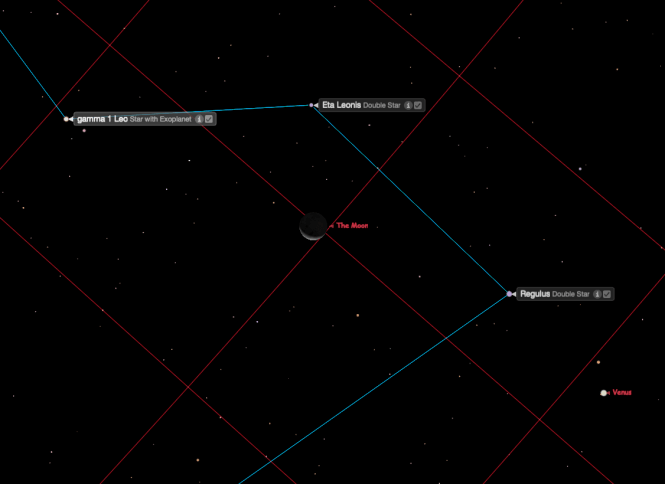
This morning, 10 Oct 2023, the Moon and Venus both encountered the bright star Regulus in the constellation Leo. Here is the predawn scene depicted by Starry Night Pro 8 software. The body of Leo lies in the lower left. His head rises near the top of the image. The yellow highlight box shows Regulus surrounded.

Zooming in to capture the region in the yellow box and add some labels.
Venus in Crescent Phase
Venus travels around the Sun in a faster orbit than Earth. On the days close to 13 August 2023, Venus passed between Earth and the Sun as it lapped our planet. Since then, it has moved ahead of the Sun toward the west. It rises in the east before sunrise and presents a beautiful view. In fact, if you carefully track its location with reference to some object near you like a tree branch, you can see it well after the Sun rises.
Today, our sky was very clear. I wondered if I could get a photograph of Venus as it passed directly south at noon. I got my Go-To telescope out, aligned it to vertical and north-south, then turned it on. Its GPS quickly said it was ready so I asked it to go-to Venus. After of few seconds of slewing it was almost perfectly centered on the planet. I replaced the eyepiece with my cheap eyepiece camera connected to an old cell phone via USB. A little tweak of direction and focus and it was ready to save the image.

Moon With Friends
The Moon posed with Venus, Mars, Regulus and gamma in Leo last evening about 9:41 pm CDT. It was over exposed in order to see the dimmer planets and stars. A second photo zoomed in on the Moon and adjusted for exposure.


Venus Nears Mars
Weather in the middle of the US has been unusually good for astronomy for more than a week. But, not so good for those who grow things. The forecast discussion yesterday used the term ‘flash drought’ to describe the worsening conditions. No general relief is in sight. The clear skies and dry air are welcome conditions for those of us who look upward.
Back on May 23rd, the forecast called for several days of clear skies. I’d been watching Venus in the evening as it moved below the stars Pollux and Castor and as it moved closer to Mars to its upper left. Each night for a week at about 9:30 I aimed my camera at the scene and captured a series of 7 images from the 23rd to the 29th. I used image editing software to layer those images in order to show the movements of Venus and Mars as they moved toward the upper left. Each image layer was centered on Pollux and Castor as reference points in the sky. The Sun is well below the horizon out of view to the lower right of the image frames.

In the video below, Mars (orange) being far from the Sun is in a slower orbit. Its daily movements are smaller than those of Venus (grey). Venus is much closer to the Sun and in a faster orbit. It will eventually make the turn in its orbit and pass the Earth (blue). The date of greatest elongation angle of Venus from the Sun is June 4th this year. From our point of view on Earth, Venus will stop getting nearer to Mars and appear to reverse direction across the sky as it passes the Earth. I hope to capture some images as Venus reverses course and update this post. It will become a morning planet in the late summer and fall months.
 How I See It