A longtime friend passed away in May, and as much as I will miss Kim’s laugh and her spunk, I am glad she is no longer in pain or lost in the swirl of her final days due to increasing dementia. I had known her since kindergarten — she was part of some of my craziest high school days, which will stay in the past.
We lost touch for several years in college, but Patty, another forever friend, brought us back together for long lunches and visits whenever I returned to my Iowa hometown — and I am grateful to her for that and so much more. She visited Kim in the nursing home regularly, and encouraged me to write some memories for her to share with Kim, who still had her good days. And so I wrote this poem about a moment that still burns brightly.
The last time I saw her, after prompting from Patty, I went to the nursing home and found her sleeping. I waggled her foot and called her name without much luck. I called Patty and told her so — feeling a little guilty while telling myself I had tried. Patty told me to try again (I knew she would). So I did, and this time Kim woke up. I got her out of bed, into a wheelchair, and tooled around the nursing home sidewalks and parking lot on a humid August day. I reminded her of the many times she had driven me (and other girls) around in her family’s station wagon — and all the good times we shared. And then I took her to lunch, where an aide urged her to eat a few bites. And that was it — it was the last time I saw her.
Losing friends and family at my age is common, but I am especially in awe of Patty, who continues to show up for so many people, to be there to honor their lives and their stories. I want to thank her for all she does. Peace.
I’ve reposted a poem for 2010. I’m surprised how long ago this poem about my homeplace in Iowa was written. Also hard to believe I’ve had this blog for more than 16 years. I visited the farm two (three?) summers ago, but there is nothing there now except a farm building that houses a few tractors and wind turbines dot the horizon, a new version of the windmill.
I wrote the following poem three months ago, when ICE was terrorizing the good people of Minneapolis. The news reports and videos were quite shocking — I couldn’t believe this was happening in Minnesota. My cousin Elizabeth lived there for many years before her death from a rare form of cancer. She lived most of her life in the upper Midwest, and she epitomized “Minnesota nice.” I shared the poem with her sister, so I can now share it on this site.
Her Little Home in Minneapolis, January 7, 2026 for Elizabeth Meylor, 1953 – 2023
My cousin lived among you, on Zenith Ave in a little house surrounded by flower beds and filled with her music, stacks of library books and contented cats.
And I mourn for her today, dead more than two years, because, like you— her adopted city— Elizabeth was “Minnesota nice” and tough and deep-rooted like her sunflowers and prairie ancestors.
As you grieve another one of yours, a wife, a mother, amid the specter of George Floyd and nightmares of your twin’s fiery streets, I reread my last letter from Elizabeth, written in elegant cursive, about nieces and nephews she adored, treatments coming to an end, moments collected, grace welcomed.
If she still lived among you, she would pull on her snow boots and blow her whistle and leave a light on all night in her little house to give shelter to her neighbors.
And no doubt, she would echo your mayor’s order in her heroic librarian voice: “Get the fuck out of Minneapolis!”
Thank you to The Heartland Review for publishing two of my poems in their latest 2026 publication. It’s sometimes months before you hear back from a journal, and this time they all got back to me about the same time. So it’s been fun to get the journals in the mail. This journal is well done, and it includes poetry, art, short stories and nonfiction articles, so there’s a lot of variety. Nice communication with the editor too!
Kindness, 1986
It is 3 a.m. in an emptied Iowa airport. Our plane has ricocheted across the Midwest in attempts to find safe passage around lightning strikes, hail and never- ending tempests.
The balding farmer picks up my bag “You’re coming home with us,” he says. His wife, who reaches to lift my daughter from my arms, adds, “Of course you are.”
I have already called nearby hotels— every room is taken for a baseball tournament. But these two, who sat next to us on the plane, know I have come home to surprise my dad for his sixtieth birthday.
So, despite my protests, despite gut fears spinning inside me, despite distance that took root in city life on the East Coast, I follow the couple like a cow with her calf. It is another hour to their farm.
I awake in late morning in bed with my daughter to find coffee, pancakes and bacon in the kitchen. From the porch, I see the woman picking tomatoes in her garden. The man, now in overalls, carries a basket of sweet corn.
This is when the dry knot in my throat lets go. I know this life—both making do and doing for others. I call out the door to say I will call my dad. The man says, “No, we’ll drive you home.” “You want to surprise him,” she says.
Today, I am older than my father who met us outside a farmhouse that fell in on itself years ago. My daughter is a mother. Kindness still keeps me whole. And the couple is buried in a country cemetery, where the wind blows and blows.
Geography Lesson
In the dead of winter, our teacher assigned my fifth-grade class to memorize the fifty state capitals in alphabetical order.
Every Friday we lined up next to our desks as each of us recited faraway cities, from Montgomery, Alabama,
to Cheyenne, Wyoming, labeled on the map in our geography books. Mrs. Wright marked our mistakes
on a chart with big red checks as we rooted for our friends and feared our fallible memories.
By late February the brightest chanted all fifty and sat down. In early March four rows of students
had stars after their names, while a handful still struggled to get past Providence, Rhode Island.
By late April only shy Eloise Borden stood alone as she confused Columbus, Ohio, and Columbia, South Carolina.
We watched Mrs. Wright slash another X after Eloise’s name and learned to remain silent, to look away when Eloise stood up.
I don’t remember if the girl ever recited all fifty state capitals, but I do recall waitressing with Eloise at the town cafe
my senior year, and how I never saw her except at work, where we played cards and fed the jukebox on quiet afternoons.
How Mrs. Wright came in and sat alone at the counter after her husband died. And how Eloise memorized her order:
coffee with two sugars, a well-done hamburger on a toasted bun with sour pickle chips, and cherry pie with vanilla ice cream.
How Mrs. Wright looked away whenever Eloise warmed her coffee, while I pretended to be busy in the kitchen.
And how Eloise took off when she turned eighteen, headed to a far-off city marked with a gold star on the map in her car.
Thank you for visiting. I hope you’ll share your poetry with me!
I’ve lived in Connecticut for a little over eight years now, after having lived more than 30 years in Rhode Island and exploring almost every inch of that tiny, quirky state. Today, I still have no clue where most cities are located in Connecticut, and I have to GPS them all the time only to realize I’m more than two hours away from a good chunk of them.
With that said, I love living where I do — still close enough to Rhode Island, close to the beaches, right off I-95, and close to my grandchildren. I recently had a poem selected for an anthology of poems about Connecticut, and it just came in the mail this weekend! The Nutmeg Anthology: Contemporary Poems of Connecticut, edited by Ginny Lowe Connors, includes 78 poems that look at the state from all different angles: from special memories of the past, historical figures and places, and the ever-present land, water, and weather.
My poem, “For Those Who Must” is dedicated to the staff at the Lyman Allyn Art Museum, where I worked part-time for five years. I remember wanting to work part-time in a bookstore or an art museum when I retired, so I got my wish! I enjoyed working at the front desk, where I talked to visitors two days a week because everyone who walked in the door wanted to be there — and I learned so much about art and artists.
My thanks to Ginny Connors and Grayson Books for including my poem. The cover art is beautiful, and I’ve enjoyed the variety of poems and learning more about my adopted state.
For Those Who Must For the staff at the Ly man Allyn Art Museum, New London, CT
I have watched an artist hang her canvases with breathless care—unswaddling her work like infants from family quilts—but who attended her own opening with reluctant dread.
I have listened to daughters tell stories of their artist mother, whose paintings once hung in their childhood home, and how they cried upon seeing her art on a gallery wall for the first time.
I have gazed through a magnifying glass to focus on ink strokes as fine as cilia in miniatures painted by eighteenth century sisters, one of whom went blind after years of plying her trade.
I have interrogated a roomful of abstracts that smash and trash and rehash boxed conventions of beauty and truth while standing in awe of countless hues of blue.
I have searched newsclips about a 22-year-old artist who jumped off a train in New London, where she gave drawing lessons to the city’s children and collected their coins to feed her passion.
I, too, have tasted an artist’s need to create— it is the dark pit that sprouts into tender vines despite row upon row of infertile fields. is the must that burdens us—and unburdens us.
The Nutmeg Anthology: Contemporary Poems of Connecticut, Grayson Books, 2026
I wrote this poem a few years ago based on a prompt for a exhibition of Saturday Evening Post covers by Norman Rockwell at the Mystic Museum of Art (CT). I chose a cover of an old woman sitting in an airline seat in 1938, when flights across country were just beginning. I loved the excitement on her face and her fearless energy to experience something new. It reminded me to keep on checking off items on my bucket list as long as I can. 🙂
The poem is not a memory of mine, other than the fact that the library in my small Iowa town was named after to a rich woman named Gund who set aside money for a library. I also remember going down to to the city hall basement on Main Street to take out books. Oh, and my grandma had a sister who lived in California named Esther. Otherwise, the woman is totally made up — it was fun to do.
The poem found a home in the winter/spring 2026 issue of the Naugatuck River Review. Although it didn’t take a top place in the contest, the poem was a finalist — and I am quite grateful for that. I’ve had a few other poems published recently, but it’s been several years since I’ve regularly sent out poems for publication. I’m also so grateful for my Sunday evening poetry workshop organized by the Connecticut Poetry Society. I’ve received some solid feedback and enjoyed commenting on and learning from other poets’ work. I’ve shared the poem and a crop of the cover below.
“After midnight, the moon set, and I was alone with the stars.” —Amelia Earhart
The Tale of Our Town Librarian
Grandma liked to retell this story whenever she took us to the M.E. Gund Library in town. About how, back in 1938, the librarian tacked a map of North America to the adult fiction stacks housed in the musty city hall basement.
And how Miss Lizzy, who never spoke above a whisper, plotted the course of her 18-hour Transcontinental & Western flight from Boston to Los Angeles with three stops in between, come June.
The spinster’s journey would begin in our New Hampshire village and roll to a stop under palm trees in Pasadena, California, where her sister Esther worked as a hairdresser to the Hollywood stars.
The town was in a tizzy. What had gotten into Miss Lizzy? Not even our banker and his wife had flown on a commercial aircraft. Why, the search for Amelia Earhart was still front-page news. And, honestly, how could a town employee afford a roundtrip ticket?
Miss Lizzy was never one to chitchat. She simply crossed out each day on her 1938 calendar until she reached June 5. Then she passed her leather valise to a Greyhound bus driver and ascended the first flight of steps that winged her cross-country.
Six months later, after Miss Earhart had been declared lost at sea, our mayor received a letter from Esther, who said Miss Lizzy had died while gazing at the stars. She had gifted her bungalow and all it contained to our town.
When our council members unlocked Miss Lizzy’s front door, they found news clippings about Miss Amelia and Lindbergh. Her prim bedroom was papered with maps marked with shiny stars next to exotic locales like Athens, Bangkok, Calcutta, and Baghdad.
On to her nightstand, they found a note in flowing cursive: If you are reading this, it means I am gone. Know I feared nothing except the thought of dying without ever touching the stars. If you are reading this, it means I did just that.
P.S. Please use my family inheritance to build our town a real library where my home now stands. Her looping signature—Mary Elizabeth Gund— circled and soared across the bottom of the check.
Thank you for stopping by! Let me know you were here!
I don’t know what happened — I guess, quite simply, life happened.
It’s been more than two years since I last posted. It seemed I couldn’t get onto the site the few times I tried. But I’m back now, and I need to brush up on the new tools and layout designs. Anyway, I’m hoping to write more here — and post some newly published poems in this new year. How quickly the years roll on now!
I still live in Connecticut along Long Island Sound. When the windows are open in the summer, I can hear the Amtrak trains heading out of New London; tractor trailers on I-95, the major conduit along the entire Eastern U.S.; and the fog horns on the coast. New London is home to the U.S. Coast Guard Academy on one side of the Thames River and the U.S. Navy is on the Groton side. I have yet to see a submarine glide up or down the river on its way back home or out to wherever, but I always look for one when I’m walking at Avery Point.
My last post, in 2023, described my visit to Italy with Christopher Blake, where we visited Florence, Rome and the Amalfi Coast — absolutely gorgeous! Since then, we went back to Italy last summer for the wedding of Chris’s nephew in Tuscany, and on to Milan and Lake Como. Again, can’t say enough about the people, places and food. Such a memorable experience!
This summer we are going to Paris — my first time. Everyone keeps telling me how much I’m going to love it. I know, I know! It’s all booked and now we just wait. I keep thinking that I’m going to learn some conversational French. Maybe. I took two semesters of French in college ages ago — and was horrible at it. Maybe I’ll just smile a lot and say merci.
I met Chris four years ago on an online dating site (after quitting one site and trying another), and as of September, we are now living together. He is a kind and thoughtful man, who loves the same things I do. He also writes and belongs to a writer’s group in Westerly, RI, where he used to live. He was a reporter for years in Connecticut and now teaches journalism courses at one of the state colleges. He held on to a great group of friends from his college days at the University of Rhode Island and his reporter days — and I’ve enjoyed getting to know them.
Well, that’s enough to catch you up. Now for some photos and poetry and book reviews. All the things I love to share. I’m not sure who’s still active on WordPress. I used to have a solid group of readers, but I’m sure that has changed too. I looked into Substack, but I need to learn more. I hope some choose to pop in every once in a while, but maybe this site is more for me than anyone — an audience of one.
Take care out there — if you need to take a breath, come on in. That’s why I’m here.
Walking down the street not far from our hotel, Chris was first to notice the iconic walls of the Colosseum peeking through the modern office buildings. Finding our tour was a bit more difficult the next morning since the area is huge, and tour companies stake out their spaces with flags around the park. Finally, we were shuffled into a group of English-speaking tourists with our guide Matteo.
Matteo expertly steered us through the long lines of visitors and X-ray machines in the entry of this first-century amphitheater of limestone and rock, which was the largest in the ancient world. He spoke perfect English, although a bit too quickly to follow easily through my headphones. His focus, unlike our experience at the Vatican, was much more personal as he tried to recreate the experience of a common Roman citizen as he attended an over-the-top event at the Colosseum in the first century A.D.
Matteo pointed out how the commoners sat in the nose-bleed seats and entered the stadium through numbered entries far from the elite. Once inside, the audience was treated to contests between gladiators, animal hunts that included hundreds of animals from as far away as Africa and Asia, battle re-enactments, and the execution of Christians.
He explained that commoners were given tickets to these extravagant shows, which lasted for hours, to ensure their support of the emperor. The games were first described, by a Roman poet, as “bread and circuses,” which is a phrase that means to generate public approval through diversion or distraction by satisfying the populace through food (bread) or entertainment (circuses). It’s interesting how human nature is still controlled by feeding our immediate desires.
Matteo at far left
Matteo also described how the Colosseum looked back in the day, its columns covered in beautiful mosaics in rich colors. However, over centuries, anything of value had been carted over to the Vatican to add to its rich coffers. Maybe no one complained because the Romans had originally built the Colosseum with wealth gained from ransacking Jewish riches in Jerusalem — and, no doubt, because of all the Christian blood spilled as part of gameday festivities. The view of the many cells and extensive hallways under the ground floor of the Colosseum showed how the intricate shows were created to wow the crowds.
The tour lasted more than three hours and included a trip up Palatine Hill, where we could see the Colosseum, the Forum and other remains of government buildings to imagine the glory of ancient Rome. It’s hard not to imagine what will last in Washington D.C. two thousand years from now and what tour guides will say about the legacy of our own culture.
Visiting the Vatican and Colosseum on our first-time trip to Rome was a must for both of us, but we also loved finding other surprises throughout the day on our own. I really wanted to see the Pantheon, which I’d seen often in photos. The architecture, still considered perfectly rendered, of the ancient Roman temple features a massive round dome, with a circular opening at the top that brings in light throughout the day, and its huge bronze doors. Of course, the line of tourists was long, but it moved quickly as visitors simply walked in and around the circular space and out again.
Nearby, with the help of other tourists, we also found the beautiful Trevi Fountain — GPS doesn’t always work that well. Again, on this sunny May afternoon, the popular site was overrun with tourists, so we dropped our coins in the fountain. Hmmm, we definitely stood with our back to the fountain and threw them in. But I guess the tradition says that you should use your right hand to toss a coin over your left shoulder. This will apparently ensure good luck and that you will return to Rome in the future. If you have another two coins on hand, throwing the second coin into the Trevi Fountain will let you meet the love of your life, while the third coin will have wedding bells ringing. (We should have checked out the specifics a bit more before we went!)
We also found another beautiful Catholic Basilica, the Basilica Papale di Santa Maria Maggiore, just down the street from our hotel. We got there after the building had closed for the night, but there was a service going on outside in front when we arrived. The nuns welcomed guests to sit in the chairs with lighted candles, and we decided to stay for a bit. We listened to the chanting and finally realized that the nuns were reciting the rosary — and suddenly the service wasn’t so mysterious anymore.
More yummy restaurants and views from a rooftop bar — just beautiful!
Taking a quick break from my posts on Italy to share a special afternoon of poetry organized by Notable Works Publications and the Audubon Society of Rhode Island. My poem, “Here on Earth” was published in a collection of poetry that speaks to the connection between the human and natural worlds.
I took part in a reading on June 11 at the Audubon Society of Rhode Island’s beautiful wildlife refuge in Bristol. This was very special to me because it gave me a chance to visit the East Bay Bike Path, which is right off the refuge, and where I biked for years when I lived in East Providence.
Shhh! Mother Earth cradles kids on a street corner in Rio de Janeiro, in a tent made of cattle hides in Kenya, in a room where corn is stored in Nepal, on a mat with 21 other orphans in Thailand, outdoors on a piece of carpet in the West Bank, in a bed shaped like Cinderella’s coach in Kentucky.
Shhh! Mother Earth sings a lullaby to Roathy, asleep on old tires in Phnom Penh, to Ahkôhxet, whose Amazon tribe worships the sun, to Juan David in Medellin, dreaming of life in America, to Lamine, bone-tired from harvesting maize in Senegal, to Alyssa, in a shack heated by a wood stove in Appalachia. to a Romanian boy, counting stars on a mattress near Rome.
Shhh! Mother Earth cries alone for landfills that seep lethal black liquid, for mountain quarries stripped night and day, for skies seething with smog and city high-rises, for once green fields pockmarked by bomb blasts, for human-made quotas and hate-filled boundaries, for a vanishing tribe that still reveres nature, here on earth.
I suppose it’s simply because this mammoth city teeters on centuries of history. Everything about it is larger than life, especially when touring the Vatican and the Coliseum are your main objectives.
Getting there was our first challenge. We GPSed our way to the train station in Florence, but then found Italy’s train system a little confusing. First, the ticket line was quite long, so I decided to see if I could just purchase tickets online, like Amtrak. Chris continued to hold our place in line while I got online and bought them. (Again, I’m not sure how you can travel abroad without an international phone plan in some shape or form.)
Our train from Florence to Rome.
However, we slowly found out that the train tickets I had purchased online were not from the same company that Chris was standing in line for. What?! The tickets I purchased were for a totally different company that used the same train lines. After more questions, we found that company’s ticket office was a couple of lines over from the one Chris had been standing in — and there was no line. Again, why? And the tickets for this train were much cheaper than the other line. Non capisco!
As we talked to the agent, I realized that I had bought tickets for the wrong day (duh!), and she made that change for me. So, we finally had our tickets together on the same train on the same day. Whew!
And then the next morning, after a quick trip to the incredible Duomo and another yummy coffee and croissant, we were flying through the beautiful Italian countryside to Rome. Green fields. Red poppies. Tall, elegant poplars. All good.
The train station in Rome was, again, huge, but we found our way to the cab stand and got in line. Soon we were off to our hotel, weaving through major avenues and tiny warrens of streets. Everything seemed much more worn and dirty than in Florence, and there was a lot of graffiti, but that, too, was expected.
Our hotel, the Hotel Rafaello, on a street called Via Urbana, also looked a little worn and the elevator didn’t work, which meant up and down three flights of stairs for next three days. We later learned that the hotel was slated for a major renovation. We soon found that the hotel staff would not be as helpful as they had been in Florence. In fact, it seemed as if whenever we came near the desk, at least one attendant would pretend he was taking a phone call. (ha!) To their credit, we received the free breakfast buffet every morning because of the downed elevator, which was huge and delicious.
That afternoon, we walked around, found a cute little bistro for a quick bite and soon came upon the Coliseum less than a half mile away. We walked there a bit until the sky opened, and we ran for shelter along with the rest of the crowd. We had fun chatting with other tourists until the rain let up and we headed back to our hotel.
That night we ate at the one “so-so” restaurant on our whole trip. Again, it was suggested by our hotel concierge. And it was the only suggestion they had — for lunch and dinner. Had to wonder if someone was related to someone. Anyway, we stopped asking for suggestions and found our own.
The next day we were up early and taking a cab ride to the Vatican. Once we got there, I wondered how we would ever find our tour company. Lines were wrapped around every corner, even that early, as people waited for their timed ticket entry.
We were lucky enough to have tickets for a small tour of the Vatican, the Sistine Chapel, and St. Peter’s Basilica, which allowed us to skip the line and go in early. Thank the Lord (so appropriate)! Anyway, tour guides all know each other, so all we had to do was show our letter to any tour guide and they directed us to the right spot.
While we waited, we grabbed another great coffee and the most delicious strawberry croissant I had ever had. Actually, we waited quite a while for the croissant, and when we got it, I realized why. It had just been delivered by the bakery and the strawberries were freshly sliced. Yes, a taste of heaven in a little back-street coffee shop across from the high walls of the Vatican.
Vatican’s outer wall.Our tour guide.
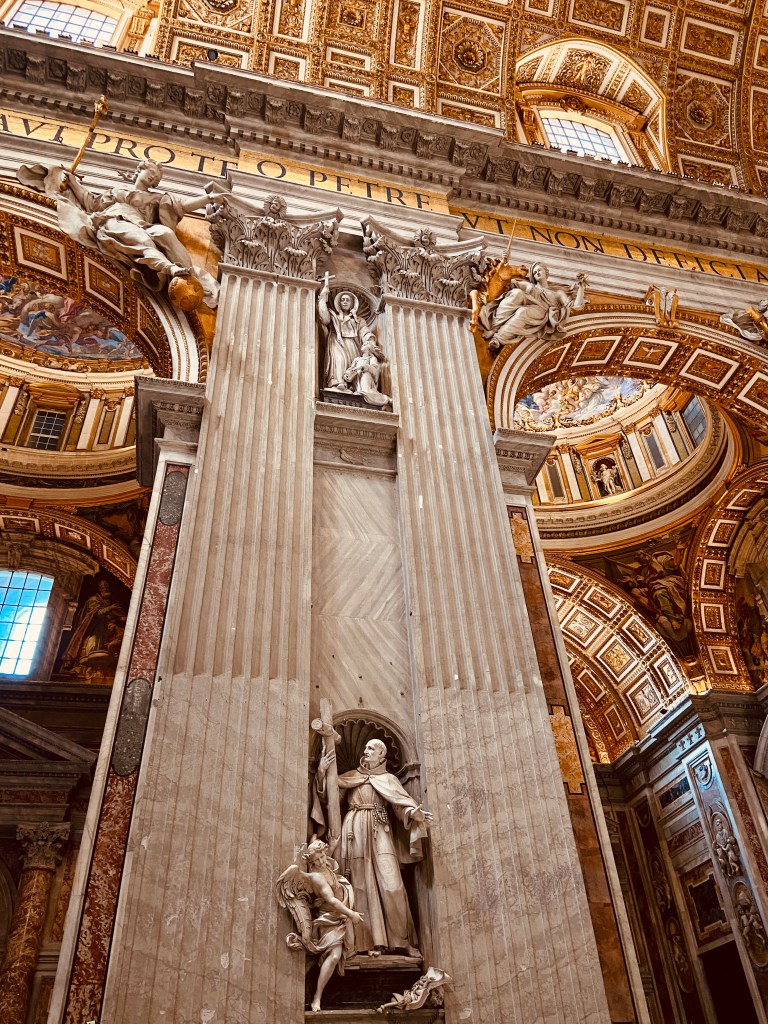
Our tour guide was an amazing young woman, whose name was Ilaria (Hilary in English), with a deep knowledge of art and an understanding of the inner workings of the Vatican. She kept us moving and shared so many stories as we walked through the long galleries and then to St. Peter’s Basilica. We even saw a wedding taking place in the one of the basilica’s side chapels. She told us that when she was engaged, she had planned to get married there, too. But the waitlist for weddings was three years long, and the engagement ended before the call came.
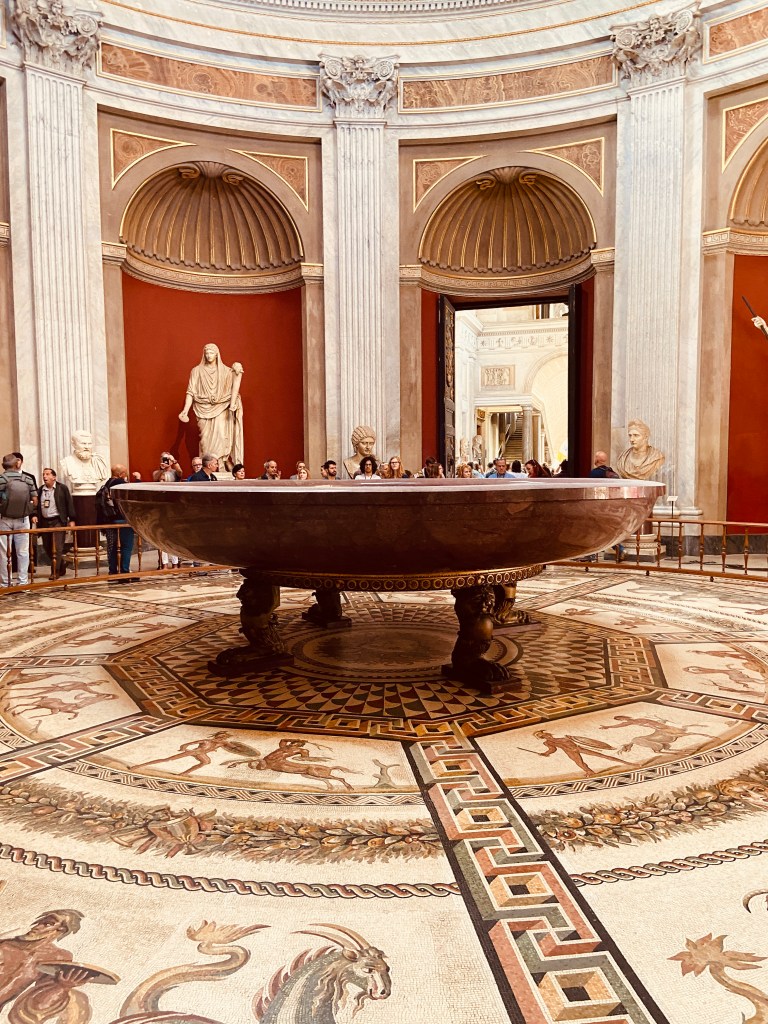
Anyone who has visited the Vatican knows of its immensity, its history, and its shocking cache of art, sculptures and riches. It’s hard not to wonder what my weekly offering of pennies went toward as a kid! And to picture Michelangelo as he lay on the rigging to paint the various scenes on the Sistine Chapel is to imagine a life so wholly different from that of any artist today. In the attempted reverential sort-of quiet of the chapel, the ceiling seems to be a riot of raw emotions. Of course, photos are not allowed here. They would not do this incredible work of art justice anyway.
Enough for now. I’ll come back for the Coliseum and more in the next chapter.




 Between Land and Sky