NRA conventions and crime

Labels: myresearch, Research
posted by John Lott at 3:11 PM
0 comments


Welcome! Follow me on twitter at @johnrlottjr or at https://crimeresearch.org. Please e-mail questions to [email protected].
An FBI report released on September 16th, 2014 makes the assertion that active shooter attacks and deaths have increased dramatically since 2000 – both increasing at an annual rate of about 16 percent. As the headline in the Wall Street Journal stated: “Mass Shootings on the Rise, FBI says.”
But the FBI made a number of subtle and misleading decisions as well as outright errors. Once these biases and mistakes are fixed, the annual growth rate in homicides is cut in half. When a longer period of time is examined (1977 through the first half of 2014), deaths from Mass Public Shootings show only a slight, statistically insignificant, increase – an annual increase of less than one percent.
The FBI’s misleadingly includes cases that aren’t mass shootings – cases where no one or only one person was killed in a public place. While the FBI assures people that it “captured the vast majority of incidents falling within the search criteria,” their report missed 20 shootings where at least two people were killed in a public place. Most of these missing cases took place early on, biasing their results towards showing an increase.The paper can be downloaded here.
Labels: Crime Prevention Research Center, Research
posted by John Lott at 4:14 AM
1 comments

Labels: Research
posted by John Lott at 4:43 AM
0 comments
. . . Belfort and her colleagues gathered data from 1,312 mothers and children in the United States, tracking everything from the mother’s frequency of breastfeeding to other factors including the mother’s intelligence, the mother and father’s education levels, measures of the home environment, the mother’s employment and the type of childcare the baby received.Unfortunately, the discussion at Fox News is really is too uncritical. Of course, the bigger blame should be placed on JAMA Pediatrics As with almost all medical studies, they ignore the issue of endogeniety when they can't do randomized experiments. If I were do the experiment, I would control for family specific effects (that is a dummy variable for each family to pick up the average intelligence of children born into that family) and, after accounting for birth order, spacing between children, and the other controls included in the study, see if intelligence of children within the family varied with the amount of breastfeeding. The problem with the current purely cross-sectional study is that the measurement error in how education and other factors are measured is large compared the differences they claim to find in intelligence.
While the link between breastfeeding and cognition had been previously explored, many earlier studies did not control for these additional factors.
“Many previous studies have been criticized because any link you might observe between breastfeeding and childhood intelligence could be explained by those other factors,” Belfort told FoxNews.com.
Belfort then performed a series of tests measuring the children’s cognitive development after infancy. At age 3, the children underwent the higher Peabody Picture Vocabulary Test, a measure of receptive language, or how well a child understands language.
“A child’s receptive language is highly correlated with general intelligence as measured by more typical IQ tests,” Belfort said. . . .
Labels: public health, Research
posted by John Lott at 4:56 AM
0 comments
Labels: Regulation, Research
posted by John Lott at 7:42 PM
0 comments
Labels: Research
posted by John Lott at 8:04 PM
0 comments
The school elections bill passed the Senate by a vote of 34-3 and the Assembly by a vote of 62-11 with three abstentions.
It makes moving the election to November optional but allows school districts that do move to forgo votes on the district’s school budget, provided the spending plan calls for a tax levy within the state’s 2 percent cap.
Supporters of the measure claim it will save money on election expenses and increase voter participation.
“Politicians and pundits have talked about doing this for years, but special interests and inertia have prevented progress on this important issue — until today,” said Assemblyman Lou Greenwald, D-6th of Voorhees, who sponsored the legislation. “Empowering towns to move their school elections to November will give voters better control of their local finances while saving property taxpayers the costs of holding yet another local election.” . . .
posted by John Lott at 1:13 AM
0 comments
. . . Tolls on the New Jersey Turnpike will go up by 53% in the new year; on the Garden State Parkway, they will jump about 50%.
Drivers could be forgiven for having forgotten the new cost: The increase is the second of a two-phase hike adopted by the New Jersey Turnpike Authority and approved by former Gov. Jon Corzine in 2008. Tolls went up by about 40% that year.
Still, the authority advertised the hikes on digital signs on the highways and fliers passed out at toll plazas, said spokesman Thomas Feeney. Of the dozen New Jersey drivers interviewed at the Thomas Edison rest stop here on Friday, most knew that the increases were coming.
"I take highways everyday, so I don't have a choice. It's crazy," said Karan Hannalla, 57, an East Brunswick customer service manager who commutes 26 miles a day to Cranford. She will be paying about $2.50 more a day to commute to and from work. . . .
Labels: Research
posted by John Lott at 3:54 PM
0 comments
Labels: Research
posted by John Lott at 6:29 AM
0 comments
posted by John Lott at 3:23 PM
1 comments
Journal of Banking & Finance
Volume 35, Issue 11, November 2011, Pages 2791-2800
The effect of macroeconomic news on stock returns: New evidence from newspaper coverage
Gene Birz and John R. Lott Jr.
Received 19 May 2010; accepted 13 March 2011. Available online 17 March 2011.
Abstract
Previous literature has produced weak evidence to support the hypothesis that real economic news affects stock returns. This is, in part, attributed to the difficulty of measuring how investors interpret macroeconomic announcements in different economic environments. In this paper, we choose a different approach of measuring macroeconomic news to better estimate its effect on stock returns. Since newspaper stories provide an interpretation of the statistical releases, we choose newspaper stories as our measure of news. Our findings indicate that news about GDP and unemployment does affect stock returns.
Keywords: Stock returns; Macroeconomic news; Information
posted by John Lott at 10:59 AM
0 comments

Labels: Research
posted by John Lott at 2:30 AM
1 comments
 Available here.
 Available here.
 Available here.
 Available here.
Labels: Research
posted by John Lott at 11:46 PM
0 comments


posted by John Lott at 7:45 PM
0 comments
The Pew Research Center for the People and the Press delivers data that puts last week’s huge election night ratings win for Fox News into some context:While Republicans followed campaign news more closely than Democrats throughout much of 2010, partisans tracked the outcome at similar levels. Fully 57 percent of Republicans and 50 percent of Democrats say they followed the election results very closely. Roughly four-in-ten independents (41 percent) say the same. However, Republicans (61 percent) are more likely than Democrats (42 percent) and independents (39 percent) to say the election is the story they followed most closely.
Four years ago, when Democrats tallied large gains, Democrats tracked the midterm results more closely than Republicans or independents. At that time, nearly six-in-ten Democrats (58 percent) said they followed news about the election outcome very closely, compared with 47 percent of Republicans and 34 percent of independents.
posted by John Lott at 5:26 PM
0 comments

Worried about when you might get dumped? Facebook knows.
That's according to a graphic making the rounds online that uses Facebook status updates to chart what time of year people are splitting up.
British journalist and graphic designer David McCandless, who specializes in showcasing data in visual ways, compiled the chart. He showed off the graphic at a TED conference last July in Oxford, England.
In the talk, McCandless said he and a colleague scraped 10,000 Facebook status updates for the phrases "breakup" and "broken up."
They found two big spikes on the calendar for breakups. The first was after Valentine's Day -- that holiday has a way of defining relationships, for better or worse -- and in the weeks leading up to spring break. Maybe spring fever makes people restless, or maybe college students just don't want to be tied down when they're partying in Cancun. . . .
Labels: relationships, Research
posted by John Lott at 6:44 PM
1 comments
Meetings of the College Democrats that attracted 200 people in 2008 now pull in a dozen. New voter registration is way down, too, and free posters of President Obama — once “the Michael Jordan” of politics, as one freshman put it — are now refused by students. . . .
This was not what Generation O expected Mr. Obama won two years ago with 66 percent of the 18- to 29-year-old vote, a historic proportion. Americans under 30 also worked on campaigns at a greater rate than the general population did for the first time since 1952, or possibly even earlier, according to the National Election Studies. . . . .
While most of them still view him more favorably than their parents or grandparents do, various polls show that the youthful passion that led to action has not been sustained. . . .
Labels: education, indoctrination, Research
posted by John Lott at 12:19 AM
2 comments
posted by John Lott at 12:08 PM
0 comments
posted by John Lott at 9:57 PM
0 comments
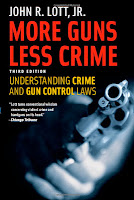
Conservative economist John Lott's 1998 book More Guns, Less Crime concluded based on the results of his own statistical analysis that more permissive hand gun laws reduced crime rates in counties and states that had adopted such laws. In a feat of statistical one-upmanship, Lott had compiled the largest data set on gun laws and crime statistics in the field. Naturally, conservatives and gun rights advocates immediately argued that Lott's empirical research was definitive reason to repeal gun laws across the country, since the result would be a decrease in crime rates.
In response, contending experts ranging from sociologists to law professors argued that before any policy was adopted based on Lott's research, that they should be able to examine Lott's raw data and the decisions that he made in conducting his analysis. Lott further stoked the fires of the controversy by being slow to release his data--which made it appear as if he had something to hide . . .
This piece makes inaccurate claims about my work. The data in my original paper with David Mustard was released even before the paper was published. Our paper was published in the January 1997 of the Journal of Legal Studies. We provided our data to critics such as Dan Black and Dan Nagin as well as Jens Ludwig in August 1996. In fact, the Brady Campaign put on a panel at the National Press Club on December 9, 1996 where I debated them on their analysis of our data.
The first edition of More Guns, Less Crime was published in 1998. All the data for all the regressions and all the tables and figures in the book was again released to others even prior to the book being published. Most of that research involved the same data from 1977 to 1992 that was in my original paper with Mustard, but the additional data in the book that extended to 1994 was also released.
Ironically, I had a computer crash in July 1997 where I lost the data that I had already provided to the critics to whom we had already provided the data. David Mustard and myself asked these individuals to get back a copy of our data, but they declined to do so. I know that David asked them several times. Because we realized that we had an obligation to make our data available to others, David and I spent more than several months putting the data together again. (David spent significantly more time than I did putting that data back together again.)
Since then the data used in More Guns, Less Crime has been provided to over 200 hundred people at universities around the world. Dozens of papers have been published using the data. The paper by Black and Nagin was published in the Journal of Legal Studies in January 1998 (which was four months BEFORE More Guns, Less Crime was published). Given the lead-time in refereeing and publications, it should be fairly obvious that they had submitted their paper a year earlier in late 1996. How could they have submitted their paper for publication in the Journal of Legal Studies before my paper with Mustard was published if we hadn't shared the data?
So your story is backwards. Our data was given out immediately. When the data was lost in a hard disk crash, our critics refused to give us a copy back of our own data. David and I redid the data a second time. It was not something that we had to do (especially given the many months of work involved), but it was the right thing to do. It would have been better if our critics had simply given us back a copy of our own data.
It is easy enough for you to check out when the Black and Nagin paper was published. Another critical paper was published by Jens Ludwig in May 1998 in the International Review of Law and Economics. An entire issue of the Journal of Law and Economics in 2001 published papers on gun control, most of those papers using the data in my book.
As to the claim about "they should be able to examine Lott's raw data and the decisions that he made in conducting his analysis" it is easy for people to evaluate that also. For example, if they look at the Black and Nagin paper, people will see that Black and Nagin replicate the research that Mustard and I had done and they were able to do that because I provided them with all the raw data as well as the "do" file that contained the regressions. There was nothing else there to provide them. They didn't replicate most of the empirical work in the original paper with Mustard, but that was their choice. If you think that there was something else, please indicate what it would be. A response to the Black and Nagin paper is available here.
As to the Mother Jones interview, I gave two interviews to someone who was obviously hostile (not all of our discussions were transcribed). I offered to go off the record to explain things in depth because I wanted to provide a detailed discussion without worrying that he would take some small part of what I was saying out of context and distort it. The point was to take the time to give him a detailed response, but he wasn't interested in doing that. When you do interviews with hostile individuals you learn very quickly that people can take things out of context and you give a different interview than in situations where you are sure that the entire transcript is going to be made available. It was my understanding that we were doing the first type of interview.
Labels: climategate, GlobalWarming, Research
posted by John Lott at 6:20 PM
2 comments

My commentary on a broad array of economics and crime related issues.
Dumbing Down the Courts: How Politics Keeps the Smartest Judges Off the Bench
Straight Shooting: Firearms, Economics and Public Policy
Are Predatory Commitments Credible? Who Should the Courts Believe?
-Research finding a drop in violent crime rates from Right-to-carry laws
-Ranking Economists
-Interview with the Washington Post
-Debate on "Guns Reduce Crime"
-Appalachian law school attack
-Sources for Defensive Gun Uses
-The Merced Pitchfork Killings
-Fraudulent website pretending to be run by me
-Steve Levitt's Correction Letter
-Ian Ayres and John Donohue
-Other issues regarding Steve Levitt
-National Academies of Science Panel on Firearms
-Baghdad murder rate
-Arming Pilots
-General discussion of my 1997 and 2002 surveys as well as related surveys
-Problems with Wikipedia
-Errata for Gun Books
-US Supreme Court Wire
-Futures for Financial Markets
-judgepedia
Economist and Law Professor David D. Friedman's Blog
Larry Elder's The Elder Statement
Economist Robert G. Hansen's Blog
Firearmstruth.com -- a media-watchdog website
A debate that I had with George Mason University's Robert Ehrlich on guns
Lyonette Louis-Jacques's page on Firearms Regulation Worldwide
An interview concerning More Guns, Less Crime: Understanding Crime and Gun Control Laws
The End of Myth: An Interview with Dr. John Lott
Art DeVany's website, one of the more innovative economists in the last few decades
St. Cloud State University Scholars
Bryan Caplan at George Mason University
Alphecca -- weekly review on the media's coverage of guns
Xrlq -- Some interesting coverage of the law.
Career Police Officer
Gun Law News
Georgia Right-to-Carry
Darnell's The Independent Conservative Blog
Robert Stacy McCain's Blog
Clayton Cramer's Blog
My hidden mathematical ability (a math professor with the same name)
geekwitha45
My Old AEI Web Page
Wrightwing's blog
Al Lowe's blog
St. Maximos' Hut
Dad29
Elizabeth Blackney's blog
Eric Rasmusen
Your "Economics" Portal to the World by Larry Low
William Sjostrom
Dr. T's EconLinks.com
Interview with National Review Online
Blog at Newsmax.com
Pieces I have written at BigGovernment.com
Updated Media Analysis of Appalachian Law School Attack
Journal of Legal Studies paper on spoiled ballots during the 2000 Presidential Election
Data set from USA Today, STATA 7.0 data set
"Do" File for some of the basic regressions from the paper