Josna Rege

Posts Tagged ‘Hampstead Heath’

662. Jan Morris and the Kenwood Ladies’ Bathing Pond

In Books, Britain, culture, Inter/Transnational, Nature, people, places, Stories, women & gender on May 24, 2026 at 5:01 am


Andrew and I have been in the U.K. for nearly three weeks, mostly in North London, with a magical five-day trip to North Wales where it was cold, rainy, and windswept. Back in London the city is undergoing a heatwave and I’m feverish in bed with a summer cold. It’s miserable, because I am itching to be out walking, but it’s also making me slow down and reflect on our trip so far.
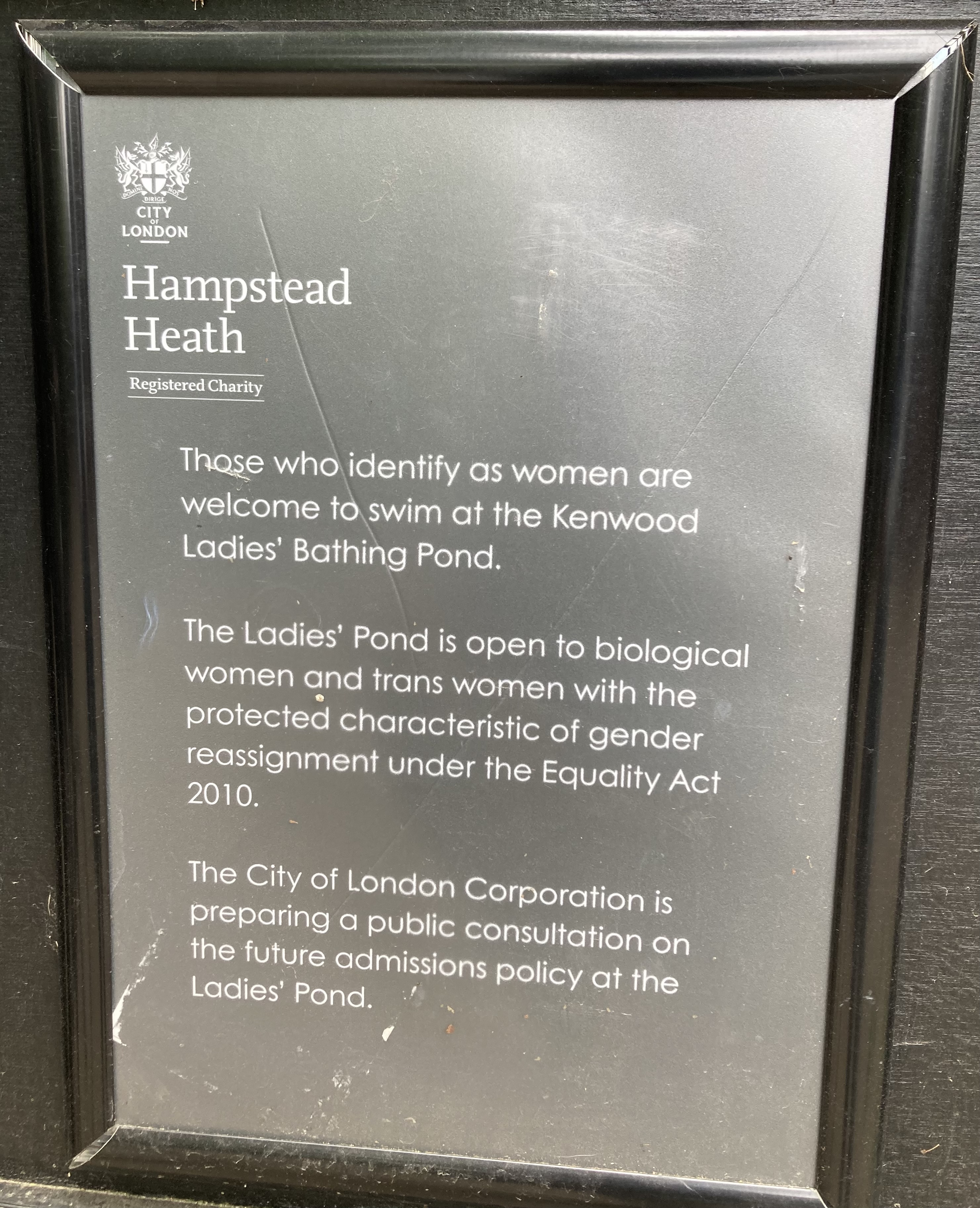
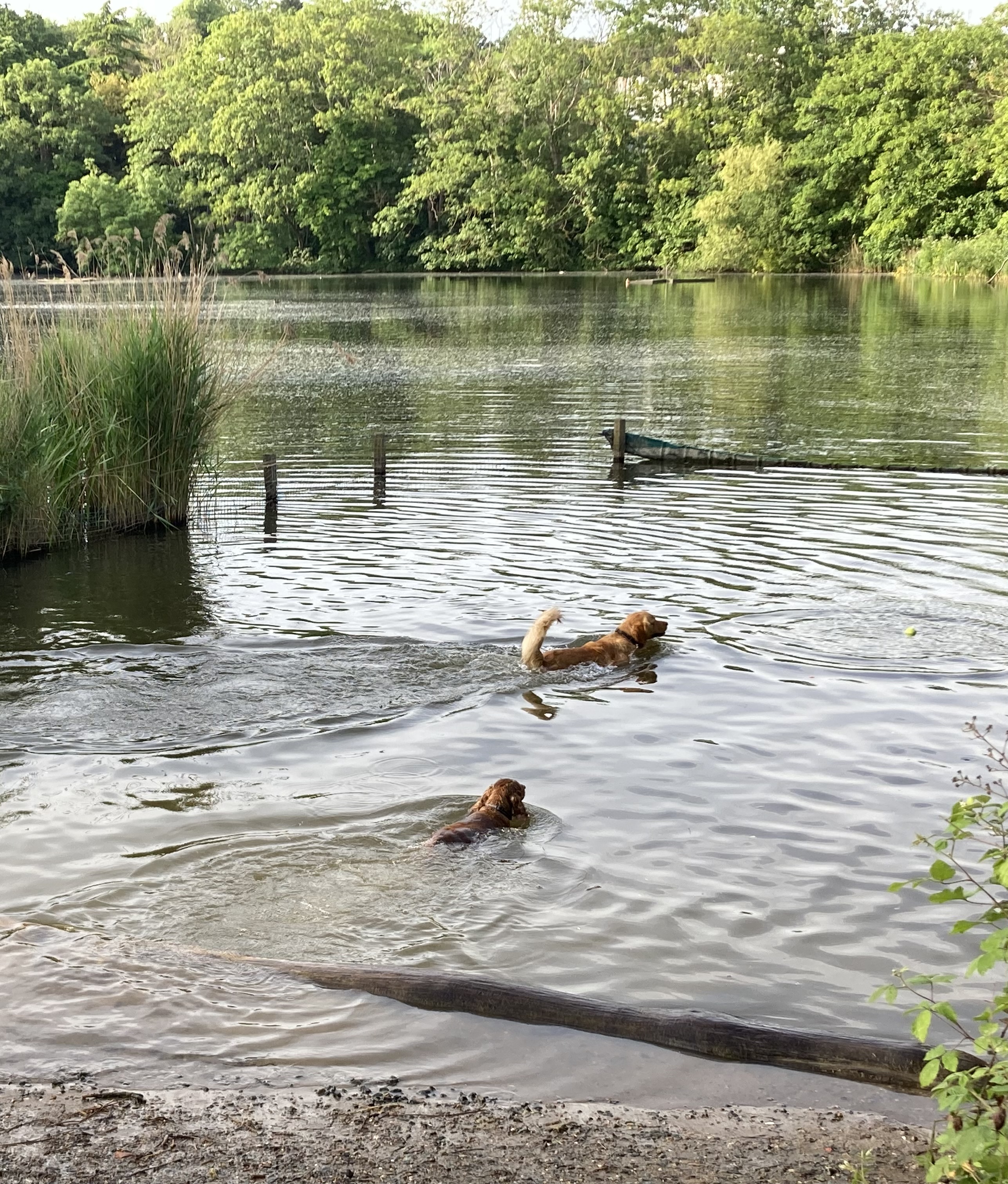
On Day 3 we set out for a walk over Hampstead Heath—one of my very favorite places in the whole world—with no particular destination in mind, soon passing the Dog Pond, the Highgate Men’s Bathing Pond, and the Kenwood Ladies’ Bathing Pond. (There is also a mixed bathing pond.) In early May it was far too cold for me to contemplate swimming there, but I may yet be able to screw up the courage to do so. I found myself taking a photo of the signs on the gate. One read: “Women Only. Men not allowed beyond this point.” The other was longer, and I only read the first sentence at the time: ”Those who identify as women are welcome to swim at the Kenwood Ladies Bathing Pond.” I thought to myself, Well said, Hampstead Heath. Clear and sensible.

Since then I have learned that the U.K. Supreme Court ruled in April, 2025 that the legal definition of a woman under the 2010 Equality Act should be based on biological sex. An organization called Sex Matters then challenged the City of London Corporation, which runs the Heath, in court, but in January, 2026 the court dismissed the case. Meanwhile, the Corporation carried out a consultation, polling more than 38,000 people on the issue, and “86% of the respondents support[ed] the existing trans-inclusive access arrangements.”

Sex Matters is likely to take up the issue again, and Trans advocacy groups such as Translucent are speaking up as well. But a spokesperson for the City of London Corporation said, “The findings [of the consultation] will be presented to City Corporation committees, which will consider them alongside legal duties, equality impact assessments, safeguarding responsibilities and operational considerations. In the meantime, the current admission rules will remain in place until a final decision has been made by members. Further announcements will be made in due course.”

I like the “in due course.” As in the U.S., transgender exclusion has become a weapon in the culture wars and has generated much more heat than is warranted, especially given that most people nowadays, especially young people, don’t see their transgender family and friends as a problem. Perhaps it’s best to pause the litigation, think the issue through, and work toward a resolution that, rather than whipping up unnecessary fears, can lay them to rest.

But why have I taken up this matter at all? Let me go back to our trip to North Wales. Arriving in Llandudno en route to the island of Anglesey, we found a snack shack atop Great Orme outside an ancient copper mine dating back to the Bronze Age, 4,000 years ago. Since we weren’t planning to go down the mine, the kind man at the shack (where the wind was so fierce that it knocked Andrew over), told us that we could take our hot drinks into a second-hand bookshop inside the mine’s gift shop.
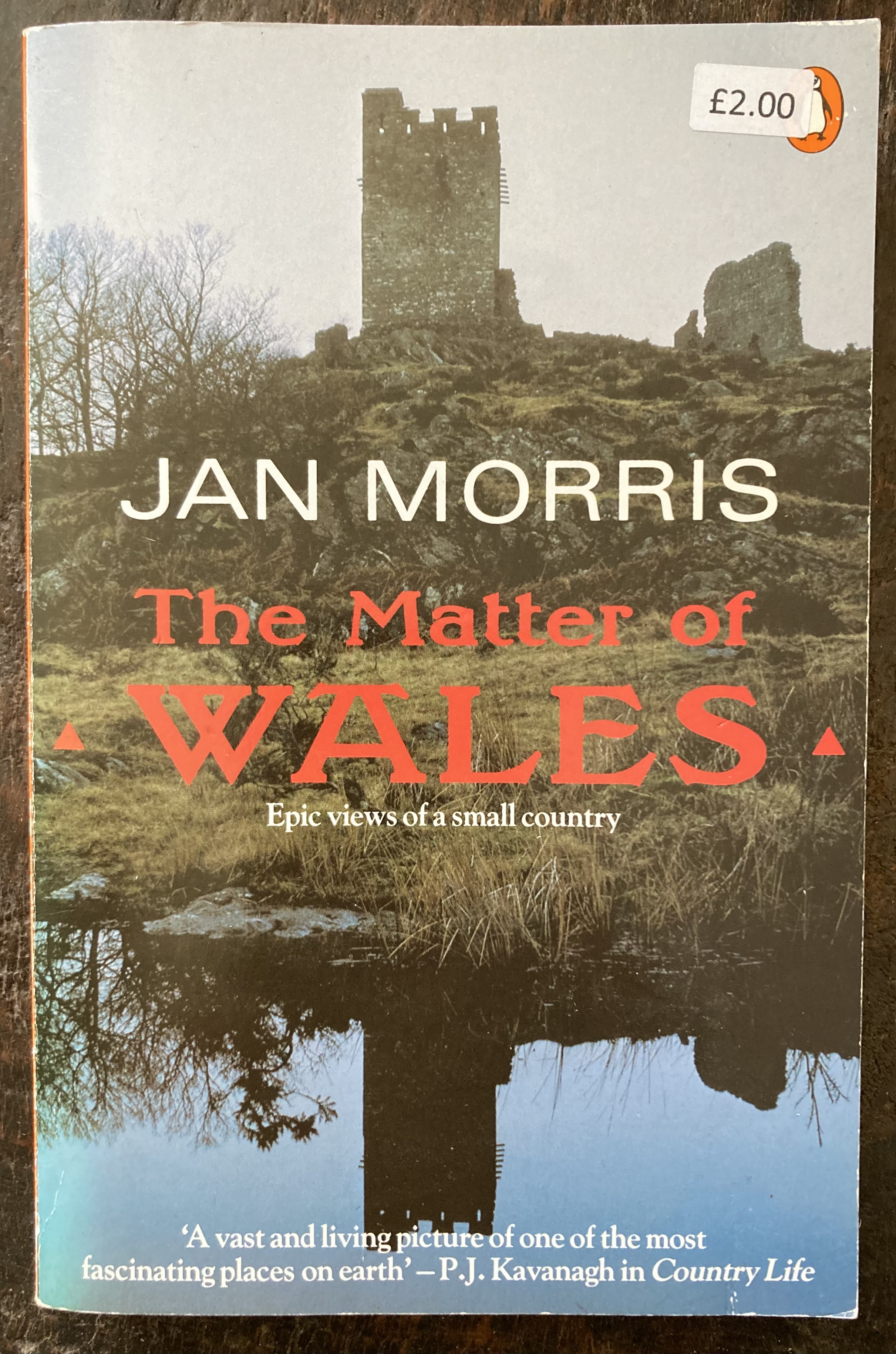

What a terrific bookshop it was! I was extremely disciplined and came away with only three books, one of which was The Matter of Wales: Epic views of a small country (1984), by one Jan Morris, a fascinating book that I have continued to read since our return from Wales. It was useful from the outset, with a helpful guide to Welsh pronunciation, and it conjured up the spirit of Wales along with its natural world, history, relationship to England, and resistance to foreign domination.

What I didn’t expect to learn, when looking up the author to learn more about her, was that Jan Morris was born James Morris, who made a name for himself as an intrepid journalist for the Times of London and then the Manchester Guardian covering the ascent of Everest in 1953, the Suez crisis in 1957, and the Cuban revolution in 1959, just to mention some of his early work. But James Morris had known from the age of four that he was female in his innermost self, and being who he was, set out to do something about it. Not only was Morris one of the first well-known people to undertake gender reassignment surgery, but she was one of the first to write a book, Conundrum (1974), about her transition. When Conundrum was published, she was attacked quite viciously by some of the mainstream media and even by feminists like Rebecca West and Germaine Greer (who said that she wasn’t a woman), but the outpouring of letters of thanks from readers more than made up for the negativity.

Morris died in North Wales in 2020 at age 94, and just last month, in April, 2026, a biography, Jan Morris: A Life, was published, written by Sarah Wheeler. Here’s Morris’ obituary in the Guardian and a review of Wheeler’s biography. You might also be interested in watching Michael Palin’s 2016 video interview with Morris in her home in Wales when she was 90 years old and in reading a Guardian article on her at the very end of her life.

What Jan Morris would have made of the current anti-trans crusades, I do not know, but it was interesting to me that I came across her fascinating book on Wales, one of more than 50 that she wrote in her lifetime, at this particular moment in time. When she made the transition from male to female, she took the negative criticism in her stride and continued to write as prolifically as she had been doing all along, but in coming out publicly as she did in 1974 she also made life that much easier for the many people who could not even be recognized at the time. I’m glad that the City of London Corporation is also taking the bathing pond controversy in its stride and keeping the current inclusive policy in place—for now, at least. “Further announcements will be made in due course.”

Tell Me Another (Contents to Date)

Chronological Table of Contents

401. More Than Enough

In Britain, Childhood, Family, Nature, places, Stories on July 24, 2017 at 2:23 am

Hampstead No. 1 Pond (photo: J. Rege)

I ought to have known as soon as the ATM at the Hampstead branch of Barclays Bank swallowed up my debit card on the morning of my return flight; when the taxi driver who drove me to St. Pancras to catch the train to Gatwick took me to the wrong station; when the airline found my painstakingly-packed suitcase 5 kg. overweight; when the price of an overflow carry-on bag rivaled the excess baggage charges; when, after my rush to the airport, the plane was delayed by nearly an hour; and when, to add the ultimate insult to injury, I was told that my two precious jars of Marmite would now have to be confiscated because I had transferred them from the overweight suitcase into my carry-on bag. As I fought back the tears of fury, frustration, and self-pity that sprang to my eyes, I told myself that I ought to have known the universe would conspire to make my last day in England a disaster.

But all along the way, felicity had trumped misfortune. The Hampstead walk that last morning was an experience that no bank or ATM could possibly take away from me; the guide who led me astray was set straight by another one who knew the way; at the airport, those who would exploit hapless travelers were rendered powerless by an open-hearted stranger; the delay was rendered delightful by tea and an M&S custard tart, sprinkled liberally with nutmeg; and even the loss of the Marmite, tragic to be sure, was not total: while two were confiscated, a third made it through, with a lot more besides.

It was a compressed trip, as highly charged as it was fleeting. In just over a week I had travelled up to the West Midlands to see my dear Uncle Ted, back down to London to see regal Auntie Bette, the matriarch of the clan, and Auntie Angy, who had not let marriage into the Sharp family (Sharp by name and sharp by nature) rob her of her sweet disposition. Time had not permitted me to travel up to Norfolk to see my cousin Susan and her brood (including a new grandbaby), or to Bristol to see my old friend Cylla (who had become a double grandmother since my last visit), or to Hoddesdon to see Barbara, or to visit Robin, who had become a widower since the last time and Savita, my old schoolmate from India, who were based in London itself; and I had missed two cousins altogether. But, to quote my sister’s favorite Rolling Stones song, “You get what you need.” I had got plenty.

When they told me, at the airport check-in, that I could either incur 45 pounds in excess-baggage charges or, at the conveniently adjacent luggage store, that the smallest bag I could contemplate buying would coincidentally also cost me 45 pounds, I almost gave way to despair; but this Kafkaesque double-bind was to give way to a singular sweetness. At the airport outpost of Boots the chemists, where I attempted to buy their largest plastic carrier bag, the young cashier asked me if I would prefer a cloth bag. “Yes,” I breathed, “yes please. Do you sell them?”

No, they didn’t, but if I could wait a few moments, she had one that she could give me.
“Don’t look so surprised,” she said, as I stood open-mouthed at her generosity, “it’s nothing.” And sure enough, the sweet young angel stepped out and returned with a bag whose capacity rivaled the £45 offering at the price-gouging luggage shop. I was overcome by gratitude, but my heartfelt thanks only embarrassed her, so I left to find a set of scales where I could off-load some of the heaviest items in my suitcase (including, sadly, the large and ill-fated jars of Marmite).

Earlier that day, the sinking feeling in my stomach when the Barclay’s ATM on Hampstead High Street swallowed my debit card threatened to plunge me into the Slough of Despond, as I wrangled in vain with the bank clerk, all the while watching my last free hour in London ticking away. But as I continued my walk down Hampstead High Street, the feeling of well-being returned from my walk across the Heath earlier that morning. I walked past the Oxfam shop at the top of Gayton Road,  where Andrew, Nikhil, and I had lived for six weeks in 1997, while I was participating in an NEH Summer Seminar on postcolonial literature and theory, and where I now picked up a pair of bone china mugs and paid 5p for a recycled-plastic carrier bag that bore the heartwarming slogan, “Be Humankind.” Hurrying down Downshire Hill, into Keats Grove, past the poet’s house and gardens, I reached the 24 bus terminus at South End Green at last, in good time.

Well Passage, Hampstead

All that morning a feeling of homecoming had accompanied me every step of the way, as I strode confidently and alone down Mansfield Road, where my cousin Lesley had once lived, and up the steps to the Heath, where morning dogs and dog-walkers mingled and meandered at their leisure. This was where my mother and her brothers had rambled in their youth, where my parents met and courted, and where I had been born. There was a moment, walking down the narrow Well Passage, when I might have been my mother in a sepia photo c. 1952, in which she walks, swinging her arms, with her brother Ted and his best friend Curly, in a circular gypsy skirt with a wide cinched-waist belt and a dimpled smile on her face as if the world was new and she and her mates owned it. No bank nonsense could dislodge that feeling.

(from michaelhaag.blogspot.com)

On the long summer evening before, Cousin Lesley and I had taken the 24 bus to South End Green, walked onto the Heath from South End Green, and stood overlooking the pond and the row of houses beyond. It was in one of those houses, in South Hill Park, where we had stayed for three months in 1963 with Auntie Dorrie and Tamara on our way back from Greece to India, where I had walked to nearby Gospel Oak School every morning with Lesley, where I first saw the Beatles on television, where I first saw television itself (see British TV, Fall of ’63). As we watched children watching the ducks and the swan and its half-grown cygnet, Lesley asked their mother to take our picture. We walked on, to the bathing ponds where Mum and her brothers and their friends had passed many long, happy hours in their teens and twenties. I passed and photographed a fallen horse chestnut branch, with the not-yet-ripe fruit still in its prickly skin. Come September, children would prise the glossy nuts out of their burst casings and play conkers, if children still played conkers today. But now was now. I was here, and on my last day in England, it was more than enough; it was plenty.

Tell Me Another (Contents to Date)

Chronological Table of Contents

194. London, My London

In 1940s, 1950s, 1960s, 1970s, 1980s, 1990s, 2000s, Britain, Childhood, Family, Immigration, Music, Nature, places, Stories on April 13, 2013 at 9:35 am

I was born in London, a London of the 1950s just emerging from the ravages of the Second World War and the era of British colonialism, a new London with more educational opportunities and better health care and social services for the poor and working classes, greater cultural diversity as immigrants from South Asia, Africa, and the West Indies came to find work in the “Mother Country,” a London where my Indian father and English mother met and married. Although I have actually lived in the city of my birth for only 5-6 years in total, they include periods in my infancy, in my nursery, elementary, and secondary school years, and while I was a university student. London, birthplace of my mother, will always be dear to me and, as cities go, is perhaps the only one where I could imagine myself feeling completely at home.

London from Parliament Hill,(hampsteadheath.org.uk)

London from Parliament Hill (hampsteadheath.org.uk)

the Heath in Autumn (hampsteadheath.org.uk)

the Heath in Autumn (hampsteadheath.org.uk)

But my London is not the home of Big Ben and Buckingham Palace—in fact, after all these years I have yet to visit the Tower of London. “My” London is a city of neighborhoods, and specifically, of the neighborhoods of North London where my mother grew up, where my father lived as a student, where I was born, and where in turn I lived as a student—Kentish Town, Belsize Park, Hampstead, and Camden Town. When I return, I go straight to my family, infinitely more important to me than any monument. When my mother returns, she and her sister Bette head straight out to Castle’s pie and mash shop (not my cup of tea—I’m squeamish about eels) and then for a ramble over Hampstead Heath, ending up at Kenwood House for tea and a bite to eat.

Queen's Crescent market (kentishtowner.co.uk)

Queen’s Crescent market (kentishtowner.co.uk)

“My” London is plaice, haddock, or cod-‘n-chips in newspaper, the thick, soggy chips salted and liberally doused with malt vinegar; crowded street markets with stalls where half the goods seem to have fallen off the back of  a lorry; corner shops run by British Asians selling fresh coriander and green chillies along with English sweets and tabloids; bakeries full of fresh crusty  loaves and squashy jam doughnuts; the Tube, double-decker busses, and black cabs (my Uncle Bill drove one–see Get Me To the Church on Time); and, of course, pubs, which can still be found on just about every street corner.

The Flask, Hampstead (tigergrowl.files.wordpress.com)

The Flask, Hampstead (tigergrowl.files.wordpress.com)

In my London, Cockney accents emerge quite naturally from the mouths of British Asian youth whose grandparents immigrated there from the former Empire—after the sun set on it. (See Gurinder Chadha’s I’m British But…) Visiting a friend in Hackney back in the 1980s, I found the adult education booklet carrying night-class listings in eight languages, including Bengali, Punjabi, Greek, and Turkish.

My London is the London of Brick Lane and Southall, of the Royal Free Hospital and aging public housing estates; of pub food that features samosas as well as Cornish pasties and traditional English Sunday dinners; of the Bank Holiday fairs on Hampstead Heath and the Caribbean Notting Hill Carnival every August Bank Holiday weekend (by the way, given the importance of Notting Hill to Britain’s history of race relations, it infuriated me that they managed to make the movie Notting Hill without a single black character in it).

Notting Hill Carnival (demotix.com)

Notting Hill Carnival (demotix.com)

My mother married for love and had to leave her beloved city for most of the rest of her life; yet it has never left her heart and therefore it can never leave mine. Every seven years, when I watch the latest edition of  Michael Apted’s 7 Up series (Here’s the late Roger Ebert interviewing Apted in 2006), I wonder fleetingly what my life might have been like had my parents decided to stay there. But if they had, I wouldn’t be who I am now.

I leave you with the British Asian band Cornershop’s 1990’s hit, Brimful of Asha, and a rendition of Hubert Gregg’s sentimental 1940’s favorite, Maybe it’s Because I’m a Londoner.

Tell Me Another (Contents to Date)

Chronological Table of Contents

A2Z-2013-BANNER-900_zps1a85732a

Design a site like this with WordPress.com
Get started