Showing posts with label mathematics. Show all posts

Friday, December 23, 2016

Friday Gen Eds MS10: The Basics of Calculus

This is the tenth post in the math/science part of my "Gen Eds in a Nutshell" series. The Gen Ed series consists of ten subjects you might study in a general education or "liberal arts" core at a university or college. I've already done the subject of philosophy, and I'm over half way through the world history subject on Wednesdays. I'm combining the last two on math and science into one series on Fridays.

Thus far in the math/science subjects:
______________________________
1. The calculus was invented in the 1600s. Isaac Newton (1643-1727) usually gets the credit, but Gottfried Leibniz (1646-1716) developed it independently at the same time. Calculus was invented to address two problems, namely, the tangent problem and the area problem.

2. We might introduce the tangent problem in this way. If you drive from location x to location y in 60 minutes and the roadway between is 60 miles, we know that you have driven an average of 1 mile per minute.

But what about the instantaneous speed? How might we know how fast you were driving 29 minutes into the trip?

We might plot your trip on a graph. We might put distance on the y-axis and time on the x-axis. Perhaps we could come up with an equation that expressed the graph.

The average speed between any two points is the difference in distance divided by the difference in time, or the "rise" (y- y1) divided by the "run" (x- x1). In other words, the average speed is the slope of the graph between those two points. And if we wanted to know the speed at any instant, it would be the slope of the tangent to the initial equation at that point.

3. What Newton and Leibniz invented was, first, a way to determine the equation of this tangent line, the instantaneous slope at a point on an equation. More broadly, they found a way to derive an equation for the tangent to an equation at every point along the equation.

Their idea is really very simple. The slope between two points, as we have said, is the rise (of y) divided by the run (of x). So the rise is the y value of the equation (or function) at x2 minus the y value of the equation at x1. Another way to put this is f(x + Δx) - f(x). The symbol Δ means the change in x, and f(x) means the value of the equation (or function) at x.

If we divide f(x + Δx) - f(x) by Δx (the change in x), then we have divided the change in y by the change in x, which is the slope.

Differential Calculus
4. Newton's idea was to take Δx to zero. When the change in x was infinitesimally small, the "limit" as the difference in x approached zero would approach the equation of the tangent line to the equation. We can write the process in this way:
The expression f'(x) is called the derivative of x. If we take an equation and plug in x and x + Δx and go through the process of simplifying it, the Δx part always cancels out and we are left with the equation for the tangents to the initial equation at every point. As we will see in the next post, this allows us to do all sorts of things in science, economics, and in any field that involves change.

5. The branch of calculus that has to do with finding the instantaneous rate of change in this way is called differential calculus. There are some basic patterns for the derivatives of certain kinds of equations. For example, the derivative of a polynomial (an equation with x raised to some power) is very predictable.
The expression dy/dx is a way of saying "the derivative of y." In this case, y = an + b. To find an equation for a line that is tangent to this equation, you multiply the power (n) times whatever number is in front of a. Then you lower the power of n down by 1. [1]

6. You can take the derivative of a derivative, called a second order derivative. In fact, you can keep taking derivatives of derivatives as long as you still have elements left of which to take the derivative.

For example, if you have an equation for the distance you've traveled in a certain amount of time, the derivative of that equation (the first order derivative) gives you an equation for the speed in relation to time. Then if you take the derivative of that equation, the second order derivative is an equation for the acceleration in relation to time. Acceleration is the change in speed in relation to time.

7. This all may sound complicated, but it can be used to do a lot of things. For example, when an equation reaches a maximum or a minimum, its slope will be zero at that point (because the graph changes directions at that point). So if you make the equation of the derivative equal to zero and solve for x, then you will have identified points where the initial equation hits maxima and minima.

If you look at whether the second derivative is positive or negative, you can decide whether it is a maximum or minimum. If the second derivative is negative, then its graph is concave down and the point where the slope equals 0 is a minimum. Otherwise, it's a maximum.

Integral Calculus
8. The opposite problem to the tangent problem might be called the area problem. Let's say you have an equation again that you have graphed. How do you find the area under the graph?

The answer is similar. You slice up the area under the graph into smaller and smaller rectangles and add up their areas. As the width of the rectangles becomes infinitesimal (approaches zero), the sum of all the rectangles approaches the area under the equation.

The way we might write this situation up is:
What this means is that we are going to slice up the area under the equation into "n" number of rectangles. As the number of them approaches infinity (the limit as n approaches infinity), the sum approaches the area. The big symbol is the summation sign. The Δx refers to the little x part of each rectangle and the f(xi) refers to the y part of each rectangle. i = 1 just refers to the fact that we start adding with the first rectangle and we keep adding till we get to the "nth" one.

We call this operation, "integrating" or "finding the integral" of an equation. An "indefinite integral" finds the equation for the area under the entire equation. A "definite integral" finds the area under a specific part of the equation.

9. As it turns out, differentiation and integration are opposite operations. In fact, this is the fundamental theorem of calculus. If you take the derivative of an equation, you can get back to the initial equation by integrating the derivative. Or if you take the integral of an equation, you can get back to the original equation by "differentiating" it.

For example, the derivative of a distance equation is a speed equation, and the derivative of a speed equation is an acceleration equation. But it works the other way too. The integral of an acceleration equation is a speed equation, and the integral of a speed equation is a distance equation.

10. The tools of calculus are immensely helpful in countless fields, especially physics, but also fields like economics, population growth--any topic that involves change.

Next Week: Math/Science 11: The Physics of Motion

[1] The b disappears because it was times an x to the 0 power (1). Zero times b is zero. When taking a derivative, all "constants" like b disappear.

Friday, December 16, 2016

Friday Gen Eds MS9: Basic Geometry and Trigonometry

This is the ninth post in the math/science part of my "Gen Eds in a Nutshell" series. It's a series of ten subjects you might study in a general education or "liberal arts" core at a university or college. I've already done the subject of philosophy, and I'm over half way through the world history subject on Wednesdays. I'm combining the last two on math and science into one series on Fridays.

Thus far in the math/science subjects:
______________________________
1. From a popular perspective, geometry is the study of shapes and spaces. More properly, it is the mathematical study of points, lines, planes, solids, and higher dimensions by analogy.

A point is a placeholder for a single location in space, a "dimensionless" entity. Two points make a line, or at least we can draw one and only line through those two points (at least in the geometry we learn in the ninth or tenth grade). A line is a "one-dimensional" entity. Three points identify a plane, a "two-dimensional" concept. Solids are thus three-dimensional entities.

2. The basic shapes have been known and used by humanity from its earliest memories--circles, triangles, squares. The areas of these shapes are the amount of space they take up. The area of a rectangle is easy enough to calculate. it is the measure of one side times the measure of another. The very idea of squaring (x2) comes from the fact that the area of a square is the measure of one side times itself.

The Babylonians, Egyptians, and Greeks knew that the ratio of the circumference of a circle divided by its diameter was a constant, and Archimedes estimated it at around 3.14. But it wasn't until the 1700s that the symbol π was used (for perimeter, since π is the perimeter of a circle). The area of a circle is equal to πr2, were r is the radius of the circle.

3. Since the Babylonians and perhaps even before, it has been to divide up a circle into 360 degrees. This is completely arbitrary from our standpoint. It's much more helpful to measure a circle in terms of pi, where the perimeter of a circle is 2π. This is called radian measurement. One radian is the measure of an arc of the circle equal to the measure of the radius.

But we are still used to measuring a circle in terms of 360 degrees. We are used to measuring the angles of a triangle in these degrees as well. A triangle has three angles. The total of these three angles always adds up to 180 degrees, or half a circle. If you were to measure the arc in a circle from one side of a line to the other, you would find that it also covers 180 degrees. That's why we say we turned 180 degrees, meaning that we completely changed directions.

There are special kinds of triangles. For example, an equilateral triangle is one where all three sides have the same measure. This means that all three angles also have the same measure. Since the total is 180 degrees, each angle of an equilateral triangle must measure 60 degrees. An isosceles triangle is one where two sides have the same measure. That means that two of the angles, the ones opposite the sides with similar measures, will have the same measure as well.

A right triangle is one where one of the angles of the triangle is 90 degrees. The other two angles then add up to the remaining 90. Pythagoras in the 500s BC knew the relationship between the measures of the sides of a right triangle: a2 + b2 = c2. This formula is called the Pythagorean theorem.

4. Geometry is usually the subject where students learn about proofs. Modern mathematics is based on a structure of axioms and theorems. Axioms or postulates are assumptions that cannot strictly be proved. They are like definitions or starting points. "For any two points, there is one and only one line that goes through them."

Axioms are usually commonsensical assumptions like "Two parallel lines never meet." However, every once and a while, what seems obvious may not be true. Since the 1700s, a whole system of geometry has been developed from removing this assumption. Euclidean geometry is geometry that assumes this "parallel postulate" as the ancient Greek Euclid (ca. 300BC) did.

By contrast, non-Euclidean geometry explores mathematics without the assumption of the parallel postulate. As it turns out, this form of geometry has been very helpful with the theory of relativity. Our common sense assumptions have turned out not to be as useful for science on this level as we thought.

Proofs then take these axioms and build theorems out of them using some basic rules of logic. For example. The "transitive property of equality" states that "if a = b and b = c, then a = c." These are the sorts of rules are used to glue axioms together into theorems.

5. Some of these theorems show when two triangles are "congruent." For example, the "side-side-side" (SSS) theorem states that if the three sides of two triangles have the same measures, then the two triangles are equivalent or congruent. There are also "side-angle-side" (SAS), "angle-side-angle" (ASA), and "angle-angle-side" (AAS) theorems.

There are also a set of theorems relating to the angles around two parallel lines. For example, if a line cuts across two parallel lines, then the "alternate interior angles" are congruent.

6. We know rectangles where all the angles of a four sided figure are 90 degree angles. A square is thus a special kind of rectangle where the four sides all have the same measure.

Any four sided figure is called a quadrilateral. If the opposite sides are parallel to each other, it is called a parallelogram. A square and rectangle is thus a special kind of parallelogram where the opposite sides are not only parallel, but at 90 degrees to each other.

A trapezoid is a quadrilateral where only one pair of opposite sides are parallel. A rhombus is a parallelogram where all four sides have an equal measure.
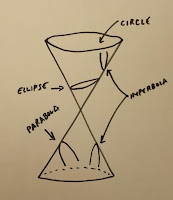

7. We can conceptualize another set of shapes as conic sections. If you look at the inverted cones to the right, you can create several shapes by taking a cross-section of it. A straight horizontal slice cuts out a circle, while a slanted slice through a cone gives an ellipse, an elongated circle.

If you slice slanted but in a way that does not cut all the way through, then you have a parabola. Finally, if you cut up and down vertically, you get the equivalent of two opposite parabolas, which is called a hyperbola.

8. These sorts of explorations took a massive leap forward when René Descartes developed his Cartesian coordinate system (see post on basic algebra). The branch of mathematics known as analytic geometry looks at geometry from a graphical standpoint. A point is thus not just an abstract concept, but something that can be plotted on a graph. If we have a two dimensional graph with an x-axis and a y-axis, we might locate a point with the format (x, y), where the first number gives us where the point is on the horizontal, and the y tells us where the point is on the vertical.

Our minds can also conceptualize a three dimensional framwork with x, y, and z axes. Points on this sort of a graph are plotted by three points in the format (x, y, z).

It is difficult for us to imagine a graph for more than three dimensions. Usually, additional dimensions are plotted in two dimensions. For example, if you want to plot movement in space in relation to time, you would put "t" as an axis over and against a distance axis (see next post). Imaginary numbers are sometimes graphed in terms of an imaginary axis over and against a real axis (see post on basic types of numbers).

9. We already discussed the basic graph of a line: y = mx + b. In this version of the equation (slope-intercept form), m is the slope of the line and b is the y-intercept point. The conic sections we mentioned above also have basic forms:
  • A circle can be put into the form of (x - h)2 + (y - k)2 = r2, where (h, k) is the center point and r is the radius. x and y are then the points on the circle.
  • Formula for an ellipse
  • An ellipse can be put into the form to the right. In this formula, (h, k) is the center of the ellipse and a and b are the distances in perpendicular directions from the center to the ellipse itself.
  • A quadratic equation, an equation with a square as its highest power, usually graphs as a parabola. The standard equation format for a parabola is y=a(x - h)2 - k, where (h, k) is the vertex point (the h and k can be switched depending on which way the parabola is facing) and a tells us how squeezed the parabola is.
  • Finally, a hyperbola takes the form to the right, where (h, k) is the point at the center point between the two "parabolas" of the hyperbola, a represents the distance from this point to the vertices of the two branches of the hyperbola and b is the distance from the center point to where the "asymptotes" that box in the parabola meet a line going through the vertices of each wing. [1]
10. Trigonometry is the geometry of right triangles. In particular, there are certain relationships between the measures of the sides of a right triangle and the angles of that triangle:
  • The "sine" (sin) of an angle is the ratio of the opposite side divided by the hypotenuse (the side opposite the right angle).
  • The "cosine" (cos) of an angle is the ratio of the side adjacent to the angel divided by the hypotenuse.
  • The "tangent" (tan) of an angle is the ration of the side opposite an angle divided by the side adjacent.
  • There are "reciprocals" to these, basically 1/them. The reciprocal of the tangent is the cotangent (adjacent/opposite side measure). The reciprocal of the cosine is the secant (hypotenuse/adjacent) and of the sine is the cosecant (hypotenuse/opposite).
  • You can also find the angle by taking the arcsine, the arccosine, and the arctangent of the sine, cosine, and tangent respectively. This words backwards to the angle. So if you take the sine of the angle, you get the ratio between the opposite side and the hypotenuse. If you take the inverse, the arcsine of the ratio, you get the measure of the angle.
11. We might now mention that volume has to do with the three-dimensional space occupied by a three-dimensional figure. So the idea of cubing a number (x3) comes from finding the volume of a cube, which is a three-dimensional square of sorts, a box with all sides equal. The volume is the length times the width times the height.

For a sphere, a three-dimensional circle of sorts or globe, the volume is found by the formula 4/3 πr3. Surface area refers to the area of the space on the surface of a three-dimensional figure. For a cube, for example, there are 6 sides, each of which has the area of a square. So the surface area of a cube is 6x2. Meanwhile, the surface area of a sphere is 4πr2.

12. I mentioned above the rise of non-Euclidean geometry above. Hyperbolic or Lobachevskian geometry is an example of such geometry. The key is not to think of the space on which the geometry of lines and shapes is playing out as a flat space. So in hyperbolic geometry, we might think of geometry playing itself out on a saddle that bends inward. For example, a triangle drawn on a saddle will have angles that add up to something less than 180 degrees.

The opposite is spherical geometry, where we might think of geometry playing itself out on a sphere. In this case, the angles of a triangle drawn on a sphere will add up to more than 180 degrees.

Next Week: Math/Science 10: The Physics of Motion

[1] An asymptote is a line that goes onto infinity that serves as a kind of imaginary line that a graph is not allowed to cross. Take the equation y = 1/x (the inverse function). Since you cannot divide by 0, x cannot ever equal 0 for this equation. If you graph it

Friday, December 02, 2016

Friday Gen Eds MS7: The Basic Tools of Algebra

This is the seventh post in the math/science part of my "Gen Eds in a Nutshell" series. It's a series of ten subjects you might study in a general education or "liberal arts" core at a university or college. I've already done the subject of philosophy, and I'm over half way through the world history subject on Wednesdays. I'm combining the last two on math and science into one series on Fridays.

Thus far in the math/science subjects:
______________________________
Solving for x
1. It is hard to convey how much math lept forward and the greatest developments in science became possible when algebra really began to develop in the late 1500s. Algebra is basically the use of letters to stand for unknown qualities that can change (called variables because they can vary in what number they stand for). For example, x + 6 = 10. If I need 10 apples and I already have 6, how many more do I need? [1]

But this area of math did not have its greatest impact until René Descartes (1596-1650) developed it, coming up with a way to graph equations (the "Cartesian coordinate system, to the right). It was Descartes who designated the x as the unknown it has come to be.

Algebraic equations are used to express real world situations using symbols. Simple unknowns, like the one above, are often easy enough for us to solve without using algebra. But algebra lets us express much more difficult situations, often with more than one unknown, and then to solve them.

2. Perhaps the first key to solving for x is knowing that 1) you can add or subtract any amount as long as you do it to both sides of the equation and 2) you can multiply or divide any amount as long as you do it to both sides of the equation.

So in the example above, x + 6 = 10, I can subtract 6 from both sides and the equation remains the same basic situation. So x + 6 - 6 = 10 - 6. I can simplify this to x = 4, and I have my answer.

As another example, let's say I have 33 dollars to spend and I want to bring as many friends as I can to a play where the tickets are 5 dollars a piece. I also have to pay 8 dollars for a taxi ride to get there. How many friends can I invite? I might express this situation by the equation 5x + 8 = 33.

First I subtract 8 from each side, giving me 5x = 25. Then I divide both sides by 5, giving me x=5. So I can bring 5 friends.

The very simple equations above could be expressed as a point on a number line, x = 5.

3. The equations above are "equalities." This equals that. There are also "inequalities." So x can be anything "greater than" 5: x > 5. And y can be anything "less than or equal to 6": y ≤ 6.

Another kind of equation is the "absolute value." The absolute value of a number is its positive value. For 5, it's easy. 5 is already positive. But for -5, it's absolute value is 5. The absolute value is usually written between two up and down lines.

Linear Equations
4. Sometimes there is more than one unknown. x + y = 10. An equation of this sort, where two variables (to the first power, as here) are in play, is called a linear equation because it graphs as a line. As the x changes, the y changes accordingly.

So let's say that you want to build a device that requires 6 of x for every 2 of y and costs $12. So we have an equation in two variables: 6x + 2y = 12. Or a simplified version would be 3x + y = 6.

A nice way to put the formula so it can be graphed is y = -3x + 6. This is the "slope-intercept" form or the y = mx + b form. B here tells us where this line hits the up and down line, usually called the y axis. So b is the "y-intercept." In this case, the line will cross the y axis at 6.

M is then the "slope," that is how the line "rises" for every bit the line goes to the right or left. So if the slope is -3, then the line goes down three units for every one unit that it goes to the right.

To the right is what that graph would look like. The horizontal line is often called the x-axis. As I already said, the vertical line is often called the y-axis. So in this graph, the point 6 on the y axis is the y-intercept, where this line crosses the y-axis. Then the slope is negative three. The line goes down three (-3) for every 1 that x increases.

The slope is the "rise over the run," the amount it goes up or down for every one it goes right.

5. We locate points by using the format of (x, y), where x is the location of the point along the x-axis and y is the point along the y-axis. So the y-intercept is at (0, 6). If you look, the x-intercept (where it crosses the x axis) is at (2, 0). If you plug these numbers into the original formula, y = -3x + 6, you'll find that the numbers work. In fact, the line is all the sets of x's and y's that make the formula come out right. So (1, 3) works. (-1, 9) works. An infinite number of points work--the points on this line.

6. Sometimes you can have two equations that apply to a certain situation. Let's say you have 16 seats at a dinner, but for some reason you need to have 3 women for every one man. So f + m = 16 (the total number of women and men). At the same time, there are going to be three times as many women as men (f = 3m).

We can solve this situation in a couple of ways. For this one, substitution is the easiest. So we know that f = 3m, so we can plug this in for f in the other equation: (3m) + m = 16. So 4m = 16 and m = 4.

Now we can plug this value for 4 back into one of the original equations: f + 4 = 16, f = 12. So we should invite 12 women and 4 men. [2]

Quadratic Equations
7. There are equations where the variable is raised to a power more than 1. "Quadratic" equations are equations where the highest variable is squared. d = t2 - 4t - 12. This is the kind of equation that would be in play if you were tracking the motion of a baseball you hit into left field.

So we solve an equation like this one by factoring it. So t2 - 4t - 12 can be factored into (t - 6)(t + 2). We know this because if you multiply the material in these two parentheses together you get the other. The way you multiply something of this sort is by using the FOIL method (first, outside, inside, last).

So when does this equation work? For example, if t is time and d is the distance from the ground, then the baseball is at zero when t - 6 = 0 and when t + 2 = 0. The second one doesn't make sense because it is t = -2. But the second one makes sense t = 6. So the ball will return to the ground in six seconds.

8. Some quadratic equations are hard to factor. In such cases, the quadratic equation is used.


If you put a quadratic function into the form ax2 + bx + c = 0, then a and b are coefficients in front of the variables. Plugging these into the formula tells you what x works.

Other Equations
9. Of course there can be equations of higher powers than these. There are cubic equations (raised to a third power). And there can be equations raised to even higher powers. These are "polynomial" equations, where the "poly" means powers more than one.

There are inverse functions (1/x). There are equations for circles, ellipses, hyperbolas. There are trigonometric functions (sine, cosine, tangent). We we will consider in our post on Geometry and Trigonometry yet to come.  

Next Week: Math/Science 8: Thermodynamics

[1] A Greek named Diophantus (200s AD) has often been called the father of algebra, but the name "algebra" comes from the medieval Persian al-Khwarizmi (ca. 780-850).

[2] You could also find the solution by graphing both of these line equations and then finding the intersection point on a graph. In this case, the intersection would be (12, 4), if the we were graphing points as (m, f).

Friday, October 21, 2016

Friday Gen Eds MS2: Basic Types of Numbers

The second post in the math/science part of my "Gen Eds in a Nutshell" series. It's a series of ten subjects you might study in a general education or "liberal arts" core at a university or college. I've already done the subject of philosophy, and I'm half way through the world history subject on Wednesdays. I'm combining the last two into one series on Fridays.

Thus far in the math/science subjects:
______________________________
Basic Types of Numbers
1. It seems to me that it is perfectly acceptable to expect someone with a college degree to have some basic mathematical skills. Such basic math was historically part of the ancient and medieval curricula. Arithmetic and geometry were both part of the so called "quadrivium" of early medieval education, and math was part of the other two as well: music and astronomy.

Of course most people will know how to add, subtract, multiply, and divide before they even enter high school, hopefully before middle school. A child of one year old knows "less than." Before we can speak, we can signal that we have "less than" we want. By two years old we think we know when our sister or brother has "greater than" we do.

We know the circle shape of the wheels on our bikes. We may not know to call the shape of our doors a rectangle, but probably we do. Most of us learn what a triangle and a square are easily enough.

2. We learn to count early on. We may not know that the counting numbers are also integers. They are whole numbers too. We can use these numbers even if we don't know what to call them.

"How many people in your party?"

"One, two, three, four... a table for four please."

"Jim wasn't able to come tonight."

"OK, subtract one from that... a table for three please."

So the counting numbers are 1, 2, 3, 4... If we add the number 0 (which wasn't really used until Brahmagupta fully gave it notation in the 600s), then we have the whole numbers: 0, 1, 2, 3, 4...

3. These are of course highly useful numbers. We can add them to each other. We can subtract one from another. We do these operations all the time in real life.

We can add multiple times, which we call "multiplication." If we add 3 to itself 3 times (3+3+3) then we have 3x3 which is 9. We can do the same thing with subtraction. if we start with 16 and we subtract four till we get 0, then we have 16-4-4-4-4. We had to subtract 4 times, so 16 "divided by" 4=4.

We multiply and divide all the time. Sometimes we multiply a number by itself, such as when we are finding the "square footage" of a room (i.e., the area of its floor). We "square" a number when we multiply it by itself (e.g., 10= 10 x 10 = 100). We "cube" a number when we multiply it by itself three times (103 = 10 x 10 x 10 = 1000). In physics, we might do this to find out the "volume" of a room that is 10 feet long and 10 feet wide and 10 feet tall--a cube, in other words.

We call this task of multiplying a number times itself, "raising to a power." The number of times we multiply a number by itself is the "power" to which we are raising it and we call that number an "exponent." You can also go the other direction. The square root of 4 is 2 because 2 x 2 = 4. The cube root of 1000 is 10 because 10 x 10 x 10 = 1000.

4. So the whole numbers are 0, 1, 2, 3, 4... all the way to "infinity," the word we use for numbers never stopping in how high they go, numbers going on forever. The 1, 2, 3, 4 part, the counting numbers are also called "positive integers." They are called positive integers because we can imagine those numbers decreasing the other direction below zero as well, negative integers.

Think of it this way. What if I imagined a number that, when added to 3, gave me 2? It would, in effect, be the same as subtracting 1. We call this number -1 or "negative one." If we imagine that negative numbers go on to negative infinity, we have -1, -2, -3, -4, -5... and so forth.

The whole set of numbers of this sort, positive and negative (1, 2, 3, 4... and -1, -2, -3, -4...), along with 0, make up the set of integers.

5. When we divide a number by another, say 8/4, then we have, in effect, something called a "fraction." In this case, 8/4 is 2. In this case, since this "ratio" of 8 to 4 is greater than one, we might call it an "improper" fraction.

So what is a "proper" fraction. It is a ratio of this sort that is less than one. I ordered a pizza last night and between my daughter and I, we consumed "half" of it. That is to say, we only consumed a "fraction" of the pizza. Of the 8 total slices, we consumed 4. So we ate 4 out of the 8, which is 4/8, a fraction.

Of course there is an easier way to write 4/8. We can "reduce" this fraction. Any number divided by 1 is the same number, and 2/2 is one. So if I divide 4/8 by 2/2 we get 2/4. If we do it again, we get 1/2, a much more familiar way to write 4/8.

Of course there are all sort of fractions: 3/4, 5/9, 13/37. We can come up with an infinite number of them. These are called "rational numbers," because they are numbers that can be put in the form of a ratio like 3/5. All the integers fit into this set, because all the integers can be expressed in fractional form (like 4/2 is the same quantity as the integer 2).

Fractions can also be expressed as decimals, numbers presented in the form of tens and tenths. Because we have 10 fingers, Arabs and others in the Middle Ages developed systems of using numbers to express fractions in tenths. So 0.1 is one tenth, 0.2 is two-tenths. If we go further to the right 0.01 is one tenth of one tenth or one hundredth (1/100). 0.001 is one tenth of one hundredth or one thousandth (1/1000).

Fractions can thus be converted into decimals. 1/5 turns out to be 0.2. 3/7 turns out to be 0.4285714 and then the decimal repeats 285714 over and over forever. We call this a "repeating decimal."

6. As math has progressed, we have realized that some numbers in decimal form go on forever without repeating. These are numbers that relate closely to certain shapes and patterns in the real world. Because they cannot be put into the form of a ratio, they are called "irrational" numbers.

One of the best known is the ratio of the circumference of a circle (the distance one time around its edge) and the diameter of a circle (the distance across the circle at any point through its center). This number is known as "pi" (π) and is approximately 3.1415926535...

Similarly, there are some "roots" of numbers that do not come out "perfect." They are not "perfect squares" like 2 is the square root of 4. These roots also can be expressed as decimals that go on forever.

They relate especially to the shape of a triangle. For example, let's say that I have a "right triangle" (one with one angle that is 90 degrees), with two sides that have the same measure. Let's say its longest side is 7 inches. How long are each of the two other sides? As we'll see when we get to geometry, the answer is the "square root" of 7 (√7). In decimal form, this number goes on forever: 2.6457513... It is, in other words, an irrational number.

Another very important number is e, which stands for the answer to (1 + 1/n)n as n becomes larger and larger. It turns out to be 2.718281828459... This number is important for calculating something called "compound interest," which explains how much extra we often pay the bank for our mortgages.

7. All the numbers we have mentioned so far--rational numbers (which includes all the integers) and irrational numbers--together form a set of numbers known as the set of "real" numbers.

Starting in the 1500s, certain mathematicians began to explore solutions to various equations that involved taking the square root of negative 1 (-1), written √-1. [1] In the twentieth century, the physics of the atom was discovered to involve this square root extensively, written as "i" for short.

Eventually, another whole set of numbers--all the real numbers multiplied by i--developed. These came to be called "imaginary numbers." When we combine the real number system with this imaginary number system, we get the "complex number system," which finally constitutes all possible numbers.

All numbers can thus be expressed in the form of a + bi, where a is the real part and bi is the imaginary part. If b equals 0, then we simply have a real number.

Next Week: The Atom and Quantum Physics

[1] For example, what is the solution to x2 + 1 = 0

Sunday, September 25, 2016

Classifying Mathematics

As an idle curiosity for some time, I've been trying to get my head around all the areas of the field of mathematics, and how to categorize them.

1. So first there's the way they are approached in education:
  • arithmetic (numbers and their relations)
  • algebra (I took in the 8th and 10th grades) 
  • geometry ( I took in the 9th grade)
  • analytical geometry and trigonometry (I took in the 11th grade)
  • calculus 1 and 2 (I took in the 12th grade)
  • calculus 3 (series, summations) and differential equations (I took first year of college)
  • My step-daughters have taken math courses I haven't: finite math and statistics.
  • I remember hearing about number theory in high school, which speaks patterns and tricks among numbers (prime numbers, how to tell if a number is divisible by 3 or 6, etc...)
2. Then I got called into ministry, but the Duke University math department seems to lay out what the rest of an undergraduate math degree would look like:
  • Linear Algebra (matrix algebra, vector spaces)
  • Abstract Algebra (group theory, ring theory)
  • Complex Analysis (doing calculus with imaginary numbers)
  • Topology, Differential geometry (this is geometry stuff on steroids)
  • Set theory
3. I also looked at how the Dewey Decimal System and the Library of Congress classify math.

Dewey Decimal System
Library of Congress


4. So here's my attempt to organize math in my own way.

I. Quantities and Their Relationships
  • arithmetic
  • number theory
  • set theory and logic 
  • probability, statistics, combinatorics (finite)
  • series and summations (infinites)
  • analysis (change: differential and integral calculus, complex analysis)
II. Spaces
  • geometry
  • analytical geometry
  • trigonometry
  • differential geometry
  • topology
III. Tools
  • algebra
  • linear algebra (including matrix algebra)
  • abstract algebra (group theory, ring theory)
  • differential equations
  • numerical analysis
OK, math people, critique?