The past few days I attended a summer course on thermoelectric materials at the Univ of Toronto. A good course, and an opportunity to hear the thoughts of some of the best researchers in the field. A friend pointed out that there are two styles of summer course, one truly an introduction, the other more of a symposium for fellow researchers. I have to say that this course was the latter variety, and I missed most of the details, as I am not expert on making of or properties of specific materials. I did gain some understanding of a method of calculation of properties, which perhaps I will discuss in another post. Right now I want to talk about a specific material.
One of the presentations reminded me of what I believe is an open question regarding bismuth-telluride Bi2Te3 and antimony-telluride Sb2Te3 alloys. I mentioned the topic to a colleague at the course, and also had a chance to ask one of the lecturers, an expert, whether this was still an open question. I’m not an expert, but will set out my thoughts for possible exploration by others with suitable background and equipment.
Here’s the question. Consider the following graph, figure 1 from a paper by Mac Smith, et al, in 1962 (reference given below). It exhibits a difference between the two materials which can be used, for instance, to purify a mix by zone melting. Where the two curves are separated, if a bar of solid mix is moved thru a heater, one material will tend to migrate to one end of the bar, the other material to the other end of the bar. Zone melting is a well known technique for removing impurities from the middle of a bar of material by migrating the impurities to the ends.
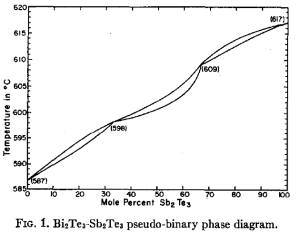
However, in this case, the two curves come together when the molar ratio of Bi:Sb is either 1:2 or 2:1. Such a mix cannot be purified by zone melting. Moreover, if one has a bar whose gross contents of Bi:Sb is 1:2 or 2:1 (with Te in appropriate proportions so one is actually dealing with bismuth-telluride or antimony-telluride), the zone melting process should tend to average out the contents, producing a uniformly distributed alloy which might be described as Bi(6-x)Sb(x)Te9, where x is either 2 or 4.
This raises the question, in my mind, if what we are dealing with is not simply an alloy, ie a mixture of crystals of one material with another, each crystal being pure Bi2Te3 or pure Sb2Te3, but rather there is a crystal which has 2 or 4 Bismuth, 4 or 2 Antimony, and 9 Tellurium atoms. The “a” lattice constants of Bi2Te3 and Sb2Te3 are different, though there are subtleties — see the paper by Mac Smith, et al for details.
I’ve not read a large fraction of the literature on (Bi,Sb)-(te,Se) materials, but the few that I’ve seen that use a mixture of Bi and Sb with Te, have seemed to focus on mix ratios 1:3 or 3:1, not 1:2 or 2:1. Maybe there is an opportunity being missed? H. J. Goldsmid, in his 2009 book “Introduction to Thermoelectricity”, reproduces the Smith, et al, figure 1 on page 104, as figure 7.6, with the following remark: “The meeting of the liquidus and solidus curves at Sb2Te3 concentrations of one-third and two-thirds suggests that there may be some measure of ordering at these compositions.” When I asked the expert who had lectured at the summer course, he said that he believed that concentrations 1:2 and 2:1 had been determined to be optimal for thermoelectric figure of merit, but he was not aware of any work on the “measure of ordering” remark of Goldsmid’s. That was of course an off the cuff response, to a casual question, and there may have been additional work since 1962, or since 2009 — but at least it suggests that there is something to investigate. H. J. Goldsmid is the expert on bismuth-telluride and its relatives, and in 2009 had some 55 years experience investigating its properties. If he says something is a topic worth investigation, that is pretty good advice!
I would expect that, if there is a novel crystal structure, that its increased complexity of structure might be useful for improving its thermoelectric figure of merit — with the usual considerations of orientation, magnetic field etc.
My purpose with this post is simply to point out the opportunity. I’m sure that those with suitable training and experimental apparatus can, using more modern techniques, revisit the 1962 work of Mac Smith, et al, and obtain a better understanding. I’ve not done my own literature search. This is definitely a side-observation for me, not on my main path of exploration. If this topic interests you, I hope you have fun and perhaps find something useful.
Best wishes,
Ken Roberts
13-July-2014
The paper referenced is: Mac J. Smith, R. J. Knight, C. W. Spencer, “Properties of Bi2Te3-Sb2Te3 Alloys”, Journal of Applied Physics, vol 33, pp 2186-2190, 1962.

 Logic, Astronomy, Science, and Ideas Too