Tag Archives: Abraham

Abraham and Sarah, Living on Our Land

Abraham sent to Canaan

The Book of Abraham   by Laya Crust    (Hand-painted accordion fold book)

The Torah readings over the last few weeks have featured Abraham and Sarah, the patriarch and matriarch of the Jewish nation. Their story began when God chose Abraham to go to the land of Canaan and start a new nation. The painting above states, “He went with Sarai, his wife, and his nephew Lot to Kana’an.” The parashah begins with Sarah’s death and concludes with Abraham’s death.

Sarah, our matriarch, dies in Qiryat Arba at the age of 127. Abraham comes to mourn and weep for her and to find a fitting burial place for his beloved wife.  He pays for the cave of Machpela even though it has been offered to him as a gift. The text is detailed. “And the field of Efron, which was in Machpela, which was before Mamre, the field, and the cave which was in it,  and all the trees that were in the field, that were in all the borders round about, were made over to Avraham for a possession in the presence of the children of Chet,…before Mamre: the same is Hevron in the land of Canaan.” ( Ch. 23 v 17 -19)

abraham - akeida and hebronThe Book of Abraham  by Laya Crust (Hand-painted accordion fold book)

Avraham pays full price for this small piece of property, also known as Hebron, in front of witnesses so there would never be a question of ownership.

The Cave of Machpelah - Vincent van Gogh

              The Cave of Machpela by Vincent Van Gogh
At the end of this week’s reading Abraham dies and his two sons, Isaac and Ishmael, come together as brothers to bury their father. They mourn together and bury their father in the cave of Machpela, beside Sarah. The two brothers meet in peace and act cooperatively. They bury their father on the land belonging to Abraham.
The biblical Qiryat Arba still exists. It is an Israeli town with about 7,500 residents outside of Hebron. Hebron, mentioned in these Torah readings exists. The Cave of Machpelah exists. The land of Canaan exists. Today Canaan is known as Israel.
Israel is historic Canaan with a modern name. We Jews have lived there longer than any other people.  Jews have owned and lived in the land- Canaan, Palestine, the Turkish Empire, Israel- call it what you will – ever since Abraham bought and owned that parcel 5,000 years ago… Jews owned Israel before 1967, before 1948, before the Balfour Declaration, and before the Zionist movement under Herzl. We owned the land all the way back to the time of Abraham.
We are strong, we are united, and we are right to protect ourselves and our land. I pray our hostages come back soon and that there is no more loss of life, that we will see peace and cooperation in Israel very soon.”
chayi sara map with hebron machpelah-genesisShabbat Shalom,   Laya
partial map of Israel in Abraham’s time

Leave a comment

Filed under Uncategorized

VaYeira- The Sacrifice

As I write this entry, my thoughts are filled with the war Israel is fighting against HAMAS terrorists in Gaza, and terrorists in Syria, Yemen, and Lebanon. The atrocities HAMAS perpetrated on innocent civilians are unbelievable. I worry for the Israeli soldiers. I worry for the 240 innocent hostages. This tragic reality has made me reform my thoughts about today’s Torah reading.

Bird’s Head Haggadah,  1290, Southern Germany

“Akeidat Yitzchak” is a distressing story. It is read daily in our morning prayers. It is a cornerstone of our literature and has figured in Jewish art throughout the centuries.  

 God promises Avraham they will be the parents of a great nation. A nation so numerous that the population would exceed the number of stars in the sky. Avraham and Sarah wait decades to have a child. First, they have a child with a “surrogate” mother- Hagar. Then, years later, they have another son. Sarah is 90 years old when she gives birth to Yitzhak, or Isaac. As time passes, Sarah disapproves of Ishmael as a role model for Isaac and has Avraham send him and his mother away. 

Later, God tells Avraham to take Isaac to Mount Moriah and sacrifice him there. Avraham doesn’t argue. To protect Sarah, Avraham doesn’t tell her what he and Isaac are about to do. He and Isaac walk up the mountain together. Can we begin to imagine what Avraham is thinking? He is with his son. The son he has raised. The son whom he loves. Avraham protects Isaac as long as he can, carrying the dangerous materials, the knife and the fire, while Isaac carries the kindling.  As they go up together Isaac asks, “Avi, (my father, or Daddy,) where is the sacrifice?” Avraham answers that God will provide. And it’s all true. God provides a sacrifice. And Isaac survives.

File:The sacrifice of Isaac.jpg  

Beit Alpha Synagogue Mosaic 5th C. CE

Can we relate to a father sacrificing his child? I think of the parents who have children serving in the Israel Defence Forces today. Parents give birth to sweet, innocent babies. As they grow up, Israeli babies and exceptional Jewish babies from outside of Israel become soldiers. Parents with conflict in their hearts send them to protect our nation of Israel, praying that it will be OK. That their children will be safe. That the nation will be fine. The children go, knowing this is their role as Israelis and Jews. How can we send our children into that kind of danger? We can’t. We don’t want to. But we do.

I transfer these thoughts to Avraham. Avraham and Sarah were chosen to begin a new nation. They were selected because they believed in one God, in justice, in honour, and in the sanctity of life. The nation they created would become “a light unto the nations.” When Avraham made a covenant with God he was ready to sacrifice what he held most dear to ensure the survival of the promised nation.

Image result for sacrifice of Isaac Rembrandt, 1636

Isaac trusted that his father and God were right. If Isaac was to be part of the covenant, he had to participate in the way he was called upon to participate. He had to be ready to sacrifice himself. And Sarah? Sarah had to stay home, to worry, pray, and wait, as parents of soldiers do today. 

Image result for rembrandt Abraham and IsaacAbraham and Isaac, Rembrandt, 1645

We raise our children for joy and peace. But at a breaking point, we have to send them to fight. October 7, 2023 was a breaking point. This war is a fight for our survival. We each do what we can. Some of us, with pain in our hearts, see our children go to war. Some write letters of protest, attend rallies, pray, send money, send food, send clothing, provide shelter, or art, or babysitting, or music, or a hug and a shoulder to cry on. It’s all important. We win when we are united.

Listen to this beautiful song by Lea Shabat called “Avraham.”

https://www.google.com/search?q=lea+shabat+sings+%22Avraham%22&rlz

May we see peace. May our hostages be returned healthy in mind and body. May we experience no more war.

Shabbat Shalom, Laya

lea shabat

Lyrics:

Avraham, what courage, How you walked until the end.

In the morning you woke up, How did you feel going up?

How many tears I have shed over you? And shed on myself through you?

Avraham, How you were one, And after One, you followed

Outside of everyone, You heard only Him

Avraham,  And Yitzchak knew nothing,  And he walked with his father

What is more than a father, Each one walked with his father

How many tears have I shed over you? And shed on myself through you?

Avraham

Continue reading

5 Comments

Filed under Uncategorized

Lech Lecha, The Good and the Evil

Lech Lecha sigDesert Sky by Laya Crust

The first reading in the Torah, parashat Bereisheet, includes the narrative of Cain murdering his brother Abel in jealousy and anger. The second reading of the Torah, p[arashat Noah, describes the chaos and evil that prompted God to flood the world and start a new group of people through Noah. In this week’s reading, Lech Lecha, Abraham goes to war. He saves Lot and his family from warriors who are holding them hostage.

Avraham was already in his eighties when God told him they would begin a new nation. “He (God) brought him outside and said, “Look now toward heaven and count the stars, if you are able to number them.” And He said to him, “So shall your seed be.” (ch. 15  v.5)   On a clear night the desert sky is unbelievable. It is so crowded with stars that one wonders how many diamonds can fit up there. And that was God’s promise to this man and woman who traveled the land together and were our first leaders.

There are millions of Jews living in Israel and around the world. We have never disappeared. God kept His promise. Our history hasn’t been an easy or pleasant one, but we’re still here! And we have our homeland, Israel.

I AcheinuAcheinu by Laya Crust

Translation: As for our brothers,​ the whole house of Israel, who are given over to trouble or captivity​, whether they abide on the sea or on the dry land:     May the All-prese​nt have mercy upon them, and bring them forth from trouble to enlargeme​nt, from darkness to light, and from subjectio​n to redemptio​n, now speedily and at a near time.

It is October, 2023. We Jews are facing another war. Three weeks ago, on October 7, HAMAS attacked Israel, intending to annihilate Israel and all the Jews of the world. They massacred over 1,200 innocent people, including babies, pregnant mothers, and infirm seniors. They abducted 224 individuals- again babies, pregnant women, ill seniors and others) to be held as hostages. These atrocities are being applauded by anti-semites around the world.

Abraham and Sarah’s story in the Bible is being repeated today. Abraham and Sarah hosted the needy and the poor. They exemplified justice. Jews around the world are pouring their abilities, their money, and their energies into helping everyone in the world who is being affected by this war. Israelis are opening their kitchens, homes, and hearts to soldiers, evacuees, the wounded, and those in mourning. Jews across the world are speaking out to support Jews and Zionists in cities, on campuses, and in unions who are facing misplaced hatred.

Abraham put his life on the line to try and save his nephew’s family. He bargained to save the righteous in Sodom and Gomorrah. He and Sarah opened their home and hearts to those in need. Jews and those who support Jews are doing the same today. Atrocities against humanity and genocide continue to this day. It has to be fought on many fronts in a variety of ways. We have to fight for freedom, each in our own way.

Rabbi Jonathan Sacks wrote a wonderful essay for this difficult time. Here is the link:  https://www.facebook.com/rabbisacks/posts/999081956809626

May we see peace and all the hostages returned safely.  Shabbat Shalom,

Laya

ILLUMINATIONS, An Exploration of Haftarah through Art and History is a collection of all the haftarah pictures you have seen on my blog. The book boasts 82 full-colour pictures. A rich commentary accompanies each painting. To order a book or a haftarah print, go to https://www.haftarah-illuminations.ca/

Leave a comment

Filed under Uncategorized

The Promise

The Promise by Laya Crust

The story of Noah is a favourite children’s story. Illustrators have a great time with it, drawing waves, the ark, and frolicking animals. It is presented as a joyful story, but it is a serious one.

Noah lived in the tenth generation after the creation of the world. His father named him Noah נח, from the verb ינחם, comfort or console. Noah was called a righteous man, and at the beginning of this week’s parasha it says that Noah walked with God. During Noah’s time people behaved sinfully. Upset with the vile behaviour on earth God decided to destroy the world and restart life on earth with Noah’s family and representatives of each type of animal that roamed the earth.

After the flood, families grew. The population increased. People still had free will and freedom of choice. Evil again began to imbed itself. This week’s Torah reading ends with the story about the Tower of Babel.

Our religion is family and community-based. The stories in Genesis chart the growing pains of family and community. Noah may not have been an orator or a community leader but he knew what was moral and what was not and ran his household in that way. That is why God saw him as the progenitor of the new nation. Noah’s standards of behaviour were passed down through the generations to Abraham, also a man who walked with God. Abraham cared about his wife, sons, and the strangers passing by his tent.

When we read the delightful Noah’s Ark books to our children and grandchildren, we leave out the dark parts. But Noah faced that darkness, lived through it, and exposed the light enough for Abraham to take on the next chapter of our legacy.

This is a devastating time. On October 7, 2023, HAMAS terrorists swarmed southern Israeli communities, killing as many Jews as possible. There are too many painful and horrific stories to count. There is deep pain in Israel and in our diaspora communities. We have banded together to support each other. Communities in and outside of Israel are collecting food, money, toiletries, and clothing for displaced and evacuated families. Millions of dollars have been collected to buy medical equipment and ambulances. Hot meals, socks, and underwear are being delivered to soldiers on duty and at their bases. The volunteerism and outpouring of compassion is beyond description.

Photo by Joey Lightstone, Israel, October 14, 2023

We see this unity in the time of crisis. It is a quality we must retain. God flooded the world Noah lived in because of the evil He saw. God hoped the new world would be kind and honest and that people would help each other. I hope the evil unleashed on Israel on October 7 is destroyed, and the unity and compassion we see among Jews will continue.

The above photo was taken by a soldier in Israel after a rainfall. There is a rainbow In the lower sky just above the tank. Above the rainbow are clouds forming a blue Magen David (Star of David.) On the right side of the photograph, the clouds form an Israeli flag. The picture has not been photoshopped. It’s real. It is a reminder that Israel will live. Good and truth will prevail. Prayers and good deeds will help us overcome the evil attacking our country Israel, and our Jewish people.

עם ישראל חי

Have a Shabbat Shalom. May we have peace.

Laya

For good entertainment, watch the following link for a great gospel Noah song sung by the Jubalaires. https://www.youtube.com/watch?v=6CLFwW85O20

ILLUMINATIONS, An Exploration of Haftarah through Art and History is a collection of all the haftarah pictures you have seen on my blog. The book boasts 82 full-colour pictures. A rich commentary accompanies each painting. To order a book or a haftarah print, go to https://www.haftarah-illuminations.ca/

4 Comments

Filed under Uncategorized

Lech Lecha

Dear Reader,

I painted the pictures you see here as part of a collection of pieces for a sefer haHaftarah- a haftarah scroll. You have seen many of these images over the years if you have been following my blog. I’m excited to announce that a collection of these paintings and their explanations will be published in a book called “ILLUMINATIONS, An Exploration of Haftarah through Art and History”. I will share more information about the book in the coming weeks.

“Count the Stars”

If you’ve ever been camped in the desert or in the countryside at night without artificial light, you will have seen a  sky studded with stars. The heavens are so full of stars it seems amazing the sky can hold them all.

The parasha of Lech Lecha introduces us to Abraham, the man Gd chose to begin a new nation. Gd tells Abraham that He will bless him. Abraham’s descendants will be as numerous as the dust on the ground and the stars in the skies. Gd said, “Look now toward the heavens and count the stars if you are able to count them. And He said, “and so your descendants shall be…” (Genesis 15:5) Looking up at that night sky Avram couldn’t have begun to imagine how many stars there were. There were too many to count, too many to even guess at.

God told Abraham to leave his birthplace and travel to where God would direct him. Just as Abraham was called by God and promised a new homeland, the haftarah relates that God will gather all Jews from the corners of the earth and take them to their homeland – to the land of Israel.

This week’s haftarah is from the Book of Isaiah. The Jews have been in Babylon, in exile, for decades. They are sure they will never be able to return home. It seems that King Cyrus is about to conquer Babylon and Isaiah is hopeful that Cyrus will allow the Jews to go back to Israel. Isaiah assures the Jews that Gd will not abandon them. Gd reminds the Jews that they are His chosen people. “The coastlands look on in fear, the ends of the earth tremble … But you, Israel my servant … whom I drew from the ends of the earth and called from its far corners …”(Isaiah 41:5, 8, 9)   

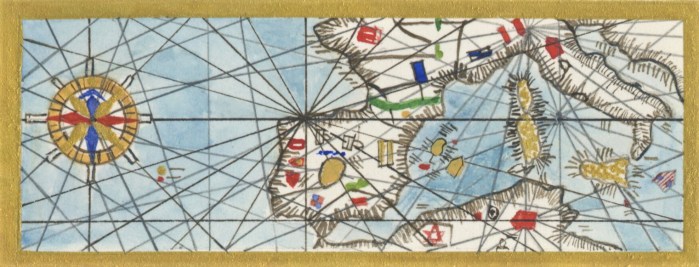
Compass Rose by Laya Crust

The references to coastlands and the ends of the earth evoke thoughts of maps and atlases. This painting shows a section of the famous Catalan Atlas which incorporates Majorca, Spain, and the compass rose which is found on every navigational map.

One of the most accomplished medieval mapmakers was Abraham Cresques who lived in Majorca, Spain. He was the mapmaker to the king. In 1375, Prince John of Aragon commissioned Cresques to make a set of nautical world charts as a gift for the future King Charles IV of France. Abraham and his son Jehuda created the Catalan Atlas, which is recognized as the most important atlas of the medieval period. The Catalan Atlas included the names of coastal towns, locations of houses of worship, and drawings of traders, rulers, and flags of the empires.

Although he had worked on maps which were commissioned by royalty, ironically, Jehuda was caught in the snare of the Spanish Inquisition. He was forcibly converted to Christianity during the anti-Jewish outbreaks of Spain in 1391, and took the name Jaume Riba. He continued to create maps and was called Magister Cartarum Navegundi – “Master of Navigational Maps”.

Abraham was chosen to begin a new nation, the nation that would one day be known as Jews. Even back then Gd told Abraham that his descendants would be slaves in a strange land, referring to their enslavement in Egypt. Abraham was warned that life would be tough for the Jewish people, his descendants.  The hardships have continued throughout history. In this haftarah Isaiah gave encouragement to his exiled brethren in Babylon, telling them that Gd would not abandon them.

Every time period is a time of challenge for the Jews. Right now we are still facing challenges and terrible anti-Semitic tides. We are reminded that Gd made a promise and will always keep that promise initialized with Avraham Avinu- Abraham our father.

Have a good week and a good Shabbat. May it be one of peace and health for klal Yisrael and the world.

Laya

Leave a comment

Filed under Uncategorized

Shabbat Shira – it’s music

Halleluhu by Laya Crust

Parshat B’Shalach                        Haftarah: Judges 4: 4 – 5: 31

Music is magical. We can’t see it, touch it, smell it or taste it. We can hear it and magically it can transform our mood and take us to other places in our imagination. We all know about love songs (a billion), break-up songs (2 billion), songs of tribute (“Starry Night” about Vincent Van Gogh) and patriotic songs (“La Marseillaise”and “HaTikvah”). All our secrets can be unearthed (“Killing Me Softly”) and raw emotion can be exposed (Stravinsky’s compositions).

Music is a beautiful union of art, science, math, and imagination. I remember a friend of mine- a physicist- being amazed and unbelieving when I told him I loved music. “How is that possible? ” he asked. “You’re an artsy.” I was really surprised by that comment because I had always thought that music was art and emotion. That was when I found out that there is a close relationship between science and music.

Miriam’s Song by Laya Crust

Music is an integral part of joyous Judaism. In the Torah portion B’Shalach we read “The Song of the Sea”.  It is Moses’ song of praise to God that was sung after the Israelites safely crossed the Red (or Reed) Sea, and were saved from the angry Egyptian army. The women, led by the prophet Miriam, sang and danced and made music on their “tof”, a handheld drum. There is a beautiful painting of the women led by Miriam playing their drums in The Golden Haggadah, and another lovely rendition in The Sarajevo Haggadah.

Devorah the Prophetess by Laya Crust
(inspired by a painting from a 17th C. Judeo-Persian book)

This Bible reading describing the escape into the desert, across the sea, and the ultimate Song of the Sea is paired with an adventure story in the Book of Judges. Led by the prophet Devorah the Israelites won a battle against Sisera’s Army. A woman named Yael completed the defeat by killing Sisera. Devorah then sang a song of praise about the triumph and Yael’s conquest.

 When we are happy, when we are sad, when we want to remember or forget, when we want to meditate or pray, be left alone or celebrate with others we often turn to music. Because it is a comforting, joyous and spiritual medium the most beautiful parts of prayer are often paired with music. The painting at the top of the page shows biblical instruments mentioned in “psoukei d’zimra”, prayers we say in the morning.

On this Shabbat Shira, the Shabbat of Song, pay attention to the songs and music composed by Moses, Miriam, and the prophetess-judge Devorah. Enjoy the art, the sounds, and the music around you and have a Shabbat Shalom.

Laya

If you would like to be notified when I write a new blog post go to the top of the page and hit “follow”. You will get a notification each time I write a new post.

Leave a comment

Filed under Uncategorized

VaYechi- And He Lived

King David and Saul by Laya Crust

VaYechi is the last Torah reading in the Book of Beresheit (the Book of Genesis). It is just that- the story of the beginning, or genesis, of the world and of a people. The parsha begins with a word that in biblical Hebrew means “and he lived”, and in modern Hebrew means “and he will live”. It is appropriate because this word refers to Jacob who died in this parsha but created the family legacy which would continue, living as the Jewish nation.

Our forefathers and foremothers did not have perfect family lives. There was jealousy, jostling for power and attention, and lifelong resentments. We read about favouritism. There was very little tenderness exhibited in the harsh lives they led. However, tenderness does appear in this parsha.

When Jacob was 137 years old he had been living in Egypt with Joseph and his other 11 sons for 17 years. He knew he was about to die and called Joseph and Joseph’s sons to his bedside. “…he kissed them and embraced them. And Yisrael said to Joseph,’ I had not thought to see your face: and lo, God has also shown me your children.’ ” (Genesis ch 47 v..11) Yaakov was expressing the longing he had felt for decades, never believing he would see his son Joseph again. Neither Abraham nor Isaac had ever spoken to their children with such honesty and warmth.

We go on to read the first ethical will ever recorded. Jacob spoke to each of his sons, and to his two favourite grandsons. He foresaw how they were going to navigate the world. The prescience could have been see by the sons either as warnings or as guidelines for how to lead their lives in the best way possible. As well as speaking about the children’s’ attributes Jacob also made it clear that when he died he was to be buried in Canaan in the same place his wife Leah, his parents Isaac and Rebecca, and his grandparents Abraham and Sarah had been buried.

This scene and this request- he actually insisted that it be an oath- were the greatest lessons of all. By gathering the sons together in one room and speaking to each of them one by one Jacob was cementing the family unit. It wasn’t a speech to all the servants and to those Egyptians who respected him, it was a speech only to his sons. This showed them how he valued them as a family unit with common roots, and that they would retain their nationhood and integrity if they stayed together.

The insistence that he be buried in Canaan was an indication that Canaan, not Egypt, was his and their homeland. That being said, Joseph was the only one of the twelve sons who made an oath that he too would be buried in Canaan.

As always there are many lessons in the parsha. Communication in family, showing love to our children, expressing our deepest wishes, seeing each child as an individual, the power of the ethical will, unity, and being in the right place are all lessons from this reading.

We live in a frightening world with too much hatred and too much violence. If we stand together as a unified nation, if we live with the integrity laid out in halachah (Jewish precepts and law), and if we know who we re as Jews and where we belong, maybe we can help heal our nation and heal the world more effectively. As we go forward we might also be able to learn from Yaakov Avinu (our father Jacob’s) ethical will to us, his descendants.

With blessings for goodness and peace, Shabbat Shalom.

Laya

2 Comments

Filed under Uncategorized

Funerals and a Wedding

The Cave of Machpelah - Vincent van Gogh
The Cave of Machpela by Vincent Van Gogh

This week’s parsha begins with the news that Sara Imeinu (our matriarch) had died in Qiryat Arba at the age of 127. Abraham came to mourn and weep for her and to find a fitting burial place for his beloved wife.  Although the cave of Machpela was offered to him as a gift, he insisted on paying for it.  The text reads, “And the field of Efron, which was in Machpela,which was before Mamre, the field, and the cave which was in it,  and all the trees that were in the field, that were in all the borders round about, were made over to Avraham for a possession in the presence of the children of Chet,…before Mamre: the same is Hevron in the land of Canaan.” ( Ch. 23 v 17 -19)

Avraham paid full price for this small piece of property, also known as Hebron, in front of witnesses so that there would never be a question of ownership.

chayei sarah0040
Abraham’s Journey by Laya Crust

At the end of this week’s reading Abraham died and his two sons- Isaac and Ishmael-came together as brothers and buried their father in the cave of Machpela, where Sara his wife had been buried. There had been a separation in the family after Isaac was born. Ishmael and Hagar were sent away because Sarah was adamant that Ishmael was a bad influence in Isaac’s life. It’s quite a testament to the strength of Abraham’s personality that the two half brothers united and buried their father together and without rancour. The ability to live apart but with respect was not the situation in King David’s family.

The haftarah is from the Book of Kings and concerns the last days of King David. After leading the nation of Israel through many battles, King David was old and ailing. In his illness and on his deathbed he was always cold. The court found a young and beautiful maiden, Avishag the Shunemite, to attend to him and “keep him warm”. The last days of two King David in the haftarah and the patriarch Abraham in the Torah reading link the haftarah to the Torah reading: .

Heir to the Throne by Laya Crust

This scene shows King David on his deathbed. Avishag, his attendant is there along with Bathsheba his wife, and Nathan the prophet. The calm scene in the picture belies the bloodshed and jockeying for leadership that was going on outside David’s chamber walls.

The ailing king had not yet appointed an heir to his throne. Although David had promised Batsheva that their son Solomon would be the next king of Israel, it had never been officially announced. There was a vicious power struggle among his sons and Adonijah, was about to declare himself king. Nathan the prophet knew that David had to announce his successor before his death to prevent a possible civil war. He also knew that David would listen to Bathsheba. “Then Nathan said to Bathsheba, Solomon’s mother….’Go immediately to King David and say to him, “Did not you, O lord king, swear to your maidservant: ‘your son Solomon shall succeed me as king, and he shall sit upon my throne.’ ?”   ( 1 Kings 1: 11, 13 )   When Adonijah announced himself king, Nathan and Bathsheba approached King David.

David was a great warrior and beloved king, but his leadership skills as a father left much to be desired. The fighting continued among his sons. In contrast Isaac and Ishmael reunited at Abraham’s funeral. Isaac had been chosen as heir and leader of Abraham’s legacy and Ishmael accepted that.

David was always in conflict with the nations surrounding him, and brilliantly led the battles that needed to be fought. Abraham fought as a last resort, attempting to make compromise and make peace when possible. Maybe Abraham’s non-confrontational policy paved the way so that his estranged sons could meet in peace and live parallel but non-combatant lives.

May all parents and leaders choose paths of dialogue and peace. Maybe then the world will be a safer and peaceful place.

Have a Shabbat Shalom.

The scene of David surrounded by Avishag, Bathsheba, and Nathan is one of the paintings in my forthcoming book, “Illuminations”. Stay tuned for more information!

Leave a comment

Filed under Uncategorized

Sarah and the Divine

VaYeira Sig
art by Laya Crust

Vayeira- Genesis 18 – 22 Haftarah- Kings II, ch. 4: 1-37

This week’s parsha is a series of at least five incredible narratives, each worthy of detailed study. Today I will focus on Sarah, the woman chosen to be the mother of the Jewish nation.

When Gd told Avraham to leave his homeland and that he would become the father of a great people, he left Ur Kasdim, taking his wife Sarai and his nephew Lot with him. Sarai was 75 years old when she and her husband left their home for an unknown destination. She was described as beautiful- so beautiful that King Avimelech took her to his harem. We may wonder how a woman of 75 can be that appealing, but some have an ageless beauty that is enhanced by grace and wisdom.

etching by Laya Crust

Gd chose Sarai to be the mother of His nation. Her name was changed from Sarai to Sarah at the same time Avram’s name was changed to Avraham. Twice Gd protected her from the leaders of alien nations- first from the pharaoh of Egypt and later from Abimelech, the king of Gerar. After Sarah suggested that her handmaiden bear a son to Avraham Gd made it clear to Avraham that Sarah was to be the matriarch of the nation and that no other woman would fulfill that role.

In this parsha, the Lord told Avraham that he and the men in his group would need to be circumcised. Then Gd had told Avraham that he and Sarah would have a child together. It seemed so ridiculous Avraham fell on his face and laughed. Gd declared that the baby would be called Isaac, after the Hebrew word “to laugh”.

The circumcision was, and is, the sign of the covenant between Gd and the Jewish people. Sarah did not become pregnant until after Abraham was circumcised. As a dear friend pointed out, the covenant between Jews and Gd had to be initiated before the line of the Jewish people was created.

Abraham and Sarah by Marc Chagall

Like Avraham, Sarah laughed when she heard she was to bear a child at the age of 90. When Sarah laughed “within herself” Gd asked Avraham why she had laughed. The question was actually two questions. Did Avraham not tell his wife and partner that she was to become pregnant and have a child? Is that why she was incredulous and laughed? The second question was – why did Avraham and Sarah still not believe that Gd can make unusual and unexpected things happen? The Torah and commentaries seem to criticize Sarah for laughing when she heard the news, but the rebuke wasn’t just to Sarah. It was to Abraham as well. That whole incident can be seen as a larger conversation Gd had with Sarah, the future matriarch.

There are many criticism of Sarah and her attitude towards Hagar. We can’t judge. Life and community were very different in biblical times. Recognizing her infertility Sarah offered her handmaid Hagar to her husband, hoping that way he would become a father. Recognizing Hagar’s behaviour Sarah handled the situation as she thought she had to. When the three angels appeared at their tent in the desert Avraham and Sarah worked as a team to create a feast for them. It appears that Sarah ran her community with wisdom and level-headedness.

May we learn from Sarah’s strengths and have wisdom in dealing with our challenges.

Have a Shabbat Shalom, Laya

The illustration at the top of the page is from the haftarah of VaYeira. It shows the prophet Elisha with the Shunammite woman who had a room built for him for when he visited Shunem. This woman, like Sarah, was childless for many years. Her son, like Isaac, almost died. Unlike Sarah, she was able to watch her son grow to adulthood.

The print is from my collection of 82 paintings of the haftarot. The collection is currently on display at Beth Tedec Synagogue in Toronto, Canada. The address is 1500 Bathurst Street. The exhibit is free and open to the public 7 days a week, 9 a.m. through 9 p.m. I am currently working on a book focusing on the haftarah paintings and their meanings.

1 Comment

Filed under Uncategorized

Lech Lecha and Respect

Compass Rose by Laya Crust

The Torah reading For “Lech Lecha” begins, “Gd said to Abram, ‘Go forth from your land, your birthplace, and your father’s house, to the land that I will show you. I will make of you a great nation’…” (Gen. 12:1)

Three weeks ago we read about the creation of the world and the creation of humanity. There were problems. Adam and Eve, the first people, did not listen to Gd’s instructions and were punished. The first children were Cain and Abel. From feelings of anger, jealousy, and shame Cain killed his brother. The negative behaviours of humanity increased until Gd decided to wash the world clean and start again.

Noah, a righteous man was chosen to restart the community of mankind. But once again murder and disrespect became rampant in the civilization. Rather than destroy the world again Gd chose Abraham and Sarah to become the ancestors of a new and righteous nation.

“Turn your gaze towards the heavens and number the stars. if you can count them. And Gd promised him, and so shall your seed be.” (Genesis 15:5)

In Genesis chapter 13 there is a description of a quarrel between Abraham’s herdsmen and the herdsmen of Lot, Abraham’s nephew. The men were arguing over the grazing fields for their cattle. The situation could easily have gotten out of hand but Abraham used calm and wisdom to find a solution. “There should be no quarrel between you and me, and your herdsman and mine, for we are close kin. The whole land lies before you! Please, part from me. If you go north I will turn south and if you turn south, I will turn north.” (Gen. 13:8,9)

Abraham was the patriarch and Lot’s uncle. It would have been acceptable for him to choose the best land for himself. Alternatively, there could have been a skirmish over ownership of the grazing lands. Abraham’s approach was an example of insight and sympathy delivered with respect, attributes of a good leader.

In Toronto the week leading up to November 11, Remembrance Day, is Holocaust Education Week. There are hundreds of films, talks and presentations throughout the city and neighbouring communities. Millions and millions of people were exterminated because of horrible arrogance and the lack of respect or acceptance of difference. The presentations address heroism, compassion, anger, and resolution.

The understanding and calm Abraham displayed is a model we can take forward to our interactions. If everyone looked at the person across from him/her and said: “What is on their mind? How can I understand them and communicate my position respectfully?”, maybe strikes, fights, and wars could be avoided.

I guess the lesson we can learn is very basic. Everyone has their own story. Everyone has their own approach. By explaining ourselves and listening to others, problems can be solved respectfully, without anger or bloodshed.

May you have a week of joy, peace and understanding.

Laya

2 Comments

Filed under Uncategorized