Tag Archives: Haftorah

Tetzaveh – Temple Visions

Titzaveh

Temple Floor Plan by Laya Crust

The first forty chapters of the parashah Teztaveh (“You will command”) are dedicated to the High Priest’s clothing. The text describes combining fibres, fabrics, embedded gemstones, bells and tiny pomegranates.

The haftarah is from the Book of Ezekiel. Ezekiel was among the 8,000 Jews exiled to Babylon in 597 BCE. He writes that he is carried by God to the land of Israel. He is set on top of a very high mountain where he sees something like the structure of a city. A man, seemingly made of brass, gives Ezekiel a thorough tour of the future Temple. There are detailed descriptions of each element to be measured and positioned.

We read measurements and the positioning of each holy object in the future Temple. The illustration above is based on a rendering of Solomon’s Temple from an early 12th C. German manuscript illumination. It shows the Temple’s floor plan. All the sacred objects in the floor plan seem to lie on the floor. I used the manuscript drawing because it is so unusual and delightful. It is a charming way for the viewer to see the Temple artifacts. The manuscript is currently in Vienna, Austria in the National Library.

The haftarah begins with the words, “Thou, son of man, describe the house…”

The Jews were miserable. It was the 25th year of their exile in Babylon. God gave Ezekiel an incredible amount of information about the next Temple to share with the Jews. Hearing about the future Temple in Jerusalem, the Jews were optimistic that they would indeed return to their homes. A provision accompanied the details and plans. The Temple would only be restored if the Jews were repentant and corrected their behaviours and observances.

We will fast-forward almost 2,550 years. Under Jordanian rule, Jews were forbidden to pray at the Western Wall from 1948 until 1967. When Israeli forces liberated Jerusalem in 1967, Jews were once again free to go to the Kotel, the only remaining wall of the Second Temple. We don’t have a Third Temple, but we have a unified Jerusalem, and we can pray at the Kotel.

The Temple Mount is the holiest place of Judaism. The Kotel is the only remaining wall of the Temple’s encompassing structure. This remnant of the Temple is proof of our history, our commitment to God and Judaism, and our right to Jerusalem and Israel. This remnant of the Temple is a place where all Jews can speak to God in their own way.

Today we are fighting for our survival. Every Jew in Israel is fighting for all Jews around the world. Jews outside of Israel are defending Israel, defending democracy, and defending our religion. it is a difficult time, but we will retain our courage, our compassion, and our right to our land.

עם ישראל חי, and BRING OUR HOSTAGES HOME.

May you have a Shabbat Shalom-one of peace, understanding and warmth.

Laya

My illustrations and commentaries of all 82 haftarot can be ordered from www.haftarah-illuminations.ca as a book, a print, or a p[oster.

Leave a comment

Filed under Uncategorized

VaYigash – UNITY

Joseph0002Joseph’s Journey   by Laya Crust

The parashah VaYigash continues the saga of Joseph and his brothers. Joseph was sold into Egyptian slavery and rose through Egyptian society to become second in command to the Pharaoh. Now, after many years, the family is reunited. Although Joseph’s story had begun many years earlier with fraternal jealousy, the brothers allow themselves to reunite and rebuild their family. In the earlier Bible stories, the siblings did not reconcile. Cain killed his brother Abel. Isaac grew up without his brother Ishmael. Jacob and Esau never truly reconciled. In this story, we see Joseph and Judah rebuild the family, which would eventually become the nation of Israel, the Jewish people.

VaYigashReunited   by Laya Crust

The haftarah also speaks of unity. The prophet Ezekiel appeals to the Children of Israel to reunite. Ezekiel (c.622 BCE – 570 BCE) was among the 8,000 Jews exiled to Babylonia after the destruction of The First Temple. In this reading, he theatrically foretells the reunification of the nation of Israel. Ezekiel takes two branches as instructed by God. One represents the nation of Judah, and the other represents the nation of Ephraim, Joseph’s lineage.  The prophet writes, “For Judah and for the children of Israel his companions” on one branch, and “For Joseph, the stick of Ephraim, and of all the house of Israel his companions” on the other. Ezekiel then holds the two branches together, forming a single entity. He says that the Jews can reunite and become a unified nation, and that God will gather them from exile and return them to the land of Israel. The text reads, “I will make them one nation in the land, upon the mountains of Israel.” (v. 22) Jerusalem Nahal_Sorek_Panorama

Judean Hills

Both readings are about unity. This is a timely theme. Israelis and Jews around the world have been deeply divided about many things. They were particularly divided about the direction of the Israeli government. Our Jewish world was crumbling. The horrors of October 7 unified us as a people. Our love for our nation and our country has reignited a Jewish spirit so deep that we are fighting on every front and helping our beleaguered brothers and sisters. And we are winning. Hatred destroys countries and civilizations. We have to work together to ensure our survival. Just as Joseph and his brothers forged a better future together, we will do the same. Joseph saved Egypt and its neighbours from starvation by sharing wisdom and strategy. We have the potential to do the same. We are stronger as a united people. With prayers for our hostages, for our soldiers, and for peace and security, Shabbat Shalom,    Laya ILLUMINATIONSAn Exploration of Haftarah through Art and History is a book of all the haftarah pictures you have seen in my blog. It boasts 82 full-colour pictures and a rich commentary that accompanies each painting. For more information or to order a book go to https://www.haftarah-illuminations.com/ or to haftarah-illuminations.com
Leave a comment

Filed under Uncategorized

And He Returned

A Grievous Sin by Laya Crust

The title of this week’s parashah describes Jacob returning to Canaan with his family. Jacob, was the father of 12 sons and one daughter. This week’s Torah reading exposes the dynamics between Jacob’s children. Ten of Jacob’s sons were jealous of their brother Joseph. The jealousy led them to sell Joseph to itinerant traders on their way to Egypt. The haftarah, from the Book of Amos, touches on elements of unrighteous behaviour- like selling someone.

The prophet Amos was a herdsman and farmer. He taught that if the members of society are not good to each other, the society will crumble. The Kingdom of Judaea was experiencing a period of affluence. The rich were selfish and unrighteous, and there was a significant economic gap between the rich and the poor.

Amos begins this haftarah by saying, “… they sell the righteous for silver and the needy for a pair of shoes…And a man and his father go unto the same maid to profane My holy name”.  Both phrases reflect the parashah. “The man and his father going to the same maid ” reminds us how Yehuda was unfair to Tamar, his daughter-in-law. The first phrase, “they sell the righteous for silver…” describes the brothers selling Joseph to Ishmaelite traders for 20 shekels of silver.

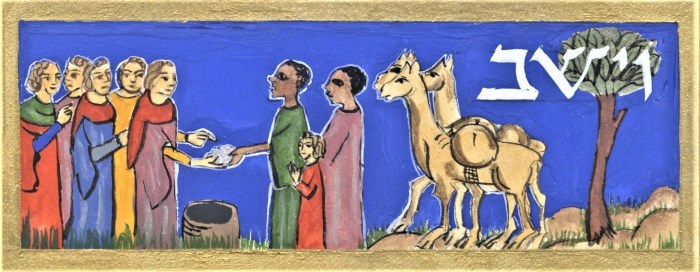
The illustration above is based on a painting in the Sarajevo Haggadah from 1350 Spain. We see the brothers exchanging money with Ishmaelite traders. The brothers are depicted as  Spanish merchants with fair skin and light hair wearing typical clothing of the period. The traders are black, with dark skin and curly black hair.  Joseph, portrayed as a young boy, stands with the foreign traders, begging his brothers to take him back. Camels carry the merchants’ goods.

 This image tells us that the Spanish Jews traded with black merchants traveling from North Africa. It tells us about the clothing of the time and the art produced for the Jewish community. We also learn that today we use the same haggadah that Jews used in medieval Spain and that Pesach was so important that someone commissioned a handwritten, illustrated book to be used at their seder.

Amos’s words and the story of Joseph’s sale were viciously used in history by Roman judges under the emperor Hadrian about 120 CE.  On Yom Kippur, we read about ten righteous Rabbis who were martyred. The Roman judges quoted a law which stated, “Whoever kidnaps a man and sells him, or if the man is found in his possession, must be put to death.” They used Amos, Devarim 24:7,  and the story of Joseph as an excuse to torture the ten Rabbis.

The story of Joseph took place about 3,500 years ago. Amos’s words in the haftarah, the sin of “selling your brother,” are from around 2,800 years ago. That quote was abused by Roman tyrants 1900 years ago. And then we move to the beautiful Sarajevo Haggadah from 660 years ago, replete with Jewish cultural history. Amos’s message comes through- do not sell your brother. Tragedy will unfold if you don’t treat your family and society with respect and understanding. This is the line through history.

One of the goals in creating my haftarah art pieces is to forge a connection between text, art, and Jewish history. Tanach is alive. Although time continues to pass, we can still learn from our history and know that we are living the history.

Shabbat Shalom, with prayers for the return of all our hostages and a lasting peace. A peace where Am Yisrael lives in unity and safety.

Laya Crust

“ILLUMINATIONS, An Exploration of Haftarah through Art and History” is a collection of all the haftarah pictures you have seen on my blog. The book boasts 82 full-colour pictures. A rich commentary accompanies each painting. To order a book or a haftarah print, go to https://www.haftarah-illuminations.ca/


Leave a comment

Filed under Uncategorized

VaYeitze – And he went out

VaYeitzei SigLadder of Angels   by Laya Crust

VaYetzei is the story of Yaakov’s (Jacob’s)  journey from his parents’ home to his uncle’s tribe in Padan-aram. Rivka sent him to her brother Lavan to find a wife and avoid Esau’s anger.

 On the first night, Yaakov lay down to sleep and dreamt of a ladder reaching up to heaven. Angels ascended and descended the ladder, and God stood above it. God told Yaakov, “I will give you and your descendants the land on which you lie. And your seed will be like the dust of the earth. You will spread abroad to the west, and to the east, and to the north, and to the south…And I am with you and will keep you in all the places you go and will bring you back to this land: for I will not leave you until I have done what I have promised…” (Bereshit/ Genesis 28: 13 – 15)

Yaakov continued his journey to Padan-aram and was tricked into marrying two sisters, his cousins Rachel and Leah. The story continues with his life trajectory over a 20-year period. We read about the birth of eleven sons and one daughter and working for his father-in-law Lavan. Under Yaakov’s management, Lavan’s flocks and wealth increased. Lavan and his sons became suspicious and jealous of his son-in-law. Reading the signals and listening to God’s words, Yaakov realized it was time to go home- to Israel. He returned to the land of his birth.

When he left Lavan’s territory “…angels of God encountered him. When he saw them Jacob said, ‘This is God’s camp’ and named the place Mahanaim.” (Bereshit/ Genesis 32: 2,3)

This parsha is a template for the history of the Jews.

First, there was a struggle causing Jacob to leave to leave his place of birth- just as has happened so many times in our history. God told him that his descendants would spread abroad to the west, the east, the north and the south. And it is so. Jews live in virtually every country and corner of the world.

When Yaakov went to Lavan he was invited to stay and work. Lavan encouraged his son-in-law to stay when he recognized Yaakov’s business acumen. Yaakov’s wealth increased Lavan became suspicious and angry so Yaakov fled with his family. How many times has that happened throughout history? Jews were welcomed to Egypt, Spain, France,  Holland, Germany, England, Poland, Lithuania, and more, where they practised medicine, were traders, and improved the mercantile system. When the population either became jealous of their success or ran into financial difficulty, Jews became scapegoats and were victimized. And the Jews have had to escape unprovoked persecution time and time again.

Yaakov and his wives had thirteen children- each of them unique. Today, we are a people of many unique traditions and interpretations.

It is significant that angels begin and end the narrative. As Yaakov leaves his homeland, he is greeted by angels and God. When God warns him to leave Lavan, the angels meet Yaakov again.

This is a horrifying time. These tragedies can only be attributed to שׂינאת חנם, baseless hatred.  Even in these terrible times, lives in Israel are miraculously protected every day. In these times of terror and upside-down morality, we are accompanied by angels. Many of the angels are our fellow Jews and the people who believe in Israel and Humanity. They bring comfort and healing and help in many different ways. Through donations, cooking, prayer, personal bravery, words and hugs of comfort. Yaakov’s descendants, the Children of Israel, are accompanied by angels of God, but we must keep our hearts and ears open to hear them.

Have a Shabbat Shalom. with love and prayers for peace, Laya

Here are two videos. One from the UN about the silence of women’s rights activists:

And another – Kuloolam singing “Like a Prayer” for our Hostages.

Leave a comment

Filed under Uncategorized

Abraham and Sarah, Living on Our Land

Abraham sent to Canaan

The Book of Abraham   by Laya Crust    (Hand-painted accordion fold book)

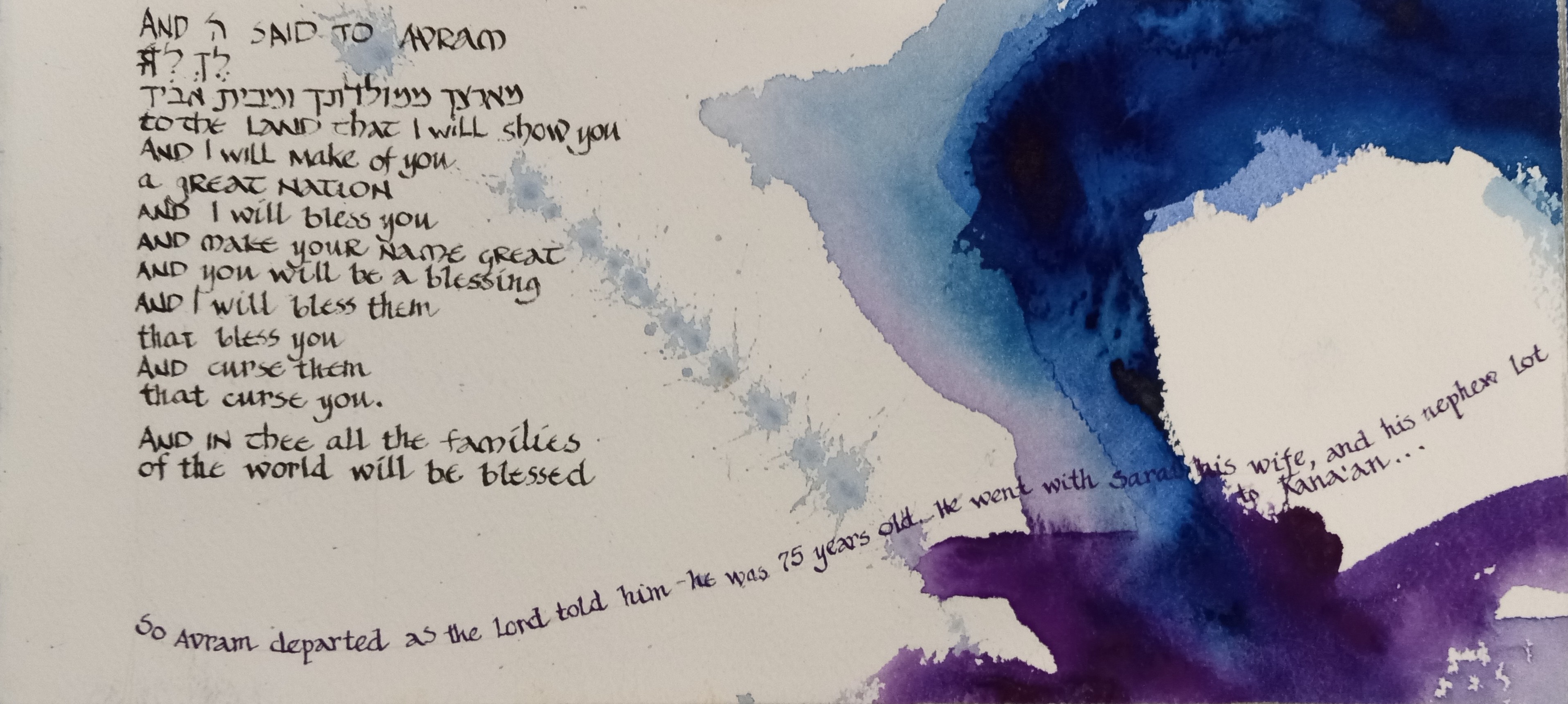
The Torah readings over the last few weeks have featured Abraham and Sarah, the patriarch and matriarch of the Jewish nation. Their story began when God chose Abraham to go to the land of Canaan and start a new nation. The painting above states, “He went with Sarai, his wife, and his nephew Lot to Kana’an.” The parashah begins with Sarah’s death and concludes with Abraham’s death.

Sarah, our matriarch, dies in Qiryat Arba at the age of 127. Abraham comes to mourn and weep for her and to find a fitting burial place for his beloved wife.  He pays for the cave of Machpela even though it has been offered to him as a gift. The text is detailed. “And the field of Efron, which was in Machpela, which was before Mamre, the field, and the cave which was in it,  and all the trees that were in the field, that were in all the borders round about, were made over to Avraham for a possession in the presence of the children of Chet,…before Mamre: the same is Hevron in the land of Canaan.” ( Ch. 23 v 17 -19)

abraham - akeida and hebronThe Book of Abraham  by Laya Crust (Hand-painted accordion fold book)

Avraham pays full price for this small piece of property, also known as Hebron, in front of witnesses so there would never be a question of ownership.

The Cave of Machpelah - Vincent van Gogh

              The Cave of Machpela by Vincent Van Gogh
At the end of this week’s reading Abraham dies and his two sons, Isaac and Ishmael, come together as brothers to bury their father. They mourn together and bury their father in the cave of Machpela, beside Sarah. The two brothers meet in peace and act cooperatively. They bury their father on the land belonging to Abraham.
The biblical Qiryat Arba still exists. It is an Israeli town with about 7,500 residents outside of Hebron. Hebron, mentioned in these Torah readings exists. The Cave of Machpelah exists. The land of Canaan exists. Today Canaan is known as Israel.
Israel is historic Canaan with a modern name. We Jews have lived there longer than any other people.  Jews have owned and lived in the land- Canaan, Palestine, the Turkish Empire, Israel- call it what you will – ever since Abraham bought and owned that parcel 5,000 years ago… Jews owned Israel before 1967, before 1948, before the Balfour Declaration, and before the Zionist movement under Herzl. We owned the land all the way back to the time of Abraham.
We are strong, we are united, and we are right to protect ourselves and our land. I pray our hostages come back soon and that there is no more loss of life, that we will see peace and cooperation in Israel very soon.”
chayi sara map with hebron machpelah-genesisShabbat Shalom,   Laya
partial map of Israel in Abraham’s time

Leave a comment

Filed under Uncategorized

Devarim, 5783

Devarimart by Laya Crust

Devarim/ Deuteronomy     Haftarah- Isaiah I: 1- 27

The parsha Devarim and its haftarah always precede the fast of Tisha B’Av  (the 9th of Av) when we read the Book of Lamentations or איכה .  Michael Mirsky- Torah reader and “leining” teacher extraordinaire-  explained why Devarim is always read before Tisha B’Av.  In the parsha Moses asks,”איכה אשא לבדי טרחכם ומשאכם וריבכם.” “How can I bear unaided the trouble of you, and the burden, and the bickering!” (Devarim 1: 12). As you can see, Moses’ plea  begins with the word איכה – Eicha.

This desolate haftarah is the last of the “Three Haftarot of Rebuke”. Isaiah recounts how God laments that His children – B’nei Yisrael – have rebelled against Him. They are corrupt, their prayers are empty and their sacrifices are meaningless.

Isaiah tells the nation their sins can become white as snow, and the land can become fruitful and full again.  God asks Israel to “Learn to do well; Seek justice, relieve the oppressed, judge the fatherless, plead for the widow.” (Isaiah 1: 17) There is a parallel phrase in the parsha. Moses reminds B’nei Yisrael, “You shall not be partial in judgment: hear the small and the great alike.” (Devarim 1:18) These quotations remind the Israelites to act fairly and care for those who are in need, no matter what station they hold in life.

In searching for an image for this haftarah I wanted something that expressed God’s desire that His children act well and justly.  The care of Jewish refugees in the nascent Israel of 1949 came to mind.

As we know, Jewish immigration to Israel, their ancestral homeland, was severely restricted by the White Paper of 1939. Jewish survivors of the Shoah (Holocaust) had to enter mandate Palestine illegally and if they were caught were sent to D.P.camps. When Israel was declared a state in 1948, thousands of Jewish immigrants and refugees arrived. They needed food, clothing, and shelter.          

Ma’abarot” (or makeshift camps and cities) were set up to temporarily house survivors and refugees. In the early 1950’s they accommodated 130,000 expelled Iraqi Jews. By the end of 1951 there were over 220,000 people in about 125 different areas.

The ma’abarot had problems and were not “perfect” solutions, but they were an attempt to take care of the widows, the orphans, and the needy when Israel was first established.

 The illustration at the top of this post was inspired by a photograph of a ma’abarah in 1952.

B’nei Yisrael was promised the land of Israel, and we have the good fortune to be able to live there today. The direction to judge all people with the same fairness and righteousness, and to take care of all of those in need still stands today. We should be proud of what Israel and Jews internationally have achieved in terms of social justice and care of the sick and needy- but let’s remember to improve the world by being better ourselves.

Have a meaningful fast on the Tisha B’Av fast day. (This year the fast will be on Thursday, the 27th of August.) And let’s keep on making the world a better place!

Best, Laya

P.S. I will be giving a lecture about Tisha B’Av, the Book of Lamentations, and art that illustrates the readings. Join me on ZOOM this Sunday, July 23, 202. The lecture is free, and interesting!

https://www.bac.org.il/en/events/?eventID=18731

https://us02web.zoom.us/webinar/register/WN_A5LicpntRACR2lxB71ztmQ#/registration


1 Comment

Filed under Uncategorized

Masei

Mas'ei The Perilous Desert by Laya Crust

Jeremiah 2:4– 28; 3:4;  4:1-2

Haftarat Masei is called “The Second Haftarah of Rebuke” and is read during the “Three Weeks of Mourning.” (17th of Tammuz to the 9th of Av).  I will discuss several aspects of admonition, Jeremiah the prophet, and parallels between the parasha and the haftarah.

The parasha describes the Israelites’ route as Moses and Aharon led them through the desert. The first 49 psoukim list all the places where they camped.  The next chapter of the parasha (perek 34) delineates the boundaries of the land of Canaan being awarded to B’nei Yisrael.

In the haftarah, the prophet Jeremiah reminds B’nei Yisrael “how God led His people out of the land of Egypt, through the wilderness, through a land of deserts and pits, through a land of drought and of the shadow of death…. And into a land of fruitful fields…” (ch.2: 6,7).  The map above shows the route mentioned in the parasha and the haftarah. The Jews left the green pastures of Goshen in Egypt, walked through the desert for forty years, and arrived in Israel. It was a land green with crops, and flowing with milk and honey.

The prophet Jeremiah lived through a tumultuous time in Jewish history. His life spanned the reign of 5 kings- Josiah, Jehoahaz, Jehoiakim, Jehoiachin, and Zedekiah. It was a time of idolatry and war. Using direct and damning language Jeremiah warned B’nei Yisrael they would be punished for their idol worship. In 586 BCE, the kingdom of Judah was destroyed, and Nebuchadnezzar sacked Jerusalem. The majority of Jews were exiled to Babylon. Jeremiah, who never married and was reviled for his messages, was taken to Egypt. He continued his prophecies from Egypt and died there.

Jeremiah begins this haftarah by reminding B’nei Israel how God brought them to Canaan. Then he describes a litany of B’nei Israel’s sins. At the very end of the haftarah Jeremiah mitigates the message slightly by telling the people that if they return to God “in sincerity, justice and righteousness nations will bless themselves by you and praise themselves by you.”

The haftarah begins with the word “Shim-u”- “Listen” or “Hear” the word of God. The rabbis remind us that these words remind us of “na’asei v’nishma” –we will do, and we will hear- the words B’nei Yisrael used at Sinai to affirm their covenant with God. Another word of note in the haftarah is “Eich”- How? “Eich” is used twice in the haftarah, asking how Israel can have changed so much, turning to sin and base behaviour. This reminds us of the word “Eicha”- the name of the book we read on Tisha B’Av.

I hope we will see peace and unity within Israel. Let these weeks be a time of self-reflection and a path to honesty and security.

Shabbat Shalom, Laya

FYI: I will be giving three ZOOM lectures this July about art and text for the weeks surrounding and including Tisha B’Av. The lectures, hosted by Beit Avi Chai in Jerusalem, will be broadcast live on Sunday, August 16, 23, and 30 at 8:00 p.m. Israel time.

The lectures are free, and you have to register through this link.

Leave a comment

Filed under Haftorah Image

Korach and a Change in Leadership


KorachKorach   art by Laya Crust

I Samuel 11:14- 12:22

Samuel (prophet and judge) 1070 – 970 B.C.E

This Torah reading tells how Korach, a Levi, led a group of people and confronted Moses. They wanted to know why Moses and Aaron were so special, and they wanted a change in leadership. The accompanying haftarah is also about a call for change in leadership.

Samuel was a prophet and judge, and as things turned out he was to be the last of the judges of Israel. The Israelites asked for a King so that they would be like the neighbouring nations. Samuel reluctantly anointed Saul as the first King of Israel in this haftarah. He reminded the people of all God had done for them, and how he had been an honest and caring prophet and leader. He told the children of Israel that they would be punished if they did not listen to God and obey His commandments.

The image I painted shows Samuel advising Saul.  My painting is based on a woodcut in a book from Southern Germany, 1450 called “Meshal ha-Kadmoni” (The Ancient Proverb) written by  Isaac ben Solomon ibn Abi Sahulah.  He was born in 1244 and lived in Guadalajara, in Castile. Isaac ben Solomon was worried about the influence of secular writings on his fellow Jews.  He noted that Jews were reading and being influenced by non-Jewish books. For example, The Voyages of Sinbad the Sailor and Kalila and Dimna- fables from India- were translated into Hebrew and read extensively by Jews in the Middle Ages. Below are two illustrations from an edition of Kalila and Dimna dated 1210 CE.


To counter the effects of these non-Jewish texts, Isaac wrote his own book of stories, poems, fables, and parables. The book was illustrated with miniatures and woodcuts. The “Meshal ha-Kadmoni” was so popular it was reprinted six times in Hebrew and nine times in Yiddish! It was a popular book, but it didn’t stop Jews from reading and loving secular literature.

Samuel was concerned that the people would turn away from God and subconsciously conclude that because they had anointed a King as the leader of their country, they could ignore God’s commandments. Samuel wanted to remind the people that their fate would always be in God’s power. It was the wheat harvest season. After speaking, Samuel called to God, asking for thunder and rain. When the thunderstorm came, the show of force frightened the Israelites. They realized, “…we have added to all our sins to request a King for ourselves…” (Ch 12 v.19).  Although they admitted their error, the statement did not prevent the Israelites from sinning against God as they continued their lives.

People are always looking for a change in power. When the leader is a good leader, the forces of extremism or selfishness want to change the status quo. When someone with poor vision or evil intentions is at the helm, those with good leadership abilities must try to change the direction of politics. It is an important element to have the wisdom to recognize good leadership and bad leadership and to further the goodness.  Let’s all hope for good directions in this crazy world of crazy leadership that seems crazier.

Have a good Shabbat,

Laya

2 Comments

Filed under Uncategorized

Shabbat Zachor

Shabbat Zachor sig

It’s Purim next week, the holiday on which we read the Scroll of Esther. The story of Esther takes place around 480 BCE in Persia. Queen Esther and her Uncle Mordecai foil Haman’s plans to exterminate the Jews of Persia. The Shabbat before Purim is called Shabbat Zachor- the Shabbat of Remembrance. On this special Shabbat we read a section from the Torah about the evil King Amalek.  Amalek instructed his army to attack the  Children of Israel, specifically the defenseless and the weak, as they walked through the desert after leaving Egypt. Amalek is identified as the ancestor of Haman, the villain in the Purim story.

The haftarah recounts a poignant story about King Saul . The prophet Samuel tells King Saul that he is to remember what Amalek did to B’nei Yisrael  (the children of Israel). Saul is to destroy ALL the Amalekites, the young and the old, their animals, and all their possessions. King Saul gathers his warriors, and they go to war.

Saul and his warriors flatten the towns, and kill the inhabitants and their cattle- but he spares Agag the Amalekite king. King Saul’s soldiers spare the choicest sheep, intending to offer some as sacrifices o God. to offer as sacrifices to God. When God sees what has happened, He instructs Samuel to depose King Saul.

The text is powerfully written. Saul, a man with a good heart, does not carry out God’s instructions. Samuel reminds him, “Though you are little in your own sight were you not made head of the tribes of Israel? And the Lord anointed you King?…” Samuel turns his back on the broken king. As Samuel walks away Saul falls to the ground and grabs Samuel’s cloak. The cloak rips in his hand, and Samuel tells Saul, “The Lord has ripped the kingdom of Israel from you this day and given it to a neighbour of yours that is better than you…”

It is a heartbreaking story of a fallen King. The most tragic element is that Saul had never wanted to be king. He wanted to live a simple life but monarchy was thrust upon him. He wasn’t a natural leader. He was a follower. In the battle against the Amalekites Saul he followed the desires of his warriors rather than the commandment of God.

In this week’s maftir (the last paragraph of the Torah reading) we read the commandment to blot out Amalek’s name. We read this just before Purim because tradition tells us that Haman was Amelek’s descendant. As we read we are reminded that in every generation there rises an enemy whom we must fight. We are reminded to have faith in God and listen to God’s teachings.

Read the story. It’s another exciting and emotional incident in our canon. And it’s OUR story. Shabbat Shalom.and have a great Purim.

Laya

ILLUMINATIONSAn Exploration of Haftarah through Art and History is a book of all the haftarah pictures you have seen in my blog. It was published in October and released on November 24, 2022. It boasts 82 full-colour pictures and a rich commentary that accompanies each painting. For more information or to order a book go to https://www.haftarah-illuminations.com/ or to haftarah-illuminations.com

Leave a comment

Filed under Uncategorized

VaYigash 5783

VaYigash This week’s haftarah for the parashah is from the Book of Ezekiel. The prophet Ezekiel (c.622 BCE – 570 BCE) was among the 8,000 Jews exiled to Babylonia after the destruction of The First Temple. He both criticized the behaviour of the Jewish people and encouraged them during a time of despair with his spectacular visions. He was also a  great advocate of individual responsibility. This haftarah’s message is “unity.” God told Ezekiel to take two branches. One represented the nation of Judah, and the other represented the nation of Ephraim, Joseph’s lineage.  The prophet was to polish the branches, carve on them and display them. Ezekiel wrote the following phrases onto the branches: “For Judah and for the children of Israel his companions” on one, and “For Joseph, the stick of Ephraim, and of all the house of Israel his companions” on the other. Ezekiel then held the two branches up in front of a gathering of the exiled Jews. He showed that the two groups could be reunited and grow together as one unified nation. He also told them that God would gather them from among all the nations and return them to their own land, the land of Israel. The text reads, “I will make them one nation in the land, upon the mountains of Israel.” (v. 22) beit horon passage

Photo of the Judean Hills by Yoni Lightstone tour guide

The parashah VaYigash continues the saga of Joseph and his brothers. We have read how Joseph was sold into Egyptian slavery and his father believed he was dead. Joseph rose through Egyptian society to become second in command to the Pharaoh. Now, after many years, the family is reunited. Joseph’s story had begun many years earlier with fraternal jealousy, butthe brothers reunited and rebuilt their family. In earlier Bible stories the siblings did not reconcile. Cain killed his brother Abel. Isaac grew up without his brother Ishmael.  Jacob and Esau never truly reconciled. In this story we see Joseph and Judah build the unified family which would become a nation. Both readings are about unity. In every era and in every generation there are disagreements between different sectors of Jews. The competition for leadership, and the separation of the nations began as early as the story of Cain and Abel. We allow ourselves to be divided by traditions, dress, levels of observance, and politics. We live in frightening times which are difficult to navigate. We witness and experience the Covid-19 epidemic, international terrorism, increased anti-Semitism, tyrannical dictatorships waging war on their citizens and neighbours, slavery, and bizarre weather-related disasters. WHat is most frightening is the divisiveness in the Jewish community. People have become extreme in their views, accusing those on the “other side” of being nasty, dangerous, and untrustworthy. Respectful speech has been discarded. Hatred destroys countries and civilizations. We have to work together to ensure our survival. Just as Joseph and his brothers could forge a better future together, we can do the same. Joseph saved Egypt and its neighbours from starvation through sharing wisdom and strategy. We have the potential to do the same. We are stronger as a united people. With prayers for peace and understanding, Shabbat Shalom,    Laya The painting “Reunited”, showing Ezekiel writing on a branch,  is one of the images in my book, “ILLUMINATIONS.”: I’m excited to introduce you to the newest member of my family. ILLUMINATIONSAn Exploration of Haftarah through Art and History is a book of all the haftarah pictures you have seen in my blog. It was published in October and released on November 24, 2022. It boasts 82 full-colour pictures and a rich commentary that accompanies each painting. For more information or to order a book go to https://www.haftarah-illuminations.com/ or to haftarah-illuminations.com
1 Comment

Filed under Uncategorized