Tag Archives: history

Tetzaveh – Temple Visions

Titzaveh

Temple Floor Plan by Laya Crust

The first forty chapters of the parashah Teztaveh (“You will command”) are dedicated to the High Priest’s clothing. The text describes combining fibres, fabrics, embedded gemstones, bells and tiny pomegranates.

The haftarah is from the Book of Ezekiel. Ezekiel was among the 8,000 Jews exiled to Babylon in 597 BCE. He writes that he is carried by God to the land of Israel. He is set on top of a very high mountain where he sees something like the structure of a city. A man, seemingly made of brass, gives Ezekiel a thorough tour of the future Temple. There are detailed descriptions of each element to be measured and positioned.

We read measurements and the positioning of each holy object in the future Temple. The illustration above is based on a rendering of Solomon’s Temple from an early 12th C. German manuscript illumination. It shows the Temple’s floor plan. All the sacred objects in the floor plan seem to lie on the floor. I used the manuscript drawing because it is so unusual and delightful. It is a charming way for the viewer to see the Temple artifacts. The manuscript is currently in Vienna, Austria in the National Library.

The haftarah begins with the words, “Thou, son of man, describe the house…”

The Jews were miserable. It was the 25th year of their exile in Babylon. God gave Ezekiel an incredible amount of information about the next Temple to share with the Jews. Hearing about the future Temple in Jerusalem, the Jews were optimistic that they would indeed return to their homes. A provision accompanied the details and plans. The Temple would only be restored if the Jews were repentant and corrected their behaviours and observances.

We will fast-forward almost 2,550 years. Under Jordanian rule, Jews were forbidden to pray at the Western Wall from 1948 until 1967. When Israeli forces liberated Jerusalem in 1967, Jews were once again free to go to the Kotel, the only remaining wall of the Second Temple. We don’t have a Third Temple, but we have a unified Jerusalem, and we can pray at the Kotel.

The Temple Mount is the holiest place of Judaism. The Kotel is the only remaining wall of the Temple’s encompassing structure. This remnant of the Temple is proof of our history, our commitment to God and Judaism, and our right to Jerusalem and Israel. This remnant of the Temple is a place where all Jews can speak to God in their own way.

Today we are fighting for our survival. Every Jew in Israel is fighting for all Jews around the world. Jews outside of Israel are defending Israel, defending democracy, and defending our religion. it is a difficult time, but we will retain our courage, our compassion, and our right to our land.

עם ישראל חי, and BRING OUR HOSTAGES HOME.

May you have a Shabbat Shalom-one of peace, understanding and warmth.

Laya

My illustrations and commentaries of all 82 haftarot can be ordered from www.haftarah-illuminations.ca as a book, a print, or a p[oster.

Leave a comment

Filed under Uncategorized

Sukkot and the Yom Kippur War

Valley of Tears by Laya Crust

This Shabbat, we will read a challenging haftarah from the Book of Ezekiel. Ezekiel describes the war of Gog and Magog in great detail as a cataclysmic event involving earthquakes, fires, and weapons. He describes the horrendous punishment of Israel’s enemies, threatening that their bodies will be carrion for the predators in the countryside.

Ezekiel is speaking to the exiled Jews in Babylon. The prophecy is to tell them they will overcome their oppressors, and they will once again control their own land. Those who plan to plunder and destroy the Jews will instead be destroyed by the Jews.

It is 50 years since the Yom Kippur War of 1973. It was a brutal war. Many young Israeli soldiers lost their lives protecting their country from the enemies surrounding them. One battle echoes the prophecy that we will read this Shabbat of Sukkot. It was a miraculous victory for the Israelis against Syria’s superior army.

The Syrians attacked the Israelis in a valley south of Mount Hermon called “Emeq haBacha,” The Valley of Tears. It is the name given to an area in the Golan Heights. It was the site of a major battle in the Yom Kippur War. At one point, fewer than forty Israeli tanks faced approximately 500 Syrian tanks. On the fourth day of the battle, the Israeli force was down to about a dozen tanks and almost out of ammunition. The Syrians retreated. They had received incorrect intelligence.

The battle ended on October 9, 1973, one day before Sukkot began. This photograph is from that battle during the Yom Kippur War. The haftarah painting at the top of the post shows plumes of smoke coming from Syria in the north and the remains of Syrian tanks in Emeq HaBacha. The defeat of the Syrian tank corps was as miraculous as the Ezekiels’s prophecy. The painting is also meant to represent the destruction of Gog and Magog.

We are blessed to have the Land of Israel, and to be protected by the young men and women who serve in the Israeli Defence Forces. It is important to remember the sacrifices of the past and the miracles that allowed Israel to survive and thrive. We should all celebrate the coming holidays – and regular days – with appreciation and gratitude.

Have a lovely Shabbat, Shemini Atzeret, Simchat Torah, and Canadian Thanksgiving.

Laya

“”ILLUMINATIONSAn Exploration of Haftarah through Art and History” is a collection of all the haftarah pictures you have seen on my blog. The book boasts 82 full-colour pictures. A rich commentary accompanies each painting. To order a book or a haftarah print, go to https://www.haftarah-illuminations.ca/

Leave a comment

Filed under Uncategorized

Va’Eira, Brotherhood

Confronting Egypt by Laya Crust

This week’s Torah portion presents the first wave of plagues against Pharaoh and the Egyptians. At the beginning of the Torah reading, Gd talks to Moses tracing His relationship back to Abraham, Isaac, and Jacob. Gd points out to Moshe that He is more open to Moshe than He had been to his forefathers. This link between Moshe and Gd allows Moshe to fully act as an agent of redemption and miracles.

There are parallels and contrasts between the Book of Genesis and the Book of Exodus. The most glaring contrast is the role of family in the two books. There are many stories of brothers and their relationships with each other. Sibling relationships in the Book of Genesis are fractious, but in the Book of Exodus (Shemot), there is family unity.

Cain murders his brother Abel. Isaac is kept away from his half-brother, Ishmael. Jacob and Esau have a relationship founded on deceit.

Family Dynamics by Laya Crust

The other story we all know is the jealousy of Jacob’s 10 sons toward his favourite child, Joseph.

A Grievous Sin by Laya crust

At first, they plan to kill Joseph but then soften their stance and merely sell him into slavery. Of course, slavery was probably a death sentence.

That is the family dynamic in the history of the fledgling Jewish nation. Abraham was selected to lead a new people who would follow Gd’s laws and ethics. The story we read in Va’Era, this week’s parashah, is about Abraham’s descendants enslaved in Egypt, but with a change in that family dynamic.

We are introduced to Moshe, a man who risks everything to save his brethren. He is not jealous or arrogant and welcomes his brother Aaron as an equal. Aaron, three years older than Moshe, takes the lesser role, allowing his younger brother to lead the way. The two men accept Gd’s direction. Their partnership allows them to stand before the ruler of Egypt and free their brethren. Miriam is Moshe and Aaron’s sister. She is the sister who risked everything to save her baby brother Moshe from certain death. Later Miriam joins her brothers and becomes a leader of the people in her own right.

It is a beautiful contrast to the painful relationships in the Book of Genesis. It is a lesson that if we act as caring partners, and work in cooperation for the good of the community/ city/ country/ world, we can make monumental changes for freedom and equality.

Shabbat Shalom,

Laya

The illustrations you have seen in this post are part of the upcoming book “ILLUMINATIONS”. Stay tuned for the 2022 publication!

If you would like to get weekly reminders of these blog posts just click on the “Follow” notice in the top right hand corner.

Leave a comment

Filed under Uncategorized

B’ Ha’alotecha- “Not by Might nor by Power”

BehaalotchaTemple Menorah by Laya Crust

At the beginning of this week’s Torah reading, the menorah is described and Aaron is commanded to light it. In the haftarah reading, Zechariah describes the golden menorah. Zechariah was a prophet in Jerusalem around the year 520 BCE.  The Jews had been exiled to Babylon but under King Cyrus were allowed to return to Jerusalem. Zechariah and the prophet Haggai encouraged the people to stop being so despondent and start rebuilding their destroyed temple.

Zechariah by Michelangelo, Sistine Chapel

This haftarah is replete with angels- angels talking to Joshua and angels talking to and waking Zechariah.  Zechariah tells the angel that he has had a vision of a golden menorah flanked by two olive trees. A bowl above the menorah has seven pipes funneling olive oil to the menorah.  When the angel realizes that Zechariah doesn’t understand the symbolism of the vision he explains that the trees represent the leadership of Joshua the High Priest and Zerubbabel the governor in building the Second Temple. The angel says, “Not by might nor by power, but by My Spirit, says the Lord of hosts.” meaning that the reestablishment of the Jewish people will come through faith, not war.

This parsha and haftarah are timely readings. We are living during a frightening pandemic, international violent unrest some of it instigated by the treatment of blacks in America, and negativity towards Israel and her desired steps for greater sovereignty over her ancestral land. The readings teach that we must take the initiative and move forward to make progress in our lives. On one hand, just complaining or protesting will not improve a situation. On the other, sitting back and expecting Gd to make the changes is not the right way either.

The Jews in the desert complained about their diet (“But the multitude among them began to have strong cravings. Then even the children of Israel once again began to cry, and they said, ‘Who will feed us meat?'” Numbers 10:4).  They should have looked to see how they themselves could satisfy their hungers and cravings. The Jews returning to Jerusalem were despondent. When they returned from exile they were pushed by Zechariah and Haggai to take action and rebuild their Temple to Gd. In that way, they could reclaim their lives and their history.

We have to recognize our responsibility to participate in our future, but we also have to recognize that if we move forward with faith and integrity Gd will help us. Ignoring the respect and mitzvot entrusted to us will cause us to be defeated. “Not by might nor by power, but by My Spirit, says the Lord of hosts.” (Zechariah 4:6)

Cervera, Spain, c. 1300

My illustration at the top was based on this beautiful manuscript painting from Spain, with the menorah painted in gold leaf. The menorah was a central fixture in the Temple and was lit by the Kohanim. The wicks of the menorah were arranged to shed light in one flame. That light can be seen as the light we bring to the world.

On that thought, may you have an illuminated week and weekend, full of flaming conversation and bright ideas. Let’s keep on working to make the community and the world better!

Have a good Shabbat, Laya

4 Comments

Filed under Uncategorized

Va’Eira, Brotherhood

Confronting Egypt by Laya Crust

This week’s Torah portion presents the first wave of plagues against Pharaoh and the Egyptians. At the beginning of the Torah reading, Gd talks to Moses tracing His relationship back to Abraham, Isaac, and Jacob. Gd points out to Moshe that He is more open to Moshe than He had been to his forefathers. This link between Moshe and Gd allows Moshe to fully act as an agent of redemption and miracles.

There are parallels and contrasts between the Book of Genesis and the Book of Exodus. The most glaring contrast is the role of family in the two books. There are many stories of brothers and their relationships with each other. Sibling relationships in the Book of Genesis are fractious, but in the Book of Exodus (Shemot), there is family unity.

Cain murders his brother Abel. Isaac is kept away from his half-brother, Ishmael. Jacob and Esau have a relationship founded on deceit.

Family Dynamics by Laya Crust

The other story we all know is the jealousy of Jacob’s 10 sons toward his favourite child, Joseph.

A Grievous Sin by Laya crust

At first, they plan to kill Joseph but then soften their stance and merely sell him into slavery. Of course, slavery was probably a death sentence.

That is the family dynamic in the history of the fledgling Jewish nation. Abraham was selected to lead a new people who would follow Gd’s laws and ethics. The story we read in Va’Era, this week’s parashah, is about Abraham’s descendants enslaved in Egypt, but with a change in that family dynamic.

We are introduced to Moshe, a man who risks everything to save his brethren. He is not jealous or arrogant and welcomes his brother Aaron as an equal. Aaron, three years older than Moshe, takes the lesser role, allowing his younger brother to lead the way. The two men accept Gd’s direction. Their partnership allows them to stand before the ruler of Egypt and free their brethren. Miriam is Moshe and Aaron’s sister. She is the sister who risked everything to save her baby brother Moshe from certain death. Later Miriam joins her brothers and becomes a leader of the people in her own right.

It is a beautiful contrast to the painful relationships in the Book of Genesis. It is a lesson that if we act as caring partners, and work in cooperation for the good of the community/ city/ country/ world, we can make monumental changes for freedom and equality.

Shabbat Shalom,

Laya

The illustrations you have seen in this post are part of the upcoming book “ILLUMINATIONS”. Stay tuned for the 2022 publication!

If you would like to get weekly reminders of these blog posts just click on the “Follow” notice in the top right hand corner.

Leave a comment

Filed under Uncategorized

Sarah and the Divine

VaYeira Sig
art by Laya Crust

Vayeira- Genesis 18 – 22 Haftarah- Kings II, ch. 4: 1-37

This week’s parsha is a series of at least five incredible narratives, each worthy of detailed study. Today I will focus on Sarah, the woman chosen to be the mother of the Jewish nation.

When Gd told Avraham to leave his homeland and that he would become the father of a great people, he left Ur Kasdim, taking his wife Sarai and his nephew Lot with him. Sarai was 75 years old when she and her husband left their home for an unknown destination. She was described as beautiful- so beautiful that King Avimelech took her to his harem. We may wonder how a woman of 75 can be that appealing, but some have an ageless beauty that is enhanced by grace and wisdom.

etching by Laya Crust

Gd chose Sarai to be the mother of His nation. Her name was changed from Sarai to Sarah at the same time Avram’s name was changed to Avraham. Twice Gd protected her from the leaders of alien nations- first from the pharaoh of Egypt and later from Abimelech, the king of Gerar. After Sarah suggested that her handmaiden bear a son to Avraham Gd made it clear to Avraham that Sarah was to be the matriarch of the nation and that no other woman would fulfill that role.

In this parsha, the Lord told Avraham that he and the men in his group would need to be circumcised. Then Gd had told Avraham that he and Sarah would have a child together. It seemed so ridiculous Avraham fell on his face and laughed. Gd declared that the baby would be called Isaac, after the Hebrew word “to laugh”.

The circumcision was, and is, the sign of the covenant between Gd and the Jewish people. Sarah did not become pregnant until after Abraham was circumcised. As a dear friend pointed out, the covenant between Jews and Gd had to be initiated before the line of the Jewish people was created.

Abraham and Sarah by Marc Chagall

Like Avraham, Sarah laughed when she heard she was to bear a child at the age of 90. When Sarah laughed “within herself” Gd asked Avraham why she had laughed. The question was actually two questions. Did Avraham not tell his wife and partner that she was to become pregnant and have a child? Is that why she was incredulous and laughed? The second question was – why did Avraham and Sarah still not believe that Gd can make unusual and unexpected things happen? The Torah and commentaries seem to criticize Sarah for laughing when she heard the news, but the rebuke wasn’t just to Sarah. It was to Abraham as well. That whole incident can be seen as a larger conversation Gd had with Sarah, the future matriarch.

There are many criticism of Sarah and her attitude towards Hagar. We can’t judge. Life and community were very different in biblical times. Recognizing her infertility Sarah offered her handmaid Hagar to her husband, hoping that way he would become a father. Recognizing Hagar’s behaviour Sarah handled the situation as she thought she had to. When the three angels appeared at their tent in the desert Avraham and Sarah worked as a team to create a feast for them. It appears that Sarah ran her community with wisdom and level-headedness.

May we learn from Sarah’s strengths and have wisdom in dealing with our challenges.

Have a Shabbat Shalom, Laya

The illustration at the top of the page is from the haftarah of VaYeira. It shows the prophet Elisha with the Shunammite woman who had a room built for him for when he visited Shunem. This woman, like Sarah, was childless for many years. Her son, like Isaac, almost died. Unlike Sarah, she was able to watch her son grow to adulthood.

The print is from my collection of 82 paintings of the haftarot. The collection is currently on display at Beth Tedec Synagogue in Toronto, Canada. The address is 1500 Bathurst Street. The exhibit is free and open to the public 7 days a week, 9 a.m. through 9 p.m. I am currently working on a book focusing on the haftarah paintings and their meanings.

1 Comment

Filed under Uncategorized

Mattot- Masei

Jeremiah’s Despair Laya Crust

It is the height of summer and we are observing a period of mourning leading up to Tisha B’Av, the day commemorating the destruction of the First and Second Temples. There are three “Haftarahs of Rebuke” which are read in the three weeks preceding Tisha B’Av, all words from the prophet Jeremiah. On this week’s Shabbat we read two parshas: Mattot and Masei.

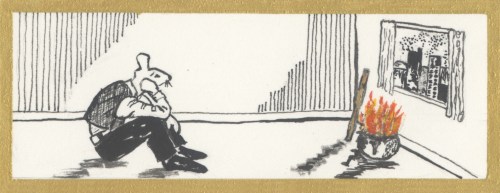
Jeremiah was a prophet whose life spanned the reign of 5 kings. It was a tumultuous time in Jewish history, a time of idolatry and war. Jeremiah warned B’nei Yisrael that they were going to be punished for their idol worship, . At the end of his life, in 586 BCE, Judah was destroyed and Jerusalem was sacked by Nebuchadnezzar. Jeremiah, who was reviled for his messages, escaped to Egypt but the majority of Jews were exiled to Babylon. The illustration I created for Mattot is an homage to Art Spiegelman’s “Maus”. I have drawn Jeremiah looking out of his window watching his beloved city’s destruction.

The path the Israelites followed from Egypt to Canaan is described in great detail in the first 49 verses of the parsha Masei. It was a long and arduous journey for the Israelites and they strayed from Gd’s lessons throughout.

The Perilous Desert Journey Laya Crust

In the haftarah of Masei the prophet Jeremiah reminded B’nei Yisrael how Gd led His people “out of the land of Egypt, through the wilderness, through a land of deserts and pits, through a land of drought and of the shadow of death…. And into a land of fruitful fields…” (ch.2: 6,7). 

There is negativity and sadness in the haftarah. Jeremiah reminded B’nei Israel of the difficult trek through the desert and how Gd protected and took them to the Promised Land. Then Jeremiah describes B’nei Yisrael’s sins. At the very end of the haftarah Jeremiah mitigates the message slightly by telling the people that if they return to Gd “in sincerity, justice and righteousness nations will bless themselves by you and praise themselves by you.”

The word “איך”- How? is used twice in the haftarah asking how Israel can have changed so much, turning to sinning and base behaviour. This reminds us of the word “איכה”- the Hebrew word for “Lamentations”. On the Ninth of Av we will read the book of “Lamentations”.

Messages from the haftarah still resonate today. We are blessed to be in the “Land of Milk and Honey”, creating, cultivating, and helping nations in need. During these three weeks Jews all over the world will read Jeremiah’s words and hopefully try to improve themselves and society around them. Have a good week, and let’s look forward to a time of jubilation and more positive growth.

The artwork featured in this and most of my blogs is part of a collection of art created to illustrate the haftarahs read throughout the year. Currently the collection is on exhibit at the Beth Tzedec Synagogue in Toronto, Canada. It is a great exhibit of my work and will be on display to the end of December, 2019. And, to let you know, I am currently working on a book of the art pieces and accompanying commentary. Exciting!!!! Have a Shabbat Shalom, Laya

Leave a comment

Filed under Uncategorized

Marriages and Weddings

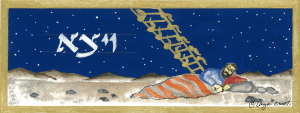
Jacob’s Dream  by Laya Crust

This week’s parsha, VaYeitze, tells the story of Jacob’s time in Padan Aram from start to finish. He left his family in Be’er Sheva to escape his bother’s wrath and seek a wife among his mother’s family. When he decided to return home he had two wives, two concubines, twelve sons and one daughter plus cattle and wealth.

When Jacob arrived in Padan Aram he saw his cousin Rachel at a well and fell in love with her. He promised to work for seven years for her hand in marriage. He was tricked by his Uncle Lavan and the morning after the wedding he discovered he had married Leah, the older sister. So Jacob worked an additional seven years in order to marry his beloved Rachel.

In this story we see the foundation of certain elements of the traditional Jewish marriage ceremony. Before the wedding ceremony under the chuppah we have the “Bedecken” when the groom sees the bride’s face before lowering her veil. This is to ensure the groom marries his chosen bride, and avoids the trick played on Jacob. As in ancient times there is an exchange of goods between the two families. The bride brings a dowry and the groom gives something of value to the bride’s family. In Isaac’s case his proxy, Eliezer, gave precious silver and gold and “raiment” to Rebecca’s family. In Jacob’s case he didn’t have valuables so he pledged to work for seven years for each of his brides.

Florentine Ketubah by Laya Crust

Over 2,000 years ago Jews began to use a written marriage contract. The ketubah, meaning “writ” in Hebrew, records the date and place of the wedding, the names of the bride and groom, and the financial obligations of each family. This legal document was the first legal document in history designed to ensure financial stability for a married woman.

Throughout time couples started to get decorated ketubahs. Now it is very popular for a couple to commission an original, hand written and painted ketubah, or to buy a poster-type ketubah on line.

I’ve been making ketubahs for decades and have designed and painted over 600 of them! The ketubah in still written in the ancient language of Aramaic and still mentions dowry and the husband’s responsibilities towards his wife and her well being.  Some traditions use actual dollar values and some ceremonially use ancient currencies.


Joy by Laya Crust ——- Tova and Cliel’s Stairway to Heaven by Laya Crust

Leah and Rachel, Jacob’s wives, didn’t have a ketubah. They were fortunate to be married to a man who took care of them and their children, honoured his obligations to his father-in-law, and was able to feed and shelter his large family. It’s true- there were jealousies and difficulties, but Jacob did take care of his own.

I love making ketubahs- discovering a couple’s dreams and preferences. If you want to see more examples of my ketubahs, maybe even order one or commission your own, take a look at my website: www.layacrust.com. 

Make sure to read this week’s Torah portion and enjoy. It’s the beginning of a world altering family saga! Have a Shabbat Shalom,

Laya


Leave a comment

Filed under art, Haftorah Image, Uncategorized

Bill Glied z”l

Image result for bill gliedBill Glied z”l,  1930 -2018

We are reading the first stories in the Book of Genesis, ספר בראשית.  After creating the world and creating humankind with the gift of free will, God saw that free will wasn’t a trait that always would be used for good purposes. Rather than using their choices for beauty and good, some of humanity showed themselves to be envious, greedy, violent,  and, well murderous. God found a man, Abraham, who had integrity and searched for truth. Together Abraham and his wife Sarah were chosen to begin a new nation, God’s chosen people the Jews.

In the Torah readings of “Lech Lecha” and VaYeira” we read some of the challenges that God put before Abraham. One of those tests was “Akeidat Yitzchak” the binding and threatened sacrifice of Abraham and Sarah’s precious son Isaac. There were personal repercussions, but Abraham retained his faith in God and his descendants are the Jewish people of today.

Bill Glied wrote the following poem which he read when he led groups to the concentration camp of Majdanek:

Bill Glied z”l was a wonderful man of faith. He was born  in 1930 in the town of Subotica, Serbia. In April of 1944 Hungarian gendarmes rounded up more than 400,000 Jews. Bill Glied and his family were among those Jews and were transported in cattle cars to Aushcwitz. His mother and 8 year old sister were killed immediately. He and his father were sent to a camp in Bavaria where they worked for 12 hours a day to build an underground airplane factory. Bill survived the camps and the war but tragically his father died of typhoid fever eight days before U.S. troops liberated the camp in 1945.

Bill was not a bitter man and devoted a great deal of time to teaching youth about the Holocaust, and making sure that the tragedy will not be forgotten.

He wrote a beautiful poem, “I AM A JEW” as a wake-up call and an inspiration to others.”I AM A JEW” is a lesson, a guideline, for what we, as Jews, are. It describes the best that we can strive for. It outlines the traits we should cultivate and can achieve.

I was honoured to be asked to write out the poem,  With the family’s permission I am reprinting it and showing the illustrated poem.

Bill Glied came to Canada in 1947,  and married Marika Nyiri in 1959. They had three daughters, Sherry, Tammy, and Michelle, eight grandchildren, and a great grandchild. His family carries on Bill’s love of the world and let’s all ensure that his name will be remembered as a blessing.

Have a Shabbat Shalom,   Laya

bill glied_20181025_0001 (3)

6 Comments

Filed under art, Haftorah Image, Uncategorized

Days of Awe 5777

ShabbatShuva sigart by laya Crust

Haftarah:   Hosea 14:2-10,   Micah 7:18-20,   Joel 2:15-27

This year I was at my wonderful little shul where we have the most beautiful tefillot (prayers) imaginable. Every year we are treated to the niggunim  (tunes) and heartfelt prayers that come from the souls of two wonderful brothers. Aaron and Jeremy have been leading us in prayers and shofar blowing for many years.

I based my painting at the top of the page on a piece by the American Artist Ben Shahn. His life was dedicated to human rights and social action, and he expressed that through his prolific art works. His paintings, graphic art, photographs and essays are devoted to the “human condition”.  The strength of human beings to survive difficulty and stand tall in the face of  adversity and unfairness runs through his works. I love the music and the movement he brings to his compositions.

Image result for ben shahn paintingsImage result for ben shahn poster

Shahn’s work communicates the struggle of the human spirit to succeed, not just to survive. He paints individuals and groups overcoming the destruction of their homes and their belongings…but continuing in spite of it. He represents those who are trodden upon but rise up in spite of it. He reminds us that we don’t live in a bubble. We must care for ourselves and those around us. Those are among the meditations of Rosh HaShana.

We are reborn each day. Each day we have the opportunity to make new choices and make them good choices. Each day we can forgive ourselves for what we didn’t do yesterday, or what we wish we had done differently. We can begin anew and strive to have a fulfilling day.

I take it back to the painting at the beginning of this post. The sound of the shofar is the sound of remembrance. It is the sound of Gd’s “still, small voice” that resides inside us. It is the sound of faith and of fighting for what is right. We all- regardless of race or colour- can hear the still, small voice, and carry it with us.

 Rosh HaShana and Yom Kippur are “The Days of Awe”.  They are a gift that we as Jews were given in order  to reflect on our values and our goals.

Enjoy this time and have a wonderful Shabbat.

with blessings for a good year of peace, joy and health,

Laya


Leave a comment

Filed under Uncategorized