Tag Archives: Jerusalem

Tetzaveh – Temple Visions

Titzaveh

Temple Floor Plan by Laya Crust

The first forty chapters of the parashah Teztaveh (“You will command”) are dedicated to the High Priest’s clothing. The text describes combining fibres, fabrics, embedded gemstones, bells and tiny pomegranates.

The haftarah is from the Book of Ezekiel. Ezekiel was among the 8,000 Jews exiled to Babylon in 597 BCE. He writes that he is carried by God to the land of Israel. He is set on top of a very high mountain where he sees something like the structure of a city. A man, seemingly made of brass, gives Ezekiel a thorough tour of the future Temple. There are detailed descriptions of each element to be measured and positioned.

We read measurements and the positioning of each holy object in the future Temple. The illustration above is based on a rendering of Solomon’s Temple from an early 12th C. German manuscript illumination. It shows the Temple’s floor plan. All the sacred objects in the floor plan seem to lie on the floor. I used the manuscript drawing because it is so unusual and delightful. It is a charming way for the viewer to see the Temple artifacts. The manuscript is currently in Vienna, Austria in the National Library.

The haftarah begins with the words, “Thou, son of man, describe the house…”

The Jews were miserable. It was the 25th year of their exile in Babylon. God gave Ezekiel an incredible amount of information about the next Temple to share with the Jews. Hearing about the future Temple in Jerusalem, the Jews were optimistic that they would indeed return to their homes. A provision accompanied the details and plans. The Temple would only be restored if the Jews were repentant and corrected their behaviours and observances.

We will fast-forward almost 2,550 years. Under Jordanian rule, Jews were forbidden to pray at the Western Wall from 1948 until 1967. When Israeli forces liberated Jerusalem in 1967, Jews were once again free to go to the Kotel, the only remaining wall of the Second Temple. We don’t have a Third Temple, but we have a unified Jerusalem, and we can pray at the Kotel.

The Temple Mount is the holiest place of Judaism. The Kotel is the only remaining wall of the Temple’s encompassing structure. This remnant of the Temple is proof of our history, our commitment to God and Judaism, and our right to Jerusalem and Israel. This remnant of the Temple is a place where all Jews can speak to God in their own way.

Today we are fighting for our survival. Every Jew in Israel is fighting for all Jews around the world. Jews outside of Israel are defending Israel, defending democracy, and defending our religion. it is a difficult time, but we will retain our courage, our compassion, and our right to our land.

עם ישראל חי, and BRING OUR HOSTAGES HOME.

May you have a Shabbat Shalom-one of peace, understanding and warmth.

Laya

My illustrations and commentaries of all 82 haftarot can be ordered from www.haftarah-illuminations.ca as a book, a print, or a p[oster.

Leave a comment

Filed under Uncategorized

VaYigash – UNITY

Joseph0002Joseph’s Journey   by Laya Crust

The parashah VaYigash continues the saga of Joseph and his brothers. Joseph was sold into Egyptian slavery and rose through Egyptian society to become second in command to the Pharaoh. Now, after many years, the family is reunited. Although Joseph’s story had begun many years earlier with fraternal jealousy, the brothers allow themselves to reunite and rebuild their family. In the earlier Bible stories, the siblings did not reconcile. Cain killed his brother Abel. Isaac grew up without his brother Ishmael. Jacob and Esau never truly reconciled. In this story, we see Joseph and Judah rebuild the family, which would eventually become the nation of Israel, the Jewish people.

VaYigashReunited   by Laya Crust

The haftarah also speaks of unity. The prophet Ezekiel appeals to the Children of Israel to reunite. Ezekiel (c.622 BCE – 570 BCE) was among the 8,000 Jews exiled to Babylonia after the destruction of The First Temple. In this reading, he theatrically foretells the reunification of the nation of Israel. Ezekiel takes two branches as instructed by God. One represents the nation of Judah, and the other represents the nation of Ephraim, Joseph’s lineage.  The prophet writes, “For Judah and for the children of Israel his companions” on one branch, and “For Joseph, the stick of Ephraim, and of all the house of Israel his companions” on the other. Ezekiel then holds the two branches together, forming a single entity. He says that the Jews can reunite and become a unified nation, and that God will gather them from exile and return them to the land of Israel. The text reads, “I will make them one nation in the land, upon the mountains of Israel.” (v. 22) Jerusalem Nahal_Sorek_Panorama

Judean Hills

Both readings are about unity. This is a timely theme. Israelis and Jews around the world have been deeply divided about many things. They were particularly divided about the direction of the Israeli government. Our Jewish world was crumbling. The horrors of October 7 unified us as a people. Our love for our nation and our country has reignited a Jewish spirit so deep that we are fighting on every front and helping our beleaguered brothers and sisters. And we are winning. Hatred destroys countries and civilizations. We have to work together to ensure our survival. Just as Joseph and his brothers forged a better future together, we will do the same. Joseph saved Egypt and its neighbours from starvation by sharing wisdom and strategy. We have the potential to do the same. We are stronger as a united people. With prayers for our hostages, for our soldiers, and for peace and security, Shabbat Shalom,    Laya ILLUMINATIONSAn Exploration of Haftarah through Art and History is a book of all the haftarah pictures you have seen in my blog. It boasts 82 full-colour pictures and a rich commentary that accompanies each painting. For more information or to order a book go to https://www.haftarah-illuminations.com/ or to haftarah-illuminations.com
Leave a comment

Filed under Uncategorized

Abraham and Sarah, Living on Our Land

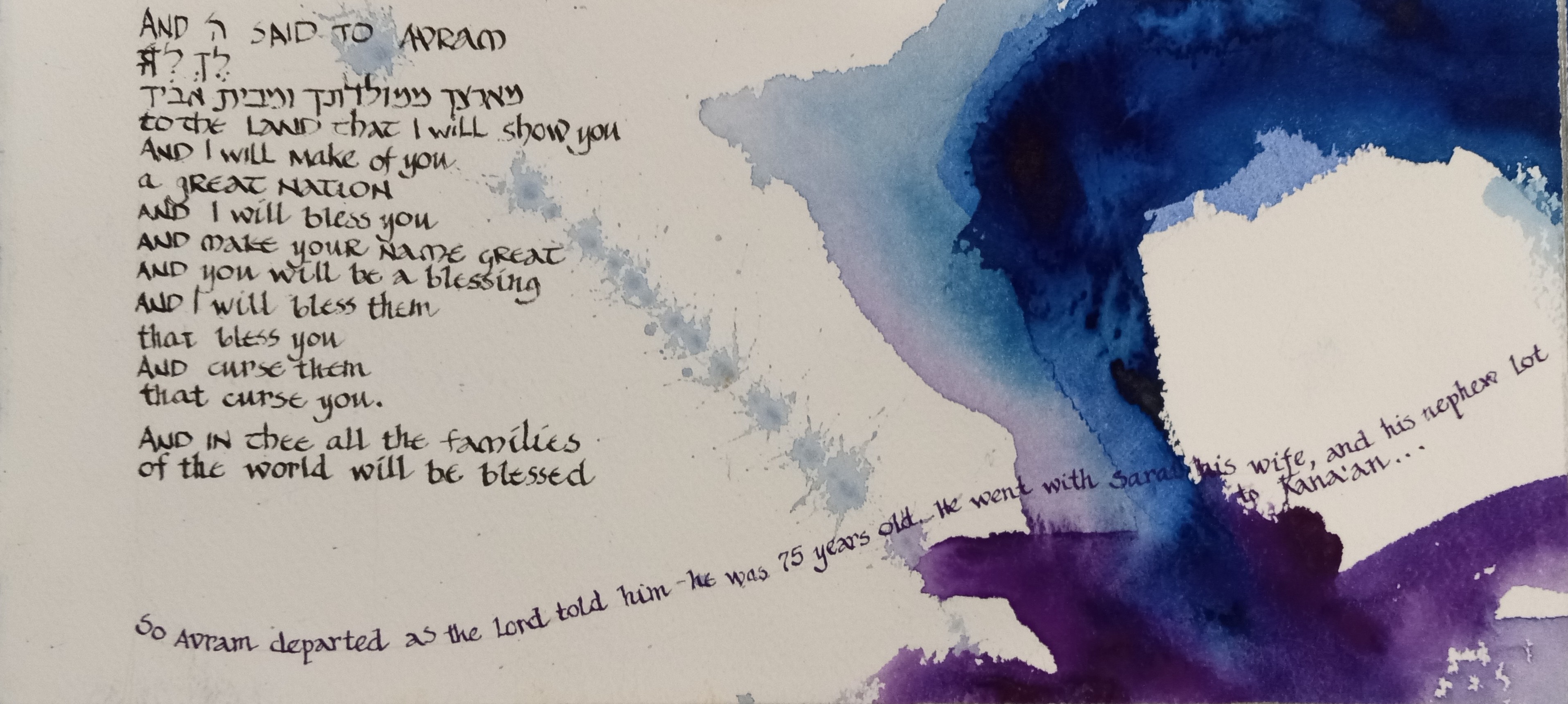
Abraham sent to Canaan

The Book of Abraham   by Laya Crust    (Hand-painted accordion fold book)

The Torah readings over the last few weeks have featured Abraham and Sarah, the patriarch and matriarch of the Jewish nation. Their story began when God chose Abraham to go to the land of Canaan and start a new nation. The painting above states, “He went with Sarai, his wife, and his nephew Lot to Kana’an.” The parashah begins with Sarah’s death and concludes with Abraham’s death.

Sarah, our matriarch, dies in Qiryat Arba at the age of 127. Abraham comes to mourn and weep for her and to find a fitting burial place for his beloved wife.  He pays for the cave of Machpela even though it has been offered to him as a gift. The text is detailed. “And the field of Efron, which was in Machpela, which was before Mamre, the field, and the cave which was in it,  and all the trees that were in the field, that were in all the borders round about, were made over to Avraham for a possession in the presence of the children of Chet,…before Mamre: the same is Hevron in the land of Canaan.” ( Ch. 23 v 17 -19)

abraham - akeida and hebronThe Book of Abraham  by Laya Crust (Hand-painted accordion fold book)

Avraham pays full price for this small piece of property, also known as Hebron, in front of witnesses so there would never be a question of ownership.

The Cave of Machpelah - Vincent van Gogh

              The Cave of Machpela by Vincent Van Gogh
At the end of this week’s reading Abraham dies and his two sons, Isaac and Ishmael, come together as brothers to bury their father. They mourn together and bury their father in the cave of Machpela, beside Sarah. The two brothers meet in peace and act cooperatively. They bury their father on the land belonging to Abraham.
The biblical Qiryat Arba still exists. It is an Israeli town with about 7,500 residents outside of Hebron. Hebron, mentioned in these Torah readings exists. The Cave of Machpelah exists. The land of Canaan exists. Today Canaan is known as Israel.
Israel is historic Canaan with a modern name. We Jews have lived there longer than any other people.  Jews have owned and lived in the land- Canaan, Palestine, the Turkish Empire, Israel- call it what you will – ever since Abraham bought and owned that parcel 5,000 years ago… Jews owned Israel before 1967, before 1948, before the Balfour Declaration, and before the Zionist movement under Herzl. We owned the land all the way back to the time of Abraham.
We are strong, we are united, and we are right to protect ourselves and our land. I pray our hostages come back soon and that there is no more loss of life, that we will see peace and cooperation in Israel very soon.”
chayi sara map with hebron machpelah-genesisShabbat Shalom,   Laya
partial map of Israel in Abraham’s time

Leave a comment

Filed under Uncategorized

Devarim, 5783

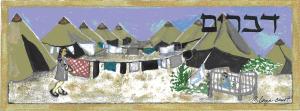
Devarimart by Laya Crust

Devarim/ Deuteronomy     Haftarah- Isaiah I: 1- 27

The parsha Devarim and its haftarah always precede the fast of Tisha B’Av  (the 9th of Av) when we read the Book of Lamentations or איכה .  Michael Mirsky- Torah reader and “leining” teacher extraordinaire-  explained why Devarim is always read before Tisha B’Av.  In the parsha Moses asks,”איכה אשא לבדי טרחכם ומשאכם וריבכם.” “How can I bear unaided the trouble of you, and the burden, and the bickering!” (Devarim 1: 12). As you can see, Moses’ plea  begins with the word איכה – Eicha.

This desolate haftarah is the last of the “Three Haftarot of Rebuke”. Isaiah recounts how God laments that His children – B’nei Yisrael – have rebelled against Him. They are corrupt, their prayers are empty and their sacrifices are meaningless.

Isaiah tells the nation their sins can become white as snow, and the land can become fruitful and full again.  God asks Israel to “Learn to do well; Seek justice, relieve the oppressed, judge the fatherless, plead for the widow.” (Isaiah 1: 17) There is a parallel phrase in the parsha. Moses reminds B’nei Yisrael, “You shall not be partial in judgment: hear the small and the great alike.” (Devarim 1:18) These quotations remind the Israelites to act fairly and care for those who are in need, no matter what station they hold in life.

In searching for an image for this haftarah I wanted something that expressed God’s desire that His children act well and justly.  The care of Jewish refugees in the nascent Israel of 1949 came to mind.

As we know, Jewish immigration to Israel, their ancestral homeland, was severely restricted by the White Paper of 1939. Jewish survivors of the Shoah (Holocaust) had to enter mandate Palestine illegally and if they were caught were sent to D.P.camps. When Israel was declared a state in 1948, thousands of Jewish immigrants and refugees arrived. They needed food, clothing, and shelter.          

Ma’abarot” (or makeshift camps and cities) were set up to temporarily house survivors and refugees. In the early 1950’s they accommodated 130,000 expelled Iraqi Jews. By the end of 1951 there were over 220,000 people in about 125 different areas.

The ma’abarot had problems and were not “perfect” solutions, but they were an attempt to take care of the widows, the orphans, and the needy when Israel was first established.

 The illustration at the top of this post was inspired by a photograph of a ma’abarah in 1952.

B’nei Yisrael was promised the land of Israel, and we have the good fortune to be able to live there today. The direction to judge all people with the same fairness and righteousness, and to take care of all of those in need still stands today. We should be proud of what Israel and Jews internationally have achieved in terms of social justice and care of the sick and needy- but let’s remember to improve the world by being better ourselves.

Have a meaningful fast on the Tisha B’Av fast day. (This year the fast will be on Thursday, the 27th of August.) And let’s keep on making the world a better place!

Best, Laya

P.S. I will be giving a lecture about Tisha B’Av, the Book of Lamentations, and art that illustrates the readings. Join me on ZOOM this Sunday, July 23, 202. The lecture is free, and interesting!

https://www.bac.org.il/en/events/?eventID=18731

https://us02web.zoom.us/webinar/register/WN_A5LicpntRACR2lxB71ztmQ#/registration


1 Comment

Filed under Uncategorized

Korach and a Change in Leadership


KorachKorach   art by Laya Crust

I Samuel 11:14- 12:22

Samuel (prophet and judge) 1070 – 970 B.C.E

This Torah reading tells how Korach, a Levi, led a group of people and confronted Moses. They wanted to know why Moses and Aaron were so special, and they wanted a change in leadership. The accompanying haftarah is also about a call for change in leadership.

Samuel was a prophet and judge, and as things turned out he was to be the last of the judges of Israel. The Israelites asked for a King so that they would be like the neighbouring nations. Samuel reluctantly anointed Saul as the first King of Israel in this haftarah. He reminded the people of all God had done for them, and how he had been an honest and caring prophet and leader. He told the children of Israel that they would be punished if they did not listen to God and obey His commandments.

The image I painted shows Samuel advising Saul.  My painting is based on a woodcut in a book from Southern Germany, 1450 called “Meshal ha-Kadmoni” (The Ancient Proverb) written by  Isaac ben Solomon ibn Abi Sahulah.  He was born in 1244 and lived in Guadalajara, in Castile. Isaac ben Solomon was worried about the influence of secular writings on his fellow Jews.  He noted that Jews were reading and being influenced by non-Jewish books. For example, The Voyages of Sinbad the Sailor and Kalila and Dimna- fables from India- were translated into Hebrew and read extensively by Jews in the Middle Ages. Below are two illustrations from an edition of Kalila and Dimna dated 1210 CE.


To counter the effects of these non-Jewish texts, Isaac wrote his own book of stories, poems, fables, and parables. The book was illustrated with miniatures and woodcuts. The “Meshal ha-Kadmoni” was so popular it was reprinted six times in Hebrew and nine times in Yiddish! It was a popular book, but it didn’t stop Jews from reading and loving secular literature.

Samuel was concerned that the people would turn away from God and subconsciously conclude that because they had anointed a King as the leader of their country, they could ignore God’s commandments. Samuel wanted to remind the people that their fate would always be in God’s power. It was the wheat harvest season. After speaking, Samuel called to God, asking for thunder and rain. When the thunderstorm came, the show of force frightened the Israelites. They realized, “…we have added to all our sins to request a King for ourselves…” (Ch 12 v.19).  Although they admitted their error, the statement did not prevent the Israelites from sinning against God as they continued their lives.

People are always looking for a change in power. When the leader is a good leader, the forces of extremism or selfishness want to change the status quo. When someone with poor vision or evil intentions is at the helm, those with good leadership abilities must try to change the direction of politics. It is an important element to have the wisdom to recognize good leadership and bad leadership and to further the goodness.  Let’s all hope for good directions in this crazy world of crazy leadership that seems crazier.

Have a good Shabbat,

Laya

2 Comments

Filed under Uncategorized

VaYigash 5783

VaYigash This week’s haftarah for the parashah is from the Book of Ezekiel. The prophet Ezekiel (c.622 BCE – 570 BCE) was among the 8,000 Jews exiled to Babylonia after the destruction of The First Temple. He both criticized the behaviour of the Jewish people and encouraged them during a time of despair with his spectacular visions. He was also a  great advocate of individual responsibility. This haftarah’s message is “unity.” God told Ezekiel to take two branches. One represented the nation of Judah, and the other represented the nation of Ephraim, Joseph’s lineage.  The prophet was to polish the branches, carve on them and display them. Ezekiel wrote the following phrases onto the branches: “For Judah and for the children of Israel his companions” on one, and “For Joseph, the stick of Ephraim, and of all the house of Israel his companions” on the other. Ezekiel then held the two branches up in front of a gathering of the exiled Jews. He showed that the two groups could be reunited and grow together as one unified nation. He also told them that God would gather them from among all the nations and return them to their own land, the land of Israel. The text reads, “I will make them one nation in the land, upon the mountains of Israel.” (v. 22) beit horon passage

Photo of the Judean Hills by Yoni Lightstone tour guide

The parashah VaYigash continues the saga of Joseph and his brothers. We have read how Joseph was sold into Egyptian slavery and his father believed he was dead. Joseph rose through Egyptian society to become second in command to the Pharaoh. Now, after many years, the family is reunited. Joseph’s story had begun many years earlier with fraternal jealousy, butthe brothers reunited and rebuilt their family. In earlier Bible stories the siblings did not reconcile. Cain killed his brother Abel. Isaac grew up without his brother Ishmael.  Jacob and Esau never truly reconciled. In this story we see Joseph and Judah build the unified family which would become a nation. Both readings are about unity. In every era and in every generation there are disagreements between different sectors of Jews. The competition for leadership, and the separation of the nations began as early as the story of Cain and Abel. We allow ourselves to be divided by traditions, dress, levels of observance, and politics. We live in frightening times which are difficult to navigate. We witness and experience the Covid-19 epidemic, international terrorism, increased anti-Semitism, tyrannical dictatorships waging war on their citizens and neighbours, slavery, and bizarre weather-related disasters. WHat is most frightening is the divisiveness in the Jewish community. People have become extreme in their views, accusing those on the “other side” of being nasty, dangerous, and untrustworthy. Respectful speech has been discarded. Hatred destroys countries and civilizations. We have to work together to ensure our survival. Just as Joseph and his brothers could forge a better future together, we can do the same. Joseph saved Egypt and its neighbours from starvation through sharing wisdom and strategy. We have the potential to do the same. We are stronger as a united people. With prayers for peace and understanding, Shabbat Shalom,    Laya The painting “Reunited”, showing Ezekiel writing on a branch,  is one of the images in my book, “ILLUMINATIONS.”: I’m excited to introduce you to the newest member of my family. ILLUMINATIONSAn Exploration of Haftarah through Art and History is a book of all the haftarah pictures you have seen in my blog. It was published in October and released on November 24, 2022. It boasts 82 full-colour pictures and a rich commentary that accompanies each painting. For more information or to order a book go to https://www.haftarah-illuminations.com/ or to haftarah-illuminations.com

1 Comment

Filed under Uncategorized

Bo, The Stand-off

Bo sig

Haftarah:  Jeremiah 46: 13-28

This week’s haftarah is from the Book of Jeremiah. Jeremiah lived most of his life in Israel, witnessing both sieges of Jerusalem (597 and 586). In this haftarah, after the fall of the First Temple, he warned the Children of Israel not to ally themselves with Egypt. He prophesied that Egypt would fall to the Babylonians.

In the illustration Egypt {Pharaoh) is being confronted by Jeremiah (Moses). The images Jeremiah uses in his warnings about Egypt are painted in the background. The heifer, gadflies, serpent, locusts, and trees that will be cut down have been painted to look like an Egyptian wall painting. The images the prophet used echo the plagues visited upon the Egyptians in parsahat Bo.

The Egyptians had already experienced 7 plagues. Some were unpleasantly uncomfortable (being overrun with frogs) and some were devastating (pestilence killing the cattle and hail destroying crops). In this week’s parashah, Moshe warned Pharaoh that if he didn’t free the children of Israel there would be even more dire consequences. Three more plagues were to be visited upon the Egyptians. Pharaoh lost patience with Moses. After the plagues of locusts and darkness, he wanted the threats to stop. Bombastically, he proclaimed, “Depart from me, take heed of yourself. Make sure never to see my face again. For on the day you see my face you will die.”  (Exodus 10:28) Moses answered, “You have spoken well. I will not see your face again.” Pharaoh’s threat was answered. He did not ever see Moses’ face again.

Pharaoh had been given opportunities to let the Israelites leave. His pride would not allow Moses to threaten him or speak of a Gd more powerful than he. Pharaoh threatened Moses with death. He would never see Moses again, but he paid a horrific price. His eldest son- and the eldest of all Egyptian families would die. Pharaoh’s decree not to see Moshe’s face again had negative implications and terrible results.

Rabbi Ari Kahn, a rabbi in Israel, points out that children are the focus of the Exodus narrative. Our all-powerful Gd could have freed the Israelites from Egyptian slavery with little pain and fuss. For instance, the plague of darkness immobilized the Egyptians for three days while the Israelites had light. Moses could have led Gd’s people out of Egypt and across the Red Sea without their oppressors even knowing what was happening. Why the elaborate choreography of the plagues?

The cries of pain began with overwork and Pharaoh’s decree to kill newborn Jewish babies. Midwives and mothers risked their own lives to save the babies. The lives of children are precious to Jews. In this parashah Gd tells Moses that our children may forget the story of Egypt, slavery, and deliverance. The seder itself will be the reminder. That reminder will ensure our children’s education and the continuity of our people.

We are told to remember the stranger because we were strangers. We are reminded to remember our past and learn from it. We live in challenging times and hopefully if we remember to be kind to those around us we will get through this period without too many bruises.

Shabbat Shalom, Laya

2 Comments

Filed under Uncategorized

Reunited- VaYigash

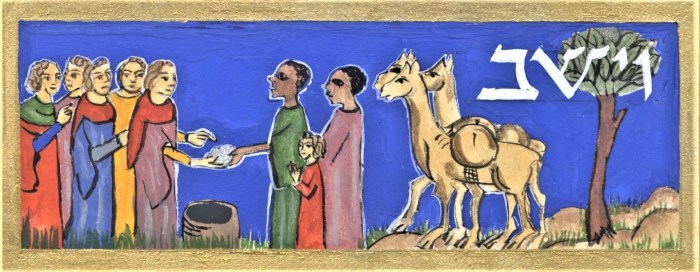
The brothers selling Joseph to passing traders from the parasha VaYigash

For the last number of weeks we have been reading about our ancestors, Jacob’s children. More specifically, we have read about Joseph’s trajectory from favoured son at home, to being a slave, and then to becoming viceroy of all Egypt. By the time he was thirty years old Joseph ruled Egypt. He ran the finances and oversaw all of Egypt’s policies.

In this week’s Torah reading Joseph’s brothers still did not know that the leader they were speaking to was their brother. This parsha begins just after Benjamin had been “framed”. Joseph’s personal silver chalice had been “planted” in Benjamin’s belongings, and the Israelite brothers had been told that Benjamin would become enslaved to Pharaoh’s court as payment for the infraction. Joseph was playing a game with his brothers.

English: Joseph Converses With Judah, His Brot...Joseph Converses With Judah, His Brother, c. 1896-1902
 by James Jacques Joseph Tissot    (Photo credit: Wikipedia)
 
 
Judah, The same brother who decades earlier had suggested Joseph be sold rather than be killed, begged for understanding. He pouredout his heart to the great Egyptian before him. Judah hoped that by telling this regent of his father’s heartbreak and frailty the leader might accept Judah as a slave rather than take his youngest brother. 
 

Joseph could carry on the charade no longer. He cleared all the Egyptian attendants from the room. The text says, “And no man stood with him while Yosef made himself known to his brothers. And his voice cried out with weeping, and Egypt heard…” When I read those phrases I imagine a stately, handsome regent who is always in control. He is a man who has faced one challenge after another but has always kept his wits about him, analyzed, strategized, and succeeded.  He has played with his brothers, waiting for just the right time to reveal his identity.  I think he was “undone”, hearing Judah’s humility and love for Yaakov, the father Joseph hasn’t seen and possibly thought he never would see again. The narrative sets the scene in a compelling way. Joseph is so overcome that he loses his controlled facade. Alone with his brothers he lets out such a cry of anguish that the entire land of Mizrayim (Egypt) hears… What powerful text. Joseph forgave his brothers. He feasted with them, gave them gifts of clothing and food, and convinced them to return to Egypt and live in comfort.

Although the story had begun many years earlier with fraternal jealousy, the brothers reunited and rebuilt their family. This was contrary to the patterns we had seen before. Cain killed his brother Abel. Isaac grew up without his brother Ishmael.  Jacob and Esau never truly reconciled. In this story we see Joseph and Judah build the unified family which would become a nation.

VaYigashReunited  by Laya Crust

The haftarah features the prophet Ezekiel. He lived from around 622 BCE – 570 BCE and was among the 8,000 Jews exiled to Babylonia. God told Ezekiel to take two beautiful branches, carve phrases on them and display them. One branch represented the nation of Judah and the other represented Joseph’s lineage, the nation of Ephraim. Ezekiel wrote phrases about the two Jewish nations onto the branches and held the two branches together. The action was to indicate that just as the branches could be rejoined, the Israelites could be reunited and grow together as one unified nation.

Both readings are about unity. In every era and in every generation there are disagreements between different sectors of Jews. The competition for leadership, the separation of the nations – began as early as the story of Cain and Abel. We have seen the story played out over and over again. We allow ourselves to be divided by traditions, dress, levels of observance, and politics. We are stronger as a united people.

We live in frightening times which are harder to navigate if we are divided. We witness and experience the Covid-19 epidemic, international terrorism, increasd anti-Semitism, tyrannical dictatorships waging war on its citizens and neighbours, slavery, rising opiad deaths, and bizarre weather related disasters. On the other hand we live in a time with potential for incredible good. Using medical innovation, social network, communication and the sharing of resources, we can create and heal the world.

 Just as Joseph and his brothers could forge a better future together, we can do the same. Joseph saved Egypt and its neighbours from starvation through sharing wisdom and strategy- we have the potential to do the same.

With prayers for peace and understanding,

Shabbat Shalom,    Laya

The painting “Reunited”, showing Ezekiel writing on a branch,  is one of the images in my forthcoming book, “ILLUMINATIONS: The Art of Haftarah”. Stay tuned for more information!

Shabbat Shalom,  Laya

Leave a comment

Filed under Uncategorized

Dreams and the Dreamer

Joseph was the ultimate dreamer in the bible. As we know it got him into trouble with his brothers, yet saved him and an entire country when he was in Egypt. In Parashat Miketz we read how Joseph interprets dreams for Pharaoh, changing the course of economic and agricultural history, as well as changing the course of history for the children of Israel.

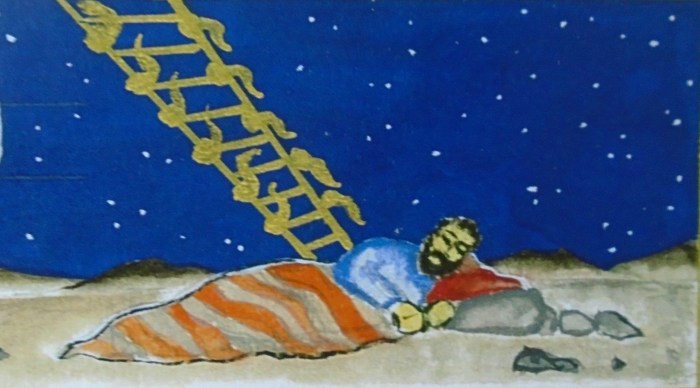
Joseph came by his ability to remember and read his dreams honestly. His father Jacob was guided both by his dreams and by angels. (The angel connection did not figure as highly in Joseph’s life.)

Jacob and the Ladder by Laya Crust

Dreams are important in many cultures. There are dream journals, dream symbols, and the idea that each element of a dream symbolizes something specific. One commonly held theory is that each person in a dream represents one characteristic of the dreamer. The truth is that successful people, those who achieve greatness, are dreamers. They have an idea, a focus, and they follow it. They hold tightly to the goal they wish to achieve and imagine or strategize how to reach their objective.

Not By Might by Laya Crust

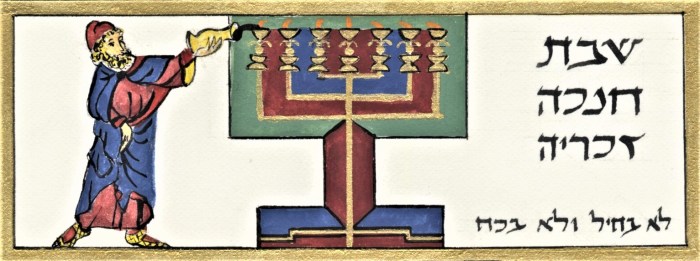
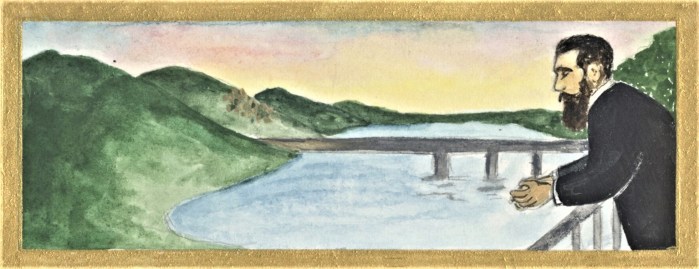
We are celebrating Hanukkah this week. The Jewish leaders who fought and overcame the Greeks were focused dreamers who achieved what they had to achieve in order to survive. Herzl had a dream as did other Jews throughout the millennia. The dream was to return to Israel and make the land flourish, allow it to become a homeland for all Jews once again

Before Jews resettled the land in the early 1900’s the country was a barren, dusty, desert. The Jewish pioneers came and irrigated, cleared, drained swampland, and created what is now a flourishing agriculturally rich and technologically amazing jewel.

We have dreams. Dreams can lead to beautiful results. We can pay attention to our dreams- analyze what they may mean, and how we can do something better or differently. Dreams may help us reach a goal that we thought was impossible but really isn’t. We can make our lives- and the world- a happier place.

Have a Happy Hanukkah. May it be full of light, joy, peace, and happy dreams.

Shabbat Shalom,

Laya

I painted many of the pictures you see in this post as part of a collection of pieces for a sefer haHaftarot- a haftarah scroll. You have seen many of these images over the years if you have been following my blog. I’m excited to announce that a collection of these paintings and their explanations will be published in a book called “ILLUMINATIONS, An Exploration of Haftarah through Art and History”. I will share more information about the book in the coming weeks.

1 Comment

Filed under Uncategorized

Korach- Rebelling against the Establishment

Samuel and Saul by Laya Crust

Parasha: Korach Haftarah: I Samuel 11:14- 12:22

In the Torah reading Korach, a priest, gathered 250 followers and challenged Moshe’s authority. Korach thought it was presumptuous of Moshe and Aaron to retain the leadership of the Israelites. He said, “You take too much upon you, seeing all the congregation are holy, every one of them, and the Lord is among them…” (Numbers 16:3). The accusation was particularly galling since Korach and his followers were already distinguished as men of note with special roles.

Later in the parasha there was another rebellion concerning Aaron’s role as High Priest. Gd proscribed a test where each tribe inscribed a wooden staff with its name then put the rod into the Tent of Meeting. The rod of the true leader would sprout leaves overnight. The next morning Moshe brought out the twelve rods. Not only had Aaron’s rod sprouted leaves but it had flowering buds and almonds on the staff.

The haftarah echoes the rebellions against the established leadership. The prophet Samuel was the prophet and leader of the Jews around the year 1000 BCE. The Israelites saw that other nations were ruled by a king, and they wanted to be like other nations. Samuel saw this as a betrayal of Gd and Gd’s rule. Moshe and Samuel each attempt to convince the Israelites not to overturn the leadership. Moshe says, ” I have not taken a single donkey of theirs, nor have I wronged even one of them.” (Numbers 16:15) Samuel says, “Whose ox have I taken or whose ass have I taken? Whom have I defrauded or whom have I robbed? From whom have I taken a bribe to turn the other way?” (I Samuel 12:4)

The parasha is resolved with Moshe and Aaron each retaining their positions and the rebels being punished. In contrast, Samuel loses his position as leader. He anoints Saul as king and becomes Saul’s advisor.

The Israelites wanted a king so they would be like all the other nations.  The change wasn’t being sought for positive, constructive purposes. Rather the change was being pursued so that the Israelites would be like the other nations.  Similarly, Korach’s goal was not the improvement of his people. His goal was self-promotion and personal power.

The issues of self-interest and personal power are issues that plague us to this day. To create a healthy society and a healthy world we need leaders who are leading for the betterment of society, not for self-promotion. At the grassroots level, we need to strive to make the world a better place by supporting wise leaders and with our own fair and caring actions. Hopefully, through these actions we will see peace,  justice, and equality in the world sooner rather than later.

A word about the illustration for this haftarah: The painting is inspired by a woodcut from a book by Isaac ben Solomon ibn Abi Sahulah. Born in Castile in 1244, he was a scholar and Hebrew poet. He noticed that Jews were reading foreign novels like “The Voyages of Sinbad the Sailor”, fables from India, and books from other cultures. Isaac wanted Jews to read about Jewish subjects so he wrote his own book of poems and parables called “Meshal ha-Kadmoni” (The Ancient Proverb). It was so popular it was reprinted six times in Hebrew and nine times in Yiddish! My painting shows Samuel speaking to Saul, based on a German reprint from 1450. 

Let’s all hope for good directions in this crazy world of crazy leadership that just seems to get crazier. Shabbat Shalom, Laya

Leave a comment

Filed under Uncategorized