Tag Archives: Jewish

Conflict and Strength – VaYishlach


P1140396
Angel and Self  by Laya Crust

Va Yeishev: Bereshit (Genesis) 32:4 – 36

Haftarah:  The Book of Ovadiah

This week’s Torah reading takes us on Yaakov’s (Jacob’s) journey through the country of Edom towards Bethlehem and Efrat. He was a successful man. He had huge flocks, 2 wives, 2 concubines, 11 sons and a daughter, yet he was nervous. He knew he had to travel through his brother’s landholdings but did not want to face his twin because of their unresolved history. Would Esau be angry at Yaakov? Did Esau still want to kill his brother?

The narrative begins with Yaakov sending messengers to his brother, announcing his approach. The report came back that Esau was coming to meet Yaakov, accompanied by 400 men.  Yaakov, frightened and anxious, sent his messengers ahead with many expensive gifts. He sent his family to the far side of the Jabok River for safety and he slept on the closer side of the river, possibly to be on the alert for any attack.

A man came and wrestled with him through the night. Finally, at dawn, the stranger told Yaakov to let him go. Yaakov demanded that the man give him a blessing, and the blessing came in the guise of a new name- Yisrael, “because you have striven with beings Divine and human” (כּי שׂרית עם אלהים ועם אנשׁים).

Image result for jacob and the angel golden haggadah
Golden Haggadah, c. 1320

Who was the man Yaakov fought with? An angel sent by God? An adversarial angel representing Esau? Or was it an inner battle that Yaakov was struggling within himself? At the end of the battle, Yaakov had a new name and an injury that stayed with him for the rest of his life.

Yaakov’s name has many meanings. It can mean follow, heel, or deceive. Yaakov followed his brother into the world when he was born, holding on to Esau’s heel. As they grew up, he deceived his brother and his father and, in turn, was deceived by his father-in-law.

He left Canaan to avoid confrontation with Esau and to seek a wife. Many years later he left Lavan’s estate at night, hoping to avoid confrontation. He may have been a successful man in terms of his career but he was afraid to face the consequences of his actions.

Yaakov couldn’t avoid wrestling with the angel and he refused to give up or give in to the aggressor. He was given a name that represented his strength and position.

Image result for jacob and the angel
by Gustave Dore, 1855

The night of struggle heralded a new beginning. He faced himself and the enemy across from him. That incident strengthened him in his role as leader of a nation. He could carry on and deal with whatever life put in front of him. The struggle with the immortal being took place between sending a message to Esau and actually facing him. Maybe the fight itself influenced Yaakov’s interaction with Esau.

These days, we are facing an evil, psychopathic army, gleefully bent on Israel’s destruction. They are supported by vicious, lying anti-Semites. Jews, Israelis, and Zionists face attacks- verbal and physical, hurtful and deadly, overt and covert, on a frightening level. We are witnessing anti-Semitism from UN speeches and resolutions, rallies calling for genocide, and unconscionable displays of hatred against Israel and Jews on campuses. Like Yaakov we have to face our fears rather than run away from them. Strength as a people and a nation is the only way to combat hatred and violence.

Like Yaakov we are struggling with the adversaries. Israel’s soldiers are heroes. So are those who are taking action by supporting the victims of terror, fighting media bias, feeding the hungry and displaced, aiding the ill and wounded, and speaking out for what is right. May our hostages return and may we achieve a lasting peace.

In prayer, Sabbat Shalom,

Laya

Leave a comment

Filed under Uncategorized

VaYeitze – And he went out

VaYeitzei SigLadder of Angels   by Laya Crust

VaYetzei is the story of Yaakov’s (Jacob’s)  journey from his parents’ home to his uncle’s tribe in Padan-aram. Rivka sent him to her brother Lavan to find a wife and avoid Esau’s anger.

 On the first night, Yaakov lay down to sleep and dreamt of a ladder reaching up to heaven. Angels ascended and descended the ladder, and God stood above it. God told Yaakov, “I will give you and your descendants the land on which you lie. And your seed will be like the dust of the earth. You will spread abroad to the west, and to the east, and to the north, and to the south…And I am with you and will keep you in all the places you go and will bring you back to this land: for I will not leave you until I have done what I have promised…” (Bereshit/ Genesis 28: 13 – 15)

Yaakov continued his journey to Padan-aram and was tricked into marrying two sisters, his cousins Rachel and Leah. The story continues with his life trajectory over a 20-year period. We read about the birth of eleven sons and one daughter and working for his father-in-law Lavan. Under Yaakov’s management, Lavan’s flocks and wealth increased. Lavan and his sons became suspicious and jealous of his son-in-law. Reading the signals and listening to God’s words, Yaakov realized it was time to go home- to Israel. He returned to the land of his birth.

When he left Lavan’s territory “…angels of God encountered him. When he saw them Jacob said, ‘This is God’s camp’ and named the place Mahanaim.” (Bereshit/ Genesis 32: 2,3)

This parsha is a template for the history of the Jews.

First, there was a struggle causing Jacob to leave to leave his place of birth- just as has happened so many times in our history. God told him that his descendants would spread abroad to the west, the east, the north and the south. And it is so. Jews live in virtually every country and corner of the world.

When Yaakov went to Lavan he was invited to stay and work. Lavan encouraged his son-in-law to stay when he recognized Yaakov’s business acumen. Yaakov’s wealth increased Lavan became suspicious and angry so Yaakov fled with his family. How many times has that happened throughout history? Jews were welcomed to Egypt, Spain, France,  Holland, Germany, England, Poland, Lithuania, and more, where they practised medicine, were traders, and improved the mercantile system. When the population either became jealous of their success or ran into financial difficulty, Jews became scapegoats and were victimized. And the Jews have had to escape unprovoked persecution time and time again.

Yaakov and his wives had thirteen children- each of them unique. Today, we are a people of many unique traditions and interpretations.

It is significant that angels begin and end the narrative. As Yaakov leaves his homeland, he is greeted by angels and God. When God warns him to leave Lavan, the angels meet Yaakov again.

This is a horrifying time. These tragedies can only be attributed to שׂינאת חנם, baseless hatred.  Even in these terrible times, lives in Israel are miraculously protected every day. In these times of terror and upside-down morality, we are accompanied by angels. Many of the angels are our fellow Jews and the people who believe in Israel and Humanity. They bring comfort and healing and help in many different ways. Through donations, cooking, prayer, personal bravery, words and hugs of comfort. Yaakov’s descendants, the Children of Israel, are accompanied by angels of God, but we must keep our hearts and ears open to hear them.

Have a Shabbat Shalom. with love and prayers for peace, Laya

Here are two videos. One from the UN about the silence of women’s rights activists:

And another – Kuloolam singing “Like a Prayer” for our Hostages.

Leave a comment

Filed under Uncategorized

The Promise

The Promise by Laya Crust

The story of Noah is a favourite children’s story. Illustrators have a great time with it, drawing waves, the ark, and frolicking animals. It is presented as a joyful story, but it is a serious one.

Noah lived in the tenth generation after the creation of the world. His father named him Noah נח, from the verb ינחם, comfort or console. Noah was called a righteous man, and at the beginning of this week’s parasha it says that Noah walked with God. During Noah’s time people behaved sinfully. Upset with the vile behaviour on earth God decided to destroy the world and restart life on earth with Noah’s family and representatives of each type of animal that roamed the earth.

After the flood, families grew. The population increased. People still had free will and freedom of choice. Evil again began to imbed itself. This week’s Torah reading ends with the story about the Tower of Babel.

Our religion is family and community-based. The stories in Genesis chart the growing pains of family and community. Noah may not have been an orator or a community leader but he knew what was moral and what was not and ran his household in that way. That is why God saw him as the progenitor of the new nation. Noah’s standards of behaviour were passed down through the generations to Abraham, also a man who walked with God. Abraham cared about his wife, sons, and the strangers passing by his tent.

When we read the delightful Noah’s Ark books to our children and grandchildren, we leave out the dark parts. But Noah faced that darkness, lived through it, and exposed the light enough for Abraham to take on the next chapter of our legacy.

This is a devastating time. On October 7, 2023, HAMAS terrorists swarmed southern Israeli communities, killing as many Jews as possible. There are too many painful and horrific stories to count. There is deep pain in Israel and in our diaspora communities. We have banded together to support each other. Communities in and outside of Israel are collecting food, money, toiletries, and clothing for displaced and evacuated families. Millions of dollars have been collected to buy medical equipment and ambulances. Hot meals, socks, and underwear are being delivered to soldiers on duty and at their bases. The volunteerism and outpouring of compassion is beyond description.

Photo by Joey Lightstone, Israel, October 14, 2023

We see this unity in the time of crisis. It is a quality we must retain. God flooded the world Noah lived in because of the evil He saw. God hoped the new world would be kind and honest and that people would help each other. I hope the evil unleashed on Israel on October 7 is destroyed, and the unity and compassion we see among Jews will continue.

The above photo was taken by a soldier in Israel after a rainfall. There is a rainbow In the lower sky just above the tank. Above the rainbow are clouds forming a blue Magen David (Star of David.) On the right side of the photograph, the clouds form an Israeli flag. The picture has not been photoshopped. It’s real. It is a reminder that Israel will live. Good and truth will prevail. Prayers and good deeds will help us overcome the evil attacking our country Israel, and our Jewish people.

עם ישראל חי

Have a Shabbat Shalom. May we have peace.

Laya

For good entertainment, watch the following link for a great gospel Noah song sung by the Jubalaires. https://www.youtube.com/watch?v=6CLFwW85O20

ILLUMINATIONS, An Exploration of Haftarah through Art and History is a collection of all the haftarah pictures you have seen on my blog. The book boasts 82 full-colour pictures. A rich commentary accompanies each painting. To order a book or a haftarah print, go to https://www.haftarah-illuminations.ca/

4 Comments

Filed under Uncategorized

Sukkot and the Yom Kippur War

Valley of Tears by Laya Crust

This Shabbat, we will read a challenging haftarah from the Book of Ezekiel. Ezekiel describes the war of Gog and Magog in great detail as a cataclysmic event involving earthquakes, fires, and weapons. He describes the horrendous punishment of Israel’s enemies, threatening that their bodies will be carrion for the predators in the countryside.

Ezekiel is speaking to the exiled Jews in Babylon. The prophecy is to tell them they will overcome their oppressors, and they will once again control their own land. Those who plan to plunder and destroy the Jews will instead be destroyed by the Jews.

It is 50 years since the Yom Kippur War of 1973. It was a brutal war. Many young Israeli soldiers lost their lives protecting their country from the enemies surrounding them. One battle echoes the prophecy that we will read this Shabbat of Sukkot. It was a miraculous victory for the Israelis against Syria’s superior army.

The Syrians attacked the Israelis in a valley south of Mount Hermon called “Emeq haBacha,” The Valley of Tears. It is the name given to an area in the Golan Heights. It was the site of a major battle in the Yom Kippur War. At one point, fewer than forty Israeli tanks faced approximately 500 Syrian tanks. On the fourth day of the battle, the Israeli force was down to about a dozen tanks and almost out of ammunition. The Syrians retreated. They had received incorrect intelligence.

The battle ended on October 9, 1973, one day before Sukkot began. This photograph is from that battle during the Yom Kippur War. The haftarah painting at the top of the post shows plumes of smoke coming from Syria in the north and the remains of Syrian tanks in Emeq HaBacha. The defeat of the Syrian tank corps was as miraculous as the Ezekiels’s prophecy. The painting is also meant to represent the destruction of Gog and Magog.

We are blessed to have the Land of Israel, and to be protected by the young men and women who serve in the Israeli Defence Forces. It is important to remember the sacrifices of the past and the miracles that allowed Israel to survive and thrive. We should all celebrate the coming holidays – and regular days – with appreciation and gratitude.

Have a lovely Shabbat, Shemini Atzeret, Simchat Torah, and Canadian Thanksgiving.

Laya

“”ILLUMINATIONSAn Exploration of Haftarah through Art and History” is a collection of all the haftarah pictures you have seen on my blog. The book boasts 82 full-colour pictures. A rich commentary accompanies each painting. To order a book or a haftarah print, go to https://www.haftarah-illuminations.ca/

Leave a comment

Filed under Uncategorized

Devarim, 5783

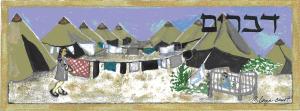
Devarimart by Laya Crust

Devarim/ Deuteronomy     Haftarah- Isaiah I: 1- 27

The parsha Devarim and its haftarah always precede the fast of Tisha B’Av  (the 9th of Av) when we read the Book of Lamentations or איכה .  Michael Mirsky- Torah reader and “leining” teacher extraordinaire-  explained why Devarim is always read before Tisha B’Av.  In the parsha Moses asks,”איכה אשא לבדי טרחכם ומשאכם וריבכם.” “How can I bear unaided the trouble of you, and the burden, and the bickering!” (Devarim 1: 12). As you can see, Moses’ plea  begins with the word איכה – Eicha.

This desolate haftarah is the last of the “Three Haftarot of Rebuke”. Isaiah recounts how God laments that His children – B’nei Yisrael – have rebelled against Him. They are corrupt, their prayers are empty and their sacrifices are meaningless.

Isaiah tells the nation their sins can become white as snow, and the land can become fruitful and full again.  God asks Israel to “Learn to do well; Seek justice, relieve the oppressed, judge the fatherless, plead for the widow.” (Isaiah 1: 17) There is a parallel phrase in the parsha. Moses reminds B’nei Yisrael, “You shall not be partial in judgment: hear the small and the great alike.” (Devarim 1:18) These quotations remind the Israelites to act fairly and care for those who are in need, no matter what station they hold in life.

In searching for an image for this haftarah I wanted something that expressed God’s desire that His children act well and justly.  The care of Jewish refugees in the nascent Israel of 1949 came to mind.

As we know, Jewish immigration to Israel, their ancestral homeland, was severely restricted by the White Paper of 1939. Jewish survivors of the Shoah (Holocaust) had to enter mandate Palestine illegally and if they were caught were sent to D.P.camps. When Israel was declared a state in 1948, thousands of Jewish immigrants and refugees arrived. They needed food, clothing, and shelter.          

Ma’abarot” (or makeshift camps and cities) were set up to temporarily house survivors and refugees. In the early 1950’s they accommodated 130,000 expelled Iraqi Jews. By the end of 1951 there were over 220,000 people in about 125 different areas.

The ma’abarot had problems and were not “perfect” solutions, but they were an attempt to take care of the widows, the orphans, and the needy when Israel was first established.

 The illustration at the top of this post was inspired by a photograph of a ma’abarah in 1952.

B’nei Yisrael was promised the land of Israel, and we have the good fortune to be able to live there today. The direction to judge all people with the same fairness and righteousness, and to take care of all of those in need still stands today. We should be proud of what Israel and Jews internationally have achieved in terms of social justice and care of the sick and needy- but let’s remember to improve the world by being better ourselves.

Have a meaningful fast on the Tisha B’Av fast day. (This year the fast will be on Thursday, the 27th of August.) And let’s keep on making the world a better place!

Best, Laya

P.S. I will be giving a lecture about Tisha B’Av, the Book of Lamentations, and art that illustrates the readings. Join me on ZOOM this Sunday, July 23, 202. The lecture is free, and interesting!

https://www.bac.org.il/en/events/?eventID=18731

https://us02web.zoom.us/webinar/register/WN_A5LicpntRACR2lxB71ztmQ#/registration


1 Comment

Filed under Uncategorized

Shemot- Those Who Are Nameless

Hopeless Desperation by Laya Crust

“Shemot”, meaning “Names”, is the title of the second book of the Five Books of Moses.  The book begins with the names of the patriarch Jacob and his sons, and tells how Jacob went down to Egypt with an entourage of 70 people. It says, “And the children of Jacob were fruitful and increased abundantly and multiplied and grew very very mighty, and the land was filled with them.” (Shemot/ Exodus 1:7)

The Israelites became slaves to the Egyptians. Neither slaves, taskmasters, nor nobility are named in the narrative. The first names we read are those of two heroic midwives, Shifra and Pua, who had the courage to ignore the edict to drown every Israelite boy at birth.  The next name we read is that of Moses- not when he was born but after he was rescued by Pharaoh’s (nameless) daughter, then taken by his own (nameless) sister to be nursed and raised for three years by Moses’ own (nameless) mother.

We read of Moses’ entanglement with an Egyptian taskmaster and three Israelite slaves, yet the next person who is named is Re’uel (Jethro), the Midianite priest who kindly took Moses in.

There is a pattern here. The people who were named were those who stood up against the norm of apathy and acceptance. The midwives risked their own lives because they didn’t want to kill innocent baby boys. The adopted boy Moses grew up to rail against the injustice he witnessed. Jethro the priest took in a needy stranger from a rival country.

photograph by Malcolm Peterson, 2003

Names are important. When Moses met God at the burning bush surprisingly Moses asked for God’s name. Moses knew that the Israelite slaves needed a name for God in order to believe. He demanded a name from a powerful, unknown, force. God complied and furnished Moses with a name – “אהיה אשר אהיה“, “I Will Ever Be What I Will Be”.Names are a key to identity and self-determination.  The Israelite slaves were nameless. Black slaves were stripped of their birth names and given new monikers. Victims of the Nazi regime were numbered in order to add one more level to their dehumanization.  Victims of famine and genocide; and victims of large natural disasters like tsunamis, mudslides, and earthquakes, are unnamed. Missing Indigenous women needed their names shared in order to be noticed, and for their disappearances to be investigated.

When we see a face or hear a name we are more capable of empathizing with a person or an unfolding tragedy.  That is why, when a memorial is set up for fallen soldiers or victims of the Shoah (Holocaust), the invisible individuals can then be remembered, and why the Holocaust Memorial in Jerusalem is called Yad V’Shem (“A Monument and a Name”).

Ai Weiwei's Snake Ceiling, a serpentine form made from children's backpacks, is currently on display at the Hirshhorn Museum's "According to What?" exhibit. It commemorates the thousands of students who died in poorly constructed schools during the 2008 Sichuan earthquake.
A Snake made out of children’s backpacks, Ai Wei Wei,
Hirshhorn Museum, 2008/ photograph by Cathy Carver

Ai Wei Wei, the Chinese dissident artist, took another approach in one of his installations.  In 2008, thousands of school children were killed by an earthquake in Sichuan, China, in shoddily constructed government schools. Wei Wei has produced a list of all the victims of the earthquake on his blog. He also created a number of art pieces made from thousands of children’s backpacks to memorialize their lives.

The thousands of victims have been given identities.

Referring to the narrative from the bible, it may seem that calling this story “Shemot” or “Names” is ironic, but on second thought it is a lesson. The people who were named were doers and helpers. They were people who stepped beyond normal expectations to change a condition and make it better.

When we see people in need it may help us to find out their names. That may make it easier for us to see them as individuals and allow us to reach out more quickly.

Claiming a name

May this be a Shabbat of welcoming and hope, of reaching out to help the other- the nameless and those in need. And through our actions may we bring peace and healing to the world.

Shabbat Shalom, Laya

You can follow my blog by clicking on “Follow this Blog” at the top right corner.

Leave a comment

Filed under Uncategorized

B’ Ha’alotecha- “Not by Might nor by Power”

BehaalotchaTemple Menorah by Laya Crust

At the beginning of this week’s Torah reading, the menorah is described and Aaron is commanded to light it. In the haftarah reading, Zechariah describes the golden menorah. Zechariah was a prophet in Jerusalem around the year 520 BCE.  The Jews had been exiled to Babylon but under King Cyrus were allowed to return to Jerusalem. Zechariah and the prophet Haggai encouraged the people to stop being so despondent and start rebuilding their destroyed temple.

Zechariah by Michelangelo, Sistine Chapel

This haftarah is replete with angels- angels talking to Joshua and angels talking to and waking Zechariah.  Zechariah tells the angel that he has had a vision of a golden menorah flanked by two olive trees. A bowl above the menorah has seven pipes funneling olive oil to the menorah.  When the angel realizes that Zechariah doesn’t understand the symbolism of the vision he explains that the trees represent the leadership of Joshua the High Priest and Zerubbabel the governor in building the Second Temple. The angel says, “Not by might nor by power, but by My Spirit, says the Lord of hosts.” meaning that the reestablishment of the Jewish people will come through faith, not war.

This parsha and haftarah are timely readings. We are living during a frightening pandemic, international violent unrest some of it instigated by the treatment of blacks in America, and negativity towards Israel and her desired steps for greater sovereignty over her ancestral land. The readings teach that we must take the initiative and move forward to make progress in our lives. On one hand, just complaining or protesting will not improve a situation. On the other, sitting back and expecting Gd to make the changes is not the right way either.

The Jews in the desert complained about their diet (“But the multitude among them began to have strong cravings. Then even the children of Israel once again began to cry, and they said, ‘Who will feed us meat?'” Numbers 10:4).  They should have looked to see how they themselves could satisfy their hungers and cravings. The Jews returning to Jerusalem were despondent. When they returned from exile they were pushed by Zechariah and Haggai to take action and rebuild their Temple to Gd. In that way, they could reclaim their lives and their history.

We have to recognize our responsibility to participate in our future, but we also have to recognize that if we move forward with faith and integrity Gd will help us. Ignoring the respect and mitzvot entrusted to us will cause us to be defeated. “Not by might nor by power, but by My Spirit, says the Lord of hosts.” (Zechariah 4:6)

Cervera, Spain, c. 1300

My illustration at the top was based on this beautiful manuscript painting from Spain, with the menorah painted in gold leaf. The menorah was a central fixture in the Temple and was lit by the Kohanim. The wicks of the menorah were arranged to shed light in one flame. That light can be seen as the light we bring to the world.

On that thought, may you have an illuminated week and weekend, full of flaming conversation and bright ideas. Let’s keep on working to make the community and the world better!

Have a good Shabbat, Laya

4 Comments

Filed under Uncategorized

Naso- Sanctity, Equality, and Justice

Samson by Laya Crust

My thoughts this week have been circling around all the painful news coming out of Minneapolis and Hong Kong. And of course the overwhelming health issues faced by the entire world. I tried to see what we might learn from this week’s Torah and haftarah portions.

This week’s haftarah is the story of an angel telling a woman and her husband that they will become parents. The wife is to raise her child as a Nazir- a holy individual who cannot cut his hair or partake of food or drink from grapes. The two farmers listen to the messenger’s instructions. The woman herself follows the rules of a Nazir, and they raise their son as directed. The fact that the baby will be a Nazir is the connection to this week’s parashah.

The parashah discusses the certain rules surrounding the purity of the Israelite camp while traveling through the desert:

  • Men and women are to be housed outside of the camp if they are suffering from tza’arat.
  • Men and women are allowed to take the oath of the Nazir, elevating them to a higher level of purity.
  • If a jealous husband accuses his wife of adultery without any evidence of impropriety, she is not to be punished by him. Instead, a specific ritual trial is held. [The trial may have been put in place to protect the women from jealous husbands.]
Gamaliel , leader of the Menashites by Laya Crust

As well as protecting the sanctity of the camp we see a measure of equality established. The leader of each of the twelve tribes brought forth a specified series of offerings to the Tabernacle. All leaders brought the same offerings, and each was assigned a different day to perform the ceremony. In that way, each tribe was given the same honour and recognition as the other tribes.

Aaron’s priestly blessing is introduced in this parashah. “May the Lord bless you and keep you: May the Lord make His face shine upon you and be gracious to you: May the Lord lift up His countenance to you and give you peace…” (Numbers 6:24-26)

Aaron gave this blessing to all the Israelites. It was a prayer to give children of Israel a sense of love and security. The nation was given rules in the form of the Ten Commandments to create a society of equality, fairness, integrity, and respect. Cohanim bless their congregations with this prayer to this day. Parents say this blessing over their children on Friday nights.

I have been thinking about the terrible murder of George Floyd. Some people have reacted violently by destroying property, looting stores, and injuring others.

What can we learn from this week’s readings? We must treat others with respect and equality, no matter what their station in life. We can only surmount the difficulties through cooperation, wisdom, and respect. If we carry Aaron’s prayer in our hearts we may feel less alone. If we act with integrity, respect, and love we will be able to pass it on to those around us and help to heal this fractured world.

With hopes for love and respect, have a Shabbat Shalom. Laya

Leave a comment

Filed under Uncategorized

Yom Yerushalayim- and food

Jerusalem

Yom Yerushalayim, or Jerusalem Day, will be celebrated this week on Thursday night, May 21, and Friday, May 22, 2020. Jerusalem was established as the capital of Israel by King David almost 3,000 years ago, and the Jerusalem Antiquities Authority has just discovered more ancient ruins near the Western Wall.

My question is: What food should we eat to celebrate Jerusalem Day? I reached out for expert advice and received a few suggestions. The top winners were Jerusalem Mixed Grill (מעורב ירושלמי) and Jerusalem bagels.

Jerusalem Mixed Grill photo by Bridges for Peace

You can find great kiosks selling Jerusalem mixed grill around the city, but particularly near Mahane Yehuda. The smell of the greasy, spicy mixtures wafts through the streets, and here is a video about the originator of this fine fare.

Another contender, the Jerusalem Bagel, is found all over the city. During the Six Day War in 1967 Jerusalem was reunited by the Israelis. Tourism blossomed in the city and these bagels, sold by vendors became super popular. They are long and oval, and the bagel itself is softer and lighter than the usual bagels. They are covered with sesame seeds and served with zatar, an Israeli spice mixture, which is given in a little packet made of newsprint.

The bagel recipe is a closely guarded secret, but adding extra oil to a regular bread recipe will make the dough lighter.

Here are two recipes, one for zatar, and one for a homemade Jerusalem Grill.

Zatar: (from Janna Gur’s cookbook)

2 Tablespoons sesame seeds, toasted in a pan

1/2 cup dried hyssop

1 Tablespoon sumac

1/2 teaspoon salt

Grind the hyssop in a spice mill or blender until it is powder. If you don’t have hyssop you can use dried rosemary or thyme. Add all the other ingredients and you are ready to go!

Jerusalem Grill

about 1 1/2 lbs. chicken innards- liver, heart, spleens, plus some chicken breast or thigh.

For a vegetarian version chop up firm tofu & portobello mushrooms, and you can add blanched cauliflower

4 sliced onions

4 cloves garlic, chopped

olive oil

1 tsp. paprika

1/2 tsp. pepper

1 tsp. cumin

1/2 tsp. cardamom

1 tsp. salt

Cut the chicken into small pieces. Put into a bowl with the onions and the garlic. Pour on some olive oil and the spices, and leave to marinate in the fridge for 3 -24 hours.

Heat up a large frying pan and add some olive oil. Pour in the meat mixture. Fry until the meat is done. Serve in a pita with tehina, hummus, pickles, and olives. Enjoy!

Have a wonderful Jerusalem Day. I hope you found my Jerusalem food blog interesting and that you might even try something new!

Have a happy Shabbat Shalom and stay safe. -Laya

Leave a comment

Filed under Uncategorized

Halfway through the Torah

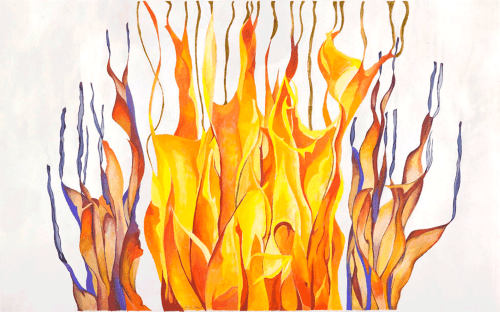
Flames of Division by Laya Crust

A couple of weeks ago we read parshat Shemini on Shabbat. It is an unexpected combination of two very different narratives, and the break between the two narratives occurs pretty much in the middle of the reading. Similarly, the parsha itself appears right in the centre of the Torah cycle. Coincidently we are experiencing an unprecedented break in the functioning of the world. I want to explore this dividing of text and experience.

In the first half of parsha Shemini we read about the sacrifices that Moses and Aaron offered to Gd. In the second half of the parsha we read about which animals are kosher (acceptable for Jews to eat) and which are treif (not acceptable for Jews to eat).

Aaron and his sons had spent weeks purifying and spiritually readying themselves to perform these important offerings. The sacrifices were accepted. Dramatically, Gd’s fire consumed the sacrificial remains and His flames ascended to the heavens.  In a moment of religious fervour Aaron’s sons Nadav and Avihu offered their own (unholy) fire to Gd. In anger, Gd sent down flames that killed the two men. It was a shocking and tragic incident.

Following this distressing event, the Israelites were told which animals were kosher and which were non-kosher. The two narratives are very different- one is a drama the other is a list of guidelines. Yet they are united by a phrase at the end of each of the 2 sections.

After Nadav and Avihu died Aaron and his sons were tasked with being able לְהבדיל בּין הקדשׁ ובין החֹל ובין הטמה ובין הטהור -to distinguish between holy and common, between impure and pure.

Later, when Israelites were told what they could eat and what they could not eat, we read: לְהבדיל בין הטמה ובין הטהור. They were “to separate between the impure and the pure”.

The phrases of separation are obviously very important, and fire is used in Torah as a means of separation. HaShem formed a pillar of fire to light the way of the nation of Israel, and to separate and protect them from their enemies as they traveled through the desert. We, ourselves, use Aish (fire) to separate Shabbat from the rest of the week. We light candles before Shabbat begins and at Havdalah when Shabbat ends. So, to restate, Aish or fire is used as a device to divide and separate.

Fire is mysterious, beautiful, and threatening. If flames come too close they are dangerous- destroying and killing what is in their path. It is a contrary force, and ambiguous one. We need fire for light, for warmth, and in historical times humans needed fire to protect them from wild beasts at night. And yet this protective force can suddenly, without warning, rage out of control.

Differentiating, “לְהבדיל”, creates awareness. That is a theme in this Torah reading. The list of acceptable and unacceptable animals makes us conscious of our dietary choices. The dire punishment of Nadav and Avihu remind us of the sacredness of HaShem’s commands and words. Boundaries create awareness. Without boundaries all things are equal. With limits, there is greater focus and the focus makes everything more precious.

The world is experiencing a time of separation. Due to the danger of COVID-19 we are forced to separate from others in order to keep ourselves and others safe. The separation allows us time to reflect on what is necessary and what is unnecessary. Let’s use this time wisely and make our lives and the world better.

Be safe, be well, be healthy and be kind.

Laya Crust

2 Comments

Filed under Uncategorized