The parashah VaYigash continues the saga of Joseph and his brothers. Joseph was sold into Egyptian slavery and rose through Egyptian society to become second in command to the Pharaoh. Now, after many years, the family is reunited. Although Joseph’s story had begun many years earlier with fraternal jealousy, the brothers allow themselves to reunite and rebuild their family. In the earlier Bible stories, the siblings did not reconcile. Cain killed his brother Abel. Isaac grew up without his brother Ishmael. Jacob and Esau never truly reconciled. In this story, we see Joseph and Judah rebuild the family, which would eventually become the nation of Israel, the Jewish people.
The haftarah also speaks of unity. The prophet Ezekiel appeals to the Children of Israel to reunite.
Ezekiel (c.622 BCE – 570 BCE) was among the 8,000 Jews exiled to Babylonia after the destruction of The First Temple. In this reading, he theatrically foretells the reunification of the nation of Israel. Ezekiel takes two branches as instructed by God. One represents the nation of Judah, and the other represents the nation of Ephraim, Joseph’s lineage. The prophet writes, “For Judah and for the children of Israel his companions” on one branch, and “For Joseph, the stick of Ephraim, and of all the house of Israel his companions” on the other. Ezekiel then holds the two branches together, forming a single entity. He says that the Jews can reunite and become a unified nation, and that God will gather them from exile and return them to the land of Israel. The text reads, “I will make them one nation in the land, upon the mountains of Israel.” (v. 22)
Judean Hills
Both readings are about unity. This is a timely theme. Israelis and Jews around the world have been deeply divided about many things. They were particularly divided about the direction of the Israeli government. Our Jewish world was crumbling. The horrors of October 7 unified us as a people. Our love for our nation and our country has reignited a Jewish spirit so deep that we are fighting on every front and helping our beleaguered brothers and sisters. And we are winning.
Hatred destroys countries and civilizations. We have to work together to ensure our survival. Just as Joseph and his brothers forged a better future together, we will do the same. Joseph saved Egypt and its neighbours from starvation by sharing wisdom and strategy. We have the potential to do the same. We are stronger as a united people.
With prayers for our hostages, for our soldiers, and for peace and security,
Shabbat Shalom, Laya
ILLUMINATIONS, An Exploration of Haftarah through Art and History is a book of all the haftarah pictures you have seen in my blog. It boasts 82 full-colour pictures and a rich commentary that accompanies each painting. For more information or to order a book go tohttps://www.haftarah-illuminations.com/ or to haftarah-illuminations.com
The title of this week’s parashah describes Jacob returning to Canaan with his family. Jacob, was the father of 12 sons and one daughter. This week’s Torah reading exposes the dynamics between Jacob’s children. Ten of Jacob’s sons were jealous of their brother Joseph. The jealousy led them to sell Joseph to itinerant traders on their way to Egypt. The haftarah, from the Book of Amos, touches on elements of unrighteous behaviour- like selling someone.
The prophet Amos was a herdsman and farmer. He taught that if the members of society are not good to each other, the society will crumble. The Kingdom of Judaea was experiencing a period of affluence. The rich were selfish and unrighteous, and there was a significant economic gap between the rich and the poor.
Amos begins this haftarah by saying, “… they sell the righteous for silver and the needy for a pair of shoes…And a man and his father go unto the same maid to profane My holy name”. Both phrases reflect the parashah. “The man and his father going to the same maid ” reminds us how Yehuda was unfair to Tamar, his daughter-in-law. The first phrase, “they sell the righteous for silver…” describes the brothers selling Joseph to Ishmaelite traders for 20 shekels of silver.
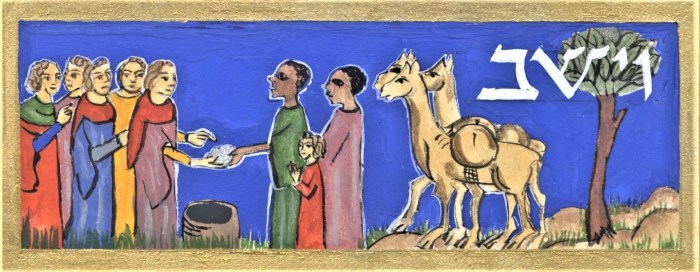
The illustration above is based on a painting in the Sarajevo Haggadah from 1350 Spain. We see the brothers exchanging money with Ishmaelite traders. The brothers are depicted as Spanish merchants with fair skin and light hair wearing typical clothing of the period. The traders are black, with dark skin and curly black hair. Joseph, portrayed as a young boy, stands with the foreign traders, begging his brothers to take him back. Camels carry the merchants’ goods.
This image tells us that the Spanish Jews traded with black merchants traveling from North Africa. It tells us about the clothing of the time and the art produced for the Jewish community. We also learn that today we use the same haggadah that Jews used in medieval Spain and that Pesach was so important that someone commissioned a handwritten, illustrated book to be used at their seder.
Amos’s words and the story of Joseph’s sale were viciously used in history by Roman judges under the emperor Hadrian about 120 CE. On Yom Kippur, we read about ten righteous Rabbis who were martyred. The Roman judges quoted a law which stated, “Whoever kidnaps a man and sells him, or if the man is found in his possession, must be put to death.” They used Amos, Devarim 24:7, and the story of Joseph as an excuse to torture the ten Rabbis.
The story of Joseph took place about 3,500 years ago. Amos’s words in the haftarah, the sin of “selling your brother,” are from around 2,800 years ago. That quote was abused by Roman tyrants 1900 years ago. And then we move to the beautiful Sarajevo Haggadah from 660 years ago, replete with Jewish cultural history. Amos’s message comes through- do not sell your brother. Tragedy will unfold if you don’t treat your family and society with respect and understanding. This is the line through history.
One of the goals in creating my haftarah art pieces is to forge a connection between text, art, and Jewish history. Tanach is alive. Although time continues to pass, we can still learn from our history and know that we are living the history.
Shabbat Shalom, with prayers for the return of all our hostages and a lasting peace. A peace where Am Yisrael lives in unity and safety.
Laya Crust
“ILLUMINATIONS, An Exploration of Haftarah through Art and History” is a collection of all the haftarah pictures you have seen on my blog. The book boasts 82 full-colour pictures. A rich commentary accompanies each painting. To order a book or a haftarah print, go to https://www.haftarah-illuminations.ca/
This week’s haftarah for the parashah is from the Book of Ezekiel. The prophet Ezekiel (c.622 BCE – 570 BCE) was among the 8,000 Jews exiled to Babylonia after the destruction of The First Temple. He both criticized the behaviour of the Jewish people and encouraged them during a time of despair with his spectacular visions. He was also a great advocate of individual responsibility.
This haftarah’s message is “unity.” God told Ezekiel to take two branches. One represented the nation of Judah, and the other represented the nation of Ephraim, Joseph’s lineage. The prophet was to polish the branches, carve on them and display them. Ezekiel wrote the following phrases onto the branches: “For Judah and for the children of Israel his companions” on one, and “For Joseph, the stick of Ephraim, and of all the house of Israel his companions” on the other. Ezekiel then held the two branches up in front of a gathering of the exiled Jews. He showed that the two groups could be reunited and grow together as one unified nation. He also told them that God would gather them from among all the nations and return them to their own land, the land of Israel. The text reads, “I will make them one nation in the land, upon the mountains of Israel.” (v. 22)
Photo of the Judean Hills by Yoni Lightstone tour guide
The parashah VaYigash continues the saga of Joseph and his brothers. We have read how Joseph was sold into Egyptian slavery and his father believed he was dead. Joseph rose through Egyptian society to become second in command to the Pharaoh. Now, after many years, the family is reunited.
Joseph’s story had begun many years earlier with fraternal jealousy, butthe brothers reunited and rebuilt their family. In earlier Bible stories the siblings did not reconcile. Cain killed his brother Abel. Isaac grew up without his brother Ishmael. Jacob and Esau never truly reconciled. In this story we see Joseph and Judah build the unified family which would become a nation.
Both readings are about unity. In every era and in every generation there are disagreements between different sectors of Jews. The competition for leadership, and the separation of the nations began as early as the story of Cain and Abel. We allow ourselves to be divided by traditions, dress, levels of observance, and politics.
We live in frightening times which are difficult to navigate. We witness and experience the Covid-19 epidemic, international terrorism, increased anti-Semitism, tyrannical dictatorships waging war on their citizens and neighbours, slavery, and bizarre weather-related disasters. WHat is most frightening is the divisiveness in the Jewish community. People have become extreme in their views, accusing those on the “other side” of being nasty, dangerous, and untrustworthy. Respectful speech has been discarded.
Hatred destroys countries and civilizations. We have to work together to ensure our survival. Just as Joseph and his brothers could forge a better future together, we can do the same. Joseph saved Egypt and its neighbours from starvation through sharing wisdom and strategy. We have the potential to do the same. We are stronger as a united people.
With prayers for peace and understanding,
Shabbat Shalom, Laya
The painting “Reunited”, showing Ezekiel writing on a branch, is one of the images in my book, “ILLUMINATIONS.”:
I’m excited to introduce you to the newest member of my family. ILLUMINATIONS, An Exploration of Haftarah through Art and History is a book of all the haftarah pictures you have seen in my blog. It was published in October and released on November 24, 2022. It boasts 82 full-colour pictures and a rich commentary that accompanies each painting. For more information or to order a book go tohttps://www.haftarah-illuminations.com/ or to haftarah-illuminations.com
The brothers selling Joseph to passing traders from the parasha VaYigash
For the last number of weeks we have been reading about our ancestors, Jacob’s children. More specifically, we have read about Joseph’s trajectory from favoured son at home, to being a slave, and then to becoming viceroy of all Egypt. By the time he was thirty years old Joseph ruled Egypt. He ran the finances and oversaw all of Egypt’s policies.
In this week’s Torah reading Joseph’s brothers still did not know that the leader they were speaking to was their brother. This parsha begins just after Benjamin had been “framed”. Joseph’s personal silver chalice had been “planted” in Benjamin’s belongings, and the Israelite brothers had been told that Benjamin would become enslaved to Pharaoh’s court as payment for the infraction. Joseph was playing a game with his brothers.
Joseph Converses With Judah, His Brother, c. 1896-1902
by James Jacques Joseph Tissot (Photo credit: Wikipedia)
Judah, The same brother who decades earlier had suggested Joseph be sold rather than be killed, begged for understanding. He pouredout his heart to the great Egyptian before him. Judah hoped that by telling this regent of his father’s heartbreak and frailty the leader might accept Judah as a slave rather than take his youngest brother.
Joseph could carry on the charade no longer. He cleared all the Egyptian attendants from the room. The text says, “And no man stood with him while Yosef made himself known to his brothers. And his voice cried out with weeping, and Egypt heard…” When I read those phrases I imagine a stately, handsome regent who is always in control. He is a man who has faced one challenge after another but has always kept his wits about him, analyzed, strategized, and succeeded. He has played with his brothers, waiting for just the right time to reveal his identity. I think he was “undone”, hearing Judah’s humility and love for Yaakov, the father Joseph hasn’t seen and possibly thought he never would see again. The narrative sets the scene in a compelling way. Joseph is so overcome that he loses his controlled facade. Alone with his brothers he lets out such a cry of anguish that the entire land of Mizrayim (Egypt) hears… What powerful text. Joseph forgave his brothers. He feasted with them, gave them gifts of clothing and food, and convinced them to return to Egypt and live in comfort.
Although the story had begun many years earlier with fraternal jealousy, the brothers reunited and rebuilt their family. This was contrary to the patterns we had seen before. Cain killed his brother Abel. Isaac grew up without his brother Ishmael. Jacob and Esau never truly reconciled. In this story we see Joseph and Judah build the unified family which would become a nation.
Reunited by Laya Crust
The haftarah features the prophet Ezekiel. He lived from around 622 BCE – 570 BCE and was among the 8,000 Jews exiled to Babylonia. God told Ezekiel to take two beautiful branches, carve phrases on them and display them. One branch represented the nation of Judah and the other represented Joseph’s lineage, the nation of Ephraim. Ezekiel wrote phrases about the two Jewish nations onto the branches and held the two branches together. The action was to indicate that just as the branches could be rejoined, the Israelites could be reunited and grow together as one unified nation.
Both readings are about unity. In every era and in every generation there are disagreements between different sectors of Jews. The competition for leadership, the separation of the nations – began as early as the story of Cain and Abel. We have seen the story played out over and over again. We allow ourselves to be divided by traditions, dress, levels of observance, and politics. We are stronger as a united people.
We live in frightening times which are harder to navigate if we are divided. We witness and experience the Covid-19 epidemic, international terrorism, increasd anti-Semitism, tyrannical dictatorships waging war on its citizens and neighbours, slavery, rising opiad deaths, and bizarre weather related disasters. On the other hand we live in a time with potential for incredible good. Using medical innovation, social network, communication and the sharing of resources, we can create and heal the world.
Just as Joseph and his brothers could forge a better future together, we can do the same. Joseph saved Egypt and its neighbours from starvation through sharing wisdom and strategy- we have the potential to do the same.
With prayers for peace and understanding,
Shabbat Shalom, Laya
The painting “Reunited”, showing Ezekiel writing on a branch, is one of the images in my forthcoming book, “ILLUMINATIONS: The Art of Haftarah”. Stay tuned for more information!
Joseph was the ultimate dreamer in the bible. As we know it got him into trouble with his brothers, yet saved him and an entire country when he was in Egypt. In Parashat Miketz we read how Joseph interprets dreams for Pharaoh, changing the course of economic and agricultural history, as well as changing the course of history for the children of Israel.
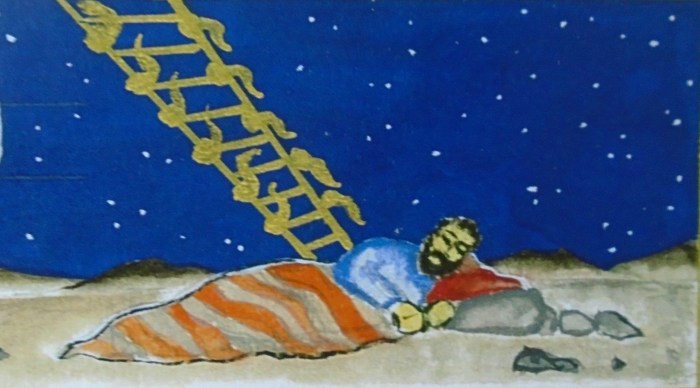
Joseph came by his ability to remember and read his dreams honestly. His father Jacob was guided both by his dreams and by angels. (The angel connection did not figure as highly in Joseph’s life.)
Jacob and the Ladder by Laya Crust
Dreams are important in many cultures. There are dream journals, dream symbols, and the idea that each element of a dream symbolizes something specific. One commonly held theory is that each person in a dream represents one characteristic of the dreamer. The truth is that successful people, those who achieve greatness, are dreamers. They have an idea, a focus, and they follow it. They hold tightly to the goal they wish to achieve and imagine or strategize how to reach their objective.
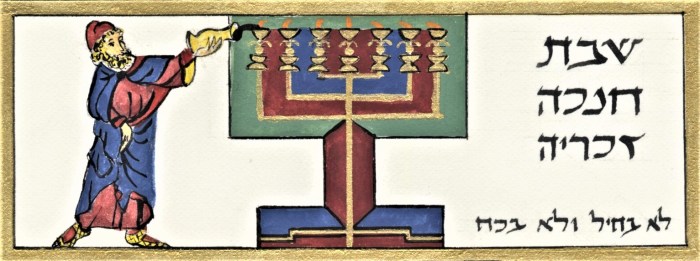
Not By Might by Laya Crust
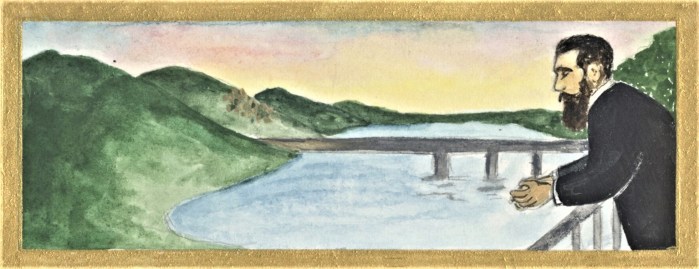
We are celebrating Hanukkah this week. The Jewish leaders who fought and overcame the Greeks were focused dreamers who achieved what they had to achieve in order to survive. Herzl had a dream as did other Jews throughout the millennia. The dream was to return to Israel and make the land flourish, allow it to become a homeland for all Jews once again
Before Jews resettled the land in the early 1900’s the country was a barren, dusty, desert. The Jewish pioneers came and irrigated, cleared, drained swampland, and created what is now a flourishing agriculturally rich and technologically amazing jewel.
We have dreams. Dreams can lead to beautiful results. We can pay attention to our dreams- analyze what they may mean, and how we can do something better or differently. Dreams may help us reach a goal that we thought was impossible but really isn’t. We can make our lives- and the world- a happier place.
Have a Happy Hanukkah. May it be full of light, joy, peace, and happy dreams.
Shabbat Shalom,
Laya
I painted many of the pictures you see in this post as part of a collection of pieces for a sefer haHaftarot- a haftarah scroll. You have seen many of these images over the years if you have been following my blog. I’m excited to announce that a collection of these paintings and their explanations will be published in a book called “ILLUMINATIONS, An Exploration of Haftarah through Art and History”. I will share more information about the book in the coming weeks.
I painted the picture you see here as part of a collection of pieces for a sefer haHaftarah- a haftarah scroll. You have seen many of these images over the years if you have been following my blog. I’m excited to announce that a collection of these paintings and their explanations will be published in a book called “ILLUMINATIONS, An Exploration of Haftarah through Art and History”. I will share more information about the book in the coming weeks.
VaYeishev, A Grievous Sin by Laya Crust
The last number of weeks the Torah readings have been about the families of our forefathers and mothers. Abraham and Sarah’s grandson, Jacob, was the father of 12 sons and one daughter. This week’s Torah reading exposes the dynamics between Jacob’s children.
This illustration is based on a painting in the Sarajevo Haggadah from 1350 Spain. I’m going to take you on a time traveler’s tour using this image from Sarajevo Haggadah from 1350 Spain. I’ll touch on the haftarah, the Torah reading, Roman persecution of the Jews, and the culture revealed in the Sarajevo Haggadah.
The haftarah is from the Book of Amos. The prophet Amos was a herdsman and farmer. He taught that if the members of society are not good to each other the society crumbles. The Kingdom of Judaea was experiencing a period of affluence. The rich were selfish and unrighteous, and there was a large economic gap between the rich and the poor.
Amos begins this haftarah by saying “… they sell the righteous for silver and the needy for a pair of shoes…And a man and his father go unto the same maid to profane My holy name”. Both phrases reflect the parashah. “The man and his father going to the same maid ” reminds us how Yehuda was unfair to Tamar, his daughter-in-law. The first phrase “they sell the righteous for silver…” describes the brothers selling Joseph to Ishmaelite traders for 20 shekels of silver.
The Sarajevo Haggadah has a wonderful rendering of the scene. We see the brothers exchanging money with Ishmaelite traders. The brothers are depicted as Spanish merchants with fair skin and light hair wearing typical clothing of the period. Look at the traders- they are black, with dark skin, curly black hair, and black features. Joseph stands with the foreign traders. He’s portrayed as a little boy, his hands held together, begging his brothers to take him back. And we see the camels carrying the merchants’ goods.
This image tells us that the Spanish Jews traded with black merchants traveling from North Africa. It tells us about the clothing of the time and the art produced for the Jewish community. We also learn that today we use the same haggadah that Jews used in medieval Spain and that Pesach was so important that someone commissioned a handwritten, illustrated book to be used at their seder.
This scene reflects the first phrases of the haftarah and takes us to how the story of Joseph’s sale was viciously used in history. On Yom Kippur, we read about ten righteous Rabbis who were martyred by the Romans under the emperor Hadrian about 120 CE. The Roman judges quoted a law which stated, “Whoever kidnaps a man and sells him, or if the man is found in his possession, must be put to death”. They used Amos, Devarim 24:7, and the story of Joseph as an excuse to torture the ten Rabbis.
The story of Joseph took place about 3,500 years ago. Amos’s words in the haftarah, the sin of “selling your brother” are from around 2,800 years ago, That quote reminds us of the Roman tyrants 1900 years ago. And then we move to the beautiful Sarajevo Haggadah from 660 years ago, replete with Jewish cultural history. Amos’s message comes through- do not sell your brother. If you don’t treat your family and society with respect and understanding, tragedy will unfold. This is the line through history.
One of the goals in creating my haftarah art pieces is to communicate the theme of the haftarah, relate it to the parashah, integrate Jewish history, and forge a connection between the viewer and our Jewish past. In that way we can remember that the Tanach is alive. Although time continues to pass we can still learn from our history and that in truth we are living the history.
So, I hope you are enjoying my posts. Please always feel free to comment. Pass the posting to your friends. If you like my blog sign up and “Follow” me. You will receive an update by e-mail.
Shabbat Shalom, with prayers for peace, understanding. Respectful communication is a path to healing.
Music is magical. We can’t see it, touch it, smell it or taste it. We can hear it and magically it can transform our mood and take us to other places in our imagination. We all know about love songs (a billion), break-up songs (2 billion), songs of tribute (“Starry Night” about Vincent Van Gogh) and patriotic songs (“La Marseillaise”and “HaTikvah”). All our secrets can be unearthed (“Killing Me Softly”) and raw emotion can be exposed (Stravinsky’s compositions).
Music is a beautiful union of art, science, math, and imagination. I remember a friend of mine- a physicist- being amazed and unbelieving when I told him I loved music. “How is that possible? ” he asked. “You’re an artsy.” I was really surprised by that comment because I had always thought that music was art and emotion. That was when I found out that there is a close relationship between science and music.
Miriam’s Song by Laya Crust
Music is an integral part of joyous Judaism. In the Torah portion B’Shalach we read “The Song of the Sea”. It is Moses’ song of praise to God that was sung after the Israelites safely crossed the Red (or Reed) Sea, and were saved from the angry Egyptian army. The women, led by the prophet Miriam, sang and danced and made music on their “tof”, a handheld drum. There is a beautiful painting of the women led by Miriam playing their drums in The Golden Haggadah, and another lovely rendition in The Sarajevo Haggadah.
Devorah the Prophetess by Laya Crust (inspired by a painting from a 17th C. Judeo-Persian book)
This Bible reading describing the escape into the desert, across the sea, and the ultimate Song of the Sea is paired with an adventure story in the Book of Judges. Led by the prophet Devorah the Israelites won a battle against Sisera’s Army. A woman named Yael completed the defeat by killing Sisera. Devorah then sang a song of praise about the triumph and Yael’s conquest.
When we are happy, when we are sad, when we want to remember or forget, when we want to meditate or pray, be left alone or celebrate with others we often turn to music. Because it is a comforting, joyous and spiritual medium the most beautiful parts of prayer are often paired with music. The painting at the top of the page shows biblical instruments mentioned in “psoukei d’zimra”, prayers we say in the morning.
On this Shabbat Shira, the Shabbat of Song, pay attention to the songs and music composed by Moses, Miriam, and the prophetess-judge Devorah. Enjoy the art, the sounds, and the music around you and have a Shabbat Shalom.
Laya
If you would like to be notified when I write a new blog post go to the top of the page and hit “follow”. You will get a notification each time I write a new post.
VaYechi is the last Torah reading in the Book of Beresheit (the Book of Genesis). It is just that- the story of the beginning, or genesis, of the world and of a people. The parsha begins with a word that in biblical Hebrew means “and he lived”, and in modern Hebrew means “and he will live”. It is appropriate because this word refers to Jacob who died in this parsha but created the family legacy which would continue, living as the Jewish nation.
Our forefathers and foremothers did not have perfect family lives. There was jealousy, jostling for power and attention, and lifelong resentments. We read about favouritism. There was very little tenderness exhibited in the harsh lives they led. However, tenderness does appear in this parsha.
When Jacob was 137 years old he had been living in Egypt with Joseph and his other 11 sons for 17 years. He knew he was about to die and called Joseph and Joseph’s sons to his bedside. “…he kissed them and embraced them. And Yisrael said to Joseph,’ I had not thought to see your face: and lo, God has also shown me your children.’ ” (Genesis ch 47 v..11) Yaakov was expressing the longing he had felt for decades, never believing he would see his son Joseph again. Neither Abraham nor Isaac had ever spoken to their children with such honesty and warmth.
We go on to read the first ethical will ever recorded. Jacob spoke to each of his sons, and to his two favourite grandsons. He foresaw how they were going to navigate the world. The prescience could have been see by the sons either as warnings or as guidelines for how to lead their lives in the best way possible. As well as speaking about the children’s’ attributes Jacob also made it clear that when he died he was to be buried in Canaan in the same place his wife Leah, his parents Isaac and Rebecca, and his grandparents Abraham and Sarah had been buried.
This scene and this request- he actually insisted that it be an oath- were the greatest lessons of all. By gathering the sons together in one room and speaking to each of them one by one Jacob was cementing the family unit. It wasn’t a speech to all the servants and to those Egyptians who respected him, it was a speech only to his sons. This showed them how he valued them as a family unit with common roots, and that they would retain their nationhood and integrity if they stayed together.
The insistence that he be buried in Canaan was an indication that Canaan, not Egypt, was his and their homeland. That being said, Joseph was the only one of the twelve sons who made an oath that he too would be buried in Canaan.
As always there are many lessons in the parsha. Communication in family, showing love to our children, expressing our deepest wishes, seeing each child as an individual, the power of the ethical will, unity, and being in the right place are all lessons from this reading.
We live in a frightening world with too much hatred and too much violence. If we stand together as a unified nation, if we live with the integrity laid out in halachah (Jewish precepts and law), and if we know who we re as Jews and where we belong, maybe we can help heal our nation and heal the world more effectively. As we go forward we might also be able to learn from Yaakov Avinu (our father Jacob’s) ethical will to us, his descendants.
With blessings for goodness and peace, Shabbat Shalom.
For the last number of weeks we have been reading about our ancestors, Jacob’s children. More specifically, we have read about Joseph’s trajectory from favoured son at home, to being a slave, and then to becoming viceroy of all Egypt. By the time he was thirty years old Joseph ruled Egypt. He ran the finances and oversaw all of Egypt’s policies.
In this week’s Torah reading Joseph’s brothers still did not know that the leader they were speaking to was their brother. This parsha begins just after Benjamin had been “framed”. Joseph’s personal silver chalice had been “planted” in Benjamin’s belongings, and the Israelite brothers had been told that Benjamin would become enslaved to Pharaoh’s court as payment for the infraction. Joseph was playing a game with his brothers.
Joseph Converses With Judah, His Brother, c. 1896-1902
by James Jacques Joseph Tissot (Photo credit: Wikipedia)
Judah, the same brother who decades earlier had suggested that Joseph be sold rather than be killed, stepped forward and begged for understanding. He poured out his heart, recounting the family history to the great Egyptian before him. Judah hoped that by telling this leader of his father’s frailty the leader may accept Judah as a slave rather than take his youngest brother.
Joseph could carry on the charade no longer. He cleared all the Egyptian attendants from the room. The text says, “And no man stood with him while Yosef made himself known to his brothers. And his voice cried out with weeping, and Egypt heard…” Joseph forgave his brothers. He feasted with them, gave them gifts of clothing and food, and convinced them to return to Egypt and live in comfort. He told them how to get land so they could raise cattle.
Although the story had begun many years earlier with fraternal jealousy, the brothers reunited and rebuilt their family. This was contrary to the patterns we had seen before. Cain killed his brother Abel. Isaac grew up without his brother Ishmael. Jacob and Esau never truly reconciled. In this story we see Joseph and Judah build the unified family which would become a nation.
Reunited by Laya Crust
The haftarah features the prophet Ezekiel. He lived from around 622 BCE – 570 BCE and was among the 8,000 Jews exiled to Babylonia. God told Ezekiel to take two beautiful branches, carve phrases on them and display them. One branch represented the nation of Judah and the other represented Joseph’s lineage, the nation of Ephraim. Ezekiel wrote phrases about the two Jewish nations onto the branches and held the two branches together. The action was to indicate that just as the branches could be rejoined, the Israelites could be reunited and grow together as one unified nation.
photo by Yoni Lightstone, tour guide
Ezekiel also told them that God would gather them from among all the nations and bring them back to their own land. The text reads, “Behold I will take the children of Israel from among the nations, whither they are gone, and will gather them on every side, and bring them to their own land. I will make them one nation in the land, upon the mountains of Israel.” (v. 21, 22)
Both readings are about unity. In every era and in every generation there are disagreements between different sectors of Jews. We are stronger as a united people. I hope we can learn to discuss, consider, and be united for the benefit of all.
The painting “Reunited”, showing Ezekiel writing on a branch, is one of the images in my forthcoming book, “ILLUMINATIONS: The Art of Haftarah”. Stay tuned for more information!
The last number of weeks we have been reading about Abraham and Sarah, Isaac and Rebecca, Jacob, Leah and Rachel. Jacob was the proud father of 12 sons and one daughter, and moved his family from Padan Aram back to Canaan. In this week’s Torah reading we find out more about the dynmics in Jacob’s family.
Jacob left his father-in-law’s home a wealthy man with huge herds of cattle and flocks of goats. The sons were shepherds. Joseph was favoured by Jacob, and was given a beautiful coat. While his brothers were out iin the hot fields for days at a time Joseph stayed at home with their father. There was a lot of jealousy for more than one reason.
At one point in this week’s Torah portion Joseph was sent out to the fields to look for his brothers and report back to Yaakov (Jacob). They had gone to Shechem with their flocks, and then traveled further. Joseph went to Shechem but couldn’t find them. A man- we suspect that he was an angel- redirected Joseph to Dothan. The brothers saw him approaching. To paraphrase Maurice Sendak, they “made mischief of one kind and another”. They threw Joseph into a pit and gave him to Midianite traders who then sold him to Ishmaelite traders.
I’ve often wondered about the brothers out in the fields, sleeping and eating there. What did they have for lunch? What were they eating as Joseph approached? Many Israeli cookbooks feature eggplant recipes, and I thought- could the brothers have enjoyed something like roasted eggplant?
Roasted Eggplant with Silan and Tomatoes
Ingredients:
1 medium eggplant 1 – 2 Tbsp. freshly squeezed lemon juice
1 Tbsp. raw tehina 1- 2 Tbsp. olive oil
1 Tbsp. yogurt sprigs of fresh parsley, cilantro or hyssop leaves
1 tomato halved, cored, and diced 1 crushed clove of garlic
1Tbsp. silan or dark honey sea salt and crushed pepper to taste
Bake the eggplant. You can roast it over a bonfire, a gas flame or, as I have here, an electric element. It gives a wonderful smokey flavour.
Slice in half and drizzle with tehina, yogurt, silan (or honey), olive oil and lemon juice. Season with salt, pepper, and garlic. Garnish with parsley, cilantro or hyssop.
The roasted eggplant is delicious with warmed or toasted pita and a good glass of beer. (P.S. To be honest, the brothers wouldn’t have been eating eggplant or tomato. Eggplants are indigenous to India and tomatoes to South America. But, they are popular in Israel now! )
Enjoy, and Shabbat Shalom.
Laya
This illustration for the parsha VaYeishev is based on a beautiful panel from the Sarajevo Haggadah. The haggadah was created in 1350 Spain, and has beautiful paintings illustrating the Bible from the story of Creation to the giving of the Torah on Mount Sinai. This particular image shows the brothers selling Joseph to Ishmaelite traders. Joseph is portrayed as a young boy begging his brothers not to sell him.
I have created pictures for each haftarah and parsha of the year and am currently working on a book, showcasing each painting. Stay tuned for updates! Please always feel free to comment. Pass the posting to your friends. If you like my blog sign up and “Follow” me. You will receive the current blog by e-mail.

 Joseph’s Journey by Laya Crust
 Reunited by Laya Crust
 ILLUMINATIONS, An Exploration of Haftarah through Art and History is a book of all the haftarah pictures you have seen in my blog. It boasts 82 full-colour pictures and a rich commentary that accompanies each painting. For more information or to order a book go to https://www.haftarah-illuminations.com/ or to haftarah-illuminations.com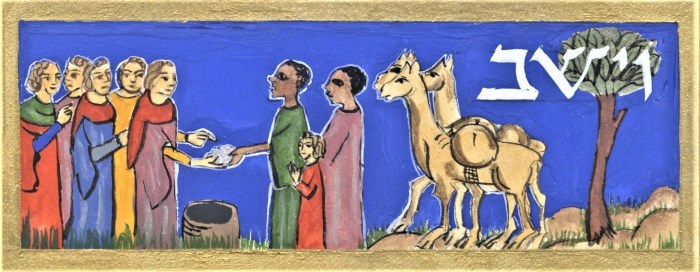

 Joseph Converses With Judah, His Brother, c. 1896-1902


 Laya Crust