
The title of this week’s parashah describes Jacob returning to Canaan with his family. Jacob, was the father of 12 sons and one daughter. This week’s Torah reading exposes the dynamics between Jacob’s children. Ten of Jacob’s sons were jealous of their brother Joseph. The jealousy led them to sell Joseph to itinerant traders on their way to Egypt. The haftarah, from the Book of Amos, touches on elements of unrighteous behaviour- like selling someone.
The prophet Amos was a herdsman and farmer. He taught that if the members of society are not good to each other, the society will crumble. The Kingdom of Judaea was experiencing a period of affluence. The rich were selfish and unrighteous, and there was a significant economic gap between the rich and the poor.
Amos begins this haftarah by saying, “… they sell the righteous for silver and the needy for a pair of shoes…And a man and his father go unto the same maid to profane My holy name”. Both phrases reflect the parashah. “The man and his father going to the same maid ” reminds us how Yehuda was unfair to Tamar, his daughter-in-law. The first phrase, “they sell the righteous for silver…” describes the brothers selling Joseph to Ishmaelite traders for 20 shekels of silver.
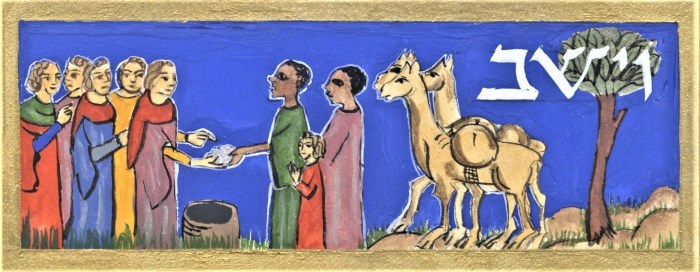
The illustration above is based on a painting in the Sarajevo Haggadah from 1350 Spain. We see the brothers exchanging money with Ishmaelite traders. The brothers are depicted as Spanish merchants with fair skin and light hair wearing typical clothing of the period. The traders are black, with dark skin and curly black hair. Joseph, portrayed as a young boy, stands with the foreign traders, begging his brothers to take him back. Camels carry the merchants’ goods.
This image tells us that the Spanish Jews traded with black merchants traveling from North Africa. It tells us about the clothing of the time and the art produced for the Jewish community. We also learn that today we use the same haggadah that Jews used in medieval Spain and that Pesach was so important that someone commissioned a handwritten, illustrated book to be used at their seder.
Amos’s words and the story of Joseph’s sale were viciously used in history by Roman judges under the emperor Hadrian about 120 CE. On Yom Kippur, we read about ten righteous Rabbis who were martyred. The Roman judges quoted a law which stated, “Whoever kidnaps a man and sells him, or if the man is found in his possession, must be put to death.” They used Amos, Devarim 24:7, and the story of Joseph as an excuse to torture the ten Rabbis.
The story of Joseph took place about 3,500 years ago. Amos’s words in the haftarah, the sin of “selling your brother,” are from around 2,800 years ago. That quote was abused by Roman tyrants 1900 years ago. And then we move to the beautiful Sarajevo Haggadah from 660 years ago, replete with Jewish cultural history. Amos’s message comes through- do not sell your brother. Tragedy will unfold if you don’t treat your family and society with respect and understanding. This is the line through history.
One of the goals in creating my haftarah art pieces is to forge a connection between text, art, and Jewish history. Tanach is alive. Although time continues to pass, we can still learn from our history and know that we are living the history.
Shabbat Shalom, with prayers for the return of all our hostages and a lasting peace. A peace where Am Yisrael lives in unity and safety.
Laya Crust
“ILLUMINATIONS, An Exploration of Haftarah through Art and History” is a collection of all the haftarah pictures you have seen on my blog. The book boasts 82 full-colour pictures. A rich commentary accompanies each painting. To order a book or a haftarah print, go to https://www.haftarah-illuminations.ca/
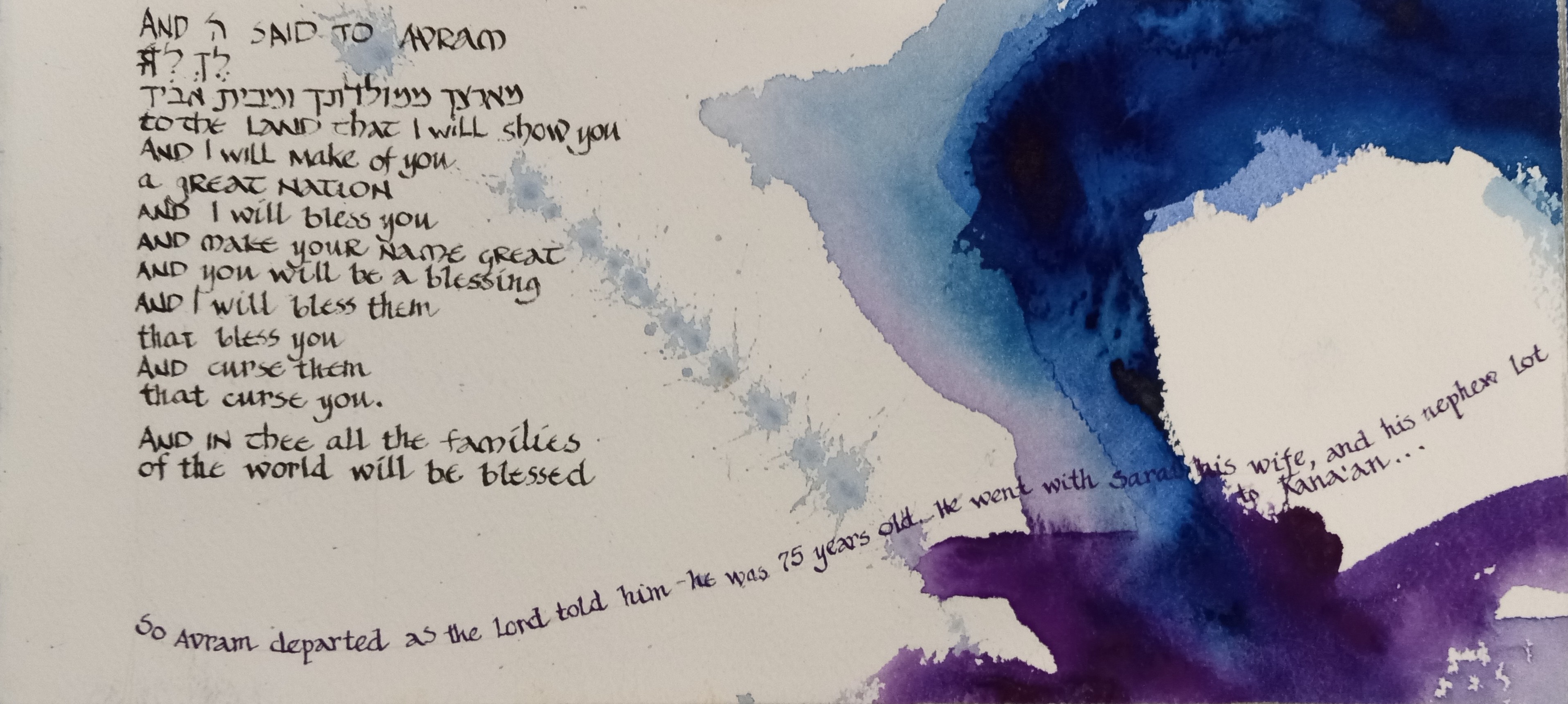
 The Book of Abraham by Laya Crust (Hand-painted accordion fold book)
 Shabbat Shalom, Laya
 Korach art by Laya Crust




 Laya Crust
