Tag Archives: Yisrael

Tetzaveh – Temple Visions

Titzaveh

Temple Floor Plan by Laya Crust

The first forty chapters of the parashah Teztaveh (“You will command”) are dedicated to the High Priest’s clothing. The text describes combining fibres, fabrics, embedded gemstones, bells and tiny pomegranates.

The haftarah is from the Book of Ezekiel. Ezekiel was among the 8,000 Jews exiled to Babylon in 597 BCE. He writes that he is carried by God to the land of Israel. He is set on top of a very high mountain where he sees something like the structure of a city. A man, seemingly made of brass, gives Ezekiel a thorough tour of the future Temple. There are detailed descriptions of each element to be measured and positioned.

We read measurements and the positioning of each holy object in the future Temple. The illustration above is based on a rendering of Solomon’s Temple from an early 12th C. German manuscript illumination. It shows the Temple’s floor plan. All the sacred objects in the floor plan seem to lie on the floor. I used the manuscript drawing because it is so unusual and delightful. It is a charming way for the viewer to see the Temple artifacts. The manuscript is currently in Vienna, Austria in the National Library.

The haftarah begins with the words, “Thou, son of man, describe the house…”

The Jews were miserable. It was the 25th year of their exile in Babylon. God gave Ezekiel an incredible amount of information about the next Temple to share with the Jews. Hearing about the future Temple in Jerusalem, the Jews were optimistic that they would indeed return to their homes. A provision accompanied the details and plans. The Temple would only be restored if the Jews were repentant and corrected their behaviours and observances.

We will fast-forward almost 2,550 years. Under Jordanian rule, Jews were forbidden to pray at the Western Wall from 1948 until 1967. When Israeli forces liberated Jerusalem in 1967, Jews were once again free to go to the Kotel, the only remaining wall of the Second Temple. We don’t have a Third Temple, but we have a unified Jerusalem, and we can pray at the Kotel.

The Temple Mount is the holiest place of Judaism. The Kotel is the only remaining wall of the Temple’s encompassing structure. This remnant of the Temple is proof of our history, our commitment to God and Judaism, and our right to Jerusalem and Israel. This remnant of the Temple is a place where all Jews can speak to God in their own way.

Today we are fighting for our survival. Every Jew in Israel is fighting for all Jews around the world. Jews outside of Israel are defending Israel, defending democracy, and defending our religion. it is a difficult time, but we will retain our courage, our compassion, and our right to our land.

עם ישראל חי, and BRING OUR HOSTAGES HOME.

May you have a Shabbat Shalom-one of peace, understanding and warmth.

Laya

My illustrations and commentaries of all 82 haftarot can be ordered from www.haftarah-illuminations.ca as a book, a print, or a p[oster.

Leave a comment

Filed under Uncategorized

Conflict and Strength – VaYishlach


P1140396
Angel and Self  by Laya Crust

Va Yeishev: Bereshit (Genesis) 32:4 – 36

Haftarah:  The Book of Ovadiah

This week’s Torah reading takes us on Yaakov’s (Jacob’s) journey through the country of Edom towards Bethlehem and Efrat. He was a successful man. He had huge flocks, 2 wives, 2 concubines, 11 sons and a daughter, yet he was nervous. He knew he had to travel through his brother’s landholdings but did not want to face his twin because of their unresolved history. Would Esau be angry at Yaakov? Did Esau still want to kill his brother?

The narrative begins with Yaakov sending messengers to his brother, announcing his approach. The report came back that Esau was coming to meet Yaakov, accompanied by 400 men.  Yaakov, frightened and anxious, sent his messengers ahead with many expensive gifts. He sent his family to the far side of the Jabok River for safety and he slept on the closer side of the river, possibly to be on the alert for any attack.

A man came and wrestled with him through the night. Finally, at dawn, the stranger told Yaakov to let him go. Yaakov demanded that the man give him a blessing, and the blessing came in the guise of a new name- Yisrael, “because you have striven with beings Divine and human” (כּי שׂרית עם אלהים ועם אנשׁים).

Image result for jacob and the angel golden haggadah
Golden Haggadah, c. 1320

Who was the man Yaakov fought with? An angel sent by God? An adversarial angel representing Esau? Or was it an inner battle that Yaakov was struggling within himself? At the end of the battle, Yaakov had a new name and an injury that stayed with him for the rest of his life.

Yaakov’s name has many meanings. It can mean follow, heel, or deceive. Yaakov followed his brother into the world when he was born, holding on to Esau’s heel. As they grew up, he deceived his brother and his father and, in turn, was deceived by his father-in-law.

He left Canaan to avoid confrontation with Esau and to seek a wife. Many years later he left Lavan’s estate at night, hoping to avoid confrontation. He may have been a successful man in terms of his career but he was afraid to face the consequences of his actions.

Yaakov couldn’t avoid wrestling with the angel and he refused to give up or give in to the aggressor. He was given a name that represented his strength and position.

Image result for jacob and the angel
by Gustave Dore, 1855

The night of struggle heralded a new beginning. He faced himself and the enemy across from him. That incident strengthened him in his role as leader of a nation. He could carry on and deal with whatever life put in front of him. The struggle with the immortal being took place between sending a message to Esau and actually facing him. Maybe the fight itself influenced Yaakov’s interaction with Esau.

These days, we are facing an evil, psychopathic army, gleefully bent on Israel’s destruction. They are supported by vicious, lying anti-Semites. Jews, Israelis, and Zionists face attacks- verbal and physical, hurtful and deadly, overt and covert, on a frightening level. We are witnessing anti-Semitism from UN speeches and resolutions, rallies calling for genocide, and unconscionable displays of hatred against Israel and Jews on campuses. Like Yaakov we have to face our fears rather than run away from them. Strength as a people and a nation is the only way to combat hatred and violence.

Like Yaakov we are struggling with the adversaries. Israel’s soldiers are heroes. So are those who are taking action by supporting the victims of terror, fighting media bias, feeding the hungry and displaced, aiding the ill and wounded, and speaking out for what is right. May our hostages return and may we achieve a lasting peace.

In prayer, Sabbat Shalom,

Laya

Leave a comment

Filed under Uncategorized

VaYeitze – And he went out

VaYeitzei SigLadder of Angels   by Laya Crust

VaYetzei is the story of Yaakov’s (Jacob’s)  journey from his parents’ home to his uncle’s tribe in Padan-aram. Rivka sent him to her brother Lavan to find a wife and avoid Esau’s anger.

 On the first night, Yaakov lay down to sleep and dreamt of a ladder reaching up to heaven. Angels ascended and descended the ladder, and God stood above it. God told Yaakov, “I will give you and your descendants the land on which you lie. And your seed will be like the dust of the earth. You will spread abroad to the west, and to the east, and to the north, and to the south…And I am with you and will keep you in all the places you go and will bring you back to this land: for I will not leave you until I have done what I have promised…” (Bereshit/ Genesis 28: 13 – 15)

Yaakov continued his journey to Padan-aram and was tricked into marrying two sisters, his cousins Rachel and Leah. The story continues with his life trajectory over a 20-year period. We read about the birth of eleven sons and one daughter and working for his father-in-law Lavan. Under Yaakov’s management, Lavan’s flocks and wealth increased. Lavan and his sons became suspicious and jealous of his son-in-law. Reading the signals and listening to God’s words, Yaakov realized it was time to go home- to Israel. He returned to the land of his birth.

When he left Lavan’s territory “…angels of God encountered him. When he saw them Jacob said, ‘This is God’s camp’ and named the place Mahanaim.” (Bereshit/ Genesis 32: 2,3)

This parsha is a template for the history of the Jews.

First, there was a struggle causing Jacob to leave to leave his place of birth- just as has happened so many times in our history. God told him that his descendants would spread abroad to the west, the east, the north and the south. And it is so. Jews live in virtually every country and corner of the world.

When Yaakov went to Lavan he was invited to stay and work. Lavan encouraged his son-in-law to stay when he recognized Yaakov’s business acumen. Yaakov’s wealth increased Lavan became suspicious and angry so Yaakov fled with his family. How many times has that happened throughout history? Jews were welcomed to Egypt, Spain, France,  Holland, Germany, England, Poland, Lithuania, and more, where they practised medicine, were traders, and improved the mercantile system. When the population either became jealous of their success or ran into financial difficulty, Jews became scapegoats and were victimized. And the Jews have had to escape unprovoked persecution time and time again.

Yaakov and his wives had thirteen children- each of them unique. Today, we are a people of many unique traditions and interpretations.

It is significant that angels begin and end the narrative. As Yaakov leaves his homeland, he is greeted by angels and God. When God warns him to leave Lavan, the angels meet Yaakov again.

This is a horrifying time. These tragedies can only be attributed to שׂינאת חנם, baseless hatred.  Even in these terrible times, lives in Israel are miraculously protected every day. In these times of terror and upside-down morality, we are accompanied by angels. Many of the angels are our fellow Jews and the people who believe in Israel and Humanity. They bring comfort and healing and help in many different ways. Through donations, cooking, prayer, personal bravery, words and hugs of comfort. Yaakov’s descendants, the Children of Israel, are accompanied by angels of God, but we must keep our hearts and ears open to hear them.

Have a Shabbat Shalom. with love and prayers for peace, Laya

Here are two videos. One from the UN about the silence of women’s rights activists:

And another – Kuloolam singing “Like a Prayer” for our Hostages.

Leave a comment

Filed under Uncategorized

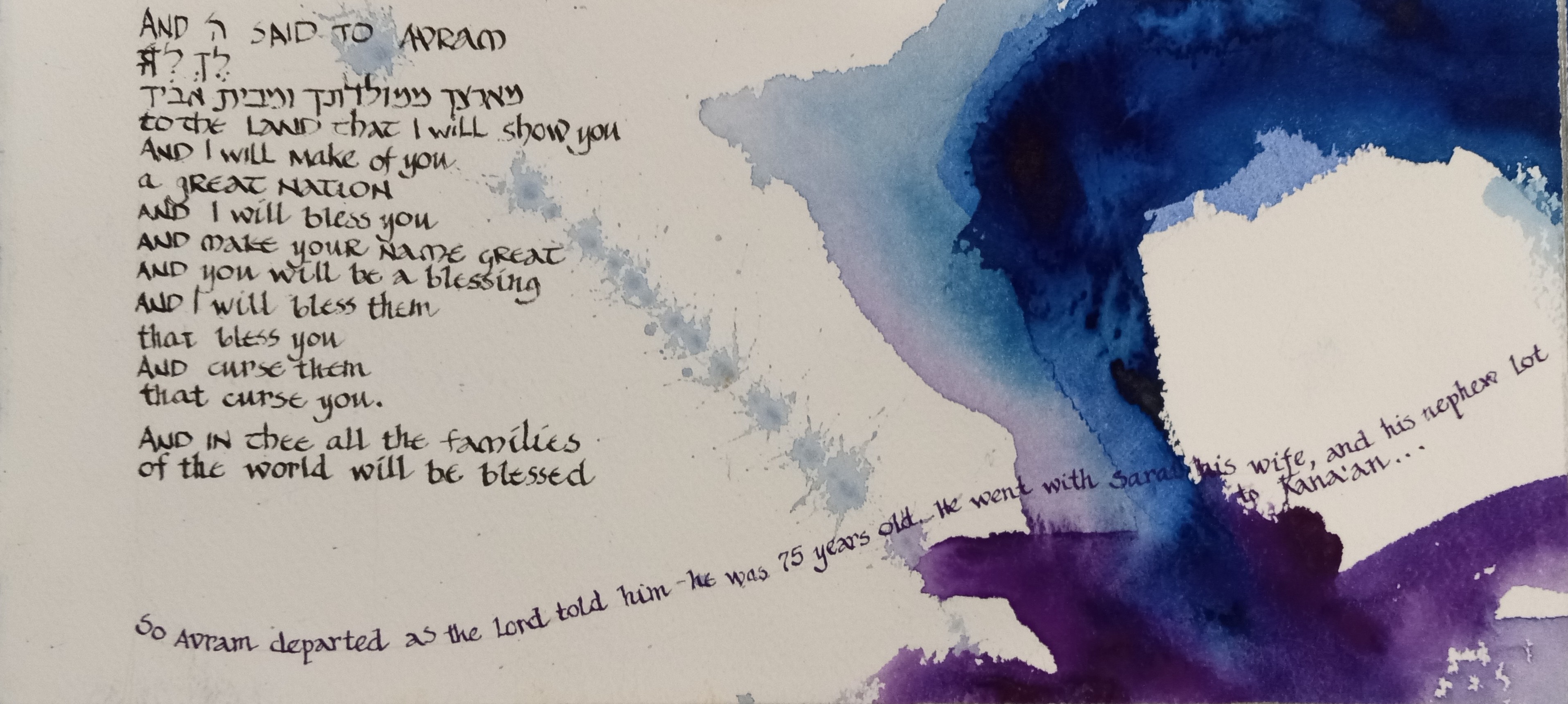
Abraham and Sarah, Living on Our Land

Abraham sent to Canaan

The Book of Abraham   by Laya Crust    (Hand-painted accordion fold book)

The Torah readings over the last few weeks have featured Abraham and Sarah, the patriarch and matriarch of the Jewish nation. Their story began when God chose Abraham to go to the land of Canaan and start a new nation. The painting above states, “He went with Sarai, his wife, and his nephew Lot to Kana’an.” The parashah begins with Sarah’s death and concludes with Abraham’s death.

Sarah, our matriarch, dies in Qiryat Arba at the age of 127. Abraham comes to mourn and weep for her and to find a fitting burial place for his beloved wife.  He pays for the cave of Machpela even though it has been offered to him as a gift. The text is detailed. “And the field of Efron, which was in Machpela, which was before Mamre, the field, and the cave which was in it,  and all the trees that were in the field, that were in all the borders round about, were made over to Avraham for a possession in the presence of the children of Chet,…before Mamre: the same is Hevron in the land of Canaan.” ( Ch. 23 v 17 -19)

abraham - akeida and hebronThe Book of Abraham  by Laya Crust (Hand-painted accordion fold book)

Avraham pays full price for this small piece of property, also known as Hebron, in front of witnesses so there would never be a question of ownership.

The Cave of Machpelah - Vincent van Gogh

              The Cave of Machpela by Vincent Van Gogh
At the end of this week’s reading Abraham dies and his two sons, Isaac and Ishmael, come together as brothers to bury their father. They mourn together and bury their father in the cave of Machpela, beside Sarah. The two brothers meet in peace and act cooperatively. They bury their father on the land belonging to Abraham.
The biblical Qiryat Arba still exists. It is an Israeli town with about 7,500 residents outside of Hebron. Hebron, mentioned in these Torah readings exists. The Cave of Machpelah exists. The land of Canaan exists. Today Canaan is known as Israel.
Israel is historic Canaan with a modern name. We Jews have lived there longer than any other people.  Jews have owned and lived in the land- Canaan, Palestine, the Turkish Empire, Israel- call it what you will – ever since Abraham bought and owned that parcel 5,000 years ago… Jews owned Israel before 1967, before 1948, before the Balfour Declaration, and before the Zionist movement under Herzl. We owned the land all the way back to the time of Abraham.
We are strong, we are united, and we are right to protect ourselves and our land. I pray our hostages come back soon and that there is no more loss of life, that we will see peace and cooperation in Israel very soon.”
chayi sara map with hebron machpelah-genesisShabbat Shalom,   Laya
partial map of Israel in Abraham’s time

Leave a comment

Filed under Uncategorized

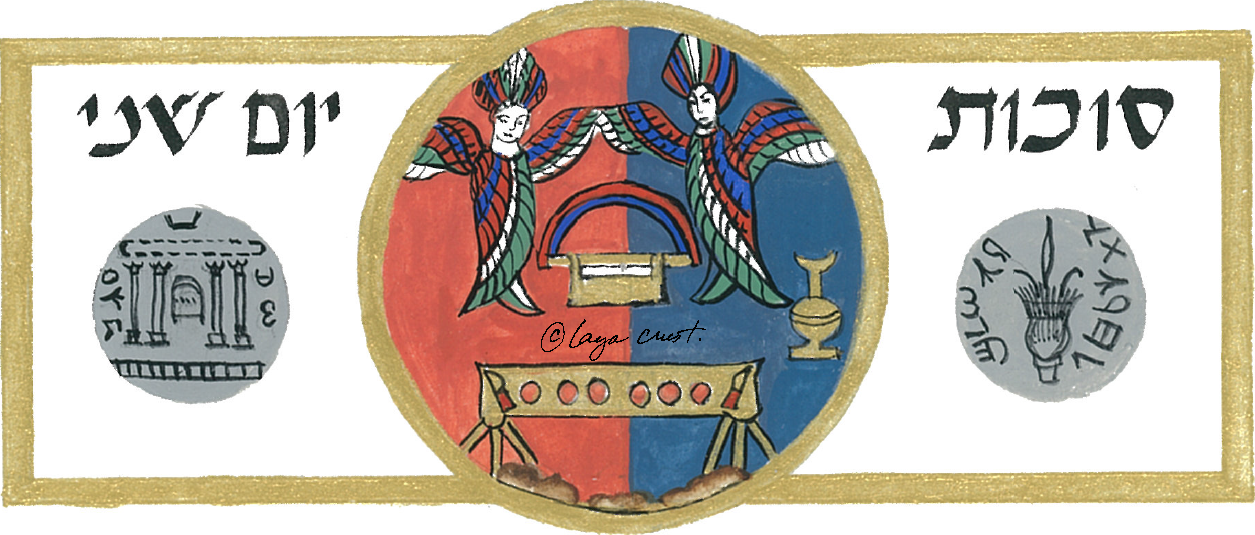
The Etrog- NeHedar! (Splendid!)

Sukkot day 2
“Shielding the Ark”  by  Laya Crust

This weekend we celebrate Sukkot, a beautiful holiday when we eat in a sukkah (a small structure with tree boughs in place of a roof) and make blessings over the lulav and etrog. It says in the Torah, “And you will take on the first day fruit of splendid trees, (עץ פרי הדר), branches of date palm trees, boughs of leafy trees, and willows of the brook…” The Rabbis put the elements together to create the lulav and etrog as we know it. A palm branch is gathered into a bundle with myrtle and willow branches. The etrog (citron) is the עץ פרי הדר- “the splendid fruit.”

p1150696

“Etrogim” by Laya Crust

How was the etrog chosen to be used as the splendid and magnificent fruit? It is not native to Israel and it’s inedible. Where did it originate and how did it arrive in Israel?

The etrog was native to Persia- archeologists have found evidence of it dating back over 4,000 years. There are references to the etrog in Indian literature dating to 800 BCE. It was taken to Greece by traders. It seems it made its way to Israel after the campaigns of Alexander the Great. It is widely agreed that the etrog didn’t reach Israel until the period of the Second Temple. It was so unusual, beautiful, and aromatic it was chosen to be the beautiful fruit to accompany the lulav.

Image result for bar kokhba coins

Bar Kochba coins

We see the etrog depicted in ancient Israeli craft. The lulav and etrog are stamped onto this Bar Kochba coin and figured in ancient mosaics. I used the Bar Kochba coin in the haftarah painting at the top of this blog.

Image result for etrog mosaic

Mosaic from Tiberias Synagogue

The etrog is beautiful and smells heavenly, but the fruit is bitter and needs a lot of help to become edible. The fruit is never eaten on its own since it’s so bitter. It seems it is used mostly for medicinal purposes- in teas and mixed with oils to use as ointments in Persian and Indian and Persian cooking. Sometimes it’s made with sugar and combined with oranges and lemons for etrog jam or marmalade. The zest is used in rice and as a colourful accent, and some people candy it and then dip it in chocolate.

Etrog Marmalade- Breaking Matzah     Etrog Marmalade from breakingmatzah.com
I hope you enjoyed this little peek into the history of the beautiful, perfumed etrog. Enjoy your Sukkot, and maybe try something new with your etrog- but use an organically grown one!

Chag Sameach, Laya

ILLUMINATIONSAn Exploration of Haftarah through Art and History is a collection of all the haftarah pictures you have seen on my blog. The book boasts 82 full-colour pictures. A rich commentary accompanies each painting. To order a book or a haftarah print go to https://www.haftarah-illuminations.ca/

Leave a comment

Filed under Uncategorized

Devarim, 5783

Devarimart by Laya Crust

Devarim/ Deuteronomy     Haftarah- Isaiah I: 1- 27

The parsha Devarim and its haftarah always precede the fast of Tisha B’Av  (the 9th of Av) when we read the Book of Lamentations or איכה .  Michael Mirsky- Torah reader and “leining” teacher extraordinaire-  explained why Devarim is always read before Tisha B’Av.  In the parsha Moses asks,”איכה אשא לבדי טרחכם ומשאכם וריבכם.” “How can I bear unaided the trouble of you, and the burden, and the bickering!” (Devarim 1: 12). As you can see, Moses’ plea  begins with the word איכה – Eicha.

This desolate haftarah is the last of the “Three Haftarot of Rebuke”. Isaiah recounts how God laments that His children – B’nei Yisrael – have rebelled against Him. They are corrupt, their prayers are empty and their sacrifices are meaningless.

Isaiah tells the nation their sins can become white as snow, and the land can become fruitful and full again.  God asks Israel to “Learn to do well; Seek justice, relieve the oppressed, judge the fatherless, plead for the widow.” (Isaiah 1: 17) There is a parallel phrase in the parsha. Moses reminds B’nei Yisrael, “You shall not be partial in judgment: hear the small and the great alike.” (Devarim 1:18) These quotations remind the Israelites to act fairly and care for those who are in need, no matter what station they hold in life.

In searching for an image for this haftarah I wanted something that expressed God’s desire that His children act well and justly.  The care of Jewish refugees in the nascent Israel of 1949 came to mind.

As we know, Jewish immigration to Israel, their ancestral homeland, was severely restricted by the White Paper of 1939. Jewish survivors of the Shoah (Holocaust) had to enter mandate Palestine illegally and if they were caught were sent to D.P.camps. When Israel was declared a state in 1948, thousands of Jewish immigrants and refugees arrived. They needed food, clothing, and shelter.          

Ma’abarot” (or makeshift camps and cities) were set up to temporarily house survivors and refugees. In the early 1950’s they accommodated 130,000 expelled Iraqi Jews. By the end of 1951 there were over 220,000 people in about 125 different areas.

The ma’abarot had problems and were not “perfect” solutions, but they were an attempt to take care of the widows, the orphans, and the needy when Israel was first established.

 The illustration at the top of this post was inspired by a photograph of a ma’abarah in 1952.

B’nei Yisrael was promised the land of Israel, and we have the good fortune to be able to live there today. The direction to judge all people with the same fairness and righteousness, and to take care of all of those in need still stands today. We should be proud of what Israel and Jews internationally have achieved in terms of social justice and care of the sick and needy- but let’s remember to improve the world by being better ourselves.

Have a meaningful fast on the Tisha B’Av fast day. (This year the fast will be on Thursday, the 27th of August.) And let’s keep on making the world a better place!

Best, Laya

P.S. I will be giving a lecture about Tisha B’Av, the Book of Lamentations, and art that illustrates the readings. Join me on ZOOM this Sunday, July 23, 202. The lecture is free, and interesting!

https://www.bac.org.il/en/events/?eventID=18731

https://us02web.zoom.us/webinar/register/WN_A5LicpntRACR2lxB71ztmQ#/registration


1 Comment

Filed under Uncategorized

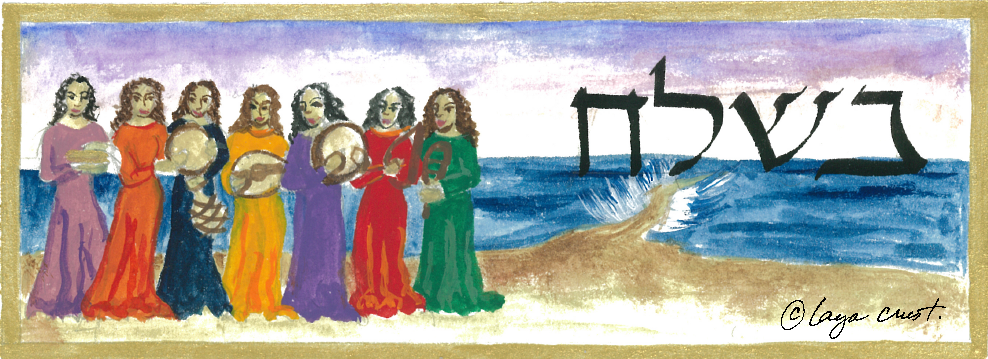
BeShalach-Shabbat Shira

B'Shalach
Miriam’s Song by Laya Crust

This week’s Torah reading, Beshalach, is called Shabbat Shira- the Shabbat of Song. We read three songs-  Miriam’s song after crossing the Red Sea, Moshe’s “Song of the Sea,” and Devorah’s song of victory. Women sing and play music in both the Torah and haftarah readings, and they are also significant figures in these biblical stories.

Before focusing on our heroines, Miriam, Devorah, and Yael, I will mention some elements from this week’s parashah. The Israelites have fled Egypt, but Pharaoh and his army are in quick pursuit. God splits the Red Sea so the Israelites can cross to the other side. We read about the manna that appears to feed the hungry people. God introduces the notion of “Shabbat” by sending two portions of manna on the sixth day so that everyone can refrain from collecting food on the seventh day, Moses sweetens the water in this parashah and we read about the battle with the Amalekites.

Miriam is called a prophet in this parashah. She and her brothers, Moses and Aaron, lead b’nei Yisrael to freedom. God has confidence in the abilities and wisdom of women and chose Miriam to be the female role model for the nation. She exemplified strength and leadership. After crossing the Red Sea, Miriam led the women, celebrating with song and dance.

h shabbat shira

Devorah the Prophet by Laya Crust

 Devorah was a judge and prophet who led the Israelites for 40 years. She sat under a palm tree to meet with her people. The haftarah tells of a battle waged by the Canaanites against the Israelites. The Jewish commander, Barak, asks Devorah to lead the battle with him. She warns Barak that a woman will be credited with the victory if she goes, but he still insists on her help.

Yael Killing Sisera Maciejowski Bible, ca 1240

Yael, the other significant woman in the haftarah, is not a Jew but a Kenite. After the battle, Sisera, a general, flees from the Jews, seeking refuge with Yael. She gives him warm milk to drink, covers him with a blanket, then drives a tent peg through his temple, killing him. The haftarah is unusual in that it features two women- Devorah and Yael- as heroic characters.

Devorah writes a song of praise, mentioning herself as a mother of Israel, Barak as a leader, and Yael as a heroine. The end of the song is powerful. Devorah describes Sisera’s mother waiting at the window for her triumphant son to return home from battle. Devorah sings, “…The mother of Sisera…moaned…’Why is his chariot so long in coming? Why are the hoofbeats of his steeds so tardy? …Have they not found spoils and treasure? Have they not divided the prey; to every man a damsel or two; to Sisera many kinds of plunder…?”. Devorah describes the scene- a mother waiting for her son- all the while knowing Sisera has been murdered. The mother’s pride that her son has successfully killed, looted, and abducted the Israelites is disquieting.

The women in the parashah and haftarah show strength and leadership. God chose Miriam to be one of the three leaders of the children of Israel as they trekked towards freedom. God appointed Devorah and later Hulda as prophets and made Yael a hero.

Women may not be mentioned in our writings as often as men, but women were essential leaders and educators then, as women are today. Let’s work in strength and harmony, and sing in harmony too!

Have a joyous and tuneful Shabbat,

Laya

Leave a comment

Filed under Uncategorized

Bo, The Stand-off

Bo sig

Haftarah:  Jeremiah 46: 13-28

This week’s haftarah is from the Book of Jeremiah. Jeremiah lived most of his life in Israel, witnessing both sieges of Jerusalem (597 and 586). In this haftarah, after the fall of the First Temple, he warned the Children of Israel not to ally themselves with Egypt. He prophesied that Egypt would fall to the Babylonians.

In the illustration Egypt {Pharaoh) is being confronted by Jeremiah (Moses). The images Jeremiah uses in his warnings about Egypt are painted in the background. The heifer, gadflies, serpent, locusts, and trees that will be cut down have been painted to look like an Egyptian wall painting. The images the prophet used echo the plagues visited upon the Egyptians in parsahat Bo.

The Egyptians had already experienced 7 plagues. Some were unpleasantly uncomfortable (being overrun with frogs) and some were devastating (pestilence killing the cattle and hail destroying crops). In this week’s parashah, Moshe warned Pharaoh that if he didn’t free the children of Israel there would be even more dire consequences. Three more plagues were to be visited upon the Egyptians. Pharaoh lost patience with Moses. After the plagues of locusts and darkness, he wanted the threats to stop. Bombastically, he proclaimed, “Depart from me, take heed of yourself. Make sure never to see my face again. For on the day you see my face you will die.”  (Exodus 10:28) Moses answered, “You have spoken well. I will not see your face again.” Pharaoh’s threat was answered. He did not ever see Moses’ face again.

Pharaoh had been given opportunities to let the Israelites leave. His pride would not allow Moses to threaten him or speak of a Gd more powerful than he. Pharaoh threatened Moses with death. He would never see Moses again, but he paid a horrific price. His eldest son- and the eldest of all Egyptian families would die. Pharaoh’s decree not to see Moshe’s face again had negative implications and terrible results.

Rabbi Ari Kahn, a rabbi in Israel, points out that children are the focus of the Exodus narrative. Our all-powerful Gd could have freed the Israelites from Egyptian slavery with little pain and fuss. For instance, the plague of darkness immobilized the Egyptians for three days while the Israelites had light. Moses could have led Gd’s people out of Egypt and across the Red Sea without their oppressors even knowing what was happening. Why the elaborate choreography of the plagues?

The cries of pain began with overwork and Pharaoh’s decree to kill newborn Jewish babies. Midwives and mothers risked their own lives to save the babies. The lives of children are precious to Jews. In this parashah Gd tells Moses that our children may forget the story of Egypt, slavery, and deliverance. The seder itself will be the reminder. That reminder will ensure our children’s education and the continuity of our people.

We are told to remember the stranger because we were strangers. We are reminded to remember our past and learn from it. We live in challenging times and hopefully if we remember to be kind to those around us we will get through this period without too many bruises.

Shabbat Shalom, Laya

2 Comments

Filed under Uncategorized

Vayechi- Family Continuity

Va'yechi Sig
King David and Solomon by Laya Crust

Both the haftarah and the parashah are narratives of handing over the reigns of power. Jacob, in the parashah, is on his deathbed. He describes each of his sons and predicts how they will lead their lives. King David, in the haftarah, tells Solomon to vanquish their enemies, be strong, and follow Gd’s laws. Yaakov and David recognize that their death means a new beginning for their sons.

 We have a beautiful prayer we say each morning, “My Gd, the soul You placed within me is pure. You created it. You fashioned it. You breathed it into me. You safeguard it within me, and eventually, you will take it from me and restore it to me in time to come. As long as the soul is within me, I gratefully thank you, my Gd and Gd of my forefathers, Master of all works, Lord of all souls…”

Morning Prayer by Laya Crust

Each day we have the opportunity to see our life as a new beginning. We can make a change for the better, face a challenge, or make a fresh start.

Jacob was 137 years old. He had lived in Egypt with Joseph and his other 11 sons for 17 years. Jacob was about to die and called for Joseph, Ephraim, and Menashe (Joseph’s sons). “…he kissed them and embraced them. And Yisrael said to Joseph,’ I had not thought to see your face: and lo, God has also shown me your children.’ ” (Genesis ch 47 v..11). Jacob expressed the pain he had felt for decades, never believing he would see his son Joseph again. Neither Abraham nor Isaac had ever spoken to their children with such honesty and warmth.

We go on to read the first ethical will to be recorded. Jacob spoke to each of his sons and to his two favourite grandsons. He foresaw how they were going to navigate the world. While speaking to his children, Jacob insisted that he be buried in Canaan, indicating that Canaan, not Egypt, was their homeland.

Jacob cemented the family unit with his words. It wasn’t a public speech, and it was a speech only for his sons. He valued them as a unified family, and they would retain their nationhood and integrity if they stayed together.

In this week’s texts Yaakov and David, reflecting on their own lives, gave their sons guidance for the future. Their sons could listen to the exhortations and ignore them or take them on a more profound level. The deeper level would be for the sons to listen to their father’s words and ask themselves- “What can I change in myself to heed this wisdom and at the same time become a better person using the wisdom?”

When we read the morning prayer thanking Gd we remind ourselves that we have a fresh soul each day. Let’s remind ourselves to do things we love that make us feel good and are beneficial to others. We can use the newness of each day to move towards a great ideal.

Shabbat Shalom,

Laya

Leave a comment

Filed under Uncategorized

Conflict and Strength – VaYishlach


P1140396
art by Laya Crust

Va Yeishev: Bereshit (Genesis) 32:4 – 36

Haftarah:  The Book of Ovadiah

This week’s Torah reading takes us on Yaakov’s (Jacob’s) journey through the country of Edom towards Bethlehem and Efrat. He was a successful man. He had huge flocks, 2 wives, 2 concubines, 11 sons and a daughter, yet he was nervous. He knew he had to travel through his brother’s landholdings but did not want to face his twin because of  their unresolved history. Would Esau be angry at Yaakov? Did Esau still want to kill his brother?

The narrative begins with Yaakov sending messengers to his brother, announcing his approach. The report came back that Esau was coming to meet Yaakov, accompanied by 400 men.  Yaakov, frightened and anxious, sent his messengers ahead with many expensive gifts. He sent his family to the far side of the Jabok River for safety and he himself slept on the closer side of the river, possibly to be on the alert for any attack.

A man came and wrestled with him through the night. Finally at dawn the stranger told Yaakov to let him go. Yaakov demanded that the man give him a blessing and the blessing came in the guise of a new name- Yisrael, “because you have striven with beings Divine and human” (כּי שׂרית עם אלהים ועם אנשׁים).

Image result for jacob and the angel golden haggadah
Golden Haggadah, c. 1320

Who was the man Yaakov fought with? An angel sent by Gd? An adversarial angel representing Esau? Or was it an inner battle that Yaakov was struggling within himself? At the end of the battle Yaakov had a new name and an injury that stayed with him the rest of his life.

Yaakov’s name has many meanings. It can mean follow, heel, or deceive. When he was born Yaakov followed his brother into the world, holding on to Esau’s heel. As they grew up he deceived his brother and his father, and in turn was deceived by his father-in-law.

He left Canaan to avoid confrontation with Esau and to seek a wife. Many years later he left Lavan’s estate in the night, also hoping to avoid confrontation. He may have been a successful man in terms of his career but he was afraid to face the consequences of his actions.

Yaakov couldn’t avoid wrestling with the angel and he refused to give up or give in to the aggressor. He was given a name that represented his strength and position.

Image result for jacob and the angel
by Gustave Dore, 1855

The night of struggle heralded a new beginning. He faced himself and the enemy across from him. That incident strengthened him in his role as leader of a nation. He could carry on and deal with whatever life put in front of him. The struggle with the immortal being took place between sending a message to Esau and actually facing him. Maybe the fight itself influenced Yaakov’s interaction with Esau.

These days we are facing anti-Semitic attacks- verbal and physical, hurtful and deadly, overt and covert, on a frightening level. We are witnessing anti-Semitism from the British elections to UN resolutions, to terrorist attacks in kosher grocery stores and in synagogues, and unconscionable displays of hatred against Israel and Jews on campuses. Like Yaakov we have to face our fears rather than run away from them. Strength as a people and a nation is the only way to combat the hatred.

Like Yaakov let’s struggle with the adversaries and stand firm for what is right. May we see peace soon,

Sabbat Shalom,

Laya

3 Comments

Filed under Uncategorized