why you should keep writing your book

Hello, everybody, and welcome back to Quote, Unquote!

This post went up earlier today, but WordPress glitched out and ended up erasing half of it. So here it is once again.

There is one question that always nags at the back of a writer’s mind. It’s the worst possible thing for a writer–a weed that kills motivations and ends stories before they’ve even started.

The question takes many forms, but it essentially boils down to:

“Why am I doing this?”

The time will come when you are writing your story, and the words are coming slowly and your brain feels like it’s slogging through molasses, and you just take back your hands from the keyboard and think, “What’s the point?”

At which point I will physically enter your house, force you to look at me, and tell you that what you are thinking is LIES ALL LIES and pump you up until you have to start clacking away again.

Okay, maybe I won’t actually come to your house. But consider this post your “grabbing by the shoulders” of the writing world. We’re going to go through some things you might be thinking to yourself and debunk them, one by one, until you have no choice but to write the awesomest story this world has ever seen.

no one will like my story

In 2020, I started writing and posting this Minecraft fanfiction on my writer’s workshop. It had no plot, awful dialogue, a confusing storyline–and more fans than any of my other writing has ever had.

I read part of it back recently to remind myself of how far I’ve come, and let me tell you, I cringed the entire time. It was probably the worst thing I’ve ever written. Yet people still love it (and recognize me as “the person who wrote that Minecraft fanfiction that one time”).

Everyone has their own personal likes and dislikes, and no two peoples’ are going to be exactly the same. There are seven billion people on this planet. You cannot tell me that there is no one who will like your story. Somewhere out there, there’s someone who is going to love your WIP so much that they are going to make fanart and write fanfiction and squeal about it on social media. The book that’s sitting in your drafts or in your head right now could be someone’s favorite book.

Someone will love it. I promise you.

I’m never going to finish it, so why bother?

I’m going to tell you a boiling hot take that I don’t see often enough in the writing community.

Your time spent enjoying the creative process is infinitely more valuable than anything you could ever create. I’ve made dozens of little cross-stitches and embroidery projects that I immediately shoved in a drawer and forgot about. The pleasure for me was not in the having, it was in the making.

This goes for anything creative–including writing. Especially writing, I might go so far as to say. Humans were made in the image of God, and what did God do? He created. Creation is one of the essentials of human life. It’s what we were made to do.

I don’t care how much you wrote of that new, exciting WIP. I don’t care if it was half the book or just one chapter. You still carried on that human tradition of just creating, and you took joy in it (I hope). Even if your story never gets finished, you still created. And that’s the important thing.

someone might have done it better than me

There’s something I found on Pinterest a little while ago that I found really inspiring. (I had to censor it a little bit to make it appropriate for my audience, but you’ll get the gist.)
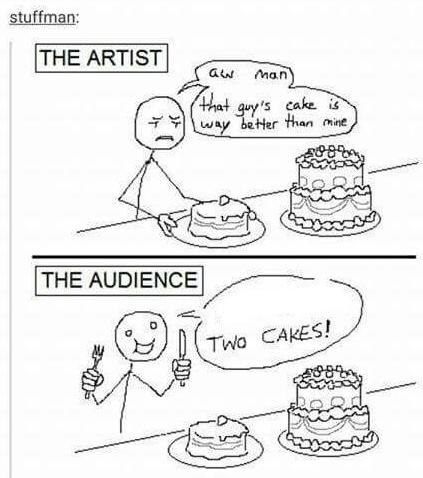
This image pretty much sums it up. What you, as the artist, see as lesser compared to someone else’s art, the audience sees as an absolute win. For them, it’s another fun thing that they get to consume. It’s not better or worse to them, because they aren’t looking at the inside–they’re just happy that there’s more.

Even if someone does do it “better” than you, it won’t matter. Your audience will love it either way.

my writing is terrible

This one fills me with such rage that it’s going to be a struggle to write a few coherent paragraphs about it. Every time someone tells me “My writing is terrible,” I want to pick them up and slam-dunk them into a pit of positivity until they behave. I’m typing at insane speeds right now because of just how angry this phrase makes me.

YOUR. WRITING. IS. NOT. TERRIBLE.

Please. Please hear this. Your writing is not terrible. Your writing is not terrible. Your writing is not terrible.

This one, I feel like, stems from comparison. You look at talented writers and think, “Man, I could never write a metaphor like Markus Zusak. I could never weave together storylines like Jodi Picoult. I could never come up with a world that sticks with generations to come like J. K. Rowling.” And then, because you’re focused on the “can’t”s, you miss the “can”s.

When you say, “I can’t write metaphors,” you’re missing the way your dialogue flows so smoothly. When you say, “I can’t create coherent and seamless storylines,” you’re not focusing on the way your characters feel so human. When you say, “I can’t worldbuild well,” you’re ignoring how your action scenes grip your readers with suspense.

It all boils down to strengths and weaknesses. Maybe you feel like you can’t write a metaphor like Markus Zusak. But I bet Markus Zusak couldn’t come up with something that you have.

Every writer struggles with this. It’s natural, it’s normal. It’s just not good. Your writing is not terrible. I promise you.

And if you keep saying that? If you think there’s absolutely no way it can be good? Show me. Show me your writing. And I will confirm this for you: Your writing is beautiful.

Quit comparing and get to work.

final words

I hope that this virtual shaking by the shoulders has somehow encouraged you. And I hope that you’re ready to go out into the world, confident in your abilities as a writer, and slam out someone’s new favorite book.

Thank you so much for reading. I will see you next Wednesday.

naïve leaders: a comparison essay

Hello, everybody, and welcome back to Quote, Unquote!

One of the biggest parts of my exposition and composition (language arts in normal-people-speak) subject is writing essays. This year, we are studying Shakespeare, and oh boy is it a wild ride.

Anyway, one of the plays we just studied was Julius Caesar, and I got into it. Like, into it. I seriously loved the play. It was so good. And because I also love The Hunger Games, I noticed a lot of similarities between the two works.

So for my Julius Caesar essay, I wrote a comparison between the protagonist Brutus in the play and the protagonist of The Hunger Games, Katniss Everdeen. My former director suggested that I post it on my blog, so…here it is! (Mrs. Arndt, if you’re reading this, thank you for the post idea.)

Be warned! Spoilers for both Julius Caesar and the Hunger Games series abound! So if you have not read one or either of them and you would like to, I do recommend not reading this post. I try to keep most of my book reviews spoiler-free, but in this in-depth analysis, it can’t be avoided.

Enjoy!

Naïve Leaders

When one decides to overthrow an entire corrupt government system, be it a dystopian society in the distant future or a soon-to-be dictator in the distant past, one must be ready for the consequences that come with this rebellion. Katniss Everdeen, protagonist of Suzanne Collins’ well-known The Hunger Games trilogy, and Brutus, protagonist of William Shakespeare’s Julius Caesar, both attempted an enormous rebellion. While they were both more or less successful, their personal losses were devastating enough to make it a Pyrrhic victory, and their naïveté meant that these losses were much more acute than if a normal person had been leading their respective rebellions. 

A common symbol in both of these works of literature is that of family. Both Brutus and Katniss’ families play a part, however insignificant, in these books. To Katniss, family is her most important thing. After her father dies in the mines, her mother sinks into deep depression. When Katniss is about to leave to participate in the Hunger Games, she shouts at her mother not to leave again, and in her voice is “all the fear [she] felt at [her mother’s] abandonment” (Collins, The Hunger Games 35). If Katniss lost her family, she would be destroyed. Meanwhile, Brutus neglects his only family, his beloved wife Portia, for his cause. He is so wrapped up in his plot to kill Caesar and the hullabaloo that follows that his wife commits suicide, “[i]mpatient of [his] absence” (Shakespeare 4.3.174). Brutus valued his cause over his family so much that he would not stay with her and give her the help she needed. While family is a symbol in both The Hunger Games and Julius Caesar, the two main characters have wildly different stances on it.

Both Katniss and Brutus are figureheads of a rebellion. In The Hunger Games, Katniss and her merry band of rebels are fighting against the injustice of the Capitol suppressing the districts. In Julius Caesar, Brutus leads the plot to kill Caesar, ending him with his famous final words, “Et tu, Brutè” (Shakespeare 3.1.85)? However, though they are both figureheads, they do not make their own plans for their rebellions. Katniss is not mentally sound enough to be able to lead her country to victory—she is merely a symbol. Her mockingjay that inspires the rebels is used on everything, even “baked into bread” (Collins, Catching Fire 139). Her plot is masterminded by someone else—namely, President Coin, the corrupt leader of District 13. Meanwhile, Brutus could invent his own schemes if he wanted to, but he makes some fatal mistakes and therefore lets Cassius do the orchestrating. Though they are leaders and seen as the most important people behind their plans, there are several others working in the background.

Perhaps the most important and shocking trait of these two characters, though, is their startlingly similar naïveté. For such important leaders as these, one might think that they would be mature and ready to take on such responsibilities. Katniss’ naïveté can be explained, as she is only seventeen years old and already suffering immense losses, but she is still severely mentally ill and should not be leading a rebellion in the first place. She acknowledges in Mockingjay that it is “impossible to be the Mockingjay” (Collins 162). She is clearly not old enough or strong enough to lead a rebellion against an entire country. However, Brutus has no excuse. He was likely in middle age, which means that his brain had had ample time to develop. Given this, he still made fatal mistakes, such as allowing Antony to have the last word at Caesar’s funeral. Antony turns the crowd against Brutus using several logical fallacies, telling them over and over again that “Brutus was an honorable man” (Shakespeare 3.2.96) but clearly meaning the opposite. By allowing Antony to publicly turn against him, it weakened his spirit and his public support so much that he eventually ran upon his own sword, meeting the same end as his neglected wife—death by suicide. Brutus’s naïveté meant a much bloodier and more devastating end than Katniss’s, but neither of them should have been able to lead a rebellion as far as they did, given their lack of mental stability and maturity. 

Given these similarities and differences, Katniss and Brutus are similar to the point where it is fair to say that they should not be in charge of as much as they are. Their families are both detrimental to their cause in extreme ways, and they are both naïve enough that even if they were the masterminds of their own plots, they should not be—in fact, they should not be in charge of a rebellion at all. A rebellion takes mental and emotional maturity. If one decides to lead a rebellion, one would do well to ensure that they are properly equipped and emotionally ready for such an enormous task.

Works Cited

Collins, Suzanne. Catching Fire. Scholastic Press, 2009.

—. The Hunger Games. Scholastic Press, 2008.

—. Mockingjay. Scholastic Press, 2010.Shakespeare, William.

Julius Caesar. Edited by Barbara A. Mowat and Paul Werstine. The Folger Shakespeare Library, 2011.

Well, I hope you enjoyed! Have you read either or both of these works? What other similarities have you noticed?

Thank you so much for reading, and I’ll see you next Wednesday!

hot takes: The Sound of Music and Jane Eyre

Hello, everybody, and welcome back to Quote, Unquote!

It’s been a little while since I’ve last posted Hot Takes, a series where I compare modern film to classic literature. And, okay, maybe The Sound of Music isn’t exactly modern, but hey, it was made after Jane Eyre, so it counts. In this post, we’ll be comparing the two stories, their themes, and their plots, and seeing what makes them similar.

Without further ado, let’s start by explaining the plots of both stories. Warning: There will be spoilers ahead! If you haven’t seen/read either of these works and you still wish to, please do so before continuing to read this post.

plot summary: The Sound of Music

Austria, 1938. Maria is failing at her one job: becoming a nun. She just can’t seem to stop singing and dancing and racing away to the mountains, so the Mother Abbess sends her to be a governess for Captain von Trapp’s seven children (the eldest of which I was named after, although I pronounce my name slightly differently. However, this isn’t relevant, so moving on). The Captain rules his household with an iron fist, and after he goes away, the children take every opportunity possible to misbehave, but Maria responds with kindness and soon they become good friends.

Maria teaches the children to sing, which displeases the Captain greatly when he returns home with his romantic interest, the Baroness, and he almost returns Maria to the abbey. But he is impressed and overcome by his childrens’ beautiful voices and changes his mind. He hosts a lavish party, during which Maria realizes that she has romantic feelings for the Captain. The Baroness, jealous, indirectly convinces her to return to the abbey. She does so, and during this time, the Baroness and the Captain are engaged.

Maria soon returns, and the Captain breaks off his engagement and marries Maria instead. However, this is Austria in 1938, so things aren’t happy for long. The Captain is ordered to report to the German naval base, but he’s opposed to the Nazis, so the family attempts to escape, but they are stopped. The family goes and sings in the Salzburg Festival to buy time, afterwards slipping away and hiding at the abbey. After a close call with the Nazis, the von Trapps are able to escape, and they make their way into Switzerland safely.

plot summary: Jane Eyre

(buckle up)

Young Jane Eyre lives with her abusive Aunt Reed, who, close to the beginning of the book, sends her away to school. The school is nowhere near as idyllic as Jane hoped it would be, and she spends a total of nine years there before finally accepting a governess position at a manor called Thornfield.

Her employer is a dark, brooding old man named Mr. Rochester, who she secretly starts falling in love with. One night, she saves him from a fire that she is told was set by a drunken servant. Later, Rochester brings home a wealthy and beautiful woman named Blanche Ingram. Jane is despondent and expects Rochester to propose to Blanche, but to her surprise, Rochester proposes to Jane instead. As their wedding day draws nearer and nearer, Jane is uncomfortable with the amount of lavishness (is that a word?) that Rochester heaps upon her. And on the wedding day itself, a man called Mr. Mason interrupts the vows, calling out the unbelievable truth: Rochester is already married.

Rochester admits that he is, but his wife, Bertha, is insane, and proves it to Jane by showing her. He tells her that it was really Bertha who set the fire that night. Rochester keeps Bertha hidden on the third floor and pretends she doesn’t exist. Horrified, Jane flees, knowing that it is impossible to stay with Rochester after this. She is forced to beg for food and wander the moors until she is taken in by three siblings: Mary, Diana, and St. John. St. John finds Jane a job teaching at a nearby school, and one day shocks her by delivering two pieces of news: her uncle has died and left her a vast fortune, and her uncle is also his, Mary’s, and Diana’s uncle, thereby making them cousins.

St. John decides to travel to India as a missionary and invites Jane to accompany him, proposing marriage to her (EW). She declines after nearly giving in and realizes that she cannot leave Rochester, who she truly loves. She hurries back to Thornfield and finds that it has been burned in a fire, during which Rochester lost his sight. They reconcile, marry, and live happily ever after.

(I know that was long, but that was like the SparkNotes of the SparkNotes, so…there’s not a whole lot I can do.)

their similarities

Now, you may be noticing some eerily similar things in these synopses. Let’s list them:

  1. a spirited young woman with strong faiths (Jane and Maria are both strong believers in God) as the main character
  2. a moody, rich older man as the love interest (who also owns a mansion in Europe)
  3. the men being scarred from their previous marriages
  4. the women leaving their former lives to become governesses
  5. the governesses falling in love with their employer
  6. a rich woman who comes in between the main character and their love interest
  7. governesses leaving their employers, despite being deeply in love with them
  8. the (former) governesses returning to their employers after a deep internal conflict
  9. the governesses marrying their employers and gaining children, whether by birth or inheritance (that’s not the right word but honestly who cares)

Obviously, The Sound of Music actually happened–the original musical was based off of Maria von Trapp’s memoir The Story of the Trapp Family Singers. But isn’t it a little…odd how much the 1965 film mimics the 1848 classic novel?

Maybe this is a conspiracy theory–it definitely could be. But The Sound of Music and Jane Eyre really are creepily similar. No one knows why….

Until next time,

hot takes: Zootopia and Pride and Prejudice

Hello, everyone, and welcome back to Quote, Unquote!

This week we’ve got something just a little different. That’s right, I’m starting a new series!

I was watching Zootopia the other day because I was sick and Zootopia is one of my comfort movies. While I was barely paying attention to the movie, something struck me, and I grabbed my phone and texted my friend:

Of course, her response was more along the lines of “you’re insane and there’s nothing I can do about it,” but I thought I was onto something, so I’m subjecting you all to it.

In the process of brainstorming for this post, I realized that there are a lot of movies that share a lot of events and themes of classic literature. So I’m making it a series. But for now, let’s just focus on the post at hand.

Anyway, obligatory disclaimer: If you have not watched Zootopia or read Pride and Prejudice, I would encourage you to do so before you read this post. It won’t make sense otherwise, plus there are going to be a million spoilers.

Let’s jump right in!

Zootopia plot summary

Rabbit Judy Hopps has become a police officer despite the astronomical odds against her, and she aims to go to Zootopia, “where anyone can be anything,” to make the world a better place. On her first day on the job, she is assigned to parking duty, while all the other officers are sent to handle the fourteen missing mammal cases. But a twist of fate finds her trying to track down one of the missing mammals, Emmitt Otterton. With a fox named Nick Wilde, she tracks Emmitt to an asylum, where all fourteen of the mammals are found, but they have gone savage.

She appears on a press conference, where a reporter maneuvers her into saying that they may have gone savage because of their predatory biology. Nick angrily storms away and Judy returns home, wracked with guilt. While she’s there, she figures out the reason all the predators have gone savage, and returns to Zootopia, where she reconciles with Nick.

Together, they apprehend the mastermind behind the whole plot, who turns out to be the mayor. Nick becomes Judy’s partner and the first fox on the ZPD.

Pride and Prejudice plot summary

(there are about a million things going on here, so I am just covering the main plot–Darcy and Elizabeth’s relationship)

Mrs. Bennet is desperate to see her five daughters married off, and the news that the wealthy Mr. Bingley has moved into the manor at Netherfield Park causes quite a stir. Mr. Bennet visits Mr. Bingley, and soon after they attend a ball at which Mr. Bingley is present. Mr. Bingley spends most of the evening with the eldest, Jane, but his friend, Mr. Darcy, refuses to dance with the second-eldest, Elizabeth, and this causes the other guests to view him as arrogant and obnoxious.

But over the next few weeks, at social functions, Darcy finds himself growing increasingly more attracted to Elizabeth. Elizabeth, however, is cold towards him, as another gentleman, Mr. Wickham, tells her how Darcy cruelly cheated him out of an inheritance. Later, Darcy proposes to Elizabeth quite rudely, shocking her. She declines it and reprimands him for disinheriting Wickham. Darcy leaves, but shortly thereafter sends her a letter explaining that Wickham lied to her. Elizabeth realizes how prejudiced she has been.

Long story short, one of Elizabeth’s sisters runs off with Mr. Wickham, and Darcy helps her family enormously with financial aid. Darcy proposes to Elizabeth again, much more kindly this time, and Elizabeth accepts and is married.

how are they similar?

Now, reading these two synopses, you’ll most likely be thinking, She’s insane. They’re nothing alike! And you would be right. I am insane. In some ways, they aren’t. Let’s count the ways:

Zootopia
  • action/adventure police story
  • anthropomorphic characters
  • recent technology, mannerisms, and customs
  • themes of leadership, doing what’s right
Pride and Prejudice
  • novel of manners, romance
  • human characters
  • Regency-era customs and manners
  • themes of reputation, gender roles, and class

But now, let’s take a look at how they are similar. I listed a few themes of each, but I failed to mention the most important one of both: prejudice.

In Zootopia, there is a lot of discrimination against predators, especially after Judy makes her statement in the press conference about biology. It’s actually kind of hard to watch these days–it hits too close to home after all the Black Lives Matter and race struggles going on today. Animals fight in the streets, and the police force is overwhelmed. Fear runs rampant.

In Pride and Prejudice, the prejudice is more at an individual level. Elizabeth is heavily prejudiced against Mr. Darcy after Mr. Wickham lies to her about the inheritance. She believes him to be a terrible person and acts cold and indifferent towards him. However, this prejudice is later solved after he clears it up and makes Elizabeth aware that Wickham was lying.

While they have their (large) differences, Zootopia and Pride and Prejudice, at their cores, are very similar. I thought this was kind of interesting, and hey, free blog content is free blog content. (Plus, this is good use for all the comparison essays I wrote this year.)

Let me know if there are any other similar movies and classics that you’d like to see in the future!

Until next time,

Comparison: It’s What You Make of It

There’s this song by Britt Nicole that I absolutely love: “Work of Art.” In it, Britt sings: “Comparing is poison/That’s killing you and me/The lies of perfection/We ain’t gonna believe.”

I was thinking about this song the other day while I was writing my “Nine Truths Writers Need to Remember” post, where I talked about how you shouldn’t compare your writing journey against anyone else’s because yours was unique.

You’ve probably heard that a tool is just a tool–neutral. It’s just what you do with it that makes it good or bad. A shovel, a knife, an axe can be used in a positive way or a negative way.

It’s the same with comparison. Comparison is not, in itself, good or bad. It’s just a tool. A tool that can be helpful or harmful, depending on how you use it.

The instructors at the Young Writer’s Workshop put a heavy emphasis on this. They say that the only person you should be comparing against is your past self and not other people.

For example: A while back (I’d say 2018), I took a creative writing class at my homeschool co-op. For one assignment, I wrote flash fiction about a girl at a military funeral. Recently, I found it in my desk drawer and reread it, and let me tell you, it was terrible.

But that’s actually a good thing, because it shows me how far I’ve come since then. I compared my writing against something that I had written, and it actually encouraged me–proof that comparison isn’t bad in and of itself.

So next time you think “She’s so much better than me” or “I can’t write as well as him,” stop. Shove that thought out of your brain like it’s a hot potato. The only person you should be comparing against is your former self.

I hope you find comfort and solace in this, and I hope that if you remember nothing else that I have said, at least you will carry this little tidbit with you for the rest of your life.