
Still mildly jet-lagged and otherwise distracted, I came across this list of “amazing facts about Japan” from Sushobhan Dhar at Quora. So to kill a few minutes between Japanese bureaucratic machinations, I thought I’d respond with my own insights (italics)…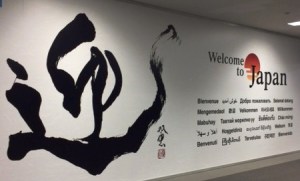
1. Raw horse meat is a popular food in Japan.
Actually, it’s a tradition confined primarily to the southern part of the country. Horse is served, both as raw “sashimi,” and as thin steaks in much of Kyushu, usually at specialty restaurants. The meat is considered very high quality, and far superior to beef steak in terms of taste and tenderness.
2. Sometimes the trains are so crowded railway staff are employed to cram passengers inside.
This is really only a characteristic of urban commuter trains during morning rush hours. There is a posture technique for a commuter to request a push, which is backing against the crowd at the door while placing hands up behind the top of the door frame, and placing one heel onto the threshold. A white gloved pusher will give a careful but firm push against the lower ribs.
3. Many couples in Japan celebrate Christmas like Valentine’s Day. It is definitely more of a “lovers” holiday in Japan.
I don’t know about this one. Christmas in Japan is an entirely commercialized holiday. Since most businesses shut down during the New Year, it’s mostly a convenient time to shop for gifts for bosses, friends and relatives. As for lovers, “love hotels” are a common sight in some parts of Tokyo as privacy can be a rare commodity in a place with such a crowded population.
4. Poorly written English can be found everywhere, including T-shirts and other fashion items.
Unfortunately, this is true. Wearing clothing with English phrases has been trendy for quite some time. And much like Americans who get kanji tattoos without really knowing their meanings, some of what is written on shirts ranges from embarrassing to downright offensive. For some reason, the word “f…ck” became popular for a couple of years, though its usage was often completely incoherent.
5. More than 70% of Japan consists of mountains, including more than 200 volcanoes.
Despite having a population of about half that of the United States crammed into an area the size of the state of California, Japan remains a magnificently beautiful country. And much of this is due to the fact that a large percentage of the country is rugged and not easily accessible. An interesting side note is that in order for Japan’s high-speed train network to efficiently cross the country, many routes simply tunnel straight through entire mountains.
6. Mt. Fuji, the tallest mountain in Japan, is an active volcano (although scientists have not reached a consensus on what defines “active”).
Mount Fuji, or “Fuji-san,” last erupted on December 16, 1707. The eruption occurred shortly after an 8.7 earthquake that severely damaged the city of Osaka. Scientists believe that the earthquake compressed the magma chamber below the volcano, forcing lava to the surface. The eruption spread ash as far as Edo (modern day Tokyo).
7. Religion does not play a big role in the lives of most Japanese and many do not understand the difference between Shintoism and Buddhism. However, there are also many Japanese who do understand the difference.
The saying goes that the Japanese are “born Shinto, married Christian, and die Buddhist.” In Japan, religion is approached mostly as a functional matter, with ceremonies revolving around whatever tradition is seen as most aesthetically appealing. Consequently, despite its many beautiful temples and shrines (and both real and fake Christian churches), Japan hosts an overtly secular culture. Only about 5% of the population consider themselves to have religious beliefs in the Western sense of following a faith. And overt displays of religious beliefs of any kind, while tolerated, are generally perceived as socially dysfunctional. Of course, however, an accurate accounting of the matter is far more complex than could be encapsulated in a single paragraph.
8. A nice musk melon, similar to a cantaloupe, may sell for over $300US. For example, a nice specimen of Yubari melon. These are often physically perfect, not like their American counterparts with dark smudges and scars.
Japanese culture places a high value on “perfection,” especially with regard to gifts. And foods hold a high cultural value in Japan. Most of the time, these types of items are given as special gifts, often associated with business. However, passing an orchard where the farmer has carefully placed bags over each developing fruit on a tree, it becomes apparent that the care taken in Japanese food production has no counterpart in the US.
9. There are four different writing systems in Japan; Romaji, Katakana, Hiragana, and Kanji.
“Romaji” are actually Western characters (English “alphabet”) used to represent the sounds of Japanese to Westerners. They are very difficult for Japanese to read with comprehension. “Katakana” are Japanese characters used to represent onomatopoeia, foreign loan-words, and foreign names. “Hiragana” are Japanese phonetic characters used to represent grammatical markers and some Japanese words. And “kanji” are logographic characters, usually based on Chinese characters, which are used to represent most nouns, verbs, and concepts. Typically, Japanese writing will contain a mix of katakana, hiragana, and kanji together.
10. Coffee is very popular and Japan imports approximately 85% of Jamaica’s annual coffee production.
I had no idea, although Starbuck’s has done well in Japan. Regardless, up until a few years ago, I had to request that the barista look in the back for an Amerika-no-gaijin sized cup. For a long time, the biggest thing they kept out front was a “grande.”
11. Japan’s literacy rate is almost 100%.
“Literacy” in Japan is defined as a complete knowledge of all 220-or-so various katakana and hiragana markers (usually accomplished by the start of 2nd grade), and mastery of about 2,000 kanji and their most commonly-used associated combinations. Most native Japanese who don’t don’t qualify as literate have precluding disabilities. I, however, cannot appeal to that excuse.
12. Sumo is Japan’s national sport, although baseball is also very popular.
Lately, baseball seems to have lost some of its appeal, while sumo has regained a bit of the luster it lost from a rigging and gambling scandal a few years back. And popularity can vary regionally.
13. Sumo wrestlers eat a stew called Chankonabe to fatten up. Many restaurants in the Ryogoku district of Tokyo serve this nabe (Japanese word for stew).
Not that I would necessarily consider it to be “cuisine,” but there are restaurants that prepare sumo-style food.
14. Most toilets in Japan have a built-in bidet system for spraying your backside. These are known as washlets and are now the norm in homes and nicer restrooms. However, in some train stations and other public restrooms you may still find the traditional Japanese “floor toilet”.
In just the last few years, there seems to have been a move to install more washlets, or at least Western-style toilets in public spaces. However, even in many nicer public spaces, such as airports and Shinkansen stations, there remain many Asian-style “squat” toilets. Some people still prefer their use, as there is no need to touch anything that might be considered unsanitary.
15. When you use the restroom in someone’s home you may need to put on designated bathroom slippers so as not to contaminate the rest of the home.
Yes… And the slippers should NEVER be worn outside of the toilet area. Doing so is a major faux pas.
16. Noodles, especially soba (buckwheat), are slurped somewhat loudly when eaten. It has been said slurping indicates the food is delicious. The slurping also serves to cool down the hot noodles for eating.
Eating can be a gloriously noisy activity in Japan.
17. Japan is the world’s largest consumer of Amazon rain forest timber.
Observe the massive timbers being used in typical Japanese post-and-beam house construction, and you will understand why. Using similar timbers in the US would result in a house that no one would be able to afford.
18. Vending machines in Japan sell beer, hot and cold canned coffee, cigarettes, and other items.
High-tech vending machines in Japan are a national icon. Most will accept payment by “RFID” chip, (radio chips embedded in Japanese credit and rail-pass cards), as well as from cell phones (which can be charged with cash in Japan). Beer and cigarette machines generally shut down late at night.
19. When moving into an apartment it is often required to give the landlord “gift” money, usually equal to two months’ rent.
Having never directly rented in Japan, I’m not entirely familiar with the practice. However, I can say that buying a place to live also entails monetary “gifts” to realtors, brokers, construction companies, and others. Amounts vary, but there are some informal guidelines, something along the line of calculating an appropriate “tip” in the US. However, this isn’t a practice that can be ignored if one doesn’t wish to encounter some difficulties along the way.
20. On average there are around 1,500 earthquakes every year in Japan.
That’s all? In Japan, earthquakes are monitored like weather. Reports are continuously updated through a national system that can be accessed on the Internet at: http://www.jma.go.jp/en/quake/ . Shaking can even be predicted before it reaches areas away from an epicenter, as with the automated Shinkansen stop system which activates any time an earthquake could cause a derailment.
21. In Japan it is not uncommon to eat rice at every meal, including breakfast.
Rice is the staple food for two-thirds of the world’s population, and is commonly eaten at every meal throughout many parts of Asia.
22. Average life expectancy in Japan is one of the highest in the world. Japanese people live an average of 4 years longer than Americans.
Despite the population’s high rate of liquor and fatty-food consumption, Japan’s highest life expectancy is concentrated in Okinawa. Spend any time there, and you’ll understand why.
23. Japan is the largest automobile producer in the world.
What I find more interesting is that the “Toyota president delivers highest returns for lowest pay.“
24. The Japanese language has thousands of foreign loan words, known as gairaigo. These words are often truncated, e.g. personal computer = paso kon. The number of foreign loan words is steadily increasing.
These are the kinds of words that are written in katakana.
25. Tsukiji market in Tokyo is the world’s largest fish market.
It’s actually about to be moved in order to make space for developments associated with the 2020 Olympics. By March of 2016, it will be relocated about a mile-and-a-half away to the Toyosu area. The new facility is planned to be twice as large, more modern, and to have better transportation access.
26. Although whaling is banned by the IWC, Japan still hunts whales under the premise of research. The harvested whale meat ends up in restaurants and supermarkets.
While expensive, whale meat is available throughout Japan.
27. Men might shave their heads to apologize. Not common these days.
Never seen that done, but I’ve observed a few missing little fingers (really).
28. Women might cut their hair after breaking up with a boyfriend. Again, not common these days.
Never seen that done either. Usually, the women I know just get a new boyfriend — or not.
29. The first novel, The Tale of Genji, was written in 1007 by a Japanese noble woman, Murasaki Shikibu.
The name was probably a pseudonym as Japanese women of the time were forbidden learning Chinese, the characters of which were used as the script for writing the sounds of the Japanese language. Some scholars believe that the novel’s writer was actually Fujiwara Takako, who was an imperial lady-in-waiting. A later work, “The Diary of Lady Murasaki,” probably documents her own life.
30. The term karaoke means “empty orchestra” in Japanese.
I don’t ordinarily sing — which is a serious social disability in Japan. However, this also excuses much social drinking.
31. In a Sumo training “stable” the junior rikishi Sumo wrestlers must wash and bathe their senior sumo wrestlers and make sure their hard to reach places are clean.
This might actually qualify as more than even I want to know.
32. Contrary to popular belief, whale meat is not a delicacy in Japan. Many Japanese dislike the taste and older Japanese may be reminded of the post-World War II period when whale meat was one of the few economical sources of protein.
I have take issue with this one… While it was the traditional “bacon” of post (and pre) WWII, whale meat is now actually quite expensive, reflecting both a low supply as well as a high demand. Most whale meat in markets today is canned raw, and is of a quality that can be eaten as sashimi (uncooked). It is considered very desirable and good-tasting meat, and is usually served for special occasions.
33. Rampant inbreeding of dogs has resulted in one of the highest rate of genetic defects in the world for canines.
Dogs have something of a revered status in Japan, but few people have the space in which to keep them. Consequently, several very small breeds have become popular, especially among older women without children. I suspect that it’s these breeds that are having the most genetic defects.
34. Raised floors help indicate when to take off shoes or slippers. At the entrance to a home in Japan, the floor will usually be raised about 6 inches indicating you should take off your shoes and put on slippers. If the house has a tatami mat room its floor may be rasied 1-2 inches indicating you should to take off your slippers.
In Japan, shoes are traditionally outdoor wear and left near an entrance location. There is actually an etiquette to the way in which shoes are arranged in formal situations, and slippers may be used indoors. Many restaurants, hotels, “ryokans” (traditional travelers’ inns), as well as temples and shrines, castles and museums may also require that shoes be removed before entry.
35. Ramen noodles are a popular food in Japan and it is widely believed extensive training is required to make a delicious soup broth. This is the subject of the movies Tampopo (1985) and The Ramen Girl (2008).
While most Americans probably wouldn’t notice the difference, good noodles are an art appreciated throughout much of Asia.
36. On average, it takes about 7-10 years of intensive training to become a fugu (blowfish) chef. This training may not be needed in the future as some fish farms in Japan are producing non-poisonous fugu.
I didn’t know about the non-poisonous fugu, but it seems to me that would defeat the whole purpose of eating them. A good (Japanese) fugu chef leaves just enough of the poisonous tissues to give the diner a bit of an experience.
37. Ovens are not nearly as commonplace as rice cookers in Japanese households.
Considering space limitations in a typical Japanese kitchen, this makes more sense than one might think. However, Americans might be surprised by the $300+, computerized rice-cookers found on some Japanese countertops.
38. Geisha means “person of the arts” and the first geisha were actually men.
You can read about this in my own article about “Oiran” culture.
39. It was customary in ancient Japan for women to blacken their teeth with dye as white teeth were considered ugly. This practice persisted until the late 1800’s. The American style smile (big, wide, and white) would have been seen as “exposing too much bone”.
Teeth blackening is still practiced among some maiko initiates, however it’s rarely seen in public. Women, however, may still be discouraged from big, toothy smiles.
40. In addition to a “boneless smile”, small eyes, a round puffy face, and plump body were considered attractive features, especially during the Heian period.
Slightly before my time.
41. Some Japanese companies conduct a morning exercise session for the workers to prepare them for the day’s work.
This is a continuation of a customary team-building practice that starts in Japanese pre-schools.
42. In Japan non-smoking areas are difficult to find in restaurants, including family restaurants. Many of Japan’s politicians have interest in the tobacco industry and anti-smoking laws are almost non-existent. If you are planning a trip to Japan you may want to think twice if you are sensitive to tobacco smoke.
Gradually, this is changing. Japan is beginning to realize the social costs of smoking, and it’s recently become illegal to smoke on public sidewalks in Tokyo where the crowded conditions have resulted in burn injuries, most notably to children. Some family parks, such as Disneyland, have now restricted smoking to specific areas within the park.
43. Many companies hire people to hand out small packages of tissues which include a small advertisement flyer. Some non-Japanese are surprised when they are handed a free package of tissues.
Take them… you’ll appreciate having them when you find out how few public restrooms have paper.
 But considering the area’s predictably unpredictable weather patterns, it wasn’t much of a surprise that the recent warm spell didn’t preclude last Tuesday’s brief memory of winter. Snowing lightly all night and into the morning, sunrise greeted the town beneath a dusting of powdered-sugar snow. So accepting nature’s invitation to don
 I didn’t say anything, and stayed inside while my partner engaged in a lively conversation with the driver. She glanced over briefly as two men with rifles slung over their shoulders approached and quickly lifted a third, younger man into the back of the vehicle. A tourniquet was wrapped tightly around the young man’s lower leg which ended abruptly where his left foot should have been. I stood up to make room for him on the floor of the truck, and that was when I took out my little camera, aimed it as discretely as I could, and took several hip-shots.
 For two years, I lived in a one-room house with an outdoor, communal kitchen in the city of ChiangMai in northern Thailand. It wasn’t a big or luxurious place by American standards. But it was safe, clean, comfortable, and friendly. It too was a good quality of life. In the US, I choose not to live in a city at all. It’s no less convenient, no more expensive, far safer, much friendlier, and more aesthetically appealing to live in a small town. The quality of life is good. But I’ve also lived at the edge of Tokyo, the most populous city in the world.
 It was February 2002 in Phnom Penh, and a haze from burning rice fields hung in the air. A brief taxi ride concluded at a closed gate blocking a dirt driveway about a mile east of the airport. The driver didn’t wait, and several minutes passed before deciding to move the barrier myself. No one seemed to care.
 Luminous Aether