浄化の季節 (Season of Purification)

It was my winter break protestations regarding a despised class in high school that instigated my father’s firm reminder of a familial obligation to accept that some choices in my life would be made for me while I still lived at home. And just in case I had forgotten, he also added that no one in our family could expect a free ride. I would need to master and to produce something for myself. Exactly what would be my own choice… but after I had left home.

Fine then,” I responded. “I’ll go live on the beach and surf.

My mom called the bluff with a shake of the head before leaving the table. At least, I think that’s what she was doing. To be honest, at that point in my teenage life she may have simply given up.

I did, however, actually consider the idea… if just for a moment. The local surf was notable, and there were places I could have stayed. But somehow, sharing a van with a perpetually stoned boyfriend seemed like an idea that would lose its romance in fairly short order. The topic didn’t get brought up again; but I returned to high school after the start of the new year to finish that last, detested class in French.

That was thirty years ago.  But the memory resurfaced recently in a spontaneous moment of self-reflection.  I’d always recognized it as marking something of a turning-point in my character, as unquestioned deference to familial wisdom had been eclipsed by an unexpectedly independent moment of rational assessment. It didn’t matter that the conclusion had been the same. The difference was in how I had arrived.

The start of the decade that followed was tempered by episodes of beating out the rhythms of a band formed with two somewhat less studious girlfriends from the university where I attended.  But another of those assessments would eventually result in that final gasp of youthful experimentation yielding to a commitment to classwork… and eventually graduate school.  The last of youth slipped away in the transition from mastery to productivity in the pursuit of a career.

The chase proceeded up in the world – literally – to a suburban hill in a big Pacific city.  But there was always an underlying sense of being like a kid with fake ID who’d forged her way into the adults’ club.  I tried not to let on how out-of-place I felt.  But occasional ministrations of loud music blasting through a big, empty house served only to stir images of chasing the surf in a van.  Someone suggested it was the merely affective discontent of a “mid-life crisis”… at twenty-nine.   But one gray morning arrived like a smoking dumpster.
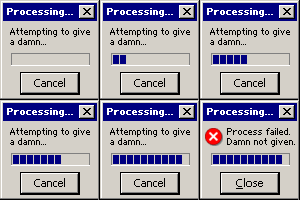
What wasn’t sold or given away within the month that followed was left on the curb or hauled off.  Two boys, young college students, gleefully appropriated my living room furniture.  I can only imagine what celebrations left their marks upon its tissu élégant.  A few anchors-of-identity were remitted to the care of family. That which remained fit into the single carry-on that went with me to northern Thailand.

ChiangMai is nowhere near the ocean.  But the city’s relaxed Lanna culture gave the place the feel of a perpetual day on the beach. That November of the last year of the last millennium, during the Thai celebrations of Loy Krathong and the local Lanna Yi Peng, I watched a decade of life float into nothingness. (The “kohm loi” sky-lantern in my avitar is from a Yi Peng festival.)  A new path would include some more considered choices.

Three years on, arriving exhausted and alone in Japan after a hastily arranged series of flights from Southeast Asia, my welcome back to the place of my birth was a withering tempest of derisions from two familial matriarchs.  But quietly surprised at how well my little emotional life-raft weathered their contempt for my years of absence, there was a sudden and liberating recognition that I had grown to be comfortable in my own identity.

Independence can be a good thing, making it easier to move forward.  But it can also make it too easy to walk away from good things. The saving balance in my life has always been that generally rational and reasoned perspective.  That, and a good accountant, have prevented much regret. But it can also be a characteristic of an uninvolved and indifferent partner-in-life (if not a lousy shopper). So I do sometimes wonder where the beach might have lead.

The more rewarding years since starting over have been productive in ways that I think my Dad would have thought okay.  Still, it’s easy to lament about things that never were.  Granted, running off to surf probably wouldn’t have been such a good idea.  And the truth is, I lead a pretty easy life.  But it’s a characteristic of youth that for better or for worse we mostly draw pictures of our future selves from the patterns that surround us.  So who knows… I might have found the perfect wave, or become a fair musician, or been a pretty good mom.  I just never believed I could — and so I never really tried.

Thirty years on from that moment of rationality’s conquest over my teenage passions, and the other night’s music had been captivating enough to distract from how long I’d been standing.  But relaxing between performances in the little Japanese live-house, legs relayed expressions of profound appreciation to the cognitive faculties that had finally granted them respite.  And admiring the thin veneer of artificial reality in front of me, I was suddenly struck by the recognition of having again reached one of those turning points.

Go Rin no Sho


A message on my hotel toothbrush wrapper.

I first read, Go Rin no Sho, or, “The Book of Five Rings”, while I was in college. The text describes “Ni-ten Ichi-Ryū”, or the two-heavens best-way approach to Japanese swordsmanship, as well as the philosophy behind its use. “Ni-ten” alludes to the wielding of of two swords as opposed to the traditional Japanese style of holding a single sword with both hands. The book discusses the technique within the context of the traditional Buddhist “godai” (五大), or the five-great elements of nature. But underlying this presentation emerges a philosophy, that of pragmatism over tradition.

The book was originally written around 1645 by Miyamoto Musashi (宮本 武蔵), usually referred to simply as “Musashi” due to his legendary status within Japanese culture. Born in 1584, Musashi grew to adulthood at the end of Japan’s one-hundred year long, “Sengoku”, or Warring-States period as a member of the “samurai” class. This was the culmination of a time in Japan’s history when the introduction of Western technologies including firearms resulted in increasingly violent conflicts between feudal leaders.

Musashi may have fought as a samurai alongside the losing, Toyotomi clan in the monumental Battle of Sekegahara in 1600. This event would mark the start of a rapid transition to Japan’s unification under the leadership of the victorious Tokugawa clan and the beginning of Japan’s Edo period in 1603. Left without a feudal retainer, wealth or lands of his own, it was within this backdrop that Musashi lived out the remainder of his life as a “rōnin” (浪人, literally, “wave-man”), or a wandering swordsman.

Despite this, Musashi is said to have survived six battles and sixty duels, dying peacefully at the age of sixty-two, probably due to some type of progressive disease. Consequently, his writings have been studied closely for generations. More recently, his philosophical perspective also gained popularity within American business circles.

Musashi’s overall approach was to employ anything that helped in the completion of a committed task, even if it broke with tradition – or perhaps even stretched the rules. He had no use for ceremony or flourishes, and focused instead upon the more utilitarian aspects of defeating an opponent while staying alive. In the case of fighting with two blades, he simply determined that two swords (one long and one short) allowed for better coverage and more options.

Illustrating his pragmatism, Musashi admonished traditional swordsmen for dropping the “saya”, or scabbard, after a sword had been drawn, observing that it could be useful in tripping or clubbing an opponent. He even advocated throwing the short sword at an enemy, should such an opportunity for defeating an opponent at a safe distance come to avail itself. And he wasn’t averse to avoiding a fight altogether, if it wasn’t necessary. This made Musashi into an unpredictable adversary in confrontations with the more traditional samurai of his time.

Go Rin no Sho, starts with the Book of Earth. As an introduction, Musashi used the element of earth as a euphemism for a foundation upon which to build one’s skills. In this case, the foundation is essentially (in Western terms) focus, a disciplined attitude, and study or practice. He also advocated a main focus only upon the most useful of skills, and then upon the acquisition of as many of those skills as possible. He contended that over-specialization or dependence upon extreme mastery of a single skill was a weakness, and that the ability to execute properly-timed changes in strategy created a more balanced foundation against even a more skilled opponent.

The Book of Water discusses philosophical and spiritual aspect. In my own opinion, Musashi was implying that moving successfully from any starting point to a purposeful destination requires an ability to adapt to a changing environment while applying an appropriate force as it becomes necessary. He addressed approaches to varying situations from observation and outward appearance, to the “five attitudes” with which one advances upon and responds to movements. These range from the instantaneous and decisive, to the fluid and responsive.

The Book of Fire takes a broader perspective of overall strategies in the midst of battle. Here, Musashi explained in more depth why he believed that pursuing the perfection of a single skill was short-sighted. He acknowledged that many new approaches to warfare, such as the use of firearms, were game-changers. He was acutely aware of the “disruptive technologies” of his own time. Consequently, Musashi emphasized the importance of awareness of an overall situation, noticing one’s environment, and planning ahead to take advantage of whatever possibilities exist. He discussed terrain, timing, and the drawbacks of various strategies. In one case, he described the use of a feigned attack to draw gunfire so that an enemy’s own gunpowder smoke could be used as cover in which to advance.

The Book of Wind is actually a play on the meaning of the kanji character that references “wind” (), pronounced “kaze” or “furi”. The same character can also be used to refer to a “form” or “style”, pronounced “fū”. In this book, Musashi criticized the various dogmatic forms or styles of several then well-known schools, implying that they had become entrenched bureaucracies more concerned with keeping alive the institutions than the swordsmen they trained. But he also didn’t dismiss them, and advised his own followers to understand their approaches and techniques.

The Book of Void is a brief post-script, addressing a more philosophical perspective that aligns with Zen Buddhist thought. In this section, Musashi cautioned not to confuse a lack of knowledge or understanding, or bewilderment, with void. Instead, he declared that void is the realm of the spirit which is itself nothingness. My own reading of this is that Musashi was contrasting the immaterial nature of the human “mind” with the manifestations of mind. Thoughts by themselves are immaterial, but they may be expressed in an objective reality, even if that reality may defy understanding.

As a straight-to-university student approaching my twenties, the book had a strong effect on my own thinking at the time. It provided a seed to one of those sudden moments of insight that would rapidly crystallize from a supersaturated solution of experiential angst. Beginning to question “common wisdom” regarding things like success, purpose, and happiness, it had become increasingly evident to me that wisdom itself is a fairly uncommon and vaporous commodity.

The broken shoulder acquired after pitching a perfectly good motorcycle down a mountain road had kept me from raising my right arm to desk height for about two months. So, it was with my non-dominant left hand that I was taking notes while sitting in a class on introductory logic. Pausing to study my writing for a moment, I noticed that it had become surprisingly good. But I also noted that it looked quite different from the very controlled script that usually emerged from my right hand… and I liked it. The use of a second tool had allowed me to prevail.

Ni-ten Ichi-Ryū… And it was in that moment that I committed to abandon what up to then had been the single-focused pursuit of a pre-med.