
A Treatise on the Importance of Smoke
by Joseph Lucas, (1834-1902), founder of the British electrical manufacturer, Lucas Industries.
“A gentleman does not motor about after dark.“
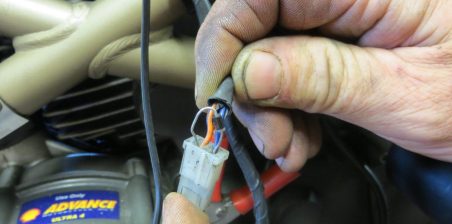
All electrical components and wiring harnesses depend on proper circuit functioning, which is the transmission of charged ions by retention of the visible spectral manifestation known as “smoke”. Smoke is the thing that makes electrical circuits work. Don’t be fooled by scientists and engineers talking about excited electrons and the like. Smoke is the key to all things electrical
We know this to be true because every time one lets the smoke out of an electrical circuit, it stops working. This can be verified repeatedly through empirical testing. For example, if one places a large copper bar across the terminals of a battery, prodigious quantities of smoke are liberated and the battery shortly ceases to function. In addition, if one observes smoke escaping from an electrical component such as a Lucas voltage regulator, it will also be observed that the component no longer functions.
The logic is elementary and inescapable! The function of the wiring harness is to conduct the smoke from one device to another. When the wiring harness springs a leak and lets all the smoke out of the system, nothing works right afterward.
Starter motors were considered unsuitable for British motorcycles for some time largely because they regularly released large quantities of smoke from the electrical system.
It has been reported that Lucas electrical components are possibly more prone to electrical leakage than their German, Japanese or American counterparts. Experts point out that this is because Lucas is British, and all things British leak. British engines leak oil, British shock absorbers, hydraulic forks, and disk brake systems leak fluid, British tires leak air and British Intelligence leaks national defense secrets.
Therefore, it follows that British electrical systems must leak smoke. Once again, the logic is clear and inescapable.
Sometimes you may miss the component releasing the smoke that makes your electrical system function correctly, but if you sniff around you can often find the faulty component by the undeniable and telltale smoke smell. Sometimes this is a better indicator than standard electrical tests performed with a volt-ohm meter.
In conclusion, the basic concept of transmission of electrical energy in the form of smoke provides a clear and logical explanation of the mysteries of electrical components and why they fail.
This occasionally circulated bit of British-inspired motorcyclist humor re-emerged as the result of a recent, and rather serendipitous exchange. I had a most remarkable and surprising encounter last weekend… one that’s actually left my brain a little smoked. I reconnected (online) with my college boyfriend…
sort of.
Looking into something motorcycle related last week, I sent an email query to an old, Italian-motorcycle connection. After a couple of back-and-forth messages, one of them included, “You know, ‘Mark’ is still around. I can give you an email address, if you want. But I should fill you in, first.“
I first met “Mark” as an occasional member of a mostly college-student group of sport-bike (motorcycle) riders that I’d sometimes join for day-rides. A Criminal Justice major, he’d usually show up on a black, Ducati 900SS for canyon rides out to places like the Lookout Roadhouse above Lake Elsinore , accessed via the area’s winding “Ortega Highway”.
During my first year of college, I only knew Mark as that good-looking guy who rides a piece of Italian exotica. And then, I pitched my bright red, white and blue Honda VF500 down some asphalt in the San Gabriel mountains, leaving me without a ride while paying-off a repair bill that involved installing a surgical wire into my right shoulder.
Sort of a “Come-to-Jesus” moment for me, the event initiated a few reassessments of my life-direction in general while learning to write with my left hand. As a result, I decided to quit an utterly life-sucking Bio-Chem Pre-Med that I knew in my heart I was never going to use. And then, I switched my major…
and my motorcycle, to a black Kawasaki ZZR-600, “Ninja”.
Rejoining the riding group that spring, perhaps it was that we were both into black motorcycles… or maybe just dopamine; but Mark and I somehow ended up hanging out together over the following year. Mark had been an MP in the US Navy, explaining the Criminal Justice thing. And he’d acquired his interest in Italian motorcycles while stationed in Europe.
Mark was also a pretty good rider, easily outpacing me on his Ducati despite the Kawasaki producing considerably more horsepower. But mostly, he was into working on the infernal machines.
Once explaining that I’d settled on the Kawasaki largely because it was low enough for me to get my boot-heels on the ground, Mark let me sling a leg over his 900SS and take it for a short ride. I was instantly sold. And therein began my affair with the “Pirate Kitty”, a bright red, Ducati 900SS CR with a cracked frame that I acquired in a trade for the Black Ninja. Subsequent to its own skeletal repair, my relationship with the Kitty would well outlast that with Mark.
Ducati motorcycles were fairly unique at the time. While Japanese sport bikes were getting faster by becoming increasingly more complex (and civilized), Ducatis were little more than stripped-down race bikes. With their stiff and rattling dry clutches, high foot-pegs, low handlebars, and hard seats, they weren’t known for comfort. But that wasn’t why people rode them.
Riders of older Ducatis, however, also quickly learned how to work on them. Unless one had an on-call mechanic with a name like Marcello or Enzo, owning a Ducati that would actually start and keep running also implied knowing how to adjust their valves, replace timing belts, or fix just about anything electrical. And Ducatis were absolutely notorious for their electrics.
Given enough time, it was pretty much guaranteed that virtually nothing in a functioning Ducati’s electrical system would be original. And while I actually got to be pretty good at what could otherwise be fairly sketchy 2nd-gear bump-starts of the 900’s, torquey, high-compression V-twin, it was once suggested that I had renamed it, “Start! You piece of …” Consequently, my familiarity with Lord Lucas’s alleged, Treatise on Smoke.
Graduate school would eventually change my priorities. It wasn’t the greatest split. But we stayed civil while moving-on, each in our own directions. We exchanged a few messages for awhile, among the last being when I finally acquired a long-coveted Ducati “916” in the late 90s… the infamous , “Garage Queen”.
A great deal has changed for both of us in the three-plus decades since college. But far more than I would ever have guessed for Mark. Perhaps not so surprising, he ended up in a line of work that had absolutely nothing to do with his old college major. But what’s really left my brain so thoroughly smoked…
she now goes by “Marlie”.


 Luminous Aether
You must be logged in to post a comment.