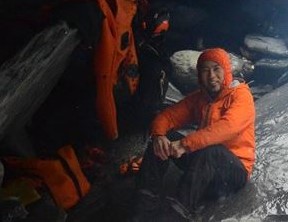
Acceptance and Courage

When one loses the deep intimate relationship with nature,
then temples, mosques and churches become important.

–Jiddu Krishnamurti

Japan is known for its mountains. And its mountains are known for the extraordinary numbers of Japanese who climb to their summits. Probably the best known of Japan’s mountains is “Fuji-san”, or Mount Fuji. A 3,776 meter (12,388-ft.) dormant volcano, Fuji-san is considered the traditional symbol of Japan, as well as the dwelling place of the goddess, Konohanasakuya-hime (shortened, “Sakuya-hime”), the “Cherry-Tree Blossom Princess”.

Fuji-san’s summit hosts several shrines to Sakuya-hime, whom the Japanese Shinto religion reveres as a bringer of healing, rebirth and spiritual happiness, encouraging many to seek peace by climbing the mountain. And during the 2024 summer climbing season, almost 205,000 people attempted the journey.


“Yamabushi” 山伏 (ones who bow to the mountain) are Japanese ascetic monks who worship the mountains as the dwelling-places of powerful spirits. Their practices combine ancient Shinto beliefs in nature spirits, or “kami”, with esoteric Buddhist traditions in a practice known as “Shugendō”.

Shugendō dates to the 7th-century, when it was ostensibly founded by En no Gyōja (役行者), or “En the Ascetic”. At Kongōsan Tenhōrin-ji, a Shugendō temple near Osaka, En is regarded as a “Bodhisattva”, or a spiritually awakening individual approaching Buddhahood. Most depictions of En, however, date from the Kamakura period (1185-1332) or later, and are usually associated with the mountain ascetic traditions practiced in Japan’s Ōmine mountains.

Accordingly, the traditional center of Shugendō is considered to be the sacred, Mount Ōmine, in the Yoshino-Kumano National Park, south of the city of Nara and west of the central Shinto shrine complex in Ise. And while the edict can’t actually be enforced in modern Japan, Shugendō still considers the mountain and its shrines and temples as sacred grounds, and thus off-limits to women.

Shugendō is a syncretic, “Kami-Buddhist” practice developed during the Heian era (794-1185), blending both Shinto and Buddhist beliefs. Shinto is an indigenous religion to Japan that recognizes a vast pantheon of gods and natural spirits, or “kami”, which may inhabit various locations, or even natural phenomena. The emperor of Japan was believed to be a direct descendant of the heavenly Shinto Sun-Goddess, Amaterasu.

After Buddhism was introduced into Japan during the 6th-century, Buddhist temples began to be constructed alongside Shinto shrines on many sacred mountains. The powerful Shinto kami considered to reside on these peaks were then also treated as Buddhist deities, thus merging both Shinto and Buddhist beliefs. This fusion of Shinto with esoteric Buddhism thus allowed the two religions to coexist without challenging imperial authority.

Shugendō’s Buddhist aspect is strongly influenced by both Tendai and the more esoteric Shingon sects of Buddhism. Tendai promotes faith in the Lotus Sutra, Amida (Pure Land) worship, and Zen concepts. And Shingon philosophy centers around complex esoteric, mystical and occult practices. Combined with Shinto beliefs, the practice treats the natural environments of mountains as sacred spiritual locations.

Among the more well-known (and public) of these mountain-top complexes is the temple of Enryaku-ji, located on the summit of Mount Hiei, northeast of Kyoto.  The temple is central to the present-day, “Marathon Monks”, mountain ascetics who practice a Shugendō meditation known as Kaihōgyō, or “circling the mountain”. In its traditional form, Kaihōgyō practitioners spend 1,000-days over seven-years walking more than 45,000-kilometers along mountain trails, all while following a very strict regimen.

The several thousand historical Yamabushi warrior-monks of Enryaku-ji were far from pacifist, and renowned for their tenacity and endurance. Any who resolved to continue beyond the 100th day of Kaihōgyō’s walking meditations committed either to completing the entire course, or to taking his own life. But in 1571, the warlord, Oda Nobunaga, decided to put an end to the temple’s power by laying siege to Hiei-zan with a massive army, eventually burning its temples and slaughtering its entire population. 

The current temple complex was reconstructed during the late 16th to early 17th centuries, and is central to the Tendai sect of Japanese Buddhism. Contemporary practitioners may still carry a dagger and hemp rope as a reminder of their commitment. But having reached the limit of my own endurance at the summit of Hiei-zan in 100-degree F (38C) heat and the steamy mists of 100-percent humidity, neither would have been required to have ended my own meditations.

Far to the north, however, are the seasonally snow-covered “Dewa Sanzan”, three mountains that also remain sacred to Shugendō and the Yamabushi… Mount Haguro, Mount Gassan, and Mount Yudono. The historical Yamabushi of the region were notably less militant, but no less committed than those of Hiei-zan. There are 21 known “Sokushinbutsu” in northern Japan who trained at Dewa Sanzan’s Mount Yudono. These were monks who observed a form of ascetic meditation the point of eventual self-mummification.

The contemporary Yamabushi of northern Japan follow a more life-affirming approach to Shugendō through the philosophy of “Uketamo”, which emphasizes developing both acceptance and courage. In many ways, this might be considered analogous to the Protestant theologian Reinhold Niebuhr’s 1930s philosophy that would later be encompassed in the Serenity Prayer: “The victorious man in the day of crisis is the man who has the serenity to accept what he cannot help and the courage to change what must be altered.

Each mountain of the Dewa Sanzan has a shrine, with the main shrine located on the summit of Mount Haguro. Each year, many Shugendō practitioners and Yamabushi monks make the pilgrimage to the Dewa Sanzan. However, unlike Mount Ōmine, lay practitioners, including women, are also permitted to make the journey to the various mountain shrines, so long as it’s done with observance and respect.

After purification ceremonies on Mount Haguro, travelers make their way the summit of Mount Gassan, the highest and least accessible of the three peaks. This is where the spirits of the dead are said to reside before moving on to the “Pure Land”, the realm of the Amitabha Buddha, who is also seen as a manifestation of the Shinto Tsukuyomi-no-Mikoto, the Kami of the Moon. Mount Gassan is consequently known as both the “mountain of the moon”, and the “mountain of death”.

Mount Yudono is the final destination. Considered the “mountain of rebirth”, it is treated as especially sacred. And yet, there is no shrine building. Rather, the shrine is the mountain itself, making it a sacred area in its entirety. Shoes may thus not be worn on the mountain, requiring visitors to walk barefoot along its trails. No photography is allowed, and visitors are not to talk about anything they see or hear there. Experiencing the mountain and its environment is consequently entirely personal… something unique in an age of selfies on social media.

At the conclusion of the Dewa Sanzan, the Yudono-san Sanrojo is located beside the massive tori gate at the bottom of the Mount Yudono Mountain Shrine. The facility offers a place for those who have traveled the mountains to stay and to contemplate the journey, as well as a hot spring for bathing.

Following the Meiji Restoration in 1868, the Japanese government officially disallowed Shintō-Buddhist amalgamations, declaring Shintō alone as the official state religion. Shugendō consequently became an officially banned practice until after World War II, when it re-emerged as a minor spiritual movement.

In its contemporary form, Shugendō is fundamentally an ascetic meditation based in the development of self-discipline through an interaction with the mountain environment, combined with a complex set of esoteric practices. As an alternative to the Western Stoic version of mindfulness and acceptance, it offers a more direct and visceral approach to meeting the unknowns and the challenges of life through its deep and intimate relationship with nature.

Map and Compass

As we invent more species of AI, we will be forced to surrender more of what is supposedly unique about humans. We’ll spend the next decade—indeed, perhaps the next century—in a permanent identity crisis, constantly asking ourselves what humans are for.
-Kevin Kelly


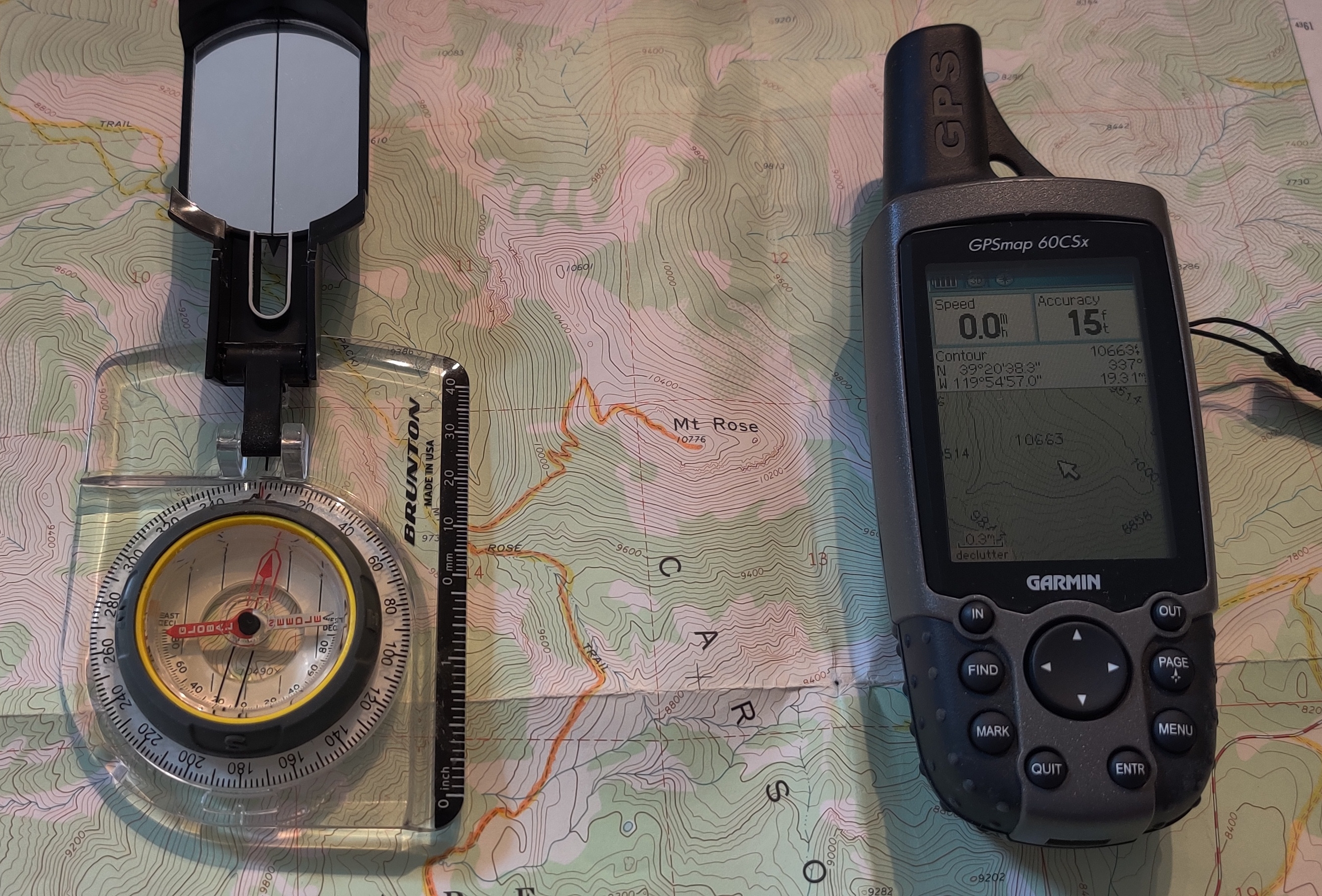
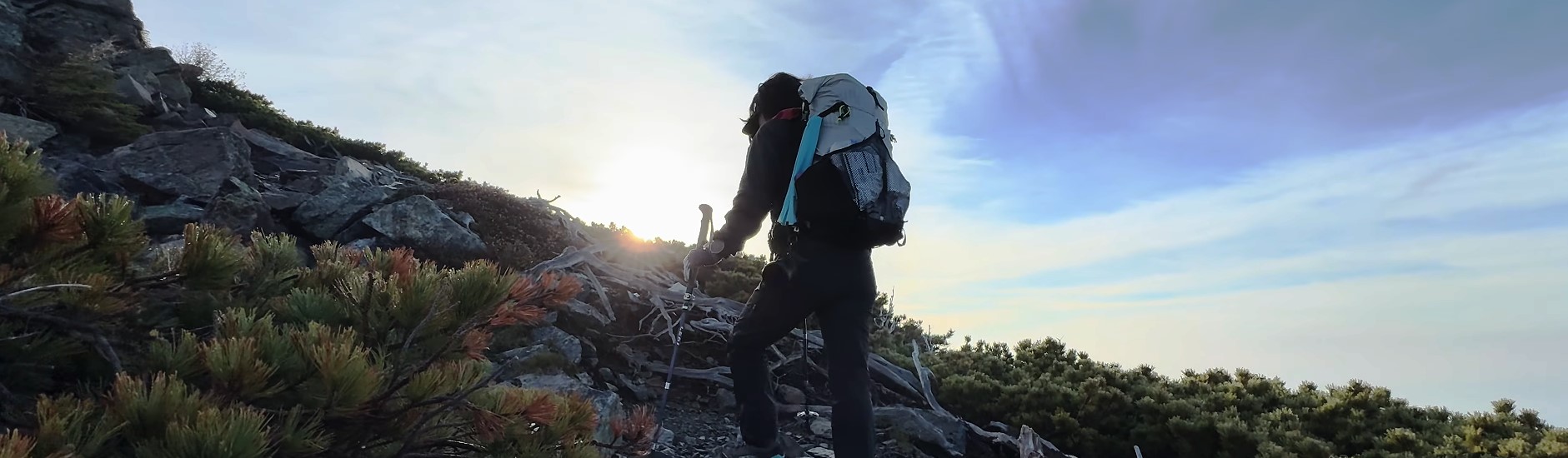
Last week’s travels through a local wilderness area traversed only partially familiar terrain. One new section threaded between a cluster of small lakes in a high glacial scour, mostly without a trail due to a large zone of exposed granite. So staying on track toward an intersection with a ridge-line that I wanted to use to shortcut to a trail took a little navigation.

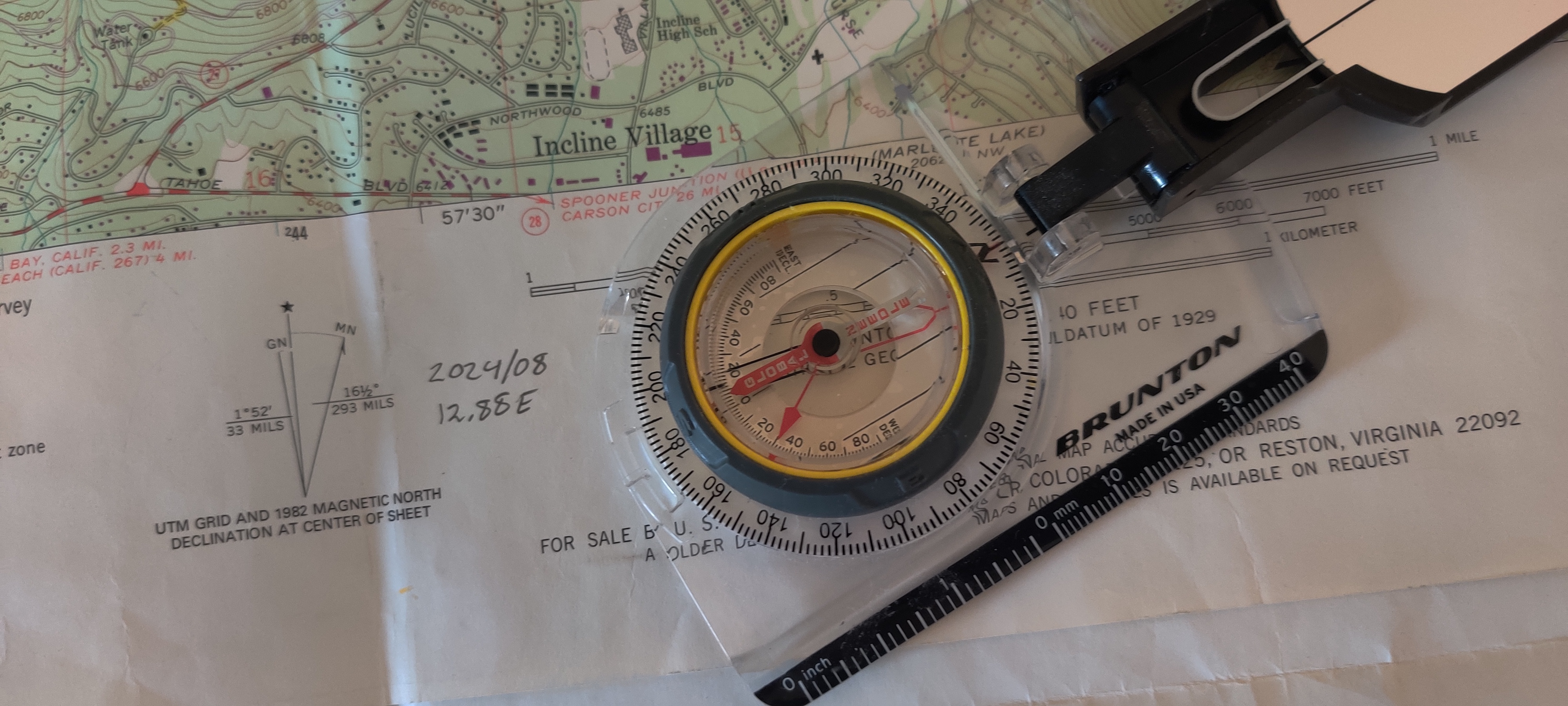
I have a GPS receiver that I’ll carry. But I use it mainly for keeping a record of routes to download into a computer after returning home. In the field, my go-to choice is still a simple map-and-compass. It’s a lot faster; and I don’t have to worry about batteries. And I like being able to see an overall lay of the land.  But these older navigation tools do require some modicum of ability to read and to utilize.

My dad often carried a field transit to use with his topographic maps. By taking a bearing and a vertical angle toward a mountain top, he could also approximate his distance and elevation with a little back-of-the-envelope trigonometry.

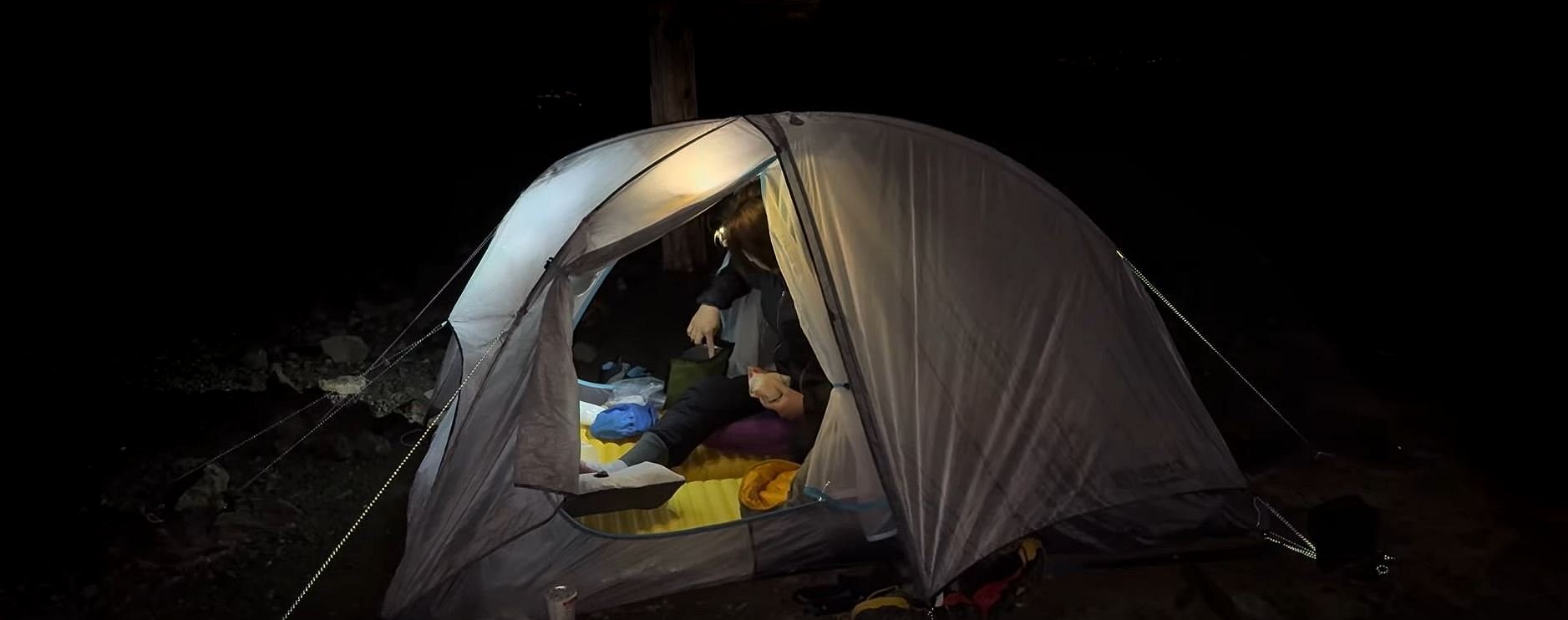
Looking out at a distant peak during a quiet sunset, it occurred to me that a big part of the whole concept of “wilderness” is that sense of it requiring some degree of skill to counter the innate inconvenience. Reading a map, hiking a trail, pitching a tent, cooking on a tiny stove, sleeping among nocturnal animals… no climate-control, refrigerator or microwave, it’s not “traveling” by TV before nodding-off between the sofa cushions and a blanket.

This isn’t to suggest a Luddite attitude or to imply that the use of modern technology is somehow inherently wrong. Technologies of many types work to alleviate much unnecessary human suffering. But they can also isolate us from the very source of what we are. Direct engagement with the world offers a different kind of perspective in exchange for accepting its challenges, an understanding that acknowledges human limitations.

Regardless, that map and compass often result in, “You don’t have a GPS?” And don’t even get me started on subscription emergency beacons, satellite text messaging, or God forbid… cell phone coverage. “Camping” with solar panels and string lights merely reminds me of the mountaineer, Cesare Maestri’s, use of a 300-pound air-compressor to bolt his way up the sheer granite face of Patagonia’s magnificent Cerro Torre in order to claim having reached its summit. Is that really even “mountaineering”?


Relaxing by the tent as the sun set, I watched a Cooper’s hawk perched at the top of a nearby tree as it made a long series of curious calls back-and-forth with some distant partner. The sounds were surprisingly complex and oddly engaging, somehow reminding me of a live music performance… probably of something that wouldn’t make it past either side of today’s pop-cultural moral guardians.

Like the digitized images on my camera, much contemporary music also strikes me as having been absorbed into the convenient simplicity of technology. Mechanically timed and auto-tuned pieces, they’re precisely rendered and efficient. But creating interest and tension in music, as in life, is a subtle process of imperfection. Real human expression is messy.

A skilled musician can “swing”, or very slightly offset the beats within a rhythm. And knowing when and just how much can create a powerful sense of depth and anticipation. It’s the reason why synthesized drums sound “flat” when compared to a talented percussionist. It’s as a GPS to the map-and-compass of music; it sounds human.

These tiny, intuitive aberrations are how the really great artists give a feel to their works. At best, computers can merely simulate these “errors”. Regardless, it seems as though few younger listeners appreciate those kinds of nonconformities anymore, their attentions trained on the sterilized digital simulations of reality experienced since first being handed an iPhone with which to entertain themselves in their car seats.

Music and language algorithms will get better at sounding more human-like. And I suppose they will eventually be able to create new “hits” as fast as they can be promoted among the virtual communities of social media, perhaps even generating simulated pop-stars to perform them. Live performances may very well die out in the same way that people have replaced brick-and-mortar stores with online shopping… wilderness with civilization. Granted, it’s certainly more efficient. But it also obscures the contemplated visceral experience of what it means to be “human”.

What I Think About When I’m Running

Being active every day makes it easier to hear that inner voice.
― Haruki Murakami, What I Talk About When I Talk About Running

Haruki Murakami is a marginally controversial, Japanese writer best known for his surrealist/post-modernist novels, including, “Norwegian Wood” (1987), “Kafka on the Shore” (2002), “1Q84” (2010), and his 2014 collection of short stories collectively called, “Men Without Women”.

I’ve never read any of them.

I’m often asked what I think about as I run…  I don’t have a clue.
― Haruki Murakami, What I Talk About When I Talk About Running

However, I have read Murakami’s 2007, autobiographical memoir on 25-years of running, “What I talk About When I talk About Running”. Murakami was about 5-years older than my current age when he published the book, and consequently shared some experiences to which I’m beginning to relate. In particular, running times are rather a meter-stick for age.

This year marks my 41st year of running.

I started when I was twelve, at first just to spend a little time with my dad. But at school, I discovered that I was actually pretty fast. Mostly, it was just because I was willing to endure the pain. As other kids would begin to flake from the discomfort, I’d just keep on pushing them until they gave up.

In most cases learning something essential in life requires physical pain.”
― Haruki Murakami, What I Talk About When I Talk About Running

In middle school, I joined the girls’ cross-country team; but I never placed better than a third… once. Competing against other like-disciplined and often far more talented runners, it became apparent that running was never going to be a route to athletic stardom. Regardless, I was hooked on the challenge. So while shifting to field-hockey as a competitive sport in high school, I still ran with the girls’ track team. And that’s where I learned about the “440”, or quarter-mile.

Since replaced by the metric, “400-meter”, the distance is a nearly all-out, single lap of a track. It’s generally considered to be the longest “sprint”. One of my longer-legged friends could run the distance in fifty-five seconds, well beyond my abilities. But the coach insisted that I could break 1-minute… if I tried. So I did.

Nothing in the real world is as beautiful as the illusions of a person about to lose consciousness.
― Haruki Murakami, What I Talk About When I Talk About Running

I’d go out to the track every day and do two miles. I’d run a lap all out, walk a recovery lap… and then do it again, and again, and again. Pushing through a 440 required mental toughness and a constant fight against the sense that I just HAD to stop. One thing it taught me was that a person is capable of far more than the conscious mind conveys. But I would definitely end those 440s at my limit.

Each week, I’d replace one of the training sessions with a lap timed by the girls’ track-and-field coach, Miss Miller. And every time, she’d announce that I’d gotten just a little closer to that one-minute lap. Then I’d train for another week, and try again, and again. And then, one warmer-than-usual morning, I finished by first losing the contents of my stomach, and then passing out.

Afterward, Miss Miller confessed that I’d been running under a minute for about six weeks.

If you’re young and talented, it’s like you have wings.
― Haruki Murakami, What I Talk About When I Talk About Running

My very best running times ever were 5Ks on a flat, mondo-rubberized track during my college years. Despite not having a “runner’s” build (long legs), I could regularly finish at around 21:40, which averages to almost 7-minute miles. And there was a particularly committed year when I could just break into the 6-minute range. Despite still being in excellent physical condition, however, the pattern of each year adding a few seconds to every mile started in my late twenties.

Admittedly, some of that had to do with lifestyle changes. But for Murakami, who started running in his thirties, he observed from the beginning how younger runners, including many women, regularly outpaced him. Still, he managed to find ways to improve himself personally into his fifties… where I am now.

Murakami, however, was a regular Marathon distance runner, and engaged in some fairly serious competitions. Comparatively speaking, my usual running distances are limited to around 10-kilometers (about 6.2-miles), with 9-miles being my upper limit. Still, I could understand a great deal of what he was saying.

Most runners run not because they want to live longer, but because they want to live life to the fullest. If you’re going to while away the years, it’s far better to live them with clear goals and fully alive than in a fog, and I believe running helps you do that. Exerting yourself to the fullest within your individual limits: that’s the essence of running, and a metaphor for life.
― Haruki Murakami, What I Talk About When I Talk About Running

Those 7-minute miles of my youth are now but a distant memory. Last year marked finally hitting 10-minute miles on my local, 10K route. I’d been approaching them for awhile. But one of those “rare” adverse vaccine reactions early last October took the wind out of my sails, and it’s been a slow recovery. And then, a month abroad at near sea-level in Singapore and Japan over the New Year erased much of my acclimatization to the local altitudes.

Regardless, these days I run for reasons that don’t have anything at all to do with times. It’s my meditation, an hour each day when I can disconnect from the artificial distractions of day-to-day life. As strange as it might sound, I’ve learned to focus on the pain with a sort of objective indifference. It’s momentary, and it’s real in a “Be Here Now” sort of way; but it’s not the same thing as suffering. It’s just me, existing. And that’s okay.

I look up at the sky, wondering if I’ll catch a glimpse of kindness there, but I don’t. All I see are indifferent summer clouds drifting over the Pacific. And they have nothing to say to me. Clouds are always taciturn. I probably shouldn’t be looking up at them. What I should be looking at is inside of me.
― Haruki Murakami, What I Talk About When I Talk About Running

The Sound of Distant Thunder

“…what people fear in death is the loneliness of having to leave this world forever. Though people may not be consciously aware of all the phenomena around them under normal circumstances, the thought that that which makes them themselves will be lost forever is a terribly lonely thing.
Kaneko Fumiko (金子文子), 1903-1926, The prison memoirs of a Japanese woman”; translator Jean Inglis. A translation of: “Nani ga watakushi o kō saseta ka,” (1991).

Over the last few weeks, I’ve come across a number of articles that were essentially about the topic of, “Be Here Now”. Short attention-spans and inefficient multi-tasking were cited, at least three articles mentioned putting down your phone, and “meditation” was brought up in several of them. In one case, however, it was suggested in a comment that Eastern meditation had been “corrupted”. And then I heard a radio article about how online media has been connected with higher rates of teen depression and suicide.


When I was much younger, my father said many times that when a person no longer fears death, the world will reveal itself. I was in my thirties before I really understood what he was talking about.

We usually equate “death” with the consequences of a physical conclusion to the biological processes that keep us “alive”.  But it’s not really our bodies that describe the experience of life. That’s something less corporeal, whether the sum of patterns in firing neurons, or an immortal “soul” existing on some higher plane.

Death consequently, is really about the loss of “ego”, or the internal narrative that makes us unique as human beings. Carl Jung called it “psychic death”, or the “…loss of subjective self-identity“. Consequently, what we actually fear is the loss of that uniqueness in our personal experiences. We fear the loss of “self”.

One of the articles I read asserted that all fear is really a fear of death. I’m inclined to agree.

Staying alive is rather essential to the perpetuation of the species. So it shouldn’t be surprising that fear of that which might cause one’s demise is the prime-mover behind most human action…
or inaction.

However, humans, as thinking beings with personal identities based in the interpretations of our own memories, apply it to all sorts of aspects of self-identity… from loss of personal power or usefulness in society, to social identity, and even to our presumed metaphysical selves. And this creates a constant background narrative of fearful noise.

We become accustomed to all this noise, like the din of a city or voices in a crowded restaurant… or the latest “news” on a screen that plays continuously in the background. The sounds become a part of our own identity, keeping us company while creating a familiar space.  And it can be surprising to find one’s self in the clarity of its sudden absence.

Sitting in the living room quietly with the back door open to the darkness.  No sound of laundry or dishes.  The heat is off.  The refrigerator unexpectedly stops running to the unwinding rhythm of a rapidly dying beat.  I can hear refrigerant boiling off for a few seconds, and then…

Unexpectedly, everything changes.

A breeze is blowing in the treetops, and the smell of humid air.  Aspens rustle closer to the ground.  Something chirps rhythmically in the distance, and then stops.  A faraway pine cone tumbles down through a tree.  The air slows for moment, becomes still.  The very distant sound of thunder.
My own breathing.


Photo: View from the top of the Sierra Buttes.

Connections (2023)

We leave some part of ourselves behind when we leave a place; we stay there, even though we depart. And there are things in us that we can find again only by returning.
Pascal Mercier, Night Train to Lisbon.

The New Year is an important social occasion in Japan, when much of the country closes down for the three days of “Oshogatsu” (お正月).  People travel, friends and families come together, and temples and shrines become the centers for yearly ceremonies.

The familiar patterns start in a New Year’s eve with a few old friends.  We eat together, enjoy the energy of live music, and afterward visit one of the larger shrines to attend the night’s celebrations. The last moments of the old year depart to the reverberations of “joya-no-kane”, the 108-tollings of the temple bell.  Its final sounding rings in the New Year with a hope that those who heard its echoed reminder that all things pass will not be anguished by their passions in the year ahead.

The first and second days of the New Year usually include visits and meals with various family, and perhaps attending some local shrine events together. And on the third day, extended family traditionally converge for ohakamairi (お墓参り), a gathering at the family tomb.

A cold morning in the countryside, we assemble above an expanse of frozen fields, bounded by hills shrouded in a snow-covered bamboo forest.  Walking together through a lightly falling snow, our route follows a narrow road that winds its way up to a pair of monuments overlooking the terraced farmland below.

There are many names carved into the old central pillars.  The newer granite column has characters in black to mark those whose bones lie beneath, and red for those who yet do the remembering. The stonework of the older memorial is darkened by the passage of time, the paint of its names faded into unremembered generations.

Elder family remove old offerings, while the rest of us brush snow from the monument.  Then, new offerings are placed, incense lit, and an elder matriarch carefully recites a Buddhist sutra.  I watch from a respectful distance.  My name is not inscribed upon this place, as I am “tōi kazoku”, distant family. Even so, when the ceremonies are concluded, I touch a column of darkened characters, and remember…

My father and I were always very close, even during my horrible, rebellious teenage years. A compassionate Buddhist cast in the unforgiving wreckage of total war, whatever might have been left unsaid was somehow reflected in the warmth of his presence.

The last time I talked to my father was over a bad telephone connection at my home in Thailand. After six-months softened in the Cambodian heat, I had returned to ChiangMai only a week earlier, recovering from an illness that had left me hospitalized in Phnom Penh.

Despite the gaps and static, it was a nice call. He was about to depart the US for a visit with family in Japan, and said that he just wanted to check-in on me before he left. I told him that I was starting to feel much better, that things were going well in my life — and that I loved him.

About a week later, while writing of my time in Cambodia and how it had changed my feelings about sharing my life with someone else, I was very suddenly overwhelmed by a sensation that I could only describe as “absolute and unconditional love.” It was so powerful that I actually had to stop what I was doing for a few moments as it swept over me.

Afterward, I wondered what had just happened. But considering the subject of my writing and my rather less than entirely sound physical condition, I attributed the episode to a spontaneous hormonal malfunction, or maybe even a few short-circuiting neurons.

Very late that night, I received the call that my father had died several hours earlier, right around the time I’d been writing at the desk in my little house in ChiangMai.
A coincidence — perhaps.

For a brief time, my transpacific family spanned five-generations of mothers and first-child daughters. My American mom’s mother dearly loved her great-great granddaughter (my grand niece). “Ba-ba chan” is the Japanese children’s expression for grandmother, and it was the term the family reserved only for my mother’s mother.

My grandmother many times expressed how she wished she could give her great-great granddaughter a bath; but she was far too frail. She died when my grandniece, who says that she doesn’t remember her, was about a year old. But the family kept my grandmother’s home for a long while afterward, taking time to withdraw the accumulations of sentiment and family history from its spaces… to say goodbye to the memories.

My grandniece first started talking a few months after her great-great grandmother died. And it was about six months later when my sister and my niece and her daughter stayed at the old house one last time. That evening, my niece gave her daughter a bath. And as they were leaving the room, my grandniece looked back toward the tub, waved and called out,
Bye bye ba-ba cha!

During college, my Vietnamese housemate once told me about her grandmother, who had fled Vietnam with the rest of her family at the end of the war. She said that for many years, her grandmother had lamented that she would die in America alone because her husband had been buried in Vietnam. Her husband’s spirit, she felt, could not find her so far from their ancestral home. But then one morning, she happily announced that her husband had visited her in a dream, and so they were together again.

I dreamed about my father for several years after he died, during a time when I still needed to talk to him. Until, one night, when I told him, “You know, you’re dead. You’re not supposed to be here anymore.”

Hontou desu-ne,” he replied. A rhetorical, “Is that a fact?

Despite being an overtly secular society, Japanese culture respects a typically East Asian tradition that there exists a metaphysical connection between lives that become linked in this world, even after death. And many believe that young children still bear some connection to the “Buddha-nature”, the nothingness of a luminous mind from which our spirits and all material reality emerges… and to which it returns.

I can’t say that I know, or that I even believe that any of this is true. But I like the ideas. I would like to think that my dad let me know how much he loved me, and that he hung around for awhile until I was ready to let him go. I’d like to think that my grandmother had a chance to wave a sweet goodbye to her great-great granddaughter. I’d like to think that our loved-ones and our ancestors watch over us, and that our lives somehow amount to more than the sum of their moments in this transitory existence.

Or perhaps, as someone once said, such beliefs are little more than so much “sophomoric bullshit.

The voice of that rebellious teenager telling her father that his faith was merely ridiculous superstition still rings in my ears. The words were merely an assertion of an emerging self. But I still regret them. It would take another lifetime to realize the transcendental nature of human experience, of compassion, and of love. And I would only briefly get to share this discovery with my aging father over a crappy phone connection.

And maybe that’s the point of those monuments to the souls who live on within the refuge of our memories.

Temple bells ring-in the promise of another New Year.  Still, we lose our place in the way-of-things as memories fade. So we trace the outlines of patterns from the past, and join them into our own.

Cold, unyielding edges, darkened characters that map an uncertain landscape between nothingness and light.  Despite my own starkly faithless existence, they guide me to a recollection. Temple bells echoed in the quiet contentment that my father seemed to understand so well; some part of myself left behind, and found again in returning.


Onarigami (Sister goddess)


Nagisa-san took me aside to meet someone, explaining that the woman wanted to ask me a question, and that she would help by translating some of her expressions into English. After a brief introduction, the woman spoke in enough Japanese that I could understand most of what she was asking. I could feel the anguish in her voice. But why was she asking me?

In the summer of 2013, after finishing up on one final job for a now defunct ship-builder in South Korea, I celebrated my retirement by meeting my husband in Okinawa. One of the reasons for traveling there, aside from it being a wonderful place and culture in which to simply relax and explore, was to indulge my husband in something that rather interested him at the time, the history of Okinawan castles.

To facilitate a chronological tour of the main island’s various castles, or what remains of them, we hired out a taxi driver who turned out to be an expert on just that topic. And for two days, he drove us up and down the island, guiding a series of impressively detailed private tours while I dutifully explained technicalities in English to cover for my husband’s somewhat limited command of Japanese. It was a strange feeling, tracing perhaps two-thousand years of history under the footsteps of a mere two days.

Okinawa is presently considered a prefecture of Japan. But historically, it was the “Ryukyu Kingdom”, a string of islands extending from southern Japan to the island of Formosa, or present day “Taiwan”. The islands are thought to have been inhabited for 20 to 30 thousand years, from a time when lower sea-levels exposed now submerged ridges that would have connected Japan with the Asian Mainland. The islands’ earliest occupants were likely the paleolithic ancestors of Japan’s indigenous “Ainu” people, with various later seafaring migrations adding to its diversity.

Combining these influences, the Ryukyuan people developed their own languages, including several localized dialects.  These languages share commonalities with Japanese; however, they are not mutually understandable.  Modern Japanese has become a contemporary standard across the island chain, but local Ryukyuan languages and dialects are still spoken by many native to the region.  And likewise, uniquely Ryukyuan religious beliefs developed over thousands of years are still followed by some.

Among significant aspects of the traditional Ryukyuan religious perspective was to view women as the bearers of a special connection between the earthly and spiritual domains.  Women were venerated for both their abilities to create new life by physically bringing together these realms, as well as their ability to protect the men of their society through their connection with the otherworld.  This resulted in a society in which women were the high priestesses of Ryukuan religion, and in which they held and maintained the bonds of full kinship to both families upon marriage.

The “Omoro Sōshi” are a collection of ancient Ryukuan songs.  Among them are songs of the “Onarigami” (“Unarikami” in the northern, “Amami” dialect), revered women with sacred access to the spiritual power, or “Shiji”, of the gods or “kami” of the skies over the land and sea.  Women of the Ryukyu islands were always treated as Onarigami by their male siblings, seen to possess the powers of a priestess or even a kind of goddess themselves, able to convey appeals for good fortune during times of peril.  But this spiritual connection also implied something more.

Among those women considered to have especially strong connections to the spiritual realm were the female shamans known as “Yuta”.   And it is still believed by some today that these women can communicate directly with either kami, or the spirits of ancestors.  Somehow, this characteristic had been attributed to me.

We met up with Nagisa-san and several of her friends at a restaurant in Naha. We’d first met each other many years earlier at Esalen, near Big Sur along the California coast. Nagisa-san had learned massage and worked as a massage practitioner there for several years. Eventually, she left for Okinawa where she had set up shop for herself.  But she had always remembered something I once shared with her.

For whatever reason, my dreams have always been populated by strangers, only very rarely hosting familiar faces from my waking life.  In fact, familiar faces are so rare that they will usually compel a call or an email to make sure things are okay.  But my dreams have no issue with rendering the faces of those with whom I can no longer speak in the corporeal world.  And I had once mentioned this peculiarity of my quiescent mind’s mental imagery to Nagisa-san.

It was a part of a conversation about how I had dreamed of my father for years after his death, during a time when I still needed him to be there for me.  After about three years, the dreams had become quite commonplace, though I’d long since worked things out.  So one night, I had finally said to my father, “You know that you’re dead… You’re not supposed to be here.

Sō desu ne,” he responded – a rhetorical, “Is that so?” That was last time we spoke.

And now this woman was looking across the table, wanting to know what her twin sister wanted to say to her.

I told her honestly that I could not hear her sister’s voice. I could only respond with what my father once told me when he was still alive. He believed in a collective consciousness, that the universe is awake through each person’s experience here, while we’re alive in this world. 

My father believed that we honor and we speak to our ancestors by adding our own experiences, our own feelings, joys and sorrows to the universe. Our duty to those who have passed is merely to allow ourselves and others to contribute to that awareness of being in the best way that we can.  It is the spirits who listen, through us.

I wished that I could have said more to this woman who had lost someone so close that it was as losing a part of herself. I understood her reach for answers in a place that can’t be touched, at least not by the logic of an apparently indifferent universe. But she seemed satisfied, at least with my honesty if nothing else. And if my father was right, then perhaps we really do speak to the spirits, and the women of the Ryukyu islands are indeed Onarigami.

Photo (top): The ruins of the 15th-century, “Katsuren-jô”, or Katsuren Castle.  It still hosts an active shrine of the Ryukyuan religion within the first bailey.

Vocal by: Ikue Asazaki
“Unarikami”, (“Yoisura Bushi”, Sailors’ Song)
Traditional folk song from the Amami Islands in present day Kagoshima prefecture.

Yoisura-bushi is a song of the Amami Islands that was also handed down to Okinawan tradition. It’s a song of protection for brothers or men who have gone out to sea, and is based on the belief in a god or, Onarigami [“Unarikami” in Amami dialect], who lives in sisters. A white bird or swan perched upon a ship’s stern is regarded as a symbol of Onarigami, and considered a good sign. The title of the song comes from the musical accompaniment of “Surayoisura”.

The verses were difficult to translate, but it’s the lament of a sailor on the high seas who wishes for a sister-goddess, or “Unari-kami” to worship for the blessings of good fortunes against the pull of the gods, or “kami”, who rule over the sky and the sea.

舟ぬ高艦に ヨイスラ  (Upon a high ship, Yoisura)
白鳥ぬ 坐ちゅり スラヨイスラヨイ  (No swan sitting, Sura Yoisura Yoi)
白鳥やあらぬ ヨイスラ  (The swan is not there, Yoisura)
白鳥やあらぬ ヨイスラ (The swan is not there, Yoisura)
姉妹神がなし スラヨイスラヨイ (Without a sister goddess [Unarikami].  Sura Yoisura Yoi)

汝きゃ拝む節や ヨイスラ  (I would worship you, Yoisura)
スラヨイスラ (Sura Yoisura)
夢やちゅんば見りゃぬ スラヨイスラヨイ  (Unseen in my dreams, Sura Yoisura Yoi)

神ぬ引きゃ合わせに ヨイスラ  (To match the pull of the gods, Yoisura)
スラヨイスラ  (Sura Yoisura)
汝きゃばくま拝むでぃ スラヨイスラヨイ (The goddess I would worship.  Sura Yoisura Yoi)


Dad (part 2) “Fear”

There is no hope unmingled with fear, and no fear unmingled with hope.
–Baruch Spinoza

Somehow, I think my dad was fundamentally the result of everything that he had determined was “wrong” in his upbringing.  The third of four children, he was born in 1937 Japan, beginning his life with the start of the Second Sino-Japanese War. The deadliest Asian war of the 20th century, it was what most historians consider the beginning of World War II in the Pacific. For the next eight years, the world of his childhood would be circumscribed by a society consumed in a nationalism intended to excuse the unforgivably brutal military expansion of an empire.  He watched as various male relatives one-by-one simply disappeared forever into faraway struggles for an idea he didn’t really understand.

The war never quite reached into his own immediate family, as agricultural land-owners were classified as “essential” in their capacity of food-production.  But on the night of July 28, 1945, just a few days after my father’s eighth birthday, sixty-three American B-29 bombers appeared in the evening sky above the nearby city of Aomori.  And by nightfall, eighty-three thousand “M74” incendiary bombs had rained down upon the city’s mostly wooden buildings.  The war had reached home.  And within months, all that remained of Japan itself was the burnt out husk of a previous civilization.

It was only in the war’s aftermath that my father began to realize how much the family had sacrificed for the welfare of their children.  During the winter subsequent to the country’s surrender, my father once asked his mother why meals were just a handful of rice and some dried sardines.  His father instantly rose from the floor.  Saying nothing, he took my father’s arm and silently walked him outside, through the darkness to the edge of the family property.  Then he told my father that if he wished ever to be allowed back into the family household, he would never speak of such things again, and simply left him there.  

It was the following spring when my father’s family traveled together into what was left of the city of Aomori.  Among the casualties of war had been the family’s government birth, death and property records, administrative documents burned along with the cities.  Since these were the legal registries of family histories and of the births that defined a person as “Japanese”, they needed to be reconstructed from the surviving records of the families themselves.  Arriving in the city, my father recalled his mother protectively covering her children’s faces and warning them to stay close.

Four decades later, my dad said that he could still vividly recall both the sight and the smell. Temporary government offices had been set up in various buildings left standing alongside a cemetery where the remains of the dead still being found among the rubble were cremated.  From there to the sea lay an expanse of charred wasteland.

The road was lined with the homeless, starving and destitute, some burn-scarred and war-wounded, all simply waiting.  Among them, a woman lay face down at the edge of a street, a boy perhaps three years old crying inconsolably at her side. My father stopped and stared while his mother explained that there was nothing they could do for them.  He would never forget that moment.

When my father returned home, he began to have terrible nightmares.  And awakened by them he, would refuse to allow himself to fall back to sleep.  He struggled to stay awake during school, and came to dread the sunsets as they would remind him of an approaching darkness. The nightmares lasted for years until finally one night he caught himself half awake and decided to face his fear. 

My father said that in a moment of “letting go” and accepting his own death, it had given him the power to rise above his fears and to see it all.  And what he saw in his dreams was war, endless and without purpose.  There was nothing to achieve, no honor, only misery and suffering.  In an instant of realization, he saw how he had been caught up in a terror of own making, and he committed that he would no longer participate.  By the age of twelve, my father had decided to stop fighting… forever.

Sitting on our back patio one evening while watching a sunset over the Pacific, my dad told me a little about his mother, whom I never had a chance to meet.  The daughter of landowners in the southern island of Kyushu, his parents’ marriage had been a “renai-kekkon”, one founded in both love and in respect for traditional familial commitments.  But the marriage also took his mother away from the warmth of her extended family and the southern Japanese climate, leaving her stranded in a faraway land of winter snows and loneliness.  His father, he said, took care of her as best as he could.  But like a tree transplanted from its own environment, he could only watch as she slowly withered.

She died years before I was born, while my father was attending college in Tokyo, and shortly after his younger sister had left to attend college in Sendai.  My dad said that he thought the only reason she stayed alive that long was to watch over the last of her children.  He described her as having been held together by a tough veneer of strength through which she could never allow any direct expression of her own.  In a very traditionally Japanese way, the only means for her to show her love for her family was through her absolute commitment to their welfare.  It was only after his mother was gone that my father fully understood why he had been left in the darkness by the road that winter night. 

But my father also said that while he deeply respected and admired his mother, that she was wrong, that there was something that they could have done.  At that moment in Aomori, they could have taken the boy with them.  He said that he understood why they didn’t, that all of Japan was starving and that no one wanted to risk the lives of their own families by spreading what was left even more thinly.  And his mother’s traditional duty was solely to her own children, her own family.   

Still, my father explained, the choice was theirs.  And like so many of the choices made in those times of his young life, it was one justified by fear and in tradition.  So after his mother’s death, my father joined in one of the university student movements that idealistically sought to move Japanese culture into a more humane and compassionate direction.  But when even that descended into violence and destruction, he decided to find his own way.  And that’s where his story leads to my own.

Dad (part 1) “Running”

No matter how far you run, distance might not solve anything.
― Haruki Murakami, “Kafka on the Shore”

Mid-August is the time of “Obon”, the festival that according to Japanese tradition is a time when the spirits of ancestors return to visit their loved ones. “Obon”, derived from the Sanskrit word, “ullambana”, refers to the suffering of the spirits.  The festival is seen as a time when the living might free them of their troubles, though I suspect the custom works more to the contrary.  One of the last happy moments I shared with my mom was at an “Obon-odori”, a festival dance.  And while I do keep a family shrine, it’s merely to maintain some sense of place within the images it shelters.  Among its photos is one of my dad.

Despite being close to my dad, I’ve never written much about him.  I think there’s just too much that I don’t have the means, or maybe even the knowledge to properly explain.  While I loved and respected my father, I wasn’t anything like him.  He was a committed pacifist and observant Buddhist, things my teenage mind attributed merely to naivete and superstition.  I really only began to understand him near the end of his life.

I first started running with my dad when I was twelve years old, mostly just because it was a way to spend some time with him.  As I grew older, I followed along with more of his activities.  He taught me how to ski in old free-heel gear, and how to use a rope, and how to climb… and sometimes just to sit in stillness.  Years after he was gone, I discovered that the latter were among the things that he had learned from his own father.  But the running was his own, and lasted until the day that he died.

Much of my dad’s idealism went down the drain with the collapse of Japan’s progressive movement in the 1970’s.  He had come to the conclusion that too many of the people with the passion to drive change are also affected by too much of a compulsion to fight, so that the conflict ends up overshadowing the message.  I don’t think he would have been much surprised by recent events in both Hong Kong and in the US.  But he never lost his personal sense of responsibility in compassion for others.  And despite never really understanding its source, that was probably what most impressed me in my youth. 

I was my dad’s firstborn.  My older sister is actually my half-sister, her “koseki”, or legal family registry entry in Japan recording a different family name.  But she’s always insisted that my father never treated her as anything but his own, and that she was as much a part of his family as were my brother and myself. Like Mrs. Murasaki, the older woman who was our live-in “nanny” when I was very young, or the Japanese couple who lived with us for two months after the wife lost her baby in the US… that was my dad.

Not long after moving to the US in the mid 70’s, a man approached my father asking if he could, “spare some change”. As my dad handed him what was probably a couple of dollars, the man explained that he had just ridden a train into the city and was wondering if there was a place to get a coffee. I commented that it must be fun to travel on a train. But the man responded that it was better to have a good place to belong, while gesturing to my father.

My dad watched as the man walked away, eventually going after him. In the distance, they talked for a moment before my dad handed him something else.  I could hear the, “Thank you!” and, “God bless you!” in the distance.  My dad explained to me later about Americans traveling on freight trains.

My dad’s character was certainly the product of many things.  But I suspect that much was the result of a single event in his life, a tragic diffusion of responsibility that happened a little before his ninth birthday.  I didn’t know much about it until I was older, but I think it left him with a sort of existential angst to express his own will in “doing the right thing”.  I’m certain that it played a role in his considering himself an ethical Buddhist and in becoming a physician, though he always said the latter was merely something expected of a second son. 

I’m still grateful that he was willing to break those old traditions, as I was not even a “son”.  But he saw me suffering through the old family customs, and let me follow his lead instead.  So I was at least able to share in some of his adventures.  And quietly perhaps, he even encouraged a few of my own.  Still, I have no photograph of that understanding image of my father that lives in the shrine of my mind.

Quietly returning home from his rounds, a dark silhouette would emerge in the back yard of our homes in both Japan and the US.  My father would watch the gathering darkness in silence, sunsets having become the focus of silent meditations on the impermanence of things.  But if I sat next to him, he would put an arm around me and I would know I had a place.  And as I grew into an adult, he would also sometimes share his thoughts.  A few of them even became my own.  And sometimes, I’ll think about them on a long run.


“Ma” and Pa

I still have my dad’s old “Bokken”, a hardwood sword, leaning by the door of my office. Its long, slightly curved wooden “blade” bears some battle scars, though not so much from my father. My brother and I, occasionally ignoring our dad’s edicts never to touch the Kendo stuff, still managed to beat the crap out each other in a few instances Bokken versus Shinai. We were kids…

My dad practiced “Kendo” (剣道) during his high school and college years.  Kendo is a competitive discipline based in the tradition of “Gekken”, or Japanese swordsmanship. Similar to Western fencing, it’s a highly focused, quick and decisive competition that bears little resemblance to the swordplay of movies. Past that, however, the two sports bear little resemblance.

To keep from summarily killing each other (though not necessarily preventing death), Japanese sword technique, or “Kenjyutsu“(剣術), is traditionally practiced with a “Bokken” (木剣), literally “wood sword”. However, even a Bokken (at least in trained hands) is an infamously lethal weapon. So modern Kendo settled on the use of the less-lethal, but still bone-fracture worthy “Shinai” for competitions, a stand-in constructed from several pieces of bamboo.

Kendo is among the standard choices of individual sports in many Japanese high schools’ physical education programs, but it can become a lifelong discipline for some. My dad, however, gave it up after his college years. The few times he talked about the sport mostly involved either rules, variations in technique, or injuries. That last topic sorely dampened my interest in ever pursuing Kendo myself. But I do remember one of my dad’s discussions of technique.

Commenting on what he thought was the most important aspect during competitions, he said that it was in both understanding and controlling the space between the coming together and the conflict. And there’s actually an expression for this… “maai” (間合い).

In much the same way that the Japanese have several categories for what Westerners lump into the overall idea of “love”, Japanese language also recognizes at least four types of space. In each case, the space exists within a different perspective of human engagement and interaction with an environment. And appealing to perhaps a degree of “linguistic relativity”, this influences the way Japanese culture approaches the whole concept of “space”.

“Tokoro” () refers to space in the sense of location, but also includes all of the connections that give that location context. Surroundings, cultural significance, history, and evoked feelings are all considered a part of tokoro. For example, a death in a particular location becomes a part of that space, especially in the case of homes where law dictates that it must be included in sales disclosures.

“Ba” () refers to situational space, and implies the need for an appropriateness of understanding or knowledge of a particular circumstance. The common phrase, “Ba no kūki wo yomu,”(場の空気を読む) translates literally (though grammatically reversed) as, “Reading the air of a space.” Ba is thus a social and emotional space, and it must be sensed and understood objectively and from differing human perspectives in order to achieve harmony.

“Wa” () is a Japanese cultural concept usually translated into English as “harmony”. However, wa is better described as a space of harmonious interaction, or the harmonious sum of actions appropriate to a particular time and space. Wa is thus a flowing space congruent to ba, describing anything from an implicit mutual understanding, to the respect and order appropriate to a workplace, or even letting-off steam after work at an izakaya.

And lastly is “ma” (), which stands among the most implicitly loaded ideas in Japanese culture. Translated literally as “interval”, it refers to a space left unfilled by its surroundings. As used in Kendo in the term, “maai” (間合い), the kanji describes the space in which two opponents will meet. But ma isn’t merely an empty space; rather, it implies an opportunity to conceive a reality.

The kanji, “間”, which depicts the sun between two gates, refers to both physical and immaterial ideas of space. It is objective in that it depicts a physical space where light can be seen as it passes through an opening.  But it also depicts the subjective aesthetic of an ephemeral moment and its imagined potential beyond. The Japanese ma is a space that allows for a moment of awareness where a flow of interaction can be created.

American consciousness detests such a vacuum, filling even the gaps between statements or moments of nascent awareness with sounds… “uh”, or “mmm”.  And likewise responding to an impulse to fill every moment of a life with something, even the transitions are filled with either stress or distraction, and conflicts are met merely as matters of struggle.

The rhythm of spoken Japanese “moras”, the segments of words distinguished only by subtle manipulations of timing, drawn out sounds or pauses don’t allow for such incidental fill when speaking. And yet, conversations in Japanese can be marked by long pauses that are uncomfortable to the Western aesthetic. But such space allows for intentional reflection and for addressing contradictions and conflict.  It enables creativity and is the substance of human potential. 
Ma is a space of possibilities.


松林図 屏風, “Shōrin-zu byōbu” (Pine Trees screens) , by Hasegawa Tōhaku, circa 1595.