The Way Home

I wrote this initially about two decades back, ironically during an apparently rather tedious, science-related conference. I first posted it at another, now defunct website.  I re-posted it again at WP in September of 2015, just before some travels to the general area where I witnessed this event.
I was eleven-years old, and it left a deep impression on my still young mind.


“不知周之夢為蝴蝶與,蝴蝶之夢為周與。”
Did a man dream he was a butterfly,
or is a butterfly dreaming it is a man?

Zhuāngzǐ (c.369 BC – c.286 BC).

Science has been at the center of nearly all of my adult life. Ironically, however, I find some reassurance in that science doesn’t have answers to every question. To be honest with myself, I don’t want to know everything.

Bewilderment can be a marvelous sensation, hinting at possibilities that some wondrous magic perhaps awaits just behind the curtain. The joy in watching a good magician is in the mystery. And life itself is filled with mysteries — experiences that liberate stories far more wonderful than anything possibly rendered into mere description.

Finding myself alone one autumn afternoon in the years before being endowed with the all-knowing condition of teenager-hood, my eyes fell upon one of those magnificent, but mysteriously unexplainable phenomena. Rounding a corner along a trail through the hills near my childhood home, the very landscape suddenly transformed into a rolling, whirling, orange and yellow cloud of pulsating wings.

A tremendous gathering of monarch butterflies had settled into a ravine of wild oaks and milkweed near the edge of the Forest of Nisene Marks, draping everything in a living fabric of what entomologists refer to as the “imago stage of lepidoptera” — or “butterflies” for the rest of us.

In one of life’s great mysteries, scientists have no idea how, or even why tens-of-millions of monarch butterflies travel thousands of miles across the North American continent, ultimately to converge on just a few locations. Moreover, a single migration is accomplished through generations. Each delicate butterfly’s life enduring only a fleeting few weeks, it will be the offspring of many generations on who complete the cyclic annual journeys started by distant ancestors.

Of course, scientists know some things. Experiments show that southward migrations can be triggered by cold weather. But this only tells us that the butterflies don’t like to get too cold, and that’s not really very surprising.

Some also think that monarchs orient themselves to the sun during their travels. But they don’t know how the insects compensate for the sun’s different positions over a day, or at different latitudes. And even more mysterious is how a butterfly, so many generations removed from any who previously congregated at some special location deep in a Mexican forest, can ultimately return to that exact spot.

Scientists are also just as mystified by how monarchs form “roosts” along their migratory routes, such as the one I happened upon in the local hills near my childhood home. These delicate insects don’t travel in flocks, like birds. Rather, they migrate alone.

Yet, these sudden gatherings of sometimes vast numbers of butterflies will form spontaneously over a few hours, with members converging from every direction onto a single location. It’s as if countless flyspeck minds suddenly resolved that this particular place should be called “home.”

And just as suddenly, they’re gone.

Maybe there was a message for that solitary witness. After all, what is “home”, and what is it that draws us to gather in such places? And why is it that just when we might think we’ve discovered such a place, it just as suddenly disappears?

The world around us changes. The young and the old alike, move on. New generations take their places. We awaken to a changed landscape, perhaps even one in which we no longer find refuge. Maybe home isn’t a place after all?

And so we migrate. And if not in our bodies, then in our hearts. We go on to what comes next and gather anew. We gather with our friends and fellow travelers, our families, lovers and companions, or perhaps just our faith in something greater. That, or we die alone.

And how we know when it’s time to travel is not by the temperature of the air, or by the positions of the sun or the stars, or by changes in some physical field. Instead, we look inward, toward something else entirely, to something unquantifiable. We turn to a counsel for which there is no science.

Standing within a swirling sea of pulsating wings, some brushed my face while others took momentary refuge upon outstretched arms. I stood in place until my muscles ached, until I knew that I’d be missed among my own. But the warm memory of the experience remained, like the magical iridescence of orange dust that was left on my skin afterward.

Returning to that same spot the next day, but for a few lifeless husks they were gone. Now even the hills where nature once performed that blissfully mysterious act of magic for an awestruck child have been tamed by other humans in search of homes for themselves. And I too have moved on. But every journey has a destination, even if we don’t know what it is.
 

Some “Winter” Photos

Everything made by men will be destroyed by nature in the end.
Mountains and river, the creations of nature — they will remain.

Richard Lloyd Parry, Ghosts of the Tsunami (2018).

Just a few photos… maybe a nature-will-do-whatever-it-wants theme. There hasn’t been much snow this winter, so the views are unusual for the season. Unfortunately, we did get a heavy snow about two weeks back that resulted in an avalanche that killed nine back-country skiers. Nature isn’t concerned with human pursuits. But this is still a beautiful place.

From the end of January. Sitting on some rocks near the water, I was just messing around with aperture and exposure settings while the sun settled into the clouds across the lake. The haze over the water is from controlled burns in the basin.

“Artist’s Point” – With no snow in February! This is usually only accessible on skis this time of year. Right out of the camera, without any editing other than to downsize the image to 50% for WP. This is from just about the same spot in 2020.

I tend to shoot panoramic views, but decided to crop this one into a square. This was another of those cases of just sitting on the rocks and messing around with settings while the sun and the clouds did their thing. The lens was a 20-millimeter, so this was simply cropped down to a pretty small area at full resolution.

Heading toward the Fredericksburg area on bike rides, I’d always noticed this tree off to the left of the road. Looking southeast on a late December morning.

From an overnighter. Making hot water for dinner in a snow pit next to the tent, I took out my avi beacon for a couple of shots. The thermometer read 7-degrees F. You could have put a zero after that number in town yesterday.


Nature does whatever it wants.

Descent

Every worthy act is difficult. Ascent is always difficult.
Descent is easy, but often slippery.

— Mahatma Gandhi, Courageous or Cowardly, New Delhi, 23 November 1947.

My dad first taught me how to ski in cross-country gear when I was maybe eight or nine years old. As I became older, the boots became heavier and the skis became wider, as I learned how to get them to turn on down-slopes. My dad also taught me how to use “skins” to ski uphill…
and how to locate buried skiers with an avalanche beacon.

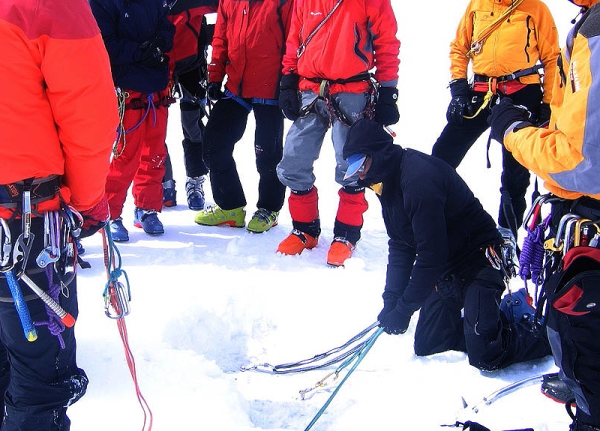
Years later, I accompanied my dad on a winter trip to the state of Washington, where we learned how to ski on glaciers. The instruction included a review of crevasse rescue, something I’d first learned about several months earlier. Thinking about this, it probably explains the claustrophobia I sometimes feel in confined spaces. 

Still, I’ve never been a particularly good downhill skier. I never really learned how to properly use ski-bindings that hold a boot’s heel down, something useful for safely negotiating steeper or more technical terrain. But that didn’t necessarily keep me from trying in some moments of more-or-less painful instances of experiential learning.

For me, skis are mostly a way to escape while accessing a kind of beauty that not too many people get to experience. They can also make for an easier return after reaching a high-elevation objective. That trip to Washington with my dad would prepare me for a roped and cautious ski descent down a glacier on Alaska’s almost 5,000-meter tall, Mount Sanford. But that trip would also cure me of any further ambitions to reach those kinds of altitudes.

Last May, I wrote about an expedition to Mount Everest that had been covered in media, mostly due to press-releases. The summit attempt was intended to publicize the use of medical technologies and pre-conditioning to allow four men to reach the 8,849-meter high summit in a record time. But the whole thing struck me as more of a publicity stunt intended to promote expensive selfies as opposed to actual “mountaineering”. Regardless, another recently promoted Mount Everest summit attempt actually left me deeply impressed.

As I mentioned in my May post, nearly all climbers reach the summit of Mount Everest while using supplemental oxygen. But on September 22, 2025, the Polish mountaineer, Andrzej Bargiel, summited the mountain without supplemental oxygen. Moreover, he carried up a pair of skis which he then used to ski back down via the South Col Route. The following day, he then skied down the “Khumbu Icefall”, a feat I didn’t even know was possible. The icefall consists of the massive shattered ridges and deep crevasses formed by the constantly moving Khumbu Glacier, which blocks the bottom of the approach to the South Col.

Much of the attempt was filmed, and sometimes guided by a drone that was flown by Bargiel’s brother, Bartek. Some of the drone footage is utterly astounding, really showing the scale of the endeavor. In other places, we get to see Andrzej Bargiel’s perspective as he struggles merely to stay standing in the thin air of Everest’s “death zone”, coughing as fluid slowly fills his lungs.
And knowing what it would mean to fall into a crevasse alone, the icefalls were simply terrifying.

Worthy of a full screen…


Yosemite’s Back Door

This country, with its institutions,
belongs to the people who inhabit it.

Abraham LincolnFirst Inaugural Address (1861).

Taking advantage of a local October tradition to shut down the town for a week, combined with the US government’s decision to see which political party can hold its breath longer, we decided to make a dash into the Yosemite high-country while no one was watching. Heading south down US-395, our route took us over a pass known for its autumn trees. Still a little early for full color, the area is at 8,143 foot (2,482 m) Conway Summit. The view is to the southwest, toward the peaks of the Hoover Wilderness.

From the eastern side of the Sierras, the national park’s entrance is reached via Tioga Pass on California State Route 120. This is the southernmost pass for traveling entirely over the Sierra Nevada Range. With most of the route lying within a high-elevation section of Yosemite National Park, the pass usually closes for the winter in late October or early November (closed today as I’m writing this). And overnight parking along the road isn’t allowed after October 15.

From its junction with US-395 at the south end of the town of Lee Vining, the route ascends 3,000 vertical feet over twelve miles to the eastern park entrance. The Yosemite National Park entry at the 9,945 foot (3,031 m.) summit is usually backed up with traffic while visitors have their reservations checked and and hand over a $35 “parking fee”. However, the reservation requirement had been lifted for the remainder of 2025, and no one was manning the entry station. And since the park is “cashless”, there was no way to pay. Oh well… 

Our only real destination for this trip was 10,620-foot Tresidder Peak, which was named after the 1943 to 1948 President of Stanford University. This mountain actually has two prominences, a lower northern peak, and a somewhat higher and more difficult to reach southern peak. There’s also another interesting tower of rock along a ridge to the south known as Columbia Finger. This mountain had been on our radar since a trip up nearby Cathedral Peak in late 2017. Reaching our destination would require staying in the higher elevation, Tuolumne Meadows region of the park. 

Northeast toward Tenaya Lake, which is at an elevation of 9,039-feet.
Tresidder is on the other side of 10,266-ft Tenaya Peak, which rises to the right of the lake.

Tresidder Peak from Upper Cathedral Lake.

The Columbia Finger, flipping off bureaucracy from its 10,360 foot perch.

High country hiking.

After a couple of days in the high country, it was time to head back to the alternate reality of “civilization”, thus justifying a trip into the Yosemite Valley part of the national park for grub and gasoline. This is the part of the national park with which most people are familiar. Despite the government shutdown, the valley was mostly business-as-usual since its public services are mainly run by a contractor, “Yosemite Hospitality” (aka: Aramark). This meant that everything from gasoline to groceries, and even the valley shuttle busses were fully operational.

Half Dome from the Curry Village area of the valley.

It was the usual traffic into the valley, with people stopping to take pictures. But this time of year avoids the back-ups and traffic jams that are why Yosemite started requiring reservations to enter the national park several years back. Still, the crowds were far less than we expected; and it was fairly easy to get ourselves parked right in the central, Yosemite Village area. That left us with plenty of time for lunch and to be tourists.

Yosemite Falls and the Lost Arrow Spire.

A leisurely drive home over Tioga Pass would take us back into Lee Vining by late afternoon. And after a dinner at one of the local mom-and-pops, we made a stop by the US Forest Service, Mono Basin Scenic Visitor Center… which was closed. It’s an interesting facility with good bathrooms; however, it’s usually shut down in the winter. This time, however, the website hosted a rather more terse message. Meh… whatever.

So, we walked ourselves around the back of the building where we could watch the shadow of the eastern Sierras settle over Mono Lake…


September Shots

In this autumntime,
why do I so feel the years?
In the clouds a bird

Matsuo Basho
(Translation by Andrew Fitzsimons)
 

Just a few shots from the last month. Clicking on a photo should cause it to enlarge in a new tab.
It was a pretty pleasant summer this year, with moderate temperatures, and at least one high-elevation snow. September has marked the end of summer with several days of rain and some cooling temperatures. It’s not quite autumn here yet. But the seasons are definitely changing.

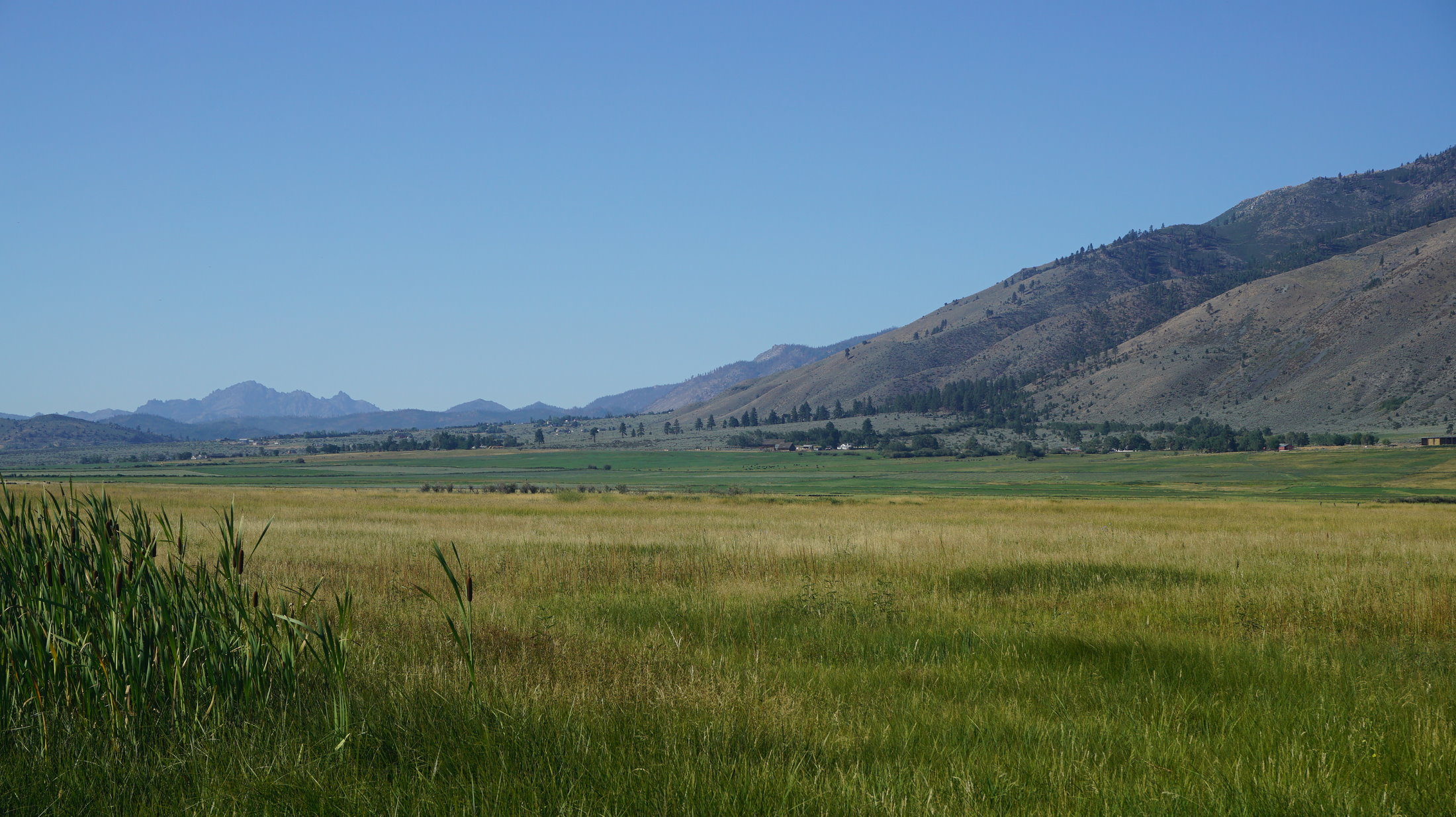
Looking up toward the eastern Sierras from the bottom of Route 88. Our destination is Ebbetts Pass, which is on the other side of the distant mountain to the left, Reynolds Peak.

Upper Kinney Lake is at about 8,700-feet elevation, just off the Pacific Crest Trail a few miles north of Ebbetts Pass. Raymond Peak is in the background. The pass is one of the least used routes over the Sierras, so this is an area that hikers can have pretty much to themselves.

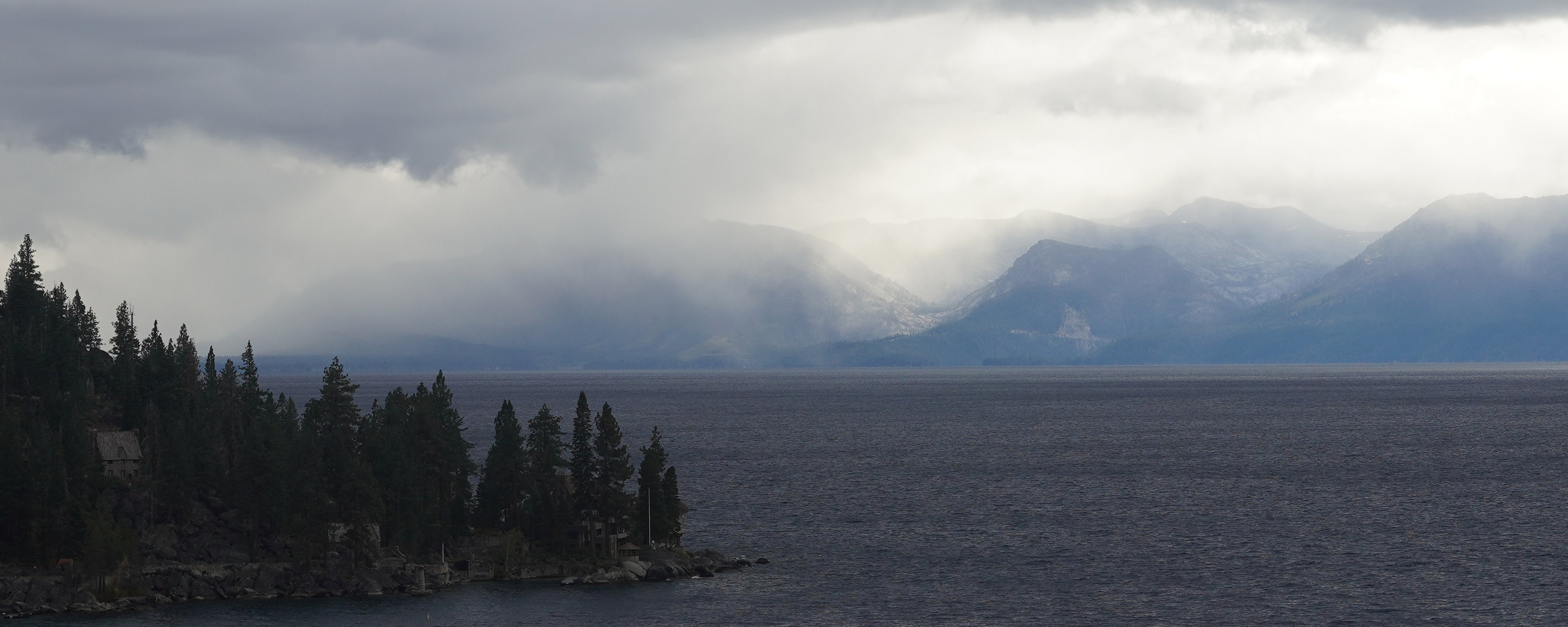
A local shot from State Route 28 on Lake Tahoe’s east shore. The structures to the left are part of Thunderbird Lodge, a once private estate built in the latter 1930s. The mountains, about 20-miles distant, rise above Emerald Bay on the lake’s west shore to form the crest of the Sierra Nevadas.

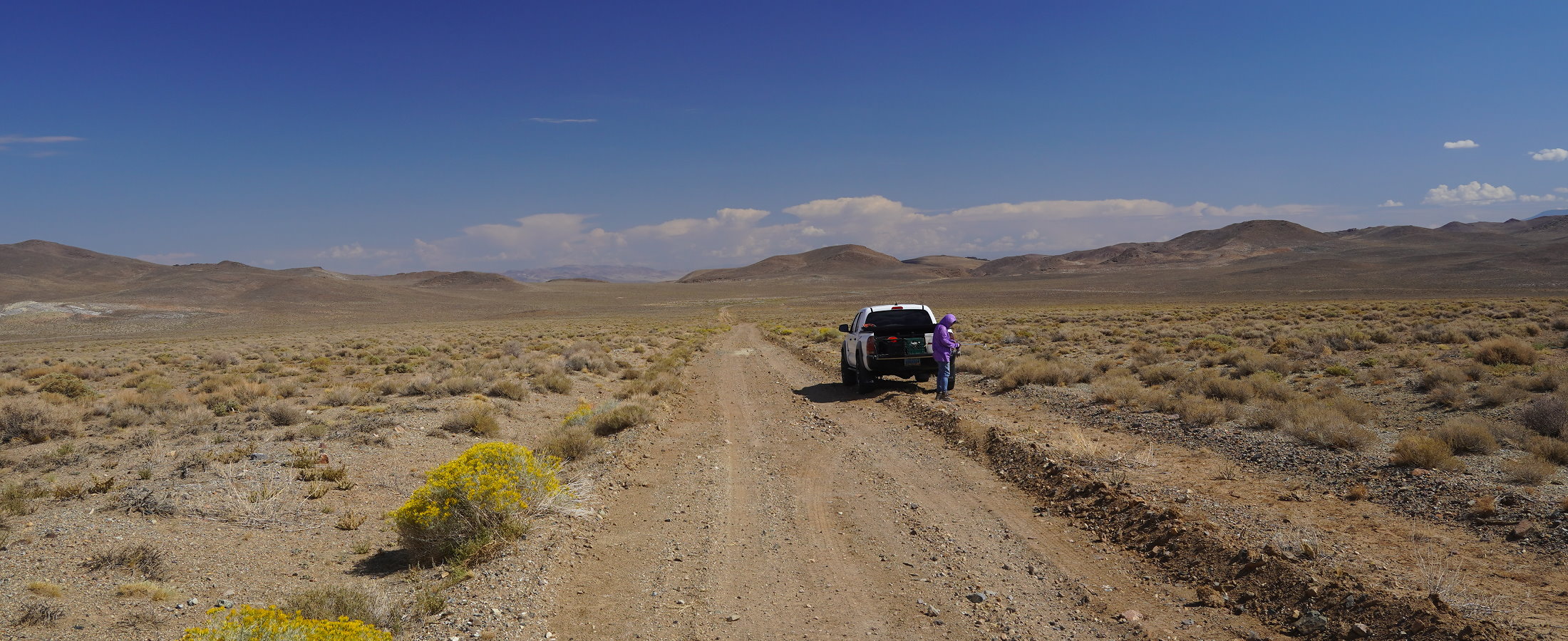
Much of Nevada is accessed by back roads. This was from a day trip with a geologist-friend out to a quarry site about 30-miles to the east.

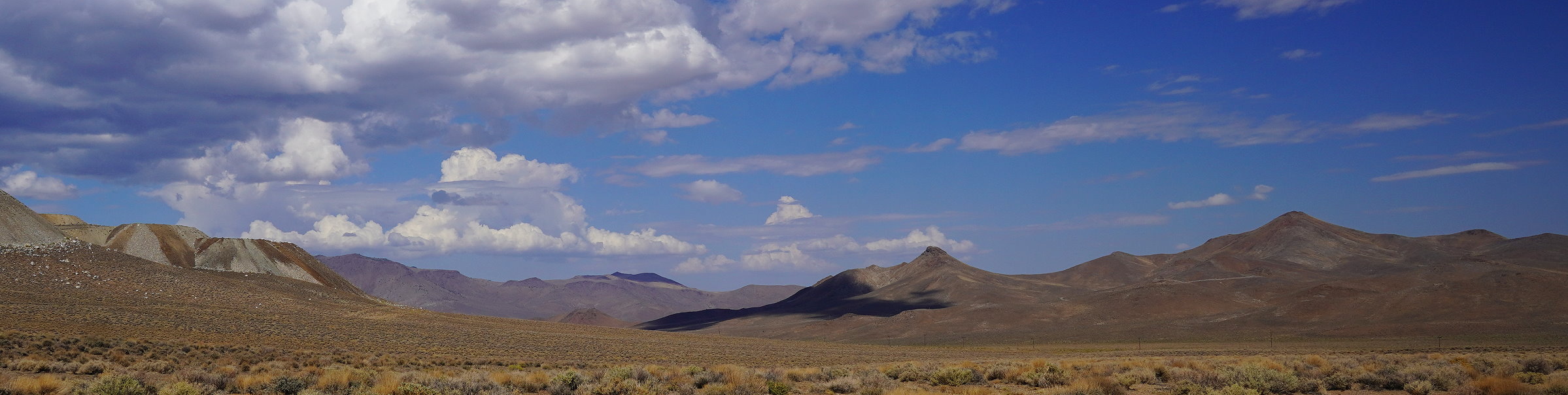
A panorama from the same trip, toward the route to a 7,200-foot elevation pass over the Pine Nut Range. These mountains divide the southern Lake Tahoe region from the Mason Valley area in Nevada. This characterizes most of the “Great Basin” region of Nevada, with mountain ranges separating high-elevation valleys.

Autumn is my favorite season. So we’ll see what October brings…


Just Some Photos

Haven’t been so inclined to sit in front of a computer this summer. So these are just a few recent photos from some local excursions around the neighborhood. I’m trying the “block editor” this time around. I’d mostly given up on it since it was deleting my first paragraphs whenever I tried to hand edit anything (like this ridiculous text size). But I think I’ll give the “expand” function for photos a try this time around.

The south meadow at Mount Rose Summit. Just below the pass at about 8,900-feet, the boardwalk heads out toward “Chickadee Ridge”. The unofficial name is due to so many tourists feeding the birds in the area that they have learned to land on people’s outstretched hands.

A dead tree along the Rim Trail, right at about the alpine limit. It impresses me that anything at all can grow here. This will be under at least ten-feet of snow in the winter. (This one links to the image file.)

Lake Tahoe, from above the northeastern shore. The mountains on the left are the Carson Range of the Sierra Nevadas. The Sierra Nevada high country, which marks the divide between the California watershed and the Great Basin, is on the other side of the lake. That means that none of this water ever reaches the sea.

The Spooner Lake loop off the Tahoe Rim Trail. This area is adjacent to Highway-50 at Spooner Summit and pretty easily accessible. Unfortunately, the northern Lake Tahoe side of the Carson Range has been closed this summer due to work on the higher elevation Marlette Lake dam, which was originally built in the late 1800s.

Spooner Lake, looking north. The dam on the opposite side was also built in the late 1800s. The water was used in flumes that moved timber down the slopes to the east to Carson City. The lake is a regular stop for migrating birds, and it’s a popular fishing spot. However, I wouldn’t recommend swimming here. The lake is, unfortunately, also home to some kind of invasive leech.

The end of the trail.

Alpine Environment

Panic is the sudden realization that everything around you is alive.
William S. Burroughs

The signs are trying to say something.

The first full day of “summer”, the night had been unusually cool for this time of year. I’d actually considered running the heat in the house in the morning; but the breezy sunshine seemed to promise a warm day. So after warming myself with a cup of coffee and a long shower, I closed up the house and headed down the hill to pick up some supplies.

Passing by the usual, massive swarms of Saturday tourists heading in the opposite direction, I could understand their wanting to take advantage of the beautiful summer weekend weather. Cars lined up at the entrance to the beaches at Sand Harbor, and hikers in shorts were heading out at trailheads along the pass. But leaving the grocery store in Carson City a couple of hours later, it was to the sight of an absolutely massive wall of clouds rolling like a 40,000-foot ocean breaker over the eastern Sierras!

The mountain just being swallowed up by the wave of clouds is 10,680-foot (3,242m) “Jobs Peak”.

Heading back home, the rain had become a downpour by the time I reached the bottom of the route up to the pass into the lake basin. And it wasn’t long before it turned into a heavy shower of fat, white flakes. Lines of snow-plastered cars heading in the opposite direction attested to people trying to bail-out before getting stuck in the high country. Indeed, I put the truck into four-wheel drive over the pass, though mostly just out of caution at its being shod in summer tires.

Most concerning were the dozens of snow-covered cars parked at the trailheads at the pass. More experienced hikers know well that it’s never wise to venture into the high country without cold-weather gear. I’ve seen snowflakes in every month here. But this was an unexpected bomber; and I was hoping that it wouldn’t turn into a local high elevation Search and Rescue event.

By the time I reached home, the snow had turned into a light, but cold rain. So after unpacking the groceries, I decided to take my camera out to a beach on the other side of town. Dodging the geese sheltering there, I managed to shoot a couple of dozen photos while I could still feel my fingers. Summer in the Sierras…

East and west from Burnt Cedar Beach.

Back home, I fell asleep to a hot cocoa and a blanket, before being awakened about an hour later by the sun streaming in through a window. This morning, the sunny silence was broken by a firefighting helicopter heading to the east. But I haven’t heard about any rescues from yesterday’s unseasonal outburst. So I guess it was just a reminder of the old adage that, “If you don’t like the weather, come back in an hour.

Post Script: Unfortunately, there were eleven fatalities and two emergency rescues as result of the weather and its interaction with the regional water. All were drownings, eight in the lake, and three more in a nearby river. I suspect that “PFDs” (life-jackets) were the difference between rescues and drownings in the lake incidents. Despite being an excellent swimmer, I always where a PFD (as well as a wetsuit top) when out on the lake. If you’ve never experienced cold water, it’s difficult to understand how quickly it can lead to hypothermia. And a person can become too weak to swim or to self-rescue well before the cold affects brain function. So a person might know what to do, but just not be be able to do it, regardless.

Thin Air

Mount Sanford (I think)

I am nothing more than a single, narrow, gasping lung, floating over the mists and summits.
-Reinhold Messner, Everest: Expedition to the Ultimate (1979).

Air

When I was a teen, my dad spent two months preparing to reach the summit of Denali in Alaska, the highest peak in North America at just over 20,000-feet (about 6,200-meters). A physician, he was well aware of the need to acclimatize to the altitude.

During that time, I accompanied him and several others to the summit of Mount Sanford, at just under 5,000-meters, the highest elevation I’ve ever reached. I was fairly well acclimatized up to 3,500-meters at the time. Still, I well recall the thin air during the last day up to, and back from the summit.

A month in Japan, mostly in near sea-level Tokyo and Osaka, and I’m reminded that the Earth’s atmosphere is little more than a thin blanket. And the oxygen that I like to breath accounts for only about one-fifth of it.

Still, the atmosphere presses with almost fifteen pounds per square-inch (14.7 “psi”) at sea-level . The weight of all the air above, that’s more than a ton per square-foot!  And though we don’t notice, our bodies push back with the same force.

Travel higher, and there’s less air above. So air-pressure decreases with altitude, by roughly one-half for every 18,000-feet (5,600-meters). At around 63,000-feet, it drops to a mere 0.9-psi, not even enough to keep human-body temperature water from boiling. (The “Armstrong limit”.)

Aside from keeping the fluids in our bodies from vaporizing, atmospheric pressure also pushes oxygen molecules close enough together for breathing. But with only half the pressure at 18,000-feet, only half as much oxygen is available as at sea-level. And at 29,000-feet, or the summit of Mount Everest, it’s only about one-third. And that’s not enough for human life.

Humans at Altitude

In the US, I live at around 6,300-feet (≈2000-meters), so there’s about 20% less “oxygen pressure”. That’s enough to affect the human body, especially when exercising. Humans can adapt; but it takes time. And a month at sea-level is more than enough time to lose that adaptation.

Those not adapted may reflexively breathe more deeply (“hyperpnea”), or faster (“tachypnea”), and the heart may beat faster (“tachycardia”). But this can throw-off blood “pH” (acidity or alkalinity), eventually leading to a medical condition known as “alkalosis”. But this is only temporary.

Over about a week, kidneys will work to re-balance blood pH, a process that mountaineers can speed up with certain drugs, such as acetazolamide. But the kidneys also respond by secreting a hormone called “erythropoietin”, or “EPO”.

Most notably, EPO causes a gradual increase in red blood cells [“hematocrit” on a blood test]. Blood plasma also decreases, and more capillaries form in skeletal muscles. And the heart’s right ventricle may enlarge, increasing blood-pressure to the lungs. This all helps to more efficiently move oxygen.

Traveling to high altitudes without giving the body time to adapt can cause an illness known as “acute mountain sickness” (AMS). Severity can depend on elevation change, altitude, and rate of ascent. But AMS can be deadly.

Most who ascend from sea-level to 10,000-feet will experience some AMS symptoms for a few days, usually a headache and fatigue. Severe headaches, nausea, and difficulty with coordination might require descending to a lower elevation.

An inability to “get enough air” even when resting, and severe difficulties with coordination require immediate descent and medical attention, as they signal two potentially lethal forms of AMS.

A common thumbnail calculation for the time needed to fully adapt to an altitude is to multiply the elevation-change in kilometers (1,000-meters) by 11.5 days. So to fully adapt from sea-level to my home in the US at about 2,000-meters should take around 23-days.

Likewise, adapting to Base Camp at Mount Everest at around 5,200-meters (about 17,000-feet) should take about 60-days, assuming a start from sea-level. However, that pushes a limit. Most healthy humans can only adapt to long-terms up to about 5,000-meters (16,500-feet).

Thin Air

The summit of Everest might now be reached by hundreds each year. But only a handful have done so without supplemental oxygen. Elevations above 8,000-meters are commonly called the “death zone” due to the thin air. In fact, until the mountaineers, Reinhold Messner and Peter Habeler, reached Everest’s summit without supplemental oxygen in 1978, it was a feat considered impossible.

Still, after months of acclimatization, the two mountaineers only barely succeeded. Falling to their knees in the snow to catch their breaths, Habeler began hallucinating. And Messner later described feeling as though he had lost his sense of “self” before literally crawling onto the summit.

In a later recollection of that moment, Messner declared that, “In my state of spiritual abstraction, I no longer belong to myself and to my eyesight. I am nothing more than a single narrow gasping lung, floating over the mists and summits.

V̇O2 max

“V̇O2 max” is a measure of how much oxygen a person can utilize during a physical activity; and it’s constrained by the rate of blood oxygen transport. Many aerobic athletes, such as bicyclists and runners, will train at high altitudes in the weeks before events to naturally increase this capacity. However, the use of synthetic EPO to artificially induce the effect is almost universally banned in sports as a form of “doping”.  But there’s an odd gray area.

“Xenon” is a chemical element with the atomic number 54, and symbol “Xe”. It is a dense, colorless and odorless “noble gas” found in very small amounts in the Earth’s atmosphere. As a noble gas, like helium or argon, it’s generally non-reactive. However, the atom’s large size allows for some weak chemical interactions, including some that affect the human body.

Most importantly, breathing xenon can easily prove fatal. Not only can it displace the oxygen necessary for life, but high concentrations will also put a person to sleep in seconds. In fact, xenon is used for general anesthesia by trained physicians with proper equipment and careful administration. But a side effect is that it also stimulates the body to produce EPO.

The Russians apparently tried this with athletes at the Sochi Olympics, causing the World Anti-Doping Agency (WADA) to later ban xenon use. But whether xenon-elevated EPO really improves performance is still an open question, with no scientific studies demonstrating any advantage.

Regardless, four British military veterans just summited Mount Everest in a single week by using xenon to boost their red blood cell count while at sea-level. Under medical supervision, the four men inhaled a xenon-oxygen mix in a single administration that lasted less than an hour, with the hope that the greatest effects would occur 10 to 14 days afterward.

Gas

Personally, I think this is mostly a stunt, with media (again) treating a press-release as “news”. The four men have also been sleeping and exercising for weeks in low oxygen environments, simulating the high altitudes. So this was more likely how they pre-acclimated their bodies. Still, Reinhold Messner has expressed his support of the process, including the use of xenon. 

These guys did manage to make it from sea-level to the summit of Mount Everest in a mere week, a record to be sure… with months of medically-supervised preparation, a massive support team, and supplemental oxygen. To what extent this represents a “human” endeavor I suppose depends upon what technologies one considers as a part of the human identity, whether high-tech clothing, synthetic ropes and aluminum ladders, bottled oxygen, or medically administered xenon gas.

The whole point of “mountaineering” was once considered to be the challenge. Granted, I’m nowadays happy to make it up a local hill to enjoy the view. But Mount Everest, at least, seems to have been reduced to the status of reaching the top of a tabloid news cycle with an expensive selfie.


References (though there’s plenty of media coverage):

Dias, K. A., Lawley, J. S., Gatterer, H., Howden, E. J., Sarma, S., Cornwell, W. K., Hearon, C. M., Samels, M., Everding, B., Liang, A. S., Hendrix, M., Piper, T., Thevis, M., Bruick, R. K., & Levine, B. D. (2019). Effect of acute and chronic xenon inhalation on erythropoietin, hematological parameters, and athletic performance. Journal of Applied Physiology, 127(6), 1503–1510. https://doi.org/10.1152/japplphysiol.00289.2019

Horwath, H. (2020, January 3). Blood Doping and EPO: An Anti-Doping FAQ | USADA. U.S. Anti-Doping Agency (USADA). https://www.usada.org/spirit-of-sport/blood-doping-epo-faq/

Malcolm, C. (2021, December 30). Into thin Air: The Science of Altitude Acclimation. iRunFar. https://www.irunfar.com/into-thin-air-the-science-of-altitude-acclimation

UIAA Medical Commission. (2025, February 5). Statement on xenon and high-altitude mountaineering – UIAA. UIAA – International Climbing and Mountaineering Federation (UIAA). https://www.theuiaa.org/statement-on-xenon-and-high-altitude-mountaineering/

Wilkerson, J. A. (1985). Medicine for mountaineering. Mountaineers Books.


Induced Atmospheric Vibration

Do not merely accept the prejudices of that which calls itself ‘news’, especially from the Internet.
-Abraham Lincoln

Sometimes, I just have to cough up my coffee and mumble “WTF!” under a facepalm.  Usually, the response corresponds to some new conspiracy theory, a UFO sighting, chakra realignment, or something else along those lines. But it’s started occurring frequently enough of late to affect my laundry schedule.

Most disturbingly, many of these episodes of reflexive coffee-spewing have been as a result of “news”. And I’m not talking about those editorials from self-appointed arbiters of misinformation. Rather, it’s established mainstream sources, like the BBC, PBS, or institutional media networks that are apparently just repeating whatever convenient nonsense emanates from some unquestioned source.

One latest descent into utterly uniformed idiocy involves the remarkably under-reported, but absolutely catastrophic power outage that just affected most of Spain and Portugal on April 29, including their capitals, Madrid and Lisbon. Sixty-percent of the two nations’ power infrastructure went offline within 5-seconds during the middle of a workday. And a cascade of subsequent failures then shut down many remaining, but interconnected systems, some extending into parts of France.

Airports, rail lines, and traffic signals were disabled. Banking systems, Internet and cell-phone services went down. Petrol (gasoline) stations, water-pumping and other electricity-dependent infrastructure ceased functioning. This resulted in massive numbers of people trapped in nonfunctional infrastructure, epic traffic backups, and everything from stores to hospitals unable to function.

A state-of-emergency was declared across most of Spain, authorizing the deployment of 30,000 police officers. Police and Red Cross workers were deployed to hand out blankets and bottled water to trapped commuters. Unfortunately, three people in the Galicia region died from carbon-monoxide poisoning after attempting to power a medical oxygen machine with a generator. And grocery stores and restaurants began disposing of produce lost after more than eight hours without refrigeration.

Restarting a power grid after such a complete failure is called a “black start”, and it’s a slow and involved process. Power had been restored to about half of affected areas by midnight, amounting to about one-third of total electrical demand. But the Spanish power company, Red Eléctrica (REN), warned that it could be a week or more before power is fully restored to all affected areas.

This is a big story because it relates directly to how drives to increasingly electrify infrastructure while moving to “renewables” can, and inevitably will affect populations.  What happened here should be a warning. However, the large corporations that are behind this failure have been allowed to control the narrative with little more than nonsense.

Spain has made huge investments into renewable energy sources over the last two decades, including bioenergy, wind, solar, and hydro sources. And in 2023, Spain reached having more than 50% of its electricity generation derived from renewable sources, mostly wind and solar. And at the same time, it has shut down fossil-fueled power plants and started to phase out its nuclear facilities. But this comes with problems.

Electrical grids are a balancing act. Energy in at power sources has to be matched to energy out to consumers. A surplus can disrupt a power grid just as much as a deficit. Moreover, the timing of oscillations in the “alternating current” sent along power-lines and through transformers has to be carefully matched between different sources. And this is made even more difficult when a power source is provided merely at nature’s whim, such as with wind or solar.

In the week before the blackout, Spain saw several power surges and cuts. One cut due to “excessive voltage” disrupted rail lines, stranding high-speed trains near Madrid on April 22. Later that day, Repsol’s Cartagena refinery was also shut down by power supply problems. It was clear that the grid was operating on a knife-edge and becoming increasingly unstable. And on April 29, it reached a tipping-point where everything cascaded into one massive failure.

Initially, speculation on a cause considered a cyber-attack; though that was quickly ruled out. But in the background, operators already knew what had happened. The closure of coal, gas-fired and nuclear plants had simply reduced the grid’s capacity to balance itself to the point where it couldn’t adjust to demand.

Solar farms generate direct current (DC) power which needs to be converted to alternating current (AC) in order to be transmitted through grids. But if solar generation drops, there has to be a back-up source of AC power to help maintain a high enough voltage to keep the output frequency steady. Otherwise, the solar power source will be disconnected from the grid. And likewise, a drop in wind energy has to be compensated for if electricity demand exceeds production.

April 29 was nothing more, or less than a demonstration of the fragility of electrical grids. And it revealed how increasing dependence upon renewable, “flow” sources of energy for electrical power generation, such as wind and solar, make these systems even more susceptible to failures. This massive power outage illustrates exactly why such systems need to have some type of power-generation backup, perhaps nuclear if “decarbonization” is the objective. Betting everything on the vagaries of nature is merely a formula for disaster.

Initially, however, the outage in Spain and Portugal was blamed on a rare atmospheric phenomenon referred to as “induced atmospheric vibration“. WTF!? 

News agencies apparently obliviously reporting on the occurrence of this cosmic alignment of atmospheric chi-energy originally cited REN. But officials from the company have since claimed that the statement was wrongly attributed to it, probably realizing how idiotic it sounded.

Regardless, you can now find numerous articles on the topic of Induced Atmospheric Vibration, probably resulting in an eventual Wikipedia page. In one case, it’s claimed that this is a phenomenon caused by, “…rapid temperature shifts between layers of the atmosphere which set off dramatic pressure changes, leading to powerful electromagnetic disturbances.” 

Damn… coffee all over another shirt!


Tōkyō

I think Tokyo is going to sink under water soon. All those stupid high-rise buildings will sink and maybe all the traffic will be gone. And everything will be peaceful and quiet.
Hayao Miyazaki

Scenes from Tokyo, spring ’25…
(Please forgive the phone shots and editing.)

Higher elevation cherry blossoms.

Flora

Trails


Fauna


O-Jizo-sama, guardians of children and travelers,
and the Seven Lucky Gods of (front left to right):
fortune, longevity, wisdom, talent, protection, prosperity, & commerce.


Fujisan


Back to “civilization”…