Descent

Every worthy act is difficult. Ascent is always difficult.
Descent is easy, but often slippery.

— Mahatma Gandhi, Courageous or Cowardly, New Delhi, 23 November 1947.

My dad first taught me how to ski in cross-country gear when I was maybe eight or nine years old. As I became older, the boots became heavier and the skis became wider, as I learned how to get them to turn on down-slopes. My dad also taught me how to use “skins” to ski uphill…
and how to locate buried skiers with an avalanche beacon.

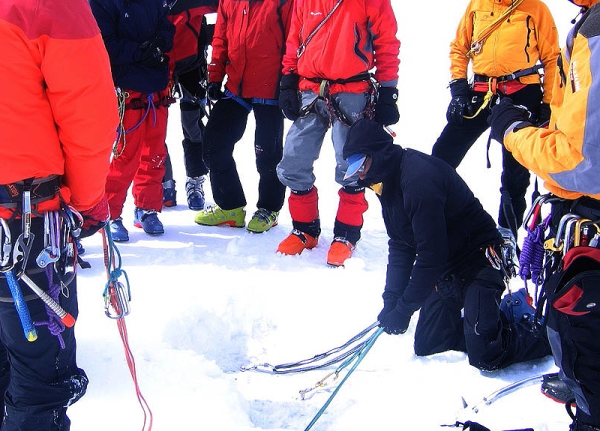
Years later, I accompanied my dad on a winter trip to the state of Washington, where we learned how to ski on glaciers. The instruction included a review of crevasse rescue, something I’d first learned about several months earlier. Thinking about this, it probably explains the claustrophobia I sometimes feel in confined spaces. 

Still, I’ve never been a particularly good downhill skier. I never really learned how to properly use ski-bindings that hold a boot’s heel down, something useful for safely negotiating steeper or more technical terrain. But that didn’t necessarily keep me from trying in some moments of more-or-less painful instances of experiential learning.

For me, skis are mostly a way to escape while accessing a kind of beauty that not too many people get to experience. They can also make for an easier return after reaching a high-elevation objective. That trip to Washington with my dad would prepare me for a roped and cautious ski descent down a glacier on Alaska’s almost 5,000-meter tall, Mount Sanford. But that trip would also cure me of any further ambitions to reach those kinds of altitudes.

Last May, I wrote about an expedition to Mount Everest that had been covered in media, mostly due to press-releases. The summit attempt was intended to publicize the use of medical technologies and pre-conditioning to allow four men to reach the 8,849-meter high summit in a record time. But the whole thing struck me as more of a publicity stunt intended to promote expensive selfies as opposed to actual “mountaineering”. Regardless, another recently promoted Mount Everest summit attempt actually left me deeply impressed.

As I mentioned in my May post, nearly all climbers reach the summit of Mount Everest while using supplemental oxygen. But on September 22, 2025, the Polish mountaineer, Andrzej Bargiel, summited the mountain without supplemental oxygen. Moreover, he carried up a pair of skis which he then used to ski back down via the South Col Route. The following day, he then skied down the “Khumbu Icefall”, a feat I didn’t even know was possible. The icefall consists of the massive shattered ridges and deep crevasses formed by the constantly moving Khumbu Glacier, which blocks the bottom of the approach to the South Col.

Much of the attempt was filmed, and sometimes guided by a drone that was flown by Bargiel’s brother, Bartek. Some of the drone footage is utterly astounding, really showing the scale of the endeavor. In other places, we get to see Andrzej Bargiel’s perspective as he struggles merely to stay standing in the thin air of Everest’s “death zone”, coughing as fluid slowly fills his lungs.
And knowing what it would mean to fall into a crevasse alone, the icefalls were simply terrifying.

Worthy of a full screen…


Please Get Out of My Way.

…if a man has not discovered something that he will die for,
he isn’t fit to live.

Martin Luther King, Jr., Walk to Freedom, Detroit, 23 June 1963.

I’ve been watching the 2024 version of Shōgun, the historical drama based on the 1975 novel by James Clavell. I have to say, I’m rather impressed. Most of the actors are Japanese, a majority of the dialogue is in Japanese (if somewhat “jidaigeki), and the production is pretty authentic to what I know of 16th-century Japan.

I’ve never read Clavell’s novel, which while fictional in detail is based on actual people and events from late 16th-century Japanese history. This was a pivotal moment in Japan, marking the end of the country’s Feudal period, or 418-years of near continuous civil war.

Japan’s Feudal period began in the late 12th-century when the “shōguns”, powerful Japanese military leaders, replaced the imperial court as the country’s central government. Generals loyal to the shōgun were compensated with land and regional powers, becoming the feudal lords known as “daimyo”. But some among the daimyo would eventually grow in power enough to challenge the authority of the shogunate with their own private armies.

This resulted in the rise of the “samurai”, or more accurately, “bushi” (武士), who were an elite professional warrior class. For bushi, war was a way of life that often included entire families. The term “samurai” more accurately denotes service as a trusted retainer to a daimyo. So for bushi as samurai, this amounted to pledging one’s life to a daimyo.

Alliances of convenience among the daimyo, and sometimes even the civil authority of the imperial government, would form and wane through generations as power shifted. And by the mid 15th-century, Japan had become a society that existed in a state of almost constant internal warfare. During this time, Zen Buddhism began to strongly influence the development of a bushi philosophy and an associated code-of-behavior. Much of this emphasized salvation through self-discipline, applying it to Confucian ideals of loyalty and duty.

After 415-years, this pattern of endless warfare would ultimately culminate in the monumental, “Battle of Sekigahara” on 21 October 1600, in which at least 30,000 combatants would lose their lives. But the result would be a subsequent two-and-a-half centuries of peace, economic and cultural development, and isolationism under the unified leadership of the “Tokugawa Shogunate” during Japan’s subsequent “Edo period“. It was during this time that the bushi philosophy would become consolidated into various forms of a doctrine known as “Bushido”, or the “way of the warrior”.

Japanese samurai are usually associated with the use of swords, and primarily the “katana”. With its long curved blade and single sharpened cutting edge, it is intended to be drawn and used quickly in a single slashing motion. In 1588, the right to carry swords was restricted only to samurai, making the wearing of swords also a display of elite social status. However, the sword was not typically the first weapon of choice in warfare.

Especially before the introduction of firearms, the primary weapon of a samurai was actually the “yumi”, an asymmetrical longbow with a shorter lower limb. This design allowed for the bow to be more easily used from horseback, or from behind protection. At over two meters in length, properly drawing and releasing arrows from a yumi requires significant strength and years of training.

Regardless, a skilled samurai on horseback could accurately release an arrow every few seconds while riding at full gallop. These arrows, called “ya”, would be tipped with a variety of different types of steel points depending upon the intended target. In warfare, this allowed for long-range attacks before closing on an adversary.

At closer quarters, however, foot soldiers especially would utilize a type of gripped spear known as a “yari” (). Yari were usually equipped with a long and thin, pointed steel tip intended to puncture through armor. These steel tips also sometimes included cross bars or hooks, which were intended to keep an impaled enemy from pushing any closer. But there was also another common polearm.

The “naginata” (薙刀, “mowing sword”) consists of a metal or wooden pole with a long, single-edged, curved blade on its end. The pole extended the reach of the blade, which was intended primarily for slashing and cutting. During warfare, these could be swung at an enemy in order to break lines or to combat cavalry, and were sometimes used by mounted samurai and foot soldiers, as well as warrior monks.

A form of the naginata, the somewhat lighter “ko-naginata”, is the iconic weapon of women of the Japanese nobility. Nearly all women of status were trained to use these weapons to protect themselves, as well as their homes and children. Because of its reach, it could be used to sweep an area clear, or to keep an attacker at a distance. The naginata was also effectively used by female warriors. The legendary female samurai, Tomoe Gozen (“Lady Tomoe”), was said to have wielded the weapon with great skill.

Sixteenth-century feudal Japan was an at once extraordinarily beautiful, and extraordinarily violent society. And the introduction of Western weapons, such as early firearms and cannons to Japanese battlefields only served to amplify the latter. Important to the context of what the story is attempting to illustrate, the 2024 Shōgun doesn’t shy away from depictions of this violence. It was a utility to the Japanese society of the time. Life was seen as but a fleeting moment in which to appreciate beauty. Purpose came only from dedicating one’s self to something greater.

I won’t get into the plot or the story-line of Shōgun, which is placed during the lead-up to the Battle of Sekigahara, as there are plenty of other sources. But a pivotal character in Clavell’s story is “Toda Mariko” [family name, given name], who is based on the historical, Akechi Tama (明智たま), also known as Hosokawa Gracia (細川ガラシャ).  From an aristocratic bushi family, she lived from 1563 until her death on August 25th of 1600. After learning both Latin and Portuguese, she was baptized as a Christian in 1587, taking the name Gracia

In 1600, the feudal lord Ishida Mitsunari attempted to force Gracia’s husband into joining his side in the coming battle by effectively holding her hostage at Osaka Castle. Unwilling to accept the disgrace, Gracia was said to have had a family retainer end her life since her Christian beliefs would not allow suicide. Her death severely damaged Ishida’s reputation, causing him to lose the support of many generals, several of whom were probably also Christians themselves. These defections would ultimately result in Ishida Mitsunari’s defeat at the Battle of Sekigahara.

Clavell’s version of the real-life Gracia in the character of “Mariko” illustrates the feudal Japanese ideal of samurai bushi, while also bringing together much of the preceding story through her use of the ko-naginata. Meaning is established through a formalized, but unyielding loyalty, even if to fight against one’s own destiny is futile. Whether or not such a death is worthwhile is left to the viewer, as Clavell didn’t take a side in what constitutes “barbarity”.

Warning! Bloody content:


Notes about some of the images:

“A Medieval Japanese Archer” is a lithograph by Émile Théodose Thérond (1821–1883), and Jean Gauchard (1825-1872). I believe that it was drawn from a photograph with a posed subject, probably taken around the end of the Edo era in 1868 or shortly thereafter. Personal collection.

The arrow points (“yanone” or “yajiri”) are all Edo era (1603-1868). The longer-shafted points were sourced from the Kobe/Osaka region. The others are from the Tokyo/Chiba area (Edo). Some of the smaller points were made with the same craftsmanship as that seen in traditional blades, and were signed by their makers. Personal collection.

Japanese Print, “「英勇一百伝」 「巴御前」” (“One Hundred Tales of Heroes” “Tomoe Gozen”), by Utagawa Kuniyoshi (1851).
At the Tokyo Metro Library: https://ukiyo-e.org/image/metro/H020-004

Battlefield Archery: This is a link to a ceremonial demonstration of “kyujutsu”, or battlefield archery. The archers first demonstrate a “Sashiya”, where a group of archers release a steady stream of arrows. This is followed by a “koshia”, where the archers advance in alternating ranks. This was intended to pin-down enemy archers, allowing spearmen from their own ranks of a “kumiyumi”, or a group of archers and spearmen who have trained to work together, to move forward. The headwear signifies that these archers have been temporarily blessed as Shintō priests while they perform as entertainment to the gods of the shrine.
https://www.youtube.com/watch?v=tJVC6ExVUi4
There’s a good article here.

Dealing with Feudal Bureaucrats  Partially just for fun, but also because it depicts a fairly accurate use of the katana, or long sword. These were not “fencing” weapons; rather, they were a utility. This is the sequence preceding the accumulation of bodies (and body parts) visible in the background during Mariko’s confrontation with the replacement entry guards. The bushi-samurai assigned to Mariko-sama by Lord Toranaga would indeed have followed her direction without question. Observing appropriate formality, however, the samurai bows respectfully in recognition of the bureaucratic status of the official in charge of the gate. What follows is an example of “Iaijutsu” (居合術).

This is a response to an attack starting from the “saya”, or the katana’s sheath. As the gate official reaches for his weapon, the samurai immediately disables his would-be attacker in a single move of the katana from the saya (takes off his opponent’s fingers), dispatches his assistant, returns to conclude his business with the official, shakes the blood from the katana, and then replaces it back into the saya in a span of five seconds. Efficiency!


Belief


“Every great and deep difficulty bears in itself its own solution.
It forces us to change our thinking in order to find it.

-Niels Bohr

Leaning back into space, weight shifted slowly from my feet onto the rope that would keep me from falling. Finally, pushing off from the rock, I loosened my grip on its connection to the earth and allowed my body to fall… just a little. It was a moment of faith, balanced by reason.

“Reason” is that characteristic of mind through which we come to rational conclusions. “Faith” is merely an acceptance of that not empirically provable. A combination of both is the source of all foundations upon which we build our lives, whether functional, intellectual, moral, or religious. And once established, they become the beliefs, or the set of rules from which trusted expectations are drawn. So it’s no small thing when those foundations fail.

Constructing a reliable climbing or rappel anchor requires a fair amount of informed consideration. And among the first things learned is not to place much faith in those structures relied upon by others. Rusted bolts and sun-rotted nylon webbing are but crumbling invitations to disaster. That worthy of trust requires knowledge, understanding, and the effort to create and to verify for one’s self. But in science, this defines the trade-off in avoiding “Type II” error; minimizing the risk of bad ideas comes at the cost of overlooking potentially good ones.

“Cognitive Dissonance” is what we feel when established expectations suddenly fail to describe reality. Opening the front door of my old house one morning, the snow-covered tree that had fallen across the front porch during the night’s blizzard resulted in a moment of startled confusion. The rational expectation of a familiar world was suddenly replaced by a profoundly disturbing experience.  It was as the unexpected sensation of falling in a dream.

There are two ways to avoid such moments. The first is to plan carefully, and to prepare backups for those times when things fall apart anyway. Likewise, a good climbing anchor is not only sturdily constructed, but it’s also built with no single point-of-failure. Regardless, there will always be risks beyond our ability to control.

But the alternative is merely not to climb.

In the mountains, acceptable risk is understood to be subjective; and it’s usually assessed by looking at four factors: probability, consequence, exposure, and tolerance. The first three multiply to increase actual risk. And this is where things like building a good anchor, or tying knots at the ends of a rope can make a difference.

Still, there are always risks in the approach to a summit. Some are physical. Others are the consequence of a clear view, the experience of nearing the boundaries of both reason and faith, and peering into the abyss. Plato called them the “beautiful dangers”. Heidegger called it “metaphysical vertigo”.  And the degree of willingness to accept such risk can only be determined by an individual.

Tolerance is consequently founded in something deeply personal. It represents a threshold for an acceptance of risk in exchange for what it promises in return. For the honest and informed, it’s a belief in one’s self grounded in experience, ability, fortitude, and goals.

But there’s always some aspect of a Kierkegaardian-like leap as one leans back, trusting in the thin strand that holds a spirit to the mountain.

Todd Skinner leaned back into space, just as he had thousands of times before. This particular day in October of 2006, he and his climbing partner, Jim Hewett, had been exploring a route for a first free-climb of the 3,000-foot, “Leaning Tower” in Yosemite. Deciding to call-it-a-day in the heat of the afternoon, they ate a lunch and then began a series of easy rappels back down.

As Skinner neared the end of his second rappel, Hewett heard a strange sound. “I looked down really quickly and just saw him falling… and I knew he was dead.” Skinner had experienced an almost unheard of equipment failure of the “belay loop” on his harness, the sturdy and utterly reliable nylon ring through which climbers secure themselves to their ropes.

Same Same, but Different

I look up at the sky, wondering if I’ll catch a glimpse of kindness there, but I don’t. All I see are indifferent summer clouds drifting over the Pacific. And they have nothing to say to me. …all I see is my own nature… I’ve carried this character around like an old suitcase, down a long, dusty path. I’m not carrying it because I like it. The contents are too heavy, and it looks crummy, fraying in spots. I’ve carried it with me because there was nothing else I was supposed to carry.
– Haruki Murakami
(translated by: Philip Gabriel), What I Talk About When I Talk About Running (2007).

The Akira Kurosawa film, Rashomon, is a Japanese period-drama set in late Heian-era (1185) Kyoto. The story follows the accounts of four witnesses to the mysterious death of a traveling samurai. As each witness tells seemingly contradictory versions of events, questions arise about the meaning of evidence, subjective versus objective experience, and biases in perceptions.

As in the parable of the blind men and the elephant, each of the story’s characters is confined to discerning an overall meaning from his or her own limited perspective. But conceptualizing the whole by interacting with only a part ends up leaving no one with an entirely accurate representation. Though each knows an objective truth with the certainty of personal experience, none can agree to an overall interpretation.

Rashomon is about how personal circumstance affects an individual’s experiences, value judgments, and understandings. Even the most sincere attempts at discerning an objective reality become a subjective process whenever humans are involved. “Rashomon effect”, is commonly used in reference to the unreliability of eyewitnesses in courtrooms.

The takeaway is that a belief in absolute truth based in the limits of human experience leaves an individual ignorant of others’ experiences, which may be equally true. But the limitations of personal perspective also speaks to the cognitive tools we use to interact with the world. “When your only tool is a hammer, every problem becomes a nail.

For several years during my undergraduate college days, I played mostly percussion in a down-tuned, Japanese-American “power-trio”. We called ourselves “Byōki”, meaning “Sickness”… three Asian-American women responding to the nauseous corporate saccharin of 80’s Americana.

Our sound was hosted in garages or at the college bar, and at a couple of Japanese-American cultural events where I’m not so sure how welcome we were after sponsors actually heard our music. We were slow, loud, dark, and scrappy.

Listening to an old recording, I could barely hold a note; but it didn’t really matter. Hammering out lyrics like nails, the words to a piece inspired by the experience of a friend betrayed in a moment of weakness started, “I know God is dead. I will bury him.

Still, I have long-time friends who talk to Angels, to the Universe, and even to God personally. I’m not sure whether I should envy, or pity them. Most seem pretty happy; and I don’t have any better ideas for making life work. Regardless, God has never taken much interest in speaking with me.

If I’m honest with myself, and I try to be, my perspective would probably keep me from hearing anything anyway. Pathologically unable to take Kierkegaard’s “leap” into faith, it is simply my own voice in the silence, saying what I want to hear. And if those who try to communicate the depths of their faiths to such as myself could understand, I don’t know whether they would feel pity or despair.

Living in northern Thailand for a couple of years at least put a lot of my first-world problems into a better perspective. And there was a kindness, an understanding allowing the forgiveness that I’m not omniscient. We can’t know the depths of others’ experiences; and we can’t look back. And especially when the people we love die suddenly and unexpectedly.

It’s a circumstance of enduring. And it becomes numbing after awhile, brushed off like snow at the door, left outside. A photo from decades ago, young friends, healthy, ambitious… It reminds me of a scene at the end of some old war film where the recollected dead outnumber the living, each representing some different lost promise.

Friends, family, mentors and heroes leave in ways that hit closer to home. Unexpected, discouraging… not lost to adventure, life’s risks, or simply poor judgment… but at home. For some, it was time. But for others, there was no goodbye, no word. Just a phone call… they’re gone.

A mentor and a friend, cursed with integrity and a kind heart, a beautiful mind and generous soul. Giving, simply that he could. But never taking enough. One of those rare people found on the path taken because of wanting to be more like them. To dare to be invested in life. Not a God-like man to proclaim how he lived. Just a humble man who claimed no special status with God at all. In the words of Krishnamurti,
Love is not aware of itself as love, for the word is not the thing.

Seeing the self-serving limits to each witness’s story, the Buddhist priest in Rashomon finds that he has lost his faith in humanity. There is no honor among any… thieves, opportunists, the unfaithful, the samurai’s self-inflicted death. But in a humble woodcutter’s appeal to spare the life of a child, the priest finds at least some promise.


To Destroy a Nation, Part 6

This is part six (and a merciful last) in a short series of brief summaries about the collapse of the 19th-century Chinese Qing Dynasty, and how and why China has emerged as the country we know today.

This section is the second of two about Mao Zedong, who emerged as the architect of China’s communist revolution, with Zhou Enlai as its executor.  The details of Mao’s rise to lead China are far beyond the scope of these articles.

Part 1, Drugs and Greed: The First Opium War
Part 2, Religion and Fanaticism: The Taiping Rebellion
Part 3, Open Borders and Nationalism: The “Boxer” Rebellion
Part 4, Promise and Politics: The New Republic
Part 5, Charisma and Ignorance: The Long March
Part 6, Ideology and Anarchy: The Red Guard


Convictions are more dangerous enemies of truth than lies.
– Friedrich Nietzsche, Human, all too Human: A Book for Free Spirits (1878).

Ideology and Anarchy
The Red Guard

The Long March gave Mao Zedong control over what was left the Red Army. But leadership of the Chinese Communist Party (CCP) was still in question. Pro-Bolsheviks educated in Moscow, led by the popular CCP senior leader, Wang Ming, wanted a government in line with the “Comintern”, an international organization to promote world communism led by the Soviet Union.

Mao had a different vision for China, later articulated in “Mao Zedong Thought”. He asserted that a Marxist-Leninist style revolution led by a “proletariat”, or working-class, would fail in a nation dominated by a rural peasantry. Mao saw the peasant-class leading a Chinese revolution.

While rebuilding his army in the north, Mao accordingly imposed strict rules-of-conduct in interactions with peasants, including respectful treatment and fair exchanges. This greatly enhanced Mao’s reputation among the rural populations, quickly swelling his ranks.

From 1937 to 1945, the Communists and the Nationalists suspended fighting while forming a loose alliance against the Japanese during the Second Sino-Japanese War. This gave Mao a further opportunity to establish his leadership while developing a more disciplined and experienced Red Army. Utilizing Wang Ming’s Soviet connections, Mao was able to gain access to financial and military support through the Comintern. But Wang was summarily sidelined after Mao had what he wanted.

The period from 1941 to 1944 also marked Mao’s “Yan’an Rectification”, a movement supposedly intended to consolidate CCP ideology. Party members were to study Mao Zedong Thought, subsequently engaging in self-criticisms. But the program’s actual purpose was to identify and to purge opposition. By the end of the Rectification, as many as 10,000 party cadre had been “re-educated”, establishing Maoism as the official ideology of the CCP.

A more experienced, disciplined, and better equipped Chinese communist military would re-emerge from the close of World War II as the “People’s Liberation Army” (PLA), while the nationalist Kuomintang had lost the support of a German military alliance. Using tactics refined in battles against superior Japanese forces, the PLA would consequently drive the Kuomintang entirely out of Mainland China, forcing them to take refuge on the island of Taiwan.

By 1949, the CCP under Mao’s leadership turned inward, toward the destruction of the Chinese Confucian social order through land reform. Mao directed the development of the Agrarian Reform Law in June of 1950, ordering the seizure of lands from landlords, industrialists and capitalists, and its redistribution to landless peasants.

Mao described the process as, “a vicious war. …our troops are 260 million peasant soldiers. …it is the most terrible class war between peasants and landlords. It is a battle to the death.” The CCP encouraged peasant revenge through the “Speak Bitterness” campaign. Indifference was interpreted as counter-revolutionary, and villagers complied if merely as a way to survive.

Former landlords and presumed supporters were accused of crimes, interrogated, and put on trial. Punishments ranged from public humiliation and beatings to torture and execution. Others were banished, imprisoned, or forced into suicide. By 1953, an estimated 500,000 to 2-million landlords had perished, along with their knowledge.

Party meetings and propaganda sessions replaced ceremonies that had helped to time and to coordinate plantings and harvests and to forge bonds of assistance between farmers and villages. Old farming methods were forgotten or banned, replaced with the pseudo-scientific theories of a discredited Soviet scientist, Trofim Lysenko. The results were crop failures and damage to farmlands.

And then came Mao’s “Great Leap Forward”.

The Great Leap was the CCP’s second, “Five Year Plan”, implemented during the four years from 1958 through 1962. Grossly underestimating what would be required to develop an industrial production base, Mao directed a policy aligning with rural agricultural collectivization. Peasants would lead in the modernization of industry, thus omitting the development of an urban bourgeois class of “experts”.

Despite Zhou Enlai urging caution, collectives were ordered to organize labor forces that would shift tens-of-millions of rural Chinese into non-agricultural and industrial work. This would include the smelting of iron in “backyard furnaces”, sometimes by melting down farm implements.

Mao’s plan rapidly devolved into a bureaucratic catastrophe. As farms failed, the demands on rural food production became unsustainable, and the CCP’s food-rationing systems entirely collapsed. The “Great Chinese Famine” from 1958 to 1962 would be among the greatest man-made disasters in all of human history, with estimates ranging from 15-to-55 million deaths due to starvation. In some provinces, one-in-five would perish.

The CCP would call this time the, “Three Years of Natural Disasters”. Floods, droughts, severe weather and infestations certainly played a role in crop failures. But flawed and unrealistic policies and poor governance were at the root of an inability to manage any meaningful response. In 1962, First Vice Chairman of the CCP, Liu Shaoqi, declared that the Great Famine was, “30-percent natural disasters, and 70-percent human-error,” earning his eventual arrest in 1967.

Mao’s waning power after the Great Famine would motivate the “Cultural Revolution” from 1966 through 1976. Promoted by Mao as a means to cleanse the socialist state and society of traitors and bourgeois, it was initiated by mobilizing a few thousand fanatically loyal students from universities in Beijing, unleashing the ultimate expression of his destructivism.

By August of 1966, the student “Red Guards” had exploded to include more than a million members in Beijing alone. Looking to Mao for direction, he focused their energies toward the eradication of the “Four Olds”: old customs, old culture, old habits and old ideas. The Red Guards had been given free rein to destroy anyone or anything not born of Maoist socialism.

In a frenzy of destruction, thousands of years of Chinese imperial history was obliterated, including sculptures and statues, tombs, architecture, and irreplaceable artworks, antiques and artifacts. Books and literature were burned, and the people who possessed them were punished. Historical landmarks, temples and palaces, and religious structures were ransacked and vandalized. Family heirlooms were seized from private homes, and their residents were beaten. Even street signs were torn down and streets renamed. The Forbidden City survived only because Zhou Enlai ordered its protection.

Then the Red Guards turned their attentions toward the cultural knowledge of the Chinese people themselves. Teachers and intellectuals, former capitalists or business-owners, those wearing traditional or foreign clothing or religious items, including Catholic nuns and the elderly, were attacked.  Many were tormented, forced to confess to crimes, and beaten to death in front of crowds during “struggle sessions”.

By 1968, Mao would order the Chinese military to encourage the Red Guards, who had become too difficult to control, dispersed into the countryside. But over the next decade, the Cultural Revolution would continue to sweep away the last of traditional Chinese culture while leaving the nation’s economy in ruins. It was a war with a death toll of unknown millions in a final form of destruction.  It was a battle against thought, until even the last memories of a nation had been destroyed.


Images:

Mao Zedong shakes hands with People’s commune workers, 1959. Unknown Photographer, Chinese book ,”10th Anniversary Photo Collection of the People’s Republic of China 1949-1959″, published by the People’s Republic of China Editorial Committee, Public Domain.
(*Note the wristwatch worn by the “peasant” farmer. This was clearly a posed propaganda photo.)

Red Guards marching in Shanghai, April 30, 1967. People’s Pictorial, Public Domain.

References and Further Reading:

Ash, A. (2014). The Red Guard and the Landlady, The Wang Post (blog).
https://thewangpost.blogspot.com/2014/01/the-red-guard-and-landlady.html

Bennett, G. A., & Montaperto, R. N. (1980). Red guard: The Political Biography of Dai Hsiao-ai. Peter Smith Publisher.

Brown, K. (2016). Why China still can’t make sense of the Cultural Revolution. The Conversation.
https://theconversation.com/why-china-still-cant-make-sense-of-the-cultural-revolution-59624

Hays, J. (n.d.). Cultural Revolution Enemies. Violence, Attacks and Betrayal, Facts and Details.
https://factsanddetails.com/china/cat2/sub6/item67.html

Janku, A. (2021). China’s Communist Party at 100: revolution forever. The Conversation.
https://theconversation.com/chinas-communist-party-at-100-revolution-forever-163665

Keane, M. (2007). Created in China: The Great New Leap Forward. Routledge.


To Destroy a Nation, Part 3

This is part three in a short series of brief summaries about the collapse of the 19-century Chinese Qing Dynasty, and how and why China has emerged as the country we know today.

Part 1, Drugs and Greed: The First Opium War
Part 2, Religion and Fanaticism: The Taiping Rebellion
Part 3, Open Borders and Nationalism: The “Boxer” Rebellion
Part 4, Promise and Politics: The New Republic
Part 5, Charisma and Ignorance: The Long March
Part 6, Ideology and Anarchy: The Red Guard


Nationalism in that part of the world is like cheap alcohol. First it makes you drunk, then it makes you blind, then it kills you.
– Daniel Fried, from: Old Divides Plague Bosnia, by Christine Spolar, Chicago Tribune, May 14, 2007.

Open Borders and Nationalism
The “Boxer” Rebellion

By the 1890s, as many as 90-million Chinese out of a population of around 400-million were addicted to opium in a country functionally fragmenting into territories run by pirates, feudal drug lords, and powerful ethnic clan-leaders. The Manchu, Qing imperial dynasty found itself in existential danger as various foreign powers each poised themselves to descend upon the carcass of its empire and claim an economic zone-of-influence.

In China’s Shandong province, the region had become known primarily for its poverty and famines, as well as for its population of almost mythically-hardened fighters. The region harbored a Chinese secret society, the Fists of Righteous Harmony, or the “Boxers” as they were known in the West.

The Boxers, were both critical of the weakness of the Qing government, and strongly anti-foreign and anti-Christian. In November of 1897, a group of armed men, probably Boxers, broke into a Catholic mission in Juye in the Shangdong province, destroyed the church, and murdered two German priests.

Seeing an opportunity to claim a right to territorial oversight, the German government responded by sending two naval vessels to the Shandong coast. Then, it demanded that the Qing government financially compensate the German Catholic Church, and hand over control of the province to German authorities in order to assure the safety of its own citizens.

The Germans then brought in soldiers, fortified their churches, removed any suspect or uncooperative local officials, and began to flood the region with German missionaries. Eventually, a Buddhist temple in the city of Liyuantun was occupied by a group of Christians and converted into a church, resulting in further conflicts. In response, attacks against foreigners began to spread across the Shandong province starting in late 1898.

In October of 1899, about 1,500 emboldened Boxers battled a much smaller group of Qing government soldiers in the city of Pingyuan, in north-west Shandong. The Battle of Senluo Temple ended a myth that Boxers possessed magical defenses against bullets. But a nationalist, anti-foreign faction that had gained power in the Chinese government in 1898 subsequently convinced the Boxers to end their mutual hostilities, effectively granting approval to the Boxers’ anti-foreign campaigns.

By the end of 1899, the Boxers began openly attacking both foreigners and Chinese Christians in western Shandong. Foreign homes and businesses were burned. And Chinese found with Bibles, Christian religious symbols, English-language books or European-sourced objects or clothing were beaten, or in some cases killed. The Boxers also began to spread rumors about foreigners, and to distribute anti-foreign posters and propaganda.

In the spring of 1900, word spread that thousands of Boxers were moving toward Beijing. Panic spread among foreigners in the Chinese capital as naval vessels from various countries began to congregate just off the northern Shandong coastline. And in June of 1900, a group of more than 20,000 Boxer rebels and Chinese Muslim, “Gansu Brave” fighters flooded into Beijing, and began moving toward its foreign and diplomatic quarter near the Forbidden City.

A group of Boxers and Gansu began attacking Chinese Christians whom they accused of collaborating with foreigners, burning some alive.  The secretary of the Japanese legation, Sugiyama Akira, was captured while trying to leave the city, and was subsequently torn to pieces by a group of Gansu.  And the German ambassador, Clemens von Ketteler, was shot dead by a member of the anti-foreigner, “Manchu Bannermen” whom he had mistaken as an Imperial Lancer. 

Foreign officials and Christian missionaries from nine countries, along with about 400 troops gathered for safety inside a fortified compound.  With little food or ammunition, and a single canon, the troops would defend the besieged refuge for fifty-five days. The Empress Dowager Cixi issued a decree on June 21st, ordering soldiers of the regular Chinese army to join the Boxers in their attacks.  But Imperial authority had become so weak that it was largely ignored.  

Meanwhile, a cooperative military agreement was reached between eight countries with economic interests in various Chinese territories. The “Eight Nation Alliance” consisted of forces from Britain, France, Germany, Austria-Hungary, Italy, Russia, Japan and the United States.

On August 14 of 1900, a force of about 20,000 Alliance soldiers entered Beijing, rescuing the foreigners trapped in the compound.  The Eight Nation forces then occupied Beijing for weeks, dividing the city into areas of control.  Each force was to root-out, identify, and quell any resistance from Boxers or their sympathizers.

Mostly, however, the occupation turned into a frenzy of looting, rape, and summary and mass-executions. Even the Forbidden City was looted. German soldiers were among the worst offenders, responding to a 1900 speech by Kaiser Wilhelm II: “No quarter shall be given. Prisoners will not be taken. Whoever falls into your hands is forfeited. Just as a thousand years ago the Huns made a name for themselves under Attila… may the name ‘German’ be stamped by you in such a way that no Chinese will ever again dare to look cross-eyed at a German.

Fearing for their lives, the Dowager Empress Cixi and the Guangxu Emperor fled Beijing, going into hiding in the safety of the mountains of Shaanxi province. Eventually returning to a plundered capital city, they were able to negotiate an end of hostilities with the “Boxer Protocol”, signed in 1901. Among its provisions was a massive financial compensation to the Eight-Nation Alliance, to be paid out over the subsequent thirty-nine years.

This final plunder of China’s national wealth combined with various royal intrigues so weakened Qing power that it became irrelevant to the leaders of many provinces. Subsequent Qing government efforts to modernize the country, even allowing intermarriage among the ruling ethnic-Manchu and Han majority population amounted to too little, too late. 

In 1909, the 37-year-old Guangxu Emperor died suddenly, likely after having been poisoned with arsenic. The next day, the 72-year old Dowager Empress Cixi, who had probably ordered the poisoning, died in her sleep.

The Qing imperial throne was then passed on to a two-year-old boy, Puyi.


Images:

A “Boxer” of the Boxer Rebellion in China, 1900, by H.W. Koekkoek (1867-1929).

Troops of the Eight-Nation Alliance (except Russia) that fought against the Boxer Rebellion in China, 1900. From the left Britain, United States, Australia, India, Germany, France, Austria-Hungary, Italy, Japan. 1900, by Captain C.F. O’Keefe; Colorized by Julius Jääskeläinen.

British, Indian and international troops outside the Forbidden City, Beijing, 1900.
National Army Museum, Study Collection, Out of Copyright.
NAM. 1953-07-24-1-61.
https://collection.nam.ac.uk/detail.php?acc=1953-07-24-1-61

References and Further Reading:

Chung-Mao, H. (2021, June 25). [Picture story] The Boxer Rebellion: A wound in China’s modern history. ThinkChina – Big Reads, Opinion & Columns on China.
https://www.thinkchina.sg/history/picture-story-boxer-rebellion-wound-chinas-modern-history

Esherick, J. W. (1988). The origins of the boxer uprising. Univ of California Press.

Gady, F. (2015, June 4). When Americans ruled Beijing. The Diplomat.
https://thediplomat.com/2015/06/when-americans-ruled-beijing/

MIT Visualizing Cultures. (n.d.).
https://visualizingcultures.mit.edu/boxer_uprising/bx_essay01.html

Purcell, V. (2010). The Boxer Uprising: A Background Study. Cambridge University Press.

Thompson, R. R. (2000). Military dimensions of the ‘Boxer Uprising’ in Shanxi, 1898-1901. In BRILL eBooks (pp. 288–320).
https://doi.org/10.1163/9789004482944_010


Goddess in the Clouds

地獄に仏

(Jigoku ni hotoke.) “Buddha in Hell.”
– Japanese Proverb, meaning: A savior in a moment of darkness.

“The Great Wave,” by Katsushika Hokusai (1760–1849), has become recognized throughout the world. Its title in Japanese, “神奈川沖浪裏” (Kanagawa oki nami ura), reads literally, “Kanagawa (region) open-sea waves amidst”, and is usually translated as, “Under the Wave off Kanagawa”. The woodblock print, or “ukiyo-e”, was first published in 1831, at a time when Hokusai was in his seventies and at the height of his career.

The print was the first of a series, Thirty-six Views of Mount Fuji, commissioned and promoted by the Yohachi shop in the Nihon Bashi area of Edo (present day Tokyo). However, the series was so successful that Hokusai produced an additional ten works which were added after the original thirty-six had been completed. The prints were intended to display new perspective techniques and Prussian blue ink, both introduced from Europe.

Nishimuraya Yohachi, founder of the publishing shop, was an important figure in the production, promotion and sales of ukiyo-e in early 19th-century Japan.  Due to his ability to employ many of the very the best Japanese artists of his time, he held great influence as an art promoter.  But this also meant that he had a strong influence with regard to what was produced.

Significantly, Nishimuraya was a member of an Edo-era religious cult known as “Fuji-kō”, with beliefs based in principles originally founded by a “Shugendo”, or mountain ascetic named Hasegawa Kakugyō (1541–1646). This Shinto faction venerated Mount Fuji as the domain of the goddess of earthly life, Konohanasakuya-hime“, literally “Cherry-Tree Blossom Bloom Princess“, embodied in sakura, or the ephemeral pink beauty of cherry blossoms.  Fuji-kō practitioners revered the goddess as a bringer of healing, rebirth and spiritual happiness, and encouraged finding peace by climbing the mountain.

Nishimuraya’s association with Fuji-kō reveals much with regard to his support of Hokusai’s series depicting Mount Fuji. Each of the artworks in the series uses the mountain to anchor various perspectives of nature, the seasons, and daily life firmly into some aspect of Japanese culture. So what of The Great Wave?

The Kanagawa region, in which the scene takes place, lies between Tokyo and Mount Fuji. During the Edo period, oshiokuri-bune (押送船), or a type of fast fishing-trade boat would have plied the open waters of the Sagami Bay along the region’s coastline.  Built for speed, these long, narrow boats could be sailed in a good wind. But the sails could also be dismantled,and a small crew of single oarsmen could keep them moving quickly through the water. These are the kinds of boats depicted in The Great Wave.

Water-spirit beliefs and traditions in Japan probably date back to paleolithic times. These were seen as powerful nature spirits, associated with both life and sickness, rain and snow, rivers and floods, and the sea. As Chinese culture began to influence Japan during the 1st to 5th centuries, these water-spirits became associated with dragons.

In Shinto tradition, Ōwatatsumi-kami is the god of the sea. Japanese mythology treats him as an ancient water deity and protector of the oceans. According to the Kojiki, he was the eighth of ten “kami” (gods of nature) created after the primal gods, Izanami and Izanagi had created the islands of Japan. In some traditions, he is synonymous with the sea deity, Ryūjin, literally “Dragon God”.

The boats in Hokusai’s work have ventured into the domain of a powerful dragon. A fearsome and merciless water-spirit, the wave is alive. It rises from the sea, claws bared in long tendrils of whitewater foam ready to pounce upon its prey. The anonymous sailors who man the oars have no hope. Or do they?

A distant Mount Fuji sits unflinching and immovable in the distance, a seeming passive monument. But something emerges quietly from the layers of haze and clouds. Rising from above the mountain into a cherry-blossom pink sky, something reaches out… a goddess in the clouds!

Saeculum

Gods die. And when they truly die they are unmourned and unremembered. Ideas are more difficult to kill than people, but they can be killed, in the end.
—Neil Gaiman, American Gods (2001).

Another year drawn to a close, I find myself looking back and considering whether anything was accomplished. In all honesty, I don’t know. In terms of the big picture, I’m not sure most really try anymore. And I think a certain loss-of-faith plays a big part in that. You have to open the door in your mind before you can walk through it.

Among the great disappointments of modernity is that few truly believe in the benefit of our personal rituals anymore. Instead, we’ve turned outward, to the manifestations of modern life, to the worship of technology, to consuming sermons on the Internet while reciting the sutras of those who have something to sell.

That’s not to say that we should expect that even the most sincere incantation allows surviving an act of ignorance. Knowledge, real knowledge anyway, grants an understanding of the elements of life. But what we believe is potent magic, giving access to whatever alchemy influences what we make of ourselves, and especially in the ways that make the most difference.

The old sacred places were once temples and shrines to the gods-of-nature, those who brought the rain and the harvest, and animals to hunt. The voices seeking assurance from their gods are long forgotten. But images found etched into the ancient stone monuments speak in muffled, distant echoes attesting to their importance.

The farmers had faith that the rains would come, and so they planted. And the hunters prepared, so that they would be ready to act on their good fortune.

Subsequent generations would add their own invocations, perhaps when the river flooded, others arrived on the lands, or groups moved on. New ceremonies would provide the confidence instilled by a belief in something greater, and a sense of purpose in being a part of the way in which things worked. Whole civilizations were born around the shared experience of spirits glimpsed flickering in the ceremonial fires.

And they died when those fires went out.

Just a few thousand years from those sacred illuminations, the blink of an eye in Earth’s history, and the flickering lights of today’s collective fires have been captured within strands of glass. The gods of nature have been forgotten, their wisdom replaced by an “artificial” version. The new gods find a place in our minds, though mostly without purpose.

I stopped believing in much a long, long time ago… when I was still a child, perhaps. But my father made sure that I would at the very least have a mantra. To paraphrase a wise man who once thought about such matters while meditating for years in the desert, Trustworthiness and creativity belong to your own mind.*

The Universe may not care that I exist; but I can still find some meager light of faith in myself. And the internalized repetition of that belief, instilled by the god-like wisdom of an attentive parent, it’s been enough to open a few doors.  So I keep running, and learning, and trying to understand… doing the things that bring passion to a life lived among others.

Looking for people who still believe in the value of trying, I don’t find them so much anymore. It seems as though the last few years have extinguished all but a few of the lights who once surrounded me. Ashes, under stones, scattered in forests, on mountain tops… the wisdom slowly disappears. The end of a generation leaves only the edited versions of their stories. The gods wink out, and their incantations go silent.

The Romans called it a “saeculum”, in reference to an era of history with a span marked by the silencing of those last voices to have experienced what preceded. The concept linked cycles of time to the loss of wisdom, and to subsequent intervals of catastrophe. And they marked the periods of revolutions that fundamentally reorganized civilizations.

We build a world around ourselves based upon what we believe. And we mostly believe the stories we are told when still young, when we’re learning how to perceive and to categorize. We instinctively accept the wisdom of previous generations, seeing them as god-like witnesses to what came before one’s own brief time in this existence. And for better, or for worse, these perceptions define us.

But as we grow older, the voices of our histories wink out, one by one, lost stars in the night sky. The route forward becomes less clear, and we’re left to our own means. We look back in the direction from which we came. And a next generation, seeing our uncertainty, turn their eyes toward new gods.

Podcast sermons implore that we pull down the old idols, and replace them with what’s right. They tell us to forget the ways of the past, even the ways that worked, that made us happy, that made us feel “alive”. The old heroes were wrong, God is dead, and there was no wisdom in their words. And the protective social fabric of compassion and a belief in the incredible magic of life itself needs to be replaced by the passive worship of a benevolent and protective state.

Now the temple priests sell themselves in the firelight of cold living-room shrines. But their sacred voices offer little assurance; fears deliver more followers. Catastrophism is the new catechism. The gods of nature have been defeated, their flickering stars trapped in fiber-optic cables, and lightning wrath confined to power-lines. And we must free ourselves of their memory before the new gods can save us from our own ignorance.


References and recommended reading:

Top Photo: Nike Athena guarding a tomb at an old cemetery in the Nevada desert.

Bottom Photo: from Future Atlas, https://www.futureatlas.com/

* [Paraphrasing Tippy Gnu, a “Unicorn Hunter” presently stalking game from somewhere in the deserts of the the American Southwest]:
Gnu, T. (2009, 2019).  The Logic of Life and Death: How to live your life by resolving the Deep Mysteries of the here and hereafterhttps://unicorniks.com/free-bookstore/

[An extensively documented primary source account of Christopher Columbus and his voyages.]:
Delaney, C. (2012). Columbus and the quest for Jerusalem: How Religion Drove the Voyages that Led to America. Simon and Schuster.

[Journalist, Danial Gardener’s rational and scientific analysis of how we are fooled and manipulated by our most fundamental of human emotions.]:
Gardner, D. (2008). The science of fear: Why We Fear the Things We Shouldn’t– and Put Ourselves in Greater Danger. Penguin.

Gardner, D. (2009). The science of fear: How the Culture of Fear Manipulates Your Brain. National Geographic Books.

[“Strauss-Howe Generational Theory”; The concept of a “saeculum” as applied to periodicities in US history.]:
Strauss, W., & Howe, N. (1991). Generations: The History of America’s Future, 1584 to 2069. William Morrow.

[An article and critique regarding “Strauss-Howe Generational Theory”]:
The Critical Dictionary of Apocalyptic and Millenarian Movements, Strauss-Howe Generational Theory, https://www.cdamm.org/articles/strauss-howe

“News” by Omission

My apologies for the length of this article, which requires first reading, or listening to something off-site at NPR.  But understanding its point requires knowledge of a National Public Radio (NPR), “Morning Edition” news story by Chiara Eisner, which aired on December 12, 2023.

NPR includes an accuracy disclaimer at the bottom of the linked transcript; however, the text is indeed verbatim.  Also, a warning that this post involves discussion of a murder and an execution.


You can either read the transcript or listen to the broadcast, or both, here:
https://www.npr.org/transcripts/1218591962


A brief summary takeaway from the NPR article:
1) The state of Alabama is about to execute a prisoner, Kenneth Smith, with nitrogen gas, which is a method that has never been used before in the United States.
2) Mr. Smith’s “spiritual adviser”, Reverend Jeff Hood, has been informed that the state cannot guarantee his safety while in the proximity of Mr. Smith during the execution.  He has had to sign a waiver in order to attend the execution.
3) The nitrogen gas could leak from a mask that will be worn by Mr. Smith during the execution, and Reverend Hood could end up breathing some of it.
4) Breathing the nitrogen gas could potentially cause Reverend Hood to hyperventilate, possibly causing a stroke.
5) Mr. Smith was traumatized by a previous, unsuccessful attempt at execution by lethal injection when a vein for the injection could not be located.  He has further been told that he will suffer, and he is terrified.
6) Despite the risk to his safety, reverend Hood plans to attend the execution.

This sounds horrific!  The state of Alabama is going to use some kind of nasty gas on Mr. Smith as an experimental form of execution.  This gas is so dangerous that the victim’s spiritual advisor will have to risk his own safety in order to give Mr. Smith any sort of final comfort.  Moreover, Mr. Smith is being tormented by the expectation of a painful death.


The rest of the story…

In 1988, Reverend Charles Sennett gave Kenneth Eugene Smith, now 58, and another man, each $1,000 for the murder-for-hire of Sennet’s wife. Sennet’s intent was to collect on an insurance policy he’d taken out on his wife.  However, Sennet killed himself a week after the murder when it became clear that neither the insurance company, nor the police had been fooled.

Sennet’s wife, Elizabeth, was repeatedly stabbed and beaten with a fireplace implement in what was intended to look like a home-invasion and burglary.  Then Chief Investigator, Ronnie May, described the scene as, “horrific”, saying that, “…she fought hard.”  Barely clinging to life, she died on the way to the hospital, leaving behind two sons.

Smith and his partner were both convicted of the murder, and in 1996 a jury voted 11-1 for a sentence of life imprisonment for Smith. Regardless, Smith was sentenced to death by a judge. Smith’s partner, John Forrest Parker, was executed in 2010.

In November of 2022, the state of Alabama finally got around to attempting to execute Smith by lethal injection.  The planned execution was attended by Sennet’s two sons. However, it was called off after an attending physician determined that no suitable vein for intravenous injection could be found.

Smith later demanded that the state should not try to execute him by lethal injection again.  Instead , he argued, it should use nitrogen gas. He then won a case approving his request in the lower court. However, the state of Alabama asked the Supreme Court to reverse the decision because, at that time, the state had yet to finalize protocols for the method. But last May, the Supreme Court sided with Smith’s request.

Yes! Execution by nitrogen gas is by Smith’s own request!

So, what is nitrogen gas? Some readers might already recognize it as the gas that comprises 78.1% of the Earth’s atmosphere. That is, every breath of air that you take is more than three-quarters nitrogen gas. So how can an apparently harmless gas that comprises the majority of what people breath every day be lethal?

The part of the Earth’s atmosphere that we humans need to survive is the about 21% that consists of oxygen. Without oxygen, the brain will lose consciousness within 30 to 90 seconds, and begin to suffer irreversible damage within three to six minutes through a process called “apoptosis”. Death is likely after just ten-minutes.

Curiously, people can die rapidly from lack of oxygen without ever knowing that it’s happening.  Military pilots are even intentionally exposed to simulated high-altitude conditions where the low air pressure causes the brain to receive insufficient oxygen, so that they might recognize the symptoms before they become lethal.

The sense that one must breath when holding a breath actually comes from a buildup of carbon-dioxide in the bloodstream.  The brain has no sense of low oxygen levels; so it’s possible to run out of oxygen without ever feeling anything, so long as carbon-dioxide can be exhaled.

Any non-toxic gas can be fatal if breathed in a large enough concentration to displace the oxygen that the brain so urgently needs to stay alive, even the helium in balloons that gives a person that weird, squeaky voice.  And as long as a person can continue to exhale carbon-dioxide, they won’t even know that anything is wrong.

At this point, I’ll state that despite accepting that functional societies must have the ability to permanently remove members who pose a serious threat, I’m an opponent of a state-imposed death penalty for philosophical reasons that I won’t go into here.  However, I’m calling “Bullshit!” on NPR’s broadcast.

This NPR story exemplifies why I don’t trust NPR’s “news” reporting.  It’s a clear example of carefully crafting a presentation to elicit a particular emotional response by leaving out any facts inconvenient to the desired narrative.  It’s one-sided, attempting to make its case through ignorance by omission.  It’s frankly sleazy; but it’s NPR’s standard modus operandi.

So if you do listen to NPR “news” coverage, as do I, at least be aware that you’re getting filtered information, often from dubious sources that aren’t fact-checked.  And don’t have any expectation that factual errors will ever be publicly corrected.

Of course, there are plenty of other media sources that deserve equal, if not worse criticisms.  Some might even qualify as the microwave ovens of echo chambers… don’t watch the food cook!  But as NPR promotes itself as presenting “balanced”, “accurate”, and “objective” reporting, there’s a certain blatant hypocrisy to the reverberating hustle.  Caveat emptor!


Vogue, A. D. (2023, May 15). Supreme Court sides with Alabama inmate who seeks to die by nitrogen gas | CNN politics. CNN. https://www.cnn.com/2023/05/15/politics/alabama-death-row-inmate-supreme-court-kenneth-smith/index.html

Former Sheriff recalls woman’s ‘horrific’ murder-for-hire by pastor as Alabama prepares execution. (2022, November 17). al. https://www.al.com/news/2022/11/former-sheriff-recalls-womans-horrific-murder-for-hire-by-pastor-as-alabama-prepares-execution.html

Safety: Do you know the symptoms of hypoxia? (n.d.). Your Freedom to Fly – AOPA. https://www.aopa.org/news-and-media/all-news/2014/november/pilot/pe_safety

Anarchy, Instinct and Intelligence

Inside every working anarchy, there’s an old-boy network.
Mitch Kapor, founding chair of the Mozilla open source code factory.

Traffic in 2002 Phnom Penh was a sort of functional anarchy. Signage served as little more than a suggestion, and main intersections were usually chaotic. As a motorcyclist, crossing bigger intersections in the inner city generally involved merging into a large enough pack of two-wheeled vehicles until the crowd-as-a-whole could push its way across en-mass.

What precipitated that tipping-point when the flock would move together, I can’t say. But somehow, it worked remarkably well for for the vast majority of those who participated in the swarm. It’s always fascinated me how functional patterns emerge from apparent chaos.


In 1989, Gerardo Beni and Jing Wang at the University of California in Riverside proposed the idea of “Swarm Intelligence”. Both researchers were studying ways to find the best solutions to problems with regard to interacting robots.

In a swarm intelligence, each individual in the group is independent of others and responsible only for its own limited set of simple behaviors with regard to solving a problem, regardless of what others are doing. The concept is an approach to explaining how complicated, social problem-solving behaviors can emerge from a collective of relatively simple, individual actions.

You can think of this as the mass-intelligence of something like a beehive, where no single bee has the ability to make or to enforce judgments about the overall actions of the beehive as a whole. Instead, the colony’s collective behaviors emerge from just a few fundamental rules, simple enough to be encoded into the brain of an individual bee. With regard to robotic communication, interaction and artificial-intelligence systems, this algorithmic approach to emergent social behaviors is known as “computational swarm intelligence”.

Of course, emergent patterns of collective social interaction aren’t anything new. Humans have been engaging in them since… probably before we were even “humans”. But the profoundly complex social and physical structures that have emerged from massive groups of humans is something relatively new. Our oldest significant physically created structure, the Göbekli Tepe, dates back at most 10,000 years as what was probably a gathering place for trade and the sharing between tribes of some socially binding neolithic religious practices. But genuine crowds are a far more recent occurrence.

At the age of thirty, the brilliant French polymath, Charles-Marie Gustave Le Bon, witnessed the Paris Commune of 1871. Watching as mobs of Parisians burned and destroyed their own city’s irreplaceable works of architectural history, the event would deeply affect his world-view.

Le Bon observed that the behavioral boundaries of people in crowds regressed, and that they became easily hypnotized by and swept up in the moods and messages of the overall group.  In 1895, he would write a culminating, Psychologie des Foules (Psychology of Crowds). In his work, Le Bon identified several emergent characteristics of crowd psychology, which he broadly categorized as: impulsiveness, influence by suggestion, exaggeration of sentiment, intolerance, and lack of morality.

The Force has power over weak minds.
Obi-Wan Kenobi

Le Bon also proposed that the emergence of crowd politics in great cities at the centers of nations was resulting in the replacement of old systems of fealty to sovereigns. But this also meant that political movements would become, “...more and more swayed by the impulse of changeable crowds, who are uninfluenced by reason and can only be guided by sentiment,” something he referred to as, “intellectual anarchy”.

The Paris Commune may have collapsed under the weight of its own collective mismanagement. But Le Bon’s thesis appealed to the French social and political theorist and socialist-anarchist, Georges Sorel. If crowds were the new political movers, and crowds could also be easily led by emotion, then a centralized leadership could be established by those who could convey some grand and moving narrative.

For his part, Sorel attempted, if unsuccessfully, to advance the myths of French nationalism and the “general strike” as a way to gain authority over an ethically unrestrained mass-movement of working-class crowds. In his 1908, Reflections on Violence (p.108), “…there has been no hesitation in urging the workers not to refrain from brutality when this might do them service.”  It was a philosophy that directly foreshadowed the nationalist mythologies and violence of emerging fascist and communist movements and cults-of-personality in both Europe and Asia.


An amplified, if not emergent impetus can arise from the communal interactions of large numbers of people. Moving within a massive, 1:00AM crowd departing a fireworks display at San Francisco’s “Embarcadero”, the assemblage had been primed by two shootings in the area earlier that night.  A firecracker would have resulted in the collective dysfunction of a stampede; but I would have been compelled to participate if I was to survive.

When it comes down to the basic rules that govern human behaviors, we’re not really all that much more complicated than those bees that comprise the hive. Natural selection has equipped our fundamental responses to our environment such that they’re governed by just a few underlying rules to best guarantee our long-term survival: fear, a drive for social connection, and a compulsion to sense and to interact.

In that regard, both the hormones and the pharmaceuticals of a society are emotional rhetoric, mythologies, and the subliminal urgings of enabled crowds.  As individuals, we define what emerges collectively in belief systems and social or tribal customs, nationalism, “civilization”, and warfare. Kevin Kelly, in his book, What Technology Wants, even takes this a step farther, asserting that technologies physically represent that emergent intelligence.

Regardless, we don’t usually sense the underlying forces that tip a crowd’s collective behavior one way or another. In very large crowds, this greater impetus can emerge suddenly as the extreme magnification of untethered base drives, resulting in swarm behaviors ranging from concert “mosh pits” and hoarding toilet-paper to soccer riots and looting… or even mass-murder. But that’s not always the case.

Indeed, the collective impetus can also be to move en-mass across an intersection, to form a human stadium-wave, or even to come to the aid of others.  So whatever underlying seed of emotional suggestion causes a crowd’s behavior to tip in any particular direction represents a massively non-linear force.


References:

Beni, G., & Wang, J. (1993). Swarm Intelligence in Cellular Robotic Systems. In Springer eBooks (pp. 703–712). https://doi.org/10.1007/978-3-642-58069-7_38

Giddings, F. H. (1897). The Crowd. A Study of the Popular Mind . By Gustave Le Bon. The Macmillan Co. Science, 5(123), 734–735. https://doi.org/10.1126/science.5.123.734

Kelly, K. (2011). What Technology Wants. Penguin.

Silverberg, J. L., Bierbaum, M., Sethna, J. P., & Cohen, I. (2013). Collective Motion of Humans in Mosh and Circle Pits at Heavy Metal Concerts. Physical Review Letters, 110(22). https://doi.org/10.1103/physrevlett.110.228701

Sorel, G. (2022). Reflections on Violence.

Sorel, G., & Jennings, J. (1999). Georges Sorel Reflections on Violence. In Cambridge University Press eBooks. https://doi.org/10.1017/cbo9780511815614

The Crowd: A Study of the Popular Mind by Gustave Le Bon. (1996, February 1). Project Gutenberg. https://www.gutenberg.org/ebooks/445