何が私をこうさせたか。
(What made me do this?)
The memoir of Kaneko Fumiko.
The little weed twisted around my finger.
When I tug at it gently, it cries out faintly,
“I want to live.”
Hoping not to be pulled out, it digs its heels in.
I feel mean and sad.
Is this the end of its bitter struggle for life?
I chuckle softly at it.
-Kaneko Fumiko, 1926
In Japan, a family register (“koseki”) is an official document recording and certifying the lives, deaths, identities, and family relationships of all Japanese citizens. The most important aspect of koseki are the records of births and of their parentage and locations, as they serve to document and to certify Japanese citizenship. To fabricate, or to omit information in a koseki is a crime.
On January 25th of 1903, Kaneko Fumiko [Surname Given-name](金子文子), was born in Yokohama, Japan to parents who had never registered their marriage. And consequently, they never registered Fumiko’s birth. Officially, Fumiko did not exist, and this meant that she couldn’t attend school, travel, or claim any of the basic rights of a Japanese citizen. While the Japanese government expounded on the social achievements and the future promises of a rapidly modernizing Japan, Kaneko Fumiko wrote in her memoir, “…for unregistered me, these were only empty words.”
Regardless, a young Fumiko followed her friends to school where she could only observe in the classroom, as she couldn’t register as a student. Her reading materials consisted primarily of old newspaper pages that had been used to cushion store merchandise.
Fumiko’s childhood was characterized by poverty, abuse, and hardship. Her father was an irresponsible and often violent alcoholic who would disappear for days on drunken gambling binges. Eventually, when Fumiko was nine-years old, he ran off with his wife’s sister. Left in abject poverty, Fumiko’s mother considered selling Fumiko into prostitution.
In 1912, however, Fumiko was registered as the daughter of her maternal grandfather, as was a common practice with children born out of wedlock. But this was only so that Fumiko could be sent away to Korea with her paternal aunt. In 1910, Japan had annexed Korea, and Fumiko’ s aunt’s husband was a member of the Japanese colonial administration there.
Initially, Fumiko was excited by the promise of living with a relatively wealthy relative. Once in Korea, however, she was placed into the care of her paternal grandmother who saw Fumiko as little more than a troublesome nuisance. Her grandmother treated her terribly, brutalizing and punishing Fumiko to the point that she eventually contemplated suicide.
The only solace in Fumiko’s life in Korea was in her relationships with the Koreans. She understood their sufferings at the hands of the relatively wealthy Japanese who had occupied their country. Developing a closeness to her grandmother’s desperately impoverished Korean servant, she became sympathetic to the Korean nationalist cause.
After enduring seven years in Korea, Fumiko returned to Japan and spent the next year shuffling between the homes of her two unhappily remarried parents. At seventeen, she left for Tokyo, in part to avoid finding herself in an arranged marriage. But Fumiko had also concluded that the only way to escape a life as an impoverished and powerless female would be to acquire the status of an education normally afforded only to males.
While Japan’s Education Act of 1872 called for the education of girls, its purpose was primarily to prepare them to become wives and mothers. Consequently, there was little resource dedicated to women’s education beyond elementary school, and many saw the practice as socially harmful. But Fumiko wanted to study mathematics, English, classical Chinese, and eventually to attend a medical school. In Tokyo, she worked a series of menial jobs as a way to attend a co-ed school mainly intended for men.
As a Japanese center of cultural and intellectual life, the Tokyo of the early 1920s was an inspiring environment. It exposed Fumiko to new ideas, and while there she was introduced to the works of philosophers such as Henri Bergson (1859–1941) [experience and intuition over rationalism and science], Herbert Spencer (1820–1903) [“Survival of the fittest.”], and Hegel (1770–1831) [knowledge from self-identity]. She was also greatly impressed by the nihilist philosophers, Max Stirner, Mikhail Artsybashev, and Nietzsche.
Tokyo was also the center of a rapidly shifting government, where new parliamentary political party leaders were displacing the old Meiji-era autocrats. Fumiko had arrived in 1920 to the first May Day 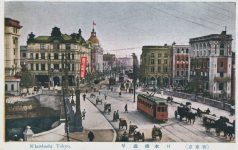 march, and a resurgence of the Japanese socialist, communist, and anarchist movements. The Japanese system itself was changing, and she was excited by the promises of leftist movements, buoyed by the 1917 victory of the Bolsheviks in Russia.
Fumiko worked for a time as a waitress at a hot-pot restaurant called the “Socialist Oden”, where she met some of the socialist and communist movements’ leaders. However, she never joined in any of the radical leftist or feminist groups of the time. The covertly organized Communist Party was crushed by the government and its leaders arrested in 1922. And Fumiko eventually concluded that nearly all of the various movements’ leaders were disingenuous, uncaring, and self-absorbed “…a species of human beings set apart.”
What would eventually most move Fumiko was a short poem in a corner of the last page of a galley proof for a monthly socialist pamphlet. In her memoir, she wrote, “Oh, what a powerful poem it was! Every single phrase gripped me. By the time I finished I was practically in raptures. My heart leapt in my breast, and I felt as though my very existence had been elevated to new heights.” Fumiko became instantly obsessed with the thoughts of the writer, a young, poor and wandering Korean nationalist named Pak Yeol.
Fumiko approached Pak Yeol, expressing her wishes to commit herself to both him, and to his cause. But Yeol was a distant, unsettled, and non-committal person. Still, Fumiko persisted, and she and Yeol together eventually formed a group they called “Futeisha” (“society of malcontents”), of which they were perhaps the only members. And then the Great Kanto earthquake struck Tokyo in 1923, demolishing the city and killing over 100,000 people.

In the chaos, anti-Korean hysteria gripped Tokyo, and rumors circulated that Korean terrorists were planting bombs and poisoning water supplies. Innocent Koreans were massacred by vigilante groups, Japanese citizens, soldiers and police. None of the rumors were true. But by the end of the violence, over six thousand Koreans, as well as 700 Ryukuan-Chinese, 700 ethnic Chinese, and hundreds of Japanese who spoke rural dialects, most of whom were mistaken as Koreans, had been either murdered or summarily executed by authorities.
Many Korean sympathizers and political dissidents, such as the socialist, Hirasawa Keishichi (平澤計七), anarchists, Sakae Ōsugi and Noe Itō, and the Chinese communalist leader, Ō Kiten (王希天), were abducted and murdered by local police and the Imperial Army. Pak Yeol was among 12,000 ethnic Koreans arrested by Tokyo police, ostensibly for their own safety. Fumiko was arrested two days later. The Japanese government was using the earthquake as an opportunity to tug out some weeds; and eventually, Yeol and Fumiko were charged with vagrancy, violation of an explosives-control law, and high treason. Police contended that that the Society of Malcontents was planning to throw bombs at the imperial family, and the government claimed that Pak Yeol had tried to smuggle explosives into Japan.
Whether or not the charges were true, Yeol and Fumiko were the ones who sealed their own fates. Despite there being no real evidence, they both confessed to the plot. Perhaps they did so as an act of defiance, and Fumiko later admitted that they had exaggerated their guilt. But in response to an official interrogation, Fumiko wrote:
“…if there is an absolute, universal law on earth, it is the reality that the strong eat the weak. This, I believe, is the law and truth of the universe. Now that I have seen the truth about the struggle for survival and the fact that the strong win and the weak lose, I cannot join the ranks of the idealists who adopt an optimistic mode of thinking which dreams of the construction of a society that is without authority and control. …So I decided to deny the rights of all authority, rebel against them, and stake not only my own life, but that of all humanity in this endeavor.“
And in the courtroom, Fumiko declared that, “We have in our midst someone who is supposed to be a living god…yet his children are crying because of hunger,… So we thought of throwing a bomb at him to show that he too will die like any other human being.”
During their trial, Fumiko also wrote a detailed memoir as a court document and intended explanation of the source of her motivations, if indeed her identity. Pak and Fumiko then officially registered their marriage in the court, two days prior to being handed death sentences. An imperial pardon commuted the sentences to life imprisonment, but Fumiko destroyed her pardon document and refused to thank the emperor.
Kaneko Fumiko was found dead in her cell four months later, on March 25th, 1926, at the age of 23-years. A guard said that at 6:30 A.M., he saw her at her prison work of twisting a hemp rope. When he walked past her cell ten minutes later, she was hanging from it.
Post Script:
 This remains the only reliably sourced photo of Kaneko Fumiko [Surname Given-name] (金子文子), her face partially hidden by a book while sitting with Pak Yeol. The photo was taken while the pair were in prison by Preliminary Court Judge, Tatematsu Kaisei, who apparently treated the couple with a degree of respect, likely to encourage their cooperation.
The photo was revealed by press in a criticism of Judge Tatematsu’s handling of the case. No other authoritative photos of her appear to exist, and those in such as English-language Wikipedia pages are now known to be of another individual.
A second photo appears to show Kaneko Fumiko, possibly during the registration of her wedding to Pak Yeol, as her headwear resembles a Shinto wedding “tsunokakushi” (角隠し). It appears on the cover of the English version of her memoir; however, I haven’t found any information regarding its source. 
During the trial, the judge also asked Kaneko Fumiko to write out an explanation of her actions, as according to Japanese law a defendant should be asked to present, “…anything which may stand in one’s favor.” She responded by writing a remarkable memoir of her life that explained in painful detail how the society in which she matured to adulthood had turned her into the committed nihilist/anarchist who sat in the courtroom. Her memoir was originally titled, “何が私をこうさせたか。 (“Nani ga watakushi o kō saseta ka.”), translated to English: “What made me do this?”
The last words to the preface of her memoir read, “My greatest wish, though, is that this be read by parents, and not only parents, but by educators, politicians, and socially aware persons as well. I would like all people who wish to better this world to read this.“ Fumiko’s heartbreaking wish had been to leave her memoir to her friends, hoping that they might publish it, if not at least better understand her. But the judge never returned the document, and her prison records stayed sealed until after World War II.
The exact circumstances of Kaneko Fumiko’s death were never entirely clear. Depending upon the source, her mother was either not interested in retrieving her body, or never allowed to see it, and Fumiko’s remains were summarily buried in a communal prison cemetery. A group of Korean anarchists located and removed her body a week later, and the Japanese lawyer and social activist, Fuse Tatsuji (布施辰治), who had defended the couple in court, led an attempt to determine Fumiko’s cause of death.
After the investigation, Fumiko’s remains were cremated, but the ashes were seized by the Tokyo Metropolitan Police. Pak Yol’s older brother traveled from Korea to retrieve her ashes, but the Tokyo police refused to hand them over and instead sent them to the Korean police. Returning to Korea, Pak Yol’s brother was eventually able to retrieve them, but only after committing to their burial in an unmarked location in a family cemetery in the mountains of his hometown of Mungyeong.
In 1973, a Korean anarchist used official records to locate the site, which had become overgrown, and eventually a two-meter monument was erected to mark the location. Then, in March of 1976, exactly fifty years after her death, the “Monument of Kaneko Fumiko”  (photo) was erected on land belonging to the Kaneko family in Somaguchi, Makioka-cho, Higashiyamanashi-gun, Yamanashi Prefecture in Japan. Finally, in November of 2003, Kaneko Fumiko’s ashes were moved from their original burial site and officially re-interred behind Pak Yeol’s birthplace in Maseong-myeon, Korea.
After 22-years in prison, Pak Yeol was released in 1945. He returned to Korea in 1949, and in 1950 was either captured by the North Korean army, or defected. He died in North Korea at the age of 71 on January 17, 1974.
In 1991, Kaneko Fumiko’s memoir was translated into English as, “The prison memoirs of a Japanese woman,” author Kaneko Fumiko; translator Jean Inglis. A translation of: “Nani ga watakushi o kō saseta ka.”
“…what people fear in death is the loneliness of having to leave this world forever. Though people may not be consciously aware of all the phenomena around them under normal circumstances, the thought that that which makes them themselves will be lost forever is a terribly lonely thing.“
-Kaneko Fumiko


 Being young and immortal, however, there was an infinite potential for becoming a more understanding partner. So to the chagrin of the local lifeguards, the risks were to me merely opportunities. But that was a long time ago.


 fluorescent middle finger screaming, “Screw it all!” Or maybe they were just a last desperate grasp at freedom from the regulations of a politically correct, everyone gets a trophy, don’t let your kids get dirty, keep everybody safe, nanny society?


 Luminous Aether
You must be logged in to post a comment.