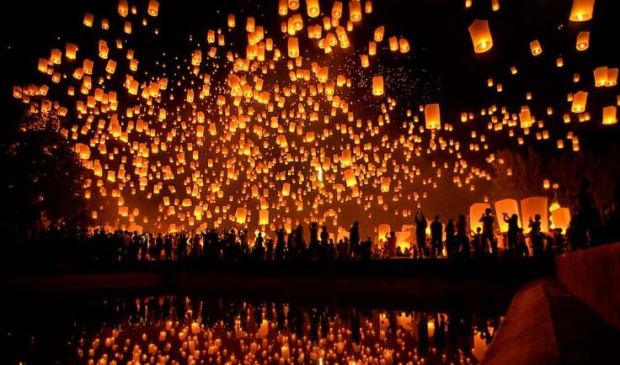
The Way Home

I wrote this initially about two decades back, ironically during an apparently rather tedious, science-related conference. I first posted it at another, now defunct website.  I re-posted it again at WP in September of 2015, just before some travels to the general area where I witnessed this event.
I was eleven-years old, and it left a deep impression on my still young mind.


“不知周之夢為蝴蝶與,蝴蝶之夢為周與。”
Did a man dream he was a butterfly,
or is a butterfly dreaming it is a man?

Zhuāngzǐ (c.369 BC – c.286 BC).

Science has been at the center of nearly all of my adult life. Ironically, however, I find some reassurance in that science doesn’t have answers to every question. To be honest with myself, I don’t want to know everything.

Bewilderment can be a marvelous sensation, hinting at possibilities that some wondrous magic perhaps awaits just behind the curtain. The joy in watching a good magician is in the mystery. And life itself is filled with mysteries — experiences that liberate stories far more wonderful than anything possibly rendered into mere description.

Finding myself alone one autumn afternoon in the years before being endowed with the all-knowing condition of teenager-hood, my eyes fell upon one of those magnificent, but mysteriously unexplainable phenomena. Rounding a corner along a trail through the hills near my childhood home, the very landscape suddenly transformed into a rolling, whirling, orange and yellow cloud of pulsating wings.

A tremendous gathering of monarch butterflies had settled into a ravine of wild oaks and milkweed near the edge of the Forest of Nisene Marks, draping everything in a living fabric of what entomologists refer to as the “imago stage of lepidoptera” — or “butterflies” for the rest of us.

In one of life’s great mysteries, scientists have no idea how, or even why tens-of-millions of monarch butterflies travel thousands of miles across the North American continent, ultimately to converge on just a few locations. Moreover, a single migration is accomplished through generations. Each delicate butterfly’s life enduring only a fleeting few weeks, it will be the offspring of many generations on who complete the cyclic annual journeys started by distant ancestors.

Of course, scientists know some things. Experiments show that southward migrations can be triggered by cold weather. But this only tells us that the butterflies don’t like to get too cold, and that’s not really very surprising.

Some also think that monarchs orient themselves to the sun during their travels. But they don’t know how the insects compensate for the sun’s different positions over a day, or at different latitudes. And even more mysterious is how a butterfly, so many generations removed from any who previously congregated at some special location deep in a Mexican forest, can ultimately return to that exact spot.

Scientists are also just as mystified by how monarchs form “roosts” along their migratory routes, such as the one I happened upon in the local hills near my childhood home. These delicate insects don’t travel in flocks, like birds. Rather, they migrate alone.

Yet, these sudden gatherings of sometimes vast numbers of butterflies will form spontaneously over a few hours, with members converging from every direction onto a single location. It’s as if countless flyspeck minds suddenly resolved that this particular place should be called “home.”

And just as suddenly, they’re gone.

Maybe there was a message for that solitary witness. After all, what is “home”, and what is it that draws us to gather in such places? And why is it that just when we might think we’ve discovered such a place, it just as suddenly disappears?

The world around us changes. The young and the old alike, move on. New generations take their places. We awaken to a changed landscape, perhaps even one in which we no longer find refuge. Maybe home isn’t a place after all?

And so we migrate. And if not in our bodies, then in our hearts. We go on to what comes next and gather anew. We gather with our friends and fellow travelers, our families, lovers and companions, or perhaps just our faith in something greater. That, or we die alone.

And how we know when it’s time to travel is not by the temperature of the air, or by the positions of the sun or the stars, or by changes in some physical field. Instead, we look inward, toward something else entirely, to something unquantifiable. We turn to a counsel for which there is no science.

Standing within a swirling sea of pulsating wings, some brushed my face while others took momentary refuge upon outstretched arms. I stood in place until my muscles ached, until I knew that I’d be missed among my own. But the warm memory of the experience remained, like the magical iridescence of orange dust that was left on my skin afterward.

Returning to that same spot the next day, but for a few lifeless husks they were gone. Now even the hills where nature once performed that blissfully mysterious act of magic for an awestruck child have been tamed by other humans in search of homes for themselves. And I too have moved on. But every journey has a destination, even if we don’t know what it is.


Sunlight and Ground

Some time on February 5th of 1999, Mutsumi Fukuhara stepped from the balcony of her Osaka apartment. Sunlight and ground became one.

Someday I’ll melt into the ground,
And be fertilizer for the earth,
So better than too fast the stream of time,
Is too slow the universe turning.
Still I battle with questions of love.

This is my life.
Only one life in this Role Playing Game.”
S.J.M.
R.P.G.

Getting myself grounded in an only marginally familiar culture after moving to Japan in mid 2002 was a difficult process. Viewed from the outside, Japan is a peaceful country… clean, safe, orderly…
Too orderly.

The peace of Japanese culture conveys the spirit of “wa” (), a concept usually interpreted in English as “harmony”. But wa isn’t really something that can be properly translated in a single word.

Wa describes a kind of communal harmony based in valuing social conformity over individual concerns; and it’s a central concept in Japanese society. Many both formal and informal Japanese social structures exist primarily as means through which to ensure this harmony. To disregard their expectations is to be as the proverbial “nail that sticks out”, and the recipient of a sort of passive-aggressive hammering down.

Individually, this results in what are known as “honne” and “tatemae”. Honne (本音, “true sound”) refers to one’s inner feelings, desires, or opinions. Tatamae (建前, “facade”), however, refers to one’s expected pattern of public expression through which wa is maintained.

Understanding this is important to understanding social interaction in a culture where people rarely say what they mean. Personal expression and negative reactions aren’t prevented; but they don’t encourage future connection. The Western saying goes that, “If you don’t have anything nice to say, don’t say anything at all.” But in Japan, even silence leaves a chill.

Like the passions of honne hidden beneath a veneer of tatemae, the Japan I experienced in the early 2000s concealed a surprisingly expressive wilderness beneath that external facade of conformity, neatness and order. At the time, cities like Tokyo and Osaka hosted entire networks of discrete, underground music establishments known as “live houses”.

Often little more than transitory basement dives, they’d be ignored by police so long as the local yakuza assured that nothing unseemly made it onto the streets. But especially in places where art-communities or vice tended to congregate, some were more established.

You can dance your dance. you can talk hard loud.
you can live your own life with your POPO…
you can walk your way. you can scream in this way.
I can live my own life!

S.J.M.POPO Bar

East Asian kids learn early on to be self-reliant. This is rooted in a Confucian ethic that one shouldn’t be a “problem” for parents, family or others. The Japanese term, “meiwaku” (迷惑) means to be troublesome, or a nuisance or annoyance. And it’s a kind of criticism most Japanese children learn to avoid. Meiwaku is more than just an expression of annoyance at another’s behavior; it’s a disruption to the communal harmony of wa.

Adults unfamiliar with meiwaku often perceive East Asian children brought up with this internalized principle as easy. But a lot of these kids are simply struggling with not getting the care or attention they need. And for those who are called out as troublesome, it can become a sort of hammering down that deeply affects self-worth.

Just like weapons (Yes) WORDS kill me
Just like weapons (Yes) WORDS kill people I love…

At some point … we must forget the WORDS
To the broken body, gentle lights
To the open pupil, Sweet liquid
To the blocked up ears, bird-like sounds
To the closed mouth, Song from stones.”

S.J.M.The WORDS

Stumbling into this music scene, I never really thought much about it having emerged from something cultural that had preceded my own time in the country. Japan was the “Asian Tiger” of the 1980s. In a mere two generations, the country had accomplished an economic “miracle”, taking itself from the ashes of WWII to a nation seemingly poised to simply purchase the world. But near the end of 1989, that all changed.

The fevered inertia of economic enthusiasm collapsed as “zombie companies” kept alive by endless injections of investment capital from over-leveraged banks eventually resulted in a stock-market crash. Then, equity and property values collapsed. Early 90s Japan marked the start of more than two decades of near total economic stagnation. But more importantly, it also represented a broken promise in the Japanese social contract.

Many lifetime jobs, once the hallmark of Japanese corporate employment, were replaced by temporary workers. Wages stagnated. And real household earnings fell as the purchasing power of a weakened Yen resulted in inflation. A generation of youth approaching adulthood were greeted by uncertain futures as families struggled. And Japan’s young population became caught up in an atmosphere of anxiety and frustration.

The era bathed in light disappears,
And new seeds are born,
Spreading branches envelop my body,
Colors flow and fill the gaps,
The empty time becomes a crimson sea,
The empty time becomes a crimson forest,
The empty time becomes a crimson sky,
The empty time becomes crimson waves,
The forging of memories… of sharp memories.

S.J.M.Forged Memories (from Japanese)

Against this backdrop, the almost mythically notorious all-female Japanese band, Super Junky Monkey, would emerge in 1991. Known for raucous performances that frequently hosted masses of stage-diving youth, their music defied any particular niche… aside from that of being “anti-mainstream”. Too experimental and unrestrained for popular domestic consumption, they remained mostly live-house performers in Japan.

Overseas, however, a 1993 live album the band had produced was getting noticed. And in 1994, they were picked up by Sony Records. Taking cues from genres like funk, metal, hardcore punk, grunge, stoner rock, and avante-garde, the band continued to skillfully navigate a wide range of sounds that utterly defied categorization.

A big part of Super Junky Monkey’s success was that all four members of the band, percussionist “Matsudaaaahh!!“, bassist Shinobu Kawai, guitarist Keiko, and vocalist Mutsumi Fukuhara, were all talented musicians. But it was frontwoman Mutsumi’s brashly charismatic performances and vocals that really gave the band its unique character, especially in  live performances.

If we were deaf and blind, could we still kill each other?
If we were able to fly, then would borders still fence us in?
If the human beings could love, would we live as equals?
If we were happy innocent and… dumb as dorks,
Would there still be wars?
Would we still want more?
Would there be users controllers and hierarchy?
Can you give me the answers?

S.J.M.IF

By all accounts, Super Junky Monkey was a successful band, producing four LPs, two EPs, and a number of videos, while developing significant followings both in Japan and abroad. They traveled extensively, performing in some larger venues in the UK, the US, and Canada, while receiving both foreign and domestic awards for their work. And in Japan, they blazed the trail for other all-female bands that also broke the usual Japanese “cuteness” mold for women as performers.

After a brief hiatus, Super Junky Monkey began performing live sets in the latter part of 1998 that pointed toward a new direction. The music was just as difficult to pigeonhole, but more contemplative and mature.

Moving away from the gritty sounds and Hip-Hop narratives that once invited stage-diving youth, Mutsumi’s voice instead began to echo into a distance that slowly disappeared into a kind of musical chaos. Her feverish leaps and long flailing ponytail were replaced by hands that slowly reached toward a calling sky. There was clearly some new inspiration to the compositions, perhaps reflecting her having had a child. 

I never saw Super Junky Monkey perform; I was hunkered down in the conformity required of my own life in the US during the band’s peak. And by the time I found myself in Japan, Mutsumi was gone, and the rest of the band had moved on. But I wish I had seen them. It would have added a great deal of context to what I witnessed in the Japanese music scene of the early 2000s.

Sometimes, success isn’t really what it’s all about. A lot of these musicians were simply pouring out their souls…
Sometimes, until there was nothing left.

Storm is gone
Earthquake is gone
Time is gone
Sunlight dazzled my eyes
Sunlight surround me
Sunlight and ground became
Congenial to each other

S.J.M.Towering Man

Same Same, but Different

I look up at the sky, wondering if I’ll catch a glimpse of kindness there, but I don’t. All I see are indifferent summer clouds drifting over the Pacific. And they have nothing to say to me. …all I see is my own nature… I’ve carried this character around like an old suitcase, down a long, dusty path. I’m not carrying it because I like it. The contents are too heavy, and it looks crummy, fraying in spots. I’ve carried it with me because there was nothing else I was supposed to carry.
– Haruki Murakami
(translated by: Philip Gabriel), What I Talk About When I Talk About Running (2007).

The Akira Kurosawa film, Rashomon, is a Japanese period-drama set in late Heian-era (1185) Kyoto. The story follows the accounts of four witnesses to the mysterious death of a traveling samurai. As each witness tells seemingly contradictory versions of events, questions arise about the meaning of evidence, subjective versus objective experience, and biases in perceptions.

As in the parable of the blind men and the elephant, each of the story’s characters is confined to discerning an overall meaning from his or her own limited perspective. But conceptualizing the whole by interacting with only a part ends up leaving no one with an entirely accurate representation. Though each knows an objective truth with the certainty of personal experience, none can agree to an overall interpretation.

Rashomon is about how personal circumstance affects an individual’s experiences, value judgments, and understandings. Even the most sincere attempts at discerning an objective reality become a subjective process whenever humans are involved. “Rashomon effect”, is commonly used in reference to the unreliability of eyewitnesses in courtrooms.

The takeaway is that a belief in absolute truth based in the limits of human experience leaves an individual ignorant of others’ experiences, which may be equally true. But the limitations of personal perspective also speaks to the cognitive tools we use to interact with the world. “When your only tool is a hammer, every problem becomes a nail.

For several years during my undergraduate college days, I played mostly percussion in a down-tuned, Japanese-American “power-trio”. We called ourselves “Byōki”, meaning “Sickness”… three Asian-American women responding to the nauseous corporate saccharin of 80’s Americana.

Our sound was hosted in garages or at the college bar, and at a couple of Japanese-American cultural events where I’m not so sure how welcome we were after sponsors actually heard our music. We were slow, loud, dark, and scrappy.

Listening to an old recording, I could barely hold a note; but it didn’t really matter. Hammering out lyrics like nails, the words to a piece inspired by the experience of a friend betrayed in a moment of weakness started, “I know God is dead. I will bury him.

Still, I have long-time friends who talk to Angels, to the Universe, and even to God personally. I’m not sure whether I should envy, or pity them. Most seem pretty happy; and I don’t have any better ideas for making life work. Regardless, God has never taken much interest in speaking with me.

If I’m honest with myself, and I try to be, my perspective would probably keep me from hearing anything anyway. Pathologically unable to take Kierkegaard’s “leap” into faith, it is simply my own voice in the silence, saying what I want to hear. And if those who try to communicate the depths of their faiths to such as myself could understand, I don’t know whether they would feel pity or despair.

Living in northern Thailand for a couple of years at least put a lot of my first-world problems into a better perspective. And there was a kindness, an understanding allowing the forgiveness that I’m not omniscient. We can’t know the depths of others’ experiences; and we can’t look back. And especially when the people we love die suddenly and unexpectedly.

It’s a circumstance of enduring. And it becomes numbing after awhile, brushed off like snow at the door, left outside. A photo from decades ago, young friends, healthy, ambitious… It reminds me of a scene at the end of some old war film where the recollected dead outnumber the living, each representing some different lost promise.

Friends, family, mentors and heroes leave in ways that hit closer to home. Unexpected, discouraging… not lost to adventure, life’s risks, or simply poor judgment… but at home. For some, it was time. But for others, there was no goodbye, no word. Just a phone call… they’re gone.

A mentor and a friend, cursed with integrity and a kind heart, a beautiful mind and generous soul. Giving, simply that he could. But never taking enough. One of those rare people found on the path taken because of wanting to be more like them. To dare to be invested in life. Not a God-like man to proclaim how he lived. Just a humble man who claimed no special status with God at all. In the words of Krishnamurti,
Love is not aware of itself as love, for the word is not the thing.

Seeing the self-serving limits to each witness’s story, the Buddhist priest in Rashomon finds that he has lost his faith in humanity. There is no honor among any… thieves, opportunists, the unfaithful, the samurai’s self-inflicted death. But in a humble woodcutter’s appeal to spare the life of a child, the priest finds at least some promise.


One Tea


.蝶と共に吾も七野を巡る哉
[Chō to tomoni ware mo nana no o meguru kana]
A butterfly my companion,
through seven fields
we wander.
Kobayashi Issa, (1795).


Among the four great Japanese “haiku masters”, Bashō, would come to be known as the most observant. But Issa is remembered as the most humane. Third among the revered poets of the tradition, alongside Matsuo Bashō (1644-1694), Yosa Buson (1716-1784), and the later, Masaoka Shiki (1867-1902), Kobayashi Issa (小林一茶), was born Kobayashi Nobuyuki, on June 15, 1763.

Issa, however, would likely have refused the title of a haiku master, or “haisei” (“俳聖”, literally, “haiku saint”), which had come to describe both Bashō and Buson. Unlike his predecessors, and despite a sincere devotion to “Jōdo Shinshū” (Pure Land) Buddhism, Issa never strove for Buddhist salvation through his meditations. Rather, he believed that a merciful Buddha would bring redemption to one’s spirit, despite our human imperfections, merely by living with peace and compassion.
.花桶に蝶も聞かよ一大事
hana oke ni chô mo kiku ka yo ichi daiji
on the flower pot

does the butterfly, too
hear Buddha’s promise?
– Issa
(year unknown)

During his lifetime, Issa wrote various types of poetry in the “haiku”, “tanka”, and “haibun” forms, and also painted “haiga” (haiku paintings). As a well-known teacher of haiku in the Shinano region of Japan, Issa took on the “haigo”, or haiku penname that would become associated with his work. “Issa” (一茶),  meaning, “One Tea”. His poems tended to express his humanity, addressing both the joys and the sufferings he felt in his life.

Issa was a prolific poet. Upon his death, he left journals containing more than 22,000 haiku. They express a caring perspective toward others, even for animals.  He also voiced his joy in seeing the perspectives of children, their hopes for the future, and their places in his own life.  And he was known for an irreverent humor, sometimes poking fun at both authority figures, as well as the rigidly stratified Japanese society of his time.
.松茸にかぶれ給ひし和尚哉
matsutake ni kabure tamaishi oshô kana
a matsutake mushroom

on his head…
high priest
– Issa
(year unknown)

Much of Issa’s perspective of life might be traced all the way back to the death of his mother when Issa was just two-years old (by Western standards). While well cared for by his grandmother over the subsequent five years, he was returned to his father’s household when his father remarried. Then, his half-brother was born two years later, leaving Issa feeling estranged within his own family.

After his grandmother died when Issa was thirteen, he fell into a lonely despair. Within a year, his father sent him away to the city of Edo to find his own way in life.  Eleven years later, at the age of twenty-five, Issa became a student of the Chikua’s Nirokuan (二六庵) school of haiku. When Chikua would die just three years later, Issa briefly took on the role of the school’s master, along with the name,
一茶”, or “Issa”.

Inspired by the itinerant life of his famed predecessor, Bashō, he left the shelter of the school just a year later. Referring to his wanderings with the phrase “beggar’s world”, Issa was alluding to a life of poverty, supported only by the good will of those whom he would meet along the way.  And yet during this time, his words often conveyed the discovery of great wealth in the beauty that surrounded him.
.雉鳴て梅に乞食の世也けり
kiji naite   ume ni kojiki no yo   nari keri
pheasant singing—
it’s a plum blossom-filled
beggar’s world now!
– Issa
(1791)

Decades later, at around the age of fifty, Issa would return to his childhood home in the town of Kashiwabara in the mountainous Shinano province.  But his stepmother and half-brother refused him access to the family home, and he found himself unwelcome in the town.  Eventually, however, he was able to legally establish the inheritance of a partial ownership to his father’s property.

After a partition wall was constructed to split the house with his step-family, Issa was finally able to return to his childhood home. And a 52-year old Issa moved in to his half of the old house, along with his 28-year old bride, Kiku. Their son, Sentarō, was then born in the spring of 1816.  Issa, however, recorded that Sentarō died just 27 days later. And then again in the spring of 1818, Kiku gave birth to a daughter, Sato. But the following year, Sato contracted smallpox and also died.
.花の世は石の仏も親子哉
hana no yo wa ishi no hotoke mo oyako kana
world of blossoms–

even the stone Buddhas
parents and children
– Issa (year unknown)

Issa wrote a deeply heartfelt account of Sato’s death. “Her mother holding tightly to her body, burst into tears. At that moment, though I tried to resign myself to the knowledge that water flows past not a second time, or that blossoms, once fallen, never return to the trees.… I couldn’t break the chain of love.”

In the autumn of 1820, Kiiku again gave birth to a boy, Ishitarō. But shortly after the New Year of 1821, a despairing Kiku would find that Ishitarō had suffocated while bundled on her back. Issa mourned terribly, lamenting that he would have no celebrating descendants to greet his own spirit when it visited the earth during the Bon festival.
.あきらめて子のない鹿は鳴ぬなり
akiramete ko no nai shika wa nakinu nari
resigned
to being childless
the silent deer
– Issa
(1821)

Then, in the spring of 1822, Kiku gave birth to a third boy, Konzaburō. But in the spring of the following year, Kiku fell ill and died. And without his mother, Konzaburō died seven months later.  Issa wrote of the depths of his loneliness during that time, comparing it to the moon in the night sky, and how he wished for even the nagging of his absent wife.

This perhaps explains why Issa remarried about a year later, in 1824… briefly. The wedding to his new wife, who was named “Yuki”, was in the Fifth Month.  The divorce was in the Eighth.  The 38-year old daughter of a local samurai, her name meant, “Snow”, which seemed fitting.  She was a cold partner to the simple, old poet, and soon abandoned Issa to return to her parents’ home. Issa didn’t seem to mind.
.鬼虫も妻を乞ふやら夜の声
oni mushi mo tsuma wo kou yara yoru no koe
even the devil bug

calls for a wife…
night voices.
– Issa
(1821)

Issa married again in 1826, at around the age of 63-years. His third wife was a 32-year old village woman named Yao. And soon, she became pregnant. But during the pregnancy, Issa’s divided house burned to the ground during a fire that swept through the town.   For shelter, the couple had to live in a cold, grain-storage barn on the property.

It was as if Issa’s life was to demonstrate the Buddhist principle that all things are temporary.  All that we yearn for, that we love, that we strive to create, everything to which we become attached eventually dissolves into oblivion. Yao would give birth to a daughter, Yata, the only one of Issa’s children to survive to adulthood.  But Issa would never meet her. 

This time, Issa would die from a stroke in January of 1828 while sheltering in the barn, five-months before her birth.

Issa’s writings spoke to both the beauty and the fragility of life, and to the elusiveness of joy. But there was never a bitterness in his voice, even in those moments where he might have placed blame onto others. Issa instead presented himself merely as a human, flawed and wanting, but grateful and aware, growing older while trusting in the “Namu Amida Butsu”.

.さすが花ちるにみれんはなかりけり
sasuga hana chiru ni miren wa nakari keri
when cherry blossoms

scatter…
no regrets
– Issa
(unknown year)


Standing Up Work

Loneliness and the feeling of being unwanted is the most terrible poverty.
– Mother Theresa

While living in Tokyo in the early 2000s, I discovered the social escape offered by its extensive “live-house” music culture, hosted in places where lesser-known bands can perform.  These are usually small, sometimes marginal establishments, often located in seedier areas like Tokyo’s Kabukichō. But this isn’t the kind of popular music followed by most Japanese.

Visit Japan, and you’ll likely see many advertisements promoting various “idol groups’”, as well as their latest recordings, performances, or products. Especially in the cities, it’s nearly impossible to escape idol culture.

The Japanese expression “aidoru” is written in phonetic-Japanese katakana, identifying it as a foreign loan word. Originally borrowed from the English “idol”, it has become a common reference to certain well-known and popular music performers.

Japanese idol culture first expanded as a mainstream phenomenon during the 1970s, sparked by television variety shows that hosted singing competitions.  Many of their most popular vocalists were recruited by large music production firms with the financial leverage to heavily promote new artists.  During this time, “aidoru almost exclusively referred to female performers.  But since the 1980s, it has expanded to also include males.

There isn’t really any Western comparison to Japanese idol culture. Some American musicians, like “En Vogue” or “The Backstreet Boys”, parallel the formulaic, mass-market approach to music and image. But the Japanese version takes it to an extreme through the carefully crafted and promoted public personas of individual group members.

According to Miki Gonohe, who provides professional “talk lessons” to idols, there are at present more than 3,000 female idol groups in Japan, with about 30,000 performers. In 2017, the BBC reported that more than 10,000 of these girls were in their teens.

AKB48”, a Japanese female idol group named after their theater in the Akihabara area of Tokyo, perform daily as “idols you can meet“. Considered among the top performing idol groups in Japan, they have sold more than one-million copies of new releases in a single day, making them the most popular female music performers in Japanese history.

Female idol fans range from pre-pubescent girls to single men in their forties, often referred to as “otaku”.  The expression describes a person with an obsession regarding some aspect of popular culture. In extreme cases, idol obsessions have resulted in abandoned careers or spending the last of one’s money supporting an idolized performer.

In a country where loneliness is literally a social epidemic, Japanese idol culture provides a fantasy version of a life still naive to the realities of adulthood. Where an American male escapist experience might equate to venting at heavy metal concerts where bands shout lyrics about about death and Satan, the Japanese equivalent is choreographed dance to songs about chocolate and pure-hearted maidens. And like a crowd of screaming girls at a Justin Bieber concert, the Japanese experience isn’t confined solely to men.

While the Kabukichō area of Tokyo is one of the places where I was first introduced to Japanese live-house music, the area is also known as Tokyo’s red-light district. Traditionally, the prostitution was conducted in a fairly nonpublic manner. Touts at the entrances to presumably yakuza-run men’s clubs might make veiled suggestions that there were extra “services” available; and you wouldn’t have seen the usually foreign or older women in public.

After 2011, however, the Japanese government enforced new laws that made it difficult for yakuza to operate in Kabukichō. And since then, the area has cleaned up greatly. So it was surprising to come across a long line of “standing up girls” in the area near Ōkubo Park.

About thirty, typically dressed, mainly younger girls were standing separately along the edges of the sidewalks near the park, mostly staring into their phones. Apparently, it’s common knowledge that the girls, many of whom appeared to be quite young or even underage (under 18-years in Tokyo), are engaged in prostitution. And the local police haven’t quite figured out how to deal with it.

One of Japanese culture’s lesser discussed secrets is the commonality of abusive home lives. Many who eventually flee such homes end up in the seedier parts of Tokyo, where they quickly find that things aren’t all that much better.

For the younger, more attractive women who are at least 20-years old, work at bars and nightclubs might be the best jobs available. But for those too young or too old, finding a boyfriend might seem like the only option. And it’s surprisingly easy in Kabukichō.

It seems there’s a ready supply of good-looking, respectful gentlemen willing to meet up with these younger girls and older women, take them out for nice meals, listen to their stories, and treat them as though they are valued. And for many of these women, it’s the first time in their lives they’ve felt like they were important to someone else. But Kabukichō is also home to more than one-hundred women’s “host clubs”, staffed by male escorts.

The men will eventually let on that they work at one of these clubs, where they have to compete for popularity with the clientele. And the women will be encouraged to help them out by visiting the clubs and leaving some small amount of cash to help boost their popularity. But gradually, the amounts increase, eventually to the point where many of those engaged in “standing up work” in Kabukichō are trying to earn money to pay-off loans used to support their male-escort idols.

On September 5 of this year, Kabukichō police arrested thirty-five women in front of Ōkubo Park on suspicion of prostitution. Most of those arrested explained that they were trying to obtain money for boosting the reputations of their favorite male hosts. To the credit of authorities, these women were referred to support groups, and at least one host-club escort was arrested for soliciting prostitution.

Paraphrasing Goethe, we see in the world what we carry in our hearts.  So if a fantasy is all that stands between feeling loved versus withering in loneliness, then it shouldn’t be much of a surprise when we see what we need to see in order to feel what we need to feel.  But fantasy is also at the heart of most business.

Ashes

Hand in Hand
Boris (Translated from Japanese)

Together we travel, walking at a pace.
I hear the whistle blowing in the distance,
You say there’s an elm tree.

Good night…
We see the birds fly away, to their nest in the forest.
Together we go home. You’ll never be alone.

To home, to home… We hurry our way home.
Your shadow hurries me on, as if it were the only hope.
[To return home.]

Traditional Japanese funeral customs might appear somewhat strange to Westerners.  But they combine native Shinto and adopted Buddhist traditions in a manner that has deep cultural meaning. 

Shinto is an ancient, native Japanese religion based in practices intended to find harmony with the natural forces of the world around us.  Buddhism, which first entered the Japanese archipelago from China around the 6th-century AD, adds an aspect of transition between lives.  And in Japanese culture, the two traditions have become intertwined in ways that include funeral practices.

Bodies are customarily cremated in Japanese culture, and the recently deceased aren’t traditionally preserved or embalmed.  They are also treated as though the spirit remains close for some period of time.

After being bathed and clothed, ice is packed around a body, which will spend one final night at or near the person’s home. If dressed traditionally, kimono are wrapped in reverse, or right-over-left.  A white cloth may also cover the face; however, my family’s traditions leave one’s face visible.

Family members including children, as well as friends and neighbors will visit to offer condolences.  Envelopes containing money and tied with black and white string called “busyugibukuro” (不祝儀袋, “non-celebratory ceremony bag”) may be offered to help with funeral expenses.  Usual amounts range from ¥3,000 to ¥30,000 (about US $30 to $300) depending upon the relationship with the deceased, and avoiding Yen amounts with the number “4” (pronounced “shi”, it sounds like the word for “death”). 

During this time, visitors may sit with and speak to the deceased as though they were still alive, and a wake, or “otsuya” (お通夜, “through the night”), takes place. Wake practices may be more or less formalized, might include formal offerings of incense and individual recitations of sutras (Buddhist prayers), and a priest may be present for varying amounts of time.

In my family, wakes include a lively dinner gathering in the nearby company of the person who has died. These include a great deal of food, and much drinking and good spirits.  Attendees will periodically leave small offerings of food or drinks adjacent to the body.  These go late into the night, with people gradually departing to get some sleep before the next day’s ceremonies.  However, at least one close family member will stay with the body overnight, making certain that incense remain lit.

Occasionally, people may stop in during the night to speak privately with the deceased. These are often moments of closure, apologies, peace-making, or expressions of respect or appreciation that may have been overlooked in life.  Traditionally, such visitors may conclude by whispering the name of the Buddha into an ear so that it’s the last thing that is heard.

The next morning, the body is moved to a location where a more solemn service is held. This could be at a Buddhist temple or other location of convenience, and some regional crematorium facilities may also have a space for ceremonies. The body is placed in a coffin which is packed with dry ice, and a portrait is placed within a flower arrangement behind the coffin.

Men wear black. Women may wear a proper formal kimono or a dress in a dark or subdued color.  A priest will conduct funeral rites, which can vary by tradition.  But in general, they are intended to release the person’s spirit to its next life.  Buddhist sutras will be recited, and the deceased may be given a “kaimyō “, a Buddhist name that will not call them back to this realm.

In my family, the coffin is open as there is a tradition of each person who offers a prayer placing flowers or another soft item with the body. This results in a final view of the person entirely surrounded by a sea of flowers, symbolizing a Buddhist imagery of paradise.

After the service, the priest and mourners will accompany the coffin to the crematorium, where the furnace may be operated by a close family member.  This is more often the case with a husband who has lost a wife, or with the adult son of a parent. While waiting for the cremation, attendees may gather with the priest and share food. This tends to be a less formal time in which to have conversations with the priest.

Americans don’t usually see the actual result of a cremation. What’s left after the process are very brittle, bleached skeletal remains.  In Japan, attendees will gather around them.  A crematory staff will briefly explain about the various bones and observe how they indicate a person’s life, signs of work and labors, injuries, disease or health issues.

Each attendee then receives a special pair of large chopstick, one of bamboo and one of willow, which symbolize the passage between life and death. Bones from the feet are first placed into a small container.  Then, pairs of attendees will choose a single bone to move into the container together.

Traditionally, each person in a pair lifts a different part of the same bone without their chopsticks touching one another. (This is why Japanese will never pass food between chopsticks since it replicates a funeral action.) This is done by everyone in attendance, including children who may need some assistance. A bone may be chosen for a blessing according to its meaning – wisdom, intelligence, strength, health, peace…

The second neck vertebra is considered the most significant bone, as it is seen to hold an image of a seated Buddha.  Remaining small bones and fragments are carefully swept up and placed into the container, with the skull placed on top.

The process of transferring bones to the container completes a ceremonial cycle of life to death. Where the body was treated as an attendee during the previous day’s gathering, each participant now experiences that it is physically gone.  And in the process of moving the bones, the various blessings of that person’s life are passed on as spiritual gifts to the living.

The container is returned to the person’s home if possible, or to the home of a close family member, and placed in a special location with a photo and various traditional Buddhist items that can be used in a series of later ceremonies or for prayers.  Usually, it is interred at a family monument or other permanent location after some prescribed period of time, often 49 days.

This really only touches on the traditions and formalities of Japanese funeral rites, which may continue on long after a person’s death, and which can vary greatly.  While most Japanese aren’t “religious” in the Western sense, Shinto traditions acknowledge the influences of our connections to the world around us, including those who are committed to our memories.  And Buddhism acknowledges that life is transitory.  Regardless, the spiritual closure of traditional funerals is becoming increasingly less common in Japan.


About the Japanese references in the song lyrics, which allude to the death of a partner:
-The elm is a symbol of a connection to the spirit world, and of the goddess of the hearth.
-One life moves on, and a relationship passes into another world.  Ashes are what returns home.
The warmth of the hearth calls to the one left behind. There is a final word spoken (not in the lyrics) after the abrupt end to the song, “kaeru,” meaning, “to return home.”

Revisiting the Lower North Swamp

By the grey woods, by the swamp,
Where the toad and newt encamp,
By the dismal tarns and pools,
Where dwell the Gouls.
By each spot the most unholy,
By each nook most melancholy,
There the traveller meets, aghast,
Sheeted memories of the Past.
Shrouded forms that start and sigh,
As they pass the wanderer by.
White-robed forms of friends long given;
In agony, to the Earth – and Heaven.

Edgar Allan Poe, Dream-Land.


Maybe I’m just suffering from cabin fever, but I’ve been doing a lot of binge-watching lately… or at least listening. Sound is one of those things that connects us to our environment. But it’s entirely imaginary. We create it in our heads to represent what are really nothing more than vibrations in the air. So if those vibrations tell us stories, we make them up ourselves.

A lot of what I’ve been watching are old YouTube uploads, including some at “LowerNorthSwamp”. The channel’s name is a literal translation of the kanji for Tokyo’s “Shimokitazawa” (下北沢). Usually referred to by locals by dropping the “swamp” part as, “Shimokita”, it’s known as Tokyo’s Bohemian district.  James, a self-described “you-know-you’ve-been-in-Japan-too-long-when…” American expat used the channel to post videos of various Japanese “live house” performances in the area.

Most of this recent watching/listening was initiated by reading something at “Japan Powered”, a site hosted by Chris Kincaid. Chris is an excellent writer, an author, librarian and researcher, trained graphic artist, and general expert on Japan and Japanese history. I had initially come across his site when researching information for something I was writing about a female poet from Japan’s “Nara” period. But many of Chris’s articles revolve around his interest in Japanese “anime”.

Anime is an animated version of Japanese manga. These are graphic novels descended from a visual story-telling style developed in Japan in the late 19th century, which themselves emerged from a long history of Japanese graphic art dating back centuries. In Japan, works of graphic art have long been used for a wide range of purposes, from the most banal of entertainment to complex technical instruction. And likewise, anime encompasses a wide range of subjects and genres in ways intended for audiences ranging from young children to mature adults.

One of Chris’s recent articles at Japan Powered mentioned a new anime series created by the CloverWorks animation studio called, “Bocchi the Rock!”  The series is about a desperately lonely teenage girl with a severe social anxiety. After seeing a television interview where the guitarist for a popular band mentions his own social anxiety, she decides to teach herself to play the guitar in the hope that it will help her to fit in somewhere.

The anime has become enormously popular with audiences in Japan, as well as among anime enthusiasts the US.  And it’s set largely in the Shimokita area music environment, a setting with which I’m familiar.  So while I’m generally not much of a fan of anime, I decide to see what it was all about.

The series is animated in some ways typical of that intended for Japanese teens to young-adults. Characters are visually somewhat “kawaii”, or cute in a Japanese sense. And depictions include some of the exaggerated expressive forms typical of the type of manga and anime. But that also means that the presentation doesn’t always have to take itself so seriously. It’s visually fun; and the writers and animators applied that to presenting some surprisingly deep characters.

The stories actually address some serious issues, including social isolation, fear of failure and rejection, impostor syndrome, alcoholism, gender identity, and the fears associated with expressing love. And yet, there’s always a safe space for viewers as characters’ emotional turmoils are depicted through interjections of wacky animations or imagined scenes that get the point across with tongue held firmly in cheek. The characters and their flaws are utterly relatable, but without being threatening.

The backdrop to all of this is an impressively accurate parallel universe to Tokyo’s actual underground music scene. “Starry”, the main live-house music venue depicted in the anime is easily recognizable to those familiar with the Shimokita music scene as the real-life, “Shelter”. In fact, the entire setting is such an accurate representation of the area that people have photographically reproduced various scenes. So this isn’t merely a formula production created by a group of isolated script-writers, animators and producers holed up in some distant corporate office.
The music is also surprisingly good. While it doesn’t perhaps reflect some of the edginess of what might actually be encountered in places like Shelter, it somehow manages to stay well clear of corporate J-pop territory. And the lyrics to the songs hold insights into the characters, who are complex in ways that keep them both realistic and interesting.

After watching a few episodes, I could easily understand why the anime has pulled in such a large and engaged audience. Even if it’s not something I’d be likely to follow, it’s fun, it’s relevant to its audience, and it reflects a hopeful and encouraging tone. While acknowledging the frustrations and seemingly insurmountable hardships of youth, it never gives up. It’s a story where the main characters find meaning by investing both in themselves and in their relationships with others, developing the trust that brings friendships.

And so, I’ve been going back to the videos left on YouTube by James and a few others all those years ago. It was a time when the Tokyo live-house scene was a welcome and friendly social escape for myself. The music was usually loud, and sometimes even good.  But it was always fun.  The very first video on my own, “東京ライブハウス” (“Tokyo Live House”), YouTube play list was shot at Shelter.

The girls in the band, TsuShiMaMiRe, were playing a song about the strange colors and smells of a popular, fluorescent orange soft drink and a bright blue laundry detergent.  Just vibrations in the air.  But it was a good feeling not to have to take life so seriously for awhile.

Connections (2023)

We leave some part of ourselves behind when we leave a place; we stay there, even though we depart. And there are things in us that we can find again only by returning.
Pascal Mercier, Night Train to Lisbon.

The New Year is an important social occasion in Japan, when much of the country closes down for the three days of “Oshogatsu” (お正月).  People travel, friends and families come together, and temples and shrines become the centers for yearly ceremonies.

The familiar patterns start in a New Year’s eve with a few old friends.  We eat together, enjoy the energy of live music, and afterward visit one of the larger shrines to attend the night’s celebrations. The last moments of the old year depart to the reverberations of “joya-no-kane”, the 108-tollings of the temple bell.  Its final sounding rings in the New Year with a hope that those who heard its echoed reminder that all things pass will not be anguished by their passions in the year ahead.

The first and second days of the New Year usually include visits and meals with various family, and perhaps attending some local shrine events together. And on the third day, extended family traditionally converge for ohakamairi (お墓参り), a gathering at the family tomb.

A cold morning in the countryside, we assemble above an expanse of frozen fields, bounded by hills shrouded in a snow-covered bamboo forest.  Walking together through a lightly falling snow, our route follows a narrow road that winds its way up to a pair of monuments overlooking the terraced farmland below.

There are many names carved into the old central pillars.  The newer granite column has characters in black to mark those whose bones lie beneath, and red for those who yet do the remembering. The stonework of the older memorial is darkened by the passage of time, the paint of its names faded into unremembered generations.

Elder family remove old offerings, while the rest of us brush snow from the monument.  Then, new offerings are placed, incense lit, and an elder matriarch carefully recites a Buddhist sutra.  I watch from a respectful distance.  My name is not inscribed upon this place, as I am “tōi kazoku”, distant family. Even so, when the ceremonies are concluded, I touch a column of darkened characters, and remember…

My father and I were always very close, even during my horrible, rebellious teenage years. A compassionate Buddhist cast in the unforgiving wreckage of total war, whatever might have been left unsaid was somehow reflected in the warmth of his presence.

The last time I talked to my father was over a bad telephone connection at my home in Thailand. After six-months softened in the Cambodian heat, I had returned to ChiangMai only a week earlier, recovering from an illness that had left me hospitalized in Phnom Penh.

Despite the gaps and static, it was a nice call. He was about to depart the US for a visit with family in Japan, and said that he just wanted to check-in on me before he left. I told him that I was starting to feel much better, that things were going well in my life — and that I loved him.

About a week later, while writing of my time in Cambodia and how it had changed my feelings about sharing my life with someone else, I was very suddenly overwhelmed by a sensation that I could only describe as “absolute and unconditional love.” It was so powerful that I actually had to stop what I was doing for a few moments as it swept over me.

Afterward, I wondered what had just happened. But considering the subject of my writing and my rather less than entirely sound physical condition, I attributed the episode to a spontaneous hormonal malfunction, or maybe even a few short-circuiting neurons.

Very late that night, I received the call that my father had died several hours earlier, right around the time I’d been writing at the desk in my little house in ChiangMai.
A coincidence — perhaps.

For a brief time, my transpacific family spanned five-generations of mothers and first-child daughters. My American mom’s mother dearly loved her great-great granddaughter (my grand niece). “Ba-ba chan” is the Japanese children’s expression for grandmother, and it was the term the family reserved only for my mother’s mother.

My grandmother many times expressed how she wished she could give her great-great granddaughter a bath; but she was far too frail. She died when my grandniece, who says that she doesn’t remember her, was about a year old. But the family kept my grandmother’s home for a long while afterward, taking time to withdraw the accumulations of sentiment and family history from its spaces… to say goodbye to the memories.

My grandniece first started talking a few months after her great-great grandmother died. And it was about six months later when my sister and my niece and her daughter stayed at the old house one last time. That evening, my niece gave her daughter a bath. And as they were leaving the room, my grandniece looked back toward the tub, waved and called out,
Bye bye ba-ba cha!

During college, my Vietnamese housemate once told me about her grandmother, who had fled Vietnam with the rest of her family at the end of the war. She said that for many years, her grandmother had lamented that she would die in America alone because her husband had been buried in Vietnam. Her husband’s spirit, she felt, could not find her so far from their ancestral home. But then one morning, she happily announced that her husband had visited her in a dream, and so they were together again.

I dreamed about my father for several years after he died, during a time when I still needed to talk to him. Until, one night, when I told him, “You know, you’re dead. You’re not supposed to be here anymore.”

Hontou desu-ne,” he replied. A rhetorical, “Is that a fact?

Despite being an overtly secular society, Japanese culture respects a typically East Asian tradition that there exists a metaphysical connection between lives that become linked in this world, even after death. And many believe that young children still bear some connection to the “Buddha-nature”, the nothingness of a luminous mind from which our spirits and all material reality emerges… and to which it returns.

I can’t say that I know, or that I even believe that any of this is true. But I like the ideas. I would like to think that my dad let me know how much he loved me, and that he hung around for awhile until I was ready to let him go. I’d like to think that my grandmother had a chance to wave a sweet goodbye to her great-great granddaughter. I’d like to think that our loved-ones and our ancestors watch over us, and that our lives somehow amount to more than the sum of their moments in this transitory existence.

Or perhaps, as someone once said, such beliefs are little more than so much “sophomoric bullshit.

The voice of that rebellious teenager telling her father that his faith was merely ridiculous superstition still rings in my ears. The words were merely an assertion of an emerging self. But I still regret them. It would take another lifetime to realize the transcendental nature of human experience, of compassion, and of love. And I would only briefly get to share this discovery with my aging father over a crappy phone connection.

And maybe that’s the point of those monuments to the souls who live on within the refuge of our memories.

Temple bells ring-in the promise of another New Year.  Still, we lose our place in the way-of-things as memories fade. So we trace the outlines of patterns from the past, and join them into our own.

Cold, unyielding edges, darkened characters that map an uncertain landscape between nothingness and light.  Despite my own starkly faithless existence, they guide me to a recollection. Temple bells echoed in the quiet contentment that my father seemed to understand so well; some part of myself left behind, and found again in returning.


Traveling Home

This is all there is; life can’t be run backward at any speed. So I hold him close for now, knowing that memories are the inevitable price of love and attachment.
Voices


The deep existential loneliness of a Japanese, post-familial social trauma periodically shows up in its stories, including two that resonate with my own sense of place in the world… or perhaps a lack thereof.  One is a brilliant, 2002, Japanese psychological horror film, “Honogurai mizu no soko kara”, or, “From the Depths of Dark Water”. Every main character in the story is motivated by a desperate search for love and belonging… including its utterly innocent and yet terrifying “hungry ghost”.

In an almost Kubrick-like sequence of carefully staged scenes, each reveals more about its characters while alluding to the social breakdown caused by loss of family.  The unreconciled anguish of Japan’s post-war missing is paralleled in a mother’s despairing struggle after the mysterious disappearance of her child. A family is torn apart by a distant father, and their daughter is left alone after her mother’s self-sacrifice.  The “dark water” seeps from lonely and unattended spaces.

In a final, often overlooked scene, the now adult daughter stands patiently in the rain.  She is watching a little girl in her kindergarten rain-clothes who stands alone in the distance, waiting for refuge in her late and rushing mother. The protective social fabric of an extended household is replaced by an anonymous guardian in another lost generation of absent family. It’s a powerful statement in a nation where the idea of “home” in a sheltering family has been exchanged for the relative soulless public-housing of a benevolent state.

After Japan’s surrender at the end of WWII, the country found itself in chaos. It wasn’t merely that its cities and infrastructure had been destroyed; there was also a kind of social instability that arose from a loss of identity. Some of this was due to the abandonment of old nationalist social traditions that had tied the population together through the emperor. But much was also due to the loss of connection that came through family.

Almost every family had lost sons, brothers, fathers or grandfathers during the war, and often without knowing what had happened to them. Few war dead were ever repatriated, a box containing sand or stones from the approximate location of a soldier’s death being the most one might expect.  And for those who did return, the shelter of old family structures provided little protection from the crushing poverty and food shortages that characterized post war Japan.

Before WWII, Japanese families had been officially recognized as patrilineal institutions. Eldest sons were their father’s heirs, obligated to the maintenance of a central family home.  Around this, daughters and younger brothers established new, extended family connections. But yielding to reconstruction and the loss of so many men, this began to change.  After the war, Western-style conjugal families became the new norm while the economic pressures of industrialization increasingly urbanized the  population.

The already emotionally reserved traditions of East Asian families worked with this to result in a kind of absent parent syndrome. Fathers disappeared into their occupations, invisibly supporting families’ financial needs through commitments to long hours in anonymous workplaces.  And mothers became “tiger parents”, delivering a tough-love characterized by the enforcement of academic expectations. The emotionally protective fortress of “family” crumbled.

Tokyo-born novelist and screenwriter, Yumoto Kazumi’s (湯本 香樹実), 1997, “Popura no Aki” (Poplars of Autumn) is a typically Japanese story.  It’s told in a way that emerges only from its character development, and without the kind of conclusion usually demanded by Western readers.

This too is a story about the loss of family, and of the life-long emotional struggle to find meaning in the absence of its grounding sense of home.  The story is told as the memories of a woman in her latter twenties, “Chiaki”, of events that happened when she was six-years old. Her recollections begin after receiving word from her mother that the old woman who had been their landlord in those times had died.

Chiaki’s memories begin with how during the summer after her father’s sudden death, she had walked with her mother as they explored an unfamiliar town. Eventually they came upon an old house, shaded by a large poplar tree in front. The house’s upper floor had been converted into apartments, one of which was available, and they decide to move there.

In Japanese culture, poplar trees are associated with the transiency of life. Their brightly colored falling autumn leaves are symbols of sadness, grief, and loneliness. But they’re also symbols of beauty in memories, gatherings, and of the opportunity for rebirth.

The book turned out to be a more difficult read than I had expected as a “young adult” story.   But several weeks spent looking up unfamiliar kanji, carefully dog-earing pages and leaving notes revealed a trail that brought the underlying implication of the story into focus.  And I found myself deeply moved by its message, conveyed through a child’s naive but sincere honesty.

Each of Chiaki’s and her mother’s new neighbors express different aspects of loneliness in their realistically human characters.  They are contrasted in Chiaki’s young mind against the frightening old woman who is their landlord.  Gradually, however, she comes to know the old woman, who reveals a secret.

The woman explains that upon her death, she is consigned the task of carrying letters that she keeps in a special drawer to those in the next world. And so, Chiaki eventually begins to write to her father. But over time, she becomes conflicted by the thought that this old woman, who has become like a grandmother, will have to die in order to carry her messages.

A young Chiaki finds comfort in the summer shade of the old poplar.  But its leaves will eventually fall and need to be gathered and burned, breaking their spell of life and reminding Chiaki of the gathering of cremated bones at her father’s Buddhist funeral. “Momijigari” (紅葉狩り) is the Japanese tradition of autumn-leaf viewing. It’s an appreciation of something that one knows can’t last. But it’s given value by a commitment to human memory.  And how we see those memories is ultimately how we see ourselves.


What Made Me Do This?

何が私をこうさせたか。
(What made me do this?)
The memoir of Kaneko Fumiko.

The little weed twisted around my finger.
When I tug at it gently, it cries out faintly,
“I want to live.”
Hoping not to be pulled out, it digs its heels in.
I feel mean and sad.
Is this the end of its bitter struggle for life?
I chuckle softly at it.
-Kaneko Fumiko, 1926

In Japan, a family register (“koseki”) is an official document recording and certifying the lives, deaths, identities, and family relationships of all Japanese citizens. The most important aspect of koseki are the records of births and of their parentage and locations, as they serve to document and to certify Japanese citizenship. To fabricate, or to omit information in a koseki is a crime.

On January 25th of 1903, Kaneko Fumiko [Surname Given-name](金子文子), was born in Yokohama, Japan to parents who had never registered their marriage. And consequently, they never registered Fumiko’s birth. Officially, Fumiko did not exist, and this meant that she couldn’t attend school, travel, or claim any of the basic rights of a Japanese citizen. While the Japanese government expounded on the social achievements and the future promises of a rapidly modernizing Japan, Kaneko Fumiko wrote in her memoir, “…for unregistered me, these were only empty words.

Regardless, a young Fumiko followed her friends to school where she could only observe in the classroom, as she couldn’t register as a student.  Her reading materials consisted primarily of old newspaper pages that had been used to cushion store merchandise.

Fumiko’s childhood was characterized by poverty, abuse, and hardship. Her father was an irresponsible and often violent alcoholic who would disappear for days on drunken gambling binges. Eventually, when Fumiko was nine-years old, he ran off with his wife’s sister.  Left in abject poverty, Fumiko’s mother considered selling Fumiko into prostitution.

In 1912, however, Fumiko was registered as the daughter of her maternal grandfather, as was a common practice with children born out of wedlock. But this was only so that Fumiko could be sent away to Korea with her paternal aunt. In 1910, Japan had annexed Korea, and Fumiko’ s aunt’s husband was a member of the Japanese colonial administration there.

Initially, Fumiko was excited by the promise of living with a relatively wealthy relative. Once in Korea, however, she was placed into the care of her paternal grandmother who saw Fumiko as little more than a troublesome nuisance. Her grandmother treated her terribly, brutalizing and punishing Fumiko to the point that she eventually contemplated suicide.

The only solace in Fumiko’s life in Korea was in her relationships with the Koreans. She understood their sufferings at the hands of the relatively wealthy Japanese who had occupied their country. Developing a closeness to her grandmother’s desperately impoverished Korean servant, she became sympathetic to the Korean nationalist cause.

After enduring seven years in Korea, Fumiko returned to Japan and spent the next year shuffling between the homes of her two unhappily remarried parents.  At seventeen, she left for Tokyo, in part to avoid finding herself in an arranged marriage.  But Fumiko had also concluded that the only way to escape a life as an impoverished and powerless female would be to acquire the status of an education normally afforded only to males.

While Japan’s Education Act of 1872 called for the education of girls, its purpose was primarily to prepare them to become wives and mothers. Consequently, there was little resource dedicated to women’s education beyond elementary school, and many saw the practice as socially harmful.  But Fumiko wanted to study mathematics, English, classical Chinese, and eventually to attend a medical school.  In Tokyo, she worked a series of menial jobs as a way to attend a co-ed school mainly intended for men.

As a Japanese center of cultural and intellectual life, the Tokyo of the early 1920s was an inspiring environment.  It exposed Fumiko to new ideas, and while there she was introduced to the works of philosophers such as Henri Bergson (1859–1941) [experience and intuition over rationalism and science], Herbert Spencer (1820–1903) [“Survival of the fittest.”], and Hegel (17701831) [knowledge from self-identity]. She was also greatly impressed by the nihilist philosophers, Max Stirner, Mikhail Artsybashev, and Nietzsche.

Tokyo was also the center of a rapidly shifting government, where new parliamentary political party leaders were displacing the old Meiji-era autocrats. Fumiko had arrived in 1920 to the first May Day march, and a resurgence of the Japanese socialist, communist, and anarchist movements. The Japanese system itself was changing, and she was excited by the promises of leftist movements, buoyed by the 1917 victory of the Bolsheviks in Russia.
Fumiko worked for a time as a waitress at a hot-pot restaurant called the “Socialist Oden”, where she met some of the socialist and communist movements’ leaders. However, she never joined in any of the radical leftist or feminist groups of the time. The covertly organized Communist Party was crushed by the government and its leaders arrested in 1922.  And Fumiko eventually concluded that nearly all of the various movements’ leaders were disingenuous, uncaring, and self-absorbed “…a species of human beings set apart.

What would eventually most move Fumiko was a short poem in a corner of the last page of a galley proof for a monthly socialist pamphlet. In her memoir, she wrote, “Oh, what a powerful poem it was! Every single phrase gripped me. By the time I finished I was practically in raptures. My heart leapt in my breast, and I felt as though my very existence had been elevated to new heights.” Fumiko became instantly obsessed with the thoughts of the writer, a young, poor and wandering Korean nationalist named Pak Yeol.

Fumiko approached Pak Yeol, expressing her wishes to commit herself to both him, and to his cause. But Yeol was a distant, unsettled, and non-committal person. Still, Fumiko persisted, and she and Yeol together eventually formed a group they called “Futeisha” (“society of malcontents”), of which they were perhaps the only members. And then the Great Kanto earthquake struck Tokyo in 1923, demolishing the city and killing over 100,000 people.

In the chaos, anti-Korean hysteria gripped Tokyo, and rumors circulated that Korean terrorists were planting bombs and poisoning water supplies. Innocent Koreans were massacred by vigilante groups, Japanese citizens, soldiers and police. None of the rumors were true.  But by the end of the violence, over six thousand Koreans, as well as 700 Ryukuan-Chinese, 700 ethnic Chinese, and hundreds of Japanese who spoke rural dialects, most of whom were mistaken as Koreans, had been either murdered or summarily executed by authorities.

Many Korean sympathizers and political dissidents, such as the socialist, Hirasawa Keishichi (平澤計七), anarchists, Sakae Ōsugi and Noe Itō, and the Chinese communalist leader, Ō Kiten (王希天), were abducted and murdered by local police and the Imperial Army.  Pak Yeol was among 12,000 ethnic Koreans arrested by Tokyo police, ostensibly for their own safety. Fumiko was arrested two days later.  The Japanese government was using the earthquake as an opportunity to tug out some weeds; and eventually, Yeol and Fumiko were charged with vagrancy, violation of an explosives-control law, and high treason. Police contended that that the Society of Malcontents was planning to throw bombs at the imperial family, and the government claimed that Pak Yeol had tried to smuggle explosives into Japan.

Whether or not the charges were true, Yeol and Fumiko were the ones who sealed their own fates. Despite there being no real evidence, they both confessed to the plot. Perhaps they did so as an act of defiance, and Fumiko later admitted that they had exaggerated their guilt.  But in response to an official interrogation, Fumiko wrote:
…if there is an absolute, universal law on earth, it is the reality that the strong eat the weak. This, I believe, is the law and truth of the universe. Now that I have seen the truth about the struggle for survival and the fact that the strong win and the weak lose, I cannot join the ranks of the idealists who adopt an optimistic mode of thinking which dreams of the construction of a society that is without authority and control. …So I decided to deny the rights of all authority, rebel against them, and stake not only my own life, but that of all humanity in this endeavor.
And in the courtroom, Fumiko declared that, “We have in our midst someone who is supposed to be a living god…yet his children are crying because of hunger,… So we thought of throwing a bomb at him to show that he too will die like any other human being.”

During their trial, Fumiko also wrote a detailed memoir as a court document and intended explanation of the source of her motivations, if indeed her identity. Pak and Fumiko then officially registered their marriage in the court, two days prior to being handed death sentences.  An imperial pardon commuted the sentences to life imprisonment, but Fumiko destroyed her pardon document and refused to thank the emperor.

Kaneko Fumiko was found dead in her cell four months later, on March 25th, 1926, at the age of 23-years.  A guard said that at 6:30 A.M., he saw her at her prison work of twisting a hemp rope.  When he walked past her cell ten minutes later, she was hanging from it.


Post Script:

This remains the only reliably sourced photo of Kaneko Fumiko [Surname Given-name] (金子文子), her face partially hidden by a book while sitting with Pak Yeol.  The photo was taken while the pair were in prison by Preliminary Court Judge, Tatematsu Kaisei, who apparently treated the couple with a degree of respect, likely to encourage their cooperation.

The photo was revealed by press in a criticism of Judge Tatematsu’s handling of the case.  No other authoritative photos of her appear to exist, and those in such as English-language Wikipedia pages are now known to be of another individual.

A second photo appears to show Kaneko Fumiko, possibly during the registration of her wedding to Pak Yeol, as her headwear resembles a Shinto wedding “tsunokakushi” (角隠し).  It appears on the cover of the English version of her memoir; however, I haven’t found any information regarding its source.

During the trial, the judge also asked Kaneko Fumiko to write out an explanation of her actions, as according to Japanese law a defendant should be asked to present, “…anything which may stand in one’s favor.” She responded by writing a remarkable memoir of her life that explained in painful detail how the society in which she matured to adulthood had turned her into the committed nihilist/anarchist who sat in the courtroom.  Her memoir was originally titled, “何が私をこうさせたか。 (“Nani ga watakushi o kō saseta ka.”), translated to English: “What made me do this?”

The last words to the preface of her memoir read, My greatest wish, though, is that this be read by parents, and not only parents, but by educators, politicians, and socially aware persons as well. I would like all people who wish to better this world to read this. Fumiko’s heartbreaking wish had been to leave her memoir to her friends, hoping that they might publish it, if not at least better understand her.  But the judge never returned the document, and her prison records stayed sealed until after World War II.

The exact circumstances of Kaneko Fumiko’s death were never entirely clear.  Depending upon the source, her mother was either not interested in retrieving her body, or never allowed to see it, and Fumiko’s remains were summarily buried in a communal prison cemetery.  A group of Korean anarchists located and removed her body a week later, and the Japanese lawyer and social activist, Fuse Tatsuji (布施辰治), who had defended the couple in court, led an attempt to determine Fumiko’s cause of death.

After the investigation, Fumiko’s remains were cremated, but the ashes were seized by the Tokyo Metropolitan Police.  Pak Yol’s older brother traveled from Korea to retrieve her ashes, but the Tokyo police refused to hand them over and instead sent them to the Korean police.  Returning to Korea, Pak Yol’s brother was eventually able to retrieve them, but only after committing to their burial in an unmarked location in a family cemetery in the mountains of his hometown of Mungyeong.

In 1973, a Korean anarchist used official records to locate the site, which had become overgrown, and eventually a two-meter monument was erected to mark the location.  Then, in March of 1976, exactly fifty years after her death, the “Monument of Kaneko Fumiko” (photo) was erected on land belonging to the Kaneko family in Somaguchi, Makioka-cho, Higashiyamanashi-gun, Yamanashi Prefecture in Japan.  Finally, in November of 2003, Kaneko Fumiko’s ashes were moved from their original burial site and officially re-interred behind Pak Yeol’s birthplace in Maseong-myeon, Korea.

After 22-years in prison, Pak Yeol was released in 1945.  He returned to Korea in 1949, and in 1950 was either captured by the North Korean army, or defected.  He died in North Korea at the age of 71 on January 17, 1974.

In 1991, Kaneko Fumiko’s memoir was translated into English as, “The prison memoirs of a Japanese woman,” author Kaneko Fumiko; translator Jean Inglis. A translation of: “Nani ga watakushi o kō saseta ka.

“…what people fear in death is the loneliness of having to leave this world forever. Though people may not be consciously aware of all the phenomena around them under normal circumstances, the thought that that which makes them themselves will be lost forever is a terribly lonely thing.
-Kaneko Fumiko