Let’s get into working with (& not against!) your cyclical nature! Whether you have a womb and a menstrual cycle, or not, you have your own natural rhythms, energies, and vibes. Wouldn’t it feel great to not judge them, but rather anticipate them, honor them, respect them, & prepare for them? We will dive into why menstrual cycle awareness is important, how to start tracking your unique cycle, & what each season offers us in terms of medicine & shadows.
Let’s get into working with (& not against!) your cyclical nature! Whether you have a womb and a menstrual cycle, or not, you have your own natural rhythms, energies, and vibes. Wouldn’t it feel great to not judge them, but rather anticipate them, honor them, respect them, & prepare for them? We will dive into why menstrual cycle awareness is important, how to start tracking your unique cycle, & what each season offers us in terms of medicine & shadows.
I’m teasing my signature group program, Womanifest, with the 7 practices of Womanifestation – a sermon on embodying divine feminine law of attraction to claim your aligned desires! If you feel guilty about wanting, if you aren’t sure how your dreams connect to the greater good, if you are curious about manifestation, law of attraction, and working with the Divine goddess archetype – this one is for you!
I’m teasing my signature group program, Womanifest, with the 7 practices of Womanifestation – a sermon on embodying divine feminine law of attraction to claim your aligned desires! If you feel guilty about wanting, if you aren’t sure how your dreams connect to the greater good, if you are curious about manifestation, law of attraction, and working with the Divine goddess archetype – this one is for you!
Welcome, Dear One! Today is the Celtic cross-quarter seasonal doorway to Imbolc. We honor the return of the Earth’s fertility, and begin to trade the Crone/Cailleach for the Maiden/Brigid goddess archetype! Gather with us for an Imbolc ritual & discussion. You may want to bring: your notebook, a candle, an early sign of spring, a late sign of winter. Happy crossing over!
Welcome, Dear One! Today is the Celtic cross-quarter seasonal doorway to Imbolc. We honor the return of the Earth’s fertility, and begin to trade the Crone/Cailleach for the Maiden/Brigid goddess archetype! Gather with us for an Imbolc ritual & discussion. You may want to bring: your notebook, a candle, an early sign of spring, a late sign of winter. Happy crossing over!
As a self-care & self-compassion coach, I work with clients to develop personalized plans for their self-care rituals & routines! I believe self-care is the foundation for self-compassion. With a routine & structure in place, it’s much easier to find the time to drop into that space of presence & gratitude where true self-love can blossom.
Self-care is near and dear to my heart, and my understanding of it radically evolved when I read the book Self-Compassion by Dr. Kristen Neff. She writes:
When we soothe our own pain, we are tapping into the mammalian care-giving system. And one important way the care-giving system works is by triggering the release of oxytocin. Research indicates that increased levels of oxytocin strongly increase feelings of trust, calm, safety, generosity and connectedness and facilitates the ability to feel warmth and compassion for ourselves. Oxytocin is released in a variety of social situations, including when a mother breastfeeds her child, when parents interact with their young children or when someone gives or receives a soft, tender caress. Because thoughts and emotions have the same effect on our bodies whether they’re directed to ourselves or to others, this research suggests that self-compassion may be a powerful trigger for the release of oxytocin (source).
If you think you don’t have time for self-care, this post is for you! I’m here to show you how simple it can really be. You don’t have to self-care by yourself – I’m here to show you the way! Grab a blank sheet of paper or your journal and a pen, and cozy up in a comfortable, undisturbed spot. Follow these 7 simple steps to create your own self-care plan, & start feeling the self-love in no time!
1. Evaluate Your Current Level of Self-Care
Before you begin creating your plan, it’s important to consider your baseline for self-care. If it helps, you can close your eyes and ask yourself the following questions:
How accessible is self-care for me right now?
When was the last time I did something to care for myself?
How does it feel to care about my own well-being?
Take your time as you consider this. It is not easy work! From these questions, you can assess your current level of self-care. Write it down on a scale of 1-10. Really dig into it, and get curious about your rating.
2. Envision Your Self-Care Goals, Set Your Intention & Manifest
This step has 3 parts. The first is to envision your self-care goals. Perhaps you already know you’d like to work out 3 times a week or start a daily journaling practice. Step two is to write it down & get super specific. This is a visioning exercise, so it doesn’t need to be in the form of goals yet. Think of them as hopes & dreams. Create a Pinterest board for inspiration or a literal vision board collage, if that feels right.
Thirdly, a manifestation exercise can help you draw these dreams into your reality. Sit or lie down comfortably with your eyes closed, and simply daydream in detail about you caring for yourself in these ways. What does the room look like? What props do you have around you? What activities are you doing? What are you saying to yourself? What is your general attitude, thoughts & emotions toward self-care? How does it affect your entire life? When you come out of the visualization, edit your written intention as necessary based on what you saw and learned.
3. Set SMART Goals
A SMART goal is a goal that is given the tools to come true! SMART stands for Specific, Measurable, Attainable, Relevant, and Time-Bound. Write SMART down the left-hand side of a piece of paper. Across the top of the paper, create self-care categories based on your intentions. For example, if you intend to wake feeling well-rested, write “Sleep” for one of your categories. My categories include sleep, exercise, yoga, meditation, journaling, reading, cooking, and outdoor time.
Now, create a goal for each category that is SMART! For Sleep, I could write: I will get at least 8 hours of sleep every night of the week. Check it against the SMART criteria:
S – This goal is specific because it specifies how much sleep I plan to get.
M – I can measure this goal by checking off whether or not I got 8 hours.
A – This is definitely attainable, as it won’t wreck my current routine and habits.
R – Getting 8 hours of sleep each night is relevant for me, as I know it’s the minimum I need to flourish and it fits into my broader self-care goals of being healthy and vibrant.
T – This is a time-bound goal, as it mentions I plan to get 8 hours of sleep each night.
Continue writing your SMART goals for each of your remaining categories. Some categories may have more than one SMART goal – that’s perfectly fine!
4. Break Them Down Into Habits
Now take the SMART goal and make it a habit. For example, if my SMART goal was to cook healthy, affordable meals 4 times per week, habits would need to include: creating a meal plan and shopping list, going to the grocery on Sundays, prepping the ingredients on Sunday night, and scheduling in the time needed to cook 4 nights per week after work. A goal can be broken down into many habits. Make sure you think through all of its angles before moving on to the next one.
5. Acknowledge Your Barriers & Brainstorm Solutions
Taking a look at these habits across all your goals, envision adapting your lifestyle to hold them. Write down any red flags that come up, and sticky places where you can see things going the most poorly or being the most difficult to adopt. Draw a vertical line and write at the top “Solutions.” How can you solve for each of these barriers? If you’re concerned you won’t be able to sit in meditation for 20 minutes each day because your kids are constantly screaming for you, rework your day so you can meditate before they wake up or after they go to bed, or perhaps find an environment where you can guarantee you won’t be disturbed. If you write down many possible solutions, circle the one you’re going to try out first. If that ends up not working, move on to another one and try that! This is an exercise in figuring out what works best for you.
6. Set Up Accountability Systems
Accountability truly is the key for habit maintenance. Studies show folks are 65 percent more likely to meet a goal after committing to another person. The chance of success then increases to 95 percent when they build in ongoing meetings with their partners to check in on their progress (source). Whoa! That’s nearly guaranteed success.
For each habit or goal, write down one accountability measure you will put in place to make sure you stick to it – at least for the first 66 days. They say it takes that long to really form a habit (source). Accountability can mean finding a buddy, setting a phone alarm, or even signing up for one of these apps that sets consequences (like paying money to your most hated causes) for failing to meet your goals!
If I wanted to work out 3 times per week, I might ask my best friend to text me every Saturday night to ask me how many times I had exercised that week. I could suggest she set an alarm on her phone to remind her, and ask if I can reciprocate with anything she wanted to be held accountable for. Another great accountability measure is to announce a 30-day challenge you are starting on social media. The pressure of posting a picture of yourself meditating every day for 30 days will help you find the time and willpower to meet your goals!
You could also set your alarm for your bedtime each night and wake up time each morning, or write in your schedule the allotted time to run the errand, leave for the spin class, make it happen! Remember, write down at least one accountability measure for each goal or habit.
7. Journal & Check-In Along the Way
Lastly, don’t forget to journal and check in with yourself along the way! I recommend setting aside 10 minutes on Sundays (or whenever you do your weekly planning) to assess your progress. Stick to it for the first couple of months, and then see if you want to switch anything up. Reconnect with your intentions and the why behind your desire to self-care. This is a life-long journey! Sometimes the care feels robotic (mine did this morning!), and other times we are chomping at the bit to set aside this sacred time. Notice how easy or difficult it is and how it changes, and the reasons for it. You could design your own self-care tracker and leave space for journaling your emotions around the practices, what you are learning about yourself, and how you might like to adjust them in the future.
Intentions are made up of pure, beautiful manifesting powerful energy to make our lives more vibrant and fulfilled. Self-care intentions are our intuitive sense of how we need to better care for ourselves in order to fulfill our life’s purpose. Goals and habits are where the rubber meets the road. They’re not always a ton of fun to set, implement and stick to, but without them our intentions are pretty meaningless. In time, these accountability measures and the discomfort that comes with setting a new goal will fade to the background and all that will remain is the automatic and desirous joy that comes with your self-care practice. When my morning yoga and meditation routine transitioned from a to-do item to check off my list to a sacred hour that I fight off all competitive time-stealers from, I knew it had morphed from a habit into a practice.
I hope these 7 simple steps help you create your own self-care plan! I’d love to hear how it goes in the comments below. Be well and take gentle self-care!
Creating a self-care plan is easy & fun. The challenge is actually sticking to it! I can write “meditate” in my calendar every day at 7am, but – unless I have the optimized my environment for self-care – these commitments can fall to the wayside.
So many people ask me how they can renew their dedication to a meditation routine. When I ask them to describe their meditation environment, it’s often, I meditate in bed.. or I try to meditate on the couch with the TV on.. yikes!
I highly recommend creating an optimal self care environment – a zen den or meditation room can work wonders for your routine. But if you don’t have a whole room to spare, fear not! Carve out another dedicated space where you can be inspired to practice, uninterrupted. (Remember this post too on optimizing your sleep environment!)
For many of you, this will be your bedroom, and that’s okay. My suggestion would be to create a meditation altar to display calming artwork and to hold your candles or incense, or using a meditation or prayer rug/blanket/cushion that helps signal to your mind – it’s time to meditate!
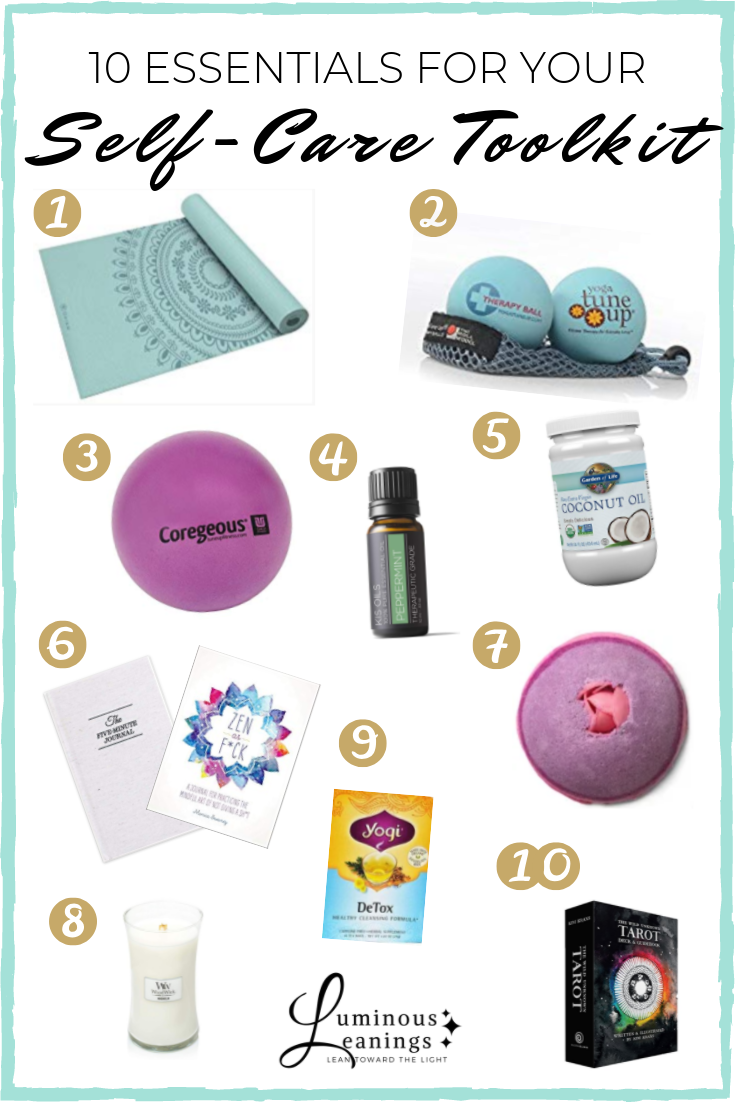
Once you have set your self-care goals, scheduled time into your calendar, & optimized your environment, the next step is to create your self-care toolkit! While practicing self-care doesn’t cost a thing, arming yourself with the right tools can exponentially increase your efficiency, deepen your experience & support you on your self-care journey.
Processing…
Success! You're on the list.
Whoops! There was an error and we couldn't process your subscription. Please reload the page and try again.
It wasn’t until I set up my own kit with the items below, that I really started to look forward to my scheduled self-care routine. These products* have helped me tremendously!
My Gaiam yoga mat is my security blanket. Whether I tote it to the park or a class, I’m basically Linus. Pairing it with my bolster or cushion is nice for a supported meditation practice, but on it’s own I use it for yoga, abhyanga, and restorative yin practices.
These little guys seriously changed my self-care practice. First thing in the morning, I like to roll them under my feet with a little peppermint oil to get grounded. Rolling with them under my sits bones has become part of my yoga therapy homework. And rolling them along my jaw and temples can relieve a migraine or TMJD symptoms almost instantly.
This coreageous therapy ball has proven so delectable when lowly inflated as a lumbar support on planes or long car rides. Due to my scoliosis, sitting upright during meditation can be quite uncomfortable. Placing the ball just under my sacrum can help give me that little bit of support I need to sustain my practice. And rolling around on it under my spine and low back is a lovely fascia release.
Processing…
Success! You're on the list.
Whoops! There was an error and we couldn't process your subscription. Please reload the page and try again.
Is there anything more calming than aromatherapy? Whether it’s sprinkling a few drops of lavender in my bath with my epsom salts, or using a diffuser with eucalyptus when I’m stuffy, essential oils are a near constant staple in my household. I just have to be careful when Tucker’s around, as they can be harmful to pets. Diffuse ’em or mix a couple of drops in with a base like coconut oil for a nice abhyanga warm oil massage. Instant luxury.
Mine & Lizzo’s go-to self massage product, coconut oil smells divine and absorbs quickly into the skin. The scent mixes well with lavender and peppermint, my two fav essential oils. Be careful with old plumbing – it’s recommended to pour a degreasing dish soap and boiling water down your drain every week or two to protect them pipes! I even use it as a cuticle oil just before bed.
I love journaling just after meditating – I find this time to be super-charged with spiritual creativity. I also recommend jotting your thoughts down at the end of the day, even if only to list a few things you are grateful for before dozing off. Focusing on the positive is one of the best ways to rewire your brain to break that negativity bias!
Baths are divine, aren’t they? There is something so yummy and sacred about that time alone with yourself. I love epsom salts and essential oils as I mentioned before, but nothing feels more indulgent than a shimmery bath bomb, like the ones in this Organic Lush Bath Bomb Gift Set! Pop one in and watch it fizz and change the color and scent of your water. Ahhhh.
Again, with the aromatherapy. 🙂 Paired with the beauty of a flame and the sound of a burning wooden wick, these Woodwick candles are a treat for the nose, eyes, and ears! It signals to my mind that it’s time to unwind and meditate. Namaste.
Processing…
Success! You're on the list.
Whoops! There was an error and we couldn't process your subscription. Please reload the page and try again.
Is there anything more cozy than a cup of tea? I got super into tea time when I studied abroad in Ireland – and it’s a habit I’m happy to report has never left my side since. I can’t recommend Yogi teas highly enough – Yogi Detox Tea, Yogi Stomach Ease Tea, Yogi Stress Relief Tea are some of my favs. This Yogi Tea Sampler looks amazing! There’s one for every kind of symptom and mood. Put that kettle on and prepare to be cozyfied.
Tarot might not strike you as a form of self-care, but for me it so is. It feels a bit rebellious to me, as a child of a Christian home, and always, always, ALWAYS teaches me something new. Whether I just want to learn about how to best care for myself in that moment, or I’m looking for bigger clarity in my career – exploring the Tarot has never let me down. With an open mind, how could you not learn and with learning more about yourself, how could those self-compassion juices not get flowing? This is the deck I use – The Wild Unknown Tarot Deck and Guidebook. The art and energy behind each card is stunning. I just love it!




 Luminous Leanings