The quintessential – and without question, the consummate – Anti-Hero(ine)

Ladies & Gentlemen, I give you: Nature. The Archetypal Anti-Heroine. She goes about Her business unconcerned with the Agendas and Intentions of Humankind.

[Nature] was indifferent to humankind’s arrival,
and she is indifferent to our survival.

Second Nature: A Gardener’s Education

I found some interesting articles that speak of Nature’s ability to heal herself.

How does Nature repair itself after an oil spill?
The Chernobyl disaster created an unexpected predator paradise
Earth can regulate its own temperature over millennia, new study finds
Please remain calm: The Earth will heal itself

All images remain the property of their original owners. All rights reserved.

This is a riff on a Post I wrote last week: Agendas, Arenas, and Anti-Heroes.

Nature does not teach its creatures to control their appetites except by the hardest of lessons – epidemics, mass death, extinctions.
Second Nature: A Gardener’s Education

ℳ –

Lord of Abundance

I haven’t drawn a three for a very long time. To be honest, they appeared a lot when I lived up North and I always viewed them as being a sign that I was a “fourth wheel” in that family dynamic. An outsider. My situation is different these days, thank Goddess, so I needed to take a step back and look at this card from another perspective.

From the Full Moon (2.24.2024) until the New Moon (3.10.2024),
what message does The Universe have for me?

The 3 of Grails (Cups) represents good fortune, exuberance, generosity, abundance, close friendships, spiritual gatherings, and the realization of a dream. Healing and teaching is also symbolized. This card can be urging us to support and inspire others through encouragement or the use of our artistic skills, as there is creativity expressed here.

As far as close friendships go, this is not a card of one-on-one relationships. Rather, it speaks of groups with a shared interest. Kindred spirits. It may also represent Life itself, calling for us to embrace it and give unexpected gifts of joy and delight in return. But because I’m still getting a threesome vibe here – a ménage à troisI’m throwing all this out the window!

Become a channel for Divine Love.

The Divine Feminine overriding the patriarchal energies coming to a climax in the World right now. These two Vampyresses are gently guiding the male Vampyre away to their lair (“There, there. Come with us.”). He is burned-out but doesn’t know it. Will the Vampyre emerge from his “rest” transformed, or will he remain in their embrace until the end of time?

ℳ –

Economic Hit Men ~ Part 2

Economic Hit Men ~ Part 1


The information contained below was taken from The New Confessions of an Economic Hit Man and remains the property of John Perkins.

“The problem is that we all believe we should do anything to achieve the ‘good life’. Anything for the American dream. Including burying ourselves in debt.” (“Your Friendly Banker as EHM”)

I thought about the core tools we EHMs used in my day: false economics that included distorted financial analyses, inflated projections, and rigged accounting books; secrecy, deception, threats, bribes, and extortion; false promises that we never intended to honor; and enslavement through debt and fear. These same tools are used today. (“Istanbul: Tools of Modern Empire”)

“Fear and debt. The two most powerful tools of empire… Most everybody thinks military might is the driver of empire, but war’s important because it – and the threat of it – instills fear. People are terrified into parting with their money. They take on more debt.” He smiled. “Whether we owe money or favors, debt shackles us. That’s why the economic hit man approach is so effective. More so than war.”

“You have to go after the businessmen, the CEOs and major stockholders of the multinationals that run the world. They are the roots of the problem.”

I was struck by how anesthetized the American public has become to being exploited. Our willingness to wear blinders is similar to attitudes in the countries I exploited during the 1970s.

Howard Zinn understood why a majority of us accept these platitudes. Those in the middle class, who have the material trappings of prosperity, are complacent because they possess the things they were taught to covet, and they don’t want to lose them. Those who live in poverty are complacent because they have to devote their energies toward simply surviving. All of this is expertly managed by a whole new breed of EHMs. (“Another EHM Banking Scandal”)

Corruption at the top has become legitimized because corporate EHMs draft the laws and finance the politicians who pass them. (“Who Are Today’s Economic Hit Men?”) (Emphasis mine.)

Tom Daschle and Chris Dodd have a lot in common. Both served as distinguished, long-term members of the US Senate… both Daschle and Dodd betrayed their images and the promises they had made to their constituents. They represent a new, powerful, and very dangerous group of people, the contemporary club of EHMs.

It is significant that the American League of Lobbyists – a professional association for the industry – changed its name to the Association of Government Relations Professionals, in 2013.

Business schools and planners may claim that corporate decisions about locating their job-creating facilities are based on rational analyses… but the greatest determinant in many cases has become the deal made with local governments.

The Boeing deal was reminiscent of things I’d done in Argentina, Columbia, Ecuador, Egypt, Indonesia, and Panama. The main difference is that, instead of World Bank loans, modern EHMs in the United States use tax policy and subsidies. These stratagems are even more effective than loans… the money is simply removed from the tax base and handed to the corporation; in essence, the money is stolen from the US taxpayer. Funds that had been earmarked for health care, education, and other social services are diverted to the coffers of greedy corporations – gifts from the lobbyist EHMs and corrupt politicians. (This seems like money-laundering.)

Good Jobs First
National policy center that reviews grants, loans, and other subsidies distributed by the federal government since 2000. Searchable databases.

One of the most disturbing reports estimated that Walmart workers are subsidized by US taxpayers to the tune of more than $6 billion a year, in public nutrition, health care, and housing assistance programs. The owners of this mega cash cow… are listed among the wealthiest billionaires on the plant… they are beneficiaries of the biggest socialized programs in history.

In Ukraine, the potential political ramifications
of sovereign-debt distress are enormous.

Citing US Supreme Court decisions and euphemisms about the virtues of their very narrow view of capitalism, [the modern EHMs] have persuaded us to give them license to make themselves fabulously wealthy. And they’ve done this, with our tacit approval, at our expense… For every $1 billion of wealth created, the average US citizen gets one dollar.

But drone operators? They don’t risk their lives; they don’t hear the screams of the wounded and dying or witness the suffering of innocent victims. They sit at computer monitors. They aren’t brave. There is nothing heroic about their jobs. Nor is there anything heroic about a nation that inflicts such suffering on other people. (“Who Are Today’s Jackals?”)

A system based on fear and debt may seem effective;
yet, history has shown that empires never last.

The tragedy of America’s rise and fall in the modern world represents a colossal failure on the part of corporate and government leaders.


Further reading:
What Charles Koch Paid to Elude 70 Years in Prison
HRC [Human Rights Campaign] and the Vulture Fund: Making Third World Poverty Pay for LGBT Rights
55 Corporations Paid $0 in Federal Taxes on 2020 Profits
The Destabilization of Haiti: Anatomy of a Military Coup d’Etat
The World Bank, Poverty Creation and the Banality of Evil
Uber-Vultures: The Billionaires Who Would Pick Our President
Israeli Mining Mogul Earns Billions on Assets Acquired Cheaply in Congo
US role in Zimbabwe, Somalia, Sudan and Nigeria illustrates continuing imperialist policy
How World Bank-financed wind farms fail communities in Mexico
FG Hemisphere vulture fund’s latest victory against the Democratic Republic of Congo (DRC)
The top 50 of the 147 superconnected companies
Capitalism: A Ghost Story
How America’s Biggest Bank [JPMorgan Chase] Paid Its Fine for the 2008 Mortgage Crisis — With Phony Mortgages
Banks’ Lobbyists Help in Drafting Financial Bills
Reforming the World Bank Policy on Involuntary Resettlement
Carving up a continent: How the UK government is facilitating the corporate takeover of African food systems
Firestone and the Warlord: The untold story of Firestone, Charles Taylor and the tragedy of Liberia
Where Have All the Lobbyists Gone? The-Shadow-Lobby
Trans-Pacific Partnership: A Trade Rule that Makes It Illegal to Favor Local Business
American Legislative Exchange Council (ALEC) Exposed!
How the Red Cross Raised Half a Billion Dollars for Haiti ­and Built Six Homes
Profiting from poverty, again: DFID’s [Department for International Development] support for privatising education and health
Rep. Billy Tauzin (R) aided drug firms, then they hired him
US taxpayers subsidising world’s biggest fossil fuel companies

ℳ –

Economic Hit Men ~ Part 1

I read Perkins’ book Confessions of an Economic Hit Man (2004) back in the early 2000s. The New Confessions of an Economic Hit Man (2016) contains everything from the original PLUS 14 new chapters. John covers events and subjects such as: “The Saudi Arabian Money-Laundering Affair”, “Pimping and Financing Osama bin Laden”, “American Republic vs. Global Empire”, “Venezuela: Saved by Saddam”, “A Jackal Speaks: The Seychelles Conspiracy”, “Your Friendly Banker as EHM”, “Who Are Today’s Economic Hit Men?”, and “Who Are Today’s Jackals?”

As you can tell by the plethora of Post-it™ flags, there was much that caught my attention.

Instead of laboriously making notes, I decided to do a Post instead. If any of it piques your interest, I encourage you to read the book yourself. I found a copy at my local library. (Incidentally, Mr. Perkins provides citations throughout – something I look for in books of this type.)


The information contained below was taken from The New Confessions of an Economic Hit Man and remains the property of John Perkins.

This book is the confession of a man who, back when I was an EHM, was part of a relatively small group. People who play similar roles are much more abundant now. They have euphemistic titles; they walk the corridors of Fortune 500 companies like Exxon, Walmart, General Motors, and Monsanto; they use the EHM system to promote their private interests.

It [capitalism] includes local farmers’ markets as well as this very dangerous form of global corporate capitalism… which is predatory by nature, has created a death economy, and ultimately is self-destructive. (Emphasis mine.)

I was a twenty-three-year-old [Peace Corps] volunteer assigned to develop credit and savings cooperatives in communities deep in the Amazon rain forest.

[I]n many cases helping an economy grow only makes those few people who sit atop the pyramid even richer, while it does nothing for those at the bottom except to push them even lower.

I discovered that statistics can be minipulated to produce a large array of conclusions, including those substantiating the predilections of the analyst.

“Remember, countries like this have long histories of coups. If you take a good look, you’ll see that most of them happen when the leaders of the country don’t play our game.” (“Dirty Business”)

My business school professors had taught that financing infrastructure projects through mountains of World Bank debt would pull economically developing nations out of poverty and save them from the clutches of communism. Experts at the World Bank and USAID reinforced this mindset.

[T]here were two primary objectives of my work. First, I was to justify huge international loans that would funnel money back to… other US companies… Second, I would work to bankrupt the countries that received those loans, so that they would be forever beholden to their creditors and would present easy targets when we needed favors…

EHMs would never be paid by the government… As a result, their dirty work, if exposed, would be chalked up to corporate greed rather than to government policy… In addition [they] would be insulated from congressional oversight and public scrutiny, shielded by a growing body of legal initiatives, including trademark, international trade, and Freedom of Information laws.

“You can pick and choose. Keep England. Eat China. And throw away Indonesia.” (“Civilization on Trial”)

In 1903, President Roosevelt sent in the US warship Nashville, US soldiers landed, seized and killed a popular local militia commander, and declared Panama an independent nation. A puppet government was installed… (“Panama’s President and Hero”)

He said, “North Americans don’t know much about the rest of the world.”

“Do you know who owns United Fruit?” he asked
“Zapata Oil, George Bush’s company – our UN ambassador,” I said. (“Conversations with the General”)

It was exactly what we wanted: a tool that scientifically “proved” we were doing countries a favor by helping them incur debts they would never be able to pay off. (“Panama Canal Negotiations and Graham Greene”)

He went on to explain how, once forests as animals such as the buffalo are destroyed, and once people are moved onto reservations, the very foundations of cultures collapse. (“Iran’s King of Kings”)

“Your politicians must placate the Jewish vote, must get their money to finance campaigns. So you’re stuck with Israel, I’m afraid. However, Iran is the key. Your oil companies – which carry even more power than the Jews – need us.” (“Confessions of a Tortured Man”)

“The Indians and all the farmers who live along the rivers you’re damming hate you. Even the people in the cities… sympathize with the guerrillas who’ve been attacking your construction camp. Your government calls these people Communists, terrorists, and narcotics traffickers, but the truth is they’re just people with families who live on lands your company is destroying.” (“American Republic vs. Global Empire”) (Emphasis mine.)

Like earlier empires, [the global empire] opens its arms only to accumulate resources, to grab everything in sight and stuff its insatiable maw. It will do whatever is needed to help its rulers gain more power and riches. (“American Republic vs. Global Empire”)
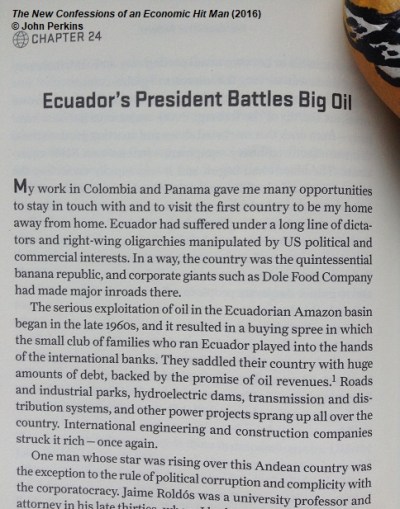
[S]ome SIL members went in an encouraged the indigenous people to move from that land, onto missionary reservations… The condition was that the people had to deed their lands to the oil companies. (“Ecuador’s President Battles Big Oil”)

I never had to see the dying bodies, smell the rotting flesh,
or hear the screams of agony. But I too had committed a sin.

Carter may have been an ineffective politician, but he had a vision for America that was consistent with the one defined in our Declaration of Independence… Reagan, on the other hand, was most definitely a global empire builder and a servant of the corporatocracy. (“Ecuador’s Presidential Death”).

Blackie Lawless stated in an interview shortly after the release of the album (The Headless Children), that “The Neutron Bomber”, is about Ronald Reagan [“Neutron Ronnie”] and the power he and America had over the world, with such a large nuclear arsenal.

It was an unprovoked attack on a civilian population. Panama and her people posed absolutely no threat to the United States or to any other country. Politicians, governments, and press around the world denounced the unilateral US action as a clear violation of international law. (“The United States Invades Panama”)

Contrary to common public opinion, Iraq is not simply about oil. It is also about water and geopolitics. Both the Tigris and the Euphrates rivers flow through Iraq… Iraq controls much of the increasingly critical important water resources… many of the major companies that had set their sights on taking over small independent power companies now looked toward privitizating water systems in Africa, Latin America, and the Middle East. (“An EHM Failure in Iraq”)

“The numbers tell us that twenty-four thousand people
die every day from hunger.”

It [global economy] is based on war or the threat of war, debt, an extreme form of materialism that pillages the earth’s resources and is consuming itself into extinction. In the end, even the very rich will fall victim to this death economy. (“Conspiracy: Was I Poisoned?”) (Emphasis mine.)

These and many other conspiracies took the EHM system far beyond where it had been in the 1970s… The heart of this system remained the same: an economic and political ideology based on enslavement through debt and enforced by paralyzing people with fear.

“We’re all guilty. We have to admit that although the big corporations own the propaganda machine, we allow ourselves to be duped.”

Jack would disappear from our dojang for extended periods. He was an avid surfer, and he brought back surfing photographs. Still, [we] commented to each other that violent things happened in countries where he went surfing – a bombing in Indonesia, riots in Lebanon, an assassination in South Africa. (“A Jackal Speaks: The Seychelles Conspiracy”)

He went on to explain that the Kenyan army had an aircraft loaded with paratroopers standing by in Nairobi. After the jackals had killed René, the Kenyans would immediately arrive to accept credit for the coup.

And anyone who happened to read or hear about the raid on the Seychelles airport or the hijacking of an Air India 707 believed it was the work of terrorists – Communists – out to overthrow a legitimate government. The public had no idea that it was a CIA plot gone sour.

On an all-night shamanic journey, I saw that I’d been brought up on bland New Hampshire foods. Now I was living with people whose diet was very different. Among other things, because the rivers were filled with organic matter, they always mixed drinking water with a type of beer fermented with the aid of human saliva.

Faced with no alternatives, I ate their foods and drank their beer. That night, I saw that each time I did so, I heard a voice telling me it would kill me. I also saw that the Shuar were incredibly strong and healthy. As the night progressed, it became clear to me that it wasn’t the food and drink that were killing me; it was my mind-set. The next morning I was totally healthy.

“Ecuador Rebels”

In 1978, Texaco had only just discovered petroleum in Ecuador’s Amazon. Today, oil accounts for roughly half of the country’s export earnings. A trans-Andean pipeline, built shortly after my first visit, has since leaked more than half a million barrels of oil into the fragile rain forest – more than twice the amount spilled by the Exxon Valdez. A $1.3 billion, three-hundred-mile pipeline… had promised to make Ecuador one of the world’s top ten suppliers of oil to the United States. Vast areas of rain forest had fallen, macaws and jaguars had all but vanished, three Ecuadorian indigenous cultures had been driven to the verge of collapse, and pristine rivers had been transformed into flaming cesspools.


This is getting long so I will stop here. To be continued…

ℳ –

Hark! The herald robin sings

♫♪ Fa-la-la-la-la, here comes Spring! ♫♪

Heeeee’s ba-ack! Rock, the robin. While getting coffee made, I heard his morning wake-up song. There he is on the fence – nope, that’s Mrs. Rock (aka “Robin”)! Rock is somewhere close by, though, heralding the sunrise from one of the nearby trees. He is our Sun King and a sure sign Spring is just around the corner.

"I hear them before the sky begins to lighten. “My Bird”
(as I called it before identifying it as a robin) is always
the first to announce the day. The songbird’s equivalent
of a rooster, I suppose. Today he – because only male robins
sing – is not close but his powerful song echoes through
the neighborhood."

May 11, 2021

I’ve never been able to get video of Rock singing, but this is exactly what he sounds like:

All About the American Robin — Harbinger of Spring!

By Catherine Boeckmann
February 20, 2024

A harbinger of spring, the American robin is one of North America’s most common and beloved songbirds.

Robins are fairly large songbirds, about 8 to 11 inches long with a wingspan of 12 to 16 inches. They are the largest of North American thrushes, almost half again as big as a bluebird. Their scientific name, Turdus migratorius, appropriately means “wandering thrush.”

We all know robins by their round warm orange breast and long tails. The female looks similar to the male, just a little duller.

Robins are often called the harbingers of spring, however, they are often around all winter in many parts of the U.S. and even parts of Canada. You just start to hear them singing in the spring as daylight lengthens because the males start to declare their territories and attract females; robins are one of the earliest nesters.

So, we think that you could still call robins’ song a sign of spring!

As early nesters, they are industrious, getting ready to mate, brood, and feed. Robins may have two or three broods a season. The female does the nest building, although the male might bring her some materials, making it of twigs, grass, and feathers and lining it with mud. She lays three to five bluish eggs which hatch in about two weeks. Very busy!

Back in 2021, I caught Rock stealing some coco fiber from a planter.
My assumption was that he was going to woo Robin with his choice of nesting material. (Apparently she did, because they engaged in “avian coitus” on the fence afterwards.)

Because the robin forages largely on lawns, it is vulnerable to pesticide poisoning; consider reducing toxins from pesticides and fertilizers as contaminated soil particles adhere to the skin of worms. Robins also often ingest lead left over from leaded gasoline and paint.

According to Wikipedia, Rock and Robin are western robins (T. m. propinquus). It says this subspecies is paler than the eastern robin and that some lack almost any red. Wikipedia further states this lack of color is probably only found in female western robins (like Robin), however, I can attest that Rock’s red breast is barely red at all. More like a pale orangey-red. He still sings a mean birdsong in the morning. Welcome, Rock! Welcome, Spring!

ℳ –