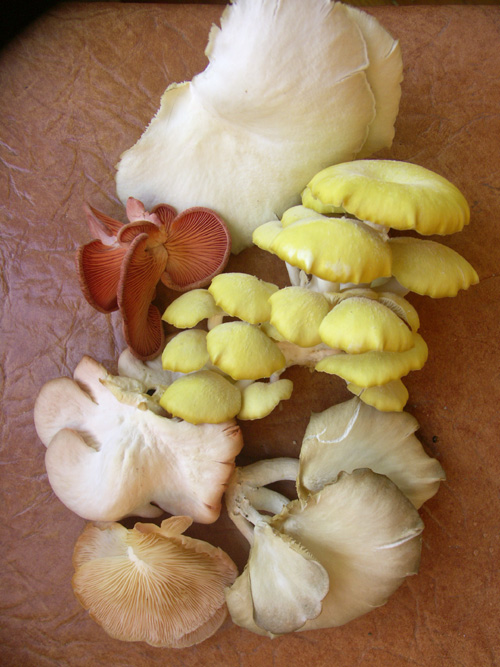
Assorted oysters.
Source: Kari and Joe of Herb’n Oyster Mushroom Farm in McFarland, Wisc. Kari was at the Tuesday-afternoon Isthmus farmer’s market in Madison. All Pleurotus, I’m told, but which ones?

Assorted oysters.
I’ve never been to a World Dairy Expo or any dairy expo, but I’ve been salivating for weeks at the thought of booth after booth of cheese samples. I’m on my way this morning. The dairy farmers are in crisis at oversupply/low prices, so I figured they’ll be extra excited to see me, although I expect I’ll have to hide from them the fact that I’m hardly a new customer.
The Wisconsin State Journal somewhat derailed my enthusiasm by describing the main buzz at the event as a machine that will “remove the odor from liquid manure.” I investigate, and learn the booth categories range from Animal Genetics to Sanitation Equipment; the closest they come to cheese is Milk Marketing; and the food concessions include Pizza Hut.
The NYT jumps in to say, accusingly, that the milk glut is the farmers’ own damn fault, because they sorted the sperm and grew too many milk heifers.
Wisconsin dairy leaders respond to the crisis by going over to China and modernizing their dairies. (“We’re trying to teach Chinese people to like cheese, because right now they don’t like cheese very much unless it’s on a piece of pizza,” Nielsen said [of what is Wisconsin’s fifth-largest customer base]. Can we teach a nation of lactose-intolerant people to love cheese? Should we?) The China news spawned a lot of nasty comments out here in Dairyland, let me tell you.
I say it’s time to build up our nation’s artisanal cheese caves.

What is that you're growing on, dearie?
As I recall, the suburban Maryland where I grew up has lots of trees. Don’t ask me what kind they are, though.
These are the types of trees I remember: Trees that drop leaves I must rake. Trees that can be climbed. Maple trees, which someday I will learn how to get the syrup from. Dogwoods. The nasty-smelling ornamental pear trees inexplicably planted everywhere there. A few others.
Certainly my father tried to teach me others, but I couldn’t tell you which trees are dominant there, which ones lined the highways, what lives in them, what their bark looks like. I have, it turns out, a vast ability to ignore large classes of objects in my view.
Only when I went to Africa, a totally foreign place, to study gorillas was I forced to ask, “What is this?” several hundred times a day. A deep desire to categorize and label all that green in front of me. Each month my neck got a crick from the phenology transects, in which we tracked certain trees to see when they flowered and fruited. So most of the trees I know are those of central Africa’s wet forests, and they all have Baaka, not Latin names.
However. This morning’s fully formed realization was that mushroom hunting might be easier if I knew something about those big wood objects in the forest. As Michael Kuo writes:
Mushrooms and trees are inextricably linked. Most trees cannot survive without mycorrhizal partners from the fungal world–and saprobic fungi play a vital role in forest ecosystems, decomposing tree litter. Thus identifying trees is essential to understanding and identifying mushrooms.
And I’d just been dividing them into oak, birch or apple. Whoops.
My knowledge grows in organic blooms, one topic infecting the next. A desire for mushroom soup leads to chanterelles and honeys, but also inedible earthstars and jelly fungi; my curiosity about some hanging yellow frills, some curious puffballs, leads me finally to pay attention to the trees.
Posted in Uncategorized
Surely, said California friend Peter, I could find something more interesting than oyster mushrooms here.
So I did.

It finally rained this week ... so everyone came out.
I can’t say I picked all these; I was with the Wisconsin Mycological Society’s Madison Interest Group—a small bunch of knowledgeable, kind and obsessive people.
My brain, at the end of the hunt, was completely full of fungus names, shapes, oddities of behavior. Instead of wondering about each strange new mushroom I found, I’d simply bring it over to one of the gurus. “Hygrophorus,” he’d say. “Clitocybe. Oh, I haven’t seen one quite like this.” At which I would get a little thrill. I have too many mushroom pictures to post, and almost too many to eat, but the best find of the day was a flock of hedgehogs—wait, I’m told the collective term is “prickle”—all on a single root line, a half-pound or more. Each of us came home with several.

See those teeth? Rawr!

Little Coral travels the world.
The hedgehog, Hydnum repandum, is a meaty toothed mushroom. It loses quite a bit of water upon sauteing and is mild and unremarkable in flavor. I suspect people love it because it’s so huge. I wholeheartedly agree.
(This may require more study. Last night a hedgehog stuffing on top of baked salmon was not, I’m sorry to report, delicious. But I blame myself, not the mushrooms.)
Another picture I like:

A mushroom huntress in the society examines her kill: chicken of the woods.
A solid three hours of cooking, and I was ready for my man to make me dinner.
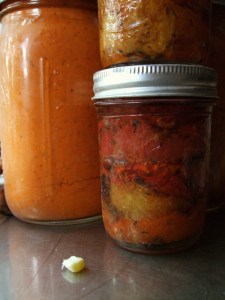
Blighted tomatoes never got so much respect.
I learned about confit from a lovely French matron outside Paris. At the time I preferred cooking your hundred-ingredient Kashmiri curries, and didn’t know squat about French food. Making confit was a passionate affair, with plenty of smoke and bravado; the tomatoes reducing in a pan on high heat for as long as one could stand it in the kitchen, transmogrifying into a charred gold. It’s the sort of dish that cannot be done without disabling the smoke detector first.*
Thomas Keller’s version, however, is an Apollonian one, methodical and pure. You core, blanch, peel, halve, and seed your tomatoes; lay them cut-side-up in an olive-oiled baking dish; lay sprigs of thyme, add salt and pepper; and cook at 225 degrees until you remember they’re there again, maybe three hours. During which time the tomato thinks hard, transcends, transforms into the condensed taste of summer.
2. Cherry tomato sauce—The cherries sat around for a few days while I worried about skins, picturing myself blanching and peeling 200 tiny tomatoes. I hate running into tomato skins in sauce. Then a bright light in the musty old head, and I pureed them. Perfect. One version: preserved-lemon puttanesca, with two heads of garlic and three jalapenos for a quart of sauce. For the boldest company.
3. Broiled cherry tomatoes, pureed with fried garlic, parsley, basil, olive oil. So easy. Hope it keeps.
4. With mushrooms. Pureed orange Carolinas with the usual (see above), plus wine and dried aspen boletes that W. brought from Alaska.
* I have not gone to the lengths that Jeffry Steingarden has, attempting to disable his oven’s thermometer so he could get it past its natural inhibition about temperatures beyond 500 degrees. But I once dated a housefire-phobic man, and that was doomed from the start.
Posted in Cooking, Garden, Uncategorized
All these mushrooms that grew in the rain
I found twelve. One looks like a brain.
I’m hoping to name these
In case they are tastees
But this fungus ID key’s my bane.
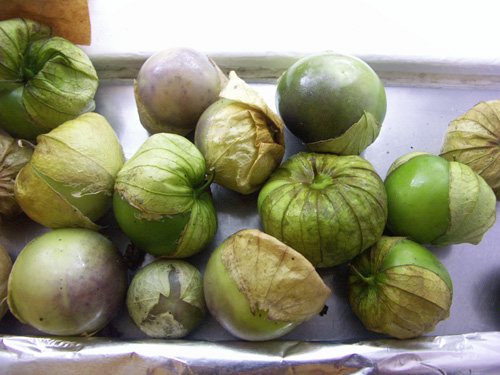
After plant science ends, then begins salsa science.
Viva la research garden! Except the scary apples over near the manure pile, which I hear may be test subjects for systemic pesticides.
Posted in Garden
I expect my jerk chicken to be spicy. As in scotch-bonnet, melt-off-my-mouth-skin spicy. I also expect allspice, thyme and quite a bit of variation after that. I also expect that at certain restaurants, even if they serve true come-to-Jesus flaming-hot food, they serve it quite a bit despicee for the majority of the clientele. OK, then—contingency plan says I ask for hot sauce. Tonight’s visit to Jamerica (1236 Williamson St., Madison), friends, was not that. This “jerk” was $14 crockpot chicken with the barest hint of dried thyme, along with some bethymed cabbage and rice. This was what I imagine Wasp chicken tastes like.
And then the waitress told me they were out of hot sauce.
Out of hot sauce? As in sorry, we don’t have flavor tonight?
The waitress did not see, I assume, the dozen unopened bottles of hot sauce on a wall shelf in front of me as she said this. Or the grocery store across the street. However, she recouped, finding a bottle of Grace hot sauce at another customer’s table.
I drowned my sorrows and my chicken in it. Sometimes the Forager fails.
Posted in Madison, Restaurants
Tagged bland, disappointing, flavorless, jamaican, jerk, Madison, restaurant, willy street

The blight's characteristic rotted-tie-dye rings.
So few tomatoes were salvageable. Often they were like stealth zombie tomatoes, perfect and firm until I spotted a few brown freckles of blight. They would be bitter.
Afterward, traumatized, I came home and therapy-cooked for four hours, invented new tomato sauces. Anything to stop thinking about the great volumes of rotted fruit.
Today will be the third day.
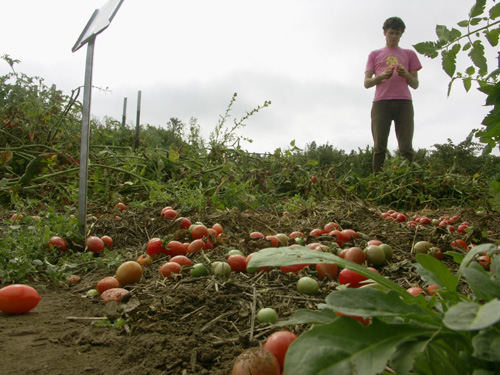
After we pull the vines, hundreds of pounds of tomatoes are still left. All of it must go.

A pile of blighted tomatoes awaits its fate: steaming hot compost.
All right. I’ve got my ale and my cheese curds. I’m clean and, at last, spore-free. A few more calming breaths, and I’ll be ready to tell you about Late Blight.
It came so quickly into the garden. The West Madison Agricultural Research Garden, where I’m helping out. I heard tell of one tomato farmer who recently destroyed 400 tomato plants. It is a fungus, Phytophthora infestans, that is more usually seen attacking potatoes. It is greatly feared, for it caused the Irish potato famine. It can cause great damage overnight. Tell-tale brownish rings appear on the tomatoes as they die. It can spread as a person picks up the spores on her clothing and moves to the next bed. As we destroyed tomato beds all day we hoped the blight had not infected the plants up the hill. But by the end of the day we learned that it had.
We destroyed tomato beds all day. Most of the tomatoes seemed perfectly fine, the plants lush and sturdy, difficult to pull out of the ground, heavy to lift. So many fine tomatoes laid on the ground. It was obscene. But we knew the blight could spread. A lot of people come through the garden, and then they go back to their own gardens. Who knows where the air could take the spores? Just the other day we were wondering what those curious rings on some tomatoes were. A few plants were totally dead.
The plants were so bountiful that when we picked the fruit each week for the food bank, it seemed like we were getting nowhere, like we were lost in a fertile tomato jungle.
The plants that had died smelled rotten. We cleared all the beds of tomato-matter, even the tiny cherry tomatoes, and hauled the lot to a compost bin a mile away. Men with loaders had dug a hole in the compost, which is mostly manure, for the still-green tomato plants. Steam rose from the hot compost the digging exposed. That was the point. At 160 degrees the fungus would be killed. The smell wafted all the way over to the garden, and everyone hoped these measures would suffice.
Posted in Agriculture, Garden
 Madison Forager
