
More brief notes in my attempt (1, 2) to bring to account live performances I have attended.
10. 22 9 SSO Ashkenazy Romeo and Juliet
This was a very neat program mounted by the SSO: Arabella Steinbacher playing the Bruch violin concerto, bookended by Tchaikovsky’s Fantasy Overture and Ashkenazy’s own selection from the two Prokofiev suites. It was also very enjoyable.
We have had a number of guest concertmasters this year. Sometimes, although they themselves play well, you get the sense that their approach doesn’t “fit” the approach of the rest of a section, so that they end up sticking out a bit at the front as the section as a whole stolidly ploughs on as usual. That wasn’t the case with Adam Chalabi, guest concertmaster for this concert: I thought the violins sounded very well with them.
11. 26 9 Belvoir Calamity Jane 6.30
D and I sat on the stage for this pocket-musical version of what was originally a Doris Day movie.
The first act was set in a bar and we were able to order drinks onstage before it started. Members of the cast were milling around and improvising business including the kind of chat-up that a barmaid at such a saloon might use to soften up a customer. I noticed that a non-cast member, tending the bar, was the only one actually able to dispense the liquor. “Is that because you don’t have an RSA certificate?” I asked the (in character) proprietor’s “niece.” “I have an RSA,” she smartly replied. “A Really Sassy Attitude.” OK, maybe you had to be there, but it was fun, as was the show as a whole. Exhilarating.
The instrumental accompaniment was provided by the MD on a little Collard & Collard upright which sounded surprisingly good considering the treatment it must have received over the years.
Virgina Gay in the title role was terrific. We are lucky that she did not suffer the same fate of her fellow assailees on Illawara Road a few years ago, one of whom was much less lucky.
12. 13 10 AE
With P (and on this occasion her husband) to the final concert of the year for the Australia Ensemble at the John Clancy Auditorium, entitled “Forces of Nature.” This gathered together:
Maria GRENFELL | Ten Suns Ablaze (2012)
Ludwig van BEETHOVEN | ‘Szene am Bach’ from Symphony no. 6 arr. Fischer (1810)
Nigel WESTLAKE | Rare Sugar (2007)
Pēteris VASKS | Landscape with birds (1980)
Aaron COPLAND | Appalachian Spring ballet suite (1944)
The Grenfell and the Westlake were return performances of works first commissioned by the Australia Ensemble. I remembered them both favourably from their first outings and enjoyed them again, but by interval the Westlake, which is a kind of clarinet concertino, given a high-voltage performance by David Griffiths, had made such a powerful impression that the Grenfell was quite overshadowed in retrospect.
Opinions amongst my companions were divided about the bird pictures which were projected on the lecture-theatre drop screen while Geoffrey Collins played the Vasks. I enjoyed them and was prepared to go with the flow.
The Szene am Bach was an arrangement for string quintet. It started a little faster than I expected it to go based on orchestral reminiscences.
The Ensemble have used Appalachian Spring as a series closer before – it’s an opportunity to coax the subscribers back for next year with about as large an ensemble (13 players) as the AE ever puts on stage. And despite (for me) some longeurs on the way through, it is a piece that really delivers by the end.
Straight after interval we got a little spiel from Paul Stanhope about next year’s season. This meant there was no delay after the Copland as we adjourned for the traditional drinks and fancy chocolates.
13. 16 10 Cosi at the Con?
This had a question mark in my concert diary because I wasn’t sure when or whether I would go. My interest was piqued by a reference to an upcoming role on the website of Gavin Brown, who had a star turn in Poulenc’s The Breast of Tiresias which I saw earlier this year.
In the end I went to the Thursday Matinee on the 18th and it was Don Giovanni.
There’s a stronger argument for seeing a student production of a rarity such as the Poulenc than for seeing a more mainstream work, but I’m still definitely glad I went.
I was more impressed by the orchestra in the Poulenc than in the Mozart. That’s probably because the Mozart is harder. You pick up any rhythmic sloppiness (which is endemic in student ensembles compared to professional ones) and mishaps stick out more. The horns were a couple of bars out for what seemed like ages but probably wasn’t really (I admired conductor Stephen Mould’s composure) and there were a few other hair-raising moments. The principal cello could have afforded to play out a bit more in Batti, batti.
But these are quibbles. It really is great that the students get to perform the opera with a credible orchestra.
There is a detailed review of the first night (I heard the same cast) here with which I mostly concur, save that I would be more commendatory of Esther Song, who grew on me in the course of the performance as Donna Anna. Haotian Qi’s performance of the Don’s serenade to Donna Elvira’s maid (here ironically oblivious to it as she was listening to something else through headphones whilst getting on with her life) was particularly fine.
The production was set in a “celebrity” world somewhere between Hollywood and the Conservatorium itself (when Masetto and his chums beat up Leporello they did so with one of those sticks that cellists use to moor their spikes. DonG was a #metoo celebrity narcissist and abuser. Hell, at the end (solving the problem that the stage lacks a trap-door) was exposure and denunciation. It all worked quite well though perhaps there was just a bit too much business with cameras and phones at times. There were a few cuts which together with the updating made things just a bit confusing at times.
14. 20 10 SSO Thibaudet Egyptian
Jukka-Pekka Saraste conducted. As well as the Saint-Saens piano concerto no 5 (surprisingly last and first played with the SSO by Thibaudet himself in 2010) the concert featured the Prélude à l’après-midi d’un faune and Sibelius 7.
The SSO seems to have given up selling choir and organ stall tickets. Only a few people were sitting there. Too cheap, or too mean? Could be both but it is shameful for subsidized tickets to go unsold if it is because of a desire to maintain a floor price.
Francisco Lopez was the latest in a series this year of guest principal flutes, and he shone in both the Debussy and the Sibelius.
I thought Saraste could have kept the orchestra a little more in check in the Saint-Saens, for which Thibaudet set a cracking pace in the outer movements. On the other hand, conducting without music (as I am sure any Finn worth his salt can do) he hypnotised the orchestra into the most dramatic Sibelius 7 I have ever heard.
Saraste last conducted the SSO in 1986. I think I probably was at that concert because I remember hearing the Schumann Konzertstucke for 4 horns played by the Canberra Horn Consort (led by Hector McDonald) and probably went out of my way to hear it. At interval I overheard Emma Dunch, the Orchestra’s CEO, loudly declaring “We must have him back sooner than another 32 years.”
In the early evening leading up to the concert a stupendous thunderstorm rolled across the city. In the forecourt of the Opera House the Invictus Games were being launched. Before playing his encore, Thibaudet thanked us for braving the weather and the security.
Thibaudet’s regular visits to our shores seem to have started at about the turn of the millenium. This is what he looked like then and the picture or something very similar still featured in the publicity for this concert:
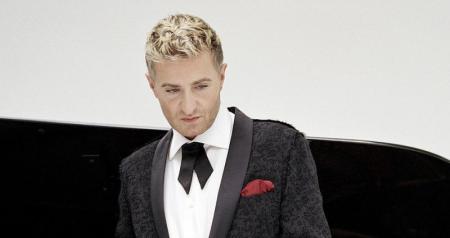
Inside the program booklet was a more up-to-date shot:

Philip Scott in Limelight referred to an earlier visit when Thibaudet played the complete piano music of Ravel; Thibaudet also performed with the ACO in 1992.
J-YT’s first visit is probably less well-known:

That’s from the program for the 1981 Sydney International Piano Competition. Soulful eh? If I’d found this before the concert I would have taken it up for an autograph and, surely, a laugh.


 Stumbling on melons