Category Archives: characterization

Some Thoughts on Writing and The Writing Life

A Random Compilation of Old and New Musings

Moi!

The Mother as Writer…and Character

Every time I create a fictional character who’s a mother, I run into the same problem: even when the kids have nothing to do with the story, editors and agents insist I create more story time for them. Thus, I’m forced to develop more characters and wrestle with a geometric increase in relationship dynamics.  If I don’t develop the children, I’ve been told, readers will “lose sympathy” for the main character.  On the surface, the solution seems simple: just don’t make the main character a mother. In some cases, however, I’ve felt it essential for a female character to have had the experience of birthing and raising a child, for motherhood to be an integral part of who she is, whether the kids are part of the story or not.

For instance, I wrote a novel about an older woman who falls in love with a man who has AIDS.   By making the protagonist a mother, I gave her specific caretaker experience. Otherwise there was no place in this tragic love story for children. They were fully grown and appeared only peripherally, via phone calls. An agent who wanted to represent the book told me it was jarring for the kids to be largely absent, that it made the character less likeable. I suppose this mother seemed like a dilettante for living a full adult life without her kids on top of her.

I should have known: the same issue arose more than thirty years ago, with one of my earliest attempts at a novel. The main character was a mother, but the plot revolved around her life as a political activist.  The fact of motherhood influenced her commitment to social justice, but otherwise the kids weren’t essential to the plot.  I purposely set the time frame as one entire summer, shipping the kids off to camp – nothing wrong with that; parents do it all the time. My agent, after getting feedback from several publishers, informed me that editors detested this woman for being absent from her kids and that I had to incorporate them into the book.

I’m not sure what this says about literature in our culture, but it says a helluva lot about how we regard motherhood. The central focus of a mother’s life is supposed to be her children, no matter how old they are and no matter what else a woman might be doing.  If she’s presented as an autonomous being with interests and activities other than her kids, she is immediately suspect.

Imagine an editor saying the same thing to a male writer.  I’m certain that no agent or editor has ever told Phillip Roth his main character is unlikable because his kids don’t make an appearance (though critics tend to dislike Roth’s characters for other assinine reasons). Do readers like Raymond Carver more than Roth because so many of his stories are child-centered? I don’t—though I do appreciate Carver’s perspective as a father. I suppose it’s unfair to blame critics; there’s no denying that, unlike fatherhood, motherhood exerts such a powerful influence on a woman’s psyche that by simply stating a character is one, I perform a hefty chunk of instant character development.

Aha! Maybe it’s my own fault for relying on what a woman is, rather than developing her character independent of maternal status. Maybe I’m simply being lazy (not to mention sexist!); maybe my critics have a point: they’re perceiving a legitimate weakness in my writing.

I think I’ll try removing the status of motherhood from one of these characters and see what happens. This is exactly why I love to write: putting down these words brought me to a new understanding of a conundrum I’ve been wrestling with for forty years.

Another reason I love to write:

Journal Entry circa October 1988

Today it happened. After days and days of writing drudgery, moving people around the page, setting them up, getting them from one place to another, from one meal to the next; after all that tedious “housekeeping,” I wrote a scene, one paragraph in particular, that’s a jewel. All the surrounding words merely hold the jewel in place—small, fake rhinestones that exist only to support the diamonds.

The scene is a blend of fiction and something that really happened.  It seethes with love and passion without being sentimental.

This is what I live for. This is why I write, even when it’s tedious. It’s the reason I live as I do—solitary, broke/poor, eccentric – all for moments like this. I wish I could hang onto this moment, but…now it’s written, tomorrow it probably won’t even seem so brilliant, and it’ll be another long lonely stretch before I produce another diamond.

But I will…and that’s what matters.

The Failed Novelist

Novel-writing is the one and only occupation I’ve ever heard described by the adjective “failed.” What makes a writer a failure? Lack of publication? Given that so many people write several novels before one gets published (Steven King is a living example), at what point has a novelist failed? I suppose the phrase is accurate if we’re talking about a novelist who hasn’t yet produced even part of a novel – but how can anyone have failed if her work is in process? Is an inventor whose inventions haven’t been produced a failed inventor? What about a musician who hasn’t recorded, or one that a very few people have heard? Is he a failed musician? No  failed painters exist – and behind many closed doors every wall is crowded with the resident’s paintings! The posthumous painter is legendary: Van Gogh, for starters. Yet we don’t call anyone a failed painter.

It must be part of the insane stigma against writing as a profession. I could probably speculate for hours on why this is so, but it would be a waste of time and energy. I only point it out because it’s something that’s bugged me for years. At this point, I cringe at the phrase failed writer as much as I do at homophobic, sexist, or racial slurs.

As they say in academia, Publish or Perish!

Speaking of Academia…

As a committed writer, I’ve worked the oddest of odd jobs to earn my keep. When I sold popcorn at a small independent movie theater, we put on a French Film
Festival which several artistic Parisian types attended. During intermission, one Frenchman got flirty with me, but when he found out I was the theater’s popcorn lady, he actually turned his back on me.

I had a nearly identical experience when I attended a Modern Language Association conference, where I’d been invited to read an essay I’d written for the Doris Lessing Newsletter. At the opening reception, a college professor – that’s who goes to MLA meetings — asked me where I taught. When I admitted I wasn’t a college professor but an independent writer, he walked away. Just up and walked away, cocktail in hand.

I remain unruffled by the snobbery of the intelligentsia; I find it amusing. It’s one of the few instances of human stupidity that I don’t get sucked into.. Au contraire: it makes me feel, in comparison to such people, enlightened, eclectic, and iconoclastic. I was a popcorn vender who wrote regularly for the town newspaper; a sex writer who published academic papers on a Nobel prize-winning author; a phone “fantasy-maker” who was also consultant to a major American chocolate company; a grandmother editing anthologies of women’s erotica.

Obviously I can’t be pigeonholed, and I can’t be bought. Oh, I’ll sell myself all right – but it won’t make me a Francophile, an academic snob, or a business consultant. I hope those smug morons who turned their backs on me feel better about themselves from our encounter; such hubris should not be a complete waste.

Another Plug for The Jewish News Pages

In case my readers haven’t yet checked out TNJP, now would be a good time to do so: my op-ed on Islam, sexism, and religion is generating a bit of controversial conversation. My favorite comment accuses me of “distaste for children” because I favor contraception. No lie. Here’s a fantastic subversive picture I posted with it:
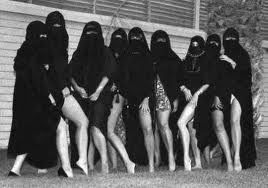
Burqa Chorus Line

The Kids Are All Right: Movie Review

Posted on

Kids All RightWarning: Spoilers and X-Rated Material Ahead

Of course the kids are all right. I always knew they would be. Some people were wringing their hands, fretting about how children raised by gay couples might turn out, but I never thought they’d have it any worse than kids from other family configurations – then again, I don’t worship at the altar of the nuclear family. Besides, unlike straight couples who just assume they’ll have children, those living outside the norm are forced to think long and hard before jumping into parenthood; in fact, they don’t “jump” at all – they sometimes go through hell and high water just to become parents. And once they do have kids, they tend to be fairly conscientious raising them. I’m not idealizing gay parents or saying they’re better at it; it’s just that living outside the mainstream in any way whatsoever forces people to deal with a host of issues that heterosexuals never have to think about.


Surprisingly, however, the film’s title is hardly the point. It turns out to be not so much about kids raised by lesbians, but rather about love and family and betrayal, and all the complexities in long-term relationships. It’s about sexuality and sexual identity and the longing for connection. That the kids are all right is almost incidental.

Eighteen-year-old Joni, named for Joni Mitchell and played by Mia Wasikowska, has the riveting looks of Claire Danes; she also happens to resemble someone I know, and I could hardly take my eyes off her. Which is quite a feat when you consider that Annette Benning and Julianne Moore, both knockouts, play the mothers. Their gorgeous looks are underplayed: if they were wearing any makeup in this movie, it was to highlight sags and wrinkles. When Moore’s character dons her gardening gear, she comes off looking like a middle-aged Annie Hall wannabe.Kids All Right

The plot is set in motion when 15-year-old Laser (Josh Hutcherson) convinces his sister to find their donor, the man whose sperm contributed to their existence, since he’s too young, by law, to get the information himself. Joni, afraid of hurting their mothers, is reluctant, but when she meets Papa Sperm (Mark Ruffalo), she just about falls in love with him. So does everyone else in the family, with the exception of Mama Benning, whose fear of rocking the boat turns out to be well-founded: Mama Moore, while creating a lush garden Papa Sperm hires her to do, jumps into bed with him. The affair almost tears the family apart. That they survive is testament to the strength of their bonds and loyalty to one another – or so I perceive director Lisa Cholodenko’s point to be.

Mark RuffaloThe sex scenes between Moore and Ruffalo are wildly, passionately, animalistic. She literally tears his pants off, and greets what’s inside them like a long lost friend: “Hel-lo!” she says, apparently awestruck. Two or three substantial scenes of their lovemaking follow, in sharp contrast to the women’s sex: there’s been just one anemic scene of them in bed. In it we see Moore moving about under the covers, and Benning’s facial expressions – which would work if she were actually being expressive, but if anything, she seems bored. From underneath the quilt comes the buzz of a vibrator. More movement. End sex scene. The lesbians sitting behind me were laughing their asses off in recognition, and I confess I too got a chuckle out of the scene. The hetero sex scenes had not yet occurred, so it’s only in retrospect that I feel the lesbian couple got the fuzzy end of the lollipop.

More important, because Moore has such a raging good time in penis-land, what comes later on, in the confrontation between her and Benning, seems off kilter.  It’s evasive, even false. A bisexual friend of mine was miffed because Benning asks, “Are you straight?” rather than “Are you bisexual?” The latter question, I think, would’ve been out of character, especially during a confrontation – but there is something missing here. Benning’s question doesn’t even seem to register with Moore, and when Benning asks if it was about sex, Moore makes a dismissive face. Finally, she claims that she slept withKids All RightPapa Sperm because she was feeling “unappreciated.”

Is that what she was getting, her legs high in the air while Papa Sperm pounded into her like a steamroller? Appreciation? Gimme a break! The intensity of the hetero sex scenes, and the absence of romanticism, utterly contradicts the lie.

So I have to ask: Why? Why did the director stereotype lesbian sex as warm and cuddly, while depicting straight sex as raw animal pleasure? Was it fear of letting a mainstream audience see what women really do in bed? Or was she just rewinding old tired stereotypes of female sexuality? I guess it was foolish of me to expect Hollywood to move beyond lesbian stereotypes — a good movie about lesbian mothers is enough of a leap.

But here’s the thing: my criticism isn’t coming from some pro-lesbian-passion crusade. This is not a political ax I’m grinding. What I’m talking about is honesty and believability in art. The director’s choices regarding sexual portrayal wreck the film. Oh, sure, it’s a fun movie, it’s enjoyable to watch  – but the premise of the film doesn’t work, not if the implication at the end is, as it appears to be, that the family’s bonds are far stronger than a roll in the hay, and their relationships will heal and go on. From what I saw between that man and woman in bed compared to what I saw between the women’s sheets, I don’t believe this ending one bit. I don’t believe that Mama Moore will be faithful from now on. She’s going to stray again. And again.

On Mothers as Characters

Posted on

The Mother as Writer…AND as Character

Every time I create a character in my fiction who’s a mother, I run into the same problem: even when the children have nothing to do with the story, editors and agents insist I give them more story time. Thus, I have to create more characters and wrestle with a geometric increase in relationships. If I don’t develop the children, I’ve been told, readers will lose sympathy for the main character.

The obvious solution, if the kids aren’t central to the plot, is to leave them out, to not make the main character a mother. But there are times when I’ve felt it essential for a female character to have had the experience of birthing and raising kids, for it to be an element in her background, even if the kids aren’t part of the story.

I wrote a novel about an older woman who falls in love with a man with AIDS. By making the protagonist a mother, I gave her a certain depth of life experience around illness and caretaking–but otherwise there was no place in this tragic love story for children. They were fully grown and referred to only peripherally, mostly via phone calls. An agent who wanted to represent the book told me it was jarring for the kids to be mostly absent from the story, that it made the woman less likeable. I suppose this mother seemed like a dilettante for living a full adult life without her kids being on top of her.

I should have known better before I even wrote her as a mother: the same issue had arisen thirty years ago, with one of my earliest attempts to publish a novel. The main character was a mother, but the plot revolved around a specific instance of political activism. It was important, I felt, that the fact of motherhood influence her commitment to feminism, but otherwise the kids were not essential to the story. My agent, after getting feedback from several publishers, informed me that I had to incorporate the children into the story: editors detested this woman for being M.I.A. as a mother.

I’m not sure what this says about literature in our culture, but it says a helluva lot about how we regard motherhood. The central focus of a mother’s life is supposed to be her children, no matter how old they are, no matter what else she’s doing. If she’s presented as an autonomous being with other interests and activities, she’s suspect.

Just think of an editor saying the same thing about male writers and characters! Can you even imagine an agent telling Richard Ford or Phillip Roth their characters are unlikable because their kids don’t make an appearance? But in these accomplished writers’ novels, that is frequently the case. Do readers like Raymond Carver any better because his stories often include children? I don’t—although I admit I appreciate getting a father’s point of view from Carver.

I’ve certainly never felt compelled to make a male character a father in order to grant him a deeper perspective. I assume a man is who he is regardless of parental status. Could I be wrong about that? I don’t know; I only know that motherhood exerts such a powerful influence on a woman’s psyche that by merely making a character a mother I’ve performed a hefty chunk of instant character development.
EUREKA! Maybe that’s the real problem. Maybe I’m relying too much on what a woman is, rather than taking the time to develop her independent of her maternal status. The people who dislike my characters don’t realize this, of course; few agents and editors these days are savvy literary critics, so when they sense something’s lacking, they jump to the easy conclusion—the lazy conclusion, actually: exactly the way I’m being lazy!

I’ll have to do some re-reading to see if this rings true, and perhaps try creating a character without relying on the fact of motherhood to describe her….hmm…it also occurs to me I’ve been a bit sexist in relying on a stereotype to develop character.

This is what’s so wonderful about the act of writing. Just putting down these words has taken me to a new level of understanding. I love it.

Design a site like this with WordPress.com
Get started