Category Archives: flicks

Nowhere Boy: Film Review

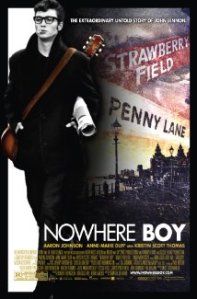
movie posterNow I know why I’ve always disliked the song “Julia”—the only Beatles song, other than the misogynist “Run For Your Life”—that I’ve ever said that about. It’s so dirge-like and mournful, so different from their usual upbeat fare, including their ballads. Having just seen Nowhere Boy, the story of John Lennon and his two mothers (Mother Julia and Aunt Mimi), I know why the song is such a downer: it is in fact a dirge, a kind of epitaph for the woman who gave birth to John and cared for him until he was five, when Mimi took and raised him.  Nowhere Boy brilliantly takes a slice of John’s life, short in duration but deeply significant, to create a film that encapsulates almost everything we  need to know about Lennon to understand the man and his music.

–MILD SPOILERS AHEAD–

The movie opens with John as a 16-year-old madly in love with American rock ‘n’ roll, but with no musical knowledge or training.  Through a series of events he comes in contact with his mother, Julia, who he hasn’t seen since he was five. At that time his father tried to take him from her, planning to drag him off to New Zealand. Julia passively let him go, but her sister Mimi grabbed him from his father and, with her husband, raised him.

Mum is now remarried with two daughters, and thrilled to see her long-lost son—who lived right around the block from her! Julia’s a lively gal, and behaves more like John’s girlfriend than his mum in every gesture and act, but this is never commented upon in any way by anyone. Julia’s husband doesn’t want John hanging around so much; apparently Julia’s prone to breakdowns, and he thinks she can’t handle it. And Mimi–well! It’s the age-old story of the sensible devoted woman who fed, washed and looked after John all these years being shoved aside for the flighty beauty who abandoned him.

Unfortunately, the story went a little differently, according to Julia Lennon’s bio in Wikipedia, than this cinematic portrayal; actually, not a little but quite a lot: “After complaints to Liverpool’s Social Services by her eldest sister, Mimi Smith (née Stanley), she handed over the care of her son to her sister. ” Additionally,  Julia saw John almost every day, and by the time he was eleven (and not, as the film tells us, 17) he was frequently staying overnight at her house. Having read the story after seeing the movie, I can’t help but question its point-of-view entirely.

One place where history and art agree, however, is that Julia influenced John’s development as a musician. In the movie she hands John a mandolin and teaches him to strum (“think Bo Diddley, she says”) and she’s always singing and dancing with him. “Why can’t I be Elvis?” he moans, and Julia replies, “Because the world is waiting for you to be John Lennon.” That quote is just too beautiful to complain about, even if the screenwriters made it up.

AaronTaylorJohnsonWhile John and Julia are getting to know each other John forms a band, begins performing, and meets Paul McCartney.  Thomas SangsterPossibly the best thing about Nowhere Boy, at least to my pure delight, is the casting for John and Paul: respectively, Aaron Johnson and Thomas Brodie Sangster. Each of them slips into his persona so effectively that after awhile they begin to look like the originals—and it couldn’t have been easy, psychologically, to play a pair of beloved icons for an audience mostly familiar with them. Their relationship is portrayed from the start as a rivalry, but I don’t know if the filmmakers were being faithful to reality or merely to legend.

The end of the movie is a matter of historical record, but if you don’t know it and don’t want to, stop reading. I didn’t know it, and was stunned when Julia got hit by a car and died.  When the movie was over, the song “Julia” kept slogging relentlessly around in my head on its endless loop of grief, and I had to play it—only to find that, knowing what I do now, I no longer hate it at all.Paul

JohnLennon-NYC

Soylent Green Is…

Posted on
soylent green

(Photo credit: vj_pdx)

********SPOILER ALERT********

Forty years after the movie premiered, I’d hazard a guess that most film goers know that Soylent Green is (GASP!) people! People….People eating people

I vaguely remembered hearing this, but I’d never seen the movie–until last night. Great experience. Forget for 90 minutes who Charlton Heston became in his

English: Actor Charlton Heston at the Civil Ri...

Charlton Heston at Civil Rights March, Washington, D.C., August 1963  (Photo credit: Wikipedia)

later years, and see him as the great actor he was; also sexy as hell. If you’re a sci-fi fan you’ll love SG, and if you aren’t, you’ll love it too. As intelligent as any Twilight Zone playlet, as gripping–even with the ending suspected or known–as any detective story (which it is) and as visually grand as today’s super special effects, Soylent Green kept me in and on the edge of my seat from start to finish. And what a finish!

English: Publicity still of actor Edward G. Ro...

Edward G. Robinson. (Photo credit: Wikipedia)

Throw in Edward G. Robinson, deviating from his usual gangster persona, in his 101st–and last–movie role, and SG is a feast for the mind and senses.

It’s always fun to return to predictions of the future in old sci-fi movies or books, and SG is no exception. The year is 2022 (not so far off) and the most salient futurism, besides the food, is climate change: it’s hot all the time. So hot that vegetables don’t grow, and sweat pours down the actors’ faces. There’s no air-conditioning relief, either: like everything else, it just doesn’t work. Overpopulation is the next biggie: at night the streets and stairways are full of sleeping people one on top of the other.

The world of SG  includes voluntary suicide booths. These have appeared in at least one TZ episode, a Kurt Vonnegut story, and several other works of fiction both pre- and post-Kevorkian. When I was younger these seemed horrifying; now they look like a great way to go. You get to plan the time of your death, choose the lighting and the music, and watch gorgeous films of nature–which the deprived denizens of SG have never seen in real life. In 20 blissful minutes it’s all over. Better than cancer, no?

Soylent is a manufactured food that comes in more benign colors than green, and it’s all anyone except the super-rich gets to eat. Brings to mind Monsanto and genetically engineered food. Lest we forget, vigilance now and in the future is the order of the day.  Never has it been so literally true that You Are What You Eat!

I give Soylent Greenthe movie, that is5 big fat stars. If you’ve never seen it, rent it. And if you have, I’m probably inspiring a re-run.

La Dolce Vita

Marcello MastroanniLa Dolce Vita

Marcello Mastroanni
La Dolce Vita

Art both reflects and creates culture.

I love that pithy phrase: so much truth in so few words. I first heard it circa 1974 when I was running around Manhattan performing home-grown drama with Womanrite, a feminist theater collective (another pithy phrase, but somewhat less truthful and praiseworthy). I thought about these words, and the idea behind them, after watching Fellini’s La Dolce Vita last night.

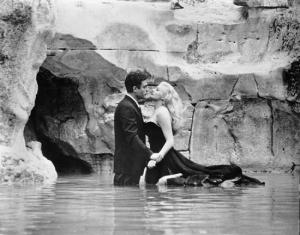
It was my first viewing, except for the famous scene of Anita Ekberg frolicking in a Roman fountain with Marcello Mastroanni—named Marcello in thela-dolce-vita

film as well. It’s frequently shown as cinematic homage or in nostalgic documentaries. Anyhow, it occurred to me that, while my generation and my mother’s went gaga over Fellini’s movies, a 20- or 30-year-old watching La Dolce Vita today probably wouldn’t think much of it at all. We were awed by all things Felliniesque—but now that the whole world is Felliniesque, his stuff doesn’t rock the way it did back in the day.  Someone born into today’s world is likely to find La Dolce Vita unremarkable outside of its sociological context.

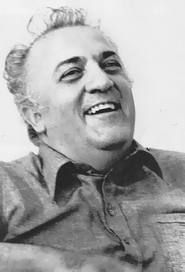
Art creates culture. How much of the world we live in sprang fully formed from Federico Fellini’s imagination? Art reflects culture. Was Fellini predicting the future, or simply portraying the times he lived in? My favorite writer-guru, Doris Lessing, says that predicting the future is merely a matter of studying the present with full consciousness, then logically extending that vision. Fellini saw hints of what was coming, and presented a logical conclusion, or rather evolution, in film.

Federico Fellini

Federico Fellini

When I visited Rome in the mid-90s, Federico Fellini had just died, and his funeral procession passed by my hotel. If I, who actually lived during Fellini’s lifetime, find La Dolce Vita unremarkable, younger people must surely see even less in it. Yet when it came out in 1960 it was considered scandalous.

Take a good look, kids, at  today’s scandals. There’s your future.

Kissing Jessica Stein

Posted on

I just adored this movie. I don’t know, maybe I’d notice problems on a second viewing, but it seemed perfect in every way on the first. Jennifer Westfeldt as Jessica is exactly right as a somewhat conservative young woman who’s nervously bi-curious; she sets out to scratch her itch, kicking and screaming all the way. Her family, especially her loving mama (Tovah Feldshuh, a regular guest lawyer on Law & Order who deserves more acting exposure), gives great Jewish attitude. Girlfriend Helen (Heather Juregensen) is gorgeous and thoroughly believable as a bi woman who’s as comfortable blending her sexuality as she is blending 3 lipsticks. (Westfeldt and Juregensen wrote the script as well.)

Jessica’s jumpy jitters about coming out—a phrase that’s never uttered but runs silently through every scene—and her fear of admitting she’s involved in a – gasp! – lesbian relationship is entirely believable: within minutes I was reeling back to my first serious relationship with a woman, in which I felt natural and altogether right when we were indoors alone or with other women, but was secretly and silently freaked out the minute we stepped outside. Unlike Jessica’s long period of foreplay, which lasted something like 3 months, I acted as if I was rarin’ to go, but deep inside I was as terrified as she was. That fear vanished in afterglow–but fear of coming out to old friends, co-workers, and family never went away. I wonder if that means the movie’s dated, considering that my “coming out” occurred in the mid-70’s, and in Jessica Stein we’re talking about last year. I don’t think so, though: human emotions are eternal, and besides, though attitudes have certainly changed , families and co-workers of those who step over the line, no matter how liberal they want to be, just aren’t universally sanguine about it.

Other than that tiny possibility, there’s not a false note in this film. It’s funny and occasionally poignant, without the saccharine sentimentality usually injected into the topic. Oh and by the way, it’s also sexy—very. Not as in X-Rated, more as in real life. Maybe as lesbian movies improve they’ll erase the memory of Lianna, a feeble attempt by John Sayles to normalize lesbianism that included the most distasteful portrayals of human sexuality, of any kind or gender, I have ever seen.

I don’t want to give away the ending to KJS, so I won’t say anymore about the plot. Rent it today, girlfriend, and see it with a girl. Or boy.  Afterwards play Katy Perry’s I Kissed a Girl .

One Mo’ Time: Hollywood and Race


Red Tails isn’t my kind of picture (warriors; loud guns; noisy machinery), so I haven’t seen it. Years ago I didn’t go see Glory – about an all-black Civil War regiment – for the same reason; later I caught it on TV and loved it to death. Anyhow, while I can’t say anything much about Red Tails, now that I’ve heard it’s immersed in controversy, I want to jump into the fray.

Racial controversy in Hollywood is a recurrent theme, one I’ve written about several times. I still haven’t gotten over my shock and anger that Hollywood failed to notice two of my favorite movies, The Five Heartbeats and Set It Off. I saw the latter when it came out on DVD, so I don’t know what the audiences were like – but I saw The Five Heartbeats in three different theaters, each time dragging white friends along to see it with all-black audiences. Both those movies were, in my opinion, absolutely fantastic, and I’ve seen each of them several times. They were at least as good as any in their genres: one the story of a rock ‘n’ roll group, the other of a bank heist. Neither was nominated for any Academy Awards. At the very least, Queen Latifah, a mere child at the time, deserved an Oscar for her performance as a bad-ass gun-toting lesbian.

The most recent film to cause a racial dustup, prior to Red Tails, is The Help. The book as well as the film drew the ire of black women, particularly those in academia,  for a multitude of alleged sins: they protested that a white woman shouldn’t tell black women’s stories to begin with; the film trivialized the lives of black domestic workers; it overlooked sexual harassment and civil rights activism; and in the end it’s really just a white woman’s coming-of-age story.

The Help –  and its black and white ensemble cast — is being showered with awards left and right. I for one am thrilled that two female movies (i.e.,chick flicks),The Help and Bridesmaids, are knocking them dead at the award ceremonies. Meanwhile, Viola Davis, who won the SAG award for best female actor, probably did more to integrate Hollywood than anyone when she named her two greatest inspirations: Cicely Tyson and Meryl Streep.

Design a site like this with WordPress.com
Get started