Category Archives: spoiler

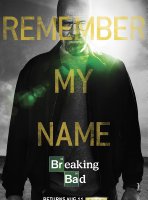
Endings: Breaking Bad: Spoilers

Walt & Jesse

MAJOR SPOILERS AHEAD! STOP NOW IF YOU DON’T WANT TO KNOW WHAT HAPPENS AT THE END OF BREAKING BAD!

We could probably count on the fingers of one hand how many long-running TV shows ended in a way that we found satisfying. Seinfeld comes to mind. M.A.S.H. Nothing else at the moment, though I’m sure there must be more, if few and far between. I mean, remember The Sopranos? Thus, when a show does deliver the goods in that last crucial episode, after flawlessly leading up to it with four or five intense programs, it seems like quite an achievement.

The ending of Breaking Bad left me completely, and fully satisfied. I’m not wondering what happened to this character or where did that one go, or why did that idiot do what he did. My one and only complaint is that Hank died, but since Jesse was allowed to live I guess I can forgive Vince Gilligan and Company. Besides, the sacrifice of Hank‘s character was integral to what followed.

Hank and Jesse were the only characters I really liked on BB….and maybe the eccentric lawyer Sol, who made a clean getaway, even if he is stuck in Omaha flipping burgers. Everyone else was either psycho—I loved it when Jesse called Todd and Jack’s gang a bunch of psycho fucks—or whining nags like Skyler and

Betsy Brandt as Marie Shrader (Photo: Imdb)

Betsy Brandt as Marie Shrader (Photo: Imdb)

son Flynn; good god, how those two worked my last nerve! Marie was no prize either, though in the final episode Betsy Brandt finally did some real acting.

Aside from the main climactic events, there were a few elegant touches executed only the way BB can do these things: for instance, the gun-on-a-turntable Walter rigs up to give those psycho fucks what they so richly deserved. The creation of that gadget brought us full circle in terms of Walter’s character, as he harkens back to the genius chemistry teacher we were introduced to in 2008. While he was setting up this contraption, I hadn’t a clue WTF he was going to do with it, and completely forgot it even existed…until the moment when Walt pushed the button that swung open the trunk of his car. Out came Robo-Gun, spinning like the turntable of a record player, firing off bullets instead of doo-wop. Within a few minutes, maybe even less, every psycho fuck but Todd and Jack lay dead and bleeding on the floor. Jesse got the gratification of choking Todd, the sociopath who physically tortured him, while Walt cut short Jack’s last drag on a cigarette the old-fashioned way, with a manual blast to the head.

By the time the cops arrived Walter was dead. Jesse refused to kill him for about the hundredth time in their complex father-son relationship, but it turned out he was shot by his own invention. No doubt he knew it might happen—but Walt’s been living on borrowed time already, and probably preferred to die now rather than endure a trial and prison, only to die of cancer during or shortly thereafter.

Anna Gunn as Skyler White (Photo: Imdb)

Anna Gunn as Skyler White (Photo: Imdb)

At least Walt made his confession before dying. Earlier he goes to see Skyler and begins by saying “Everything I did…” but she cuts him off, a great relief to her and to me, who could not bear one more bullshit declaration that he cooked meth and killed people “for my family,” the word so weighted in this context I could vomit. But Walt surprises her, and us: he tells the truth this time. “I liked it,” he said. “I was good at it. I felt alive.” It’s not like we didn’t know it, but still, I wanted to applaud: the guy came to terms before meeting his maker, if that is indeed what’s in store for him (and the rest of us).

Satisfying ending or not, saying farewell, even to characters I loathed, is just too sad.  The older I get the more I lose, and the more I see that’s one of  life’s big lessons. It’s why the Buddhists practice non-attachment: “When you ain’t got nothing you got nothin’ to lose.” But if I cry every time a show I love ends, imagine what it’s like when I lose real people or things. I don’t have to imagine…it’s happened enough already. Focussing some of life’s sadness on a show I loved is convenient. Satisfying.

Goodbye Heisenberg, you psycho fuck!

Bryan Cranston as Walter White (Photo: Imdb)

Bryan Cranston as Walter White (Photo: Imdb)

Stella Dallas: The Movie (1937)

Warning: Spoilers Ahead

I finally forced myself to watch Stella Dallas, a movie I’ve occasionally ranted about sight unseen. I did see the Bette Midler 1990 remake, though, and was so appalled it took me all these years to rent the original—which differs subtly but substantially from the remake. Maybe it’s because Bette Midler as trailer-park trash sails over the top with little effort, or maybe it’s the melodrama inherent in almost any part she plays—but her version of Stella has a definite POV, while the earlier film leaves space for the viewer to decide if Stella does right by her daughter.

At its heart the film is about class warfare. Stella is a young woman living with her dirt-poor family of Massachusetts mill workers, the only one among them with ambition. She’s taking business courses while Dad and baby bro work as mill hands and Mom schlepps around their tiny shack. Mom’s always hunched over, her hair a mess: the only thing missing from her slutty image is the dangling cigarette. Stella daydreams and watches the people come and go to the mill, her sights set on big shot “swell” Stephen Dallas (John Boles), whom she cleverly arranges to meet and manipulate into marriage. Trouble arises when Dallas realizes he took the girl from the mill but can’t get the mill out of the girl. Stella has a “vulgar” side she’s not even aware of herself. Imagine Midler as vulgar: piece of cake, right? Stanwyck’s Stella, though she talks tough and loves to dance, comes off so sweet it’s hard to sympathize with Stephen. I’m sure I’m not the only person who couldn’t stand his smug, weak-chinned visage—which is just as well, since he’s gone most of the time, all but abandoning Stella after their daughter’s birth when he moves to New York, ostensibly for business purposes.

In one scene Laurel (Anne Shirley) is a toddler, and in the next she’s a teen. In the intervening years, Stella has all but given up her partying ways to devote her life to her daughter. She sews the kid’s clothes by hand, monitors her social life, and pushes her to be like the snobbish bluebloods Stella used to want to know herself. At a Hampton-like resort, Laurel’s friends—spoiled brats one and all—cruelly mock Stella, not knowing she’s their pal’s mom : “That wasn’t a person, it was a Christmas tree,” they say, referring to her allegedly tasteless fashion sense (which isn’t half bad in black-and-white 2012). Stella wears heavy makeup, has a loud mouth, a brassy style, and…you get the picture. While Midler pulled this character off without a hitch, Stanwyck, except for the Brooklyn-ish accent, seems fairly “normal.”

Whether Stella’s vulgar or not, when she hears the rich kids making fun of her she has an epiphany: Laurel, she fears, will never be able to get very far as long as she’s stuck with her mother as an albatross around her neck. She hatches a brilliant plan, and asks hubby to let Laurel come live with  his new family; by now he’s married the woman he loved before he met Stella – a boring uptight blueblood who knows a salad fork when she sees one by god (crucial information for a mother dontcha know). When she tells Laurel what she’s decided, however, the kid, bless her gold-digging little heart, finally rises to the occasion. She declares undying loyalty to Stella,  and refuses to leave her.

This is the Big Moment in Stella Dallas, when Laurel acknowledges her mother’s devotion. Laurel doesn’t give a shit what the bluebloods have to say about Mom, she’s going to stand by her in love and loyalty. As I recall, this does not happen in the Bette Midler version.

Unfortunately, Stella subverts Laurel’s attempts to stay with her by feeding her a heroic lie, making it seem as if she wants to get rid of the kid and be free to have fun at last. Laurel buys the lie and moves in with Daddy, into the kind of household that makes her appear ever so presentable. She eventually marries the blueblood man of her dreams and lives happily ever after. Oh, yeah: She never sees Mama Dallas again.

I’ve compared the Stella Dallas story to the movie Spanglish, an immigration tale in which the mother refuses to let her daughter become “someone so different from me.” The values presented in each of these movies express directly opposing viewpoints of  the mother/daughter relationship. Stella Dallas declares that the daughter is better off gaining entry into the upper-class, even if it means cutting off the most important, loving relationship of her life. In Spanglish, by contrast, the mother-daughter relationship is paramount and worth preserving, even if it means giving up what might be a superior education and other so-called opportunities. Guess which reflects my own POV?

 Barbara Stanwyck was some terrific actress. Below is stuff about her from IMDB that I thought worth posting.

Everything You I Ever Wanted to Know About Barbara Stanwyck

• In 1944 she earned $400,000, and was listed as the nation’s highest-paid woman.

• She was nominated four times for Academy Awards, including for Stella Dallas, but never won any of them. In 1982, however, she was given an honorary Academy Award for “superlative creativity and unique contribution to the art of screen acting.”

•When she died on January 20, 1990, she left 93 movies and a host of tv appearances.

Barbara Stanwyck: Fire and Desire is a TV biopic ( 1991) directed by Richard Schickel that takes a look at her life and career. Stanwyck’s life seemed to mirror many of her famous roles.

• Stanwyck was frequently cited as a role model by such women actors as Sally Field and Virginia Madsen.

• Her stormy marriage to Frank Fay finally ended after a drunken brawl, during which he tossed their adopted son, Dion, into the swimming pool.

• Despite rumors of affairs with Marlene Dietrich and Joan Crawford, Stanwyck wed Robert Taylor, who had gay rumors of his own to dispel. Their marriage started off on a sour note when his possessive mother demanded he spend his wedding night with her rather than with Barbara.

Marilyn Monroe, who worked with Stanwyck in the 1952 film Clash by Night said that Stanwyck was the only member of Hollywood’s older generation who was kind to her.

• Her Honorary Oscar for lifetime achievement was presented to her by John Travolta, who later confessed that the experience was his supreme Oscar moment, and that Stanwyck had been a Travolta family favorite for years.

• She is the Godmother of Tori Spelling.

• Her favorite role, she said, was Stella Dallas.

• A Grand Dame. Alas, she was a staunch conservative Republican.

My Personal, Quirky, and Wildly Eclectic Cultural List for 2010


As I recently said on my post about the Millionaire Matchmaker, I’d hoped to compile a list of all the movies, books, and other cultural items I’ve ingested during the year 2010. Lacking time and energy to complete it, I’m just going to post what I managed to finish. I’m in awe of those critics who post Best Of lists, considering they must have read and seen a lot more than the ones they choose as “Best.” Me, I just dump everything – best, worst and middling – in the same place. I can barely get it together to do that.


First-Run Films

Warning: Spoilers Ahead


The Kids Are All Right. As the first mainstream movie about lesbian parents, this of course stirred up a bit of controversy. I found it to be a fun, enjoyable movie, if marred by an implausible ending. Full review here.

Religulous: Bill Maher’s funny, intelligent rant on religions across the spectrum held my interest for the first hour, but eventually got repetitive. Still, bless Bill Maher, even if he doesn’t accept blessings. I’m almost always in agreement with his views, so naturally I think the world needs his intelligent outspokenness, and more media figures like him.


Hereafter:  In contrast to the above, this movie explores the spiritual dimension and what might happen after we plotz. It’s a subject I’m always drawn to, and I was expecting at least a glimpse of enlightenment from Clint Eastwood’s take on it. Unfortunately, he didn’t contribute much of anything new to the conversation. Everything in here was said by the hospice movement and people who’ve had NDE’s (near-death experiences) over two decades ago. A rarity from Clint Eastwood: disappointing.

Inception: The premise –people can enter other people’s dreams and change them – is intriguing, so, despite knowing this would be replete with explosive special effects, which I usually can’t abide, I went to see it. I tried hard to stay alert and to follow the plot for the first half hour or so, but finally gave in to, first, annoyance, and second, boredom. Finally I fell asleep, jerked awake every now and then by an on-screen explosion. I suppose it’s unfair to ‘dis a movie I slept through, but there’s a reason I slept through it.

Going the Distance: A romantic comedy about a couple who try to keep their love alive, shuttling back and forth between their respective home bases in New York and San Francisco. 
Drew Barrymore is, as always, a joy in both appearance and performance, and this is a pretty funny movie. Still, it paled by comparison to another romantic comedy that came out months later:

Love and Other Drugs: This was THE best film I saw in 2010; apparently I’m alone in my opinion. The movie didn’t get a Golden Globe nomination, though the actors — Anne Hathaway and Jake Gyllenhall —  did; nor is it getting much press on Best lists. On a recent radio show about the year in film, speculation was that the subplot, centered on the main character’s younger brother, destroyed the movie with its inanity. Also, the relationship story skittered all over the place, so audiences didn’t know what to make of it. Now, I’m the first to underestimate the capabilities of movie-goers, but I
can’t believe that people didn’t get this picture of a real relationship (hence the many shifts in tone). I wouldn’t be surprised if the critics’ problem with Love… stems from the many sXXXplicit scenes. Which, as well as being emotional, advance the relationship and the plot, and are aesthetically pleasing, to say the least (look at him!). Many levels to the relationship and the movie; It has a lot to say about values and the way we choose to live our lives.

Social Network: I can’t believe I forgot to include Social Network on my list (I’m adding this to the list weeks later), especially considering it looks to be the big winner of the awards season. I loved it — thought it was engaging, interesting, and well-acted. Best of the Year, though? I dunno–the pickings are slim when something like this gets so many raves. I remember when Big Important Movies got chosen as Best. OTOH, maybe Social Network is a Big Important Movie.

Little Fockers: Totally trashed by the critics, Little Fockers was nonetheless the best-selling movie of Xmas weekend, no doubt because it was just about the only comedy playing. I knew it’d be a stretch to dredge up anymore humor from these characters, and it was. One running gag centers around twins who look nothing like one another: the girl is huge and smart, while the boy is little and dumb. “Jokes” about suffering children just aren’t funny. Harvey Keitel and Laura Dern were thrown into the mix for their star power; a half-minute scene between DeNiro and Keitel was the best bit in the movie. I sure hope they don’t try for a fourth go-round.

Older Movies (Via DVD or TV), rated with the 5-star system

****Heat and Dust (second viewing)

***Michael Jackson (his swan song)

***Being Julia

***The US v. John Lennon

***Yoo Hoo Mrs. Goldberg

**The Ballad of Jack and Rose

***The Bucket List

***Angels in the Outfield (Second viewing)


Books

The Appeal : While I could never subsist on a steady diet of John Grisham, he’s good for an occasional jaunt. The Appeal was, unlike most of his books, a bit depressing, without even a hopeful ending. Because of it, though, I will never again regard an electoral campaign for a judge in the same way, and in this last election I declined to vote for any judicial candidates. In an afterword, Grisham warns, “As long as private money is allowed in judicial elections we will see competing interests fight for seats on the bench.” Actually the whole book is a warning – and a highly effective one.

Deer Hunting With Jesus by Joe Bageant: See his website. Defender of every average Joe, whether plumber or bartender, this guy writes great radical critiques of America from a working-class POV.

Not Much Fun: The Lost Poems of Dorothy Parker: Maybe they weren’t much fun for her, but for readers they definitely are. Just don’t consume too many at one time or you just might want to go out and shoot someone – or yourself.


Jane Bites Back by Michael Thomas Ford. This is a hilarious page-turner. Ford and his twisted mind take the reader on a roller-coaster ride that made me wonder why I’ve shunned the vampire genre up until now. Actually, JBB doesn’t fall into any genre, fangish or otherwise, but is a novel/romance/satire / mystery all rolled into one. Jane, by the way, is Ms. Austen, undead in a remote little town in upstate NY. Ford, who (full disclosure) is a friend, has a sequel in the works. Complete review here.

Confessions of a She-Fan: The Course of True Love with the New York Yankees: Jane Heller, a writer and passionate Yankee fan, served notice in an op-ed piece for the New York Sunday Times her intention to “divorce” the team. The huge angry response she got from readers spelled out book contract, so Heller went on the road to follow the team. The result is the first book about baseball (as far as I know) that talks about the game from the perspective of a woman. Full review here.


The Beauty of Love: A Memoir of Miracles, Hope, and Healing: Yankee catcher Jorge Posada and wife Laura tell the gut-wrenching story of their son, born with a condition called craniosynostosis. If untreated, it can cause seizures, visual impairment, misalignment of the spine, and / or developmental delays. He was operated on at nine months old, at two, and at three, altogether racking up eight complicated, 12-hour surgeries in his first six years of life. The Posadas describe, in alternating chapters, how each evolved “from victims to warriors.” Full review here.

Frank Lloyd Wright, OR, My Mid-Year Mania: It all began with The Women by T.C. Boyle; I’d read several of Boyle’s books and loved every one, so I bought this historical novel about Wright’s life, his eccentricities, and his work, told from the vantage points of the four significant women in his life. Despite the poorly chosen title, Boyle managed to pass along the intensity of his own obsession with the man. Wright was a visionary who juggled massive building projects and complicated households of lovers, children and apprentices, without a steady income and without being able to pay those who worked for him half the time. The house he built as a home base for his empire, Taliessin, burned down at least twice, rising from the ashes like the phoenix, and was rebuilt each time despite there being no money for materials or labor.


The beginning of Wright’s story is told by his first wife Catherine; next comes Mamah, his soul mate who was brutally murdered; then there was Miriam, an evil nutcase who manipulated him into a relationship; and finally Olgivanna, the last Wright duchess who carried on his name and work at Taliessin for many years after his death. After I finished The Women, I wanted to know  more about Wright’s architecture, and read Loving Frank by Nancy Horan, the New York Times architecture critic (I wonder why the names of books about Wright are so unimaginative). After that I did my own online research and rented several video tours of Wright’s houses. See where a novel can lead? Who needs school?

On Beauty by Zadie Smith: A page turner with a lousy ending.  I’m lately noticing that too many books, short stories, and movies, simply go kerplunk at the end. You can tell the writer had no idea how to end things. Sometimes these abrupt or, the opposite, hanging endings can ruin everything that came before. Anyhow, I liked Smith’s earlier book, White Teeth, much better than this one: it was fresh and new, with a broad view of contemporary London.


The Help by Kathryn Stockett: I read this at the start of 2010, and I wish I’d written about it while it was still fresh in my mind. The story of black maids in the South during the 1950’s, it’s a riveting page-turner with the ring of truth, and it’s based on truth: the author is a white woman from the South who lived it out. Here are some links to stories about the book and the writer.

California Literary Review: http://calitreview.com/2526

Interview w/ KS: http://www.bookbrowse.com/author_interviews/full/index.cfm/author_number/1663/Kathryn-Stockett

Oryx and Crake and The Year of the Flood by Margaret Atwood. These two books, along with The Help, were the best books I read this year – they were certainly the most profound. Atwood’s vision of a future dystopia is staying with me a long time. While Oryx and Crake was written first, I read The Year of the Flood before it; I think if I had not, I wouldn’t have liked the earlier book as much as I did. Flood is much juicier, with more characters and events, and because I didn’t want to leave Atwood’s world when I finished it I immediately got the other book. I don’t think it would have worked the same way in reverse.

Just Kids by Patti Smith: A memoir of her relationship with the photographer Robert Mapplethorpe, this book won the 2010 National Book Award in the genre. Before she became the godmother of punk rock, before she sang one song or read one poem in public, Patti Smith fantasized becoming the wife, or the muse, of a great artist whom she could nurture and support. (I guess you can take the girl out of the frilly dress, but you can’t take away her frilly-girl fantasies.) Patti found her great artist in the person of Robert Mapplethorpe and for a few years lived out her dream on a grand scale. They lived in the Chelsea Hotel, where they did their art and, more significantly, bumped into and befriended people like Janis Joplin, Jimi Hendrix, the Warhol Factory crowd, and a cast of thousands. In Max’s Kansas City she met Sam Sheppard, with whom she had a torrid affair, while Robert was off exploring his homosexuality. From their first meeting in a Brooklyn apartment to their last moments before Robert died of AIDS, it’s a romantic, poignant tale of eternal soul-mate friendship written in poetic prose. It’s also a vivid evocation of a remarkable time and place.

Whew! It took almost as long to write this as to read and see everything!

The Kids Are All Right: Movie Review

Posted on

Kids All RightWarning: Spoilers and X-Rated Material Ahead

Of course the kids are all right. I always knew they would be. Some people were wringing their hands, fretting about how children raised by gay couples might turn out, but I never thought they’d have it any worse than kids from other family configurations – then again, I don’t worship at the altar of the nuclear family. Besides, unlike straight couples who just assume they’ll have children, those living outside the norm are forced to think long and hard before jumping into parenthood; in fact, they don’t “jump” at all – they sometimes go through hell and high water just to become parents. And once they do have kids, they tend to be fairly conscientious raising them. I’m not idealizing gay parents or saying they’re better at it; it’s just that living outside the mainstream in any way whatsoever forces people to deal with a host of issues that heterosexuals never have to think about.


Surprisingly, however, the film’s title is hardly the point. It turns out to be not so much about kids raised by lesbians, but rather about love and family and betrayal, and all the complexities in long-term relationships. It’s about sexuality and sexual identity and the longing for connection. That the kids are all right is almost incidental.

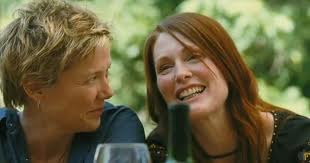
Eighteen-year-old Joni, named for Joni Mitchell and played by Mia Wasikowska, has the riveting looks of Claire Danes; she also happens to resemble someone I know, and I could hardly take my eyes off her. Which is quite a feat when you consider that Annette Benning and Julianne Moore, both knockouts, play the mothers. Their gorgeous looks are underplayed: if they were wearing any makeup in this movie, it was to highlight sags and wrinkles. When Moore’s character dons her gardening gear, she comes off looking like a middle-aged Annie Hall wannabe.Kids All Right

The plot is set in motion when 15-year-old Laser (Josh Hutcherson) convinces his sister to find their donor, the man whose sperm contributed to their existence, since he’s too young, by law, to get the information himself. Joni, afraid of hurting their mothers, is reluctant, but when she meets Papa Sperm (Mark Ruffalo), she just about falls in love with him. So does everyone else in the family, with the exception of Mama Benning, whose fear of rocking the boat turns out to be well-founded: Mama Moore, while creating a lush garden Papa Sperm hires her to do, jumps into bed with him. The affair almost tears the family apart. That they survive is testament to the strength of their bonds and loyalty to one another – or so I perceive director Lisa Cholodenko’s point to be.

Mark RuffaloThe sex scenes between Moore and Ruffalo are wildly, passionately, animalistic. She literally tears his pants off, and greets what’s inside them like a long lost friend: “Hel-lo!” she says, apparently awestruck. Two or three substantial scenes of their lovemaking follow, in sharp contrast to the women’s sex: there’s been just one anemic scene of them in bed. In it we see Moore moving about under the covers, and Benning’s facial expressions – which would work if she were actually being expressive, but if anything, she seems bored. From underneath the quilt comes the buzz of a vibrator. More movement. End sex scene. The lesbians sitting behind me were laughing their asses off in recognition, and I confess I too got a chuckle out of the scene. The hetero sex scenes had not yet occurred, so it’s only in retrospect that I feel the lesbian couple got the fuzzy end of the lollipop.

More important, because Moore has such a raging good time in penis-land, what comes later on, in the confrontation between her and Benning, seems off kilter.  It’s evasive, even false. A bisexual friend of mine was miffed because Benning asks, “Are you straight?” rather than “Are you bisexual?” The latter question, I think, would’ve been out of character, especially during a confrontation – but there is something missing here. Benning’s question doesn’t even seem to register with Moore, and when Benning asks if it was about sex, Moore makes a dismissive face. Finally, she claims that she slept withKids All RightPapa Sperm because she was feeling “unappreciated.”

Is that what she was getting, her legs high in the air while Papa Sperm pounded into her like a steamroller? Appreciation? Gimme a break! The intensity of the hetero sex scenes, and the absence of romanticism, utterly contradicts the lie.

So I have to ask: Why? Why did the director stereotype lesbian sex as warm and cuddly, while depicting straight sex as raw animal pleasure? Was it fear of letting a mainstream audience see what women really do in bed? Or was she just rewinding old tired stereotypes of female sexuality? I guess it was foolish of me to expect Hollywood to move beyond lesbian stereotypes — a good movie about lesbian mothers is enough of a leap.

But here’s the thing: my criticism isn’t coming from some pro-lesbian-passion crusade. This is not a political ax I’m grinding. What I’m talking about is honesty and believability in art. The director’s choices regarding sexual portrayal wreck the film. Oh, sure, it’s a fun movie, it’s enjoyable to watch  – but the premise of the film doesn’t work, not if the implication at the end is, as it appears to be, that the family’s bonds are far stronger than a roll in the hay, and their relationships will heal and go on. From what I saw between that man and woman in bed compared to what I saw between the women’s sheets, I don’t believe this ending one bit. I don’t believe that Mama Moore will be faithful from now on. She’s going to stray again. And again.

Spanglish Spoiler

Spoiler Alert: I am about to discuss the ending of Spanglish, having just seen it for the third time—so anyone who doesn’t want to know “what happens” better cease and desist or accept the consequences.

Spanglish is a film that provides a whole new angle on the mother-daughter relationship. The movie is primarily about the immigrant experience, but the mother-daughter dyad is a major component. Writer/director James Brooks has set up an almost too obvious contrast-and-compare of the familial pairings—the American Bernice (Sarah Steele) and her mother, Deborah Clasky (Tia Leone), and the Mexican Christina (Victoria Luna) and Flor Moreno (Paz Vega). Extra spice is tossed in with the character of Evelyn, played by a sardonic Cloris Leachman, as Deborah’s mother. The ending, however, throws obvious out the window and saves the film from the realm of cliché.

In the typical immigrant story, the second generation defects from their parents; to achieve personal success, they must necessarily distance themselves from their cultural roots and, subsequently, their families. In one complex, event-filled, life-changing summer, Christine Moreno takes her first steps into American success. She almost makes it to the starting line, but before the opening shot is fired, her mother, in an act of supreme confidence and bravery, slams on the brakes.

After spending a summer at the beach home of the Claskys, her mother’s employers, Christine gets a scholarship to Bernice’s fancy LA private school. This comes about from the meddling of Deborah Clasky, who wants to “help” the intelligent, charming girl. On the surface it represents an unprecedented educational opportunity, but when Flor visits the school she rightly suspects it will turn Christine into a slice of white bread. Even Bernice’s father, played by an uncharacteristically subdued Adam Sandler, says he worries about what the school is doing to his kids. Thus, after quitting her job with the Claskys, Flor delivers the bad news to Christine: she’s not going to let her attend the school.

During their walk and bus ride home, daughter confronts mother with the usual tears and accusations. Christine has more of a case than many daughters in rebellion—this is, after all, about her education—and surely some members of the audience are outraged by Flora’s actions. She won’t budge, however, not even when Christine literally pushes her away with that most American of all clichés, “I need space.” Me, I wanted to cheer when Flor stuck her face into her daughter’s and said, “Uh uh, between you and me is no space!” A few minutes later Flor poses the question at the heart of the matter: Do you really want to become someone so different from me?

For Christine, it’s as if she’s been struck on the head with a hammer: she wakes up and makes the decision that will set the stage for her future. She recognizes that she does not want to become other, does not want to leave her mother and her culture behind in the flotsam and jetsam of what passes for American success. This represents a stunning new twist in the immigrant story. Flor deviates from the maternal script to want her daughter to do “better” than herself. Flor refuses to “sacrifice” their relationship for some dubious better future for her daughter.

This term, sacrifice, is used all the time to define the essence of American experience and the American family. Frankly, it’s a concept I’ve never understood, and about which I’ve often felt guilty, wondering if I’m missing some essential parental gene. But if every parent sacrifices for the next generation, when do people begin to live on their own account? When is it okay to simply live one’s own life? According to the American Dream, not only are individuals expected to sacrifice, but whole generations are expected to do so. Everyone is supposed to struggle and strive. When does anyone get to relax and enjoy their lives?

In specific terms of the mother-daughter relationship, when have we ever heard or seen a daughter who wants to be like her mother, a daughter whose every move, breath and action isn’t intended to separate herself in some way from the hated maternal figure? I can’t recall ever seeing a film or play, or reading a book, in which any daughter beyond the age of puberty wished to emulate her mother. The perfect emblem of this denouement is Stella Dallas, in which a mother parts forever from her daughter so she can marry a wealthy man without being embarrassed by her lower-class roots. Think of the values touted in Stella Dallas: the mother-daughter relationship is far less important than material gain!

If ever a fictional mother prevents her daughter from “bettering” herself, she’s portrayed as deeply neurotic, clinging, and overbearing. Flor is anything but neurotic: it bears mentioning that she’s a role model worthy of emulation–a gorgeous, smart, kind and loving woman who strives to make her life and her daughter’s life function at a fairly decent level without sacrificing herself entirely.

Virginia Woolf, writing of female friendship in A Room Of One’s Own, posed the question of what the world might be if, in a novel, women actually liked one another, if, as she put it,“Chloe liked Olivia.” What would happen if mothers and daughters were portrayed liking one another, if daughters admired their mothers so much they aimed to be like them? What if the prevailing American values were more in keeping with those of Flor and Christine?

I wonder if we’ll ever know.

On a somewhat lighter note, I must mention that one of my favorite things about Spanglish is Tia Leoni’s performance. She is hilarious, an absolute gem and a pleasure to watch. Given the stunning looks of Paz Vega and Victoria Luna, and their wonderful performances, whoever played Debora Clasky had to be really special to stand out here—and Tia Leoni is.

Design a site like this with WordPress.com
Get started