Archive for the ‘Year 9 Mathspig’ Category
 May 1, 2026
Australians are the biggest (or worst) gamblers in the world per capita…………………………………………………..


Do the maths.

Why?
Do you believe in luck? Gamblers do. They believe in lucky numbers, lucky breaks, lucky colours and even a lucky rabbit’s foot (It wasn’t so lucky for the rabbit.) But more than anything else gamblers believe in patterns.
The Coin Flip
 If we flip a coin an infinite number of times Heads:Tails ratio will be 50:50. But if you think of infinity as a long, long ribbon with a HTTHTHHTTT pattern then random flips means any pattern is possible. 10 H in a row is possible… or 20 H. It’s just that we suddenly see meaning in this pattern. This is the Gambler’s Fallacy. We see 10 H in a row and we say ‘Aha! The next flip has to be Tails.’ But it doesn’t have to be Tails. The next flip – as with all flips – has an equal 50:50 chance of being Heads or Tails. That’s all. But we are surprised when we see an extended streak of, say, Heads. What has happened in the past does not effect THE NEXT FLIP!!!!!
The Rouette Wheel

Roulette Wheel has 36 numbers and an equal number of Red and Black slots. ‘The most famous example of such a phenomenon occurred in a Monte Carlo Casino in the summer of 1913 when a roulette wheel landed on black 26 times in a row.’ The Decisive Moment How the Brain Makes Up Its own Mind Jonah Lehrer (Text Publishing 2009)
What do you think the gamblers did that night???
After a few Blacks in a row they started to think it was Reds turn and kept backing Red.
The Casino kept raking in the francs. It was a very good night for the house.
Posted in probability, statistics, statspig, Year 7 mathspig, Year 9 Mathspig | Tagged $, a year, Aussies, big, coin flip, gamblers, how much, losers, lost, online, per capita, per person, Roulette Wheel, The World | 2 Comments »
April 9, 2026
With the World Fuel Crisis in play, this post from 2014 seems more relevant than ever.
Note: All ‘imaginary’ human fat will be sourced from Liposuction facilities.

Of course, in heavy traffic you are burning up the bio-fuel/fat getting nowhere.
Fuel Consumption (F) can plummet, even for the Mini, from 3.4 kg/ 100 km to 6.8 kg/100 km to 8.8 kg/100km. You may as well get out of the car and walk!!
ENERGY:
Posted in algebra, Basic Bio-fuel Calcs, direct proportion, Middle School, Ratio, Year 7 mathspig, Year 9 Mathspig | Tagged Bio-diesel, bio-fuel, car, Crisis, diesel, drive, fat, Gas, green, how far, human, mini, Petrol, travel, World | Leave a Comment »
February 27, 2026


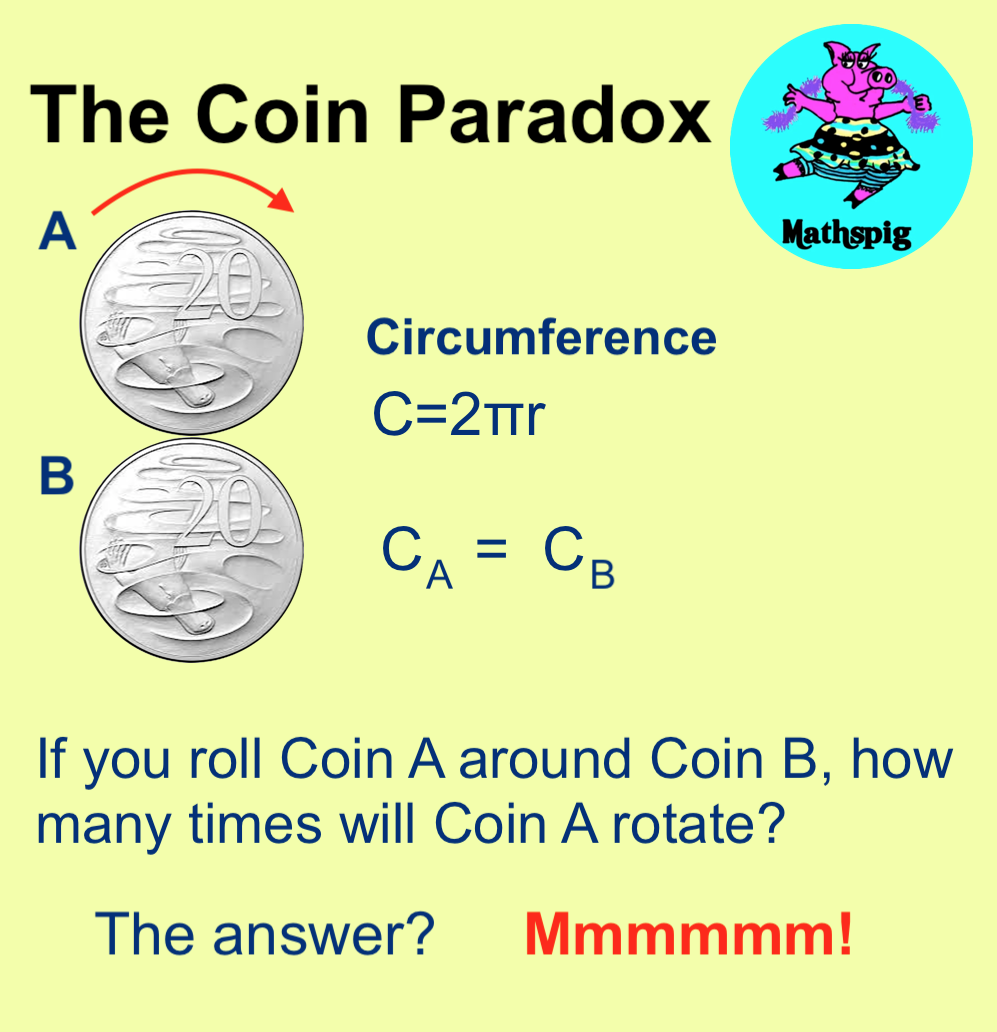
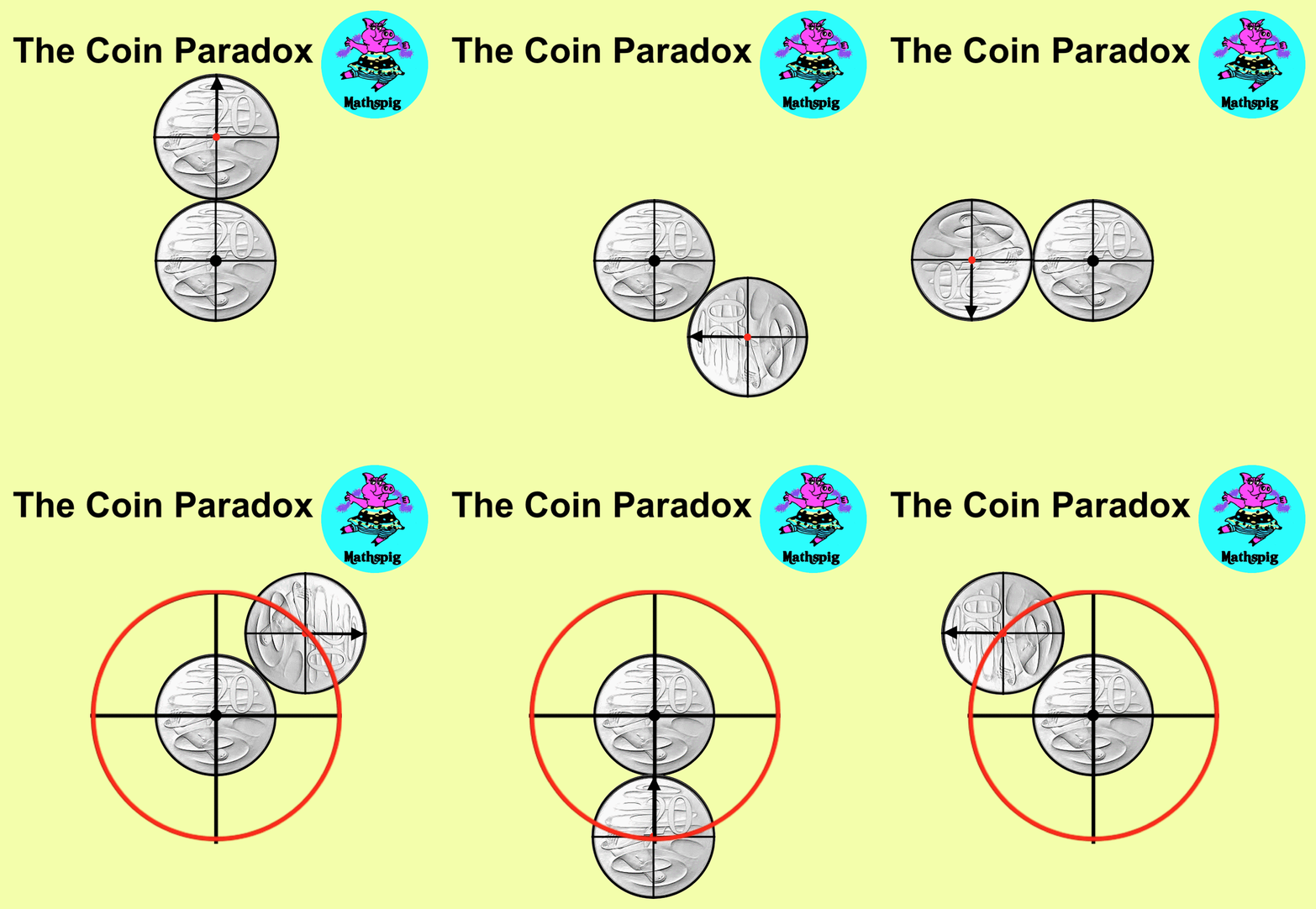
Consider the example of the coin rolling around a coin of the same size. Intuitively we think …’OK. Same circumference, so the coin will rotate once as it rolls around a same-size coin. But this doesn’t happen. It rotates twice.
TWICE!
This observation is SOOOOOOOO counterintuitive we have to know why?…
Why?
The answer is interesting. The relevant point in the ROLLING COIN PARADOX is the centre of the rolling coin. The rolling coin rotates about that point. And that centre (the red dot in the gif below) moves through a circle twice the circumference of the stationary coin. It is much easier to understand when you see it. (Below)

Posted in Circle C, Middle School, Year 7 mathspig, Year 9 Mathspig | Tagged challenge, circle, circumference, coin, crazy, exercise, Middle school, paradox, project, quick, radius, rolling, trick | Leave a Comment »
February 15, 2026
Air resistance is a significant factor used by ski jumpers to increase their jump distance.
Ski jumpers crouch going down the ramp to reduce their X-section area and therefore their air resistence. Once they leave the ramp, ski jumpers try to increase their X-section area to increase their air resistence like Ski Divers to slow their vertical fall. But they have to land safely, so they keep their skis at a minimum angle.

Austrian Stefan Kraft in the Men’s Olympic Ski Jump at Milano Cortina 2026

Abby Hughes, USA, practicing in a wind tunnel.
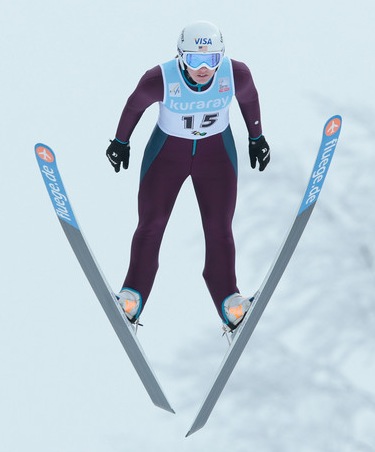
Abby Hughes, USA, in the air
Here are the X-section areas for Abby Hughes:

Mathspig calculated the X-section area by the old-fashioned method of counting squares and rounding off the final count. Mathspig sized the two pics of Abby Hughes so that her head was the same size in both pictures.
Here is the formula for Air Resistance of Drag:
D = ½CApv2
Where C is the drag coefficient or constant, which depends on the shape and spin of an object. It is found by testing the object in a wind tunnel.
A is the X-section Area,
p is the density of the air and
v the velocity of the object.
More here.
As Abby Hughes has tripled her X-section area in the air, she will have tripled the vertical drag during her jump. This will slow her descent.
Gold in the Men’s Ski Jump at the 2026 Winter Olympics goes to:
Posted in algebra, Area, Winter Olympics Maths, Year 7 mathspig, Year 9 Mathspig | Tagged 2026, air resistance, area, calculations, Domen Prevc, drag, gold, Japan, Large Hill, Middle school, Nikaido Ren, Olympics, Ski Jump, Slovenian, Winter, X-section | Leave a Comment »
February 8, 2026

Chocolate contains a poison called Theobromine.
LD50 for Theobromine for cats is 200mg.
LD = Lethal Dose. LD50= Lethal Dose for 50% of the population. Cats in this case. This is how poison toxicity is measured.
According to The Royal Society of Chemistry, cats are hypersensitive to Theobromine but, as cats cannot taste sweetness, they are rarely poisoned.
Posted in %, death by chocolate, Fast Food Maths, Year 7 mathspig, Year 9 Mathspig | Tagged 9 lives, adult, calculate, cat, cats, chemical, chocolate, death, dog, how much, humans, kill, theobromine, toxic, won't | Leave a Comment »
January 10, 2026
Correction:
It was 43°C (109.4°F) in Melbourne when Mathspig was writing the post!!! I used the wrong heading – now corrected -when it was first published.
The Maximum temperature recorded for Melbourne was 46.4°C (115.5°F) in 2009.
………………………………………….
ANSWERS TO Q 6 – 10 BELOW




AMAZING ANSWERS

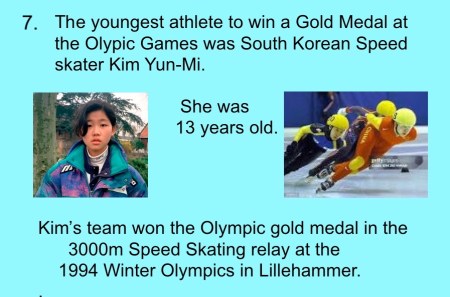

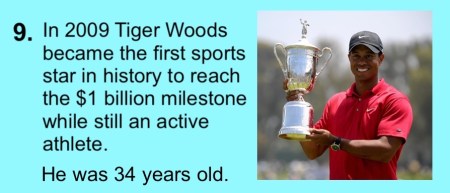

Posted in 25 AMAZING NUMBER FOR 2025, Middle School, Real Life Math, Year 7 mathspig, Year 9 Mathspig | Tagged $1 billion, 2025, earn, Middle school, million, Olympic, Prince, rates, real life, sports, star, statistics, youngest | Leave a Comment »
November 22, 2025
Posted in %, 10! or 10 Factorial, 25 AMAZING NUMBER FOR 2025, Decimals, Middle School, Real Life Math, Year 7 mathspig, Year 9 Mathspig | Tagged 1 MILLION SECONDS, amazing, blood, blood spurt, CUBIC, factorial, flavor, Foot Loops, how far, Middle school, Numbers, poop, rates, real life, SQUIRT | Leave a Comment »
February 16, 2025
How to Survive Zombie Attack
 How much will it cost to fill a bath tub with FAKE BLOOD?


Screenshot

It costs heaps more $US to have a SPECIAL FX BLOOD BATH than a Cheap Blood Bath and you’d have to do it every night of your ZOMBIE show.
Geek Zombie Maths
or Advanced Zombie Maths
You will find some amazingly advanced Zombie Maths @ Geek Zombie Maths
Posted in Decimals, Middle School, Units Volume, Year 9 Mathspig, Zombie Maths | Tagged Apocalypse, bath, blood, cheap, cost, fake, Fake Blood Bath, Halloween, Joke Math, Resident Evil, Special FX, stage, US units, volume, Zombie | 1 Comment »
February 16, 2025
How to Survive Zombie Attack
How much will it cost to fill a bath tub with FAKE BLOOD?


It costs heaps more $AUS to have a SPECIAL FX BLOOD BATH than a Cheap Blood Bath and you’d have to do it every night of your ZOMBIE show.
Geek Zombie Maths
or Advanced Zombie Maths
You will find some amazingly advanced Zombie Maths @ Geek Zombie Maths
Posted in Decimals, Middle School, Units Volume, Year 9 Mathspig, Zombie Maths | Tagged Apocalypse, bath, blood, cheap, cost, fake, Fake Blood Bath, Fun math, Halloween, Joke Math, Resident Evil, Special FX, stage, volume, Zombie | 1 Comment »
February 5, 2025
In the Apple TV show, PRIME TARGET, a young mathematician’s life is in danger because of his work involving PRIME NUMBERS:
2,3,5,7,11,13,17,19,23,29 ……..
In the TV series all global security codes are based on randomly selected Prime Nos. What if the selection is not RANDOM? If this code breaking information gets into the wrong hands the world is in danger.
Or NOT
If you saw a number like the following you may think Prime Numbers Rule the World. almost:
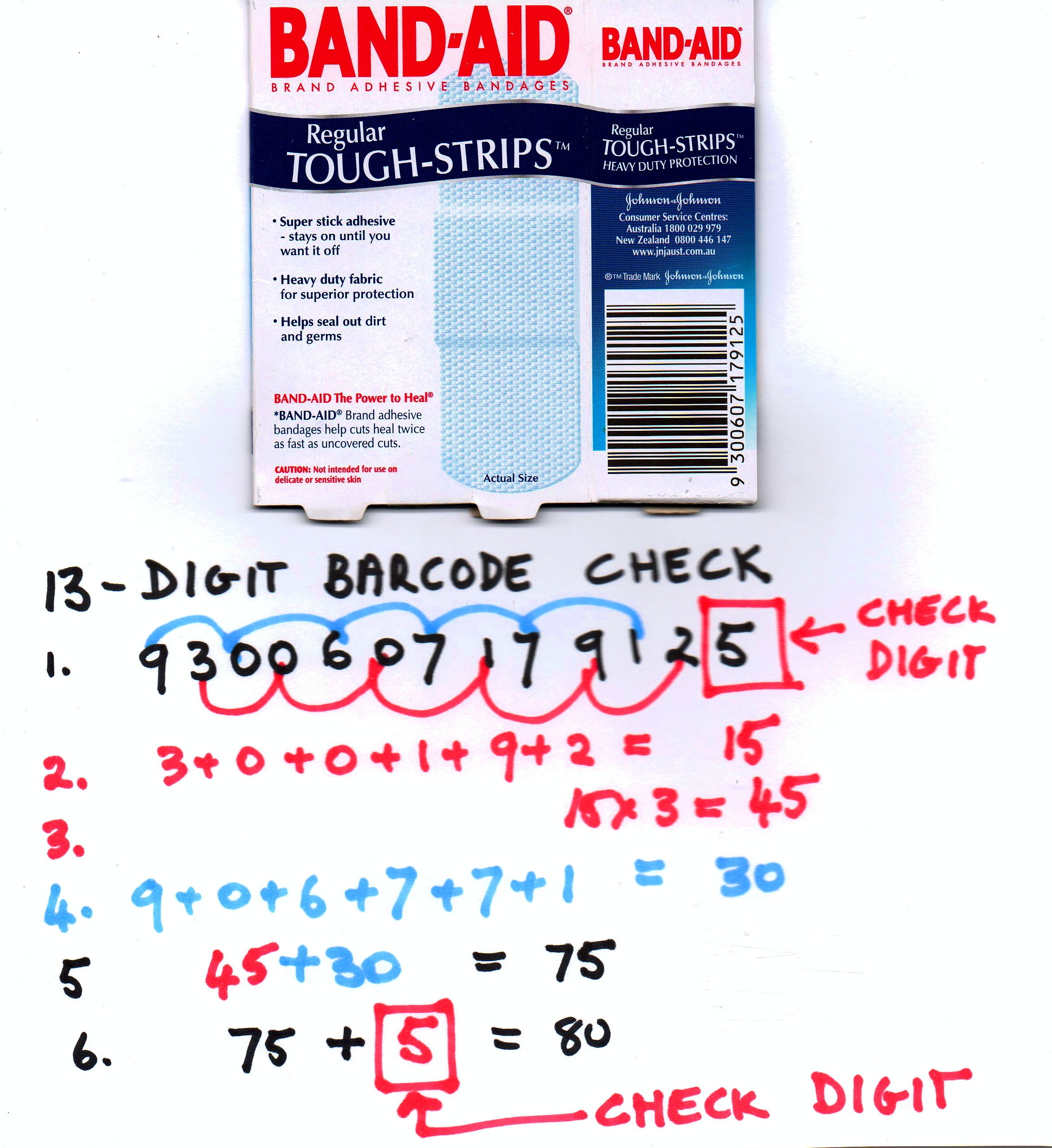
9 3 0 0 6 0 7 1 7 9 1 2 5
One code that uses lots of PRIME (and other) NUMBERS is the BARCODE. And this is how they work.

The cash register pings if the BARCODE CHECK DIGIT Algorithm matches the CHECK DIGIT, which is the last digit in the barcode. This is how the cash register computer checks that the data in the barcode has been transferred correctly. All data transfers have some sort of data check algorithm.
The PING is KING!!!!!!!!
Mathspigs, you can check your maths skills by picking up the nearest product with a 13-digit barcode and calculating the CHECK DIGIT. The answer is at the end of the barcode.
How a BARCODE works:

You can find an alternative explanation here.
If your calculations won’t work use the online CHECK DIGIT CALCULATOR (EAN 13). If it is right check your calculations again!!!!!!


Posted in Arithmetic, Junior School, Middle School, Senior School, Year 7 mathspig, Year 9 Mathspig | Tagged algorithm, barcode, BArcode Maths, check, Check Digit, easy, exercise, Fun, How do barcodes work?, Math, Middle school, ping | Leave a Comment »


 If we flip a coin an infinite number of times Heads:Tails ratio will be 50:50. But if you think of infinity as a long, long ribbon with a HTTHTHHTTT pattern then random flips means any pattern is possible. 10 H in a row is possible… or 20 H. It’s just that we suddenly see meaning in this pattern. This is the Gambler’s Fallacy. We see 10 H in a row and we say ‘Aha! The next flip has to be Tails.’ But it doesn’t have to be Tails. The next flip – as with all flips – has an equal 50:50 chance of being Heads or Tails. That’s all. But we are surprised when we see an extended streak of, say, Heads. What has happened in the past does not effect THE NEXT FLIP!!!!!










 Mathspig Blog