Partings, Bitter and Sweet…

I am not resigned to the shutting away of loving hearts in the hard ground.
So it is, and so it will be, for so it has been, time out of mind:
Into the darkness they go, the wise and the lovely. Crowned
With lilies and with laurel they go; but I am not resigned.

Lovers and thinkers, into the earth with you.
Be one with the dull, the indiscriminate dust.
A fragment of what you felt, of what you knew,
A formula, a phrase remains,—but the best is lost.

The answers quick and keen, the honest look, the laughter, the love,
They are gone. They are gone to feed the roses. Elegant and curled
Is the blossom. Fragrant is the blossom. I know. But I do not approve.
More precious was the light in your eyes than all the roses in the world.

Down, down, down into the darkness of the grave
Gently they go, the beautiful, the tender, the kind;
Quietly they go, the intelligent, the witty, the brave.
I know. But I do not approve. And I am not resigned.

– Edna St. Vincent Millay: “Dirge Without Music”


They say learning to let-go is the hardest lesson of life. For it is not a person’s thoughts that are missed in their absence, as much as their thoughtfulness. All things do come to an end and when the farewells have all been said and done or in cases tacitly implied, parts of them – their sentiments, their gestures remain with us; having subtly shaped us and that shared past into the present. What is missed is their twinkling eyes and singular statements that betrayed a yearning, and the delicate significance within those ephemeral moments that withheld a thousand promises.

To forget them is to deny your very being and to live with them nigh impossible. So what must a man do? How does one accept and move on?

McLeod – A Bastion of Hope

It’s that time of the year again when people make their way for new jobs: bidding the insti a final goodbye, amidst sad recollections and with a grieving heart. Some move out quietly, while a few others may find a bunch waving them off as they make their way to the buses and trains that await to take them away from that sleepy little town, maybe for the last time. And even as the volume of the senti status messages and wall posts decrease already, so will the number of calls and texts sent to that friend who lived down your corridor, whose room was the local hangout spot for night long bakar sessions and what-not. Moments will be missed and people will still be thought of – longingly, lovingly – but those contacts will be lost amidst the scores of new ones from work. And so life will move on.

———

Leaving college was difficult – almost as if a piece of me was being left behind. So naturally when my time at Roorkee came to an end, I went on this crazy, rampant spree of revisiting every nook and corner of the campus if only in a desperate bid to create memories – to keep the place alive, knowing fully well that the best of those memories had already happened silently, unplanned without me realizing then. I stayed back even as most of the people I knew, one-by-one, departed.

My trip to McLeod Ganj came about in June of the previous year, at the very end of my college term. It was an outcome of a long pending desire to escape the mundanity – of work, deadlines and wages – which was sure to reclaim me soon enough. As it turned out, McLeod didn’t quite appear to be the peaceful retreat I sought. The place was too full of people, and as a result, unquiet and often at some places unclean. Intensive commercialization had taken its toll on the surroundings and the once beautiful, serene location, home to the Tibetan government-in-exile had been reduced to a tourist destination that witnesses among others, countless Indian families with excess baggage and an even excessive litter of kids. The sheer number of cabs was an eye-sore and the blaring vehicles often ended up causing jams in the town square. My initial response was that of disappointment. And as I trudged up Tipa Road to Dharamkot, a mile away from the bustling crowds, I was hoping dearly the trip wouldn’t be for a lost cause.
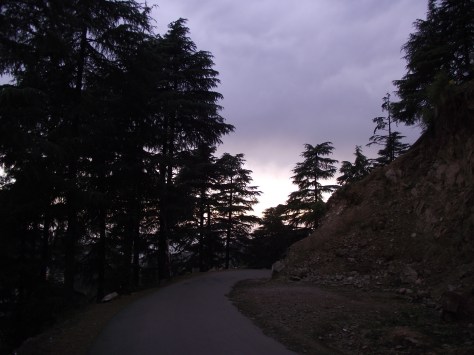
The getaway road: to Dharamkot and beyond

A small dose of afternoon slumber, though, saw much more than a changed weather. The place grows on you and I, on my part, soon learnt to look beyond the throngs of people and buildings. And as we moved a little farther anywhere from the heart of McLeod, there emerged landscapes that have stood silent witnesses to the undefiled beauty this place once was. A small trek of just over 3 kms. lead to a small hamlet – the village of Naddi.

Deodars lining the slopes near McLeod
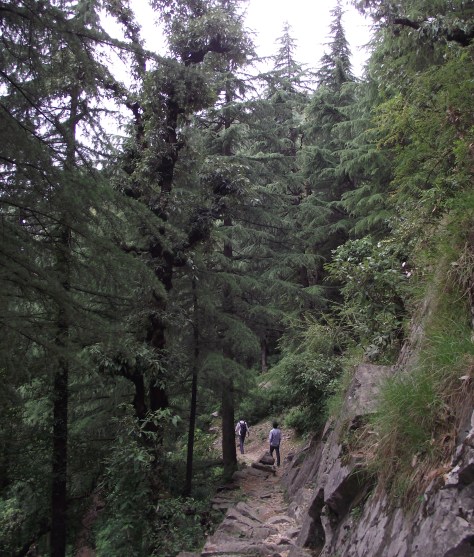
Road to Naddi and the Children’s Village, through the heart of Deodar forests

The narrow, winding path through the Deodar jungles was replete with its refreshing scent and Tibetan faith: cairns piled along the path and prayer flags fluttering in the cold mountain breeze, conspicuous among the branches by their motley of colors. The walk was delightful and the trees offered a much welcome shroud that broke only to offer some breath-taking views of the valley below. Far away in the distance, the Himalayas stood pensive, majestic; the very clouds descending over their lofty peaks. Most assertive of nature’s creations, the mountains have this humbling effect. We stayed there, soaking it all in, a silence broken only by the rushing of the stream in the valley below.

Prayer flags and cairns scattered around a clearing

The majestic Dhauladhars rising above the Deodar forests

In McLeod I saw Tibetans away from their homeland, as they lived and survived. A life in exile – each day a struggle to keep their traditions alive; keeping off the arms of modernism and local culture from snatching away their precious heritage. But more than anything else, they could be seen striving hard against their oppressors – for freedom, for a life of dignity and for the sake of their culture that is being systematically murdered. It was touching and inspiring at the same time to see a community bound by a common faith and the dream of returning to a free Tibet.

Stalls like these are lined all across the streets of McLeod

The place has so much to offer in terms of culture, adventure and volunteering. Treks of varying difficulty and duration can be taken up from here along with any gear or route maps that one may require. Food options are plenty, with so many restaurants that specialize in one or the other cuisines. Better still, the food is deliciously cheap. There is much to learn too in McLeod. And weaving through the numerous lanes and cafes of McLeod, I learned about the various initiatives like the Clean Upper Dharamsala Project – a reflection of Tibetans’ refined culture and their way of living that is in harmony with nature.

Tibetan Children’s Village: an effort at providing a semblance of normality

Unfortunately, the same can’t be said for the sensitivity the local government has demonstrated on such issues. In spite of the long grievous years of unfair treatment: invaded and exploited by an aggressively developing nation, sheltered yet shunned in another and snubbed, in general, the world over, the Tibetans’ have stuck to non-violence. They aim only to spread awareness and win the support of the international community for their cause in a world that would more easily pay attention to gun-shots and mortar. The cause and effects of the political nuances being played out at India’s northern borders are numerous and the petty bargains with China are keeping a nation’s future and their culture hostage.

A view of McLeod as seen from Dharamkot

McLeod is a sort of place whose beauty reaches out through the shrouds of human activity; its natural serenity in stark contrast with the buzz of life on its streets. It is one of those rare places that derive its color as much from the diversity of its people and their culture as from the enviable position it enjoys in the greens of Himalayas. To some, the place is a refuge, to others a symbol of resistance, while some others look back its way as a summer retreat. For me, McLeod was the end of an era – the most cherished one at that – and the wait for things new and unfamiliar… and a prayer that the wanderlust which grew in my heart then, may never die.

A World Of My Own

Everyday of this life is the sum total of two worlds – one that is shaped to our desires and the other of how life really is. If you are lucky, in a day, most things that come to pass will be parts of both these worlds.

But there will always be some days, when you would do all the right things and yet the only thing that you really wanted then in your life will elude you. It is difficult still, if you actually had that something for sometime. The heart, you see, has a way of holding on to moments, people or simply objects it comes to cherish. And it is then, more than ever, that the two worlds never felt more further apart. There is a terrible void instead that all the activities and objects of the second world are unable to fill in, as the mind continues to dwell in the only place it knows that dear thing still exists – the world of our desires.

Yesterday

This time, as I came back from McLeod, it was with a realization that it may be the last time for a long while before I’d return to Roorkee again. The milling crowd of rick-pullers at the station thronged the few passengers who had alighted in this undistinguished little town. And a myriad thoughts came rushing in with the question: “Kaun sa bhawan?”. Of how ‘Azad’ had jumped to my tongue so naturally and how this may be the last time ever anyone would unquestionably assume us to be students. Of how the next monsoons when the “Dehradun Jan Shatabdi” would return to Roorkee, running over with IITR folks, I wouldn’t be one of them.
It was 5 in the morning and the sky was overcast, with hues of sunrise. On the rick, while on my way to campus, the place never seemed more endearing or the weather more pleasant. It reminded me of the July here that I would sorely miss; the town that rushed to meet the hurtling train every new session. Inside an incessant chatter among scores of familiar faces. Outside the soft patter of the gently falling rain.

I remember from my childhood, the first time I returned to my hometown. It was 1994; two years after my family had shifted to this place near Delhi, where my father was working. Within this span of two years I had gained several inches and a degree of consciousness. This is when my earliest memories begin. I had the time of my life there in that place and the trip alone was enough to lose my heart to the countryside and its way of life. Games and harmless pranks with cousins, being chased around for a dose of playful licking, the restlessness of the lone soul unable to fall asleep on summer afternoons, the lanterns twinkling in the doorway as evening set in and the bedtime stories – they seem a part of a different life now. I remember vividly how upset I was on my way back home – the silent tears that were shed curled up on the upper berth of the train; its rhythmic shaking a slight comfort.

Between the two train journeys a world of difference grew. The years have been a series of journeys and escapades – some wilder than others, and with a fair share of joy and sorrow. Each experience was a lesson learnt and soon they were too many to remember. Growing up is tough. And probably because everyone gets their share of it, often underrated. Swamped under the task of all that growing up to do, moments became memories that faded or were carefully stowed away in those deep recesses of mind that are often unlocked only at moments when life stands still. Moments such as these. My countryside-dream melted away, as did others that dwelt in a mind untouched by the ‘wisdom’ that age is sure to bring. Back in those days, most of us longed to be so many things. Some of us still secretly do.

School days were like a long walk – from a bawling kid of which I have only a faint recollection to the awkward teenager – leaving a void in its wake. My college, on the other hand, was over in a heartbeat. And now lying down on the bed, whiling away my time, I wait for my job to start. There’s yet another vacancy to fill and expectations galore. I wonder what changes time will bring to my associations with the past – that old town and the people that came into my life in those four years I spent there; the shortest four years of my life…

In Azad, right next to our wing was a Jacaranda tree. And when the winter chill wore off, there it would stand bearing beautiful violet blossoms – the first traces of color after a spell of winter grey, even as the last remnants of mist hung about its branches. As spring gave way to summer, there they would remain – only a few now, clinging on hopefully, almost desperately; much like I was when the time to leave Roorkee drew nigh. They bloomed in spring and died with the summer heat like they always do; only the next time they blossom I won’t be around to cherish them anymore.

So Long…

Bye-bye RJB, most cherished! The lawns, the roll-call, gaming, bakar sessions and power outages.
Bye-bye Main Building. Bye-bye Senate Steps.
Bye-bye WONA, your wicked wits remain a part of me.
Bye-bye Sports Complex, Bye-bye baddy court. Thanks for all the memorable tourneys.
Bye-bye Electrical Dep; your vacant corridors, bare classrooms and rusty machines will forever haunt me.
Bye-bye back benches and all that you stood for – naps, novels, chalks, paper airplanes and all sorts of odd games.
Bye-bye Nesci. Bye-bye Alpahaar. If not for you my attendance in lectures would have been uncomfortably high.
Bye-bye Civil Lines. You saw to most of our needs esp. where the mess failed.
Bye-bye Ganga canteen, for the first chapo and other memorable ones that followed.
Bye-bye Solani – Admin’s nightmare, Students’ delight.
Bye-bye Thomson Marg and other shady boulevards. Ummm… let’s just keep it at that.
Bye-bye Azad – for the room, the CC, gaming, footi and the rooftop riots; At your every corner a memory unfolds.
And God knows how much I hate to say this: Goodbye Roorkee!
I’ll miss being around….