Archive for January, 2026

Old

Posted: January 30, 2026 in Chat
Tags: ,

Here’s an odd thing. Some years ago, about this time of year, I found a shop selling year calendars. The one I chose was of tractors, the older the better: John Dere, Massey Fergusson, you name it.
Then someone else in the family circle wanted one.

But I had not the remotest interest in machinery, cars etc.

And then recently I saw this

*

My uncle had bought an old car with running boards a long ago (for parts? Or maybe just novelty).
I remember it: huge steering wheel, sitting very high up above normal traffic, but comfortable seats. Managing the car on the road was a nightmare, it was so heavy, and everything creaked. Just steering took a lot of strength.
The smell of it, though.

The photo is by a 35mm lomo Metropole film, which alters quality, light. We get an almost sepia, old, quality. You could say it is fitting for the subject.

What is the fascinating about these, though?
I have no idea.

page1image4138575808

Overview

Holocaust Memorial Day 2026: Bridging Generations THEME PAPER

Each year, Holocaust Memorial Day (HMD) is shaped by a specific theme that guides how we remember, reflect and learn. At the heart of these commemorations are the voices of survivors and testimonies from individuals who were murdered in the Holocaust or in recent genocides. Their first-hand accounts deepen our emotional connection to the tragedy in a way no textbook ever could. They move us, challenge us, and – most importantly – stand as a powerful defence against the denial and distortion of history.

As time passes, however, we face the heartbreaking reality that within the next decade, we may no longer have the privilege of hearing these stories from those who lived through the horrors of the Holocaust – the systematic murder of six million Jewish men, women and children. And when that moment comes, we risk losing more than just personal memories. Without these living witnesses, the depth of the suffering and the urgency to confront hatred and intolerance in our own time could begin to fade. How, then, how do we ensure that the darkness of the Holocaust and the lessons it holds for all of us, are never forgotten?

HMD 2026 Theme

The theme for HMD 2026 – Bridging Generations – is a call to action. A reminder that the responsibility of remembrance does not end with the survivors – it lives on through their children, their grandchildren and through all of us.

This theme encourages us all to engage actively with the past: to listen, to learn and to carry those lessons forward. By doing so, we build a bridge between memory and action, between history and hope for the future.

Why ‘Bridging Generations’?

As the years pass, we’re growing more distant in time from the Holocaust and from the other, more recent genocides that are commemorated on HMD. That distance brings a risk: that memory fades, that the sharp reality of what happened becomes blurred, abstract or even questioned. Bridging Generations highlights the crucial role of the next generation in preserving the memory of the Holocaust and carrying it forward. It highlights the power of intergenerational dialogue – of listening to those who came before us and of sharing those stories with those who come after. In doing so, we don’t just preserve memory – we connect it to the present.

Genocide doesn’t discriminate by age: infants, children, adults and the elderly have all experienced unimaginable suffering in different ways. In many cases, entire family lines were erased. Bridging Generations invites us to honour each life – and honour those who left no family to carry their legacy – whose legacies live on not through bloodlines but through books, films and other interpretations.

1

Scope of the theme

a) Who are the ‘generations’?

The murdered generation: The six million Jewish people murdered in the Holocaust, the non-Jewish people murdered because they were gay, disabled, Roma or Sinti, or a member of another community targeted by the Nazis. The millions of people murdered in the recent genocides recognised by the government (in Cambodia, Rwanda, Bosnia, and the Yazidi people) and in Darfur. The generation of people whose lives and voices were brutally taken away.

The first generation: survivors themselves, those who lived through the Holocaust and other genocides. A few, precious, Holocaust survivors are with us still today. In addition, we can research the testimonies of those who survived the Holocaust and who died in the 1960s, 70s, 80s and more recently. This theme will encourage HMD organisers to research those who experienced and survived the Holocaust as adults but who passed away in the decades after the Holocaust.

The theme also includes the first-generation survivors of the more recent genocides, many of whom share their histories at HMD events each year.

The second and third generations – the children and grandchildren of survivors – carry that legacy in a deeply personal way. For them, these stories are family history.

People today – of any generation – with no direct family link to the Holocaust or to recent genocides – many of whom will be organising and participating in Holocaust Memorial Day events around the country. Their role is just as vital. Through education, dialogue and a willingness to engage, we all inherit the responsibility of remembrance. Bridging Generations is about all of us. It’s about reaching across time and experience to keep memory and history alive and using them to shape a future that protects the dignity of every human being.

b) Whatdoes’bridging’entail?

Bridging from person to person – this can include the transmission of memory, such as finding ways to share stories of the Holocaust and of recent genocides that resonate with people today – through testimonies, yes, and also through education, art, literature, film and digital media. It can include intergenerational dialogue: a grandparent sharing memories, a student interviewing a survivor or young people engaging with the children and grandchildren of survivors, these moments create space for understanding.

Bridging from ‘silent witnesses’ – historical artefacts are the ‘silent witnesses’ providing evidence of the past to generations today. These are literally ‘articles of fact’ – photographs, letters, diaries, documents and personal items that belonged to people who were persecuted, murdered or who survived – and which will continue to exist long after individuals have passed on. Learning about these artefacts, where they came from and how they arrived in the UK can tell us so much about the history of the Holocaust or of more recent genocides. Some are in museums around the UK and the world, others are included in our resources – you can find out how artefacts can help us bridge generations via our website.

2

Bridging from the historical record – digitised archives can help provide a bridge from the records of the past held in archives, museums or family collections.

Bridging Generations, will encourage a shared responsibility, recognising that remembrance is a shared task – one that requires every generation to step forward. Together at HMD, we’ll build empathy and understanding, using the lessons of the Holocaust and of recent genocides to sharpen our awareness and deepen our compassion in the face of contemporary injustice.

Local HMD events

Your local HMD event could include any of the following elements:

  • Create opportunities for individuals of different ages to come together and learn about the Holocaust, Nazi persecution and more recent genocides.
  • Inspire young people to become active custodians of Holocaust remembrance – for example:

i) Barnabas Balint has been an HMDT Youth Champion and organises an annual HMD conference to encourage and facilitate his peers to learn more about the Holocaust and recent genocides.

  • Empower current and future generations to stand up against prejudice, hate, intolerance and discrimination in all their forms.
  • Explore the long-lasting effects of the Holocaust on survivors and their descendants (inter-generational trauma).
  • Research digitised archives.
  • Visit a Holocaust Museum (in person or online).Life stories that could be included in your HMD eventAnne Frank was just 15 years old when she died of typhus at Bergen-Belsen concentration camp. She, alongside countless other children, represent a generation of lives interrupted, taken too soon by the atrocities of the Holocaust. Read Anne Frank’s life story.Peter Lantos BEM endured the horrors of Bergen-Belsen concentration camp where he lost most of his family. He later returned to his home country of Hungary where he suffered abuse at the hands of the communist government who had taken over the country. In spite of this, he earned a medical degree, eventually defecting to the UK.Eva Clarke BEM was born under unimaginably harrowing circumstances in the final days of World War II. Her birth, on 29 April 1945, just outside the gates of Mauthausen Concentration Camp in Austria, came just one day after the Nazis had run out of gas for the chambers and less than a week before liberation.Mala Tribich MBE was born in 1930 in Piotrków, Poland. Her early childhood was upended in 1939 when Nazi Germany invaded Poland and her family was forced into the Piotrków ghetto – the first Nazi ghetto established in Poland. She was then incarcerated at Ravensbrück concentration camp before being deported to Bergen- Belsen where she was eventually liberated by British forces in April 1945.

3

Li-Da Kruger, an award-winning filmmaker and producer, was born in Cambodia in 1975. She was evacuated from her homeland as a baby just days before the Khmer Rouge orchestrated the genocide that claimed over a million lives between 1975 and 1979.

Second, third and fourth generations

The impact of genocide doesn’t end with those who directly experience it but can ripple through the generations. The children and grandchildren of survivors often carry the weight of inherited trauma, shaped by the memories of conversations with parents and grandparents and the silence of those who came before them.

Avital Mendelsohn‘s grandfather, Yisrael Abelesz, survived Auschwitz Birkenau and was liberated by the Russian forces at the age of 14. For the past few years, Avital has been sharing his life story of survival, hope and resilience. She believes she’s continuing his legacy by educating others and encouraging meaningful discussion on how to create a more tolerant and empathetic world.

Contact Generation 2 Generation for more information about members of the second and third generations who convey the testimony of their relatives.

Baronita Adam is a member of the Roma community; she has spoken about the prejudice she has faced in her lifetime and about her mother’s memories of being targeted by the Nazis and imprisoned in a concentration camp.

Further reading and resources

  • Generation 2 Generation
  • Northern Holocaust Education Group (NHEG)
  • Shoah Foundation
  • Holocaust Testimony UK – AJR
  • 80 Objects/80 Lives
  • Ordinary Objects Extraordinary Journeys (OOEJ)
  • My Home Town ProjectFurther reading
  • The Diary of a Young Girl, by Anne Frank. Beginning on her thirteenth birthday, Anne’s diary traces her experiences of persecution and hiding from the Nazis in World War II.
  • Night, by Elie Wiesel. An account of the author and his father’s experiences in Auschwitz and Buchenwald concentration camps.
  • Yellow Star-Red Star, by Dr. Agnes Kaposi. A poignant memoir of Dr. Agnes Kaposi, sharing her experience through the outbreak of World War II and how a series of miracles and coincidences allowed her to survive.
  • Holocaust Trauma and Psychic Deformation: Psychoanalytic Reflections of a Holocaust Survivor, by Alfred Garwood. A survivor of Bergen-Belsen, Alfred Garwood explores the massive psychic trauma suffered by a generation of Holocaust survivors.

4

  • Parallel Lines: A Journey from Childhood to Belsen, by Peter Lantos. The journey of a young boy from a sleepy provincial town in Hungary through war-torn Europe to the concentration camp of Bergen-Belsen.
  • Hitler, Stalin, Mum and Dad: A Family Memoir of Miraculous Survival, by Daniel Finkelstein. A deeply moving memoir about Daniel Finkelstein’s parents’ experience at the hands of two genocidal dictators of the 20th century.

http://hmd.org.uk/wp-content/uploads/2025/11/HMD-2026-Bridging-Generations.pdf

Also see

https://nltimes.nl/2026/01/25/hundreds-gather-amsterdam-mark-81-years-since-auschwitz-liberation

1964, at a Washington get-together, U Thant, newly re-elected Lyndon B Johnson, and other top White House people were being entertained by a folk group.

After the meal, the nearly 150 guests were treated to a performance by the popular folk group Peter, Paul and Mary. There was a sing-along to “Puff the Magic Dragon,” with the president and Thant both joining in. As midnight approached , the folk trio, with Thant, Johnson, and the entire Washington foreign policy establishment arrayed in front of them, including all the architects of the war in Vietnam – Dean Rusk, McGeorge Bundy, Henry Cabot Lodge, Defense secretary Robert McNamara, and the very members of Congress who would the next morning pass the Gulf of Tonkin Resolution and effectively begin the Vietnam War – sang Bob Dylan’s “Blowin’ in the Wind”.’

*

For the context of this piece, I need to mention that up to this point U Thant had gone out on a limb and approached Hanoi through Soviet channels to try and come to some arrangement that would rule out fighting. Hanoi were interested.
He then approached Washington for the go-ahead. None came.
And time was running out.

Thant’s idea was for a broad-based government of South Vietnam, that included communist as well as West-orientated members.
It had worked in Burma.

Washington, apparently, had their own plans.

The pathos of the quoted scene has quite an impact.
For Bob Dylan too, I would expect.

*

What do we know of those Vietnam ‘architects’? There are many unnamed in the piece above, but what of the named?

Dean Rusk

He established only a distant relationship with President Kennedy but worked more closely with President Johnson. Both presidents appreciated his loyalty and his low‐key style. Although an indefatigable worker, Rusk exhibited little talent as a manager of the Department of State.[137]

Rusk’s son Rich wrote about his father’s time as Secretary of State: “With this reticent, reserved, self-contained, emotionally bound-up father of mine from rural Georgia, how could the decision making have gone any differently? His taciturn qualities, which served him so well in negotiating with the Russians, ill-prepared him for the wrenching, introspective, soul-shattering journey that a true reappraisal of Vietnam policy would have involved. Although trained for high office, he was unprepared for such a journey, for admitting that thousands of American lives, and hundreds of thousands of Vietnamese, might have been lost in vain.”[133]
https://en.wikipedia.org/wiki/Dean_Rusk

Robert McNamarra

Perhaps the earliest assessment of Robert McNamara was David Halberstam’s 1972 book The Best and the Brightest. Halberstam reported on McNamara’s propensity to lie:

Bob McNamara was a remarkable man in a remarkable era; if at the beginning he seemed to embody many if not most of the era’s virtues, at the end of it he seemed to embody its pathos, flaws and tragedy…He would, for instance, lie, dissemble, not just to the public, they all did that in varying degrees, but inside, in high-level meetings, always for the good of the cause, always for the right reason, always to serve the Office of the President. Bob knew what was good for the cause, but sometimes at the expense of his colleagues. And indeed, experienced McNamara watchers, men who were fond of him, would swear they knew when Bob was lying; his voice would get higher, he would speak faster, he would become more insistent.[65]
https://en.wikipedia.org/wiki/Robert_McNamara#Assessments
Sound familiar?

McGeorge Bundy

Under Johnson, Bundy was a forceful advocate of expanding the United States’ involvement in the Vietnam War. In February 1965, after visiting South Vietnam, he wrote a crucial memorandum calling for a policy of “sustained reprisal,” including air strikes, against North Vietnam if it did not end its guerrilla war against the South Vietnamese government. Later, however, after he had left government service, he advised Johnson against further escalation of the war.
https://www.britannica.com/biography/McGeorge-Bundy

Views of Bundy’s role in the Vietnam War changed over the decades. Gordon Goldstein’s 2008 book, Lessons in Disaster: McGeorge Bundy and the Path to War in Vietnam, was reported in late September 2009 as the “must-read book” among President Barack Obama‘s war advisers, as they contemplated the alternative courses ahead in AfghanistanRichard C. Holbrooke, who had reviewed the book in late November 2008, was a member of the team of presidential advisers in 2009.’
https://en.wikipedia.org/wiki/McGeorge_Bundy#Legacy

Henry Cabot Lodge

was USA ambassador to south Vietnam until 1964.
In June 1964, Lodge resigned as ambassador to run to seek the Republican nomination to be the presidential candidate for the election of that year.[72] Lodge had been unpopular with his embassy staff, and most were happy to see him go.[70]
https://en.wikipedia.org/wiki/Henry_Cabot_Lodge_Jr.#After_the_coup

Henry Cabot Lodge does seem to gave been one of the most capable people to provide deep assessments of the situation in Vietnam and surrounding states of the period.

U Thant, The United Nations and the Untold Story of the 1960s. Published by Atlantic Books, London 2025.
ISBN 9781838958947

Written by U Thant’s grandson, and what good timing the publication.

It begins a little icky, ok, get through that bit, U Thant’s retirement in 1971. ‘Everybody who was anybody’ as the saying is, was there, and this included Pete Seeger, and John and Yoko.
Pete Seeger sang a song, then John Lennon borrowed the guitar and sang (hugely over-rated and simplistic twaddle) Imagine.
Get through this quickly, and on to the real stuff.

U (ie Mr) Thant was a rural schoolmaster in colonial Burma, the Irrawaddy Delta. He became headmaster. Come independence, he and family moved to Rangoon, he becoming a civil servant. His interests were always international, his English very good, and his temperament calm.
He became under-secretary to the Burmese ambassador, and travelled… a lot.

The U N General-Secretary’s plane crashed in mysterious circumstances over the Congo basin. U Thant became temporary General-Secretary in his place, being thought a safe choice.
From there to five months on he had to field the deeply ingrained fight for (racial) control of Africa in the Congo crisis, then to find himself sat face to face with Nikita Krushchev, John Kennedy, and Fidel Castro in the Cuban Missile Crisis.

As General-Secretary he could choose his own staff. USA were pushing their own people onto him, the Soviet’s theirs, and all ‘interested’ parties clamouring for their own. He held out and chose, and his choices were crucial. Of all the new countries coming out of colonisation, the South-East Asian and African were politically non-aligned. The skilled members of those countries were his choice. Most of his staff were non-white, non-aligned.

Thant Myint-U emphasises Thant’s devout Buddhism as key to his ability to steer ways through the tangled webs of conflicts he found the UN confounded in. His Buddhism did not prevent his deploying troops into conflicts.
He is perhaps little too respectful of his ancestor/grandfather, with his generous allowances in the book.

*

I doubt if most diplomats, especially from the West, really understood U Thant, for whom moral and ethical considerations took priority over political ones. He did what he believed to be right, even when it was politically disadvantageous for him to do so.
https://news.un.org/en/spotlight/character-sketches-u-thant-brian-urquhart

The terrible racial situations the new non-white UN members had to face on a day-to-day basis in the USA of the time are recorded here. If anyone thinks we have not moved on at all in this direction needs perhaps to ponder these. They still occur like this, but surely not to officials as badly.
It wasn’t just the USA, it was endemic in the Western world. Racism was one of the problems U Thant took on, attempted to find ways to peacefully defuse.

The Congo conflict hinged on European, UK, USA interests keeping a political but mostly business hold of the southern African continent. UK’s Tory PM of the time Harold MacMillan comes out of this very badly.

The author records here two points in time where the Cuban Crisis nearly went off. Fidel Castro hit the roof when he thought Krushchev and Kennedy were having meetings without him (they were). Soviet operators privately informed U Thant that the rocket sites were being dismantled as they spoke. Castro did not know.
I leave the other critical moment to readers.

Even within U Thant’s own Burma in this period the political situation changed radically, but he could not intervene.

*

To the casual observer, U Thant appeared placid and rather bland, but he was determined and courageous in his quiet way. He was totally free of the desire to take credit, to justify himself, or to blame others when things went wrong. His Buddhist self-discipline concealed the irritation and frustration that anyone else in his position would often have given vent to. He never lost his temper or showed impatience. In moments of unusual stress he would tap his foot rhythmically, his only display of emotion. He was a martyr to ulcers and various stress ailments in later years.’
https://news.un.org/en/spotlight/character-sketches-u-thant-brian-urquhart

‘… no injustice to a public figure remotely comparable to the treatment of U Thant. For a time it was impossible to get any serious public consideration of the actual facts of the case. Fashionable American columnists, and even national leaders who should have, and did, know better, had a field day denouncing U Thant. …. U Thant never complained, though we occasionally persuaded him to hit back publicly against some more than usually grotesque distortions, such as the serialized memoirs of the former British Foreign Secretary, George Brown.…. For all his stoicism U Thant was certainly wounded by such a shameless onslaught, and from the summer of 1967 his health steadily declined.
(ibid)

But I have yet to get to that.

*

Thant was … certain of his analysis of global politics generally, which echoed the views of other Afro-Asians: there was no need to think in Cold War terms. The Cold War was a European phenomenon which didn’t apply globally.‘ (page 167)
This is very refreshing a standpoint, but how far was it true? Does this ignore Australia’s, growing China’s, and Japan’s roles in Cold War matters?

We are constantly reminded here of the time-limit of the politics, the possible decisions; much of the arena changed irrevocably in proceeding decades. Or are we led to think this way? Is it possible that a non-aligned position can still be adopted? Trump wouldn’t work with it, of course, nor Putin, Xi Jinping.

It is well worth having a close look at the achievements of the United Nations throughout its time.
We have been led, not just by Trump, but by every country aggrieved at the UN for not basing itself on their own national interests, to view the UN as a failure, weak, incapable.
It is quite an eye-opener to see what they have achieved.

Each period of time has its own parameters of understanding, movement, imagination. To criticise UN heads for not having done something that in retrospect seems negligent is wrong understanding. The UN was formed to deal with pragmatic, immediate matters.

To be able to stand back and assess is a blessed position to be in. The constant sniping, bickering, blaming by states immured in their own matters has proven over and over to be destructive.
Can a General-Secretary be shielded by the organisation? To be interactive in countries, areas of the world though, is to be constantly exposed.

I have been promising myself this book for a long time.
It was well worth the wait.

The Ring and the Book, was published in twelve books, between 1868 and 1869. At 21,000 lines it was quite a feat of composition. But by then Robert Browning was a master of long-form verse.

This must surely be the most outstanding fiction (faction?) book of the whole Victorian era.
Written in condensed, highly allusive blank verse (iambic pentameter, with variations), it is not an easy read, but then, the subject matter is not easy either. He strove to give his characters complexity, depth, facets of thought and contrary behaviour, as near true to life as possible.
His were no goblins like the characters in Dickens, or rarefied sensibilities as Tennyson’s characters.

He deals here with child marriage, marital rape; moral and legal issues, what passed for legal, all filtered through the contexts of time and places. One major theme that is explored here is What is a man? He gives a number of variations, the workable and the unworkable, contemporary, and redundant.
The book makes his contemporarys’ work seem thin, insipid. Only George Eliot’s ‘Middlemarch‘ could stand alongside it.

The book is based on legal papers and letters that Robert Browning came across on a bric-a-brac stall in Florence in 1860. For those who do not know the case, here is a quick resumé.

Italy 1590s.
Old noble but by now impoverished family Franceschini. Guido is about 49 at the time; his brothers have gone into the Church, for financial security, so it all falls upon Guido to keep the family name going. He had himself taken on very minor Church roles, we gather, as a fall-back for tough times.
Of Arezzo, just outside Florence, twenty miles from Rome.

Pompilia, 13 year old. Transacted into marriage with Guido – her dowry for him, and noble status for her family.
Of Rome.

Giuseppe Caponssachi, priest, early 30s. He helped Pompilia escape her abusive husband.

Caponssachi plotted with Pompilia to get her away to her parent’s house in Rome, a different district with different jurisdictions, customs. They were captured by Guido just before getting there, and dragged back to Arezzo. But they had to go before local magistrates. Pompilia was clossetted in a house for wayward girls in the interrim.
Capanssachi was out of the picture from here on.

Pompilia’s parents revealed that she was in fact the daughter of a prostitute; that they were her step-parents.
This was a smear on Guido’s family name, and compounded with local attitudes to run-away wives, and the right to kill and his not having done so, so set out with four companions. They killed Pompilia’s step-parents and tried to kill Pompilia. She had just had a child; this was nine months on from her escape.

The killers were arrested, tortured. Pompillia had been mortally wounded, but gave her statement before dying.

Half of Rome declared Guido just in his actions; the other half Rome declared him unjust. The Pope (Pope Innocent Xll) had to make the definitive judgement.
He declared Guido, along with his companions, guilty, and to be executed the following day.

*

What Robert Browning gives us here are dramatic monologues spoken by the main characters, and secondary peoples around the case: lawyers, local-opinion, the Pope of the time.
He enters each person’s world, their point-of-view, and through this we get glimpses of the attitudes, ideas, qualities of the time and places, of characters and customs.
It is a very full picture, rich in detail.
And the contexts open and open. The current Pope had only a short time left to live, himself. He was very aware of this, he ponders responses, justifications and conscience, should he meet the man he condemned to death, Guido, in the afterlife.
We keep getting references to the then dominant Jesuit ideas, called molinism in the narratives, centred on pre-determinism and free will.

Child marriage was accepted at the time – but, at 13? We need only think of Juliet in Shakespeare, and accept that this was no exaggeration.
Guido was 39, and no great catch for anyone.
We glimpse the tricks he got up, as well as the accepted wife-beating (the rod on a nail behind the door that Guido refers to at one point). At another point he rued not having ‘corrected’ her by cutting off a top finger joint; she would have to read her missal wearing gloves, but she would have been quiescent.
On carnival days he had her sit out on the balcony to watch, whilst he sat further back and watched her, only to berate her later for disporting herself in public. The old male-control practices. But this was before such practices were openly spoken of.

Pompilia’s monologue opens, ‘I am just seventeen years and five months old’ and it hits us, because we realise by this point that she is still so young, already a mother, and with only a few days left to live.
Or was the the worst was when he informed her that it was time to fulfil her marital duties? She rushed to the local magistrate, but he was a family friend; she dashed to the bishop, he also was an associate, she asked him to be allowed to enter a convent, but he insisted she fulfil her duties, to accept, accept.

It was assumed she and the priest were lovers, and therefore that Guido could kill them both. There was no evidence of this. Guido had forged love letters between them, but the forgery was discovered and admitted.
Whose was the child? Robert Browning does not allow the priest Caponssachi any fall from grace; there was no evidence of it in the court papers he worked from. We can only assume it was Guido’s. Did she go to him acquiescent, as she was ordered to by local law and Church? Then why did she fight so strongly against capture afterwards, turning his own sword on him before being disarmed?

Pompilia’s speech reveals process of self-signification. She has reached a point in her life where she can see what she meant to the contending parties around her, and how Caponssachi was the only person not to misrepresent or misread her.
https://www.the-criterion.com/the-analysis-of-brownings-poetic-milestone-the-ring-and-the-book-focusing-on-the-excellent-characterization-of-pompilia-a-critical-assessment/

*

After the killing Guido was so certain he would be acquitted, right up to the last minute. His last monologue became famous in its way; it is quite a read, full of raving as well as horror at his encroaching execution by guillotine (he had come across it in situ). He rages against everything and everyone, putting blame everywhere but on himself. This second monologue takes us through the whole gamut of emotions of the condemned man.

What of the child, the male heir who was the main reason for the (doomed) marriage? Guido only remembered him at the very end; he was in Pompilia’s thoughts throughout.
Guido is presented as a monster of a man, but a very plausible one.
Robert Browning does not do stereotypes; his whole oeuvre is concerned with the particular, the details that give the authenticity to character.

The current psychology of that Victorian period was that fury could overcome the mind, no matter how rational the person. Robert Browning here explores this, and we find character of Guido more full of cold fury, fully in control of his actions. The only time that he had no control was in that first discovery of his run-away wife. Everyone expected him to kill her outright, but he froze. For this he lost respect in Arezzo, and it became part of the dynamic that drove the last murderous act.
Was it cowardice? Was it love for his wife? Was it cunning? What was it held back his response?
If there was forward planning, like the appeal to clergy that he was relying on, he had not bargained on a non-compliant Pope.

There is very good essay on these aspects of the book, on Academia.edu:
https://www.academia.edu/7802766/Browning_and_the_Intelligent_Uses_of_Anger_in_the_Ring_and_the_Book?sm=b&rhid=37352348227

It could be that each dramatic monologue explores all the possibilities of each characters’ actions. Which was most plausible motive? The judgement is ours.

There are plenty of moments of light relief. You only have to read the various lawyers practising their arguments to see their preposterousness.Their ludicrous characters are truly grotesque.

*

As this is based on a real court case, there are actual places where it all occurred.
Wiki gives us photos
https://en.wikipedia.org/wiki/The_Ring_and_the_Book#Major_characters

Did the book cause those Victorian patriarches to take a good look at themselves?
I doubt it. And by this time Mr Barrett of Wimpole Street had died.
Incidentally, Pompilia died near to the same age as Elizabeth Barrett Browning (and her sisters) first became ill with the ailment that stayed with her and shortened her life. Her father was by no means the cause of her illness; as for the rest of is behaviour….
It may have a meaning, it may not.

It is asserted that ‘the main plot device of Rashomon is directly taken from The Ring and the Book.’
https://en.wikipedia.org/wiki/The_Ring_and_the_Book

This is a book we can never get to the bottom of; it is a continuing read.

And from Elon Musk we learn of the worthlessness of great wealth.

https://www.bbc.co.uk/news/articles/ce3kqzepp5zo

That the life-time’s striving and sacrifices made, to achieve the high pinnacle of great wealth
still leaves revealed the littleness, crassness, moral poverty
that the climber is required to employ at all points along the way.

Great wealth does not transform a person, but further reveals him/her.
Some give hugely to charities (does anyone keep a firm grip on how these behave, and use the wealth?).

It must be asked why anyone would need/want such great wealth, who does not use it philanthropically, other than as self-engrandisement? And is that sufficient cause in face of the appalling conditions so many have to exist in through no fault of their own

or, Chichubi Chinsekkan
https://artscape.jp/artscape/eng/focus/1703_02.html

is a wonderful place. A gallery of found objects, stones, rocks, that have a recognisable human quality of expression.
Truly delightful.

Susan Roberts Chikuba is a Tokyo editor and translator. She has written on Japanese popular culture, design, and architecture for the past twenty-five years.
In this article she introduces us to ‘spirited stones’, a museum space currently run by Yoshika Hayama, after her father set it up in 1990: ‘the museum holds well over 1,000 specimens he collected over five decades before his death in 2010.’

She writes of the great popularity of the museum, whose fame is partly due to the ‘inspired captions naming the rocks for the celebrities, politicians, and anime characters they resemble — Elvis Presley, Mikhail Gorbachev, and John F. Kennedy among them.’

All images are under license, copyrighted, so I cannot give examples.
If you get chance, do visit the site. It is well worth it.

https://artscape.jp/artscape/eng/focus/1703_02.html

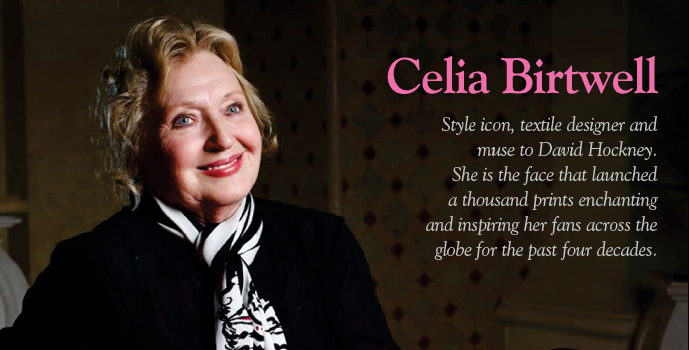
The particulars of place, and the specifics of persons, are the main grid references in the career of Celia Birtwell.

There are many images for characterising her life: she is fireweed, blown seeds fruiting everywhere; she is honeysuckle, weaving and winding through her time and age to blossom with exotic scents; she is… it has to be a floral/faunal image, especially garden variety.

The grid points depict moments of surges of growth; these are interspersed by, at times long periods of quiet, of underground rooting.

Where the grid points of place and person coincide we see the major growth spurts.

The first grid point is Salford, (Manchester, northern England) the year 1941. You will not find her on the electoral register for that year; it was a year without a census.

Where was her schooling, who were her friends? She has learned that private is indeed private, but that a personal life can become public property.

Our next grid point is Salford College of Art, the year 1956. No records exist of her Textile Design course; I have enquired. Who, again, were her friends and colleagues?

Moving in on another trajectory we find Raymond (Ossie) Clark, Warrington (Lancashire, northern England), 1942: “Born in the middle of air raid!” voluble; lively; tyro. The meeting, ‘The Cona Coffee Club’, Tib Lane, Manchester. It was a ‘bring your own record’ place; already we have the ‘bright young things’; an identity of their own; the age of the teenager. This was Manchester waking up and hopping to a new rhythm.

And so they met, one incandescent and fiery, the other grounded, earthed, maybe a little pagan.

Like any wind that could stir in those static post-war years, it blew south. We next plot them separately in Notting Hill, London, 1961; Celia worked in the Wig Department of the Aldwych Theatre. They were provincials, Northern, working class; they had all the credentials for crashing London barriers. But the confidence to hawk designs around those venerable fashion houses came from set designer Anthony Powell, painter Hugh McKinnon. Her designs sold straight away.

The Clark-Birtwell collaboration became a working reality. We hit 1965, they had dedicated outlets: the Quorum Boutique, London, and stars queuing at the door.

Celia designed the fabrics, and Ossie tailored them into outfits, shirts, dresses. They clothed the Beatles, the Rolling Stones, Pattie Boyd, Marianne Faithful, Twiggy; later Jimi Hendrix, Telitha Getty, Paloma Picasso. From the fashion aristos to the real aristos.

1969 and the relationship became a marriage, with children. But that was not the age of marriage-with-children. Ossie loved the rock star scene, spent most of his time out there; Celia meanwhile hunted out Vita Sackville-West’s wonderful garden at Sissinghurst, and Kew Gardens; taking notes from Bakst’s Ballet Russe costumes; from Picasso, Matisse. The gaps opened up. They were always there. The marriage fell apart in 1973.

A booming business; a van driver who would one day provide live, happening music: Dave Gilmour pre Pink Floyd, “He never spoke.”; Brian Jones camped out in a flat above the shop.

Paris 1969, and the person entering the graph was David Hockney, bronzed from California, suave from success. He produced the wonderful Mr and Mrs Clark and Percy, now accorded Greatest British Painting status.  But the painting shows the strain of the relationship: the cat was not Percy but Blanche; the body language is all askew. It was originally read by the hip art establishment as a depiction of modern marriage: new establishment mores, full of alternative interests and directions, yet stable. She looked in that painting, she said, “too bovine”: she was not that placid, so acquiescent.

After the break-up Celia disappeared from the chart. She had regular work with the Radley label, but time was taken bringing up two sons, one needing extra care, and teaching at Art Colleges. This was the 70’s; and very remedial times where a woman’s, not to mention a mother’s, place in industry and fashion was concerned.

It was not until 1984 we see another grid reference, when Hockney encouraged her to launch once more into the marketplace. And the place, Westbourne Grove, her own shop.

Scoot to 2006 and her fabric and clothes designs for Top Shop sold out completely within forty-five minutes of the store opening its doors.

In 2007 we chart the Elle Decoration Design Award for Fashion Contribution to Interiors. Because her work now covers Fashion, Accessories, Furnishings, Wall Papers. With ranges of Classic, Couture, Jacobean fashions in glorious silks, with pink and gold designs, with silk organza, cotton and linen, sometimes flannel, her work continues to grow, expand, gain recognition.

I have given the grid readings but not the topography; privacy became something of a major concern in her life; she saw what happened to Ossie; the publication of the Diaries was one step too close. She shielded the children from the more lurid details.

The grid points can be read also as loom settings: the fabric woven is rich, strangely textured in places, but in the whole exquisitely pleasing and accessible, malleable and delightful.

She now has the stability, and a client-base to die for.


www.celiabirtwell.com

Gag factor

Posted: January 4, 2026 in Chat
Tags: , ,

Cutl pens, an excellent product and site, also have side-lines.
For instance in their range of erasers they branch out and embrace Japanese products.
Among these are a children’s set of entertaining erasers:

we have IWAKO PUZZLE ERASER SET JAPANESE KOKESHI AND LUCKY CAT

https://cultpens.com/products/iwako-puzzle-eraser-set-birds

cats, bunnies, sea fish, hexagon puzzle shapes, cat and mouse, panda families, dinosaurs…

but also

IWAKO PUZZLE ERASER SET POOP

Yep, multi-coloured erasers in the shape of pyramids of poop.

https://cultpens.com/products/iwako-puzzle-eraser-set-poop

Cult Pens write:
‘Iwako Puzzle Erasers. The name is, technically, accurate. But also, it doesn’t really tell you what these are. Because the key thing, as you can see, is just how super-cute they are. You see them, you want them. You need some to sit on your desk; balance on your monitor; or just to accompany you everywhere, living in your pocket. Yes, we were the same. So now we have them; so you can have them if you want them.

But are they erasers? Yes, but you probably don’t want to use them as erasers. We really had to force ourselves to try one out to find out how well they worked, but the results were really quite good, so if you can bring yourself to rub out your mistakes with something this cute, go right ahead. They really do work. But we’re keeping a plain rectangular eraser to hand for that job.

And they’re puzzles? Well, they’re made of more than one piece, and they can be taken apart and put back together again, so they probably count. But in the same way as those tricky questions you have to answer to enter a competition. The ones that are there so that legally, it’s a game of skill, not a lottery. “What colour is associated with the sky? A) Blue, B) Green, C) Tom Baker”. Similar level of difficulty.

But we won’t argue with the third point – they are made by Iwako. They’re small and super-cute (or smol and kawaii, to use the technical terms) so it’s no great surprise that they’re Japanese.

Warning: choking hazard – not suitable for children under 3 years old.’

https://cultpens.com

Under-water chess

Posted: January 1, 2026 in Chat
Tags: , , , ,

I hope and wish or all a new year of rich living.
I choose to open with an entertaining snippet:

An extension of fast-paced Blitz Chess, Diving Chess has been with us officially since 2016.

‘Diving Chess is like normal chess but played in a swimming pool with a submerged,  weighted and magnetised chessboard and pieces (available for order). Each player can only think as long as they are able to hold their breath. Once they’ve made a move they can come up for air, then their opponent must dive and cannot come back up until they’ve played a move.

  1. The match starts once the player playing white goes underwater and makes the first move.
  2. If someone comes up for air without making a move, they get a warning provided that they have a legitimate excuse. The next time it’s an automatic forfeit.
  3. The player who is waiting for their opponent’s move can’t dive in until their opponent has come up for air
  4. The pool depth for tournament play is between 1.1m to 1.6m, and the chess set must be on the floor of the pool.
  5. Players must wear a swimsuit. Goggles are allowed and encouraged.
  6. Wetsuits, weight, snorkels and other accessories are not allowed.
  7. Sportsmanship is paramount and deliberate splashing or kicking during an opponent’s move is not allowed.
  8. The player who is waiting is allowed to put their head into the water to observe the board, but they are not allowed to dive down with their whole body until their opponent has resurfaced.
  9. There is no requirement to say check when putting the opponent in check, but it is allowed.
  10. There are no timeouts unless there are extreme circumstances, such as a goggle malfunction in which case it is up to the arbiter to decide whether to allow a timeout or not.’

Rules of the game, from Diving Chess site
https://divingchess.com

Also see for latest news and results:
Former Dutch champion Zyon Kollen was crowned the men’s champion while 17-year-old Josephine Damen, also from the Netherlands, took the women’s title.

https://www.bbc.co.uk/news/videos/cd9ed29vg2eo

There is nothing in those rules about how long a person is allowed to hold their breath, though.