Tag Archives: Space Program
A Day in America
Update…
The launch has been postponed
Soviet Space Dogs
“Space dogs” redirects here. For the 2010 Russian computer-animated film, see Space Dogs.
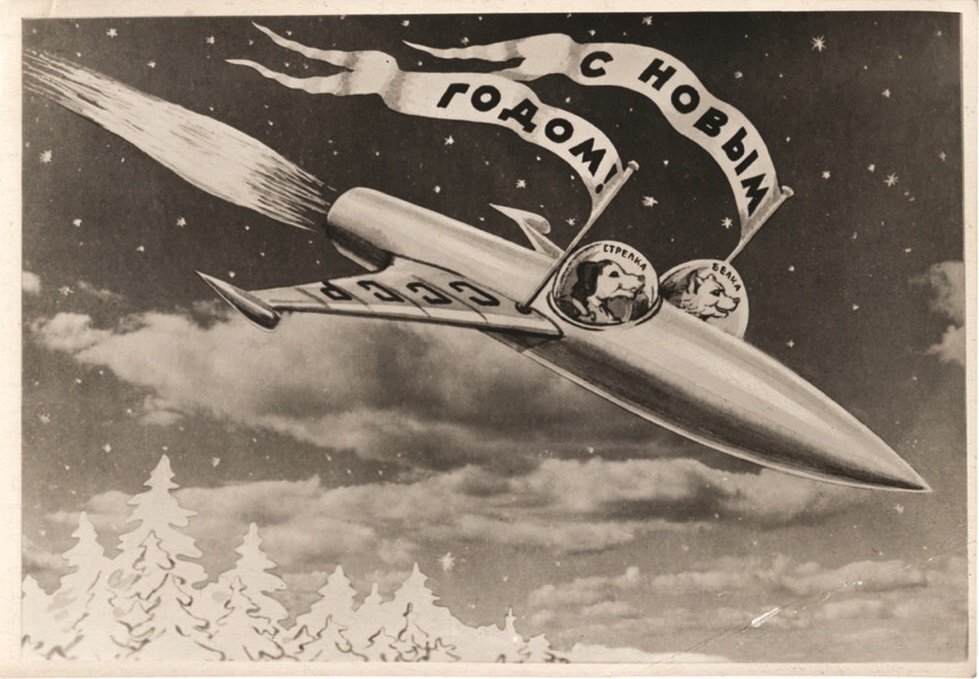
During the 1950s and 1960s the Soviet space program used dogs for sub-orbital and orbital space flights to determine whether human spaceflight was feasible. In this period, the Soviet Union launched missions with passenger slots for at least 57 dogs. The number of dogs in space is smaller, as some dogs flew more than once. Most survived; the few that died were lost mostly through technical failures, according to the parameters of the test. A notable exception is Laika, the first animal to be sent into orbit, whose death during the 3 November, 1957 Sputnik 2 mission was expected from its outset.[1]

Training
Dogs were the preferred animal for the experiments because scientists felt dogs were well suited to endure long periods of inactivity.[2] As part of their training, they were confined in small boxes for 15–20 days at a time. Stray dogs, rather than animals accustomed to living in a house, were chosen because the scientists felt they would be able to tolerate the rigorous and extreme stresses of space flight better than other dogs. Female dogs were used because of their temperament and because the suit the dogs wore in order to collect urine and feces was equipped with a special device, designed to work only with females.[3][4][page needed]
Their training included standing still for long periods of time, wearing space suits, being placed in simulators that acted like a rocket during launch, riding in centrifuges that simulated the high acceleration of a rocket launch and being kept in progressively smaller cages to prepare them for the confines of the space module. Dogs that flew in orbit were fed a nutritious jelly-like protein. This was high in fiber and assisted the dogs to defecate during long periods of time while in their small space module. More than 60% of dogs to enter space were reportedly suffering from constipation and gallstones on arrival back to base.[5][page needed]
Sub-orbital flights
Dogs were flown to an altitude of 100 km (62 mi) on board 15 scientific flights on R-1 rockets from 1951 to 1956. The dogs wore pressure suits with acrylic glass bubble helmets. From 1957 to 1960, 11 flights with dogs were made on the R-2A series, which flew to about 200 km (120 mi). Three flights were made to an altitude of about 450 km (280 mi) on R-5A rockets in 1958. In the R-2 and R-5 rockets, the dogs were contained in a pressured cabin.[6]
Dezik, Tsygan, and Lisa-1
Dezik (Дезик) and Tsygan (Цыган, “Gypsy”) were the first dogs to make a sub-orbital flight on 15 August 1951.[2] Both dogs were recovered unharmed after travelling to a maximum altitude of 110 km (68 mi). Dezik made another sub-orbital flight in 1951 with the first dog named Lisa (Лиса, “Fox”), although neither survived because the parachute failed to deploy.[2] After the death of Dezik, Tsygan was adopted as a pet by Soviet physicist Anatoli Blagonravov.[7]
Lisa-2 and Ryzhik
Lisa-2 (Лиса, “Fox” or “Vixen”) and Ryzhik (Рыжик, “Ginger” (red-haired)) flew to an altitude of 100 km (62 mi) on 2 June 1954.
Smelaya and Malyshka
Smelaya (Смелая, “Brave” or “Courageous”, fem.) was due to make a flight in September but ran away the day before the launch. She was found the next day and went on to make a successful flight with a dog named Malyshka (Малышка, “Baby”). They both crashed after the rocket failed to deploy a parachute, and were found the next day by the recovery team.
Bobik and ZIB
Bobik (Бобик, common Russian name for a small dog) ran away just days before his flight was scheduled to take place on 15 September 1951.[2] A replacement named ZIB (ЗИБ, a Russian acronym for “Substitute for Missing Bobik”, “Замена Исчезнувшему Бобику” Zamena Ischeznuvshemu Bobiku), who was an untrained street dog found running around the barracks, was quickly located and made a successful flight to 100km and back.[8][2]
Otvazhnaya and Snezhinka
Otvazhnaya (Отважная, “brave one”, fem.) made a flight on 2 July 1959 along with a rabbit named Marfusha (Марфуша, “little Martha”) and another dog named Snezhinka (Снежинка, “Snowflake”). She went on to make 5 other flights between 1959 and 1960.[9]
Albina and Tsyganka
Albina (Альбина) and Tsyganka (Цыганка, “Gypsy girl”) were both ejected out of their capsule at an altitude of 85 km (53 mi) and landed safely. Albina was one of the dogs shortlisted for Sputnik 2, but never flew in orbit.
Damka and Krasavka
Damka (Дамка, “queen of checkers”) and Krasavka (Красавка, “little beauty” or “Belladonna”) were to make an orbital flight on 22 December 1960 as a part of the Vostok programme which also included mice.[10] However their mission was marked by a string of equipment failures.
The upper-stage rocket failed and the craft re-entered the atmosphere after reaching a sub-orbital apogee of 214 km (133 mi). In the event of unscheduled return to the surface, the craft was to eject the dogs and self-destruct, but the ejection seat failed and the primary destruct mechanism shorted out. The animals were thus still in the intact capsule when it returned to the surface. The backup self-destruct mechanism was set to a 60-hour timer, so a team was quickly sent out to locate and recover the capsule.
Although the capsule was reached in deep snow on the first day, there was insufficient remaining daylight to disarm the self-destruct mechanism and open the capsule. The team could only report that the window was frosted over in the −43 °C (−45 °F) degree temperatures and no signs of life were detected. On the second day, however, the dogs were heard barking as the capsule was opened. The dogs were wrapped in sheepskin coats and flown to Moscow alive, though all the mice aboard the capsule were found dead because of the cold.[11]
Damka was also known as Shutka (Шутка, “Joke”) or Zhemchuzhnaya (Жемчужная, “Pearly”) and Krasavka was also known as Kometka (Кометка, “Little Comet”) or Zhulka (Жулька, “Cheater”). After this incident Krasavka was adopted by Oleg Gazenko, a leading Soviet scientist working with animals used in space flights. She went on to have puppies and continued living with Gazenko and his family until her death 14 years later.[10] After the incident Sergey Korolyov, who was the designer of the rocket, wanted to make the story public, but was prevented from doing so by state censorship.[citation needed]
Bars and Lisichka
Bars (Барс (pron. “Barss”); “snow leopard“) and Lisichka (Лисичка, “little fox“) were also on a mission to orbit as a part of the Vostok programme, but died after their rocket exploded 28.5 seconds into the launch on July 28, 1960.[2] Bars was also known as Chayka (Чайка, “seagull“).
Other dogs that flew on sub-orbital flights include Dymka (Дымка, “smoky”), Modnitsa (Модница, “fashionista”) and Kozyavka (Козявка, “little gnat”).
At least four other dogs flew in September 1951, and two or more were lost.
Orbital flights
Laika

Laika on a Romanian post stamp
Laika (Лайка, “barker”) became the first living Earth-born creature (other than microbes) in orbit, aboard Sputnik 2 on 3 November 1957.[2] Some[who?] call her the first living passenger to go into space, but many sub-orbital flights with animal passengers passed the edge of space first, for instance the rhesus macaque Albert II. She was also known as Zhuchka (Жучка, “Little Bug”) and Limonchik (Лимончик, “Little Lemon”). The American media dubbed her “Muttnik”, making a play-on-words for the canine follow-on to the first orbital mission, Sputnik. She died between five and seven hours into the flight from stress and overheating.[12] Her true cause of death was not made public until October 2002; officials previously gave reports that she died when the oxygen supply ran out.[9] At a Moscow press conference in 1998 Oleg Gazenko, a senior Soviet scientist involved in the project, stated “The more time passes, the more I’m sorry about it. We did not learn enough from the mission to justify the death of the dog…”.[13]
Belka and Strelka

Belka

Strelka
Belka (Белка, literally, “squirrel“, or alternatively “Whitey”) and Strelka (Стрелка, “little arrow”) spent a day in space aboard Korabl-Sputnik 2 (Sputnik 5) on 19 August 1960 before safely returning to Earth.[9] They are the first higher living organisms to survive orbit in outer space.
They were accompanied by a grey rabbit, 42 mice, two rats, flies and several plants and fungi. All passengers survived. They were the first Earth-born creatures to go into orbit and return alive.[14]

Strelka went on to have six puppies with a male dog named Pushok who participated in many ground-based space experiments, but never made it into space.[15] One of the puppies was named Pushinka (Пушинка, “Fluffy”) and was presented to President John F. Kennedy by Nikita Khrushchev in 1961. A Cold War romance bloomed between Pushinka and a Kennedy dog named Charlie, resulting in the birth of four puppies that JFK referred to jokingly as pupniks.[16] Two of their puppies, Butterfly and Streaker, were given away to children in the Midwest. The other two puppies, White Tips and Blackie, stayed at the Kennedy home on Squaw Island but were eventually given away to family friends.[15] Pushinka’s descendants were still living at least as of 2015.[17] A photo of descendants of some of the Space Dogs is on display at the Zvezda Museum in Tomilino outside Moscow.[18]
A Russian animated feature film called Belka and Strelka: Star Dogs (English title: Space Dogs) was released in 2010.
Pchyolka and Mushka
“Mushka” redirects here. For the racehorse, see Mushka (horse).
Pchyolka (Пчёлка, “little bee”) and Mushka (Мушка, “little fly”) spent a day in orbit on 1 December 1960 on board Korabl-Sputnik-3 (Sputnik 6) with “other animals”, plants and insects.[9] Due to a reentry error when the retrorockets failed to shut off when planned, their spacecraft was intentionally destroyed by remote self-destruct to prevent foreign powers from inspecting the capsule on 2 December and all died.[citation needed] Mushka was one of the three dogs trained for Sputnik 2 and was used during ground tests. She did not fly on Sputnik 2 because she refused to eat properly.
Chernushka
Chernushka (Чернушка, “Blackie”) made one orbit on board Korabl-Sputnik-4 (Sputnik 9) on 9 March 1961[19] with a cosmonaut dummy (whom Soviet officials nicknamed Ivan Ivanovich), mice and a guinea pig. The dummy was ejected out of the capsule during re-entry and made a soft landing using a parachute. Chernushka was recovered unharmed inside the capsule.
Zvyozdochka
Zvyozdochka (Zvezdochka, Звёздочка, “starlet”[20]), who was named by Yuri Gagarin,[21] made one orbit on board Korabl-Sputnik 5 on 25 March 1961 with a wooden cosmonaut dummy in the final practice flight before Gagarin’s historic flight on 12 April.[20] Again, the dummy was ejected out of the capsule while Zvezdochka remained inside. Both were recovered successfully.
Veterok and Ugolyok
.jpg)
Space dogs Veterok and Ugolyok
Veterok (Ветерок, “light breeze”) and Ugolyok (Уголёк, “ember”) were launched on 22 February 1966 on board Cosmos 110, and spent 21 days in orbit before landing on 16 March.[4] This spaceflight of record-breaking duration was not surpassed by humans until Soyuz 11 in June 1971 and still stands as the longest space flight by dogs. The two dogs showed signs of “cardiovascular deconditioning” with dehydration, weight loss, loss of muscle and coordination and took several weeks to fully recover, though they showed no long term issues.[22]
See also
- Animals in space
- Cosmo (comics)
- Félicette: First cat in space
- List of individual dogs
- Monkeys and non-human apes in space
- Museum of Jurassic Technology, which has an eternal flame dedicated to Laika and a portrait gallery of the USSR’s space dogs
- Sputnik program
- Voskhod program
References
- ^ Berger, Eric (3 November 2017). “The first creature in space was a dog. She died miserably 60 years ago”. Ars Technica. Retrieved 3 November 2017.
- ^ a b c d e f g Gray, Tara (2 August 2004). “A Brief History of Animals in Space”. NASA.
- ^ Canine Nation (3 November 2002). A Few Facts about Russian Space Dogs Archived 8 January 2006 at the Wayback Machine via dogsinthenews.com.
- ^ a b Chris Dubbs (2003) Space Dogs: Pioneers of Space Travel, iUniverse, ISBN 0-595-26735-1
- ^ Chris Dubbs and Colin Burgess, Animals In Space: From Research Rockets to the Space Shuttle, Springer, 2007, ISBN 0387360530
- ^ Ushakova, et al., Istoriya Otechestvennoi Kosmicheskoi Meditziny, Moskva-Voronezh, 2001.
- ^ Asif Siddiqi, Sputnik and the Soviet Space Challenge, University Press of Florida, 2003, ISBN 081302627X, p. 96
- ^ Lileks, James (1 November 2019). “Remembering Laika the space dog”. StarTribune.
- ^ a b c d DE Beischer and AR Fregly (1962). “Animals and man in space. A chronology and annotated bibliography through the year 1960”. US Naval School of Aviation Medicine. ONR TR ACR-64 (AD0272581). Retrieved 14 June 2011.
- ^ a b Kate Baklitskaya (1 May 2013) The remarkable (and censored) Siberian adventure of stray dog cosmonauts Comet and Shutka. Siberiantimes.com. Retrieved on 14 May 2013.
- ^ John Rhea, Roads to Space: An Oral History of the Soviet Space Program, Aviation Week Group, 1995, ISBN 0076070956 pp. 197–199 and 415–417.
- ^ “First dog in space died within hours”. BBC. 28 October 2002. Retrieved 4 January 2010.
- ^ Dick Abadzis, afterword to Laika, First Second, 2007, ISBN 1-59643-302-7
- ^ Georgiou, Aristos (3 November 2019). “Laika the dog: These are all the animals that have been launched into space”. Newsweek.
- ^ a b John F. Kennedy Presidential Library & Museum. Reference Desk: Pets. Accessed 8 July 2007
- ^ Bark At the Moon: A Short History of Soviet Canine Cosmonauts From About.com Space / Astronomy. Accessed 8 July 2007
- ^ Mosher, Dave. “I traveled to Russia and met the first dogs to ever survive space in this rare museum”. Business Insider. Retrieved 29 October 2019.
- ^ Dogs in Space: James M Skipper’s visit to the NPO Zvezda Museum, The Skipper Family magazine. Accessed 7 July 2007
- ^ Sputnik 9 and Chernushka (March 1961) on YouTube
- ^ a b Asif A. Siddiqi (2000). Challenge to Apollo: The Soviet Union and the Space Race, 1945–1974. NASA. SP-2000-4408. Part 1 (page 1-500), Part 2 (page 501-1011). p. 267
- ^ Gagarin, Jurij (2020). Put do zvezda (in Serbian). Translated by Kitanović, Ana. Belgrade: Laguna. pp. 157–158. ISBN 978-86-521-3878-4.
- ^ Brian Harvey; Olga Zakutnyaya (2011). Russian Space Probes: Scientific Discoveries and Future Missions. Springer Science & Business Media. p. 314. ISBN 978-1-44198-150-9.
External links
- A book chapter about biological experiments in geophysical rockets (in Russian)
- Space Today Online article about animals sent into space
- One Small Step: The Story of the Space Chimps, Official Documentary Site Documentary features rare footage of Laika and others.
62 years ago today Belka and Strelka were the first dogs to safely return to Earth after being in orbit
Belka and Strelka
Belka (Белка, literally, “squirrel“, or alternatively “Whitey”) and Strelka (Стрелка, “little arrow”) spent a day in space aboard Korabl-Sputnik 2 (Sputnik 5) on 19 August 1960 before safely returning to Earth. They are the first higher living organisms to survive in outer space.
They were accompanied by a grey rabbit, 42 mice, two rats, flies and several plants and fungi. All passengers survived. They were the first Earth-born creatures to go into orbit and return alive.
Strelka went on to have six puppies with a male dog named Pushok who participated in many ground-based space experiments, but never made it into space. One of the puppies was named Pushinka (Пушинка, “Fluffy”) and was presented to President John F. Kennedy by Nikita Khrushchev in 1961. A Cold War romance bloomed between Pushinka and a Kennedy dog named Charlie, resulting in the birth of four puppies that JFK referred to jokingly as pupniks. Two of their puppies, Butterfly and Streaker, were given away to children in the Midwest. The other two puppies, White Tips and Blackie, stayed at the Kennedy home on Squaw Island but were eventually given away to family friends. Pushinka’s descendants were still living at least as of 2015. A photo of descendants of some of the Space Dogs is on display at the Zvezda Museum in Tomilino outside Moscow.
Belka and Strelka in graffiti. 2008
“RockSat-X 2022 Student Sounding Rocket Launch — Launch Attempt 3”
Happy 64th Birthday
Nice Landing
The Beauty of Alaska
Wayward SpaceX rocket part will smash into the moon soon, experts say

ZACHARY ROGERS | The National Desk 3 – 4 minutes
WASHINGTON (TND) — Part of a rocket launched by a popular American aerospace company has gone off course and will reportedly crash into the moon in March.
SpaceX, founded by Tesla CEO and American entrepreneur Elon Musk, launched a rocket out of Florida back in Feb. 2015 as part of a mission to send a space-weather satellite a million miles away, according to meteorologist Eric Berger, writing for Ars Technica.
The rocket was reportedly hauling NOAA’s Deep Space Climate Observatory (DSCOVR) and sending the satellite to what NASA calls a “Lagrange Point”.
“Lagrange points are positions in space where objects sent there tend to stay put,” NASA says. “At Lagrange points, the gravitational pull of two large masses precisely equals the centripetal force required for a small object to move with them. These points in space can be used by spacecraft to reduce fuel consumption needed to remain in position.”

This still image provided by SpaceX shows a SpaceX Falcon 9 rocket lifting off from Cape Canaveral, Fla., Space Force Station on Saturday, Nov. 13, 2021. (SpaceX via AP)
After completing the initial long burn of its engines to send the satellite to a Lagrange Point, the detached second stage of the rocket reportedly became derelict. Experts strongly believe the rocket part will soon be crashing into the moon, as it did not escape Earth’s gravitational pull.
“So it has been following a somewhat chaotic orbit since February 2015,” Berger writes about the wayward rocket part.
Bill Gray, who wrote widely-used software used to track near-Earth objects, wrote a blog post about the pending impact.

This still image provided by SpaceX shows a SpaceX Falcon 9 rocket lifting off from Cape Canaveral, Fla., Space Force Station on Saturday, Nov. 13, 2021. (SpaceX via AP)
Space junk can be a little tricky. I have a fairly complete mathematical model of what the earth, moon, sun, and planets are doing and how their gravity is affecting the object,” Gray writes. “I have a rough idea of how much sunlight is pushing outward on the object, gently pushing it away from the sun. This usually enables me to make predictions with a good bit of confidence.
Gray says in the blog he predicts the rocket part will crash into the moon on March 4 around 12:25 p.m. He says the impact will probably be unobservable because, well, the moon will be in the way.
Harvard University astrophysicist Jonathan McDowell agrees with Gray’s predicted impact date, but adds “it’s interesting, but not a big deal.”
Berger and Gray both believe the crash could provide valuable data. Gray even says he is “rooting” for a lunar impact”.
“We already know what happens when junk hits the Earth; there’s not much to learn from that,” Gray says.
“This information is important because it will allow satellites presently orbiting the Moon… to collect observations about the impact crater,” Berger says. “Although scientists are most keen to understand the presence of ice at the lunar poles, being able to observe the subsurface material ejected by the Falcon 9 rocket’s strike could still provide some valuable data.”
Due to weather the launch will be January 6th
Rocket launch scheduled for January 4th
NASA Rocket Launch Dates
Look to the sky
SpaceX will launch its next Starlink satellite fleet Thursday and you can watch it live
Update for 8:40 p.m. EST on March 9: SpaceX is now targeting Thursday, March 11 at 3:13 a.m. EST for this Starlink launch, citing a desire to perform more prelaunch checks.
CAPE CANAVERAL, Fla. — SpaceX is gearing up to launch its second Starlink mission of the month tonight (March 9) as it expands its growing internet satellite megaconstellation, and you can watch the action live online.
The private spaceflight company is planning to fly one of its Falcon 9 rockets for a sixth time for the Starlink mission. The two-stage launcher will blast off from Space Launch Complex 40 here at Cape Canaveral Space Force Station in Florida at 9:58 p.m. EST (0258 March 10 GMT).
You can watch the launch live here and on the Space.com homepage, courtesy of SpaceX, beginning about 15 minutes before liftoff. You can also watch the launch directly via SpaceX.
Related: SpaceX’s Starlink megaconstellation launches in photos
SpaceX is continuing its rapid launch pace, which was set last year when the company launched a record 26 times. Tonight’s flight marks the company’s seventh launch of 2021, with at least one more Starlink mission planned for March.
Forecasters with the U.S. Space Force’s 45th Weather Squadron reported that the launch weather looks promising for Tuesday night’s liftoff, with a 90% chance of favorable weather. The only slight concerns being liftoff winds and cumulus clouds.
If needed, there is a backup attempt on Wednesday, with weather forecasts dipping slightly to and 80% of good launch conditions.
Beautiful weather is also predicted down range, which is good news for one of SpaceX’s two drone ships — “Just Read the Instructions” — which hopes to catch the booster as it returns to Earth. If successful, the landing will mark the 76th recovery for SpaceX since the company landed its first booster in 2015. And will mark the second catch in a row for SpaceX after it lost a booster in February.
SpaceX relies heavily on its fleet of veteran rockets, which have enabled SpaceX to keep up with its launch ambitions. However, company officials have stressed that while booster recovery is beneficial, the main goal of each mission is to successfully deliver the payload to space.
The booster doing the lifting in this mission is a five-time flier, set to make its sixth launch and landing attempt. Dubbed B1058, the first stage made its debut by launching two astronauts to the International Space Station in May of 2020.
Relive the historic SpaceX Demo-2 launch with this awesome highlight reel
Following that historic mission, it ferried a communications satellite for South Korea’s military, a cargo dragon spacecraft full of research and supplies for the space station, the most satellites ever launched on a single mission (Transporter-1), and today’s flight will be its second Starlink payload.
The flight also marks one of the shortest turnaround times between booster flights for SpaceX. B1058 last flew on Jan. 24, and will blast off again from the same launch pad just 45 days later — a record for a sixth reflight of a booster. (The previous record was 59 days.)
During a news conference on the upcoming Crew-2 mission, which is set to launch on April 22, SpaceX’s Benji Reed briefly discussed the refurbishment process. “We learn something about reuse after every mission,” he said. That learning process has helped the company refine its procedures and reduce times in between flights.
SpaceX deploys new Starlink batch in amazing view from space
This particular flight, Starlink 20, is the 21st set of internet-beaming satellites that SpaceX has delivered to space, including a set of initial prototypes in 2019. SpaceX’s initial constellation will contain 1,440 satellites, and the company is well on its way to achieving that milestone.
But SpaceX is not stopping there. The company was granted permission to launch up to 30,000 satellites, with the option for more at a later time.
The stack of 60 broadband satellites will join the fleet already in orbit, bringing the total number launched over 1,200. (That number includes prototypes of the satellites that are no longer in service.) With SpaceX quickly filling its initial constellation, the company is moving closer to providing commercial internet service with the Starlink network. As such, it is planning a full commercial rollout later this year.
That roll out comes after an extensive beta testing program that included both employees and the public. The “better than nothing” beta testing program kicked off in 2019 and has already provided thousands of users connectivity.
Starlink satellites make big dfference to Hoh Native American tribe
Some of those users include people in remote areas that currently have little-to-no internet service, such as the Pikangikum tribe in Canada. Starlink terminals were delivered to the reservation in late November, and have better access to education, healthcare service as well as contact with friends and family.
Students in Wise County, Virginia are also better connected now, thanks to Starlink terminals arriving earlier this year. Roughly 40% of families in the area lack access to the internet which made learning all the more difficult during the pandemic. The county board of supervisors worked with SpaceX to provide free internet service to at least 40 families, with the project expanding to more families at a later time.
In advance of an official rollout, the company recently opened up its website for preorders, allowing a limited number of users per area. If interested, potential customers can sign up via the company’s Starlink website and secure service by putting down a deposit. The website does say that it could take several months for the service to become active.
Fairing recovery

SpaceX’s dynamic fairing-catching duo, GO Ms Tree and GO Ms Chief are still sidelined, undergoing maintenance in Port Canaveral. As such, GO Searcher and GO Navigator have been dispatched to the planned recovery site.
The two boats, which typically support Dragan missions, are able to scoop the fairing pieces out of the water, enabling SpaceX to continue its plans to recover and reuse the fairing pieces. For this particular mission, both pieces have flown before. With any luck, they will live to fly again.
Follow Amy Thompson on Twitter @astrogingersnap. Follow us on Twitter @Spacedotcom or Facebook.
Join our Space Forums to keep talking space on the latest missions, night sky and more! And if you have a news tip, correction or comment, let us know at: community@space.com.
 "OUR WORLD"