On Naming Things

In an attempt to bring joy back into my life in what seems like a season of ill-will, misfortune and tired depression, I will talk today about something that brings me joy. It’s my daughter’s penchant for naming all her toys – apt names sometimes, or names that simply tickle her fancy at the time of the naming ceremony.

Her first named doll is a little bald thing with the most intense eyes and the grimiest all-in-one outfit one ever did see. When she first obtained the doll, three years ago now, my daughter had just turned two. She was enamoured with an Arabic song about seagulls flapping their wings, and one of the phrases in the song was ‘the seagull flapped it’s wings, flap flap!’. So she named her doll ‘Hallaqa Hallaq’ – which means ‘flap flap’. In fact, the doll’s name is the entire phrase but she deigned to shorten it for her own ease of play.

Then she has Foxy – which is a little white fox. Cuddly-cuddly Elephant is a little purple elephant no bigger than my hand. It’s furry and has large imploring purple eyes. She has Button, a little rag-doll with a singular button on its dress. Kung-Fu Panda, which is a panda dressed as a dragon which her father got her from China in celebration of the Chinese new year. She has Goldilocks, which is a plump little marshmallow creature that is shapeless and designed, I suppose, to be ‘cute’. Not in anyway resembling the real Goldilocks – but the name took her fancy and now we can’t see that marshmallow thing as anything other than Goldilocks! And Llamery Sparkle is a colourful little Llama who has a pair of sparkling eyes.

Flower Nice is a velvety puffy ladybird with large black beads for eyes. She followed her dad all around the supermarket the day Flower Nice was procured begging him to buy it for her. He took one look at the price tag and shook his head. But she wouldn’t let up. She implored with her large eyes, she took his hand and kissed it, she hugged and rocked the silly stuffed ladybird as if it would break her heart to part from it. He eventually gave in, of course. Who can resist the charms of an enamoured little three year old?! What will you name her, I asked, once the ladybird was paid for and safely back in her arms. Flower nice, she replied, because flowers are nice and nice because she is nice.

All of this to say, I never named a thing as a child. I had a doll but she certainly had no name, and was subject to all sorts of experimentation by myself and my sister. Bathed, hung, parachuted down the side of an apartment building – no, we did not name her. But my daughter insists on naming everything that can be constituted personage – including ants and moths that happen her way. And that, my friends, brings me much joy.
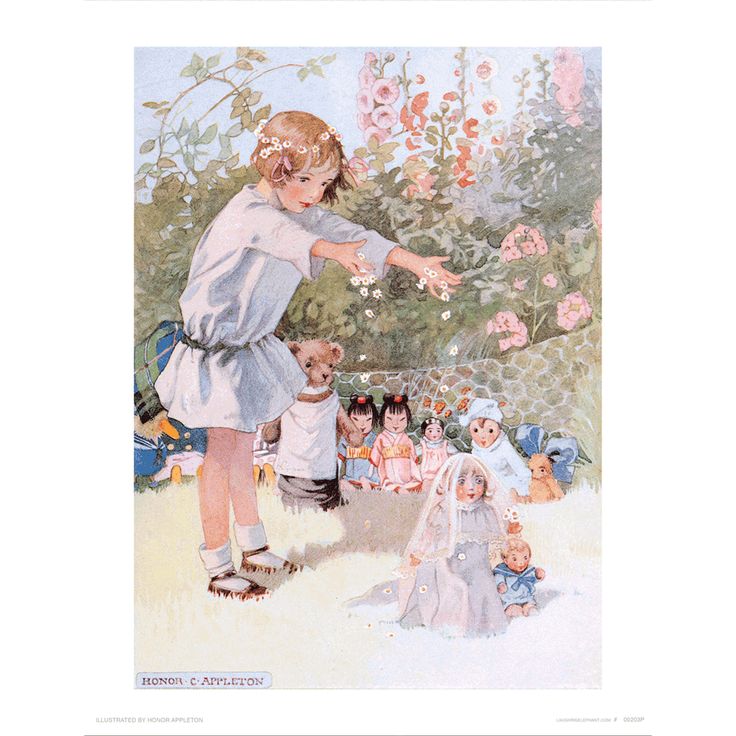
Girl, dolls and toys. Honor Appleton

[9]

Lady Zelda was ferocious. I mean that in the most literal of terms. Her face, as red and ripe as new tomatoes spotted with dew, was lined with the wrinkles one can only achieve after years of frowning at the most insignificant of matters. A frown at the maid servant because the fire was too cold, a sullen purse of the lips because the beef was overcooked and for goodness’ sake Dorothea, you know better than to let my tea steep for more than five minutes!

You do realise, of course, that Lady Zelda was quite capable of carrying out these tasks herself, as she was not so riddled with consumption as she claimed to be. She suffered from a bad case of poor humour, as her doctor wryly told her nephew, a certain Dr Robert Smith. 

Lady Zelda’s eyes were little, and shrewd. They were a vivid, piercing blue, startling in their brilliance, and certainly not diminished by her age. They added something strange to her surreal face, giving her the air of one about to explode. Lady Zelda was like the deep breath before the plunge, Laura would say. Laura was Lady Zelda’s great niece, from the lineage of Lady Zelda’s brother, Lord Edwin Darlan Smith, who was the late father of Lord Smith. Tom, or Master Thomas Laurence Norton, as he was generally known around these parts, told Laura on several occasions that that her great aunt Zelda was nothing but a besquatting, ribbetty, groany old toad. Mary, Tom’s younger sister, silently agreed with him, but because she and Laura shared a special friendship, she would never voice her opinions on the matter, and stoutly stood by her friend against her brother’s unkind and disrespectful words. 

In a nutshell, Lady Zelda was not a particularly pleasant woman to know. She might have been, in her heyday, but to be quite frankly brutal about the matter, there didn’t seem to be anybody from that particular time period left to say anything to the contrary; and that is where the Smiths left it.

The Smiths, of course, being of the lineage of Lady Zelda Smith, of Milton Manor, by the Rooks, a small, insignificant town a good twenty miles from the nearest city, housing approximately 800 residents and a number of animals. Everybody knew each other, of course, being such a small, close knit community, and everybody therefore knew that young Amelia Fox of French Way worked for the tiresome old lady. Which is why, one sunny afternoon, when young Amelia rushed into the Post Office, wringing her hands, tears streaming down her perfectly sculptured face, Master Williams at once said, ‘Why, Amelia, dear, has the old bat snuffed it at last?’

THE ARTIST AND HIS FAMILY

[4]

She was the girl who wore the navy dress, with lemon polka dots. She wore it every single day, her hair decked for conquest. Dressed with an assortment of violets and lilly-of-the-valley, thick auburn tresses braided and intertwined with violent splashes of purple and the most delicate little snowy bells.

So he asked her one day when she passed him by with her basket piled high with the bright little currants. He put his hand out, almost rudely, she thought, bemused, and he said, ‘why do you wear this dress daily?’

How rude! Thought she. ‘How rude!’ said she, lifting her basket delicately higher up her slender arm. She sidestepped him and stalked away.

He watched the evening sunlight glint and shimmer in her hair.

The next day he asked her for directions to Grousetown – and she gave him a withering glance and ignored him, stepping delicately over the stones on the uphill path, past where he stood. Her dress fluttered behind her in the breeze, and she spared him nary a glance.

The day after that, her hair was worn up. Piled high atop her head in an intricate style of weaves and plaits, and adorned with little pink rosebuds. Her nose was upturned, her eyelashes cast downwards, and her pace amiable. The basket hanging on her arm contained the evening newspaper, and in her opposite hand she twirled a small bouquet of wild red poppies. He didn’t say anything to her. As she passed, she glanced his way.

And so the days wore on and still she took the same path, and his work kept him on that path, and he said hello to her on many an occasion, and she would respond. Curtly at first. Short. Irritable. Her eyes were an indignant flash of blue, fringed with long lashes, her cheeks two scarlet dots. One day she responded with a smile, but when her eyes met his, she was startled, as though she had forgotten who she was talking to, and then she frowned and began to march up the hill with flustered purpose.

‘Good evening,’ he said finally, one evening, when May bloomed into her sunny and beautifully scented sister June. Her hair was decked with peonies. A crown of them encircled her head, and long, thick coils of dark auburn locks fell over her shoulders, brushing her cheeks, curtaining her eyes. She stopped, then, turned to him. Her basket had a green bottle inside, a little piece of twine was wrapped about the top, and a handmade label stuck to its side.

‘Evening,’ she murmured.

His work was to take him elsewhere the next day.

‘I hope it isn’t an intrusion to ask if I may call on you tomorrow,’

‘Certainly not,’ she said quietly, but her vivid gaze did not meet his. She told him where she lived. He wrote it down, and without saying goodbye, she turned and hurried away.

When he arrived at her house the next afternoon, he wondered how he would phrase the question. How ought he to ask it, without seeming rude. He straightened his coat, cleared his throat, and raised the knocker once, twice, thrice, before standing back to survey his surroundings. The garden was filled with flowers. Bushes of peonies all along the border by the fence, little blushes of sweetness nodding in the breeze. Roses climbed the brick walls, hundreds and hundreds of them, reaching for the roof and releasing a sweet, faintly lemony scene. Pale pink and ginger fringed with burnt orange. A row of lavender bushes, busy with bees around their nodding purple flower heads, and the sickly sweet smell of the mountainous piles of brightly coloured sweet-pea towers wafted his way. Everywhere he looked there was colour. Every square inch of that garden was a decorated bush or a flowering plant. Lilac trees fringed the Eastern corner, snowy white and soft, delicate pink.

Yet when she opened the door, the plainness of her navy dress with yellow polka dots shocked him. Her hair she wore down, with little daisies carefully places throughout her tresses. Her cheeks, he noticed, as well as her nose, were gloriously freckled. He could lose himself in her eyes, swimming like oceans about brim over her thick lashes.

‘Come in,’ she said, and her curtness, he realised, he had mistaken for shyness. Suddenly the question he had been so burning to receive an answer to had vanished from his mind.

Lady Lillith – by Gabriel Dante Rossetti

They’re for you.

She used to be the type of person who wore yellow gloves on a rainy day because that is where the sun shone. It had to shine somewhere. If not the sky then she would spin it with her hands. Jars of joy. Jars of jam. Preserves, she would correct. Preserves. With pieces of fruit still in them so when you spread it on your crusty toast you would always find a gem or two.

do you know what’s really nice? She asked him one day, holding a piece of her toast in an ungloved hand, when the piece of fruit is intertwined with a knob of melting butter, and it’s on the crustiest part of the toast, so when you take a bite, it tastes like you’re being hugged by a warm, sweet-smelling large-bosomed matron lady. Like Mrs Newman, remember her? Golden curls akimbo and she always talked about her big brother Georgie. As if one could call a sixty year old man Georgie! My but she loved him didn’t she. He was marvellous to her, and she was a potful of comfort and laughter.

akimbo? He raised an eyebrow at that word.

tumbled all over her head. She gestured with her hand over her head in a circular motion, and bit into her toast. Closed her eyes. Her lips curled up towards her eyelashes and her cheeks sunk into two large dimple pools. He liked to look at them.

how much jam have you made today? He asked, leaning his tired head on his hands.

Preserves, PRESERVES! Just one. I had a juicy harvest of mulberries and when we picked them this morning we ate most of them. Oh, the children looked like they had devoured fresh corpses by the time we were finished, and look, my fingers are still stained! She showed him buttery, crumby hands with purple-stained fingertips.

and who gets to have this precious jar of mulberry preserves? He asked, a small smile playing about his eyes. They shone and danced, vibrant when they looked at her. He was always laughing at a secret story with his eyes. She couldn’t help but smile in response.

did you think you would receive it? She said, playful now, running her fingertip across her plate to swipe up the last buttered crumbs. they aren’t for you. they’re for..

She stopped then, and her face became sombre. He was still looking at her, unaware of the change in her demeanour.

…for?

The Lesson – by Jean Eugene-Buland.

This was Day Four of my Short Story Challenge. The why of which is outlined here, and the challenge of which is outlined here.

O’Henry, also known as William Sydney Porter, said of the short story writing process: “Write stories that please yourself. There is no Rule 2.” That is what I shall do.

Sandstorm

It was the darkest, coldest night of the year, she felt, as she stole her way out of the side door and into the blackness outside six months ago. The world was alive, still. Cars and lights and surges of people milling around malls and shopping centres like the sun was not going to rise in 3 hours.

It was the meanest, cruellest thing, she said as she ate two scoops of chocolate ice cream.

It was the harshest storm, she whispered, as she put the coats away in the cupboard.

The floors were polished to a shine. Gleaming in the dark. When the sun rose she could see her reflection in them. Her face distorted, blurry, somebody else.

The windows were dusty, so she got her cloth and slapped at them until the sand fell in little heaps on the windowsill. Then she dampened her cloth and smeared the windows so they became muddy. She could no longer peer out of them at the sand storm outside.

‘Perhaps it is for the better, perhaps seeing the storm is worse.’

There was food they had left on the table. Bits of rice by empty plates. Clumped with leftover sauce, some yogurt smeared on the side of the plate. Glasses covered in greasy fingerprints. The dim light that fills the room after a day of torrid heat, after the sun is covered by sand dunes, yellow world, dust up nostrils, clogging all the openings into the house. And when you step outside you have to cover your face. Wrap a scarf around your head, over your nose, only your eyes visible. Like a face veil.

And silence.

I don’t think you realise this, but sandstorms are silent.

After the initial gust of wind and wailing currents, there is only silence.

And a fog of dust.

Don’t stay out too long, you shall wheeze.

It was the coldest, harshest winter.

But the summers are long and arduous. And mountains of dust engulf the city every other week.

Hill [28]

Is this how the story ends?

Will the edges be tied together like a piece of cheesecloth containing three warm scones? Put gently into a woven basket and carried over the edge of the hill?

They never told her there was a cliff on the other side.

You don’t hurtle to your death, though. No. This isn’t that kind of story. Death and decay and spattered brains on relentless rocks do not soothe a soul.

When you walk over the edge of the hill, you don’t exist anymore in the world as we know it.

It was the calmest tempest. It swooped around her, lifting her hair, caressing her hem, plucking at her sleeves with a gentle roar. Its breath was warm, while the sleet fell around her. That is how she could tell the different between a storm and the Beast. It huddled over her, protected her from harsh elements. It whispered in her ear, and she knew which way to turn in a blizzard. Should she stray too far from the Lake, she would lose it. And that is what she was most afraid of.

‘You know,’ Tom said to Laura, one such day, when the tempest blew warmly around them as they stood on the edge of the Lake, ‘I always think that the Beast has you in its grip, and doesn’t want to let go.’

Laura smiled, but she didn’t look at him. It was as though… no. It couldn’t be.

‘You understand what it says,’ she told him instead, ‘you know the language it speaks.’

‘I do, and sometimes,’ he lowered his voice, ‘sometimes Laura I worry about the things it says.’

‘Tosh!’ she threw at him, tossing her head, and walking back up the path.

He stood at the edge of the lake as she vanished into the darkening woods behind him, and watched the sun set serenely over the waters.

There was no wind, save for the whirlwind that caressed his hair and blew kisses on his cheeks. He stood for the longest while, beyond the sunset. He stood until the stars glittered one by one into existence, revealing themselves in their shining glory when daylight removed its mask and became night. He stared up at them, and even as he did, a decision was forming itself in his mind.

If she goes, he said to the tempest, I will go with her.

Daisies on a Teacup [26]

He stayed away for three years. Each term, when his fellow students would pack their trunks and shout their goodbyes, he stayed on. Always finding an excuse to stay. One summer he worked as an assistant for an old doctor who lived in a village not far from the Academy. Another, he found himself inundated with work that he had not managed to complete during term, and had a letter from Master Jeffman himself to say he required the services of one Thomas Norton, if his family would be so kind as to excuse his absence.

Each holiday when John stepped off the train alone, or arrived home alone, or exited a carriage alone, her eyes would lose some spark. Nobody noticed. She was still her energetic, cheerful self.

Nobody thought it odd that Tom did not come back. Not even John. He would cheerfully remark on his friend’s ability to throw himself wholly, completely into his studies. He would detail how well Tom was doing, the praise Tom received from Master Jeffman, praise which any for other boy was hard to come by.

And she smiled when her brother spoke of him. Gracious smile, and then a change of track in conversation.

Nobody noticed.

Until one day, she could not take it any longer.

She sat down, picked up her pen.

Dear Tom,

I do not know but that I despise December. It is cold. It is grey. Darkness arrives not long after it lifts. When I see the dawn, I see no colour, save for the few days of sunshine we are so blessed to have. Perpetual GLOOM, Tom. Daises on a teacup. The only thing I look forward to in December is John’s much anticipated arrival. We all wait for him at the station, you see, since he writes which day he will be here. Mary waits, too, and your mother. She expects you, even if you have written to tell her you will not be on that train.

We get up early in December, before the dawn struggles its way up our side of the hill. The Lake has finally, finally frozen around the edges. Not enough to skate on – never enough for THAT, but we still dream, Mary and I. She is preparing to set off to new horizons. Come February, she too will be gone and then it will be just me left. She will be an Educated Woman, and I shall be the last remaining farm girl.

I could spend the rest of my life here, Tom. Everyday I love it more. I love the wind blowing over the hills and meadows. I love watching the sun set itself over our lake. I love the rustle in the forest. I love the smell of pine and rose when I fling my windows open in late summer. I love, yes, begrudgingly, I love the frosty mornings of December when every leaf, every twig, every branch, every blade of grass is iced most delicately, the most beautiful handiwork ever seen. I have no desire to take myself off into the world, or throw myself into studies, or teach, or marry a rich man and sail the seas with him. I want to stay here. With my roses. With my beast.

Daises on a teacup, Tom.

Our John tells us you are doing so well. So brilliantly well. He says you will be a doctor so renowned one day that none of us shall ever hear from you again, you shall be wanted all over the world. Is that true? I know my brother, he embellishes a lot. He flourishes one’s positive traits until one becomes faultless in his description. You are not faultless, and I know you are excelling, but I want some grisly detail. I want to hear of the fun things you get up to. I want to know what you do when you are not wearing the tip of your nose away on the grindstone.

With Affection,

Laura

P.S. Can we possibly be friends again?

Image Credit

Freight [24]

It was the sound of the thundering freight train at 10pm every night that woke her. She knew that now. At first she thought it was something far beyond the reaches of man calling out to her. Something bigger than her Beast. Something deep in the underbelly of the earth, or soaring above the stars.

When the sound reached her dreaming ears it enveloped her completely. It dragged her by her heavy limbs from deep slumber and into the world of the living. Her eyes focused on the ceiling. Silvery in the light of the moon that always bathed her room on clear nights when the it was in its full form.

He asked her. She said no.

‘Why did you say no?’ her mother had asked, when she ran in sobbing after that fateful day in the garden.

‘I couldn’t lie to him, Mother,’ she told her mother, wringing her hands.

‘It wouldn’t be a lie, dearest.’

‘It would. It would!’

‘Well, who else are you waiting for?’

‘NOBODY!’ and she slammed the kitchen door as she flung herself out, threw herself up the stairs, stamping for emphasis, and then fell onto her bed in defeat. And perhaps some despair.

His face kept rising in front of her eyes when she tried to go to sleep. His face. She loved that face. The way he smiled, always. The secret smile. The boyish smile, when he made one of his numerous jokes or teased and teased and teased everybody who let him. The smile when he was just being himself. The smile he had ready for anybody he saw – and then the smile they reflected back at him. The smile when she spoke, the one she knew was only for her, the one she knew he didn’t even know he put on. He had no idea he smiled like that for her. The smile that she had wiped off his face so cruelly with only six little words.

She wanted to snatch those words back out of the air. Unwhisper them to the wind. Take them back and tuck them away where they belonged.

But where did they come from? They had to have come from somewhere.

Her heart felt sore. Yet the tears would not fall.

Image Credit: Euston Next Stop by Philip D Hawkins

Beast [23]

The first time they encountered the beast it was when the children were all swimming at the Lake.

It was not really a ‘lake’ – it was a small body of water surrounded by tall fir trees. You could access it via a stony, winding path, the edges of which were flanked by a low stone wall built by hand over a century ago. All the town’s children traipsed down the path in the torrid summer weeks, picnics and clothes in baskets, their chatter and laughter rising higher than the trees which brought them relief from the heat.

It was the longest day of summer. The hottest day. From the moment they woke up in the morning, they were stifled by the heat. When a ten year old Laura went downstairs, all the windows had been flung open, and the drapes hung lifeless in a nonexistent breeze. They had a light breakfast of bread and cold milk, before their mother shooed Laura, John and Phyllis out to the woods to play in the shade. It was cooler there, and on her way out Laura asked if they could swim in the Lake.

‘Yes, yes of course. Don’t forget to take your swimming things. And have Minnie pack you a lunch,’ was the response.

They met Mary once they reached the winding stone wall path. She was picking her way among the scattered stones three paces behind Tom, her older brother. As they neared the Lake, they heard splashing sounds, laughter and screams, and they all smiled at each other in anticipation.

They had to turn a final bend, which, when they did, they found themselves faced by a larger thicket of tall pine trees, rather than the slope down to the Lake that they had anticipated seeing. Tom, who was ahead, stopped dead in his tracks.

‘That’s funny,’ he said, as the others reached him, ‘that isn’t supposed to be there.’

‘We must have taken the wrong turn,’ John said quickly, grabbing hold of his sisters’ arms. The earth went silent. They could no longer heard the shouts and whoops from the Lake.

‘We can’t have taken the wrong turn,’ Tom hissed, ‘there is only one straight path.’

The children stood still. Frozen in place.

A wind started to blow. They felt it surge at them, and before they had any time to react to it, it swelled around them with a shriek so deafening that they fell to the ground. It pulled at their hair, hot and damp, tugged at their clothes, and roared in their ears. Laura, who had fallen next to Tom, locked eyes with the older boy – his, vivid, green, wide, looking directly at her, just so, in that way; she knew immediately he had heard exactly what she had.

Then it stopped, and when they looked up, the world was loud again. Birds chirruped in the trees. The path was clear ahead of them, sloping down to the grassy edge of the lake, where they saw their friends leaping into the water, squealing and splashing as though nothing was wrong.

Image Credit: Olga Beliaeva

Poetry

Am I a poet?

Goodness me, no.

I certainly have never called myself one. And I never will, for I am too old!

I used to write fanciful little limericks when I was younger, inspired by Tolkien, of course. The road goes ever on, and all that, about raindrops being like bits of broken glass. Classy. My mother told me that wasn’t a pretty description, but I so forcefully loved it that I kept it in anyway. What a small large headed fool.

I wrote little descriptive rhyming bits about all the girls in my class. They aimed to be humorous, and were received very well by my chums. Aren’t chums supportive.

I wrote what I, at the time, perceived to be ‘epics’. The lines still echo through my head, labour over them as I did at the age of 12.

Here is an excerpt:

Twenty thousand years ago there dwelled an old tree

Its beauty was so great, a splendour for eyes to see

Delightful charms it laid on people who dared to walk its way

It stood there drooping by night

But sprung up to life by day…

And so on, of course. It went on to erratically, messily describe battles and passions and disease through the passage of time. It trailed off somewhere vaguely, after about 20  pages, as my mind expanded a little more and became distracted by newer, shinier ideas.

And then, I grew to despise poetry. How absurd it all is, I thought, crossly, forced to analyse bits of Dryden I didn’t understand.

It shape-shifted before my eyes. It no longer had the elven eloquence Tolkien and Lewis and Wordsworth so earnestly declared it did. It grew horns and barred me from entry by using long and complicated words as weapons. I didn’t understand, and grew frustrated because I felt left out of a club in which I once felt welcomed.

I hate poetry, I told everybody. I am a prose girl.

So. I stopped writing it. Stopped reading it.

Until, a few years later into literary maturity, I happened across Langston Hughes. My goodness but he was raw and painful. And then he opened doors to me, doors leading to forms of poetry that didn’t rhyme, but which touched emotional chords within me, written by voices stamped and ravaged through the injustices of time – not the silken, baby skin of Wordsworth, that is for sure.

There ain’t no Klu Klux, on a 133rd.

And I grew to love it again.

So, no, I am not a poet. Poetry and I have a tumultuous, often disdainful relationship. The disdain is entirely mine, I am ashamed to say.

I daren’t dabble in it, for I would not do it justice at all.

But I love to read it, and reading other people’s poetry, especially on blogs, opens my mind more and more to it. Why, poetry is almost like an old, long lost friend!

Centaur_Trees_Jared_Shear.jpg

What do you think of poetry? Do you write it? Do share some of your favourite pieces, if you feel so inclined, for I would love to read them.