Book Review: Men at Arms by Terry Pratchett


Author: Terry Pratchett
Title: Men at Arms
Publication Info: Victor Gollancz Ltd, 1993
Summary/Review:

The Night Watch is back, but Captain Samuel Vimes is retiring to lead a life of luxury married to Lady Sybil Ramkin. Before he departs, new recruits are brought in, including a troll, a dwarf, and a woman.  The woman is actually also a werewolf, Angua, who becomes a love interest to Carrot.  Under Carrot’s increasingly competent leadership, the Night Watch begins investigating a series of murders among the guilds of Ankh-Morpork, including the Assassin’s Guild and the Clown’s Guild.  It’s a funny and intricately plotted novel with a lot of great characters and dialogue.  And it’s no spoiler to say that Vimes doesn’t actually get to retire as he becomes commander of a suddenly more respectable City Watch.

Rating: ****


Discworld Reviews Master List

No. Title Published
1 The Colour of Magic 1983
2 The Light Fantastic 1986
3 Equal Rites 1987
4 Mort (radio drama)
5 Sourcery 1988
6 Wyrd Sisters (radio drama)
7 Pyramids 1989
8 Guards! Guards! (radio drama)
9 Eric (radio drama) 1990
10 Moving Pictures
11 Reaper Man 1991
12 Witches Abroad
13 Small Gods (radio drama) 1992
14 Lords and Ladies
15 Men at Arms 1993
16 Soul Music 1994
17 Interesting Times
18 Maskerade 1995
19 Feet of Clay 1996
20 Hogfather
21 Jingo 1997
22 The Last Continent 1998
23 Carpe Jugulum
24 The Fifth Elephant 1999
25 The Truth 2000
26 Thief of Time 2001
27 The Last Hero
28 The Amazing Maurice and His Educated Rodents
29 Night Watch (radio drama) 2002
30 The Wee Free Men 2003
31 Monstrous Regiment 
32 A Hat Full of Sky 2004
33 Going Postal
34 Thud! 2005
35 Wintersmith 2006
36 Making Money 2007
37 Unseen Academicals 2009
38 I Shall Wear Midnight 2010
39 Snuff 2011
40 Raising Steam 2013
41 The Shepherd’s Crown 2015

Other books by Terry Pratchett I’ve read:

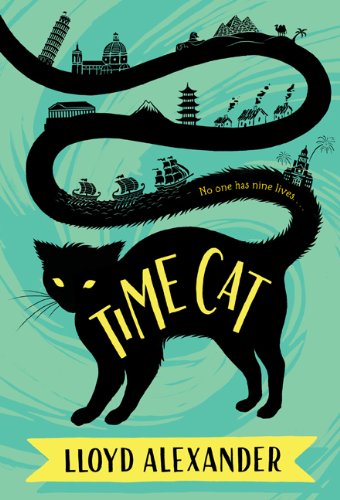
Book Review: Time Cat by Lloyd Alexander


Author: Lloyd Alexander
Title: Time Cat:The Remarkable Journeys of Jason and Gareth
Narrator: Ron Keith
Publication Info: Recorded Books, Inc., 2019 (originally published 1963)
Summary/Review:

I love stories about cats and I love stories about time travel, and yet I made it this far in my life unaware of this book about a time traveling cat! In this story we learn that it’s incorrect to say that cats have nine lives.  Instead, cats may travel to nine different periods in world history, which is why cats seem to go missing so easily or appear in rooms they weren’t previously in.  A boy named Jason discovers that his cat Gareth can talk and joins his cat on a whirlwind of adventures to ancient Egypt, Roman Britain, 17th century Germany at the height of witchcraft hysteria, and Massachusetts at the start of the Revolution.  Somehow a lot of their adventures involve groups of kittens which just heightens the cuteness.  It’s a fun, gentle novel with some history mixed in.  It’s perfect for kids who love adventure, time travel, and cats, even if they’re in their 50s.

Recommended books:

Rating: ****

Book Review: To Ride a Rising Storm by Moniquill Blackgoose


Author: Moniquill Blackgoose
Title: To Ride a Rising Storm
Narrator: Charley Flyte
Publication Info: Books on Tape, 2026
Summary/Review:

I greatly anticipated this second book in the Nampeshiweisit series – the follow-up to To Shape A Dragon’s Breath – and it did not disappoint.  The series is set in an alternate history of 1840s New England where, among other differences, dragons are real and bonded with individual humans. In the first book, Anequs, a teenage indigenous girl from the island community of Masquapaug, is chosen by the newly hatched dragon Kasaqua.  But the ruling Anglish colonizers insist that Anequs and Kasaqua train on the mainland at Kuipers Academy.

Having defied the prejudiced expectations of the Academy’s professors by excelling in her first year, Anequs and Kasaqua return to Masquapaug for the summer.  But Anequs’ notoriety has brought unwanted attention to the island with the Anglish establishing a presence on the island for the first time. Amid rising Anglish control and surveillance, members of the community attempt to meet to organize resistance.

Returning for a second year of schooling, Anequs faces new challenges, including learning to ride Kasaqua now that she is large enough to carry a person. In her personal life, Anequs continues to pursue romance with Liberty, a servant at the school, and Theod, the only other indigenous student. Since Theod was an orphan raised by the Anglish he struggles with concepts like open relationships and same-sex attraction that Anequs grew up with as natural, but he does return Anequs’ affection.  Indeed, the expectations of Anglish society for a young woman are a continued hindrance to Anequs’ goals.

Bubbling under everything happening at the Academy is a rise in white supremacist violence.  By the end of the novel, Anequs and her allies find themselves in the middle of a spreading conflict, and possibly a civil war.  Like the first novel, Blackgoose uses a lot of alternate language for people, places, and concepts that makes the book a bit hard to follow.  But I really enjoy how she weaves folklore of different traditions into the narrative so that, for example, we hear stories from what we would call the African, Jewish, and Norse traditions along the way.

I once again am looking forward to the next installment in this series.

Recommended books:

Rating: ****

Book Review: Guards! Guards! by Terry Pratchett


Author: Terry Pratchett
Title: Guards! Guards!
Publication Info: Gollancz, 1989
Summary/Review:

In the first installment of the Ankh-Morpork City Watch series of Discworld novels, the tall human raised by dwarfs Carrot joins as a new recruit.  Carrot is very literal and by the book, but his arrival brings a new sense of idealism to the corrupted Night Watch lead by Sam Vimes.  At this time a secret monastic order is plotting to overthrow the Patrician who governs Ankh-Morpork by summoning a dragon and then have their puppet slay the dragon and become king.  Things go awry when the dragon burns down wide swathes of the city and declares itself king instead.  In this hilarious and clever story, the Night Watch – and their tiny dragon mascot Erroll – have to summon the heroism to save the city.

Rating: ****


Discworld Reviews Master List

No. Title Published
1 The Colour of Magic 1983
2 The Light Fantastic 1986
3 Equal Rites 1987
4 Mort (radio drama)
5 Sourcery 1988
6 Wyrd Sisters (radio drama)
7 Pyramids 1989
8 Guards! Guards! (radio drama)
9 Eric (radio drama) 1990
10 Moving Pictures
11 Reaper Man 1991
12 Witches Abroad
13 Small Gods (radio drama) 1992
14 Lords and Ladies
15 Men at Arms 1993
16 Soul Music 1994
17 Interesting Times
18 Maskerade 1995
19 Feet of Clay 1996
20 Hogfather
21 Jingo 1997
22 The Last Continent 1998
23 Carpe Jugulum
24 The Fifth Elephant 1999
25 The Truth 2000
26 Thief of Time 2001
27 The Last Hero
28 The Amazing Maurice and His Educated Rodents
29 Night Watch (radio drama) 2002
30 The Wee Free Men 2003
31 Monstrous Regiment 
32 A Hat Full of Sky 2004
33 Going Postal
34 Thud! 2005
35 Wintersmith 2006
36 Making Money 2007
37 Unseen Academicals 2009
38 I Shall Wear Midnight 2010
39 Snuff 2011
40 Raising Steam 2013
41 The Shepherd’s Crown 2015

Other books by Terry Pratchett I’ve read:

Book Review: Cahokia: Ancient America’s Great City on the Mississippi by Timothy R. Pauketat


Author: Timothy R. Pauketat
Title: Cahokia: Ancient America’s Great City on the Mississippi
Narrator: George K. Wilson
Publication Info: Recorded Books, Inc., 2010
Summary/Review:

I’ve long been fascinated by Cahokia, the name give to a series of mounds constructed by prehistoric indigenous people in the vicinity of modern day St. Louis, Missouri and East St. Louis, Illinois.  Archaeologists have determined that culture thrived at Cahokia circa 1050–1350 CE  with 120 earthworks constructed within a 6 square mile area.  Between 15,000 and 20,000 people inhabited Cahokia.

The unfortunate part of the Cahokia story is that it’s been overlooked due prejudice and stereotypes of indigenous North Americans.  Even more positive traits such as the assumption that indigenous people were stewards of the environment and peaceful people so that researchers assumed they would never build a large city.  As a result many of the mounds were destroyed for highway building and other developments.

Pauketat, a former Illinois State Archaeologist, spent much of his career researching Cahokia.  Early in this work he creates a narrative of what it may have been like to walk through Cahokia at its peak.  Much of the rest of the work is the history of archaeological research at the site going back to 19th century settlers.  From the archaeological work at Cahokia, researchers have learned not only about the activities at the site but also Cahokia’s cultural influence elsewhere in North America and modern descendants of the Cahokians.

Recommended books:

Rating: ****

Book Review: The Complete Book of 1990s Broadway Musicals by Dan Dietz


Author: Dan Dietz
Title: The Complete Book of 1990s Broadway Musicals
Other Books Read by the Same Author:

Publication Info: Rowman & Littlefield (2016)
Summary/Review:

The 1990s feels like a transitional decade for Broadway. On the one hand, after a couple of decades of financial decline, the Broadway theater district felt thriving and viable again. On the other hand, many critics – including author Dan Dietz – saw the decade as the Disnification of Broadway.

Disney introduced only two musicals during the decade – adaptations of Beauty and the Beast and The Lion King – but the overall effect is that family-friendly megamusicals that attracted tourists edged out shows intended for grown-up audiences and local theater buffs. Revivals of books musicals continued to outnumber new productions, including Chicago, which became more successful than its original run and still plays to this day.  Speaking of long running shows, any new production on Broadway had to compete with hits like Cats, Les Miserables, and Phantom of the Opera which occupied theaters throughout the decade.

The decade also saw an increase in adapting relatively recent movies as musicals including My Favorite Year, The Goodbye Girl, Big, Victor/Victoria, and Footloose.  There were also a number of revues of songs by Rodgers & Hammerstein, Stephen Sondhem, Johnny Burke, Johnny Mercer, George and Ira Gershwin and blues and swing by Black artists.  This trend presaged the 2000s when movie adaptations and/or jukebox musical rely on reiterating the familiar and nostalgic at the expense of the new.  Nevertheless, several memorable musicals made their debut in the 1990s including: Once on This Island, The Secret Garden, The Will Rogers Follies, Crazy for You, Falsettos, Jelly’s Last Jam, Kiss of the Spider WomanPassion, Smokey Joe’s Cafe, Sunset Boulevard, Bring in ‘da Noise, Bring in ‘da Funk, TitanicRagtime, Fosse, and Parade.  Dan Dietz, who grows crankier with each volume of this series, disliked most of these shows, and trashed Rent and Ragtime (two shows I love).  Dietz’s obvious prejudices which manifest themselves in his rents against “political correctness” make this unpleasant read. But I do still enjoy that he’s gathered together so many facts about each show in one place that are hard to find anywhere else.

Rating: ***

Book Review: Adventures of Huckleberry Finn by Mark Twain


Author: Mark Twain
Title: Adventures of Huckleberry Finn
Narrator: Tom Parker
Publication Info: Blackstone Publishing, 2004 [originally published, 1884]
Other Books Read by the Same Author:

  • The Adventures of Tom Sawyer
  • Complete Short Stories of Mark Twain
  • The Innocents Abroad
  • A Connecticut Yankee in King Arthur’s Court
  • The Prince and the Pauper
  • Pudd’nhead Wilson
  • Tom Sawyer Abroad
  • Tom Sawyer Detective

Summary/Review:

It’s curious that Mark Twain is relegated to the “folksy Americana” bucket when his most famous work is actually a scathing satire of the inherent violence of American culture.  The story is about a boy escaping horrific abuse from his father accompanied by a Black man, Jim, himself escaping slavery, America’s original sin.  It’s heartbreaking that by doing the morally correct thing – helping Jim escape – Huck has been conditioned by white supremacism to believe he is being sinful.  Jim is a wonderful, loving person – really the parent Huck deserves – but even then he has been conditioned to humor Huck as a white person by playing dumb at times.

Huck and Jim’s adventures take place on a raft drifting down the Mississippi River.  On their journey the encounter thieves, feuding families, and the horrors of nature and riverboat traffic.  The better part of the second half of the novel deals with two conmen who commandeer the raft, claiming to be a British duke and the French dauphin.  As they continue downriver, they involve Huck and Jim in their attempts to scam people in the towns they pass. For a novel set 180 years ago, there’s a lot about American people and culture that feels relevant to 2026.

While, in many ways this is a perfect book, I do feel the many cons of the Duke and the Dauphin kind of drag.  Also, late in the novel when Tom Sawyer joins Huck and makes elaborate plans to rescue Jim based on romantic novels it gets a bit too absurd.  The end of the novel has something of a deus ex machina, where Tom and Jim each have a bit of information that had they revealed earlier could’ve saved them a lot of trouble. And while the language of the novel is a verisimilitude of how people talked at the time, it was really difficult to hear the “n-word” repeated so often.

As Ernest Hemingway famously noted, this is a novel from which “modern American literature” originated. It was good to revisit this book especially in a time when the character of the American people is being severely tested.  We live in a time where children suffer abuse at the hands of the powerful and people are dehumanized, and just like the characters in this novel we are tasked with choosing what we’re told is the “Real American” way or doing what is morally good.

Rating: *****

Book Review: Boston Catholics


Author: Thomas H. O’Connor
Title: Boston Catholics : A History of the Church and its People
Publication Info: Boston : Northeastern University Press, c1998.
Other Books Read By the Same Author:

Summary/Review:

Boston Catholics is a history of the church in Boston from colonial times to the end of the 20th century.  It offers an interesting overview of how Catholics grew from a persecuted minority to the dominant faith in the city.  The early parts of this book were particularly interesting with the official creation of a diocese after the Revolution under the leadership of French bishop Jean-Louis Lefebvre de Cheverus.  It was interesting to learn that while Puritan Boston persecuted Catholics in colonial Boston and nativist violence against Catholics rose in the mid-1800s, there was actually a period in-between when the French clergy ingratiated themselves with Yankee Protestants and enjoyed greater tolerance.  Albeit, this was when the number of Catholics in Boston was quite small, but soon would swell with the immigration of Irish Americans who took control of the diocese from the French Americans.

While I found the book an interesting and well-written survey of Catholic history in Boston, there were a few things that troubled me.  First, O’Connor structures the book around the bishops/archbishops of Boston and each section of the book focus on their leadership and influence on the church.  While this could be a meta-commentary on the top-down hierarchy of the Church, I would’ve liked to see more about the ordinary Catholics about whom O’Connor only writes in general terms.  Second, while the Irish American domination of the archdiocese is evident, I was surprised at how little O’Connor wrote about Catholics from other backgrounds.  Even Italian Americans only got a few pages of the narrative, while the contemporary emergence of Boston Catholic communities originating from Haiti, Latin America, and Southeast Asia are simply mentioned.  Finally, I feel that O’Connor’s respect and love for the Church made it difficult for him to write from a neutral position as a historian.

Of course, the biggest thing that’s missing from the book is due to the fact that it was published in 1998.  While O’Connor mentions cases of clergy sexual abuse of children, the full extent of the abuse and the Archdiocese’s coverup were not revealed until 2002. The scandal forever damaged the Church in Boston and ordinary Catholics relationships with the Archdiocese and their parishes.  Had the book been written a few years later it would not only be a significant addition to the history, but would also recontexualized much of the history O’Connor wrote about the Church in the 20th century.  Even beyond the sexual abuse crisis, there’s irony near the end of the book when O’Connor praises Cardinal Bernard Law for look to the future by creating Caritas Christi Health Care to manage Catholic hospitals in the city.  Caritas Christi was later sold to private equity and became Steward Health Care System, which due to financial mismanagement went bankrupt in 2024, leading to the oldest Catholic hospital in Boston – Carney Hospital – permanently closing.  It leaves a bitter taste to read O’Connor’s optimistic appraisal of Boston Catholicism knowing what has happened in the ensuing three decades.

Rating: ***

Book Review: Sweeney Todd and the String of Pearls by Yuri Rasovsky


Author: Yuri Rasovsky
Title: Sweeney Todd and the String of Pearls: An Audio Melodrama in Three Despicable Acts (Dramatized)
Narrator: Robert Dean, Martin Jarvis, Moira Quirk, Simon Templeman, Phil Proctor, Rosalind Ayres, W. Morgan Sheppard
Publication Info: Blackstone Audio, Inc. (2007) [based on the serial published in 1846–47]
Summary/Review:

This excellent full cast audio drama adapts the classic penny dreadful The String of Pearls.  The story involves Sweeney Todd, a barber with elaborate contraptions for murdering his customers for their valuables and Mrs. Lovett who uses the victims’ flesh for her popular meat pies.  It’s as gory as you might imagine (more so if you have assumptions about Victorian sensibilities) and the cast perform it with relish. 

Rating: ****

Book Review: The Complete Book of 1980s Broadway Musicals by Dan Dietz


Author: Dan Dietz
Title: The Complete Book of 1980s Broadway Musicals
Other Books Read by the Same Author:

Publication Info: Lanham, Maryland : Rowman & Littlefield, [2016]
Summary/Review:

While I didn’t attend many Broadway shows in the 1980s, growing up in the greater New York City area meant marinating in commercials, TV appearances, and references/parodies of the latest shows.  So I have a certain nostalgia for 1980s Broadway.  That being said, it was a tough decade for American musical theater.  A lot of shows bombed, most notoriously Carrie, although that seemed at least an attempt to try something new.  Throughout the decade, Broadway seemed obsessed with book musicals and revues based on vaudeville and burlesque, the Roaring Twenties and the Great Depression, the Harlem Renaissance and gospel music.  Dan Dietz jokes that there are several songs that appeared in more than one of these musicals.

Despite the struggles, some notable shows include 42nd Street, Dreamgirls, La Cage aux Folles, Big River, Grand Hotel, Barnum, City of Angels, My One and Only, The Mystery of Edwin Drood, Nine, and Sophisticated Ladies.  Stephen Sondheim created three thoughtful works: one that would have to wait 40 years for success (Merrily We Roll Along) and two that were immediate hits (Sunday in the Park with George and Into the Woods).  But the big story of the decade was imported shows – the so-called British Invasion and the birth of the mega-musical.  This includes Andrew Lloyd Webber’s Cats, Starlight Express, The Phantom of the Opera, and Aspects of Love, as well as Les Miserables, Me and My Girl, and Chess.

Dietz’s work remains fun to read for all its facts and details, although he tends to be opinionated and cranky about so-called “political correctness.” He sees the emergence of the mega-musical as negative for Broadway, for which he has a good point as it regards getting smaller and medium-sized productions a chance.  He also dislikes the growth of revivals, noting: “during the 1960s there were ninety-eight book musicals with new music and one commercial revival, but from 2000 to 2009 there were thirty-eight musicals with new musicals and forty-two revivals.”

Personally, I don’t object to revivals so much as there are a lot of older classics that people never had a chance to see.  But the combination of revivals with mega-musicals running for decades leaves very little space for new and innovative productions.  It might be more beneficial of artistry if instead of a show like The Phantom of the Opera running for three decades continuously with replacement casts, if maybe there were five one-year revivals with new casts in the same time period?  But the economics of Broadway would not allow that model to make a profit.

Rating: ***