Category Archives: Trainer Development

Be Curious About Your Dog

I want to tell you a story today about my own dog, Rig. I’ll be writing a lot about Rig in the near future, but for now, I want to focus on a lesson that she really reinforced for me: be curious about your dog.

Rig with her ball! Photo by Hailey Sobania Photography.

Rig was a tough puppy. I loved her from day one, but I’ll admit that I didn’t particularly like her for the first year of her life. She was loud, and she had a habit of shouting and height-seeking when aroused that was painful both auditorily and physically. This became a vicious cycle: she’d feel pressure (environmental or social), she’d leap up at my face, and she’d bark loudly enough that it literally triggered our doorbell to ring. It was frustrating and painful, and I didn’t react well.

I tried several training interventions, of course. The most successful was to cue her to do something else. However, she wasn’t always able to respond right away, because we were fighting through a lot of arousal. When my spoons were too low, I’d tether or crate her with a puzzle toy and stay out of her range. This didn’t solve the issue, but it managed it to keep both of us on a more even keel. At my worse moments, when I was extra painful and she was extra over-the-top, I’d cross my arms and move forwards into her bubble when she “pierced” my bubble until she yielded space: a holdover from my days as a balanced trainer, and not a technique I’m proud of. None of it fixed the underlying issue.

Watching videos of her siblings, I noticed one of her littermate’s owners doing something novel with her puppy (who displayed the same behavior). When her puppy would start to pop, she’d verbally acknowledge her change in arousal with a light “whee!” or “yahoo!” and continue on. The lightness of her tone didn’t add to her puppy’s arousal, and moving on modeled what she wanted her puppy to do. The heavy stress that Rig and I were experiencing just wasn’t present in their interactions, even when her dog was just as hot and aroused. I liken the entire litter to popcorn in hot oil: give them long enough, and they’re going to “pop” loudly. But Rig was like a little firework, whereas her sister was simply a corn kernel, light and fluffy after her pop. This was interesting!

I started to do the same thing, acknowledging Rig’s “hot” moments without trying to change her behavior. And, of course, it helped a lot. Since social or environmental pressure was the cause of her popping, adding pressure wasn’t ever going to be the solution.

Rig putting her impressive leaping prowess to good use at a disc competition! Photo by Elli Kramer.

I’ve been thinking about this lesson a lot for the past two years, through raising more puppies and coaching even more people on their relationships with their own dogs. And I know that I’m not the only person who misses the forest for the trees. So, this is important, readers. I’m giving you permission to be curious about your dog.

Be curious about who your dog is as an individual! What makes your dog their own self? What does she seek out? What does she avoid? How many body lengths away from you does your dog naturally place herself in different contexts? What does pressure (environmental, social, hormonal) look like for your dog? How does she naturally resolve pressure if you don’t step in? What do her coping strategies look like? What does she look like when she’s curious, when she’s aroused, when she’s relaxed, and when she’s unsure?

I want you to spend time just learning about your dog, separate from an agenda or any demands. Do you know what her interests are? What does she need and want from you? How can you help her, how can you have fun with her, and how does she like to receive affection? It doesn’t matter whether you’ve had other dogs of her breed, type, or even family lines before: she’s her own self, and that self is different from other dogs. The more you can celebrate who she is as her own self, the more you’ll find your connection growing.

From there, I think you’ll find, much like I did with Rig, that training is easier and more enjoyable.

When you build a bond of understanding and friendship first, skills are so much less onerous to create. Think of recalls, for example. If you know what interests your dog, you’re going to be better equipped to set her up in the right environment to provide appropriate challenges: not too hard, but not too easy. When you know how close she naturally sticks by you, leash manners become easier, because you can start with a leash length that’s appropriate for your dog (my spouse’s dog Iroh walks delightfully well on a 10’ leash, never pulling and following direction instantly, but absolutely falls apart on a 4’ leash at this stage in our training journey, for example). When you know how your dog likes to play, you can connect with her in a playful way at the vet clinic when she’s a bit stressed, and help to release that stress with some good old-fashioned endorphins. When you know how your dog copes with stress, you can better understand why she might disconnect, get the zoomies, sniff, or, like Rig, punch you in the face… and since you’ll understand that she’s trying to cope with stress instead of being “bad,” you’ll be able to more easily identify what stressed her and take steps to support her through that.

So reader, I want to hear from you. Are you curious about your dog? What have you learned about what makes your dog special and unique? Please share in the comments!

Fatphobia in Dog Training: Resistance to Using Food

Note: thank you so much to Bailey Stickney for allowing us to cross-post this wonderful piece from her blog.

I was engaging in therapy remotely a few years ago. I was on Zoom in my house, and I had a board and train client at the time. Most of my board and trains are working on impulse control and just overall refraining from terrorizing the house when someone is not paying attention to the dog 100% of the time. So I was sort of talking to my (ex)therapist and tossing treats to this dog lying on his mat every so often. The therapist asked me what I was doing. I told him I was training a dog, and he responded. His tone was shocking, especially coming from a therapist that has a couple of specialties in childhood development and in teaching parents how to parent with positive reinforcement. It was just so weird; his tone got really dark and he said, “oh he’s going to get fat.” 
 
That was his first – and possibly only – concern. He was so worried that this dog (a dog that he doesn’t know, and who’s owner paid me – a professional dog trainer – good money to train), would get fat. The longer I think about it, the crazier it feels.  He is a mental health professional, and he’s still in this mindset. That’s the state we’re working in here. 
 
I am sure that, like many a layperson, this therapist didn’t realize the dog’s regular calories could be used to do the training. The dog has to eat something every day, right? Why wouldn’t we put that to use? But still, it was absolutely crazy that I had to take time out of my therapy session that I paid for to educate this man, and eventually to tell this therapist to mind his own business.  

I think about this interaction often, and I can’t help but make the connection to fatphobia in America. Of course the resistance to using food to train dogs is rooted in our own fatphobia!  

Another time, I was walking dogs for a local rescue. We usually had one or two dogs with some pretty severe behavior problems. I’m thinking of a particular dog – we’ll call her Gretta. Gretta must have been at the building for about a year. She had some dangerous behavior problems, but one of the milder issues was lunging at cars while out on walks. Even on leash, she almost got hit several times! She pulled the leash out of many a dog-walker’s hands as well. We implemented a training plan that included pairing her favorite treats with the sight of cars. It worked! It was easy to walk her around cars after a few weeks’ worth of training. Towards the end of her stay in the shelter, Gretta started to little chunky, but she was still functional and joyful.

I was talking with the shelter coordinator because she was complaining about how fat Greta was. I said, “well I mean we’re feeding her a lot at meal times.” It was a lot. I remember thinking “this is twice what I feed my dogs of the same weight” – 4 cups a day. So I just suggested that we could reduce the regular food at mealtime. The coordinator looked at me with a sharpness in her eyes and said, “we need to cut down on her treats.” I was flabbergasted. The training treats had made her walkable in just a couple of weeks! It was dangerous to walk her before, and it was not dangerous to walk her with the treats. Fatphobia is so strong that we had this shelter manager more worried about Gretta being fat than the way her life was positively impacted through the use of positive training with food. This shelter manager was more concerned about having a fat dog than she was for the of the safety of the volunteers that were walking this dog.  

It is downright dangerous; as a society, we’re willing to sacrifice safety to avoid fatness. I hope to do better from within my company. 
 
So when we are working with the general public, who believe that food and fat are scary, we may need to reassure them that things will be okay. We will need to teach our clients that we can use their dog’s regular calories, and we don’t necessarily need to add extra calories to their diet. We will probably have to change how their dog receives their calories. Smaller dogs may have to get all or most of their calories from training. Larger dogs may be able to receive smaller meals so we can use the rest for training.  Some dogs will happily work for their regular kibble (I have one such dog, and I sure do feel lucky). Of course, we need to use food that is reinforcing to the dog in front of us, so if that dog will not work for their kibble, then maybe we can find a wet dog food and deliver it from a squeezable food tube. This way, your dog is getting something delicious and a complete, nutritious meal. This should help the general public feel better about using food to train their dogs.

I’ll end with a mantra of mine: “there are worse things to be than fat.” It’s not the worst thing if your dog is chubby, and it’s not the worst thing if you’re fat. There’s lots of lots and lots of things that go into weight. There are tons of people that can eat and eat and eat and eat and eat without gaining any weight. It’s the same with dogs! There are also people and dogs that can eat almost nothing and stay large. Weight is complicated. It’s not the most important thing, and we can focus on creating joyful, functional lives without worrying about weight.

About the author:  
I’m a fat person. I don’t eat very much. I really don’t consume many calories. I’ve also never owned a fat dog. I feed my dogs training treats all day, and they are not fat. I give them two meals each day plus training treats throughout the day. And they’re not fat. We can let go of some this fear; it’s not helpful. Genetics are a Whole Thing, and I personally will choose to live a functional, joyful life over a thin life.

You can learn more about Bailey, as well as the other Paws Abilities dog trainers, here!

The Power of Nothing: When Doing Nothing is Better than Doing Something

This post, written by the brilliant Bailey Stickney and reposted with permission from her blog, contains three examples where giving up some control was a better solution than exerting control over a situation.

Mason going on a walk (without screaming!), photo by Bailey Stickney

1. My cat used to race into the garage any time the opportunity arose. 
 
There are a lot of hiding places for a cat in my garage, and things aren’t stored in there very safely. There are boxes stacked precariously, and I worry they could fall and crush him. When we first moved in here, there were leftover chemicals and other stuff from the previous owners that I was intensely worried about.   
 
Because he is a normal, curious cat, and the garage was off-limits for him, he would race in there any chance he got. And he did not want to come out. He refused to be found. The harder we tried to get him to come out, the deeper he’d hide.  
 
Some years have gone by, and I am a better trainer now. My garage is still a mess, but it is a bit safer, and I don’t feel as desperate to keep him out of there. I’ve given up the idea of tightly controlling this cat, and it has paid off!  
 
I don’t try to block his access to that garage anymore. When he goes in, I don’t make it a big deal at all. When he comes out he gets a great treat. Now he doesn’t really care about going in the garage anymore. When he does go in the garage, he goes in with me, and follows me out when I leave. And then he gets his treat. A small price to pay for safety.  
 
The same thing happened with the yard. I used to really worry about him running away (because he did run away one time) Again, I tried to block his access to the yard, but that just made him try harder, and he refused to be caught when he did get out. Now I let him go out if he chooses, and I just reward him handsomely when he comes in. I also reward him every time the door opens; he gets a treat every time I let the dogs out. These days, if the door is open, he may dash outside, but his main goal is to immediately dash back inside. It is really quite funny – he’s not trying to get outside, he’s trying to come back inside so that he can get a treat! 
 
I had to give up my perception of control in order to gain actual control of my cat. 

 
—-  

 
2. I’m not one to say that owners and humans cause a lot of behavior problems, but resource guarding is one area where we tend to make it worse. 
 
We’ll see this often in gun dogs (retrievers, pointers, spaniels, setters, etc.). These dogs naturally like to have things in their mouths. And they are dogs, so they like to put gross things in their mouths. Things like dirty underwear and dirty socks. Humans usually don’t like this because it’s gross, and we also don’t want them to wreck our stuff. So when we see them carrying our stuff, we quickly try to take it away from them.  
 
And right here is where so many things happen that just make it all worse.  
 
As humans, we are probably doing something else when our stuff gets grabbed. We might be working, eating, watching TV, or maybe reading.  But when we notice that the dog has a Thing, our attention quickly shifts from whatever we were doing to the dog. If the dog likes having your eyes on them, the dog has just been reinforced for taking a Thing. AND THEN! We play a game of chase! So that’s fun too!! But we create a lot of conflict when we catch up to the dog. We might grab the collar, use an unpleasant tone of voice, pin them down, rip the item out of their mouth, manipulate their jaw, etc.  

As difficult as it may be, it is almost always better to just ignore a dog that has stolen an item. Paying attention to it is likely to make that item feel more valuable. Instead, we might grab a more appropriate toy and make a big deal about how special it is, play with it by ourselves, and before you know it, the dog will probably decide that the appropriate toy is more valuable than the stolen item. This is, of course, so much easier when the stuff you really care about is put up out of reach of puppies and adolescent dogs.  
 
 —-

3. Now I’m going to talk about a mistake that I made. I was speaking at a 4H class. The library was so kind to let us have dogs in the basement. It was orientation night, and the children were not supposed to bring their dogs. I brought Mason to do some demos because he is excellent with people, and he is safe with dogs, but he is… loud. He’ll scream and scream and scream and scream if they can’t meet. It’s very off-putting, and it can be very scary if you don’t know him. 
 
It was just my luck that one of the parents either didn’t see the e-mail or chose to ignore the instructions, and brought a tiny puppy. It was very small, and very cute. They hid it in their coat, and Mason made it through half of the class without realizing that another dog was there.  
 
But I knew the dog was there, and I should have just brought him to my car and completed the lesson without a demo dog. But I thought “oh, if that puppy just stays in their coat, Mason will never know, and I can teach the lesson as planned.” Alas, the puppy did not stay in their coat.  
 
I made three mistakes:  

1.) I probably should not have brought Mason into a space that’s known for requiring quiet participation.
2.) I should not have trusted that parents and kids would abide by our rules. 
3.)  When I finally did learn about the dog that wasn’t supposed to be there, I should have brought Mason to the car before anything happened. 
 
Of course, the tiny puppy woke up and wriggled out of the owner’s jacket. Mason saw A PUPPY and his brain melted out of his skull and he started screaming. Mason is safe, even mid-meltdown, but the whole performance is incredibly off-putting, extremely loud, and again, we were in a library.  
 
A library worker came down when she heard Mason’s noise. She was quite frustrated with me, and she was understandably upset that this was happening. I was already trying to get Mason out of there. I ran into this library worker in the hallway as I was trying to get him out to my car. I was already leaving, but her need for control got in the way. She ended up delaying the outcome that she was looking for. I was already on my way out, but she still felt the need to stop me in the hallway. She kept telling me over and over and over and over that the dog needed to leave.  I was nodding and agreeing, and just waiting for her to stop talking and move out of my way. She was blocking our escape with her body, and she just stood there scolding me, and I just kept nodding, and Mason just kept screaming. 

That need for control… it’s a tough thing to balance. The library worker probably thought that she was protecting her patrons. In reality, she ended up prolonging the perceived risk to her patrons by exerting her authority in that situation. Wielding that that control was totally unhelpful in that situation.  

—- 

There are so many areas in animal training – and in life – where giving up a little control will actually give us more control, and make things safer, easier and more enjoyable. It sure is hard to do, but I’m working at it. I hope you’ll join me!

Sniff Before You Drip: Essential Oils and Your Dog

Have you ever been stuck in an elevator when someone wearing way too much perfume walks on (or worse yet, stuck sitting next to that person on a plane or bus)? Not only does it bother you initially, but it can actually be physically uncomfortable. You quickly develop a headache, and may feel nauseated. Often you will go “nose blind” after twenty minutes of smelling the perfume or cologne, no longer registering its presence at all (but also not able to smell anything else in your immediate environment). Even after you’ve long since stopped being aware of the scent, the physical effects on your body linger on.

We all know how unpleasant strong odors can be. However, I think we frequently forget to look at (or rather, sniff) the world from our dog’s perspective.


Consider this: the canine olfactory system is so specialized, so amazingly designed, that we literally cannot match it. Even the most brilliant scientists in the world are unable to build a robot that can track or differentiate odors as well as your pet dog. Dogs are unmatchable.

Let’s look at the dog’s olfactory system in relation to our own favorite sense, vision. Dogs so far outperform our own limited noses that we must seem to them to be, for all intents and purposes, anosmic. If scent were vision, what you could easily see 1/3 of a mile away, your dog would be able to see three thousand miles away, just as clearly.  Dogs have somewhere between 200,000,000-300,000,000 scent receptors in their noses. They’re rock star sniffers.

Why does this matter? I want you to think about your perfume-drenched elevator companion for a moment. What if you had to live with that person 24/7? What if you could never escape that tiny elevator? This is the reality for many dogs. They’re stuck in physically overpowering and even painful scent environments for their entire lives.

That diffuser plugged into the outlet in your living room might smell heavenly to you. But, do you think it would still smell as good if it were 10,000 or even 100,000 times more pungent? Does your dog enjoy it?

Worse yet, do you use essential oils on your pet or in your home?

Essential oils may have some health or mood-altering benefits. I have no problem with dog owners using these as an ancillary treatment alongside training or behavior modification. In fact, conditioning a relaxing and “safe” scent can sometimes make a huge difference for anxious dogs! However, I often see oils used way too irresponsibly with animals. Good practitioners will tell you which oils are safe or unsafe to use with your pet. However, your responsibility doesn’t end there. You also need to make sure that you’re using the oil in the correct concentration.

Considering how keen our dogs’ noses are, we need to be highly cautious about using oils at full strength. I instead prefer to use a small bit of the essential oil diluted in a less pungent carrier oil. A single drop of essential oil can be mixed into a small glass jar of olive or coconut oil, for example. You can then further dilute the oil by repeating the process, placing a single drop of the diluted mixture into a second jar of carrier oil. While this may not smell as strongly to you, it will still be plenty powerful for your dog’s superior sniffer.

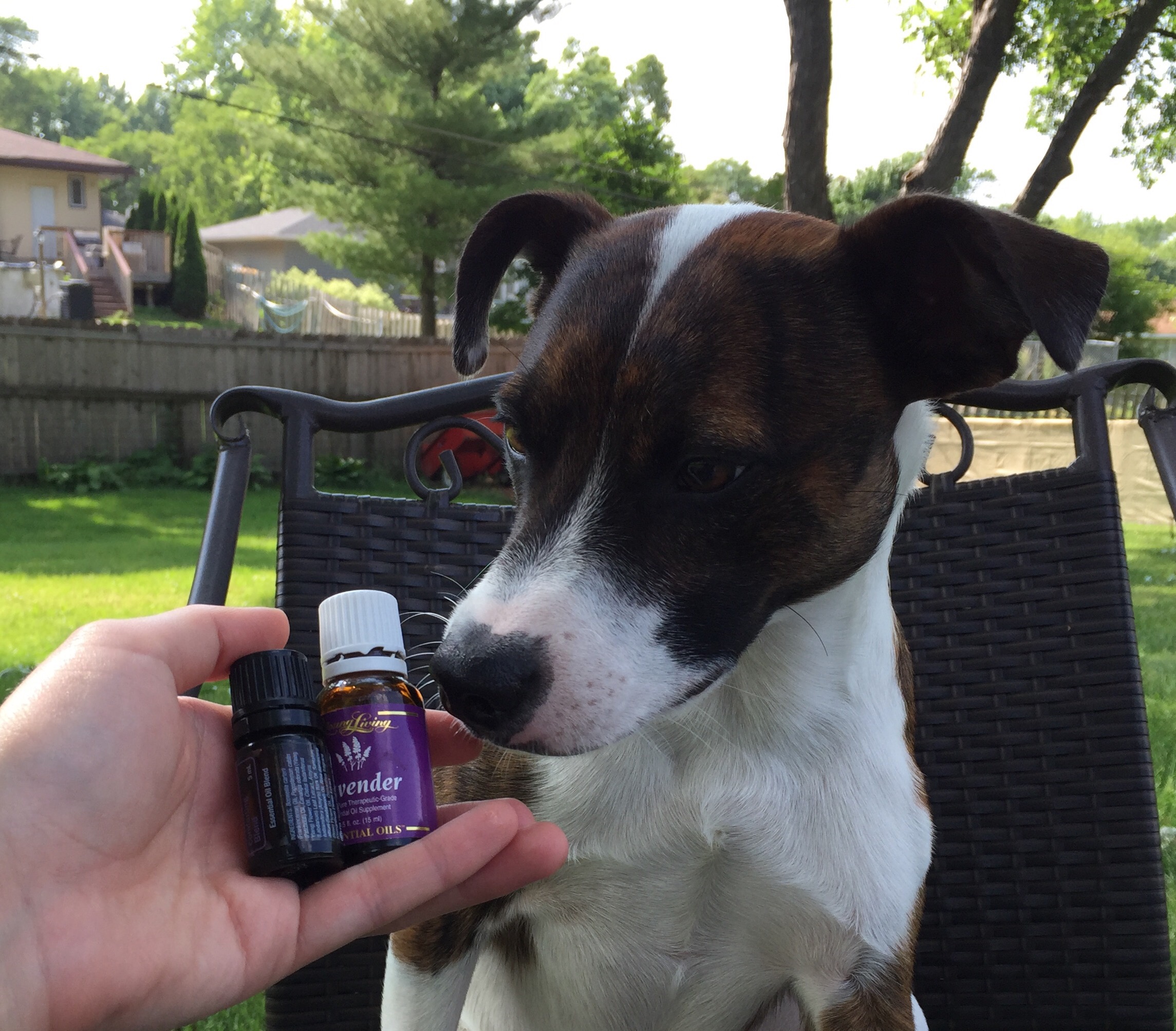
If you wish to use essential oils with your dog, I also recommend that you ask your dog which oils are best. You can do this by simply placing a single drop of your diluted mixture on a small washcloth or towel. Place the scented cloth near where your dog likes to hang out, and observe your dog’s reaction for twenty-four hours. Does your dog investigate, lie on, or seem drawn to the scented cloth? Great! That’s a green light to use the diluted oil for your dog. Does your dog ignore the cloth? Go slowly, and be cautious about its use. Does your dog avoid the cloth, or perhaps even the whole room that the cloth is in? Stop right there. Your dog finds the oil aversive, and you should not use it.

Whether you plan to use an oil diffuser or rub the essential oil directly on your pet, I encourage you to always ask your dog whether they find the scent acceptable before you proceed. The same goes for other scents in your home. Scented laundry soap, fabric softener, room sprays, candles, perfumes, cologne, and diffusers can be highly aversive to many dogs. In fact, I believe that excessive use of these products often contributes to many of the common behavioral issues we see in our pets by adding an unnecessary stressor to their lives, and perhaps even making them feel less well.

Please, be sensitive to your dog’s sniffer next time you wish to use scent in your household. You may be surprised how very many opinions they have about the topic!

Case Study: Learning to Relax

Written by Katie Kelly, CPDT-KA, ABCDT

When I was looking to adopt a second dog, one of my top priorities was to find a dog who was dog-social. I already had Minnie, my small reactive Shih Tzu, and I needed to make sure that she and my future dog could safely coexist. Having a dog-social dog would also mean a canine partner to join me at work, providing demonstration and help with behavior modification for my client dogs.

Finally, I found Jasmine. She was dog social, a good dog-sport prospect, and (most importantly!) she passed Minnie’s test. She was dog-social, alright. I found myself frustrated with many of the same problems my clients have with their dogs. Jasmine wanted to greet everyone! She would zip to the end of her leash and whine at any glimpse of a dog in view, and became very excited about people as well. This not only made her look intimidating to some, due to her pit bull type features, but it was extremely tough to go anywhere with her. I would repeat over and over to myself, “at least she’s social. At least she’s social. At least she’s social.” But there was more.

Jasmine

Jasmine

Animated beings were not the only things Jasmine got excited about. She would zoom in circles any time she touched a leaf, or felt the crunch of the snow beneath her feet. If I was out and about with Jasmine, she could never just stand still. If I stopped to talk to a friend, Jasmine would get fidget, pace, and whine until we moved on. At one point, when out on a walk, she got so excited about sniffing a tree that she zoomed around the tree multiple times until she broke the clip on her leash, and ran off in a frenzy. Gone. Thankfully, she found me again once she was able to calm down. During moments such as these, she began to worry me, as she appeared out of it, incapable of any sort of mental response. At that point, I began labeling her as “hyper-reactive,” meaning she over-reacted with hyperactive behaviors on a regular basis with everyday situations.

Eventually, after some conversation with my veterinarian, Jasmine was put on anti-anxiety medication. Once the medication took effect, I was able to work on teaching Jasmine to relax. This was life changing for Jasmine.

At first, I started in my home. I helped Jasmine realize that it was okay to go lie down on the floor like a normal dog, rather than feeling the need to seek out constant attention. Then I began to take the skills Jasmine was learning at home and apply them in our training classes. I specifically took the “Focus and Control” class, where the goal is to maintain connection, teach impulse control, and condition the dogs to relax.

One of the best parts about our “Focus and Control” curriculum, is that we teach dogs to drive to a mat, and lay down. Mat training is wonderful all by itself, but we also add a relaxed emotional response. The mat becomes a soothing comfort that can easily transport from place to place. This gave us the ability to take our training out into the real world!

I practiced relaxation with Jasmine everywhere: out in pet stores, café patios, out on walks, and at friends’ houses. She became much easier to take places. Whenever she began to escalate, I would begin some sort of relaxation technique, sometimes with the mat and sometimes not. Over time, I was seeing less and less reaction to the things that once overstimulated her.

While Jasmine is an extreme example, teaching relaxation is beneficial for every dog. Giving a dog the skills to cope and settle in everyday situations can prevent many behavior issues, such as anxiety, aggression, and hyperactivity. It is also beneficial to their overall health, as stress affects our dogs in the same ways it affects us humans. Lastly, dogs who can maintain emotional stability are much easier to train, as they have a higher capacity to process and retain information.

Jasmine (right) helps "little Jasmine" (left) learn to relax around other dogs at Day Camp!

Jasmine (right) helps “little Jasmine” (left) learn to relax around other dogs at Day Camp!

Today, Jasmine is off medication. Her daily overreactions now only happen on very rare occasions, and in those moments she is now easy to redirect. Her stable personality is perfect for day camp, where she now helps other dogs learn to relax in her presence, a skill that can be extremely difficult for those super social dogs!

These days I stress the importance of canine relaxation to my clients. It is also a major focus in our day camp programs: Puppy Headstart and Canine University. Could your dog benefit from a little more down time?

The Problems with Remote Collars

There are many different training methods out there, and each has its pros and cons. Today, I want to talk specifically about the use of remote collars (also known as shock collars or e-collars).

Photo by Tate Viehmann

Photo by Tate Viehmann

Today’s remote collars are a far cry from early versions. Many brands now have a very wide range of shocks (called “stimulations” by collar users), which can range from virtually unnoticeable to intensely painful. “Good” remote collar trainers use the collars primarily as negative reinforcement. What that means is that the dog learns to comply immediately in order to turn off a painful, uncomfortable, or annoying sensation. While this is a far cry from the early days of remote collar use, when dogs were hurt at high levels for noncompliance (a training technique called positive punishment, for you geeks out there), it’s still not a pleasant way to learn.

So, how would someone use a remote collar? Let’s use a recall (come when called) as an example. The trainer would start by asking the dog which level of stimulation was the right one. This is done by putting the collar on the dog and, starting at one, increasing the level until the dog displays a change in behavior. This level is then the one used for initial training, although the trainer may adjust the level up or down depending on a variety of factors. The dog should not be displaying significant signs of pain or distress at this level (no yelping, head shaking, or fight/flight reactions).

Once the “appropriate” level of shock is determined, the trainer will teach the dog to turn off the shock. This can be done in a variety of ways, but usually involves repeated stimulations (tapping the remote over and over rapidly) until the dog moves towards the handler, at which point the shocks stop. The dog learns that his or her behavior can make the sensation stop.

While remote collar training can certainly be effective (if it wasn’t, it wouldn’t still be around), it is not a technique that I recommend. So, what are the common problems with remote collar use?

My biggest concern with the use of these collars is that, used according to modern training directions, there is no way for the dog to avoid shock entirely. The first “tap” of the collar is given simultaneously with the command. While the dog can quickly turn off the sensation by complying, there is no time or way for the dog to entirely avoid all shocks. The dog is only able to avoid future shocks, not the initial one. This necessarily sets up a stressful learning experience.

But what if the collar isn’t used simultaneously with the command? What if, instead, the trainer only begins tapping the remote after the dog has had a few seconds to respond? While this training method would avoid the above issue, it creates other problems. Don’t forget, Pavlov is always on your shoulder! If the recall command is repeatedly followed by an uncomfortable or unpleasant stimulus, you will quickly condition your dog to feel dread when you call. This process is called classical conditioning, and it’s powerful stuff. We call cues that are associated with icky things like this “poisoned” cues, and research shows that changing the association with a poisoned cue is a very long-term, difficult process. Once your dog has associated a word with something unpleasant, they will always have that memory in the back of their mind when they heard the poisoned cue in the future, even if future repetitions of the cue have only been associated with nice things. By the way, this same process happens if you use a warning tone or vibration before (and eventually even in place of) the stimulation.

Speaking of emotions, my second concern has to do with the quadrant of learning theory that remote collar users employ: negative reinforcement. In negative reinforcement, the dog learns to do something in order to stop an unpleasant thing. The primary emotion associated with negative reinforcement is that of relief. People feel this too! Consider doing your taxes, shoveling the driveway after a big snowstorm, or loading the dishwasher. The biggest reward for completing these tasks is the sensation of relief when you’re done. The tasks are not enjoyable in and of themselves, but you feel better when they’re completed because you’ve removed the pressure of the need to act that’s been looming over you.

Compare this to the emotion that positive reinforcement causes: joy! Which would you rather have your dog feel when you call him? When trained with positive reinforcement, the recall cue becomes a tiny reward in and of itself. Dogs feel a little jolt of happiness when you call, because they’ve associated the recall over and over with very pleasant things happening. Dogs who are trained with negative reinforcement, such as remote collars, feel a strong compulsion to move towards you when you call them, followed by a feeling of relief once they are in motion towards you. That’s not the same, and it’s not what I want our relationship to be based on. That’s not to say that dogs trained with remote collars can’t have lovely relationships with their owners – they can! In fact, training of any sort will begin to build a relationship, regardless of methods used. But my opinion is that positive reinforcement works the very fastest and best to build strong, lasting relationships based on mutual respect and understanding.

Finally, remote collars can cause fear or aggression issues. This comes back to that classical conditioning we talked about before. If you repeatedly use the collar to call your dog away from people or other dogs, for example, your dog may come to associate the uncomfortable sensation with what he sees when the collar is activated (dogs or people) rather than with his behavior. If he’s looking at another dog every time he hears the warning beep or gets “tapped,” he’s going to come to associate other dogs with this, and his behavior towards other dogs is likely to change. In fact, this is such a common situation that the AVSAB has released a position statement warning about these risks, and advising that e-collars are never used in dogs who have any history of fearful or aggressive behavior.

But, aren’t remote collars necessary in some situations? What about if your dog lives near a busy road or has a history of chasing livestock? Aren’t e-collars more reliable than positive reinforcement alone? This is one of the most common excuses I hear for using remote collars. Luckily, this question has been studied, and the results were quite conclusive. Positive reinforcement training works every bit as well as remote collar methods in teaching a reliable recall, even for dogs who have a history of chasing livestock. Furthermore, dogs trained with positive reinforcement methods showed fewer signs of stress, such as yawning and tense muscles, and had lower salivary cortisol levels three months later upon visiting the training center. If you feel that you need to use a remote collar to achieve a reliable recall, you likely need a better trainer and better management tools, not a remote collar.

Ultimately, I believe that remote collars are a step up from previous compulsive methods of training dogs, such as using a long leash attached to a slip or pinch collar. But that doesn’t mean that they’re the best method out there, or even a good method, and before using one I would strongly advise you to do your research. Reward-based methods work, even with strong, hard-headed, and highly predatory dogs. In fact, they work really well for all animals, with fewer potential side effects. They can work for you, too.

Marmaduke “Nose” Reusche – in memory of a good dog

Duke CGC TT, March 2002 – September 27th, 2015

Every trainer has a story about their crossover dog. Duke was mine.

Duke was adopted by my parents when he was 9 months old. He had been found as a stray and was never claimed by his original owners. We started training classes within a couple weeks of bringing him home, and my life changed forever.

table

ramp1Duke introduced me to clicker training. He loved going to classes, and tried so hard to be a good boy. Learning wasn’t easy for Duke, as he had the canine equivalent of some sort of learning disability. He learned well in the moment, but struggled to retain new information from day to day. In spite of this, he enjoyed a steady stream of obedience and agility classes. The more treats, the better! He learned tricks and eventually even earned his CGC certificate (on our seventh try).

face4Duke was my first instructor in reactivity and anxiety. To say that Duke lacked social skills with other dogs was an understatement. Other dogs made Duke anxious, and he would charge at unfamiliar dogs on walks. When he met a new dog, Duke would hump whichever end he encountered first, the commissure of his lips pulled back anxiously, ears back and eyes wide. If corrected by the other dog, he would fight back noisily but without doing damage.

P1020088 - CopySlow introductions proved that Duke could do quite well with doggy friends, and the controlled environment of class worked well for him. He did well with a string of foster puppies and became good friends with Layla, Dobby, and Trout as I added new dogs to my canine family. At home with my parents, he enjoyed being the “only dog” most of the time, and viewed their cat Trouble with the mingled apprehension and respect that only curmudgeonly old cats can provoke.


swum6

duke9Duke’s chief joy in life after food was to be with his people. A true velcro dog, Duke was deeply unhappy when left home alone and loved nothing better than to spend time with those he loved. Anxiety medication and stuffed Kongs helped to manage Duke’s separation anxiety throughout his life, and he eventually came to view his crate (complete with orthopedic dog bed and an ever-present stuffed Kong) as a comforting place. He would even sleep in his crate when his hips were bothering him.

duke11As Duke aged, he settled into a comfortable and happy routine with my parents of evening walks with my mom and sharing popcorn with my dad. He loved getting his butt scratched, even if it sometimes hurt his sore hips. He played with his quacking duck toy, shaking it angrily whenever anyone would leave the house. He barked – oh how he barked! at noises and sometimes at nothing at all. He would get stuck barking, standing in the living room and unable to see out the front window to know what he was barking at, but still fulfilling his self-appointed sentry duties nonetheless.

sprinkler2Duke’s love of food drove him to steal and eat a veritable feast of food and food-like objects in his youth, and despite some close calls (activated charcoal when he ate the bottle of ibuprofen, treatment for pancreatitis when he got into the entire pan of apple crisp, diligent monitoring until he passed the chunks of ceramic spoon-rest), food was ultimately not his downfall. He became all-too-familiar with hydrogen peroxide and would run when he saw the brown bottle come out. Stories of Duke’s dietary indiscretions became the stuff of legends. “Remember that time he ate ten pounds of kibble at once? He looked like he was pregnant!” “Or that time he ate an entire bag of Hershey’s kisses, wrappers and all, and his poop was festive for days…”

roll4Duke was not an easy dog. He was anxious and reactive and naughty. Duke was the best dog. He was the sweetest, and so kind with children. He was a loyal and faithful family companion who loved nothing more than to be with his people, in the center of a crowd. He didn’t demand attention. He just wanted to be included. He loved to sit on laps, all 70 pounds of him. He loved to lick faces. He loved to show off his tricks for treats – sit, down, settle (tail too!), balance up, and shake. He was not an easy dog, but he was a good, good dog. He was our good dog.

We miss him like hell.

bwduke_lg1

Good Dogs Wear Muzzles Too

We were walking our dogs outside a rally obedience trial several years ago when my friend froze. “Watch out!” she said sharply, “There’s a muzzled dog across the parking lot!” I looked, and sure enough someone was walking their dog in a comfortably fitted basket muzzle. The dog was on a loose leash with soft, relaxed body language, intent on his owner. I chuckled and went back to watching my own dog. “I don’t know why you’re worried,” I said, “That’s the one dog at this show that I’m the least concerned about.”

Layla wears her basket muzzle if she's going to be off leash around unfamiliar dogs.

Layla wears her basket muzzle if she’s going to be off leash around unfamiliar dogs.

Our societal perception of muzzles is shifting, but the prejudice is still present in many communities. The thought is that only “bad” dogs wear muzzles, and if a dog is wearing a muzzle he or she must be a mean animal with horrible owners.

I’m here to tell you that this perception is antiquated and untrue. Great dogs wear muzzles all the time, and there are many wonderful reasons for teaching your dog to be happy and comfortable in a basket muzzle. The Greyhound community has had this right for years and years, and I can only hope that the rest of us will catch up soon.

Conditioning your dog to wear a muzzle is a fairly straightforward process, and is something that I recommend all dog owners put the time into. The chances are good that your dog will need to wear a muzzle at some point in his life, and having him react happily to the appearance of the muzzle is a great way to ensure that you’re not adding stress to what may already be a difficult time in the case of an accident or injury that requires painful veterinary treatment.

layla_trout_dp

So, why might your dog wear a muzzle?

Safety of your dog: some dogs engage in behaviors such as pica (eating inedible items, such as gravel or sticks) or coprophagia (eating feces) which could be dangerous to their health. While a muzzle may not entirely stop your dog from engaging in these behaviors, it can definitely slow him down and allow you the necessary time to intervene. Muzzles can also be helpful for scroungy dogs on special diets.

Safety of others: if your dog has a history of snapping or biting at people or other dogs, the muzzle can serve as a part of a comprehensive management plan to improve community safety. Even if your dog doesn’t have this history, if the stakes are high (for example, introducing two dogs of very different sizes or introducing a newly adopted dog with an unknown history to children for the first time), a muzzle should be considered.

A visual “keep back” signal: along those same lines, a muzzle can also deter unwanted interaction. Layla walked in a comfortable basket muzzle for a couple years, not because I felt that she was likely to bite someone, but rather because the appearance of the muzzle served to keep unfamiliar people from approaching to pet her, which made her uncomfortable. It also served as a great visual signal for people walking their dogs that Layla may not appreciate being rushed by their “friendly” but unmannered pet. She loved the space her muzzle created for her!

Owner comfort level: muzzles can also help the opposite end of the leash. If you tend to get tense or worried in social situations with your dog, muzzling your pet may help you relax. Remember that dogs are highly empathetic, and tense owners are one of the best ways to create tense dogs. This can become a horrible spiral – the owner tenses up when their dog approaches someone, the dog becomes stressed due to the owner’s behavior, the dog snarks, and the owner’s worst fears are confirmed, setting them up to become even more stressed during the next interaction. While a muzzle should never be used as an excuse to put a dog in a situation you know the dog can’t handle, knowing that your dog can’t cause damage may help you to remain calm in situations that your dog would otherwise rock.

Legal requirements: if you travel with your dog, there may be locations that require the use of a muzzle if your dog is to be permitted in public areas or on public transportation. A dog who is comfortable in his muzzle may find doors opening up for him!

Dog sports: some sports require muzzles, and in other sports muzzles may be an option. Layla, for example, wears her basket muzzle when she lure courses. While she has always coursed alone rather than in a group, she has a history of grabbing the lure at the end of the course and snapping the line. This is frustrating and time consuming for those hosting the event to remedy, so Layla now wears her basket muzzle to course so that we have a brief window of time to catch her at the finish line before she can grab the lure and snap the line with a terrier head shake.

layla_muzzleDog’s comfort level: because muzzle conditioning is done using reward-based methods, dogs come to love their muzzles. This can have a wonderful “bleed-over” effect, where the dog feels happier and safer wearing his muzzle because it’s always been associated with good things. The power of this emotional response can be incredible when introducing dogs into potentially stressful situations. Simply placing your dog’s muzzle on before a new situation may help to color that entire situation as safe and positive.

Whatever your reasons for muzzle training your dog, I encourage you to consider this useful tool as part of your dog’s comprehensive care plan. As for the dog at the rally trial? He continued to be happy and relaxed all day, and I complimented his owner on her dog’s lovely demeanor. Good dogs wear muzzles too.

Dog-Dog Aggression Between Housemates Part Four: Training

Last week I discussed the management techniques I used to keep Trout and Layla safe and separate after their recent fight and resulting injuries. I cannot emphasize how very important management was in our success – without it, I doubt we would have ever been able to get the two girls back together. That said, there was still some work to be done. Today, I’ll cover the training and behavior modification exercises that we employed to reintroduce the two dogs to one another.

IMG_2015

Starting right away, we began to do short sessions with the dogs on opposite sides of their gates or ex-pens. We would take the blankets off the gates so that the dogs could see one another, walk them within sight of each other, then feed them lots of treats. After 10-20 seconds of treating, we would walk one of the dogs out of sight and immediately quit feeding both dogs. The premise was simple – good stuff only happened when the other dog was present.

When we first started these exercises, the dogs were noticeably worried. Trout frequently stared at Layla and sometimes growled, her posture stiff and upright. Layla avoided confrontations, looking away and licking her lips, clearly frightened. This behavior on Layla’s part was quite surprising to me. In the past, she’s always been eager to engage if another dog started something, but I suspect that with her increasing age (she’s nine years old) and injured leg she just wasn’t feeling up to another confrontation. When Trout growled or postured, her handler instantly stopped treating or paying attention to her and walked her away, while Layla’s handler praised and treated her for avoiding conflict while also moving her further away. We never allowed growling or posturing to continue for more than a second before intervening. Remember, practice makes perfect – and we certainly didn’t want Trout to get better at these behaviors!

Within a couple days, these positive conditioning sessions began to show real results. Trout’s posturing became less intense and Layla’s appeasement signals likewise lessened. Both dogs began to visibly brighten when they spied their housemate on the other side of the gate or ex-pen, looking for their treats. They also began to signal in friendly ways towards one another, sniffing from a distance and returning calming signals. We praised them enthusiastically for any pro-social behaviors, and Trout especially seemed to really need this extra reassurance that she was doing well.

As she became less insecure around Layla, Trout’s posturing and growling melted away. This is an important point. Frequently, owners think that their dogs are growling because they’re pushy, mean, or status-seeking. However, much like Trout, these behaviors are often an indicator of a problem with insecurity. Imagine, then, the damage that can be done by punishing a dog for growling or otherwise displaying their discomfort. Not only would punishment have potentially suppressed growling and other very useful indicators of Trout’s comfort level, but it also would have completely reinforced her belief that she was correct to worry when Layla was around. By pairing Layla’s presence with good things (treats! praise! neck rubs!) and viewing any growling as information that the dogs were too close, we were able to quickly change Trout’s reaction to Layla for the better.

Oops! Sometimes we made mistakes. Here, Trout got way too close to Layla, and began to display whale eye and other signs of tension. We immediately put more distance between the two dogs, and Trout once again relaxed.

Oops! Sometimes we made mistakes. Here, Trout got way too close to Layla, and began to display whale eye and close her mouth – both major warning signs. We immediately put more distance between the two dogs, and Trout once again relaxed.

At this point, we began taking short walks multiple times a day – just halfway to the corner at first, then all the way to the corner. We started by walking the dogs across the street from one another, moving them in the same direction but allowing for plenty of parallel distance between them. Both dogs were given treats for looking at the other dog in a soft manner, as well as receiving frequent rewards for walking nicely. If either dog began to look tense or nervous, we immediately veered further away from one another, giving them even greater distance. When they were both soft and relaxed, we moved slightly closer, lessening the distance between the two.

Within a week, the two dogs were able to walk side-by-side in a relaxed manner. They began sniffing each other as they walked, and following one another to especially enticing smells. They started to urine mark over special smells together. While they were still kept completely separate inside, their outdoor walks allowed them to start interacting as a team once again.

Inside, we continued to experience problems with guarding. Both dogs guard resources (food, toys, special resting places), so we had to be very aware of potential triggers. If either dog growled or stared at the other, the offender was immediately but calmly escorted to a crate or room for some alone time, while the dog who had been growled at was rewarded liberally with treats and praise for not responding. In just a few days, Layla began to run to the treat cupboard and wait for a reward during the rare moments when Trout happened to growl, and both dogs began to posture and threaten the other less frequently.

To begin working on reintegrating the dogs indoors, I returned to one of my favorite tools for behavior modification – the Protocol for Relaxation. This step-by-step protocol teaches dogs to relax while stuff happens around them, and both Layla and Trout were already quite familiar with it. I started running through the protocol once or twice a day, at first with the dogs lying on mats on opposite sides of a baby gate, and later with them side-by-side but with Trout tethered. After a week of successful protocol repetitions, when both dogs were looking soft and relaxed on their mats, I untethered Trout. Outside of training sessions the dogs continued to be kept separate, but while we were actively working on the protocol they were able to be loose together, relaxed on their individual mats.

These three main exercises – positive associations on opposite sides of the gate, parallel walks, and the Protocol for Relaxation – set the stage for a successful reintroduction. Within a week, we began allowing the dogs to pass by one another off-leash without interacting when switching them into different areas of the house, and later began to allow short (2-5 minute) periods of time when they were loose together but heavily supervised. We continued to keep them apart for the majority of the time, but built up the amount of time they could be around one another gradually.

Relaxing during the Protocol for Relaxation, off-leash together!

Relaxing during the Protocol for Relaxation, off-leash together and all healed up!

Reintroduction after a serious fight is a slow process, but it was worthwhile in the end. After a month of gradual reintroductions, we were able to take the ex-pens and baby gates down completely. The dogs continue to be separated if left unsupervised (something we’d done prior to this incident as a matter of course), but are otherwise peacefully coexisting once again. Three weeks into this process, the two began playing together once again, at first with frequent breaks and exaggerated body language, and then with more relaxed signals as they once again became comfortable with one another. Today their interactions have returned to the pre-fight levels of peace and playfulness.

While I’ve coached many, many clients on reintroductions such as this, I’ve never before experienced inter-dog issues with my own pets at such a serious level. I can empathize with the stress and anxiety of dealing with dogs who don’t get along. My mantra for clients in similar situations has always been that “slow is fast,” and Layla and Trout were proof that this is indeed the case. Anytime we tried to rush through exercises or pushed the dogs, things fell apart. Allowing both girls time to heal, physically and emotionally, and setting them up for success with one another, gave them the tools to progress at their own paces and eventually to rebuild their relationship. We’ll continue to be vigilant in avoiding situations that could trigger a repeat of their fight, however I feel confident in saying that the dogs are better equipped to avoid conflict in the future due to the hard work we put into helping them succeed during this time.

If you’ve ever experienced inter-dog aggression in your own household, I hope your experiences at reintroduction were every bit as successful as ours. Remember, slow is fast, and it’s important to work at your dogs’ own paces. Feel free to share your tips, tricks, and stories in the comments section below.


Dog-Dog Aggression Between Housemates Part Three: Management

Over the last couple weeks, I’ve discussed the recent issues between my two dogs, Layla and Trout. After the fight, both dogs had injuries that needed time to heal. They also needed some time to heal emotionally, though, as both were frightened and on edge.

Management during these weeks was critical. By keeping the two dogs separate from one another, we avoided further confrontations and were able to set them up for success. As the days passed, both dogs were able to relax and began to show interest in interacting with one another again.

IMG_1968

The first week was spent in total separation. We divided our house up into separate areas using baby gates with blankets over them to prevent the dogs from making visual contact (Trout did a lot of hard staring at first), exercise pens, and closed doors to keep the dogs apart. Our kitchen became one zone, the upstairs another, the living room and den two more. Because our house has such an open floor plan, it took some creativity to divide it in this manner. While it was an inconvenience to navigate the various gates and ex-pen panels, I really believe that the complete separation was the best thing we did for both dogs.

Remember, it takes 72 hours on average for stress hormones to return to baseline after a big event like the fight. The physical stress on both dogs’ bodies from their injuries, as well as the stress of wearing e-collars (the “cone of shame,” not remote collars), also contributed to keep their overall stress levels high. Trying to reintroduce the two dogs right away would have been like throwing a match onto a puddle of rocket fuel. They were already keyed up and on edge, and we needed to give them the time and resources to decompress.

Knowing this, we immediately plugged in our DAP diffuser on the main floor of the house. We made sure both dogs got lots of individual attention and that we were switching them out of various areas in the house regularly. We provided the best pain control possible to make sure their injuries weren’t preventing them from resting comfortably. Once Layla’s leg was able to hold her weight, we began walking the dogs on short jaunts multiple times a day, letting them stop and sniff frequently to unwind. Our goal was an atmosphere of support and calm.

We used additional management tools, such as tethers and crates, loosely as needed. For the most part, we were able to confine the dogs in rooms rather than in crates. However, there were definitely times when tethering the dogs on opposite sides of the room, such as when I was working in my office, was helpful in keeping them safe while still allowing them to both be near me, where they wanted to spend time. I managed this by attaching short 4′ leashes to each dog’s collar, then placing the handle of a leash on the doorknob opposite the side of the door we were on and closing the door on the leash. I also attached leashes to sturdy furniture, such as my large desk.

We also revisited muzzle training. Layla was already 100% comfortable wearing a basket muzzle prior to this incident, but Trout has always been a bit more skeptical about any sort of equipment, even balking at her regular collar and harness. At least once an hour when I was home, I worked with Trout and the muzzle, until eventually she was comfortable and happy taking treats out of the basket and having it fastened around her neck. Muzzling the dogs prior to interactions served two purposes. It obviously kept everyone safe, but it also allowed the humans involved to relax since we knew that nothing too horrible could happen. Since dogs pick up on emotional cues easily, setting everyone up for success by keeping the interactions relaxed and positive was especially important.

With management in place and both dogs comfortable with the routine, we were ready to begin the training process. Next week I’ll discuss what we did to help the dogs coexist peacefully once again. In the meantime, I’d love to hear from you! How do you manage your dogs to set them up for success? Please post your tips and tricks in the comments section below.