Archive for the ‘Business’ Category

How stock buybacks cause mass layoffs

June 29, 2024

WALL STREET’S WAR ON WORKERS: How Mass Layoffs and Greed Are Destroying the Working Class and What to Do About It by Les Leopold (2024).

Les Leopold is executive director of the Labor Institute, a non-profit research and educational organization, and the author of many books on economic inequality and labor issues.

His latest is two books in one. The first, which I will review here, focuses on a specific issue: the connection between layoffs and corporate stock buybacks. The second, which I will discuss in a separate post, is a plea to progressives and the Democratic Party not to abandon the so-called “white working class.”

His book was inspired by indignation at layoffs of 102 custodial and food service workers at Oberlin College, his alma mater, in 2020.  This came as a shock, because, for generations, Oberlin has been known for its progressivism, going back to its founding in 1833.  He said protests by alumni were ignored, although about 50 of the laid-off workers were hired by a subcontractor.

I didn’t find enough information from the book or a quick Google search to make my own judgment of the facts of this particular case.  

I do know that many colleges and universities have large and profitable endowments fund that they are unwilling dip into, that they charge high tuition and pay substandard wages to support staff and that they have large, well-paid administrative staffs that are immune to layoffs.

The same pattern exists in the corporate world.  Corporations with high profits still lay off employees and hold down wages.

One way this is done is the stock buyback.  Buying back stock raises the value of the existing stock, but stockholders aren’t taxed on the gain until and if they decide to sell their stock.

Stock buybacks are a quick way of driving up stock prices – a much quicker way than in investing in research and development, improvements to machinery and equipment, market research and worker training.

One of Leopold’s examples is layoffs by Siemens Energy, a subsidiary of Siemens AG, a giant German industrial company.  Siemens Energy had bought the Dresser-Rand, a U.S. maker of fossil-fuel extraction equipment.  With the 2018 collapse of the market for “fracking” equipment, Siemens announced it was pulling out of the business and would eliminate 1,400 U.S. jobs in Iowa and in Olean, N.Y. in 2018 and 2019.

In Germany, Siemens Energy also closed six facilities.  But it agreed with the union, IG Metall, to refrain from forced layoffs and to give workers financial incentives to quit.  This is because large German companies have “co-determination” – union representatives on the board of directors.

In 2020 and 2021, Siemens Energy bought back 394 million euros of its own stock.  The stockholders, but not the workers, were shielded from the results of the company’s bad decision.

Leopold reported that 70 percent of corporate profits go to stock buybacks.  He noted that 85 percent of the compensation of chief executives on the Fortune 500 list on largest companies was in the form of stock incentives, and only 15 percent in the form of taxable salary and bonuses.

Prior to 1981, stock buybacks were considered a form of financial manipulation and were disallowed by the Securities and Exchange Commission.

(more…)

The study that justified mass opioid sales

June 16, 2024

The following is from the latest blog post by emergency room doctor Matt Bivens, M.D.

Once upon a time we’d killed babies with morphine syrups, and destroyed lives by treating laryngitis with heroin. Eventually we wised up. Yet now, a single publication was being cited, over and over again, to contradict everything we’d learned through a century of tragic experience. This publication, called “Porter & Jick” after its authors, was receiving hugely respectful attention from hundreds of other doctors and scientists, writing in hundreds of other medical journals.

Porter & Jick was even enjoying glowing write-ups in mainstream media.  TIME magazine called it a “landmark study,” one that showed fears of opioid addiction had been “exaggerated,” and were “basically unwarranted.”  Scientific American said Porter & Jick’s “extensive study” was evidence for a new modern understanding that “morphine taken for pain is not addictive.”

So, what was this landmark, game-changing, extensive study?

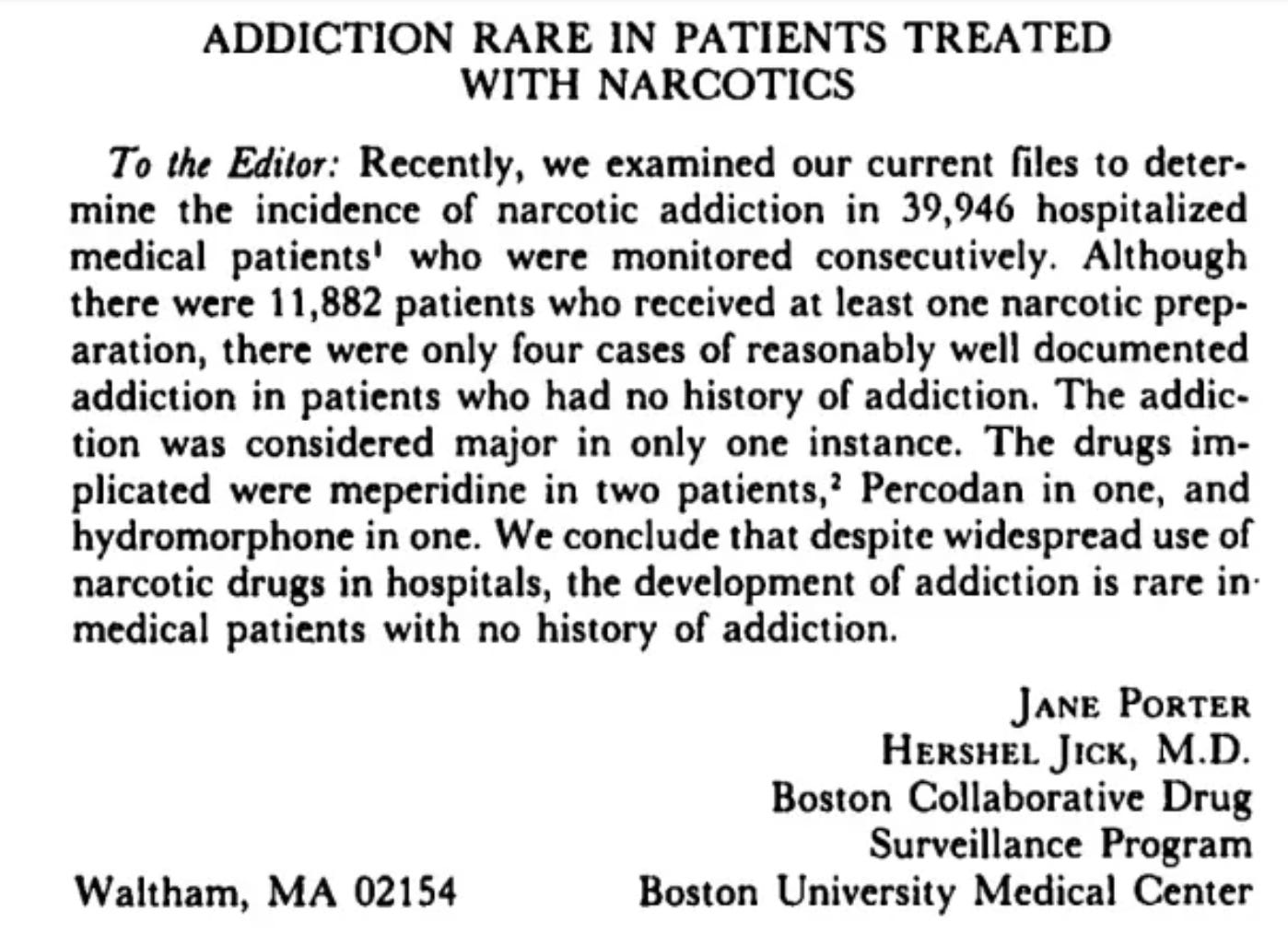
Brace yourself: It was a letter to the editor, and just five sentences

Five sentences! 

The letter’s authors were Jane Porter, a grad student, and Hershel Jick, a physician. Porter and Jick reported reviewing 11,000 patients in “our current files” at a Boston hospital who were treated with an opioid and finding only four cases of “reasonably well-documented addiction,” whatever any of that means. As evidence goes, it’s so low-quality for decision-making purposes that it borders on useless.

And that’s okay, by the way: When your research findings are too weak to merit a full publication, eking a letter to the editor out of them is a common tactic in publish-or-perish academia. Everyone understood this at the time; upon publication the Porter & Jick letter was thus promptly and appropriately ignored; and that should have been the end of it.

But, no. Many years later, unscrupulous pharmaceutical companies dusted off this five-sentence letter. Their marketing departments had come up with a clever use for it. They would claim that addiction happens far less than 1% of the time (four cases out of 11,000 would be 0.036%). They would cite The New England Journal of Medicine. Then they would grin slyly, because no one ever reads the footnotes.

And if some skeptic did read the footnotes? At the dawn of the Opioid Crisis, the New England Journal’s archives weren’t even available on-line; they were only uploaded and made accessible around 2010. Before then, doubters who wondered what this Porter & Jick citation was about would have had to go to a brick-and-mortar library for a physical copy of the journal, if they wanted to be let in on the joke.

As that should suggest, the Porter & Jick letter was ancient: Like, pre-computer ancient. It was published in 1980. (When Porter and Jick described reviewing “our current files,” they meant actual paper files.)

When the letter was rediscovered some 20 years later, the explosion of new academic citations stunned and distressed the letter’s authors. Dr. Jick came to wish he’d never published it.

“Only years and years later, that letter was used to advertise by new companies that were pushing out new pain drugs,” Dr. Jick later told NPR. “I was sort of amazed. None of the companies came to me to talk to me about the letter.” (Dr. Jick passed away in October at age 91).

(more…)

Bivens on the sociopathy of the opioid crisis.

June 15, 2024

Matt Bivens, blogger and full-time emergency room doctor, today came out with the second part of his series on “the sociopathy of the option crisis.  The first part came out in early May.  A third part is yet to come.

He shows that the pharmaceutical companies knowingly lied when they claimed opioids were not addictive to most patients.  The “study” they used to support the claim was a five-sentence letter to the editor of the New England Journal of Medicine in 1980.

The most glaring and cynical example their attitude is an Austin Powers-themed motivational and training video by the opioid manufacturer Cephalon in 2006.

Click on this to watch the full video

As Dr. Bivens described it:

This Austin Powers-themed motivational video … … was made by the opioid manufacturer Cephalon, Inc. for its sales staff, and discusses how they will market their new dissolve-in-the-mouth fentanyl tablet. Cephalon was able to patent generic fentanyl as Fentora® by adding in Alka Seltzer®-style “plop plop fizz fizz” effervescence. It was also able to patent generic fentanyl as Actiq® by making it into a lollypop. Feel free to eye-roll in disgust, but that’s how you make a cheap drug expensive: Tweak how the medication gets delivered into the body, and claim it’s now a completely new substance, worthy of a new patent. … …

The 2006 Fentora® motivational video, shown to a New York jury in 2021 over the strenuous objections of the Cephalon legal team, edits new audio into scenes from the cult classic movie Austin Powers: International Man of Mystery. “Gentlemen! I have a plan. It’s quite brilliant,” says Dr. Evil. “We are going to roll out a blockbuster marketing campaign, focusing on ‘effervescent speed’ — a concept so nebulous, so indecipherable, it will absolutely help drive prescriptions … to Fentora®!”

When his staff of fellow villains tell him that’s already been tried but “FDA shut it down,” a disappointed Dr. Evil quickly recovers. Punctuating his speech with frequent air quotes, he outlines his next evil plan:

“We will do studies in low-back breakthrough pain, neuropathic breakthrough pain and for all non-cancer breakthrough pain — a new ‘pivotal study.’  Using these ‘studies,’ we will … show doctors around the world that Fentora® ‘works for all breakthrough pain.’ “

Cephalon (later taken over by Teva Pharmaceuticals) failed to get the FDA to agree that fizzy or lollypop fentanyl were safe for anyone other than a patient with terminal cancer, and in 2008 had to pay a $425 million fine for marketing fun-and-fizzy fentanyl too broadly.

But at moment, I’m more interested in the frank, mocking acknowledgement of how pharmaceutical companies fund and organize “studies” — the very studies used to justify their commercially-sold products. That practice has massive implications for what we call evidence-based medicine. … …

(more…)

The suspicious death of a Boeing whistleblower

March 15, 2024

John Barnett was a quality assurance inspector for Boeing at its assembly plant in North Charleston, S.C., where the 787 Dreamliner was put together.

He claimed Boeing was ignoring safety issues, and he claimed Boeing forced him to retire for that reason. He sued Boeing for allegedly attacking his character and making it harder for him to get a new job.  Boeing denies these charges.

John Barnett

After having started to give a deposition last Friday in preparation for his trial, he was found dead in his pickup truck in the parking lot of his hotel the following morning.

 He had a bullet wound in the head, and was holding a silver pistol in his hand.  There was a note, whose contents haven’t been publicly revealed.

A number of people find this suspicious.  So do I.  Why wouldn’t the recoil kick the pistol out of his hand?  As the New York Post reported:

Steve Chancellor, who has written two books on staged crime scenes and runs Second Look Training and Forensic Consulting, said that when someone dies by suicide, the gun only remains in the person’s hand 25 percent of the time.

“The mere fact that the gun was in the hand, I would pay attention to that,” he told The Post.

“Because many times when someone is trying to make it look like a suicide, they make that mistake and they put the gun in the hand.”

WCIV ABC Channel 4 News in Charleston reported:

A close family friend of John Barnett said he predicted he might wind up dead and that a story could surface that he killed himself.

But at the time, he told her not to believe it.

“I know that he did not commit suicide,” said Jennifer, a friend of Barnett’s. “There’s no way.”

Jennifer said they talked about this exact scenario playing out. However, now, his words seem like a premonition he told her directly not to believe.

(more…)

GE’s Jack Welch and U.S. deindustrialization

January 16, 2024

THE MAN WHO BROKE CAPITALISM: How Jack Welch Gutted the Heartland and Crushed the Soul of Corporate America—And How to Undo His Legacy by David Gelles (2022)

Jack Welch, the CEO of General Electric from 1981 to 2001.  He was admired by corporate America and hated by working America.  Fortune magazine named him “Manager of the Century.”  His nickname among employees was “Neutron Jack.”

Welch’s mission, according to David Gelles in his new book, was to dismantle what’s called “stakeholder capitalism,” which is the theory that corporations benefit when employees, suppliers and their communities and not just stockholders have a stake in their success, and they all work together as a team.

He succeeded all too well, not only through his management of GE, but through the influence of GE-trained executives who went on to manage other companies, and his own role as a celebrity management guru.

We’re now living in Jack Welch’s USA, a nation of industrial decline, increasing poverty, increasing inequality and dysfunctional institutions.

That’s not to say Welch single-handedly broke capitalism.  There are many fingerprints on the wreckage.  But he is both a prime example and one of the driving forces behind the deindustrialization of the USA.

Gelles’ book doesn’t tell much about Jack Welch as a person.  What it’s about is the story of the impact of his style of management – why it came to be accepted, how it affected General Electric, how Welch disciples affected other companies and where Welch-ism stands today.

When Welch took over General Electric in 1981, it was a prime example of successful stakeholder capitalism in action. It produced everything from television sets, refrigerators and toasters to jet engines and nuclear reactors.  Its output accounted for a full one percent of U.S. gross domestic product.

Thanks to its long history of unbroken profitability, the 400,000 employees of  “Generous Electric” could expect lifetime employment if they worked hard and were loyal to the company.

But Welch didn’t believe in loyalty.  He actually forbid the use of the word “loyalty” in corporate communications.  He didn’t want GE workers to think of their jobs as secure.  He didn’t want teamwork.  He wanted them to compete with each other based on rewards and punishments.

He introduced “stack ranking” of employees.  Managers were supposed to rank employees in terms of performance.  Each year the top 20 percent were marked for advancement and the bottom 10 percent were fired.  So GE workers no longer had a stake on GE’s overall success; they in fact had a stake in fellow employees’ failure.

Employees were no longer regarded as assets.  They were regarded as costs, and GE’s aim was to keep the cost as low as possible.  Productive workers of profitable business divisions were laid off to achieve financial goals.

(more…)

Private equity: parasites that eat the economy

October 17, 2023

THESE ARE THE PLUNDERERS: How Private Equity Runs—And Wrecks—America by Gretchen Morgenson and Joshua Rosner (2023)

Something called “private equity” is becoming an ever-bigger part of the U.S. economy.  This is bad for everyone.

Private equity operators — I’m not going to call them “investors” — buy companies with borrowed money.  They then pay back the debt by having the companies themselves, which they then own, issue junk bonds – bonds with higher-than-average interest rates and risk.

They increase short-term profitability by laying off employees, increasing workloads and cutting back on maintenance, research and other long-term investments.  They require the acquired company to pay them for management services, and buy other needed services from other companies they own.
They hope to be able to sell the acquired company at a profit.  But even if it it goes bankrupt in the meantime, the private equity speculators usually come out ahead.

Morgenson and Rosner say that 7 percent of the U.S. work force is employed by private equity.  They say private equity owns 17 percent of U.S. nursing homes and operates 40 percent of hospital emergency rooms.

There is nothing inherently wrong with private persons buying a floundering company and trying to turn it around through better management.  This is true investment.  No doubt there are cases where this actually happens.

But Morgenson and Rosner say this is not typical.  Typically private equity operators buy profitable companies and saddle them with new debt, which they sometimes can pay and sometimes can’t, but is a hindrance rather than a benefit.

There are ways to extract additional profit that have nothing to do with the operation of the business itself.

A retail store or health clinic may be sitting on real estate that is more valuable than the business itself.  A  Or a company may own drug patents for which it is not charging monopoly prices.  Or it may simply be too solvent; it may have capital that is not being invested.

The worst harm done by private equity operators is acquiring hospitals, clinics, emergency services, schools and other enterprises that have missions other than maximizing profits.  There is a world of difference between doing what is necessary to stay above the break-even point, and maximizing profit no matter what the human cost.

(more…)

Elizabeth Warren unmasking private equity

October 16, 2023

Private equity is a process by which financial operators buy companies with borrowed money, finance the purchase with borrowed money and then typically pay back the money by selling assets while increasing short-term profits by cutting jobs, wages, research and long-term investment.

Senator Elizabeth Warren, during the committee hearing shown in the video above, said that last year private equity accounted for $4.5 trillion in investments, while the public stock exchanges, which provide much better protection for investors, did only $1 trillion worth of business.

She issued the following fact sheet on private equity two years ago while re-introducing her bill, the Stop the Wall Street Looting Act.  The fact sheet proves a need for better regulation of private equity, but her bill never came to a vote.

Private Equity: By the Numbers

The private equity (PE) industry is continuing to grow at a rapid pace.

  1. 􏰀  PE employs 11.7 million people 􏰁 nearly 3 million more than just two years ago.
  2. 􏰀  There are more than 18,000 PE funds, 􏰁 a nearly 60 percent increase in just the last five years.
  3. 􏰀  PE currently has $4.4 trillion in assets under management, including $1 trillion of uninvested capital.
  4. 􏰀  The size of these funds has more than doubled since 2016.

As a result of this growth, PE touches virtually􏰂 ever􏰂 corner of societ􏰂􏰃y

  1. 􏰀  PE investments in health care have increased more than 20-fold over the last 20 years, with investments spanning from nursing homes, to hospitals, to ambulatory services.
  2. 􏰀  PE has invested at least $1.1 trillion dollars in the energy sector over the last decade, with 80 percent of that in fossil fuels.
  3. 􏰀  About half of all daily newspapers in the country are owned by PE or hedge funds.
  4. 􏰀  Three PE firms control more than 90% of the prison telecom market, and they􏰄’re also big players in prison health care, commissaries, and food service.

And the costs to consumers, families and communities have been massive.

  1. 􏰀  PE is responsible for killing more than 1.3 million retail jobs over the last decade.
  2. 􏰀  When PE firms buy out public companies, employment shrinks 13 percent in the two years after the buyout.
  3. 􏰀  Between 2015-2019, nearly two-thirds of retail companies that went into bankruptcy were PE owned.
  4. 􏰀  When PE takes over a nursing home, mortality rates jump by 10 percent, implying that PE ownership causes more than 1,000 additional deaths every year, on average, compared to non-PE owned nursing homes. Bills for patients also rise more than 10 percent.
  5. 􏰀  PE ownership of housing is associated with rising rents, higher rates of eviction, and worse quality.
  6. 􏰀  PE buyouts of private colleges lead to higher tuition and student debt, lower graduation rates and graduate earnings, and more law enforcement actions for fraud.
  7. 􏰀  Bankruptcy rates among companies purchased in leveraged buyouts are 10 times higher than non-PE backed companies.
  8. 􏰀  PE has helped drive the growth in income inequality since 1980. One study found that there are more PE managers who make at least $100 million annually than investment bankers, top financial executives, and professional athletes combined, while another found the number of PE multibillionaires rose from three in 2005 to 22 in 2020.
  9. 􏰀  Private equity is helping to drive market concentration in health care: KKR and Blackstone control 30% of the market for outsourced ER doctors; PE owns two of the three medical air transport companies that together control two-thirds of that market.

(more…)

The new kings of finance

October 16, 2023

The Wall Street Journal reported:

High interest rates, driven by the Federal Reserve’s higher-for-longer policy, are shaking up how corporate loans get done. Soaring rates brought down banks such as Credit Suisse and Silicon Valley Bank and forced others to reduce lending. As those lenders stepped back, private-credit fund managers stepped up, financing one jumbo loan for American corporations after another.

This shift is accelerating a trend more than a decade in the making. Hedge funds, private-equity funds and other alternative-investment firms have been siphoning away money and talent from banks since a regulatory crackdown after the 2008-09 financial crisis. Lately, many on Wall Street say the balance of power—and risk—has hit a tipping point.  

“There’s been a steady progression, but since Covid and the banking crisis this year we’ve really seen the banks rein in risk,” said David Snyderman, head of alternative credit and fixed income at Magnetar Capital.

Magnetar, a hedge fund once known for bets against subprime mortgages, recently arranged a $2.3 billion loan for CoreWeave, a red-hot cloud-computing operator for artificial intelligence. It was Magnetar’s biggest private loan yet.

The loans are expensive, but for many companies they are the only option. Next, private-credit firms are coming for the rest of the credit market, bankrolling asset-backed debt for real estate, consumer loans and infrastructure projects.

Private-equity firms use revenue from most of the loans to make leveraged buyouts, saddling the companies they acquire with expensive debt. Ultimately, more companies could end up under their control.

LINK

Source: The New Kings of Finance Aren’t Banks | Private Funds Fuel Corporate America by Matt Wirz for the Wall Street Journal.  (Hat tip to Barry Ritholtz)

The American power elite

April 26, 2023

THE POWER ELITE by C. Wright Mills (1956)

C. Wright Mills was a sociologist who wrote like a novelist.  Both these traits are shown in his great work, The Power Elite, which was about the structure of American power. 

Mills did a detailed study of the men (all of them were white men) who occupied the top position in the great American corporations, in the military and in governmental administrations.  He also compiled lists of the 90 richest Americans of 1900, 1925 and 1950.  

These were the individuals who made the fundamental decisions that determined whether there would be peace or war, full employment or widespread unemployment and the priorities of the nation as a whole.

He concluded that members of these elites were not representative of the American people in their social origins, they had goals and incentives that didn’t coincide with the interests of the American people, and they were not accountable to the American people.

The corporate elite emerged in the years following the Civil War and was in full bloom by 1900.   Back then, Mills’ research showed, a typical corporate CEO was a company founder, an heir of a company founder or a lawyer or some other expert hired by the board of directors for his expertise.

By 1950, the typical corporate CEO was someone who had come up through the ranks of a corporation, Mills found.  He was someone whose goals and viewpoint on life were formed by the corporation itself, which were a desire to preserve the corporation and increase its profitability.

Most of them had college educations, which the majority of the public did not.  Most of them came from well-off backgrounds, but even the ones born into poor backgrounds were shaped by the views of their peers.

Even the public had come to regard business success as the supreme value.  Corporate structures have not proved to be as durable as they seemed to Mills, but the cult of success remains

The military elite emerged during World War Two.  Before then, Mills said, the Army and Navy were separate from the rest of society and proud of being non-political.  But in the 1940s, they emerged as key decision-makers, a strong shaping force in the economy and a political force.

Even more than the corporate elite, members of the military elite had a special identity, which was shaped by education at West Point or Annapolis and by rising through the ranks.

Mills noted that the top military leaders exercised their power and influence in secret, which meant that there was little or no check on it.  Decisions of peace and war were made without public knowledge or public accountability.

There also was what President Eisenhower was to call the military-industrial complex.  Generals, corporate executives and top politicians were part of the same social circles.

The military remains a strong power, but it has, to an extent, been superseded by the power of the secret intelligence and power agencies.  As Mills noted, the power to act without accountability is a strong power.

The third important power structure is the power of governmental administration, but it is different from the other two.  

Governmental administration became powerful as a result of the New Deal and World War Two, but it never was an independent power.  Civil servants had no voice in policy.  That was set by appointed officials who usually were chosen as representatives of particular economic interests.

There was nothing in the USA like the British Foreign Office or the Exchequer, which had their own views on policy and provided continuity during different administrations.  

In the USA, for example, experts on China were driven out of the Foreign Service by political demagogues, Mills wrote.  Ambassadors were almost all political appointees, rewarded for their service to political parties.

Other governmental departments also were subject to politics, which was dominated by business interests.

American power elites have evolved and mutated, but there is a clear from the elites of the early USA to the elites of Mills’ day, and from Mills’ elites to those of present-day America.

(more…)

A book lover revives Barnes & Noble

January 2, 2023

Back in April, 2019, the Barnes & Noble bookstore chain was on the verge of failure.  Sales of both books and non-book products were down.  It had lost $18 million in 2018 and fired 1,800 employees.  Its stock price was down 80 percent from its previous high.

But now it is profitable and growing again, and has plans to open 30 new stores.  Ted Gioia, writing on his blog, The Honest Broker, credits the new CEO, James Daunt.

Back when he was 26, Daunt had started out running a single bookstore in London—and it was a beautiful store. He had to borrow the money to do it, but he wanted a store that was a showplace for books.  And he succeeded despite breaking all the rules. 

For a start, he refused to discount his books, despite intense price competition in the market.  If you asked him why, he had a simple answer: “I don’t think books are overpriced.”

After taking over Waterstones, he did something similar.  He stopped all the “buy-two-books-and-get-one-free” promotions.  He had a simple explanation for this too:  When you give something away for free, it devalues it. 

But the most amazing thing Daunt did at Waterstones was this: He refused to take any promotional money from publishers

This seemed stark raving mad.  But Daunt had a reason.  Publishers give you promotional money in exchange for purchase commitments and prominent placement—but once you take the cash, you’ve made your deal with the devil.  You now must put stacks of the promoted books in the mostvisible parts of the store, and sell them like they’re the holy script of some new cure-all creed.  [snip]

Daunt refused to play this game.  He wanted to put the best books in the window.  He wanted to display the most exciting books by the front door.  Even more amazing, he let the people working in the stores make these decisions

This is James Daunt’s super power: He loves books. 

“Staff are now in control of their own shops,” he explained. “Hopefully they’re enjoying their work more. They’re creating something very different in each store.” 

This crazy strategy proved so successful at Waterstones, that returns fell almost to zero—97% of the books placed on the shelves were purchased by customers.  That’s an amazing figure in the book business.

On the basis of this success, Daunt was put in charge of Barnes & Noble in August 2019.  But could he really bring that dinosaur, on the brink of extinction, back to life?

(more…)

The true, lethal story of leaded gasoline

September 7, 2022

Leaded gasoline may have killed more people than Hitler.   That’s not an exaggeration.

This video tells the true story of the man who created it, and the man who exposed the harm it did.

‘Economies of fail’ and the vaccine rollout

January 27, 2021

How Monopolists Slowed the Vaccine Rollout, and Small Business Speeded It Up by Matt Stoller for BIG.  “CVS and Walgreens Didn’t Deliver.  Small pharmacies did.”

Why does big business back Black Lives Matter?

June 29, 2020

JP Morgan Chase in solidarity with Black Lives Matter. (Via The Saker)

Why are big corporations so solidly behind the George Floyd protests?

Apple replaced all of the radio stations on its music app with a single stream playing “Fuck the Police” on #BlackOutTuesday to show support for the protests.  Lego pulled advertising for its police-related toys.  Executives of JP Morgan Chase were photographed “taking a knee” to show support for the George Floyd protests.

Amazon, General Motors, McDonald’s, Target and other big corporations all issued statements supporting the protests.  The companies that held back are in the minority, and have been called on to explain themselves.

The two big Black Lives Matter organizations – the Black Lives Matter Global Network (not to be confused with the Black Lives Matter Foundation) and the Movement for Black Lives – have been pulling in millions of dollars in foundation grants for years.

In 2015, Borealis Philanthropy, established the Black-led Movement Fund to attract gifts from major philanthropists, George Soros’ Open Society Foundations. In 2016, the Ford Foundation, announced a $40 million donation to the Movement for Black Lives for “capacity strengthening.

Last summer Ford and Borealis announced “a six-year  pooled donor campaign aimed at raising $100 million for the Movement for Black Lives coalition,” to which BLM is a central part, to support organizing efforts.f

I wasn’t able to find out exactly how much money Black Lives Matter groups have received from foundations and corporate donors, nor how much they received from grass-roots small donors.  Whatever the exact amounts, the two top groups seem to be well-funded.  The Movement for Black Lives itself announced $6.5 million in grants to local BLM organizers.

Again: Why do big corporations and wealthy philanthropists give such support for this particular cause?

The most obvious answer is: Because it is right and just.  Abuse of poor and black people by police is real, it has been going on for a long time, and it is time to end it.

Another answer is: Because it is popular.  Public opinion polls show this.  Support for the protests improves their reputations.

But there is more to it than that.  Another reason is that the Black Lives Matter movement, unlike, say, the labor movement, is no threat to cooperate revenues, profits or dividends nor to CEO salaries and bonuses.

The current anti-racism movement is not an attack on what used to be called the power structure.  Its representatives see think the source of evil is the racism of white people in general.  Its solution is to change the attitudes of white people, and to silence those it can’t change.

The movement seeks to suppress not only actively racist white people, but white people who are unwilling to be affirmatively anti-racist or who inadvertently say or do things that are perceived as racist.

This attitude is, in my opinion, a threat to basic freedoms, and also counter-productive.  If you can’t frankly discuss issues, how can you address them? It also distracts attention from the real racists.  But it is not a threat to corporate power and profit.

(more…)

Thomas Piketty on corporate co-determination

June 5, 2020

I’ve written a good bit about Thomas Piketty’s new book.  Click on the Capital and Ideology tag to read my previous posts about it.  In this post, I’m going to discuss his ideas on corporate governance.

Great corporations typically begin with an individual who has a vision—a Steve Jobs, a Walt Disney, a George Eastman, a Henry Ford, a Soichiro Honda or a Jack Ma.

The drive and creativity of the individuals make the companies what they are.  Over time, though, the companies devolve into authoritarian bureaucracies, little junior watered-down versions of the Soviet Union.

Click to enlarge.  Source: Oxford Law Faculty

The goal of reform would be how to prevent corporate abuse without stifling enterprise and beneficial innovation.  Piketty’s solution is to adopt German-Scandinavian co-determination, under which corporations of a certain size have to allow employees to choose a certain number of corporate directors.

In Germany, according to Piketty,  all firms with more than 2,000 employees must reserve half the seats on their oversight committees to worker representatives.  All firms with 500 to 1,999 employees must reserve a third of their oversight committee seats to worker representatives.  There also are factory committees with union representatives who have a say one work rules and training.

However, in Germany, the oversight committees only supervise day-to-day operations of companies.  Policy is set by directorates, on which workers have no representation.

Other countries reserve one-third of seats for workers on companies of a certain size.  In Sweden, the threshold is 35 employees; in Norway, 50 employees; in Austria, 500 employees.

In April 2018, according to Wikipedia, U.S. Senators Tammy Baldwin, Elizabeth Warren and Brian Schatz sponsored the Reward Work Act,  which would amend federal legislation to require all companies listed on national stock exchanges to have one-third board representation for workers.  Polls showed majority support among Americans for the measure.

In August 2018, Elizabeth Warren sponsored a new Accountable Capitalism Act that would require 40 percent of the board of directors be elected by employees in federal corporations with taxable incomes over $1 billion.

In Britain, the Bullock Report in 1977, during the Harold Wilson administration, called for co-determination in big businesses based on the formula 2x + y. In this, workers and stockholders would have equal representation on boards of directors, but there would be two government representatives to break a tie.  It never became reality.

In practice, even though workers have a voice, the final authority rests with the owners.  I think there still is a benefit to having worker representatives.

Employees usually know things about how companies operate that the top managers don’t.  This can be valuable in avoiding the Stupidity Paradox, in which layers of bureaucrats demand good news and truthful information doesn’t filter up.

It’s also good for employees, especially union representatives, to have access to the same information that top management has.  Of course all these desirable goals can be thwarted by a sufficiently cunning and authoritarian management.

(more…)

A novel set in Renaissance Florence and Hell

June 29, 2019

Jo Walton’s LENT (2019) is a historical fantasy novel set partly in Renaissance Florence and party in Hell.

The protagonist is the Dominican monk, Girolamo Savonarola, who attempted a moral and spiritual revolution in Florence in the 1490s, but was burned at the stake for heresy.

Walton’s novel is partly an attempt to rehabilitate Savonarola’s reputation.  He is remembered as a religious fanatic who organized a Bonfire of the Vanities, in which the population of Florence consigned everything to the flames that was frivolous and distracted them from God.

But she shows him as a Renaissance humanist, a close friend of Pico della Mirandola, and a sincere religious  reformer, although not, as sometimes depicted, a forerunner of Protestantism.

The novel begins in 1492 with Savonarola exorcising demons, which in the novel are all too real, and then visiting Lorenzo the Magnificent on his deathbed, where he is given a mysterious talisman.  It follows his life to 1498, when he is tortured and killed, and learns that he is a damned soul in Hell, condemned to eternally repeat his life.

He returns to 1492 again and again, trying to make his life turn out better for himself and for Florence.  The novel reminds me of the movie “Groundhog Day” and of Ken Grimwood’s SF novel Replay.

The novel is based on an original and interesting premise, which is well-executed.  I’m not sure why I don’t like it better than I do.  Maybe it’s because the cruelty and terror of Hell and the Inquisition are so much in the foreground that they detract from the glories of the Renaissance.

(more…)

Bad news for Gannett, my old employer

January 16, 2019

Gannett Co., which owns the newspaper on which I worked for 24 years, may be bought out by Digital News Media, which is owned by a hedge fund and is known for ruthless cost-cutting.

On Monday, Digital First Media offered $1.36 billion for Gannett.  The Associated Press reported it claims it can run Gannett more profitably through cost-cutting and consolidation of operations.

Gannett is known for its flagship newspaper, USA Today, but it also owns many other dailies, including the Democrat and Chronicle here in Rochester, N.Y.  Its profits and circulation are falling.

Things are already tough for the D&C.  The reporters do a good job with what they have, but they are stretched thin and the paper has less space for news.  The newspaper is night-and-day different from what it was when I joined it back in 1974.  But things could get worse—much worse—under the new owner.

[Digital First Media co-founder William Dean] Singleton was a pioneer in “clustering”: developing groups of newspapers that centralized a variety of functions, including production, ad sales, business operations and, in some cases, editorial.

For example, the Alameda Newspaper Group in suburban San Francisco in the mid-1990s had a central newsroom in Pleasanton, California, that did all the copy editing, layout and page makeup for five daily papers.  Upon acquiring the diverse group of papers, Singleton consolidated several news sections (such as sports and features) to one local office away from the metropolitan area, having a few reporters do the job of many people.

Source: Digital First Media – Wikipedia

I wonder what would happen to my Gannett pension if the buyout went through.  The company doesn’t have any contractual obligation to pay it.  But I still would have my Social Security pension and my savings, so I’d be more secure than those actually working for Gannett.

When I was a reporter, I felt sure that if I did a reasonably good job, my job would be safe.  That’s certainly not true of people working in journalism today.

I’m glad I was able to work on newspapers when I did and I’m glad I was able to retire when I did.  I lived in a golden age and didn’t know it.

LINKS

Digital First Media Wikipedia page.

Gannett Wikipedia page.

Company known for deep cost-cutting offers to buy Gannett by Mae Anderson for the Associated Press.

Digital First Media Gannett bid too low, cost cuts likely unrealistic, analysts say by Mike Snider for USA Today.

Why Kodak declined and Fujifilm didn’t

October 24, 2018

It’s been said that no-one can succeed in business unless they understand what business they’re in.

A business writer named Oliver Kmia says that the reason Eastman Kodak failed and Fujifilm succeeded is that Fuji’s executives understood what business they were in and Kodak’s didn’t.

In the 1970s and early 1980s, Kodak was the world leader in making photographic film  and paper and Fuji was its chief competitor.  Executives of both companies foresaw that this business would be threatened by the rise of digital photography.

Kodak’s executives defined Kodak’s business by its market—imaging.  They attempted to transition to digital photography, in which they actually gained a decent market share, but were unable to make a profit.

Fuji’s executives defined Fuji’s business by its capabilities—chemistry, especially coatings.  They transitioned to other businesses in which they could use these capabilities.  One was coatings for LCDs (liquid crystal displays) essential for TVs, computers and smartphones.  Others included pharmaceuticals and even cosmetics.

There’s lesson here, both for corporations and for planners of national economic policy.

LINK

Why Kodak Died and Fujifilm Thrived: A Tale of Two Film Companies by Oliver Kmia for PetaPixel.

Are management consultants of any use?

June 13, 2018

Recently I read and enjoyed THE MYTH OF MANAGEMENT: Why the Experts Keep Getting it Wrong by Matthew Stewart (2009).

Stewart told two stories in alternating chapters.  One is a history of theories of management, which is the topic of my previous post.  The other is Stewart’s personal experience of BS jobs in management consulting.

In 1988, Stewart, at age 26, found himself with a philosophy doctorate from Oxford and no job,  On a whim, he sent his CV to some management consulting firms.  By chance, he got a job from a firm looking for “non-traditional” hires—that is, people without MBA degrees.

Matthew Stewart

He soon found himself going to distant countries and convincing executives twice his age that he understood their businesses better than they did.   His tools were a set of algorithms developed by his firm, and his ability to play the role of an expert.

The main algorithm, as described in his book, was a system for estimating the cumulative cost, revenue and profit for serving each of a business’s clients.

What the system almost always produced was a graph, which looked like a whale, that showed that 20 percent of a firm’s clients produced more than 100 percent of its profits, 70 percent added virtually nothing and 10 percent cost the firm money.

Of course the question is how to disentangle the high-value, little-value and negative-value clients.  If you follow the Pareto 80/20 rule, then 20 percent of a public library’s books can be expected to represent 80 percent of its circulation, and the remaining 80 percent of the books only 20 percent of the circulation.  But you wouldn’t want a library to dump 80 percent of its books.

Companies that stop making low added-value products, as Eastman Kodak did with cameras and Xerox did with small copiers in the 1980s, find that ceding these markets empowers potential competitors.

That’s not to say that the quantitative analyses done by Stewart and his colleagues were worthless.  Understanding numerical data is useful.  But nobody ever checked whether Stewart’s firm’s interpretation of the data was helpful or even correct.  The consultants never suffered any consequences for being wrong.

Stewart did risk analysis—he had no training in risk analysis—for a Mexican bank in the eve of the collapse of the Mexican peso and the Mexican banking crisis.  Neither he nor his client had any notion that the crisis would be upon them, and his firm walked away with millions of dollars in fees.

He quit his firm for a while, then was enticed to join with some breakaway employees to form a new firm.  He invested all of his savings in the new firm.  After a time some the partners started to squeeze out Stewart and other partners.  They stopped his pay without telling him and refused to let him withdraw his stake.

But he successfully sued, got what was owed him and sold his shares in the company at the height of the dot-com stock market bubble.  He then began his new career as an author.

His whole saga reads like a satirical novel.  Indeed, since he doesn’t mention the name of his firm, his clients or his co-workers, it could just as easily have been fleshed out and published in the form of a satirical novel.

(more…)

The many pitfalls of management theory

June 12, 2018

As a newspaper reporter who covered business for 20 years, I learned that there are intellectual fashions in management theory as in everything else.

Once the key to success was thought to be vertical integration.  The idea was that a corporation should control every aspect of its business, from raw materials to distribution, in order to guarantee quality and eliminate the middleman.

Then the key was supposed to be diversification.  The idea was that a corporation should engage in varied lines of business so that a downturn in one line of business was offset by continued gains in others.

Then it was core competency.  The idea was that a corporation should limit itself to whatever it did best and enjoyed a competitive advantage, and outsource everything else.

The path of least resistance for any manager has been to follow the fashion of the day.  Failing by doing the same thing everybody else was doing has always been more acceptable than failing by doing something different.

I recently read a book, THE MANAGEMENT MYTH: Why the Experts Keep Getting It Wrong by Matthew Stewart (2009)that validity of these management theories ranges from highly uncertain to completely bogus.

I was surprised to learn that the ideas of Frederick W. Taylor, founder of scientific management, and Elton Mayo, discoverer of the so-called Hawthorne effect, were based on fake experiments.

F.W. Taylor

Frederick W. Taylor claimed that there was one best way to perform any physical task.  It was the job of the manager or industrial engineer to discover the best way and to micro-manage workers so that they followed it, mindlessly and repetitively.

He claimed to have taught a Bethlehem Steel worker he called “Schmidt” the most efficient way of loading pig iron onto a freight car, and made that a standard method for loading pig iron.

The reality was that, one day in 1899, he gathered a group of Hungarian immigrant workers and challenged them to load as many 92-pound ingots as they could in 14 minutes.  He then extrapolated this to a 10-hour work day, discounted the total by 40 percent.  The total was 47.5 tons.

He offered a wage incentive if they could do this all day.  This would have been quadruple their normal output.  They declined.

Taylor then recruited another group of workers and challenged them to meet the target.  The only one who could was a German immigrant named Henry Noll—the “Schmidt” in Taylor’s tale.  Bethlehem Steel did not adopt Taylor’s method, but it became famous anyhow.

Taylor’s system eliminated the need for skilled workers.  They were undesirable because they might have ideas of their own.  It was up to managers and industrial engineers, not the workers themselves, to determine how each job can best be done.

His method was the same as the Soviet Stakhanovite system: Take a strong and efficient worker, determine the most he can accomplish under ideal conditions and make that the target for every worker.  Lenin praised Taylorism.

Elton Mayo

Elton Mayo claimed that workers could be managed by offering them psychological and emotional rewards.

He claimed to have found by accident that workers at Western Electric’s Hawthorne plant became more efficient as a result of being the center of attention—the so-called Hawthorne effect.

The reality was that in 1924, an engineer named Henry Hilbert at Western Electric’s Hawthorne plant ran an experiment to determine whether increased illumination would increase worker efficiency.  The study was subsidized by the electric power industry.

He gathered seven women employees in a separate room and had them assemble telephone relays under different lighting conditions.  He also experimented with work breaks.  Efficiency seemed to increase no matter what he did.

Mayo learned of the results of the experiment and decided that the real Hawthorne effect was treating these women as though they were special and making them feel they were members of a team.

But Stewart pointed out that the factor he ignored was that the assemblers were given a group wage incentive to achieve greater efficiency.  Also, two members of the original team were fired for being shirkers and malcontents, and one of their replacements strongly wanted the higher wage and pushed her co-workers to do more.

Hilbert later repeated the experiment.  One group of workers were given the same special treatment, but no wage incentive.  Their efficiency did not improve.  Another were given a group wage incentive, but no special treatment.  They achieved the same efficiency gains as the original group.

So it was the pay, not the special treatment that mattered.  But the whole point of Mayo’s method was to avoid the need for increased pay.

(more…)

Is a non-BS economy even possible?

May 26, 2018

What would the U.S. unemployment rate be if all useless or harmful jobs were eliminated?

It would probably be equivalent to the Great Depression of the 1930s.

Barack Obama, in an interview in 2006, stated the problem:

“I don’t think in ideological terms. I never have. … Everybody who supports single-payer healthcare says, ‘Look at all this money we would be saving from insurance and paperwork.’  That represents 1 million, 2 million, 3 million jobs of people who are working at Blue Cross Blue Shield or Kaiser or other places.  What are we doing with them?  Where are we employing them?”

Source: The Nation

David Graeber, in his new book, Bullshit Jobs: a Theory, quoted public opinion polls that found 37 percent of UK employees and 40 percent in the Netherlands thought their jobs made no meaningful contribution to the world.

Now maybe that is exaggerated.  Maybe some of them think they make a contribution, but that it’s not “meaningful.”

Offsetting this, the inherent bias of people is to think we are accomplishing more than other people think we do or the objective facts indicate.

For example, public relations, advertising, lobbying, consulting and even speculation on financial and commodities markets have their uses.  It is just that they play more of a role in the economy than they should.

I myself think the U.S. military and intelligence services are much greater than necessary to protect the homeland from attack.  Of course, if the mission is to make the United States the world’s only superpower, no number could be great enough.

The question is: What would happen if all these people were thrown on the job market, all at once?

It would be a catastrophe, unless there were some sort of basic income guarantee (which Graeber advocates) or basic job guarantee.

(more…)

BS jobs, sh*t jobs and moral envy

May 25, 2018
  • Huge swaths of people spend their days performing tasks they secretly believe do not really need to be performed.
  • It’s as if someone were out there making up pointless jobs for the sake of keeping us all working.
  • The moral and spiritual damage that comes from this situation is profound.  It is a scar across our collective soul.  Yet noone talks about it.
  • How can one even begin to speak of dignity in labor when one secretly feels one’s job should not exist? 
  • David Graeber: On the Phenomenon of Bullshit Jobs (2013)

David Graeber, in his new book, Bullshit Jobs: a Theory, describes the frustrations of people doing jobs that they know are useless or even harmful, because the meaningful jobs are either unavailable or low-paid.

He said that forcing people to engage on tedious activities that serve no useful purpose, or, worse still, pretending to work when they actually aren’t, constitutes a kind of spiritual violence.

Not all useless or harmful jobs are BS jobs. Graeber defines a BS job as one you know is useless, but you have to pretend is necessary.

I think many of the people who invent BS jobs, or invent useless tasks for the useful workers, are under the impression they are making a positive contribution.  Graeber said his strongest critics are business owners who deny the possibility that they could be paying anybody to do anything useless.

A certain number of people think the world is divided into predators and prey, and pride themselves on being successful predators.  An example would be the bankers and financiers who, prior to the 2008 financial crash, made subprime mortgage loans to suckers who could never pay them off, then collateralized the mortgages and sold them to other suckers.

What all these jobs—hedge fund managers, telemarketers, diversity consultants, receptionists who never get phone calls, consultants whose advice is never heeded, supervisors with nothing to supervise—is that, if they went on strike, nobody would notice.

What Graeber calls the sh•t jobs are just the opposite.  Food service workers, health care workers, trash collectors, janitors and cleaners—all these workers labor under worse conditions and for lower pay than in BS jobs, and, contrary to reason and justice, they get less respect.

Coincidentally or not, the sh•t jobs are disproportionately done by black people, Hispanics and immigrants.

∞∞∞

Graeber said many of us have come to accept the idea that work consists of following somebody’s order to do something we dislike.  It follows, then, that if you want good pay, job security and benefits, you are lacking in moral character.  He calls this rights scolding.

It takes two forms.  Among right-wingers, if you think you are entitled to anything that working people in the time of Charles Dickens didn’t have, you are a fragile snowflake.  Among left-wingers, if you think you are entitled to anything that the most oppressed person alive today has, you are told to check your privilege.

It also follows that people whose jobs are fulfilling, such as school teachers, are not really working.  The idea is: You get to do work that is pleasurable, useful and respected.  How dare you want good pay and job security in addition?  Graeber calls this moral envy.

(more…)

Managerial feudalism and BS jobs

May 23, 2018

BULLSHIT JOB: A form of paid employment that is so completely pointless, unnecessary or pernicious that even the employee cannot justify its existence even though, as part of the condition of employment, the employee fells obliged to pretend that this is not the issue.  [David Graeber]

∞∞∞

Huge numbers of people work in jobs that they themselves think are completely unnecessary.  Many of them would prefer to do something useful, but useful jobs on average pay less.  Sometimes they quit and take a lower-paying useful job anyway.

Some five years ago, David Graeber, an American who teaches anthropology at the London School of Economics, wrote an essay for an obscure left-wing magazine called Strike!, about the phenomenon of bullshit jobs.

The article struck a nerve.  It got more than a million hits on the Internet, crashed the Strike! web site several times and was translated into more than 10 languages.

A YouGov poll soon after found that 37 percent of full-time employees in the United Kingdom thought their work made no meaningful contribution to the world.  A survey in the Netherlands put the number as high as 40 percent.  I imagine a survey in the United States would be much different.

Graeber himself communicated with hundreds of unhappy, useless employees via e-mail.

The result is his new book, Bullshit Jobs: a Theory.

He learned about a museum guard whose job was to report if a certain empty room ever caught on fire; a military sub-contractor who drove more than a hundred miles in order to give a German soldier permission to move a piece of equipment from one room to another; a receptionist who, to fill her time, was tasked with jobs such as sorting paperclips by color.

But most of his reports are about people who worked in offices—making studies that were never read, making proposals that were never acted on or not doing anything at all, but doing their best to look busy.

How can there be so many admittedly useless jobs?  We live in a time of austerity and layoffs.  Full-time jobs are being replaced by temporary jobs.  That is true of government as well as the private sector.

One thing that free-enterprise advocates and Marxists agree on is that competitive capitalism produces economic efficiency.  Free-marketers think everybody benefits and Marxists think that only the capitalists benefit, but they agree on the drive of business to maximize profit.

Maybe this is wrong.  Maybe competitive capitalism is a myth.  Maybe we live under what Graeber calls managerial feudalism.

Back in the days before the French Revolution, the peasants, who were the main producers of wealth, paid so much in taxes and rent they could barely live.  They supported an aristocracy, who, in turn, supported an economic class of coachmen, door keepers, lace makers, dancing masters, gardeners and the like, who were generally better paid than the peasants.

Just like the aristocrats of old, the prestige of managers in organizations is based on the number of people they have working for them.  Prestige is not based on whether they are useful or not.  In fact, employees whose work is essential are a threat.  They have the power to quit or go on strike or to unexpectedly reveal they know more than the boss.

So the incentive is to diminish the role and power of those who do necessary work while inventing new jobs whose existence depends on the discretion of the job creators.

A large number of new jobs are administrative staff.  They are different from administrators who make actual decisions.  Their job is collect quantitative information about the work of the useful employees on the principle that “you can’t manage what you can’t measure.”

(more…)

The vested interests in organizational stupidity

July 12, 2017

Supposedly we Americans live in a “knowledge economy,” in which the source of wealth is neither financial capital, physical plants or natural resources, but the knowledge, expertise and intelligence of individual human beings.   We have a whole industry called “information technology.”

But although employers require ever-higher levels of academic credentials, this is not reflected in the work itself.   College graduates wind up doing work that high school graduates once did, and high school graduates do work that school dropouts once did.

In the early 20th century, businesses adopted a practice called Taylorism—resolving factory work into the simplest, most basic, mindless human motions.  Now we have McDonaldization—resolving service work into the following of simple checklists.

Mats Alvesson and Andre Spicer, in their 2016 book, THE STUPIDITY PARADOX: The Power and Pitfalls of Functional Stupidity at Work, attribute this to the tendency of organizations to suppress critical thinking because of their need for obedience to orders and smooth internal functioning.

What they write is true as far as it goes, but organizational stupidity is more than a simple mistake in setting priorities.   Organizational stupidity is maintained by powerful vested interests.

Knowledge Is Power

Knowledge is power.  If I am a supervisor and my subordinate is more knowledgeable and competent than I am, that diminishes my power.   What college graduate, fresh out of business school, wants to be contradicted by some grouchy old skilled craftsman, who has less schooling but may know more than he does?

Harry Braverman, in Labor and Monopoly Power and David Noble, in America by Design and Forces of Production, described the de-skilling of the American work force and the development of technologies devoted to increasing command and control by management rather than increasing productivity as such.

The more knowledgeable and skilled a worker is, the more power the worker has in relation to the employer, both as an individual and as a member of a labor union.   So knowledge and skills aren’t necessarily wanted except where they are indispensable.

A friend of mine who went back to school in mid-life to get an advanced degree in his specialty discovered that employers did not want his new skills.  What they wanted, he said, was “a jack of all trades who would work cheap.”   Employers see more benefit in having replaceable workers than in having  productive workers.

(more…)

The theory and practice of functional stupidity

July 12, 2017

You need to be remarkably intelligent to be functionally stupid.
==Mats Alvesson & André Spicer, The Stupidity Paradox

A higher percentage of Americans than ever before have advanced college degrees.  I.Q. test scores are higher in every generation, a phenomenon called the Flynn Effect.   Information technology is a major industry, and we talk about our “knowledge economy.”

So why do corporations and other big organizations do so many stupid things?

Two management experts, Mats Alvesson and André Spicer, say that the explanation is what they call “functional stupidity”—which is “the inability and /or unwillingness to use cognitive and reflexive capability in anything other than narrow or circumspect ways.”

No big organization could function efficiently if everybody in it thought critically and independently about everything they did.    The whole point of hierarchy is to enable obedience to orders on a large scale..

In a hierarchy, employees have to teach themselves to focus on their own jobs and not worry about the big picture.   Otherwise the organization wouldn’t function smoothly.

Functional stupidity reduces conflict, soothes anxiety, improves morale and increases self-esteem.   The problem is when the organization is blind-sided by reality.

The philosopher John Dewey said that all human action is the result of impulse, habit or reasoning.   It is not humanly possible to reason out every single aspect of life, according to Dewey.   We turn to reason  when our habitual ways of acting or thinking fail us.   Why do people in big organizations so often fail to turn to reason before it is too late?

In their 2016 book, THE STUPIDITY PARADOX: The Power and Pitfalls of Functional Stupidity at Work, Mats Alvesson and André Spicer identify five categories of functional stupidity.

Leadership-Induced Stupidity

 In contemporary organizations, it’s thought that the duty of an executive is not only to manage, but to inspire.   Leaders are supposed to be “change agents.”  But change can be either good or bad, depending on circumstances.  Adolf Hitler, after all, was a transformational leader.

Executives can waste their time engaging in what they think is inspirational leadership to the detriment of their tasks as managers— budgeting, assigning work, quality control, employee evaluation and so on.   Most employees, according to Alvesson and Spicer, don’t want leadership.  They just want to be left alone to do their jobs.

(more…)

Donald Trump, a walking conflict of interest

May 3, 2017

I doubt if Donald Trump could get through a single day, certainly not a single week, without being involved in a conflict of interest.

The Atlantic magazine has drawn up a list of 39 issues (and counting) in which decisions by President Trump will affect the profitability of the Trump Organization.

Maybe the biggest one is the federal investigation of the Deutsche Bank, which holds $300 million in IOUs from the Trump Organization.

U.S. banks wouldn’t give Trump credit after he defaulted on debt when his Atlantic City casinos declared bankruptcy, so he turned to the Deutsche Bank, which is under investigation by the U.S. Department of Justice on charges of  laundering money for Russian mobsters.  Attorney-General Jeff Sessions said he will continue this investigation impartially.  We’ll see,

The Department of Labor and Internal Revenue Service have been conducting investigations as to whether the Trump Organization violated labor law and tax law.   Will these investigations continue?  We’ll see.

The Trump Organization’s lease agreement with the General Services Administration for the Trump International Hotel property contains a provision that no elected official will be part of the lease.  But the GSA has ruled this doesn’t apply to Trump because he’s no longer officially head of the business.  An impartial decision?  Maybe.

Trump’s business is involved in business deals with politicians and close relatives of politicians in India, Indonesia, the Philippines, Turkey, Dubai and Argentina.  Will Trump, if necessary, make decisions that threaten those relationships?  We’ll see.

And then there are daughter Ivanka’s women’s fashion business and son-in-law Jared Kushner’s family real estate businesses.

Never even mind the penny-ante stuff—Donald Trump charging the Secret Service for use of Trump facilities while they guard him and his families.

Any of these conflict would be highly controversial as a stand-alone issue.  The problem is that there are so many issues it is impossible to remember any one of them.

The problem is that there is hardly any decision that Trump or his appointees can make—whether in foreign policy, tax policy, labor policy, environmental policy or consumer protection—that will not in some way affect the profitability of the Trump businesses.

(more…)