Laminar flow

I appreciate that lever taps are mechanically simpler to use. A flick will always use fewer muscles and tendons than a twisting motion. Though I am worried about how this labour saving subtracts yet another bit of incidental exercise from my morning bathroom visit.

It also makes it harder to adjust the tap to get just the right amount of pressure from the tap to create a laminar flow. I have spent hours doing this over my lifetime. Much harder with a lever tap; it is almost as if creating a turbulent flow was a design decision that was made when the lever tap was invented.

Those of you of a certain age and viewing habits will know of Kenny Everett. Apparently he loved polishing bathroom taps. So much so that, if I remember right, his wife bought him taps to polish. I get it, Kenny. I get it.

mmmm………..laminar
The most important painting tip of all

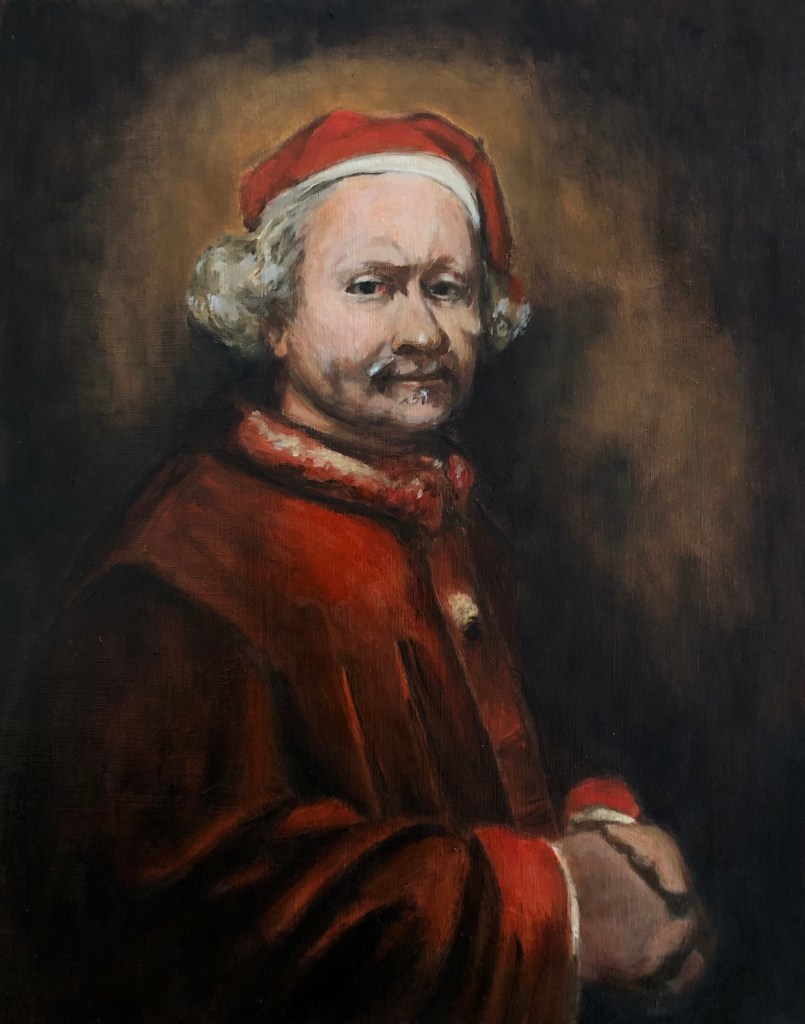
There is a biography in every Rembrandt painting. His central artistic skill was an intense, responsive sympathy for people. His emotional intelligence is what gave him true magnitude rather than mere greatness. To move through his lifetime of self-portraits is to read an unflinching autobiography that neither hides nor evades anything of importance.

This is a copy of one of his self-portraits from when the finances were tight and the walls moving in a little closer. It was certainly not all fun for him, but his work endures when the wealthy burghers whose portraits he painted are otherwise completely faded from view. And that is a miracle of sorts.

Tiny people on a folded napkin (or could people please give Everest a rest)

If you do not have ready access to a mountain range, a screwed up linen napkin can be used to practice painting peaks and valleys. This is a shot from near the summit of a folded napkin, featuring two tiny intrepid climbers.

And you know the funny thing? There were fewer people on this mountain peak than there are on the top of Everest. And I had ready access to food, shelter and oxygen – all in my kitchen.

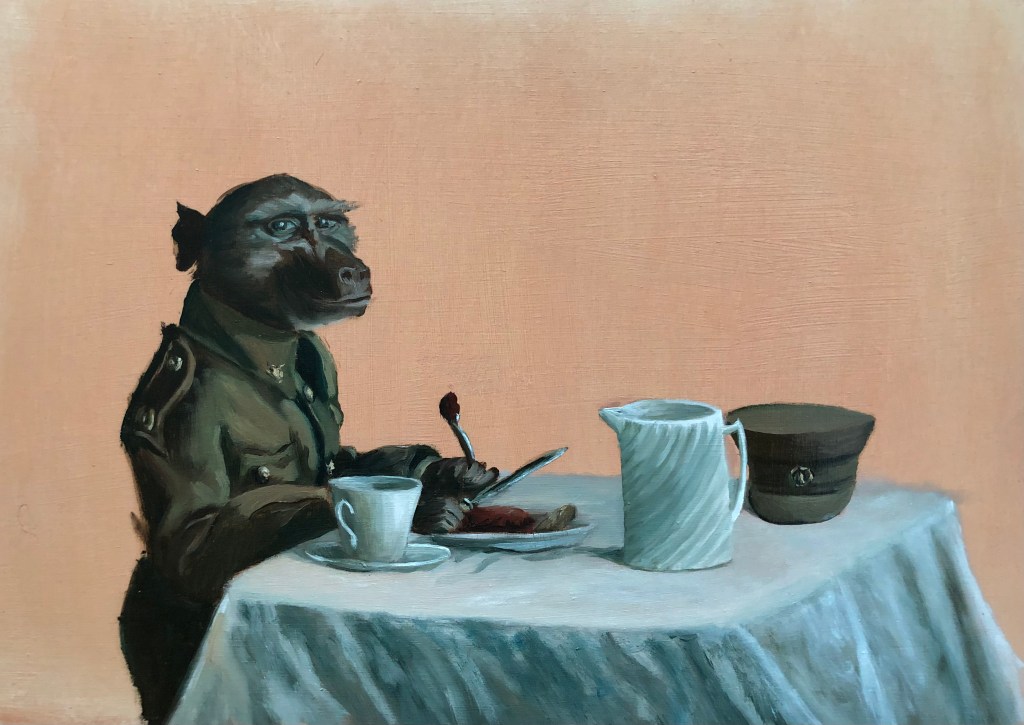
The sad sad tale of Corporal Jackie

The Rest is History episode on “History’s Greatest Monkeys” is, as expected, a delight. It pointed me towards Corporal Jackie, mascot of the 3rd South African Infantry Regiment in World War One. Poor chap lost a leg at Passchendaele and, like many, was left with PTSD. He survived, continued to eat his rations with a knife and fork, and even sat up and saluted the Colonel from his hospital bed. He died of shock during a thunderstorm after returning to his birthplace in South Africa.

Jackie was quite famous and there are many photos of him. His gaze is invariably complex.

Meanwhile in a kitchen in Bologna …

Almost by definition still life painting is contemplative. And still life painters seem, by and large, to be as decorous and calm as a bunch of well organised, plump grapes. I have no idea if Morandi collected postcards of his work. I suspect not. If he did, I do not imagine he incorporated them into his work thus …

Still life with red onion, that vinegar bottle I have painted so many times, and that silver cup I have painted even more often. And a postcard of a work by the great master, Morandi.