



Of all the paintings in the Louvre, the most dramatic might be The Raft of the Medusa. It is large. The men on the raft are almost falling off the wall onto the floor in front of you.


 by David Halliday
I don’t know how I feel about Forbes’ work. In itself. But a good part of me is Irish and this documents some of the places, some of the world, my great grandparents might have lived. I think there is something to be said for that. You can see it in some homes. Pictures of the old country. Its an emotional anchor. The feeling that you came from some place. That you or your family had a history.
But… I don’t feel attached to any of it. Me and my friends (whose parents came from Italy, Slovakia, South Africa) are more attached to our western Toronto suburb of Islington. In particular The Six Points. I don’t know with the internet etc. if that will be the same for the new generation. Perhaps their roots will be in Ipads and Blackberrys.


 by David Halliday
Wilhelm Camphausen, German painter, was born and died at Düsseldorf, and studied under Alfred Rethel and Friedrich Wilhelm Schadow. 1818 to 1885. These paintings are almost all from the imagination. With no photography, the accounts of battles must have been written/oral accounts and the artist made up the rest. Or as in Camphausen’s case he accompanied the troops and made sketches of the battle from a nearby hillside.




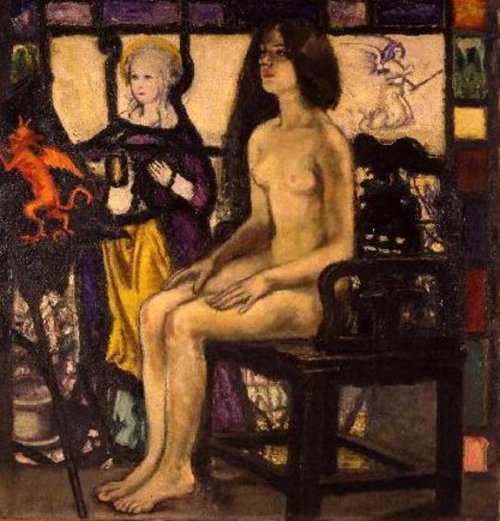
The question I can’t help asking is why so many naked women? Are they being ‘objectified’? I suppose an investigation of the artist might throw some light on this matter. But I like approaching the canvasses with complete naivity.


These are the selfies of the 19th century. Vanity is not a modern invention.








 power of h Weblog
Recent Comments