
I’ve been yammering away lately so I thought today I’d just throw in an image for a change.
Talk to you tomorrow.
I’ve been yammering away lately so I thought today I’d just throw in an image for a change.
Talk to you tomorrow.
Roman generals had a protocol that modern leadership has abandoned. Before every decision, one person was appointed to argue against the plan. Not for them particularly to be “right,” but to stress-test their thinking. They called it “advocatus diaboli.” The advocate had full immunity for disagreeing. No punishment could be levied against them for disagreeing with those in power. It was their JOB to disagree and force the decision maker to come up with the best plan, not just the decision-maker’s first plan. Historians estimate this practice alone prevented more failures than any tactical advantage Rome held on the battlefield.
In 2014, McKinsey quietly adopted a similar version. Before any $100M+ recommendation, a separate team was assigned to destroy the proposal. Internal data showed decisions surviving this process had 380% higher success over 5 years. The method stayed internal.
Disagreement isn’t dysfunction. It’s a cognitive upgrade
But, many modern leaders still make billion-dollar calls without a single structured challenge in the room. Most don’t even know this framework exists.
When a group agrees fast, the prefrontal cortex enters “coherence bias” — your brain literally stops looking for flaws. It shifts into execution mode prematurely. One single dissenting voice reactivates critical evaluation. Stanford measured it: groups with a designated contrarian made 48% fewer errors than groups reaching consensus naturally. Disagreement isn’t dysfunction. It’s a cognitive upgrade most teams never install.
Jeff Bezos understood this before the research. He required teams to write six-page memos arguing against their own proposals before presenting them to management. He said: “If you can’t destroy your idea, someone else will – after you’ve spent the money.” Amazon’s failure rate on major initiatives dropped by half within three years. This method filtered out weak thinking before it ever reached execution stage.
The Romans solved what modern boardrooms still get wrong: agreement feels safe but builds fragile outcomes.
Disagreement feels dangerous but creates antifragile decisions. Every company that rewards consensus and punishes dissent is repeating an error the ancients fixed 2,000 years ago. The data supports it. The framework exists. It isn’t standard because leaders confuse being challenged with being disrespected.
That’s enough thinking for anyone for one day. I hope you have something to ponder, especially in light of daily news and events. I’ll be back again tomorrow and we’ll delve into something else. In the meantime be kind to yourself and take care of your loved ones. :-)

Faith is elusive. The busier we are, the harder to attain. The more complicated and sophisticated we are the less inclined we are. Faith, real faith, is rare. The world thinks that people of faith are foolish. But faith doesn’t care.

I wish we humans could learn this. I think it’s an especially appropriate thing to thing about under our present world conditions. In a big, big world it’s a shame to waste energy on staying in one place.
Friction is resistance. Friction prevents movement — or at least hinders it. Friction can stop a thing completely, or it can develop heat and make movement difficult. Lubrication will reduce the heat and enable easier movement.
Think about how that plays out in life. There are minute areas of life where this happens. There are macro areas of life where we seem caught in the maelstrom and can’t escape. Families, jobs, governments, traffic jams, learning a new skill — over and over and over again we find ourselves up against friction. The slowness of our wit, the stubborness (weakness) of our muscles, the obstinance of acquaintances, the maliciousness of authorities. There is no end of the aspects of life that are not affected by friction. And we do well to find whatever means we can to reduce the friction and enable movement — hence momentum in a direction of choice.
I don’t know what friction you are facing. But I guarantee you ARE facing friction if you look honestly into your own life. And sometimes that’s the heart of the problem, isn’t it: we usually choose to look away from the problems in our own life and attempt to find solutions elsewhere. Avoidance is rarely a solution.
Given the diversity of people I would be a fool to suggest ways to solve your problems. What might work for my is pretty much guaranteed not to solve your problems as they will be different than mine — even if they look the same. And that’s a hard enough lesson to learn. I always found it simpler to look at how other people solved problems before being willing to be creative and find my own solution. Those solutions rarely worked. I learned that the friction that opposed me was something I had to find my own way to overcome. I wasn’t always elegant about it; sometimes I was pretty clumsy about my solutions — and I made mistakes and hurt people along the way — but I did get the problem solved. Years later I wonder whether it was inevitable that hurts happened — I truly believe that the resistance I felt was the result of someone else over-reaching themselves: colleagues, friends, even parents.
In the final tally, not all of us will take action to turn resistance into momentum. There are a lot of lives that but up against resistance and call it quits; they stop trying, the take an easier pathway that doesn’t lead to the goal they originally had: friction wins.
In the country today I think a lot of folks are feeling friction. We all have to find ways that work for us to turn friction into momentum. I hope we all succeed.
That’s it for today. Take care of yourself and stop by again tomorrow to see what’s up.
About this time of year I really want to sit in a pleasant garden in the dappled shade and enjoy the sounds of nature around me. That was the mood I was my mood in 2010 while on a visit to Callaway Gardens, in Georgia. Just the right bench and just the right amount of sun to while away an hour or so, watching others enjoying the garden and myself and Peggy listening to the sound of birds and the smells of the garden.

I never used to want to sit idly on a bench. The idea of being “idle” was anathema to a guy who grew up on the Protestant Work Ethic. But I have learned the error of my ways. It’s taken a while, but yes, I think I can safely say that is a lesson I have learned.
I was on a speaking trip in England some years ago and I overnighted with a dear Christian sister named Amy Wood. She lived in Sheffield England — and is long since deceased. She was about 80 years old — I was in my late 40’s I guess. She was legally blind. Actually, all she could really “see” were shadows and not very distinct ones at that. Anyway, let me get to the story.
We were to attend a meeting at which I was speaking and after breakfast we sat in her lounge (our “living room”) waiting for someone to collect us and drive us to the meeting. As we sat there chatting, Amy said to me, “How nice it is to be ready and WAITING.”
We talked for half an hour about the idea of anticipation in our lives. How waiting for things intensifies the longing. I do think that for Christians the idea of anticipating the hereafter — whatever that may be — is a significant influence on how we live our life. But religion aside anticipation has a lot of positive benefits — as long as the thing anticipated is a positive thing. Anticipation becomes worry when the thing anticipated is a negative and I guess it’s only right that if positive anticipation brings about good results so also negative anticipation is going to bring about adverse results.
As a brief sidetone, I found it particularly difficult to sit there as an able bodied male whilst she made breakfast. The cracking of eggs and the cooking of bacon was difficult enough to watch from the table at the other side of the kitchen where I was perched on a stool. But what was agonizing was to watch her make toast — the English way.
That is a thing, or it was 20 or 30 years ago. Then, among the people whom I knew, not a one of them owned an electric toaster. They all used their oven boiler to toast bread for breakfast toast. None of the ovens I saw actually had timers that were effective for the short cycle of toasting bread — so I saw a fair number of bread slices get incinerated whilst cooks talked to guest/s. And in Amy’s case I watched as she incinerated slice after slice after slice because she didn’t want to serve a “guest” burnt bread. I’m sure she put the slightly singed pieces to good use somewhere — perhaps the birds got them — I don’t know — but I wanted to get up and snatch them out of the broiler before they were ruined — except I had been previously warned by a mutual friend that dear old Amy took umbrage at things being done for her. She was a proud woman who wanted to manage her own life. A sentiment I can now appreciate infinitely more than I could at the time.
Ok — that’s it for today. Take care of yourself and I’ll be back tomorrow to chat.
I’m in a flowery mood today. This was from an early 2000’s trip to France. I don’t know about you but an entire field of sunflowers is just such a cheery sight — to me, anyway. That trip I spent a lot of time pulled over to the side of the road, stopped to admire or photograph something or another.

Our highway system here, with its expressways and interchanges certainly doesn’t encourage such behavior. The backroads of the U.S. too, don’t really favor random pull overs. But so many of the non toll roads in Europe I found at the time (may have changed in the 20 years since my last visit) almost encouraged random stops from time to time.
There’s nothing like a pause along the road in Provence in August when you can hear the bees attending to lavender plants 200 or 300 meters away from you. So many, and such a “racket” as it were — but just the sounds of life.
I’ve been dismayed in recent years here at home in the U.S. because the population of so many small critters has dwindled so dramatically. Compared to the populations that I remember as a younger birder or just nature enthusiast it’s really quite frightening to think of what we have done to the other lifeforms on our planet.
And, if I’m perfectly honest, one of THE MOST MOVING moments of my life was some years ago when I was on a deserted road in New Mexico (doing a shortcut recommended by a friend) between Phoenix and Albuquerque. I stopped for a comfort break on one of the most desolate stretches of road I’ve ever been on and there at my feet were some of the most gorgeous tiny wildflowers. Out there where no one was tending them. Where no one probably ever saw them. Just gloriously being what they were: God’s beauty strewn around the planet for “no good reason” other than to be beautiful. I was probably 25 years younger then — and that moment lives in my memory to this day.
Life changing events don’t have to be monumental. If we are listening or observing even the most innocent comfort stop can become important in the Grand Scheme of Our Life. So, keep your eyes open and attuned to the majesty and marvels around us.
Ok — just a shorty today. I’ll chat with you tomorrow. :-)
I am actually writing this on Boxing Day with a few posts written ahead that I’m not going to reorder so as to post this closer to the date. We had Mike and Katy over for Christmas Day — it’s the first time in a while that we’ve actually had the space to really have both Peg’s Christmas decorations up and displayed AND to have the family over for a self-made meal. We’ve been doing most of the holidays at their place which is much bigger and doing cooperative meals — each contributing portions. And when the grand and great grands come down for a holiday it’s easier to do it at their place.

Being out of practice being host and hostess it took a bit of concentration to get the timing down pat for all the dishes and to actually do a decent meal plan but we managed just fine.
As long as I put up the photo of the outside of Mike & Katy’s “Magnet Factory” as it’s been named — the original use for the building being the manufacture of industrial magnets in the early 20th century. Here’s a glimpse of the kind of uses the building gets put to. So often you’ll find lots of people having a good time — and so not Peggy and I — we just don’t do big groups — but all the more power to the kids.
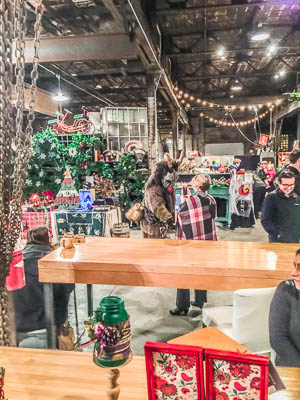


Anyway… we got through the day and had a great time. Today we’re both tuckered and not much is happening. I’m pondering moving plants around in the house. It’s not quite 3 months since we moved in this lower flat and we are still moving things around and trying to make it “home.” It’s a work in progress.
AND… I still have to figure out what to do with the basement. Mike’s “deal” with the previous owner wasn’t so much a deal as a capitulation because he didn’t want to lose the purchase by being too demanding — so the old owners were allowed to leave a lot of “stuff” that normally would have been cleared out prior to closing. Being previous property owners they gradually brought all the bits and bobs from some 20+ properties to this one which was the last of their rentals to be sold. WE have a pile of kitchen cabinet doors, probably 30 gallons and 5 gallon container of odds and ends of leftover paint, glass globes and lamp parts and …. well… all sort of junk …. still sitting in the corners of the basement. I have a right handed workbench for a left handed homeowner. I’m still trying to find electrical outlets and decipher which are on the electric meter for our unit and whether some of them are on the meter for the upstairs. Every day I spend a few minutes down there mulling over the situation and making little changes. I finally got my vise bolted to the workbench that’s there. I’ve been doing potting down there — taking cuttings from plants that should have been repotted months or even years ago — gradually making friends with the space.
I think a lot about the section of Under the Tuscan Sun where she is responding to the advice upon moving into her new villa to take a room at a time and to live with it, and listen to it and to hear what the room wants to be. I know I botched the wording but I think the sentiment is about right. And that’s what we’re doing — except not that orderly. I putter a bit here, and putter a bit there. Kind of like my approach to my Ficus. Look at it, and get used to its line. See what’s growing and what isn’t. Get rid, first of the dead bits. Then look a little more. Trim off the cross growth. Look a little more. Nip some of the leaders. Look some more. A month on and there is less tree but there are a lot of green little shoots even during what is not really growth season. We’ll let it adjust and see what it needs and wants. Fortunately we haven’t lost a lot of leaves — so that’s a sign that we’re keeping it happy.
Now I need to find a way to see whether the house is happy with our changes here. This place really is so completely not what I would ever have picked myself that “communicating” with the house is proving an unexpected challenge. Little did I realize what agreeing to the purchase would mean; but hey — it’s gonna be great eventually. Still — this really is like learning a new language. There is so much about this place that is completely foreign to my brain.
Ok — enough whining and complaining for now. Talk to you again tomorrow. Cheers.
The New Year is upon us. No turning back. A few hours from now the calendar will turn over a page and 2025 will be upon us.
One of my favorite places is a little town called Vezelay France. It’s built on a hill and has been there since 900 A.D. and before. There’s a well in the center of the cobbled street from the valley to the church at the hill’s top. On a sunny summer afternoon I noticed these two bikes leaning against the well while the bikepackers were checking out the bakery behind the camera.
When I got back home to Milwaukee I thought back on that scene quite a bit. Bucolic as it was there was a wistful optimism about it that I wanted to capture in a not-exactly-photographic way. This is the result.

I can’t help think as the year draws to a close and we have no idea what lies ahead that we could all use a little optimism and hope. The bikepackers are long gone and now — 20 plus years later — their journey is long past, but when they got back on those bikes and coasted downhill into the valley and onwards on the Camino de Santiago they were beginning a journey of self-exploration.

Perhaps we here in the U.S. are beginning our own journey of self-discovery as we enter a world whose course is charted by a madman. Maybe we all need to walk or bike or mentally take ourselves over hill and dale until we walk the truth into our body and soul. There are some facts, some truths, that don’t come easily. And reality is about to change for us all.
But on a sunny summer afternoon there was nothing but sunny skies and good prospects for those bikepackers and I’m hoping that as we enter the new year in a few hours that we will set forth into the prospects with optimism and hope. No matter what happens outside of us, moving forward with hope can only be good for us.
No post tomorrow. Enjoy the holiday and love your closest and dearest. They aren’t around forever and make the best of the time you have with them! Talk to you January 2, 2025.
I’m going to leave 2024 on this note that I glommed onto from Katy, my daughter:

 From the Far Side of '70
You must be logged in to post a comment.