The Will to Live

I freely admit I don’t have the attention span to be a good OUTDOOR gardener. There’s too much WORK involved, and it’s way too repetitious to suit the likes of me. And weeding — well, I get why it’s needed but I have no passion for yanking so called undesirable plants out of the ground because while they may be bad for the scheme of my “garden” they are useful to other creatures on this planet and we humans are simply way to fascistic in our management of the earth to realize that we can’t go around eliminating species without having an impact upon our own lives.

Let me be clear, this is not a post about humans choosing or not choosing to live. I wanna talk about plants instead.

I’ve been messing around with plants for nearly 18 months now. I’m not a gardener. I’m not a bonsai artist. I’m just messing about and having fun doing it. Emphasis on fun. And on LEARNING. With me it’s always about learning — something, everything, always.
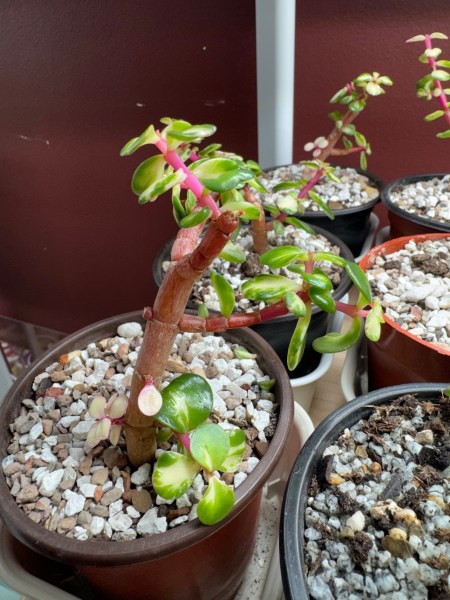
I’m concentrating on small plants like this variegated portulacaria afra. We are starting our journey together.

And the single most encouraging thing I’ve been learning is that plants — and really all non-human life — WANT to survive. We may not see or feel their effort put forth to that end, but that doesn’t mean it’s not happening. We just need to pay closer attention.

I’m also not a bonsai person. I tried to be in my 30’s, well, maybe it was in my 40’s — I lose track of time. But there are a couple stark realities that keep me from being successful at bonsai:

  • Most traditional bonsai NEED to live outdoors. Any plant that requires a dormant period to remain healthy is pretty much out for me. We don’t have the space or circumstances to keep plants outdoors and then to cycle them into a protected area for the winter months. If they were alive and in the ground that might be different, but we are on a routine city lot with not a lot of space and overwintering non-tropical trees just isn’t in the cards.
  • They need regular watering, and my traveling lifestyle never suited the plants need for life-giving water. Now that we don’t travel as much — or hardly at all, that’s not as MUCH of a problem but you only need a single forgotten water cycle to kill some bonsai as they are living in such quick draining soil.
  • Also, there is a timeline for true bonsai. It takes years and years to develop a single tree to a point of sophistication, with a sturdy trunk, lots of branching and ramification, and teeny, tiny leaves appropriate to the size plant you are looking at. All those things are attainable, but they take more time than a guy in his mid 70’s probably has left.
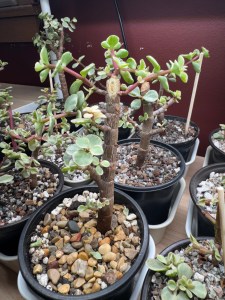
Another Portulacaria afra — also known as Spekboom (in South Africa where they originated) — they are a favorite food of elephants and given an elephant’s voracious appetite the trees have adapted to responding rapidly to “pruning” or munching by elephants. The leaves are, incidentally, edible. Some hobbyists even add them to a salad (if you like the taste which I don’t particularly care for).

Instead. after 18 months of messing about I’ve realized that my best and most enjoyable choice is to work with succulents like jades and portulacaria afras. I can control their size more easily. They respond quickly to changes/pruning/care. They are inexpensive and easy to propagate so on a limited budget I can get a lot of satisfaction from a reasonably small investment. Especially if I’m willing to wait through the process — which to a “learner” like me is just fine because half the reason I’m doing this is to have a hobby that fills in some of my time.

The thing is plants really do want to grow — to stay alive.

I’m amazed at the things that can go wrong with a plant that they are able — and determined — to recover from. There are and aren’t a lot of variable with plants, You need:

  • water,
  • soil,
  • temperature, and
  • light
  • and to make the list complete there are also bugs and diseases to be wary of and control.

That’s the simple list, but within each category there are myriad variations: water can be hard or soft, soil can be full of organic material or nearly devoid of it, cold or hot temperatures can make various plants wilt or pout, and light…. well, there’s a whole world of different light preferences among plants and finding the right plant for the amount of light you can give it can be a doctoral thesis worth of research.

Interestingly, some plants will propagate from a single leaf, left on the soil with proper light and moisture.

Yeah, I’ve killed some plants in the last 18 months. Not all that many I’m happy to say. And I’m learning — it’s not a done deal yet, but gradually I’m figuring out how to propagate them to make one plant into many.

Of course that helps keep my out-of-pocket budget under control — if you want to be patient waiting for plant babies to grow up into something significant.

Routine helps

In a run of the mill day I spend a little or a lot of time just looking at my plants. It’s not really “wasted” time. I’m getting to know them, on a one to one basis.

Typically, when I get a new plant I will repot it after a few weeks — giving it time to get accustomed to its new living situation. And of course at that point there are crucial choices to be made. Among them is the selection of soil and by sticking to succulents I make the job a LITTLE bit easier but not simple. A regular bonsai soil is extremely coarse so that water will drain through rapidly. A regular nursery soil on the other hand tends to retain water so that plants can be watered and then ignored for a while before watering again. And sometimes by the time you get your new plant home you’ll find that whatever the grower planted you new baby in has become hydrophobic — yes, the soil is afraid of water and repels it — and your new baby isn’t getting the life giving water it needs to survive.

I’ve been playing around with different soils. I mix my own most of the time. a very little peat moss or coconut coir, a little more perlite for aeration, some oil-sorb (used in automotive shops as an oil absorbent but it’s calcined clay that’s been fired in an oven and it absorbs water so that the plants can use it, and some “chicken grit” which is actually finely crushed stone — in our case usually granite. It’s been working for me with my succulents.

The whole topic of pruning and trimming is still some sort of “black art” to me. I’m learning, and getting braver about trying cuts in places I’m not sure what reaction the plant will give me, but that’s part of the reason I spend a fair bit of time just looking at the plant. I’m trying to understand HOW they grow — what their choices are. Some plants are quite predictable — cut in a certain kind of place — like just above a leaf bud — and the plant will send out a new shoot from a predictable place nearby. It’s science and luck rolled into one — because plants have their own genetic makeup and two very similar looking plants won’t necessarily give you the same results.

The thing is, there are no shortcuts to growing plants. They have their own schedule. You can help them along with light — if they are a light loving plant, and you can give them boost with fertilizer if you know how often and how much — or can figure that out through trial and error — but they aren’t going to meet your deadlines for certain milestones you have in mind — you simply have to be patient and wait. Something I’ve never been good at — but am learning about every day.

As I check in on my plants I notice little changes day by day. I can’t say we’re becoming friends but I take care of them and they respond. When I don’t care for them they pout. Just like people. I’m glad I haven’t killed many of them; I think they are too.

And I guess I’m going to stop here, sort of mid-ramble, and wait for another day.

Cheers and take care of yourselves. :-)

Former Glory

We frequently walk (for exercise and pleasure) at the local nature reserve. Being in Wisconsin, when there is water there are often a lot of willows and cottonwoods. They love having their feet (roots) wet — even standing in water. And…. they live for a good long time!

Along our regular path is this old willow. A far cry from its former glory, two thirds of it is dead — Originally there were three main stems coming up from the roots. One on this side (as seen from the camera) died long ago and has since rotten and fallen into the pond. The third stem that you cannot see as it’s on the opposite side of the tree from the camera angle still stand some 20 feet into the air with no branches, no signs of life other than offering hotel space for migratory birds, and a gazillion bugs and microscopic critters.

Its branches no longer tickle the surface of the pond. Indeed, the branches that once spread out over the pond have all fallen off — and only the crown of the tree continues to product new growth — for how many more decades that may be is anybody’s guess.

We humans go through similar processes. We sprout and grow. We extend our lives into new and exciting endeavors until out strength no longer supports continued expansion. We enjoy our existence for a period of time and eventually the ability to sustain life as we have known it diminishes; for some more than others, indeed some don’t even make it to maturity and perish while still in their youth. But at some point we are no longer prospering and we begin to struggle along — instead of grabbing life by the horns.

The other morning as Peg and I sat on a bench part way around the pond we got to talking about how our visits there have changed over the years. I first came to this park as a little nipper of 11 or 12. There was a County Executive — king of like a mayor for the county surrounding the city we lived in — who did nature hikes in that park and for several years he lead Saturday morning birding walks — which my parents and I took along with him. We brought our daughter here as a child. We walked the same trail in our 30’s and 40’s and 50’s and 60’s. So many of those walks after the bird walks were brisk and invigorating as we were in our prime and we seldom actually saw critters — no deer, or beavers, and probably not even a lot of squirrels or chipmunks as I’m sure we were chatting away and moving fast enough that the wildlife chose not to make their presence know. Today we amble along, Peggy still recuperating from her mild stroke, me with wonky legs. We stop at the benches more often — specially at one in the densest part of the woods — where we just sit and listen for a good long while during each visit. We aren’t the same people who once visited this place. We have changed as has the place.

Some of the trees in the are are known to be over 270 years old. In our lifetime we’ve seen several of the huge cottonwoods and a couple of the willows just disappear from the landscape. More than one has fallen into the pond — and water hastens the rotting process. But death provides life to other creatures. And there are plentiful birds and mammals who find food and shelter and make their presence known.

Now, when we walk through the park we see them. Deer, fox, beaver, all sorts. I wonder why we never saw them — perhaps we just weren’t ready to see them. We were too busy with our own lives and not tuned in enough to the life of the earth around us.

I love this time of life. It’s not easy like it was in our 30’s or even in our 50’s, but it’s sweet. I love being able to actually live with my wife — by that I mean not just living in the same house and being so busy that we hardly got a chance to talk or share — but being with her 24/7 and having the time to talk in depth about the things on our mind and the joys and sorrows we see around us. It’s maddening that there are so many needs around us and we are scarcely able to help ourselves much less do a lot to help others but we have learned to spend more time in prayer and to commune with each other.

We’re not much to look at…. but what you see is rarely what’s important. Like that willow in the photo — it may look old and decrepit but it provides life and vitality for a whole host of other creatures. I hope in our own way we do to.

Mrs P, This One’s For You

One of my readers offered some comments on that travel plan map I posted yesterday and in responding I got to thinking about the wonderful Live Oak in St. Augustine Florida.  It’s called the Old Senator and has been core tested to be at least 600 years old.  It was around when Ponce de Leon discovered the so-called Fountain of Youth in 1513

The Old Senator, St Augustine, FL

Anyway… I just wanted to share this big old monster with y’all. Someone built a motel around it and The Old Senator has survived the infringement on its territory.  Last I knew the motel was owned by Howard Johnson’s but that may have changed since last I saw it.

And as long as I’m posting tree pictures, here’s another one of mine from a couple years ago.

201004120917SOUTHEAST101947-e18


We’re getting rained on with a forecast to change to snow — so I think I’m staying home today.

My New Middle Name

Reading WordPress Reader yesterday was helpful. I linked across to a new blogger (to me).  In an article about remaining compassionate in the midst of turmoil I took inspiration for this re-work of an image from our trip last fall with our daughter to South Carolina.  If you want to see the blog that triggered my thinking, here it is:  Everyday Gurus!  That blog also inspired part of this entry’s content.

I realized something about myself through that blog….

My middle name should be “Antecedent”

I’ve always been a problem solver.  It’s who I am.  Mostly, I solve problems was because those who preceded me failed to look for causes:  antecedents.  That which went before.

My co-workers (in those early years before I discovered self-employment) would get angry with me.  They would schedule meetings at which little or nothing ever changed.  Too often I’d sit through an entire meeting thinking about the first topic under consideration — also the first topic to be tabled till the next meeting.  About the time the meeting was ending I would have worked through the details of the first agenda item, diagnosed the cause, formulated a solution and just when the boss wanted to gavel the meeting to a close I’d suggest returning to that first item….. (and at least we took that item off the agenda for the next meeting.)

The blog I referred to was about compassion.  I don’t hear that word very often.  But it reminded me of things I’ve forgotten. And of the fact that compassion is (at least in my mind) linked irreversibly to “Being.”  It’s easy to lose compassion when we aren’t in touch with our own humanity. If we don’t see other people as unique personalities who hurt and laugh and ache then we don’t realize that we can, or have, hurt them.  That happens for most of us when we are pressured, stressed, under duress.  But the definition of compassion also includes a sense of superiority/judgment — that we have a right/ability to determine what is suffering or misfortune.  As if we can decide what is good for them.  Or what they need.  Or should have. And sometimes when being compassionate we forget that someone else has the right to make their own decisions — good or bad — and that we don’t have the right to interfere with them being them.

COMPASSION: Sympathetic pity and concern for the sufferings or misfortunes of others: “the victims should be treated with compassion”.

I came to realize that the antecedent in this housing delay is my pacifism.   I believe in peace.   At my absolute core is a dislike for anything confrontational.

Furthermore, I believe that people buy from people — a boss several decades ago taught me that and I believe it to this day…. we tend to connect with people in ways that we don’t connect with machines.  (Whether that will still be true in 20 or 30 years with the insinuation of computers into our life has yet to be seen. Heck sometimes you can’t even get a hold of a human on a phone line anymore.) The point is that for millennia the decision to purchase has been a function of two people interacting between themselves.

Perhaps that dislike for confrontation is why I dislike lawyers:  they presuppose that any two parties are at odds.  It is an essential assumption of superiority.  I realize now that my dislike for lawyers oozes over onto real estate agents too!  Real estate people have a reputation for not wanting buyers and sellers to meet face to face. That is diametrically opposed to how I think.

I can see some of their reasoning. But only some.

Not everyone is honest. Sellers might say too much. Buyers might expect too much. One party might tick off the other party.  If buyers and sellers talk all sorts of things could happen to screw up a sale.  And we can’t forget that a salesman’s prime directive is in closing a sale, not in making friends.  They may make friends as a side effect of good service but who likes a friendly real estate agent who can’t sell a house?

This old geezer (me) who genuinely likes people (in carefully controlled doses), believes that two people can work things out if they sit down together and talk things through.  I want to sell the house and get a fair price. The buyer wants to buy the house at a fair price for what they are buying.  There is nothing wrong with what either side wants.  But show me any situation where two people who want to communicate — but are forced to do it through the interpretation of two additional people —  will have an easier time understanding each other than they would if they just talked face to face.  Somehow it just seems that adding people to that communication chain makes things harder.

I think that our two agents have finally figured that out.  They now agree that the seller is acting in good faith (that’s us) and the buyer is acting in good faith.  Hooray!  A conversation today seems to have sorted through the remaining sticky details.  We are willing.  He is willing. We have two people who want to do a deal — I’m hopeful we can get this sorted.

Tomorrow we leave for Elkhart: to deliver Journey for her new floor and sofa — I’ll have to work on the sticking points next week.  But we’ll do our best to get it twigged!

numeral 27
Twenty-Seven days till closing? Let’s hope so.

A Haiku on Hickories in Spring

Hickory1

hickories await
other trees to precede them
before their spring bloom

peter

Hickory2

A Haiku on Travel to Springfield

Castles in the Air

White powder puff skies
Zoom, zoom, zoom, big trucks passing
Blissful passages.

peter

Next Year I’d Sure Like To Be Here

Anticipating our own closing on June 7, we could not make the Blanco TX Lavender Festival this year, but next spring might just find us here…

10 Adventures in Texas’ Hidden Hill Country

Between the Lavender festival, swimming in Bluebonnets, and picking peaches — this sounds like a little bit of heaven.

numeral 33
Thirty Three more Days…

Today is home inspection day.  As you know we are out of town just so we got a good nights’ sleep Saturday night and so we had somewhere to be all day Sunday while the inspection was going on.

We’re still optimistic that we have a deal, but so far as I know the inspection today and the results of whatever testing they may or may not do are the final hurdle before closing.  They have a few days for testing results — normal enough.  And no matter what happens we head out for Elkhart a week from tomorrow to get the flooring done in Journey as well as the new sofa installed.

It’s an exciting time and a frustrating time, not only for us, but for Michael and Kathryn who are awaiting our closing so that they can proceed with renovations on their building and their new residence.  So, fingers crossed…  All we can do is wait.


To Each Their Own Beauty

2004267WASH04086-e24-600
Col Mist over Warm Water

Each season of the year has it’s own beauty.  Finding that natural beauty in the seasons is no different than trying to find the unique beauty in different size, age, and shape people.  All of the components are the same. Every photograph is the same:  line, light, texture, composition, however you categorize the elements they are always the same.

A picture is a picture is a picture

A Promontory of Pelvis

Before retiring I decided to spend several years shooting humanscapes: the landscapes we live in.  I mostly took a break from landscapes and turned onto the human form those skills I had developed shooting natural scenes. While doing so, the challenge was right in front of me.  How do I reveal unique beauty in someone skinny or overweight, athletic or out of shape?  That beauty is present – no matter how society stereotypes beauty and ignores those who don’t fit it’s definitions.  I enjoyed both the work and the reactions of people who never thought they could look as amazing as the images I created of them. Happy clients are always a good thing. :-)

The Gift of Sight

photo credit: Scott Sternbach

What amazes me is that people pretend that there is something different about shooting people, or about shooting landscapes, or architecture, or sports.  And yet, the challenge is always the same.  FIND the image from amidst a cacophony of irrelevant details.  Cull out the irrelevant,  focus on the beauty, find a way to accentuate what you really want to say. 

I have heard lazy photographers justify their lack of discipline or passion or skill by pointing to the words of Brett Weston.  Weston used an 8 x 10 view camera for most of his work.  This Scott Sternbach image gives you an idea of the size and cumbersome nature of a 8″ x 10″ view camera. It is easy to see why some might think he advocated the lazy approach to photography:

“‘Anything more than 500 yds from the car just isn’t photogenic.” – Brett Weston

If you are lazy, or if your images are ordinary, and an expert tells you it’s ok not to drag your equipment out to every beautiful panorama, then it’s easy to be satisfied with your own work. But, Weston wasn’t lazy. He had a wonderful eye for images.  He made extraordinarily beautiful images of very common place things. Of things right outside his door, right alongside his trunk, right around the corner.  How convenient to have an excuse from a master for not improving in a very un-Weston-like way.

Finding something special in a scene right in front of your eyes takes a better set of eyes than finding something beautiful in a panorama everyone agrees is beautiful.  If everyone is telling you it’s beautiful then why not trip the shutter.  Shooting the same sights everyone else shoots is an easy excuse for mediocrity.

Trying to see beauty in something other people have passed by is quite a different challenge.  When I first started pursuing such images I felt completely out of place.  There’s nothing here worth shooting I would say to myself.  Until I started looking closer — and that has often been my salvation.  When you can’t find anything worth shooting — GET CLOSER.

A single leaf on a bed of snow

I don’t know whether I always realized it, but I looking back at my images now I see that Ihave always looked at the seasons as a metaphor for life. I like metaphors.  When I create an image it’s not just about the form, lines, and color.  On some level I see plants and situations in terms of their stage in life, just as I might view a nude model in my studio. Making average people look extraordinary has helped my landscapes by helping me fine tune my ability to find greater beauty in commonplace items.

winter loneliness
A bonsai in winter

Like most Mid-westerners I get antsy about this time each year.  After being buffeted by wind and snow and howling cold for a while, any exuberance for changing seasons takes a back seat to the desire for a little sun, a little warmth, and a chance to pull on my shorts.  With no leaves on the trees I find myself looking at nothing more than the form:  the lines of a scene before me.  I get closer.  I have no choice. Where someone else sees a “dead tree” I see the hope of renewed life, the symmetry of growth, the regularity of science. These are things I taught myself — a photography class doesn’t teach you to see.

I have a secret to share. As a guy who makes a big deal about not liking large crowds I have used my aversion to crowds as a way of learning to see beauty.

The biggest crowds seem to like to go places when the scenery and weather are at their best.  When I choose to travel where the crowds aren’t, I am metaphorically enforcing my own sort of 500 feet limit to my car.  It’s sort of the anti-social way of searching for beauty: I’m looking for a way to show something uniquely beautiful in an object or scene that anyone else might pass by unnoticed. In fact they find it so uninteresting as to avoid coming to see it.  An empty park right after a snowfall.  An empty bench in a park. Trawler booms.  Incomplete construction, abandoned construction, derelict construction. Blemishes and bulges.

Central Park Bench
Central Park Bench

Take time to look around.  You don’t have to go far.  Start at the tip of your nose.

People have asked where we plan on going once the house is sold and the truth is out destinations don’t matter. Making a life is just like making an image.  And extraordinary beauty is right there in front of us — no matter where we are — if only we will look for it. Anything over 500 feet away just isn’t photogenic.