
Happy Canada Day
1 07 2025Comments : Leave a Comment »
Tags: Canada Day, Holiday
Categories : History
Wheat a Minute
22 05 2025Regular readers will recall my predilection with coincidence and happy accidents. Less regular readers should consider more fibre in their diet.
A couple of days ago, I wrote about the lowbrow humour in the name of a roadside coffee shack by the name of Fogg Dukkers, intended no doubt to approximate a Dutch name. Today I was walking Gromit and listening to podcasts to pass the time. I’ve recently been listening to a series called Uncharted, hosted by the lovely Professor Hannah Fry. Despite having a brain the size of a planet, she actually did a stint in stand up comedy about a decade ago, and has since become a human face of “pop. science” in the UK, along with the likes of Professor Brian Cox. Those of you who are older and from the UK may remember the niche previously being filled by the likes of Magnus Pyke OBE FRSE FRIC, or even Heinz Wolff, FIEE, FRSA. American readers can substitute for your own Bill Nye, less well known outside your shores, but still bringing science to the peeps. Ms. Fry also has a day job with a position at Cambridge University now, specifically to help we common people to understand what mathematics can do for us.
Anyway, the Uncharted podcast episodes are only about 15 minutes long, and therefore easily digested, being only twice my usual attention span. Each episode takes some interesting revelation that was uncovered by someone drawing a graph or looking at existing data in a new way. Things like gaming dating sites, how the VW dirty Diesel scandal was revealed, how Dr. Death was discovered in the UK, etc. One of the episodes I happened to listen to today was called The Grain of Truth (see – it’s endemic with Brits, I’m not the only one to be drawn to corny title puns). There’s an embedded player at the end of the post if you’d like to listen. An auto-generated transcript is available here, if you’d prefer to read it instead.
It tells the story of Dr. Willem Dicke (who really was Dutch, and pronounced the e at the end, though didn’t have the double-k in his name. Sadly, I couldn’t find how he felt about dogs). It goes on to explain how the wartime starvation in The Netherlands actually improved the health of some children, leading to the discovery of the cause of Coeliac disease – wheat in the now unavailable bread. Previously it had been thought that bananas were a cure, but turned out to be correlation, not causation.
Dicke’s assertion that wheat (or specifically gluten) was a cause of the disease was supressed by the local catholic doctors as wheat was used in the communion wafers and surely “the body of Christ” couldn’t be bad for children! (Though apparently cannibalism is fine).
Only when the lack of bread was forced on the hospitals through the German occupation was his theory proven.

Anyway – I thought it was an interesting coincidence to be joking about a pseudo-Dutch name of Dukkers when a real Dutch hero was called Dicke. Sadly he missed out on his Nobel Prize because he’d died before they could award it, and they’re never given posthumously.
Comments : Leave a Comment »
Categories : Food & Drink, History, Science & Technology
One Down…
25 04 2021And if my typically obsessive nature plays out as usual: 499 to go.
Let’s back up a bit.
A few weeks ago, I was fortunate enough to find myself in Victoria, the capital of our lovely province of BC, here in Canadiania. Popular legend has it that BC moved its provincial capital from New Westminster on the mainland to Victoria on the island. (Originality wasn’t a strong suit in the days of colonial expansion when it came to naming towns and cities). The supposed reason, if you look at a map, is that Victoria is in the south of the island, and the 49th parallel passes well to its north.
Unthinkable to dispossess the province of its capital, so the Oregon Treaty extension in 1846 to the 1818 convention that negotiated the border betwixt Canada and the former colonies to the south follows the 49th line of latitude only until it gets to the Georgia Strait, then detours to the south, leaving Her Majesty’s island possession whole, to the north. A cute story, but the island colony was only unified with the mainland (i.e. became part of BC) and made into the provincial capital in 1866. True that the island colony’s own capital was still Victoria prior to then… but only from ~1854.

Further east – well into the mainland and not far from my home in White Rock, there are a couple of square kilometres of peninsula to the south of Tsawwassen called Point Roberts that dip below the 49th, and the US had no qualms about planting their flag on this scrap of land, so I think the reality of the island remaining whole is likely more subtle. Perhaps some more learned visitor to these pages can educate the rest of us further…

So anyway – back from that vaguely meandering history diversion… and we were enjoying a quiet weekend in Victoria. I took the opportunity of visiting Munro’s, the book shop. Well – it would be rude not to really! The store was founded in 1963 by Jim Munro and his first wife Alice Munro… the well known Canadian author. (Echoes of a Monty Python sketch somewhere there!)

More to the point – it’s right next to Murchie’s tea shop!
I was recently fortunate enough to win a copy of a book from Charlie Rufus’ Indian Marmalade Company blog site. It’s a companion volume to the Grimm TV series (which I’ve been voraciously devouring in typically obsessive mode), which includes a character named Munro also. No relation, I hasten to add. One being literary, the other literature. (Or as I sometimes need to tell Mrs. E when she gets too invested in a TV drama- “it’s not real, you know!”).
I ended up buying a copy of Marcus Aurelius’ “Mediatations”, admittedly not in the original Latin, but I did also flirt with a copy of 500 Writing Prompts by Piccadilly. I regretted not buying it as soon as the opportunity was no longer possible. Such is life.
Yesterday though – I happened across a copy in my local Indigo bookshop, and this time I didn’t hesitate. The book is essentially an empty journal of “toothy” paper with writing prompts to encourage creative thought. 500 in fact (I know – shocker! Complete surprise, given the title.)

It isn’t PERFECT paper for fountain pens, and my first attempt with Pilot Iroshizuku Asa-gao in the Fine nib of my Narwhal Schuylkill Porpita Navy did produce a hint of feathering, but it’s far from terrible either. I’d go as far as to say I quite liked it. The paper has a strong ivory tint, and I suspect the nature of the paper would preclude any sheen, though I’m hopeful of shading. We’ll see.

The paper’s quite thick, but even the pre-printed prompts have a touch of ghosting, so I wasn’t expecting great things from fountain pen ink. Not bad though. Not bad at all. I’m sure as I work through the prompts, I’ll find some ink/nib combinations work better than others, as is true on most papers. And the primary reason for purchasing it was actually the prompts to creativity… the opportunity for fountain pen use was just a (huge) bonus. The binding is interesting, attached only to the back of the book (“open bound”) and allowing the pages to open completely flat.
I can see this book being a useful kick-start for those moments when I’m staring, pen in hand, at a blank page begging to be filled with words, thoughts and above all else… ink! At my good wife’s suggestion, I opened the book randomly for my first exercise, resisting my tendency to work methodically through each prompt in order. Having freed myself from the need to work sequentially, I felt equally liberated from starting with the prompts offered on the first pages I opened at. Eventually, I settled on Name something you wish was “glow in the dark.” I offer you the results of my warped mind, more as proof I responded to the prompt than anything else:
It occurs to me that the world might be slightly more sanitary if animal poo, and dog poo in particular, was glow in the dark. Though by no means a fool-proof solution, it would at least reduce the frequency of stepping in something unsavoury whilst perambulating after sunset.
As for naming it though… that seems an odd request. I thought long and hard. My friend has a Russian girlfriend called Yulia – like “Julia”, but more exotic. By extension, I assume there are Yuliettes too. So, I therefore suggest to name this proposed glow in the dark item “Yuliette L. Shit”.
Comments : Leave a Comment »
Tags: 1818, Oregon Treaty
Categories : Books, History, Vancouver, Writing
Of Blood, Dutch Bulbs and Market Gardening
11 04 2021Funny old day. More co-incidences (which a little like with Vinyl Café‘s Stuart McLean, is really just an excuse for stringing scenes into a loosely coherent whole).
A couple of days ago I got an email from 23 and Me, which is often an amusing read. As their data volume increases and the statistical treatment and research gets more refined, the statements made about my DNA make-up slightly change over the years. Of course, it’s all massively skewed by the fact that most of their customers are from the US, though they do include other databases of DNA traits, and continually sponsor and include other analysis and research.
Over the years that they’ve had my spit to analyse, the percentage of my DNA has gradually become less British and more “French/German”. I think I’m up to 15% or so non-British now, and drilling down, they’re confident enough to say it’s a specifically French 15%, though they’re reluctant to specify it closer to one wine region or another.
I actually enjoy the thought that by sitting at home enjoying well-priced French varietals grown in our own Okanagan region my blood is gradually becoming more French. I’m sure my good friends from France, Olive’s parents, would be horrified to think one might become more French so easily. About the same as my dear departed pater would be that one could lose one’s Britishness so easily. (Though he’d possibly argue that Britishness is already a loss of Englishness).
Of course, nothing in my DNA has really changed (plus or minus damage from cosmic waves), but the data relating to its make-up and the origin of the various bits of it (technical term) has gradually become more refined. One of the things reported on is when those non-British elements might have entered the ancestral, er, bedroom.
According to the company then, my genetic heredity looks something like this…
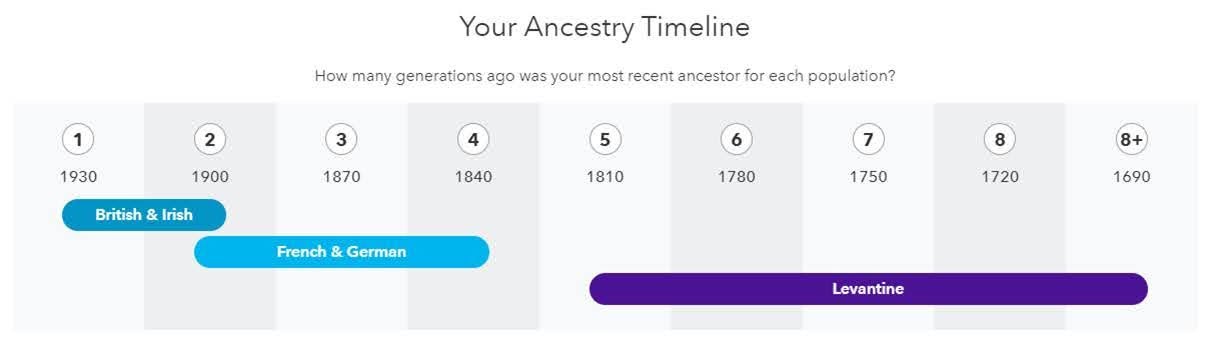
Neither of my parents have had their DNA tested, so I can’t speak with much certainty about how French, and even more surprisingly, Levantine genes entered my hitherto apparently parochial Yorkshire bloodline. Indeed, I thought my dear departed Nana was exotic when I discovered she was from Lancashire!
To be fair though, my mum’s maiden name is French-sounding, so I suspected the solution to at least the French question might lie in that direction.
It being a slow Sunday morning then, I called the UK to have a chat with the mater and see how things were faring back in God’s Own County. Snow, it seems. Somewhat ironic as I spoke to her from a sun-bathed, warm BC in “the great white North”! I was quite surprised that she knew next to nothing of her own family history or grandparents, let alone further back. She believed her dad was originally from London, but that was about it. (I vaguely remembered a conversation where he mentioned Leatherhead actually, but to most Yorkshire folk that’s just London as it’s south of Watford Gap and maps get vague there. “There be dragons”, etc…).
More coincidence/irony – Leatherhead’s as close to Guildford as I am to BC’s own Guildford in our own Surrey. (Colonists are rarely very imaginative with place naming).
With that line of investigation brought to a screaming halt, the conversation wandered around the usual filial subjects, including COVID, vaccinations, Brexit (actually – no, not this time), how I manage to spend so much money on cameras and pens, and gardening.
As I was chatting on FaceTime, I gazed out of the French window (coincidence?) and noted to mum that one of the tulips the local squirrels had spared this season looked to be only a few days away from blooming. We seem to get fewer every year, and I’m sure the little buggers chow down on them when I’m not looking. Sadly, Spiketta the Devil Dog has recently gone to the great kennel in the sky, so now they don’t even have her pedestrian chasing to contend with.

The mater related how on a trip to The Netherlands the parental units had bought lots of fancy tulip bulbs, but many of them had reverted to boring red after their first showing. Personally, I’m always grateful when my very basic horticultural ministrations result in an actual flower, no matter the colour!
Suitably reassured that mum was in as fine a fettle as usual, I briefly sat in on the conversation Mrs. E had been simultaneously having with Middle Offspring – currently studying in Den Haag. Since her grandma was about to celebrate her 80th circuit around the sun, I suggested perhaps some fancy tulip bulbs might be suitable, since Second Born had herself mentioned a desire to visit the tulip fields this Spring anyway. Nothing more socially distanced than standing in a field I’d have thought, but I suppose it gets popular this time of year. (Not a lot to see, the rest of the time!)
All this talk of tulips had reminded me of the hardships the Dutch had faced under occupation, late in the war – to the extent that they’d been forced to eat tulip bulbs. There had been a post D-Day plan to bring the war to a quick end by the Allies launching the largest airborne assault in history, in an attempt to capture the bridges over the Rhine in The Netherlands and liberate it.
The bridges in and around Arnhem were the target, and Operation Market Garden turned out to be one of the most ill planned operations of the war, with vast numbers of allied airborne troops being slaughtered and cut off due to poor support and intelligence. My grandfather was a survivor of the operation, and this was one of the points in history that helped us do a little genealogical sleuthing. Via Wikipedia, I discovered that his unit – 11th Parachute Regiment, 1st Division was actually formed in 1943 in Egypt, and I remember him telling me about his time in Alexandria, so that fit too.
I once had a business trip to Sicily and remarked to him of the bullet-holes I’d seen in the Palermo courthouse and my assumption it was from the Mafia. He divulged that he had actually fought in Palermo during the war and with a glint in his eye that perhaps the holes were even of his own doing. He didn’t voluntarily speak of his wartime experiences, but small remarks like this hinted at quite the trove of stories he might have told, were he inclined to do so. I was previously unaware he’d ever been to Italy, though have since learnt that airborne troops had extensive involvement though mixed success in the early assaults on Italy.
And so we came full circle. I found hints that his own father may have been in the army too. That he was probably born in Norfolk rather than London. We discovered things on my father’s side too, and Mrs. E’s – including a dark and terrifying Lancastrian connection! No hint of Asterix or indeed any other Gallic connection though, let alone a connection with the Levant.
Oh well – the Internet, like 23 and Me, is continually increasing the access to historical and research records. Who knows, one day I may even discover I’m related to the Syrian refugee family I helped a few years ago!
Comments : Leave a Comment »
Tags: dna, family tree, Oosterbeek
Categories : History, Opinion
All Teas are Equal…
11 07 2020… but some are more equal than others.
As a Yorkshireman living in BC, I drink gallons (sometimes quite literally) of tea a day. Being of Yorkshire, I’m always on the lookout for a good deal on prices, but need to balance it with quality and strength of the tea produced. Of late, Mrs E and I have noticed that Red Rose, and even Tetley branded teas have become a bit “meh”. The Red Rose tea is now sold in weird organic plasticy fibre mesh bags which I’m sure are better for the environment than the paper mesh, but make for a weaker brew.
Anyway, we recently ran out, so picked up a 216 bag box in the local supermarket. Red Rose brand. Owned by Unliver (as many brands in the food and household cleaning industries are). I think the price was around $13. Pretty much the going rate. It’s worth keeping one’s eyes open for when Tetley are on sale for around $10. Anyway, as we continued to shop, our meanderings took us down the “Asian cooking” aisle where all the currey pastes and powders are (from Sharwoods of Lancashire – proper authentic curry! 😉 ). Don’t ask me why, but on the top shelf, sat quite unassumingly were boxes of 216 Brooke Bond Red Label tea bags. For a mere $8 or so! Not on sale – that is their normal price.

Image Source: Wikipedia
As I kid I remember Brooke Bond PG Tips in the UK (suspect chimp TV ads anyone?), so the brand is well known to me and I had no issue buying the box, despite it being weirdly considered “Asian Speciality Food”. Do the shelf planners understand where much black tea comes from, I wonder.
My grandparents were big PG Tips drinkers and used to save all the cards they used to have in the tea boxes. You could get albums to stick them in. I particularly remember The Saga of Ships (set B22 from 1970) and The Race into Space (set B23 from 1971).

The Race For Space. Image Source: Brooke Bond Collectables
So, once I got home and had access to Uncle Google, I discovered that in fact Brooke Bond & Company was founded by Arthur Brooke, a Lancastrian in the late 1800s. In 1903, Brooke Bond launched Red Label in British India, and this is the tea we bought in our local Canadian supermarket as an “Asian Speciality Food”. By 1957, Brooke Bond was possibly the largest tea company in the world, with one third share of both the British and Indian tea markets. Something akin to selling coal to Newcastle, methinks!
The company was acquired by Unilever in 1984 and the Brooke Bond name was significantly downplayed by Unilever. However, the brand was reintroduced in 2019 in the UK after a 20 year absence.
Ironically, I found that in North America Brooke Bond’s primary product was Red Rose Tea! Red Rose is still sold by Unilever in Canada as I mentioned, but in the United States is now marketed by Redco Foods. Red Rose brand tea has been available in the United States since the 1920s, but their Original Blend is a different blend of black pekoe and cut black teas compared to the orange pekoe sold in Canada.

Image Source: Wikipedia
So, with not a little irony, I am prefering Unilever’s Brooke Bond sub-brand over Brooke Bond’s own Canadian sub-brand, despite the fact it was targeted for an Asian market and costs 2/3 the price. And – most importantly it is better tea! hopefully the word doesn’t get out too soon or they’ll put the prices up. Another irony is that Tetly’s tea – originally from Yorkshire – is now owned by TATA, a huge Indian conglomerate, so technically more deserving of being in the Asian Food aisle!
Anyway, must go now, the kettle’s just boiled…
EDIT: In case you wondered… PG Tips was originally marketed as “Digestive Tea”, implying that it could be drunk prior to eating food, as a digestive aid. It was renamed Pre-Gestee to sound more fancy and grocers and salesmen abbreviated it to PG.
Comments : 1 Comment »
Tags: tea
Categories : Food & Drink, History, Opinion
Elysian Fields
20 06 2020Years ago I was gifted a fountain pen when I was asked to be a friend’s best man. Around 1991, if I recall. I knew nothing of the brand at the time, and though the nib declares itself as an M, I found it decidedly F-like, and at the time totally unsuitable to my writing style. Sadly therefore, it languished in the back of a drawer, though happily it wasn’t discarded in our move to Canada, and I recently rediscovered it.
It’s a sleek matte black élysée series 60 Dynamic, and now I know a little more about fountain pens in general I have come to respect and appreciate it a lot more. I’ve even come to realise my writing looks a lot better (not yet “good”, but better) with a nib on the F side of M, and this one now comes a close second to my Sheaffer Sagaris with its steel but smooth F nib.
So, thanks largely to the research performed and kindly shared via the Internet by N. Dean Meyer, I’ve learnt a lot more of this slimline little beauty.
Firstly, let me precis the company’s history from N. Dean Meyer’s research.
Despite the decidedly gallic name, élysée is in fact a German brand, though sadly now defunct.

Late 1920s: Jeweller Paul Dummert founded R. Dummert Co. in Pforzheim, Germany.
January, 1974: As the global economy slipped into recession, Reinhold, Paul’s son, sold the company to watchmakers Heinz Benzinger and Wolfgang Klein. They focused on writing instruments with plated finishes and sold primarily to international firms that had their own brands.
1975: A lacquered instrument line was developed, an innovation that encouraged the company to create its own brand.
1980: The brand “élysée” was registered (despite the prior registration of “Elysee” by the Pforzheim-based watch-maker owned by jewellery-maker Harer).
October, 1981: The firm R. Dummert officially presented the “élysée” brand at the Frankfurt Book Fair. That year, it introduced the 60, 70, and 80 Lines. At that time, the logo (derived from “D” for Dummert) was introduced; it persisted unchanged through until the end of the brand.
April 1, 1991: Staedtler took over 100% of the company, which was renamed élysée Schreibgeräte GmbH. Management moved from Pforzheim to Nuremberg in late 1991, and Dummert KG was dissolved in 1992.
June 30, 2000: With a falling stock market production ceased and élysée disappeared as a brand. The “lifetime” élysée warranty ceased at the end of 2002.
The 60 series, and my matte black Dynamic model in particular was in production from around 1983 to approximately 1994. It was available in matte finishes with epoxy lacquer and stainless steel in Black / Blue / Burgundy / Brown / Steel Gold Trim / Steel Chrome Trim (nib chrome plated). It has a characteristic flat 14K gold-plated steel nib, slender body, spherical top, clip attached to top, metal section threads, and a length of 136mm.
All products were designed and specified by élysée. The production of the parts was outsourced from companies like Mutschler, including stamping, lacquering, plating, nib assemblies, etc. élysée then assembled, finished and distributed.
Like my own example, I read that several owners find their 60 series pens prone to rusting on the barrel trim near the nib assembly.

My black élysée series 60 Dynamic clearly showing the top-attached clip with branding

Close-up of cap showing etched name and “modified D” logo along with top-attached clip and matte lacquered finish

Close-up of cap showing “Germany” impression. Manufactured after reunification in 1989.

Close-up of cap showing “élysée” impression on opposite side to “Germany”.

Close-up of flat gold nib, showing logo and M. Note some failing of plating around barrel trim
Source and further reading: N. Dean Meyer.
There’s also an excellent write-up at 7heDaniel.
Comments : Leave a Comment »
Tags: élysée, fountain pen
Categories : Fountain Pens, History
It seems one can’t have too many fountain pens after all!
17 06 2020My very first fountain pen was a plastic bodied Parker 45.
11 year old me thought it was soooo fancy because it had a gold, medium width nib and a stainless steel cap (more properly “Lustraloy”). To this day, it writes with a sublime smoothness, though it has suffered from the slight collapse in the section that stalks the Parker 45 due to the cap’s clutch being a little too aggressive for the plastic section’s softness. Unfortunately my handwriting could never do it justice, but I still love that pen.
My contemporaries at school often had the more modern-looking (late 70’s – all things are relative) Parker 25 with it’s all metal Flighter design.

Parker 25 Flighters (i.e. steel bodies) – unfortunately not a mating pair
Over the years I’ve come to realise that there were in fact many variations on my basic black Parker 45, and amongst them was indeed an all-metal Flighter. There’s also a Flighter with a black plastic end, but my preference had always been for “the full metal jacket”. Today, The Pen Workshop near Aylesbury, UK delivered my dream pen. Paul Baker there kindly listened to my preferences and found the perfect match. He even located a pen with a section that shows minimal caving, and managed to find me one with a fine nib. The cap has the all important “Made in England” imprint and a lack of letter stamps puts it as likely pre-1980. I think I’ll just gaze a bit longer before inking it up.

New Old Parker 25 Flighter, c1980
Pen number two started out as simply an “oh, that looks nice” moment whilst perusing for the Parker. It has a gorgeous green marbling which I ultimately found irresistible. Never having heard of the Wyvern brand previously, I did a bit of research and discovered that my parents actually used these Wyvern Perfect Pen Nº 81’s back at high school in the early ’50s, and so with little more than that connection and a desire to own a small bit of British pen history, I added it to my shopping cart at www.penworkshop.co.uk.
Wyvern is long gone now, closing its factory in 1955. Founded in Leicester, the Wyvern Pen Company was named after the mythical creature that appeared in the crest of the borough. According to Wikipedia:
A white (Argent) wyvern formed the crest of the Borough of Leicester as recorded at the heraldic visitation of Leicestershire in 1619: “A wyvern sans legs argent strewed with wounds gules, wings expanded ermine.”
Production of pens began back in the 1890s and Wyvern made several models as well as manufacturing nibs for other pen companies and promotional pens for a variety of campaigns.
The barrel still has the faint imprint of “WYVERN Perfect Pen Nº 81” despite its ~70 year age. I hope I look this good when I’m that old!

WYVERN Perfect Pen Nº 81 in green marble finish
Comments : 2 Comments »
Tags: Flighter, Fountain Pens, Lustarloy, Parker, Parker 45, Wyvern
Categories : Design, History, Photography, Writing
6th of June 1944 – D Day
6 06 2020In 1944, the 6th of June marked the beginning of Operation Overlord, the invasion of Normandy by the allies to push back the fascist occupation of Europe. According to Wikipedia, Fascism took inspiration from sources as ancient as the Spartans for their focus on racial purity. The countries allied against fascism in that one operation alone numbered upwards of 15 – ironically including Greece.
By May 1944, around 1.5 million American troops had arrived in Britain in preparation for the invasion – to fight, and in many cases give their lives, for freedom and equality on foreign soil. Some of those American soldiers were black.
They fought in a segregated army.
Let that sink in.
Again, from Wikipedia:
“At the onset of World War II, the [US] Army remained segregated, and with the notable exceptions of units like the 92nd Infantry Division, very few African American soldiers were permitted to serve in Frontline Combat units. … However, many of these soldiers did see combat in Europe and the Pacific, particularly those in artillery batteries. Among the units going ashore at Normandy in 1944, was the 320th Anti-Aircraft Barrage Balloon Battalion which did see action on D-Day. Another unit that saw considerable action in Europe was the 761st Tank Battalion, which fought with George S. Patton‘s Third Army in 1944 and 1945.”

Image Source: The 320th Barrage Balloon Battalion
The war was won. Fascism failed. (That time.) Having played their role in defeating a system that dehumanised and routed out “the other”, those men returned to a country that itself considered them second class citizens, despite having sent them to war to fight against that very concept.
D Day was 76 years ago.
America subsequently revoked the laws that embodied segregation, but only after prolonged campaigning and protest – some of it violent. But there’s much more to a society than what’s written in its statute book. People need to embody the change and call out those that don’t. Especially those in positions of power and influence.
And don’t think for one second that racism and many other -isms are not alive and well in even the most liberal of countries. This is not solely an American problem.
“I am only one,
But still I am one.
I cannot do everything,
But still I can do something;
And because I cannot do everything,
I will not refuse to do the something that I can do.”
– Edward Everett Hale
“In our age there is no such thing as ‘keeping out of politics.’ All issues are political issues, and politics itself is a mass of lies, evasions, folly, hatred and schizophrenia.”
– George Orwell
Comments : 2 Comments »
Tags: BlackLivesMatter
Categories : History, Opinion
The shame brought to us by youth
26 11 2017I was appalled to read this on the BBC.
Personal politics aside, this showed a huge lack of empathy for the wonderful people of Durham and its surrounding area.
I was fortunate enough to be a student of Durham, and was actually studying there during the miners’ strike. The population of the city pretty much doubled during term time and despite the attendant distortion of the local demographic, I never found the “townies” to be anything but friendly and accepting of the “gownies”. Along with many other students I volunteered in the community and tried to “give back” a little to my host city during my stay.
The strike heightened town/gown frictions to be sure. I believe there may have even been a few beatings of students – presumably those showing their unjust entitlement a bit too readily.
For a group of today’s students (admittedly rugby players – rarely the brightest bulbs) who weren’t even born at the time to be so disrespectful of the city’s social history and its positive interaction with its transient student guests was shameful. Back in the ’80s Trev’s college was female only and a much more thoughtful place. Higher education is a privilege and its recipients should be more grateful to the wider community that makes that learning experience possible. Many in that community do not have the same access to that privilege yet still add to the positive experience students graduate with.
I hope to read soon about a complete and unreserved apology from Trev’s rugby team – hopefully accompanied with some community volunteering to help redress this ill-considered move.

BBC News: Durham students miners’ strike-themed event ‘disgraceful’
Comments : Leave a Comment »
Categories : History, Opinion, Travel & Places
Relatively Speaking
26 11 2016
Source: Goodreads
Did Einstein really illustrate relativity with an easy to grasp example?
“Put your hand on a hot stove for a minute, and it seems like an hour. Sit with a pretty girl for an hour, and it seems like a minute. That’s relativity.”
It seems numerous variations of this theme are reported going back as early as “The New York Times” in March 1929. The phrase “nice girl’ was used instead of “pretty girl”:
Numerous anecdotes are being circulated concerning Einstein. He once told a girl secretary when she was bothered by inquisitive interviewers, who wanted to know what relativity really meant, to answer:
Numerous anecdotes are being circulated concerning Einstein. He once told a girl secretary when she was bothered by inquisitive interviewers, who wanted to know what relativity really meant, to answer:
“When you sit with a nice girl for two hours you think it’s only a minute, but when you sit on a hot stove for a minute you think it’s two hours. That’s relativity.”
The quotation in the paper was not directly from Einstein. The reporter simply noted that the tale was being circulated.
It seems fake news is not new news.
For a full analysis, check out Quote Investigator.
Or did I just make that up?
Comments : Leave a Comment »
Categories : History, Quotes

 Quieter Elephant